

ASTM E3003-20
(Practice)Standard Practice for Body Armor Wearer Measurement and Fitting of Armor
General Information
- Abstract
SIGNIFICANCE AND USE
4.1 Properly sized and fitted body armor enhances the safety and performance of the wearer by providing protection while not restricting movement. Having body armor that fits well begins with appropriate and accurate measurements. The measurement guidance of this practice will facilitate consistency of measurement across the body armor industry and will help wearers understand proper measurements.
4.2 Accurate measurements do not necessarily result in well-fitting armor, so this practice goes a step further by providing a description of well-fitting armor along with a personal armor fit assessment that the wearer can do for himself/herself.
4.3 The measurement and fitting guidance specifically addresses officer-stated requirements for side overlap of front and back body armor panels, minimizing the armhole opening, eliminating any “V” gap (or similar) between the front and back panels, and providing vertical coverage on the front torso from approximately the “2nd uniform shirt button to 2 to 3 finger widths above duty belt.” Those requirements were considered in the development of this practice and the definition of measurements that can be consistently made for any individual.
4.4 This practice describes measurements for the front, back, and sides of the wearer, in addition to girth measurements, to achieve proper sizing of front and back panels and proper fit of the complete armor.
4.5 This practice can be used to train individuals on proper measurement techniques and to train wearers on proper fitting of body armor.
SCOPE
1.1 This practice provides measurement and fit guidance for soft ballistic-resistant or stab-resistant body armor, or both, covering the torso. Proper measurement of the wearer and fitting of armor to that individual are necessary to obtain sufficient coverage of the torso and vital organs while allowing the full range of motion required for officer operations.
1.2 This practice is primarily directed toward law enforcement and corrections officers and addresses measurements for and fit of concealable (normal duty) body armor worn under or over the uniform for both male and female wearers. This practice addresses only body armor composed of front and back protective panels contained within a carrier that positions and holds the panels on the torso.
1.3 This practice can be used to train individuals on proper measurement techniques and to train wearers on proper fitting of body armor.
1.4 Measurement guidance is provided in Section 5 of this practice.
1.5 Guidance for use of a tape measure is provided in Section 6 of this practice.
1.6 Guidance for use of sizing vests is provided in Section 7 of this practice.
1.7 A personal armor fit assessment is provided in Section 8 for use by wearers.
1.8 Units—English units are specified in this practice to be consistent with measurement units used in the United States body armor community. Approximate values in SI units are given in parentheses.
1.9 This standard does not purport to address all of the safety concerns, if any, associated with its use. It is the responsibility of the user of this standard to establish appropriate safety, health, and environmental practices and determine the applicability of regulatory limitations prior to use.
1.10 This international standard was developed in accordance with internationally recognized principles on standardization established in the Decision on Principles for the Development of International Standards, Guides and Recommendations issued by the World Trade Organization Technical Barriers to Trade (TBT) Committee.
- Status
- Published
- Publication Date
- 31-Jul-2020
- Technical Committee
- E54 - Homeland Security Applications
- Drafting Committee
- E54.04 - Public Safety Equipment
Overview
ASTM E3003-20: Standard Practice for Body Armor Wearer Measurement and Fitting of Armor provides comprehensive guidance to ensure correct measurement and fitting of soft ballistic-resistant and stab-resistant body armor for law enforcement and corrections officers. Properly fitted body armor is essential for maximizing the safety, protection, and performance of the wearer while ensuring comfort and mobility during day-to-day duties. This standard facilitates consistent and accurate measurement techniques across the body armor industry, supporting both suppliers and end users in achieving optimal protection without restriction of movement.
Key Topics
- Measurement Procedures
The standard details precise, repeatable procedures for capturing the body dimensions required to select appropriately sized armor. It delineates where and how to measure the front, back, and sides of the torso, including girth measurements, and emphasizes accuracy and comfort. - Fitting and Assessment
Guidance extends beyond measurement to describe characteristics of well-fitting armor and offers a personal armor fit assessment process. This approach enables wearers to evaluate fit in terms of coverage, comfort, and freedom of movement. - Equipment Use
Instructions are provided for using essential tools such as flexible tape measures, sizing vests, and weighing scales to gain reliable, standardized measurements. - Documentation
The standard recommends thorough documentation practices, including data sheets for each wearer, to facilitate procurement and future fit assessments.
Applications
ASTM E3003-20 primarily serves:
- Law Enforcement and Corrections Officers:
Wearers of concealable body armor, whether under or over uniforms, benefit from armor that is properly sized and fitted according to the standard, ensuring vital organ protection and a full range of motion. - Agency Procurement Officers:
By implementing the document's measurement and fit procedures, agencies can require armor suppliers to provide consistent sizing and fit data, improving procurement outcomes and user satisfaction. - Training Programs:
Organizations can use the standard to train personnel on best practices for body armor measurement techniques and fitting processes, increasing wearer comfort and safety. - Body Armor Manufacturers and Suppliers:
Consistent measurement methods help in the development, selection, and supply of body armor that better matches users’ needs, regardless of gender or body shape.
Related Standards
- ASTM D5219: Terminology Relating to Body Dimensions for Apparel Sizing
- ASTM E3005: Terminology for Body Armor
- ASTM F1731: Practice for Body Measurements and Sizing of Fire and Rescue Services Uniforms and Other Thermal Hazard Protective Clothing
These related standards provide essential terminology and context for understanding body measurements, apparel sizing, and the unique requirements of protective equipment.
Practical Value
Employing the measurement and fitting practices of ASTM E3003-20 ensures:
- Enhanced protection and comfort for officers through armor tailored to individual measurements
- Reduced risk of injury due to gaps, improper coverage, or restricted mobility
- Improved consistency in measurement results across agencies and suppliers
- Empowerment of wearers to assess their own armor fit, promoting awareness and safety
- Streamlined procurement and documentation, ensuring all parties have clear, standardized data
ASTM E3003-20 plays a critical role in the personal protective equipment (PPE) sector, ensuring that both men and women in demanding public safety roles receive appropriately fitted body armor every time.
Relations
- Effective Date
- 01-Aug-2020
- Effective Date
- 18-Jan-2019
- Effective Date
- 01-Apr-2024
- Effective Date
- 01-Feb-2020
- Effective Date
- 01-Oct-2018
- Effective Date
- 01-Nov-2015
- Effective Date
- 15-Feb-2015
- Effective Date
- 15-Jan-2009
- Effective Date
- 15-Jan-2009
- Effective Date
- 15-Jun-2008
- Effective Date
- 15-Jul-2007
- Effective Date
- 01-Mar-2007
- Effective Date
- 10-Sep-2002
- Effective Date
- 10-Aug-1996
- Effective Date
- 10-Aug-1996
Get Certified
Connect with accredited certification bodies for this standard

CIS Institut d.o.o.
Personal Protective Equipment (PPE) certification body. Notified Body NB-2890 for EU Regulation 2016/425 PPE.

Kiwa BDA Testing
Building and construction product certification.
Kmetijski inštitut Slovenije
Agricultural Institute of Slovenia. Soil testing, plant health, agricultural product analysis.
Sponsored listings
Frequently Asked Questions
ASTM E3003-20 is a standard published by ASTM International. Its full title is "Standard Practice for Body Armor Wearer Measurement and Fitting of Armor". This standard covers: SIGNIFICANCE AND USE 4.1 Properly sized and fitted body armor enhances the safety and performance of the wearer by providing protection while not restricting movement. Having body armor that fits well begins with appropriate and accurate measurements. The measurement guidance of this practice will facilitate consistency of measurement across the body armor industry and will help wearers understand proper measurements. 4.2 Accurate measurements do not necessarily result in well-fitting armor, so this practice goes a step further by providing a description of well-fitting armor along with a personal armor fit assessment that the wearer can do for himself/herself. 4.3 The measurement and fitting guidance specifically addresses officer-stated requirements for side overlap of front and back body armor panels, minimizing the armhole opening, eliminating any “V” gap (or similar) between the front and back panels, and providing vertical coverage on the front torso from approximately the “2nd uniform shirt button to 2 to 3 finger widths above duty belt.” Those requirements were considered in the development of this practice and the definition of measurements that can be consistently made for any individual. 4.4 This practice describes measurements for the front, back, and sides of the wearer, in addition to girth measurements, to achieve proper sizing of front and back panels and proper fit of the complete armor. 4.5 This practice can be used to train individuals on proper measurement techniques and to train wearers on proper fitting of body armor. SCOPE 1.1 This practice provides measurement and fit guidance for soft ballistic-resistant or stab-resistant body armor, or both, covering the torso. Proper measurement of the wearer and fitting of armor to that individual are necessary to obtain sufficient coverage of the torso and vital organs while allowing the full range of motion required for officer operations. 1.2 This practice is primarily directed toward law enforcement and corrections officers and addresses measurements for and fit of concealable (normal duty) body armor worn under or over the uniform for both male and female wearers. This practice addresses only body armor composed of front and back protective panels contained within a carrier that positions and holds the panels on the torso. 1.3 This practice can be used to train individuals on proper measurement techniques and to train wearers on proper fitting of body armor. 1.4 Measurement guidance is provided in Section 5 of this practice. 1.5 Guidance for use of a tape measure is provided in Section 6 of this practice. 1.6 Guidance for use of sizing vests is provided in Section 7 of this practice. 1.7 A personal armor fit assessment is provided in Section 8 for use by wearers. 1.8 Units—English units are specified in this practice to be consistent with measurement units used in the United States body armor community. Approximate values in SI units are given in parentheses. 1.9 This standard does not purport to address all of the safety concerns, if any, associated with its use. It is the responsibility of the user of this standard to establish appropriate safety, health, and environmental practices and determine the applicability of regulatory limitations prior to use. 1.10 This international standard was developed in accordance with internationally recognized principles on standardization established in the Decision on Principles for the Development of International Standards, Guides and Recommendations issued by the World Trade Organization Technical Barriers to Trade (TBT) Committee.
SIGNIFICANCE AND USE 4.1 Properly sized and fitted body armor enhances the safety and performance of the wearer by providing protection while not restricting movement. Having body armor that fits well begins with appropriate and accurate measurements. The measurement guidance of this practice will facilitate consistency of measurement across the body armor industry and will help wearers understand proper measurements. 4.2 Accurate measurements do not necessarily result in well-fitting armor, so this practice goes a step further by providing a description of well-fitting armor along with a personal armor fit assessment that the wearer can do for himself/herself. 4.3 The measurement and fitting guidance specifically addresses officer-stated requirements for side overlap of front and back body armor panels, minimizing the armhole opening, eliminating any “V” gap (or similar) between the front and back panels, and providing vertical coverage on the front torso from approximately the “2nd uniform shirt button to 2 to 3 finger widths above duty belt.” Those requirements were considered in the development of this practice and the definition of measurements that can be consistently made for any individual. 4.4 This practice describes measurements for the front, back, and sides of the wearer, in addition to girth measurements, to achieve proper sizing of front and back panels and proper fit of the complete armor. 4.5 This practice can be used to train individuals on proper measurement techniques and to train wearers on proper fitting of body armor. SCOPE 1.1 This practice provides measurement and fit guidance for soft ballistic-resistant or stab-resistant body armor, or both, covering the torso. Proper measurement of the wearer and fitting of armor to that individual are necessary to obtain sufficient coverage of the torso and vital organs while allowing the full range of motion required for officer operations. 1.2 This practice is primarily directed toward law enforcement and corrections officers and addresses measurements for and fit of concealable (normal duty) body armor worn under or over the uniform for both male and female wearers. This practice addresses only body armor composed of front and back protective panels contained within a carrier that positions and holds the panels on the torso. 1.3 This practice can be used to train individuals on proper measurement techniques and to train wearers on proper fitting of body armor. 1.4 Measurement guidance is provided in Section 5 of this practice. 1.5 Guidance for use of a tape measure is provided in Section 6 of this practice. 1.6 Guidance for use of sizing vests is provided in Section 7 of this practice. 1.7 A personal armor fit assessment is provided in Section 8 for use by wearers. 1.8 Units—English units are specified in this practice to be consistent with measurement units used in the United States body armor community. Approximate values in SI units are given in parentheses. 1.9 This standard does not purport to address all of the safety concerns, if any, associated with its use. It is the responsibility of the user of this standard to establish appropriate safety, health, and environmental practices and determine the applicability of regulatory limitations prior to use. 1.10 This international standard was developed in accordance with internationally recognized principles on standardization established in the Decision on Principles for the Development of International Standards, Guides and Recommendations issued by the World Trade Organization Technical Barriers to Trade (TBT) Committee.
ASTM E3003-20 is classified under the following ICS (International Classification for Standards) categories: 13.340.10 - Protective clothing. The ICS classification helps identify the subject area and facilitates finding related standards.
ASTM E3003-20 has the following relationships with other standards: It is inter standard links to ASTM E3003-15, ASTM E2902-12, ASTM E3005-24, ASTM E3005-20, ASTM E3005-18, ASTM E3005-15, ASTM D5219-15, ASTM D5219-09e1, ASTM D5219-09, ASTM F1731-96(2008), ASTM D5219-07a, ASTM D5219-07, ASTM D5219-02, ASTM F1731-96, ASTM F1731-96(2002). Understanding these relationships helps ensure you are using the most current and applicable version of the standard.
ASTM E3003-20 is available in PDF format for immediate download after purchase. The document can be added to your cart and obtained through the secure checkout process. Digital delivery ensures instant access to the complete standard document.
Standards Content (Sample)
This international standard was developed in accordance with internationally recognized principles on standardization established in the Decision on Principles for the
Development of International Standards, Guides and Recommendations issued by the World Trade Organization Technical Barriers to Trade (TBT) Committee.
Designation: E3003 − 20
Standard Practice for
Body Armor Wearer Measurement and Fitting of Armor
This standard is issued under the fixed designation E3003; the number immediately following the designation indicates the year of
original adoption or, in the case of revision, the year of last revision. A number in parentheses indicates the year of last reapproval. A
superscript epsilon (´) indicates an editorial change since the last revision or reapproval.
1. Scope 1.10 This international standard was developed in accor-
dance with internationally recognized principles on standard-
1.1 This practice provides measurement and fit guidance for
ization established in the Decision on Principles for the
soft ballistic-resistant or stab-resistant body armor, or both,
Development of International Standards, Guides and Recom-
covering the torso. Proper measurement of the wearer and
mendations issued by the World Trade Organization Technical
fitting of armor to that individual are necessary to obtain
Barriers to Trade (TBT) Committee.
sufficient coverage of the torso and vital organs while allowing
the full range of motion required for officer operations.
2. Referenced Documents
1.2 This practice is primarily directed toward law enforce-
2.1 ASTM Standards:
ment and corrections officers and addresses measurements for
D5219 Terminology Relating to Body Dimensions for Ap-
and fit of concealable (normal duty) body armor worn under or
parel Sizing
over the uniform for both male and female wearers. This
E3005 Terminology for Body Armor
practice addresses only body armor composed of front and
F1731 Practice for Body Measurements and Sizing of Fire
back protective panels contained within a carrier that positions
and Rescue Services Uniforms and OtherThermal Hazard
and holds the panels on the torso.
Protective Clothing
1.3 This practice can be used to train individuals on proper
measurement techniques and to train wearers on proper fitting
3. Terminology
of body armor.
3.1 Definitions of Terms Specific to This Standard:
1.4 Measurement guidance is provided in Section 5 of this
3.1.1 armhole, n—in garment construction, the area of a
practice.
garment through which the arm passes or into which a sleeve
is fitted (Practice F1731 – 96 (2013)).
1.5 Guidance for use of a tape measure is provided in
Section 6 of this practice.
3.1.2 body armor, n—an item of personal protective equip-
ment intended to protect the wearer from threats that may
1.6 Guidance for use of sizing vests is provided in Section
include ballistic threats, stabbing, fragmentation, or blunt
7 of this practice.
impact (Terminology E3005).
1.7 Apersonal armor fit assessment is provided in Section 8
3.1.2.1 Discussion—Law enforcement and corrections offi-
for use by wearers.
cers typically refer to body armor as a vest.
1.8 Units—English units are specified in this practice to be
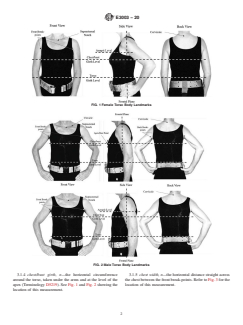
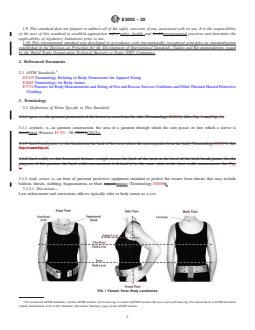
3.1.3 cervicale, n—the superior palpable point of the spine
consistent with measurement units used in the United States
of the seventh cervical (C7) vertebra. (2012 Anthropometric
body armor community. Approximate values in SI units are
Survey of U.S. Army Personnel: Methods and Summary
given in parentheses.
Statistics (ANSUR II)) ; the most protruding vertebrae at the
1.9 This standard does not purport to address all of the
back of the base of the neck. Refer to Fig. 1 and Fig. 2.
safety concerns, if any, associated with its use. It is the
responsibility of the user of this standard to establish appro-
priate safety, health, and environmental practices and deter-
For referenced ASTM standards, visit the ASTM website, www.astm.org, or
mine the applicability of regulatory limitations prior to use.
contact ASTM Customer Service at service@astm.org. For Annual Book of ASTM
Standards volume information, refer to the standard’s Document Summary page on
the ASTM website.
Gordon CC, Blackwell, C.L., Bradtmiller B, Parham, J.L., Barrientos, P.,
This practice is under the jurisdiction of ASTM Committee E54 on Homeland Paquette, S.P., Corner, B.D., Carson, J.M., Venezia, J.C., Rockwell, B.M. , Mucher,
Security Applications and is the direct responsibility of Subcommittee E54.04 on M., and Kristensen, S. “2012 Anthropometric Survey of U.S. Army Personnel:
Personal Protective Equipment (PPE). Methods and Summary Statistics (ANSUR II)” NATICK/TR-15/007. U.S. Army
Current edition approved Aug. 1, 2020. Published August 2020. Originally Natick Soldier Research, Development, and Engineering Center, Natick, MA., Final
approved in 2015. Last previous edition approved in 2015 as E3003 – 15. DOI: ReportOctober2010–April2012,publishedDecember2014.AvailablefromDTIC
10.1520/E3003-20. ADA611869 (https://apps.dtic.mil/dtic/tr/fulltext/u2/a611869.pdf).
Copyright © ASTM International, 100 Barr Harbor Drive, PO Box C700, West Conshohocken, PA 19428-2959. United States
E3003 − 20
FIG. 1 Female Torso Body Landmarks
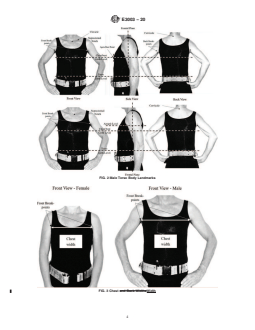
FIG. 2 Male Torso Body Landmarks
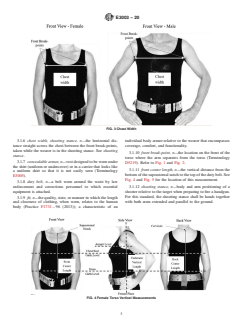
3.1.4 chest/bust girth, n—the horizontal circumference 3.1.5 chest width, n—the horizontal distance straight across
around the torso, taken under the arms and at the level of the
the chest between the front break-points. Refer to Fig. 3 for the
apex (Terminology D5219). See Fig. 1 and Fig. 2 showing the
location of this measurement.
location of this measurement.
E3003 − 20
FIG. 3 Chest Width
3.1.6 chest width, shooting stance, n—the horizontal dis- individual body armor relative to the wearer that encompasses
tance straight across the chest between the front break-points, coverage, comfort, and functionality.
taken while the wearer is in the shooting stance. See shooting
3.1.10 front break-point, n—the location on the front of the
stance.
torso where the arm separates from the torso (Terminology
3.1.7 concealable armor, n—vest designed to be worn under
D5219). Refer to Fig. 1 and Fig. 2.
the shirt (uniform or undercover) or in a carrier that looks like
3.1.11 front center length, n—the vertical distance from the
a uniform shirt so that it is not easily seen (Terminology
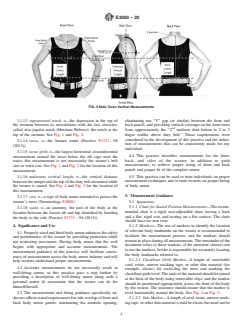
bottom of the suprasternal notch to the top of the duty belt. See
E3005).
Fig. 4 and Fig. 5 for the location of this measurement.
3.1.8 duty belt, n—a belt worn around the waist by law
enforcement and corrections personnel to which essential
3.1.12 shooting stance, n—body and arm positioning of a
equipment is attached.
shooter relative to the target when preparing to fire a handgun.
3.1.9 fit, n—the quality, state, or manner in which the length For this standard, the shooting stance shall be hands together
and closeness of clothing, when worn, relates to the human with both arms extended and parallel to the ground.
body (Practice F1731 – 96 (2013)); a characteristic of an
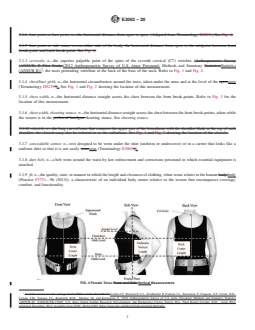
FIG. 4 Female Torso Vertical Measurements
E3003 − 20
FIG. 5 Male Torso Vertical Measurements
3.1.13 suprasternal notch, n—the depression in the top of eliminating any “V” gap (or similar) between the front and
the sternum between its articulations with the two clavicles; back panels, and providing vertical coverage on the front torso
nd
called also jugular notch (Merriam-Webster); the notch at the from approximately the “2 uniform shirt button to 2 to 3
top of the sternum. See Fig. 1 and Fig. 2. finger widths above duty belt.” Those requirements were
considered in the development of this practice and the defini-
3.1.14 torso, n—the human trunk (Practice F1731–96
tion of measurements that can be consistently made for any
(2013)).
individual.
3.1.15 torso girth, n—the largest horizontal circumferential
4.4 This practice describes measurements for the front,
measurement around the torso below the rib cage near the
back, and sides of the wearer, in addition to girth
waist; this measurement is not necessarily the wearer’s belt
measurements, to achieve proper sizing of front and back
size or waist size. See Fig. 1 and Fig. 2 for the location of this
panels and proper fit of the complete armor.
measurement.
4.5 This practice can be used to train individuals on proper
3.1.16 underarm vertical length, n—the vertical distance
measurement techniques and to train wearers on proper fitting
between the armpit and the top of the duty belt measured while
of body armor.
the wearer is seated. See Fig. 4 and Fig. 5 for the location of
this measurement.
5. Measurement Guidance
3.1.17 vest, n—a type of body armor intended to protect the
wearer’s torso (Terminology E3005). 5.1 Apparatus:
5.1.1 Chair for Seated Position Measurements—The recom-
3.1.18 waist, n—in anatomy, the part of the body at the
mended chair is a rigid, non-adjustable chair, having a back
location between the lowest rib and hip identified by bending
and a flat, rigid seat, and resting on a flat surface. The chair
the body to the side (Practice F1731 – 96 (2013)).
should have no arm rests.
4. Significance and Use 5.1.2 Markers—The use of markers to identify the location
of relevant body landmarks on the wearer is recommended to
4.1 Properlysizedandfittedbodyarmorenhancesthesafety
facilitate the measurement process, and the markers should
and performance of the wearer by providing protection while
remain in place during all measurements. The remainder of the
not restricting movement. Having body armor that fits well
document refers to these markers; if the measurer chooses not
begins with appropriate and accurate measurements. The
to use the markers, he/she is responsible for accurately locating
measurement guidance of this practice will facilitate consis-
the body landmarks referred to.
tency of measurement across the body armor industry and will
5.1.2.1 Chest/bust Girth Marker—A length of stretchable
help wearers understand proper measurements.
cord, twine, narrow masking tape, or other thin material (for
4.2 Accurate measurements do not necessarily result in
example, elastic) for encircling the torso and marking the
well-fitting armor, so this practice goes a step further by
chest/bustgirthlevel.Theendsofthematerialshouldbejoined
providing a description of well-fitting armor along with a
at the back of the body using removable clips, and the marker
personal armor fit assessment that the wearer can do for
should be positioned appropriately across the front of the body
himself/herself.
by the wearer. The measurer should ensure that the marker is
4.3 The measurement and fitting guidance specifically ad- level horizontally around the body. See Fig. 4 or Fig. 5.
dresses officer-stated requirements for side overlap of front and 5.1.2.2 Side Marker—Alengthofcord,twine,narrowmask-
back body armor panels, minimizing the armhole opening, ing tape, or other thin material (could be elastic but need not be
E3003 − 20
stretchy) for marking the midpoint between the front and back wear the uniform shirt, aT-shirt (if normally worn), duty pants,
break-points on one side of the body. The marker should be dutybeltwiththeirtypicalgearinstalled(forexample,weapon,
heldverticallyinplacebetweenthechest/bustgirthmarkerand
magazine pouch, restraints), inner belt (if normally worn), and
the duty belt. The measurer should ensure that the side marker keepers. The position of the duty belt on the wearer shall be as
is perpendicular to the chest/bust girth marker.
is typically worn, and the position should not be artificially
5.1.3 Tape Measure—The tape used shall be flexible and
adjusted. Females shall wear the type of bra that they usually
non-stretchable, have a length of at least 120 in. (3 m), with at
wear on duty.
least ⁄4-in. or mm divisions. An anthropometric tape is
5.3.1.3 Non-uniformed personnel (for example, special
recommended, but a tailor’s tape may also be used. Prior to
agents, detectives) being measured for concealable body armor
usinganyflexibletapeformakingmeasurements,averification
worn under the outermost shirt shall wear a snugly fitting
check is recommended to check that the tape has not stretched
T-shirt, pants, and a belt that are representative of what is worn
since the last use and may be done by comparing the flexible
on duty. The position of the belt on the wearer shall be as is
tape measure to a non-stretchable tape, such as a Lufkin model
typically worn, and the position should not be artificially
L610 steel tape or equivalent.
adjusted. Females shall wear the type of bra that they usually
5.1.4 Weighing Scale—A bathroom scale shall be used for
wear on duty.
weighing, if weight is unknown, and the scale shall have the
5.3.2 Markers should be appropriately placed on the wearer.
capability to be zeroed prior to weighing, shall provide weight
Refer to 5.1.2. The chest/bust girth marker should be put in
inunitsofpoundsorkilograms,shallindicateweighttoatleast
place and positioned with the aid of the wearer, especially
the nearest pound or kilogram, and shall have weight capacity
across the front of the body. The measurer should adjust the
appropriate for the individual being weighed. If better quality
position properly on the sides and back.
than a bathroom scale is available, such as a medical or fitness
5.3.3 All linear and circumferential measurements shall be
scale, it is acceptable to use such a scale for measurements,
taken to the nearest inch or centimeter.
given that the other requirements of this section are met.
5.3.3.1 Linearmeasurementsshouldberoundeddowntothe
5.2 Measurement Skill, Accuracy, and Cautions:
nearest inch or centimeter.
5.2.1 Measurement Skill—Individuals making measure-
5.3.3.2 Circumferential measurements should be rounded
ments must have a complete understanding of this practice and
up to the nearest inch or centimeter.
demonstrate their ability to make accurate measurements.
(Adapted from Practice F1731 – 96 (2013).)
NOTE 1—One centimeter is smaller than an inch and is sufficient for
5.2.2 Measurement Accuracy—Measurement accuracy de-
these measurements.
pendson(1)theskilloftheindividualdoingthemeasuring,(2)
5.3.4 For all measurements, the wearer shall breathe nor-
the condition of the equipment being used for making
mally without holding the breath and shall not hold in the
measurements, and (3) the level of cooperation from the
stomach.
subject being measured. Reliable measurements can be made
only when all of the above variables are controlled. (Adapted
5.3.5 For all measurements requiring the wearer to be in a
from Practice F1731 – 96 (2013).) The body measurements
standing position, except chest width measurements, the
described in this practice cannot be made accurately on oneself
wearer shall stand with feet shoulder width apart, facing
but require another individual as the measurer.
forward, arms relaxed down at the sides, and looking straight
5.2.3 Cautions:
ahead.
5.2.3.1 When measuring female officers, care should be
5.3.6 For all measurements requiring the wearer to be in a
taken to make appropriate measurements from behind with the
seated position, the wearer shall sit in a natural comfortable
wearer adjusting the tape over her chest.
position, facing forward and looking straight ahead with feet
5.2.3.2 When measuring officers and discussing their
apart flat on the floor and arms relaxed at sides. If the chair has
measurements, care should be taken to be sensitive to the
arm rests, the individual being measured should not place
desire for privacy of body measurements.
either arm on the arm rests but have arms relaxed at the sides.
5.3 Preparation for Measuring the Wearer:
5.4 Measuring the Wearer:
5.3.1 The type of clothing worn during measuring can
5.4.1 Weight—The measurer shall record the wearer’s
influence the accuracy of the measurements, and the following
weight in pounds or kilograms and to the nearest pound or
clothing and equipment shall be worn during measuring:
kilogram (for example, 125 lb or 57 kg) either by having the
5.3.1.1 Uniformed officers being measured for concealable
wearer specify his or her known weight or weighing the
body armor worn under the uniform shirt shall wear a snugly
wearer. If the wearer needs to be weighed, the measurer shall
fitting T-shirt, duty pants, duty belt with their typical gear
ensure that the scale is set to zero initially and record the
installed (for example, weapon, magazine pouch, restraints),
weight of the wearer to the nearest pound or kilogram. If the
inner belt (if normally worn), and keepers. The position of the
wearer is a uniformed officer and is being weighed, ensure that
duty belt on the wearer shall be as is typically worn, and the
the officer removes the duty belt prior to being weighed.
position should not be artificially adjusted. Females shall wear
the type of bra that they usually wear on duty. 5.4.2 Height—Themeasurershallrecordthewearer’sheight
5.3.1.2 Uniformed officers being measured for concealable either by having the wearer specify his or her known height or
bodyarmorwornovertheuniformshirtinanoutercarriershall measuring the wearer.
E3003 − 20
6. Procedures When Using a Tape Measure sample data sheet for recording the above information for
female wearers is provided in Appendix X2.
6.1 Chest/Bust Girth—With the wearer’s arms raised
6.9.2 It is recommended that purchasers (agencies or indi-
slightly away from the sides, the measurer shall wrap the tape
viduals) require suppliers to perform measurements as speci-
around the torso horizontally under the arms and aligned with
fied in this practice and to provide a data sheet for each wearer
the chest/bust girth marker. The measurer should stand behind
containing the details shown in Appendix X1 or Appendix X2
the wearer to take the measurement, and the wearer should
as a part of the purchase agreement for body armor.
position the tape correctly across the front of the chest. Once
thetapeisinplace,thewearershalllowerthearmstohisorher
7. Procedures When Using a Sizing Vest
sides, and the measurement shall
...
This document is not an ASTM standard and is intended only to provide the user of an ASTM standard an indication of what changes have been made to the previous version. Because
it may not be technically possible to adequately depict all changes accurately, ASTM recommends that users consult prior editions as appropriate. In all cases only the current version
of the standard as published by ASTM is to be considered the official document.
Designation: E3003 − 15 E3003 − 20
Standard Practice for
Body Armor Wearer Measurement and Fitting of Armor
This standard is issued under the fixed designation E3003; the number immediately following the designation indicates the year of
original adoption or, in the case of revision, the year of last revision. A number in parentheses indicates the year of last reapproval. A
superscript epsilon (´) indicates an editorial change since the last revision or reapproval.
1. Scope
1.1 This practice provides measurement and fit guidance for soft ballistic-resistant or stab-resistant body armor, or both, covering
the torso. Proper measurement of the wearer and fitting of armor to that individual are necessary to obtain sufficient coverage of
the torso and vital organs while allowing the full range of motion required for officer operations.
1.2 This practice is primarily directed toward law enforcement and corrections officers and addresses measurements for and fit of
concealable (normal duty) body armor worn under or over the uniform for both male and female wearers. This practice addresses
only body armor composed of front and back protective panels contained within a carrier that positions and holds the panels on
the torso.
1.3 Female wearers require more measurements than male wearers to achieve proper armor fit; therefore, the minimum required
measurements are specified individually for males and females.This practice can be used to train individuals on proper
measurement techniques and to train wearers on proper fitting of body armor.
1.4 In addition to the required measurements, optional measurements are recommended when necessary to accommodate the
wearer’s body shape and dimensions.
1.4 Measurement guidance is provided in Section 5 of this practice. Section 5 may also be used to train individuals on proper
measurement techniques.
1.5 Guidance for use of a tape measure is provided in Section 6 of this practice.
1.6 Guidance for use of sizing vests is provided in Section 7 of this practice.
1.7 In addition to measurement guidance, this practice provides two tools for assessing armor relative to the intended wearer:A
personal armor fit assessment is provided in Section 8 for use by wearers.
(1) Comparison of wearer measurements and armor measurements in Section 6.
(2) Personal armor fit assessment in Section 7.
1.8 Units—English units are specified in this standardpractice to be consistent with measurement units used in the United States
body armor community. Approximate values in SI units are given in parentheses.
This practice is under the jurisdiction of ASTM Committee E54 on Homeland Security Applications and is the direct responsibility of Subcommittee E54.04 on Personal
Protective Equipment (PPE).
Current edition approved Dec. 1, 2015Aug. 1, 2020. Published January 2016August 2020. Originally approved in 2015. Last previous edition approved in 2015 as
E3003 – 15. DOI: 10.1520/E3003-15.10.1520/E3003-20.
Copyright © ASTM International, 100 Barr Harbor Drive, PO Box C700, West Conshohocken, PA 19428-2959. United States
E3003 − 20
1.9 This standard does not purport to address all of the safety concerns, if any, associated with its use. It is the responsibility
of the user of this standard to establish appropriate safety safety, health, and healthenvironmental practices and determine the
applicability of regulatory limitations prior to use.
1.10 This international standard was developed in accordance with internationally recognized principles on standardization
established in the Decision on Principles for the Development of International Standards, Guides and Recommendations issued
by the World Trade Organization Technical Barriers to Trade (TBT) Committee.
2. Referenced Documents
2.1 ASTM Standards:
D5219 Terminology Relating to Body Dimensions for Apparel Sizing
E3005 Terminology for Body Armor
F1731 Practice for Body Measurements and Sizing of Fire and Rescue Services Uniforms and Other Thermal Hazard Protective
Clothing
3. Terminology
3.1 Definitions of Terms Specific to This Standard:
3.1.1 apex, n—the greatest protrusion of the breast as seen from the side (Terminology D5219). (See Fig. 1 and Fig. 2.)
3.1.1 armhole, n—in garment construction, the area of a garment through which the arm passes or into which a sleeve is
fitted.fitted (Practice F1731 – 96 (2013))(2013)).
3.1.3 back break-point, n—the location on the back of the torso where the arm separates from the body (Terminology D5219). See
Fig. 1 and Fig. 2.
3.1.4 back width, n—the horizontal distance straight across the back of the torso at the level of the back break-points; for the
purposes of this practice, the back width measurement is defined to be the same value as the chest width measurement. See Fig.
3.
3.1.2 body armor, n—an item of personal protective equipment intended to protect the wearer from threats that may include
ballistic threats, stabbing, fragmentation, or blunt impact.impact (Terminology E3005)).
3.1.2.1 Discussion—
Law enforcement and corrections officers typically refer to body armor as a vest.
FIG. 1 Female Torso Body Landmarks
For referenced ASTM standards, visit the ASTM website, www.astm.org, or contact ASTM Customer Service at service@astm.org. For Annual Book of ASTM Standards
volume information, refer to the standard’s Document Summary page on the ASTM website.
E3003 − 20
3.1.6 bust point to bust point, n—the horizontal distance from apex to apex. (Adapted from Terminology D5219.) See Fig. 4.
3.1.7 bust point to side seam, n—on either side of the body, the horizontal distance from apex to the midpoint between front
break-point and back break-point. See Fig. 4.
3.1.3 cervicale, n—the superior palpable point of the spine of the seventh cervical (C7) vertebra. (Anthropometric Survey
(ANSUR) II Pilot Study:(2012 Anthropometric Survey of U.S. Army Personnel: Methods and Summary Statistics)Statistics
(ANSUR II)) ; the most protruding vertebrae at the back of the base of the neck. Refer to Fig. 1 and Fig. 2.
3.1.4 chest/bust girth, n—the horizontal circumference around the torso, taken under the arms and at the level of the apex.apex
(Terminology D5219.)). See Fig. 1 and Fig. 2 showing the location of this measurement.
3.1.5 chest width, n—the horizontal distance straight across the chest between the front break-points. Refer to Fig. 3 for the
location of this measurement.
3.1.6 chest width, shooting stance, n—the horizontal distance straight across the chest between the front break-points, taken while
the wearer is in the preferred handgun shooting stance. See shooting stance.
3.1.12 clavicle, n—the long curved bone that connects the upper part of the breastbone with the shoulder blade at the top of each
shoulder; the clavicle may also be referred to as the collarbone. See Fig. 1 and Fig. 2 showing the location of the clavicle.
3.1.7 concealable armor, n—vest designed to be worn under the shirt (uniform or undercover) or in a carrier that looks like a
uniform shirt so that it is not easily seen.seen (Terminology E3005.)).
3.1.8 duty belt, n—a belt worn around the waist by law enforcement and corrections personnel to which essential equipment is
attached.
3.1.9 fit, n—the quality, state, or manner in which the length and closeness of clothing, when worn, relates to the human body.body
(Practice F1731 – 96 (2013)); a characteristic of an individual body armor relative to the wearer that encompasses coverage,
comfort, and functionality.
FIG. 4 Female Torso Front and Side Vertical Measurements
Available from www.dtic.mil/cgi-bin/GetTRDoc?AD=ADA498172.Gordon CC, Blackwell, C.L., Bradtmiller B, Parham, J.L., Barrientos, P., Paquette, S.P., Corner, B.D.,
Carson, J.M., Venezia, J.C., Rockwell, B.M. , Mucher, M., and Kristensen, S. “2012 Anthropometric Survey of U.S. Army Personnel: Methods and Summary Statistics
(ANSUR II)” NATICK/TR-15/007. U.S. Army Natick Soldier Research, Development, and Engineering Center, Natick, MA., Final Report October 2010 – April 2012,
published December 2014. Available from DTIC ADA611869 (https://apps.dtic.mil/dtic/tr/fulltext/u2/a611869.pdf).
E3003 − 20
FIG. 2 Male Torso Body Landmarks
FIG. 3 Chest and Back WidthsWidth
E3003 − 20
3.1.10 front break-point, n—the location on the front of the torso where the arm separates from the torso (Terminology D5219).
Refer to Fig. 1 and Fig. 2.
3.1.11 front center length, n—the vertical distance from the bottom of the suprasternal notch to the top of the duty belt. See Fig.
54 and Fig. 65 for the location of this measurement.
3.1.18 front lateral length, n—the vertical distance from the top of the clavicle over the bust point to the top of the duty belt. See
Fig. 5 and Fig. 6 for the location of this measurement.
3.1.12 shooting stance, n—body and arm positioning of a shooter relative to the target when preparing to fire a handgun; four types
of shooting stances are typical for law enforcement.handgun. For this standard, the shooting stance shall be hands together with
both arms extended and parallel to the ground.
3.1.19.1 isosceles stance, n—a shooting stance in which the individual is directly facing or squared up to the target, with feet
shoulder width apart, and is aiming the handgun with both arms held toward the target and parallel to the ground.
3.1.19.2 modern isosceles stance, n—a stance in which the individual is directly facing or squared up to the target, with feet
shoulder width apart, and aiming the handgun with both arms straight and both shoulders rolled forward.
3.1.19.3 modified Weaver stance, n—a stance in which the individual is directly facing or squared up to the target, with feet
shoulder width apart and is aiming the handgun with the primary arm held straight toward the target and parallel to the ground
and the support arm elbow bent toward the ground.
3.1.19.4 Weaver stance—a stance in which the individual faces the target at an angle with the primary foot back and is aiming
the handgun with the primary arm held straight toward the target and parallel to the ground and the support arm elbow bent toward
the ground.
3.1.13 suprasternal notch, n—the depression in the top of the sternum between its articulations with the two clavicles; called also
jugular notch (Merriam-Webster); the notch at the top of the sternum. See Fig. 1 and Fig. 2.
3.1.14 torso, n—the human trunk.trunk (Practice F1731 – 96 (2013))(2013)).
3.1.15 torso girth, n—the largest horizontal circumferential measurement around the torso below the rib cage near the waist; this
measurement is not necessarily the wearer’s belt size or waist size. See Fig. 1 and Fig. 2 for the location of this measurement.
3.1.16 underarm vertical length, n—the vertical distance between the armpit and the top of the duty belt measured while the
wearer is seated. See Fig. 4 and Fig. 5 for the location of this measurement.
FIG. 5 Male Torso Vertical Measurements
E3003 − 20
3.1.24 underarm vertical length, adjusted, n—the measured underarm vertical length minus approximately 3 in. (7.6 cm). See Fig.
7 and Fig. 8.
3.1.25 under-bust girth, n—the horizontal circumference around the torso under the arms and bust (Terminology D5219). See Fig.
1 and Fig. 2 for the under-bust girth measurement location.
3.1.17 vest, n—a type of body armor intended to protect the wearer’s torso (Terminology E3005).
3.1.18 waist, n—in anatomy, the part of the body at the location between the lowest rib and hip identified by bending the body
to the side.side (Practice F1731 – 96 (2013))(2013)).
4. Significance and Use
4.1 Properly sized and fitted body armor enhances the safety and performance of the wearer by providing protection while not
restricting movement. Having body armor that fits well begins with appropriate and accurate measurements. The measurement
guidance of this practice will facilitate consistency of measurement across the body armor industry and will help wearers
understand proper measurements.
4.2 Accurate measurements do not necessarily result in well-fitting armor, so this practice goes a step further by providing (1) a
method for assessing how closely an armor matches the corresponding wearer measurements, and (a 2) a description of well-fitting
armor along with a personal armor fit assessment that the wearer can do for himself/herself.
4.3 The measurement and fitting guidance specifically addresses officer-stated requirements for side overlap of front and back
body armor panels, minimizing the armhole opening, eliminating any “V” gap (or similar) between the front and back panels, and
nd
providing vertical coverage on the front torso from approximately the “2 uniform shirt button to 2 to 3 finger widths above duty
belt.” Those requirements were considered in the development of this practice and the definition of measurements that can be
consistently made for any individual.
4.4 This practice describes measurements for the front, back, and sides of the wearer, in addition to girth measurements, to achieve
proper sizing of front and back panels and proper fit of the complete armor.
4.5 This practice can be used to train individuals on proper measurement techniques and to train wearers on proper fitting of body
armor.
5. Measurement ProceduresGuidance
5.1 Apparatus:
5.1.1 Chair for Seated Position Measurements—The recommended chair shall be is a rigid, non-adjustable chair, having a back
and a flat, rigid seat, and resting on a flat surface. The chair should have no arm rests.
5.1.2 Markers—The use of markers to identify the location of relevant body landmarks on the wearer is recommended to facilitate
the measurement process, and the markers should remain in place during all measurements. The remainder of the document refers
to these markers; if the measurer chooses not to use the markers, he/she is responsible for accurately locating the body landmarks
referred to.
5.1.2.1 Chest/bust Girth Marker—A length of stretchable cord, twine, narrow masking tape, or other thin material (for example,
elastic) for encircling the torso and marking the chest/bust girth level. The ends of the material should be joined at the back of the
body using removable clips, and the marker should be positioned appropriately across the front of the body by the wearer. The
measurer should ensure that the marker is level horizontally around the body. See Fig. 4, Fig. 5, or or Fig. 65.
5.1.2.2 Side Marker—A length of cord, twine, narrow masking tape, or other thin material (could be elastic but need not be
stretchy) for marking the midpoint between the front and back break-points on one side of the body. The marker should be held
vertically in place between the chest/bust girth marker and the duty belt. The measurer should ensure that the side marker is
perpendicular to the chest/bust girth marker.
E3003 − 20
5.1.3 Tape Measure—The tape used shall be flexible and non-stretchable, have a length of at least 60120 in. (1.5(3 m), with at least
⁄4-in. or mm divisions. An anthropometric tape, such as Lafayette Instrument model J00305 or equivalent, tape is recommended,
but a tailor’s tape may also be used. Prior to using any flexible tape for making measurements, a verification check is recommended
to check that the tape has not stretched since the last use and may be done by comparing the flexible tape measure to a
non-stretchable tape, such as a Lufkin model L610 steel tape or equivalent.
5.1.4 Weighing Scale—A bathroom scale shall be used for weighing, if weight is unknown, and the scale shall have the capability
to be zeroed prior to weighing, shall provide weight in units of pounds or kilograms, shall indicate weight to at least the nearest
pound or kilogram, and shall have weight capacity appropriate for the individual being weighed. If better quality than a bathroom
scale is available, such as a medical or fitness scale, it is acceptable to use such a scale for measurements, given that the other
requirements of this section are met.
5.2 Measurement Skill, Accuracy, and Cautions:
5.2.1 Measurement Skill—Individuals making measurements must have a complete understanding of this practice and demonstrate
their ability to make accurate measurements. (Adapted from Practice F1731 – 96 (2013).)
5.2.2 Measurement Accuracy—Measurement accuracy depends on (1) the skill of the individual doing the measuring, (2) the
condition of the equipment being used for making measurements, and (3) the level of cooperation from the subject being measured.
Reliable measurements can be made only when all of the above variables are controlled. (Adapted from Practice F1731 – 96
(2013).) The body measurements described in this practice cannot be made accurately on oneself but require another individual
as the measurer.
5.2.3 Cautions:
5.2.3.1 When measuring female officers, care should be taken to make appropriate measurements from behind with the wearer
adjusting the tape over her chest.
5.2.3.2 When measuring officers and discussing their measurements, care should be taken to be sensitive to the desire for privacy
of body measurements.
5.3 Preparation for Measuring the Wearer:
5.3.1 The type of clothing worn during measuring can influence the accuracy of the measurements, and the following clothing and
equipment shall be worn during measuring:
5.3.1.1 Uniformed officers being measured for concealable body armor worn under the uniform shirt shall wear a snugly fitting
T-shirt, duty pants, duty belt with their typical gear installed (for example, weapon, magazine pouch, restraints), inner belt (if
normally worn), and keepers. The position of the duty belt on the wearer shall be as is typically worn, and the position should not
be artificially adjusted. Females shall wear the type of bra that they usually wear on duty.
5.3.1.2 Uniformed officers being measured for concealable body armor worn over the uniform shirt in an outer carrier shall wear
the uniform shirt, a T-shirt (if normally worn), duty pants, duty belt with their typical gear installed (for example, weapon,
magazine pouch, restraints), inner belt (if normally worn), and keepers. The position of the duty belt on the wearer shall be as is
typically worn, and the position should not be artificially adjusted. Females shall wear the type of bra that they usually wear on
duty.
5.3.1.3 Non-uniformed personnel (for example, special agents, detectives) being measured for concealable body armor worn under
the outermost shirt shall wear a snugly fitting T-shirt, pants, and a belt that are representative of what is worn on duty. The position
of the belt on the wearer shall be as is typically worn, and the position should not be artificially adjusted. Females shall wear the
type of bra that they usually wear on duty.
5.3.2 Markers should be appropriately placed on the wearer. Refer to 5.1.2. The chest/bust girth marker should be put in place and
positioned with the aid of the wearer, especially across the front of the body. The measurer should adjust the position properly on
the sides and back.
5.3.3 All linear and circumferential measurements shall be taken to the nearest ⁄4 in. inch or cm.centimeter.
E3003 − 20
5.3.3.1 Linear measurements should be rounded down to the nearest inch or centimeter.
5.3.3.2 Circumferential measurements should be rounded up to the nearest inch or centimeter.
NOTE 1—One cm is not equivalent tocentimeter is smaller than an ⁄4 in. but inch and is sufficient for these measurements.
5.3.4 For all measurements, the wearer shall breathe normally without holding the breath and shall not hold in the stomach.
5.3.5 For all measurements requiring the wearer to be in a standing position, except chest width, width measurements, the wearer
shall stand with feet shoulder width apart, facing forward, arms relaxed down at the sides, and looking straight ahead. For chest
width, shooting stance, the wearer shall assume his/her preferred shooting stance with the hands touching as if holding a handgun.
If the wearer does not carry a handgun during normal duties, the arms shall be extended in front of the body and parallel to each
other and to the floor.
5.3.6 For all measurements requiring the wearer to be in a seated position, the wearer shall sit straight up in a natural comfortable
position, facing forward and looking straight ahead with feet apart flat on the floor and arms relaxed at sides. If the chair has arm
rests, the individual being measured should not place either arm on the arm rests but have arms relaxed at the sides.
5.4 Measuring the Wearer:
5.4.1 Weight—The measurer shall record the wearer’s weight in pounds or kilograms and to the nearest pound or kilogram (for
example, 125 lb or 57 kg) either by having the wearer specify his or her known weight or weighing the wearer. If the wearer needs
to be weighed, the measurer shall ensure that the scale is set to zero initially and record the weight of the wearer to the nearest
pound or kilogram. If the wearer is a uniformed officer and is being weighed, ensure that the officer removes the duty belt prior
to being weighed.
5.4.2 Female Wearers Only: Bust Point to Bust Point—The wearer shall align the tape appropriately from bust point to bust point
and hold the tape in position while the measurer records the value. Refer to Fig. 4 for the location of this measurement.
5.4.3 Female Wearers Only: Bust Point to Side Seam—The wearer shall align the tape appropriately from bust point to the side
marker and hold the tape in position while the measurer records the value.
NOTE 2—If holding the tape in position is difficult for the wearer, the measurer may assist in holding the end of the tape in line with the side marker so
that the wearer can lower her arm. Refer to Fig. 4 for the location of this measurement.
5.4.2 Chest/Bust Girth—Height—With the wearer’s arms raised slightly away from the sides, the measurer shall wrap the tape
around the torso horizontally under the arms and aligned with the chest/bust girth marker. The measurer should stand behind the
wearer to take the measurement, and the wearer should position the tape correctly across the front of the chest. Once the tape is
in place, the wearer shall lower the arms to The measurer shall record the wearer’s height either by having the wearer specify his
or her sides, and the measurement shall be taken, ensuring that the tape is snug around the torso. Refer to known height or
measuring the wearer. Fig. 1 and Fig. 2 for the location of this measurement.
5.4.5 Female Wearers Only: Under-Bust Girth—With the wearer’s arms raised slightly away from the sides, the measurer shall
wrap the tape around the rib cage horizontally under the arms and under the bust. The measurer should stand behind the wearer
to take the measurement, and the wearer should position the tape correctly under the bust. Once the tape is in place, the wearer
shall lower the arms to her sides, and the measurement shall be taken, ensuring that the tape is snug around the torso and
horizontally level. Refer to Fig. 1 for the location of this measurement.
5.4.6 Torso Girth—With the wearer standing, the measurer shall wrap the tape around the torso at the largest circumference below
the rib cage and near the waist, keeping the tape horizontally level. Once the tape is in place, the measurement shall be taken
ensuring that the tape is snug around the torso and that the wearer is breathing normally and keeping the torso muscles relaxed.
Refer to Fig. 1 and Fig. 2 for the location of this measurement.
5.4.7 Chest Width—With the wearer standing with arms down at sides, the measurer shall measure the horizontal distance straight
across the front of the chest between the front break-points. Refer to Fig. 3 for the location of this measurement.
E3003 − 20
5.4.8 Chest Width, Shooting Stance—With the wearer positioned in his/her preferred shooting stance, the measurer shall measure
the horizontal distance straight across the front of the chest at the front break-point.
5.4.9 Back Width—Back width is not measured in this version of the practice because there is not a body landmark on the back
of the torso that facilitates consistent measurement. The value for chest width shall be recorded as the back width. Refer to Fig.
3.
5.4.10 Underarm Vertical Length—With the wearer in a seated position and the right arm slightly raised to the side, the measurer
shall place a plastic ruler under the arm where the arm joins the torso, ensuring the ruler is horizontally level. The wearer shall
lower the right arm trapping the ruler. The top of the ruler corresponds to the armpit location. The measurer shall measure the
vertical length straight from the armpit to the top of the duty belt. Refer to Fig. 4 for the location of this measurement.
5.4.11 Front Center Length – Standing—The measurer shall measure vertically from the bottom of the wearer’s suprasternal notch
to the top of the duty belt. Refer to Fig. 5 and Fig. 6 for this measurement location.
5.4.12 Front Lateral Length – Standing—The measurer shall measure vertically, following the body, from the top of the wearer’s
clavicle over the bust point to the top of the duty belt. The wearer shall position the tape correctly over the bust point. Refer to
Fig. 5 and Fig. 6 for this measurement location.
5.4.13 Female Wearers Only: Front Lateral Length from the Top of Clavicle to the Bust Point – Standing—The measurer shall
measure vertically, following the body, from the top of the wearer’s clavicle to the bust point. The wearer shall position the tape
correctly over the bust point. Refer to Fig. 6.
5.4.14 Front Center Length – Seated—The wearer shall be seated during this measurement. The measurer shall measure vertically,
following the body, from the bottom of the wearer’s suprast
...