

ASTM D8366-21a
(Specification)Standard Specification for Extruded and Compression Molded Shapes Made from Unfilled Poly(Vinylidene Fluoride) PVDF
General Information
- Abstract
SCOPE
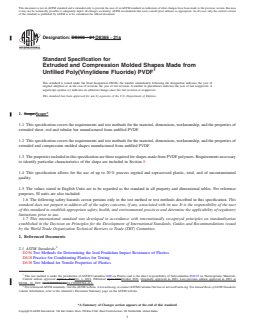
1.1 This specification covers the requirements and test methods for the material, dimensions, workmanship, and the properties of extruded sheet, rod and tubular bar manufactured from unfilled PVDF.
1.2 This specification covers the requirements and test methods for the material, dimensions, workmanship, and the properties of extruded and compression molded shapes manufactured from unfilled PVDF.
1.3 The properties included in this specification are those required for shapes made from PVDF polymers. Requirements necessary to identify particular characteristics of the shape are included in Section 5.
1.4 This specification allows for the use of up to 20 % process regrind and reprocessed plastic, total, and of uncontaminated quality.
1.5 The values stated in English Units are to be regarded as the standard in all property and dimensional tables. For reference purposes, SI units are also included.
1.6 The following safety hazards caveat pertains only to the test method or test methods described in this specification. This standard does not purport to address all of the safety concerns, if any, associated with its use. It is the responsibility of the user of this standard to establish appropriate safety, health, and environmental practices and determine the applicability of regulatory limitations prior to use.
1.7 This international standard was developed in accordance with internationally recognized principles on standardization established in the Decision on Principles for the Development of International Standards, Guides and Recommendations issued by the World Trade Organization Technical Barriers to Trade (TBT) Committee.
- Status
- Published
- Publication Date
- 30-Sep-2021
- Technical Committee
- D20 - Plastics
- Drafting Committee
- D20.15 - Thermoplastic Materials
Buy Documents
ASTM D8366-21a - Standard Specification for Extruded and Compression Molded Shapes Made from Unfilled Poly(Vinylidene Fluoride) PVDF
REDLINE ASTM D8366-21a - Standard Specification for Extruded and Compression Molded Shapes Made from Unfilled Poly(Vinylidene Fluoride) PVDF
Overview
ASTM D8366-21a is a standard specification developed by ASTM International for extruded and compression molded shapes made from unfilled poly(vinylidene fluoride) (PVDF). This standard defines key requirements for material properties, dimensions, workmanship, and test methods applicable to extruded sheet, rod, and tubular bar products fabricated from PVDF. It ensures the consistent quality and performance of PVDF components used across a wide range of technical industries by establishing uniform classification, testing, and quality assessment methods.
PVDF, a semi-crystalline polymer, is widely recognized for its exceptional chemical resistance, mechanical strength, and stable properties under rigorous conditions. Shapes produced under ASTM D8366-21a are used in applications where purity, uniformity, and reliability are paramount.
Key Topics
- Material Requirements: Standard applies to unfilled, additive-free PVDF polymer with options for virgin or general-purpose classes, with the latter permitting up to 20% high-quality process regrind or reprocessed PVDF.
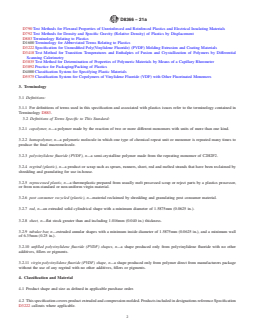
- Shape Classifications: Products are categorized by shape (rod, sheet, tubular bar), class (A: virgin, B: general purpose), type (emulsion or suspension polymerization), grade, and viscosity to address a variety of end-use requirements.
- Property Specifications:
- Thermal properties: Requirements for peak melting endotherm specific to PVDF type and grade.
- Mechanical properties: Tensile strength, flexural modulus, and impact resistance thresholds ensure structural integrity.
- Physical properties: Density and dimensional tolerances for each shape and size.
- Dimensional & Workmanship Criteria: Tight tolerances are specified for diameters, thicknesses, camber, and bow. Surfaces must be free from blisters, cracks, gouges, visible contamination, and excessive internal voids.
- Testing and Certification: Structure for consistent laboratory testing (including ASTM D638, D790, D256) and requirements for certification and packaging.
Applications
Shapes manufactured under ASTM D8366-21a are essential in industries that require high-performance, chemically resistant polymer components. Practical uses include:
- Chemical processing: PVDF rods and sheets are utilized for lining, tanks, valves, and manifolds handling aggressive chemicals.
- Water treatment: Tubular bars and sheets are employed in ultrafiltration and desalination systems due to PVDF’s purity and resistance to fouling.
- Semiconductor manufacturing: Unfilled PVDF parts ensure high purity and stability when handling sensitive process media.
- Electrical and electronics: PVDF’s dielectric properties make it suitable for components in insulating and high-frequency applications.
- Food, pharmaceutical, and medical equipment: PVDF is favored for contact surfaces and fluid handling components requiring exceptional cleanliness and resistance to corrosion.
- High precision machining: The tight dimensional tolerances and machinability make PVDF rods and sheets suitable for custom fabricated parts.
Related Standards
ASTM D8366-21a references and aligns with several other ASTM standards to support comprehensive quality control and standardization of PVDF products:
- ASTM D638 - Test Method for Tensile Properties of Plastics
- ASTM D790 - Test Methods for Flexural Properties of Plastics
- ASTM D256 - Test Method for Impact Resistance
- ASTM D792 - Test Methods for Density and Specific Gravity
- ASTM D883 and D1600 - Plastics terminologies
- ASTM D3222 - Specification for Unmodified PVDF Molding, Extrusion and Coating Materials
- ASTM D3418 - Differential Scanning Calorimetry for Polymer Transition Temperatures
- ASTM D3892 - Packaging and Packing of Plastics
- ASTM D4000 - Classification System for Specifying Plastic Materials
By adhering to ASTM D8366-21a, manufacturers can demonstrate product consistency and quality, while end users and specifiers can trust that products meet stringent industry standards for unfilled PVDF shapes.
Relations
- Effective Date
- 01-Feb-2024
- Effective Date
- 01-Nov-2023
- Effective Date
- 01-Jan-2020
- Effective Date
- 01-Aug-2019
- Effective Date
- 15-Apr-2019
- Effective Date
- 01-Feb-2019
- Effective Date
- 01-Dec-2018
- Effective Date
- 01-Nov-2018
- Effective Date
- 01-May-2018
- Refers
ASTM D1600-18 - Standard Terminology for Abbreviated Terms Relating to Plastics (Withdrawn 2024) - Effective Date
- 01-Jan-2018
- Effective Date
- 15-Aug-2017
- Effective Date
- 01-Jul-2017
- Effective Date
- 01-Dec-2015
- Effective Date
- 01-Dec-2015
- Effective Date
- 01-Sep-2015
Buy Documents
ASTM D8366-21a - Standard Specification for Extruded and Compression Molded Shapes Made from Unfilled Poly(Vinylidene Fluoride) PVDF
REDLINE ASTM D8366-21a - Standard Specification for Extruded and Compression Molded Shapes Made from Unfilled Poly(Vinylidene Fluoride) PVDF
Get Certified
Connect with accredited certification bodies for this standard

DIN CERTCO
DIN Group product certification.

Smithers Quality Assessments
US management systems and product certification.
Sponsored listings
Frequently Asked Questions
ASTM D8366-21a is a technical specification published by ASTM International. Its full title is "Standard Specification for Extruded and Compression Molded Shapes Made from Unfilled Poly(Vinylidene Fluoride) PVDF". This standard covers: SCOPE 1.1 This specification covers the requirements and test methods for the material, dimensions, workmanship, and the properties of extruded sheet, rod and tubular bar manufactured from unfilled PVDF. 1.2 This specification covers the requirements and test methods for the material, dimensions, workmanship, and the properties of extruded and compression molded shapes manufactured from unfilled PVDF. 1.3 The properties included in this specification are those required for shapes made from PVDF polymers. Requirements necessary to identify particular characteristics of the shape are included in Section 5. 1.4 This specification allows for the use of up to 20 % process regrind and reprocessed plastic, total, and of uncontaminated quality. 1.5 The values stated in English Units are to be regarded as the standard in all property and dimensional tables. For reference purposes, SI units are also included. 1.6 The following safety hazards caveat pertains only to the test method or test methods described in this specification. This standard does not purport to address all of the safety concerns, if any, associated with its use. It is the responsibility of the user of this standard to establish appropriate safety, health, and environmental practices and determine the applicability of regulatory limitations prior to use. 1.7 This international standard was developed in accordance with internationally recognized principles on standardization established in the Decision on Principles for the Development of International Standards, Guides and Recommendations issued by the World Trade Organization Technical Barriers to Trade (TBT) Committee.
SCOPE 1.1 This specification covers the requirements and test methods for the material, dimensions, workmanship, and the properties of extruded sheet, rod and tubular bar manufactured from unfilled PVDF. 1.2 This specification covers the requirements and test methods for the material, dimensions, workmanship, and the properties of extruded and compression molded shapes manufactured from unfilled PVDF. 1.3 The properties included in this specification are those required for shapes made from PVDF polymers. Requirements necessary to identify particular characteristics of the shape are included in Section 5. 1.4 This specification allows for the use of up to 20 % process regrind and reprocessed plastic, total, and of uncontaminated quality. 1.5 The values stated in English Units are to be regarded as the standard in all property and dimensional tables. For reference purposes, SI units are also included. 1.6 The following safety hazards caveat pertains only to the test method or test methods described in this specification. This standard does not purport to address all of the safety concerns, if any, associated with its use. It is the responsibility of the user of this standard to establish appropriate safety, health, and environmental practices and determine the applicability of regulatory limitations prior to use. 1.7 This international standard was developed in accordance with internationally recognized principles on standardization established in the Decision on Principles for the Development of International Standards, Guides and Recommendations issued by the World Trade Organization Technical Barriers to Trade (TBT) Committee.
ASTM D8366-21a is classified under the following ICS (International Classification for Standards) categories: 83.140.01 - Rubber and plastics products in general. The ICS classification helps identify the subject area and facilitates finding related standards.
ASTM D8366-21a has the following relationships with other standards: It is inter standard links to ASTM D883-24, ASTM D883-23, ASTM D883-20, ASTM D883-19c, ASTM D883-19a, ASTM D883-19, ASTM D883-18a, ASTM D883-18, ASTM D3222-18, ASTM D1600-18, ASTM D883-17, ASTM D790-17, ASTM D790-15e1, ASTM D790-15, ASTM D3892-15. Understanding these relationships helps ensure you are using the most current and applicable version of the standard.
ASTM D8366-21a is available in PDF format for immediate download after purchase. The document can be added to your cart and obtained through the secure checkout process. Digital delivery ensures instant access to the complete standard document.
Standards Content (Sample)
This international standard was developed in accordance with internationally recognized principles on standardization established in the Decision on Principles for the
Development of International Standards, Guides and Recommendations issued by the World Trade Organization Technical Barriers to Trade (TBT) Committee.
Designation:D8366 −21a
Standard Specification for
Extruded and Compression Molded Shapes Made from
Unfilled Poly(Vinylidene Fluoride) PVDF
This standard is issued under the fixed designation D8366; the number immediately following the designation indicates the year of
original adoption or, in the case of revision, the year of last revision. A number in parentheses indicates the year of last reapproval. A
superscript epsilon (´) indicates an editorial change since the last revision or reapproval.
This standard has been approved for use by agencies of the U.S. Department of Defense.
1. Scope* 2. Referenced Documents
2.1 ASTM Standards:
1.1 This specification covers the requirements and test
methods for the material, dimensions, workmanship, and the D256 Test Methods for Determining the Izod Pendulum
Impact Resistance of Plastics
properties of extruded sheet, rod and tubular bar manufactured
from unfilled PVDF. D618 Practice for Conditioning Plastics for Testing
D638 Test Method for Tensile Properties of Plastics
1.2 This specification covers the requirements and test
D790 Test Methods for Flexural Properties of Unreinforced
methods for the material, dimensions, workmanship, and the
and Reinforced Plastics and Electrical Insulating Materi-
properties of extruded and compression molded shapes manu-
als
factured from unfilled PVDF.
D792 Test Methods for Density and Specific Gravity (Rela-
1.3 The properties included in this specification are those
tive Density) of Plastics by Displacement
required for shapes made from PVDF polymers. Requirements
D883 Terminology Relating to Plastics
necessary to identify particular characteristics of the shape are
D1600 TerminologyforAbbreviatedTermsRelatingtoPlas-
included in Section 5.
tics
D3222 Specification for Unmodified Poly(Vinylidene Fluo-
1.4 This specification allows for the use of up to 20 %
ride) (PVDF) Molding Extrusion and Coating Materials
process regrind and reprocessed plastic, total, and of uncon-
D3418 Test Method for Transition Temperatures and En-
taminated quality.
thalpies of Fusion and Crystallization of Polymers by
1.5 The values stated in English Units are to be regarded as
Differential Scanning Calorimetry
the standard in all property and dimensional tables. For
D3835 Test Method for Determination of Properties of
reference purposes, SI units are also included.
Polymeric Materials by Means of a Capillary Rheometer
1.6 The following safety hazards caveat pertains only to the
D3892 Practice for Packaging/Packing of Plastics
testmethodortestmethodsdescribedinthisspecification. This D4000 Classification System for Specifying Plastic Materi-
standard does not purport to address all of the safety concerns,
als
if any, associated with its use. It is the responsibility of the user D5575 Classification System for Copolymers of Vinylidene
of this standard to establish appropriate safety, health, and
Fluoride (VDF) with Other Fluorinated Monomers
environmental practices and determine the applicability of
regulatory limitations prior to use.
3. Terminology
1.7 This international standard was developed in accor-
3.1 Definitions:
dance with internationally recognized principles on standard-
3.1.1 For definitions of terms used in this specification and
ization established in the Decision on Principles for the
associated with plastics issues refer to the terminology con-
Development of International Standards, Guides and Recom-
tained in Terminology D883.
mendations issued by the World Trade Organization Technical
3.2 Definitions of Terms Specific to This Standard:
Barriers to Trade (TBT) Committee.
3.2.1 copolymer, n—a polymer made by the reaction of two
or more different monomers with units of more than one kind.
This test method is under the jurisdiction ofASTM Committee D20 on Plastics
and is the direct responsibility of Subcommittee D20.15 on Thermoplastic Materi-
als. For referenced ASTM standards, visit the ASTM website, www.astm.org, or
Current edition approved Oct. 1, 2021. Published October 2021. Originally contact ASTM Customer Service at service@astm.org. For Annual Book of ASTM
approved in 2021. Last previous edition approved in 2021 as D8366 - 21. DOI: Standards volume information, refer to the standard’s Document Summary page on
10.1520/D8366-21A. the ASTM website.
*A Summary of Changes section appears at the end of this standard
Copyright © ASTM International, 100 Barr Harbor Drive, PO Box C700, West Conshohocken, PA 19428-2959. United States
D8366−21a
3.2.2 homopolymer, n—a polymeric molecule in which one 4.2.1 ThePVDFshapeproductcanbecategorizedbyshape,
type of chemical repeat unit or monomer is repeated many class, type, grade (if applicable), and viscosity, as listed in
times to produce the final macromolecule. Table1.WhiletheuseofshapeandclasstodescribethePVDF
shape product are mandatory, type, grade and viscosity are
3.2.3 polyvinylidene fluoride (PVDF), n—a semi-crystalline
optional.
polymer made from the repeating monomer of C2H2F2.
4.2.2 The shape can be described as rod, sheet or tubular
3.2.4 regrind (plastic), n—aproductorscrapsuchassprues,
bar.
runners,sheet,rodandmeltedstrandsthathavebeenreclaimed
4.2.3 The shape shall be categorized as Class A or Class B
by shredding and granulating for use in-house.
based on composition as follows:
3.2.5 reprocessed plastic, n—a thermoplastic prepared from
4.2.3.1 Class A—Virgin PVDF Shape—Extruded or com-
usually melt processed scrap or reject parts by a plastics
pression molded product made using only 100 % virgin PVDF
processor, or from non-standard or non-uniform virgin mate-
material with no regrind or reclaimed material.
rial.
4.2.3.2 Class B—General Purpose Shape—Extruded or
3.2.6 post consumer recycled (plastic), n—material re-
compression molded product made using up to 20 % total of
claimed by shredding and granulating post consumer material.
PVDF regrind and PVDF reprocessed plastic of uncontami-
nated quality.
3.2.7 rod, n—an extruded solid cylindrical shape with a
minimum diameter of 1.5875mm (0.0625 in.).
NOTE 1—Use of post-consumer recycled PVDF is not permitted.
Caution should be exercised in not using contaminated regrind or
3.2.8 sheet, n—flat stock greater than and including
contaminated reprocessed PVDF.
1.016mm (0.040 in.) thickness.
4.2.4 Each type of PVDF shape can be further categorized
3.2.9 tubular bar, n—extruded annular shapes with a mini-
by the following descriptions for the PVDF material used, as
mum inside diameter of 1.5875mm (0.0625 in.), and a mini-
follows, listed in Table 1 below:
mum wall of 6.35mm (0.25 in.).
4.2.4.1 Type I—PVDF polymerized in emulsion with prop-
3.2.10 unfilled polyvinylidene fluoride (PVDF) shapes, n—a
erties and values as listed in Table 1.
shape produced only from polyvinylidene fluoride with no
4.2.4.2 Type II—PVDF polymerized in suspension with
other additives, fillers or pigments.
properties and values as listed in Table 1.
3.2.11 virgin polyvinylidene fluoride (PVDF) shape, n—a
4.2.4.3 Grade 1—PVDF polymerized in emulsion with
shape produced only from polymer direct from manufacturers
melting point between 156-162°C as listed in Table 1.
package without the use of any regrind with no other additives,
4.2.4.4 Grade 2—PVDF polymerized in emulsion with
fillers or pigments.
melting point between 161-172°C as listed in Table 1.
4.2.4.5 Viscosity—Viscosity described as Ultra High
4. Classification and Material
Viscosity, High Viscosity, Medium Viscosity and Low Viscos-
4.1 Productshapeandsizeasdefinedinapplicablepurchase
ity as listed in Table 1.
order.
NOTE 2—Table 1 in this standard is a copy of Table 1 inASTM D3222
4.2 Thisspecificationcoversproductextrudedandcompres-
for PVDF homopolymer materials and is reproduced here for easy access.
sion molded. Products included in designations reference
ASTM D3222 lists viscosity as additional information and its exact value
Specification D3222 callouts where applicable. is not required to be provided on the PVDF shape.
TABLE 1 Classification of PVDF Resins
Typical Values or Ranges
Property Type I Type II
Grade 1 Grade 2
Specific Gravity Gms/cc 1.75-1.79 1.75-1.79 1.76-1.79
Peak Melting Endotherm °C 156-162 161-172 164-180
Melt Flow Rate g/10 min (wt in Kg)
A A
Ultra High Viscosity . 0.1-2 0.5-10
A B C
High Viscosity 0.5-8 5-8 0.5-10
A B D
Medium Viscosity 4-18 5-36 0.5-30
E F
Low Viscosity . 3.5-45 0.5-60
G
Apparent Melt Viscosity Pa’s:
High Viscosity 2800-3800 2800-3900 2500-4000
Medium Viscosity 2300-2800 1300-2800 1300-2500
Low Viscosity . 100-1300 250-1300
Note: For measuring MFR values of PVDF, the load must be selected based on the viscosity as follows:
A
= 21.6 Kg
B
= 12.5 Kg
C
= 10.0 Kg
D
=5Kg
E
=3.8Kg
F
= 2.16 Kg
G −1
Reported for a shear rate of 100 s determined by capillary rheometry at 232°C (450°F) using 0.027 radian (60°) entrance angle die with L/D of 15 and in accordance
with procedures of Test Method D3835. Multiply the pascal second values by ten to obtain poise values.
D8366−21a
4.3 Callout Designation—Aonelinesystemshallbeusedto 5.2.2 Specific Gravity—A solid specimen from the PVDF
specifyPVDFshapescoveredbythisspecification.Thesystem shape product covered by this specification shall have the
uses predefined cells to refer to specific aspects of this specific gravity indicated in Table 1 when tested in accordance
specification as illustrated below: with Test Method D792.
A
TABLE 2 Specification for PVDF Stock Shape
NOTE 6—If the type and grade of PVDF are not specified, the PVDF
Standard Shape Class Type Grade Viscosity
shape product should meet a 1.75 to 1.79 requirement for this property.
ASTM Rod, AorB IorII no Ultra
5.2.3 Tensile Properties—The PVDF shape product covered
D8366 Sheet, (virgin, (emulsion designation, High,
or Tubular General or 1or2 High,
in this specification shall have a tensile yield strength exceed-
Bar Purpose) suspension) Medium
ing 36 MPa (5200 psi) at 23°C 6 2°C (74°F 6 4°F) and a
or Low
minimum elongation at break of 10 % when tested in accor-
A
Shape and Class are required while Type, Grade and Viscosity can be specified
dance with Test Method D638 at 50 mm/min (2 in./min).
as needed.
5.2.4 Flexural Modulus—The PVDF shape product covered
4.3.1 Examples—Product can use any amount of classifica-
in this specification shall have a minimum flexural modulus of
tion descriptions, but must call out specific shape configuration
1.31 GPa (190,000 psi) when tested in accordance with Test
and Class as a minimum.
Method D790.
4.3.1.1 Example 1—PVDF Sheet made from 100 % virgin
5.2.5 Impact Resistance—The PVDF shape product used to
PVDF polymerized in emulsion with a melting point of 168°C
make shapes shall have a minimum izod impact strength of
and a viscosity of 1700 Pa’s.
80.0 J/m (1.5 ft-lbf/in.) when tested in accordance with Test
Callout: ASTM D8366 PVDF Sheet, Class A, Type I,
Method D256, except in the case of the use of a low viscosity
Grade 2, Medium Viscosity
material as specified in the shape call-out, in which case the
NOTE 3—If Grade does not apply, NA can be used, as for example, minimumimpactstrengthcanbeminimum40J/morhigher,to
ASTM D8366 PVDF Sheet, Class A, Type II, Grade NA, Medium
correspond to ASTM D3222 for PVDF materials.
Viscosity.
NOTE 7—Low viscosity PVDF is not likely to be used for extruded or
4.3.1.2 Example 2—Rod made for General Purpose appli-
compression molded processes, and is mainly used for injection molded
cation using any type of PVDF homopolymer with up to 20 %
products, which could also be called out per this shape specification.
regrind in final product.
6. Dimensional Requirements
Callout: ASTM D8366 PVDF Rod, Class B
6.1 Rods, sheets, and plates have different allowances for
5. Property Requirements dimensional tolerances as indicated in Table 3 and Table 4.
Products shall be produced within practical commercial toler-
5.1 The physical property values listed within this specifi-
ances and with the lowest stress levels for machined parts.
cation’s tables are to be considered within the ranges stated, or
as minimum as described herein.Any requirement for specific 6.2 Tubular bar dimensions shall be supplied in unfinished
data for a given production lot must be specified at the time of condition unless otherwise specified at time of order sufficient
the order. Physical properties for products not conforming to to finish to the nominal dimension ordered.
definition of unfilled homopolymer PVDF are discussed in the
6.3 The maximum allowable camber or bow, or both, shall
non-mandatory Appendix X1.
be within the limits referenced in Table 3 and Table 4.
5.2 The following thermal, physical and mechanical prop-
7. Workmanship, Finish, and Appearance
erties of the PVDF shape in this standard shall conform to the
minimums listed when following the procedures in Sections 5 7.1 Appearance—The color of the Class A or Class B
products will generally be a white, off white, or
...
This document is not an ASTM standard and is intended only to provide the user of an ASTM standard an indication of what changes have been made to the previous version. Because
it may not be technically possible to adequately depict all changes accurately, ASTM recommends that users consult prior editions as appropriate. In all cases only the current version
of the standard as published by ASTM is to be considered the official document.
Designation: D8366 − 21 D8366 − 21a
Standard Specification for
Extruded and Compression Molded Shapes Made from
Unfilled Poly(Vinylidene Fluoride) PVDF
This standard is issued under the fixed designation D8366; the number immediately following the designation indicates the year of
original adoption or, in the case of revision, the year of last revision. A number in parentheses indicates the year of last reapproval. A
superscript epsilon (´) indicates an editorial change since the last revision or reapproval.
This standard has been approved for use by agencies of the U.S. Department of Defense.
1. Scope Scope*
1.1 This specification covers the requirements and test methods for the material, dimensions, workmanship, and the properties of
extruded sheet, rod and tubular bar manufactured from unfilled PVDF.
1.2 This specification covers the requirements and test methods for the material, dimensions, workmanship, and the properties of
extruded and compression molded shapes manufactured from unfilled PVDF.
1.3 The properties included in this specification are those required for shapes made from PVDF polymers. Requirements necessary
to identify particular characteristics of the shape are included in Section 5.
1.4 This specification allows for the use of up to 20 % process regrind and reprocessed plastic, total, and of uncontaminated
quality.
1.5 The values stated in English Units are to be regarded as the standard in all property and dimensional tables. For reference
purposes, SI units are also included.
1.6 The following safety hazards caveat pertains only to the test method or test methods described in this specification. This
standard does not purport to address all of the safety concerns, if any, associated with its use. It is the responsibility of the user
of this standard to establish appropriate safety, health, and environmental practices and determine the applicability of regulatory
limitations prior to use.
1.7 This international standard was developed in accordance with internationally recognized principles on standardization
established in the Decision on Principles for the Development of International Standards, Guides and Recommendations issued
by the World Trade Organization Technical Barriers to Trade (TBT) Committee.
2. Referenced Documents
2.1 ASTM Standards:
D256 Test Methods for Determining the Izod Pendulum Impact Resistance of Plastics
D618 Practice for Conditioning Plastics for Testing
D638 Test Method for Tensile Properties of Plastics
This test method is under the jurisdiction of ASTM Committee D20 on Plastics and is the direct responsibility of Subcommittee D20.15 on Thermoplastic Materials.
Current edition approved April 1, 2021Oct. 1, 2021. Published April 2021October 2021. Originally approved in 2021. Last previous edition approved in 2021 as
D8366 - 21. DOI: 10.1520/D8366-21.10.1520/D8366-21A.
For referenced ASTM standards, visit the ASTM website, www.astm.org, or contact ASTM Customer Service at service@astm.org. For Annual Book of ASTM Standards
volume information, refer to the standard’s Document Summary page on the ASTM website.
*A Summary of Changes section appears at the end of this standard
Copyright © ASTM International, 100 Barr Harbor Drive, PO Box C700, West Conshohocken, PA 19428-2959. United States
D8366 − 21a
D790 Test Methods for Flexural Properties of Unreinforced and Reinforced Plastics and Electrical Insulating Materials
D792 Test Methods for Density and Specific Gravity (Relative Density) of Plastics by Displacement
D883 Terminology Relating to Plastics
D1600 Terminology for Abbreviated Terms Relating to Plastics
D3222 Specification for Unmodified Poly(Vinylidene Fluoride) (PVDF) Molding Extrusion and Coating Materials
D3418 Test Method for Transition Temperatures and Enthalpies of Fusion and Crystallization of Polymers by Differential
Scanning Calorimetry
D3835 Test Method for Determination of Properties of Polymeric Materials by Means of a Capillary Rheometer
D3892 Practice for Packaging/Packing of Plastics
D4000 Classification System for Specifying Plastic Materials
D5575 Classification System for Copolymers of Vinylidene Fluoride (VDF) with Other Fluorinated Monomers
3. Terminology
3.1 Definitions:
3.1.1 For definitions of terms used in this specification and associated with plastics issues refer to the terminology contained in
Terminology D883.
3.2 Definitions of Terms Specific to This Standard:
3.2.1 copolymer, n—a polymer made by the reaction of two or more different monomers with units of more than one kind.
3.2.2 homopolymer, n—a polymeric molecule in which one type of chemical repeat unit or monomer is repeated many times to
produce the final macromolecule.
3.2.3 polyvinylidene fluoride (PVDF), n—a semi-crystalline polymer made from the repeating monomer of C2H2F2.
3.2.4 regrind (plastic), n—a product or scrap such as sprues, runners, sheet, rod and melted strands that have been reclaimed by
shredding and granulating for use in-house.
3.2.5 reprocessed plastic, n—a thermoplastic prepared from usually melt processed scrap or reject parts by a plastics processor,
or from non-standard or non-uniform virgin material.
3.2.6 post consumer recycled (plastic), n—material reclaimed by shredding and granulating post consumer material.
3.2.7 rod, n—an extruded solid cylindrical shape with a minimum diameter of 1.5875mm (0.0625 in.).
3.2.8 sheet, n—flat stock greater than and including 1.016mm (0.040 in.) thickness.
3.2.9 tubular bar, n—extruded annular shapes with a minimum inside diameter of 1.5875mm (0.0625 in.), and a minimum wall
of 6.35mm (0.25 in.).
3.2.10 unfilled polyvinylidene fluoride (PVDF) shapes, n—a shape produced only from polyvinylidene fluoride with no other
additives, fillers or pigments.
3.2.11 virgin polyvinylidene fluoride (PVDF) shape, n—a shape produced only from polymer direct from manufacturers package
without the use of any regrind with no other additives, fillers or pigments.
4. Classification and Material
4.1 Product shape and size as defined in applicable purchase order.
4.2 This specification covers product extruded and compression molded. Products included in designations reference Specification
D3222 callouts where applicable.
D8366 − 21a
4.2.1 The PVDF shape product can be categorized by shape, class, type, grade (if applicable), and viscosity, as listed in Table 1.
While the use of shape and class to describe the PVDF shape product are mandatory, type, grade and viscosity are optional.
4.2.2 The shape can be described as rod, sheet or tubular bar.
4.2.3 The shape shall be categorized as Class A or Class B based on composition as follows:
4.2.3.1 Class A—Virgin PVDF Shape—Extruded or compression molded product made using only 100 % virgin PVDF material
with no regrind or reclaimed material.
4.2.3.2 Class B—General Purpose Shape—Extruded or compression molded product made using up to 20 % total of PVDF
regrind and PVDF reprocessed plastic of uncontaminated quality.
NOTE 1—Use of post-consumer recycled PVDF is not permitted. Caution should be exercised in not using contaminated regrind or contaminated
reprocessed PVDF.
4.2.4 Each type of PVDF shape can be further categorized by the following descriptions for the PVDF material used, as follows,
listed in Table 1 below:
4.2.4.1 Type I—PVDF polymerized in emulsion with properties and values as listed in Table 1.
4.2.4.2 Type II—PVDF polymerized in suspension with properties and values as listed in Table 1.
4.2.4.3 Grade 1—PVDF polymerized in emulsion with melting point between 156-162°C as listed in Table 1.
4.2.4.4 Grade 2—PVDF polymerized in emulsion with melting point between 161-172°C as listed in Table 1.
4.2.4.5 Viscosity—Viscosity described as Ultra High Viscosity, High Viscosity, Medium Viscosity and Low Viscosity as listed in
Table 1.
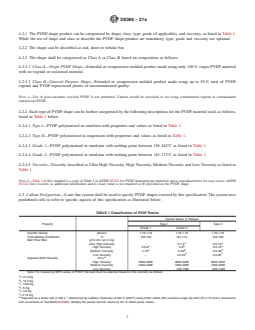
NOTE 2—Table 1 in this standard is a copy of Table 1 in ASTM D3222 for PVDF homopolymer materials and is reproduced here for easy access. ASTM
D3222 lists viscosity as additional information and its exact value is not required to be provided on the PVDF shape.
4.3 Callout Designation—A one line system shall be used to specify PVDF shapes covered by this specification. The system uses
predefined cells to refer to specific aspects of this specification as illustrated below:
TABLE 1 Classification of PVDF Resins
Typical Values or Ranges
Property Type I Type II
Grade 1 Grade 2
Specific Gravity Gms/cc 1.75-1.79 1.75-1.79 1.76-1.79
Peak Melting Endotherm °C 156-162 161-172 164-180
Melt Flow Rate g/10 min (wt in Kg)
A A
Ultra High Viscosity . 0.1-2 0.5-10
A B C
High Viscosity 0.5-8 5-8 0.5-10
A B D
Medium Viscosity 4-18 5-36 0.5-30
E F
Low Viscosity . 3.5-45 0.5-60
G
Apparent Melt Viscosity Pa’s:
High Viscosity 2800-3800 2800-3900 2500-4000
Medium Viscosity 2300-2800 1300-2800 1300-2500
Low Viscosity . 100-1300 250-1300
Note: For measuring MFR values of PVDF, the load must be selected based on the viscosity as follows:
A
= 21.6 Kg
B
= 12.5 Kg
C
= 10.0 Kg
D
= 5 Kg
E
= 3.8 Kg
F
= 2.16 Kg
G −1
Reported for a shear rate of 100 s determined by capillary rheometry at 232°C (450°F) using 0.027 radian (60°) entrance angle die with L/D of 15 and in accordance
with procedures of Test Method D3835. Multiply the pascal second values by ten to obtain poise values.
D8366 − 21a
A
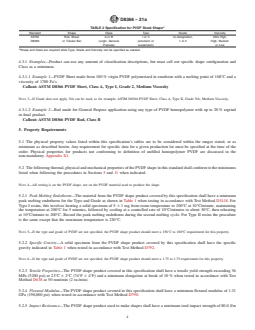
TABLE 2 Specification for PVDF Stock Shape
Standard Shape Class Type Grade Viscosity
ASTM Rod, Sheet, A or B I or II no designation, Ultra High,
D8366 or Tubular Bar (virgin, General (emulsion or 1 or 2 High, Medium
Purpose) suspension) or Low
A
Shape and Class are required while Type, Grade and Viscosity can be specified as needed.
4.3.1 Examples—Product can use any amount of classification descriptions, but must call out specific shape configuration and
Class as a minimum.
4.3.1.1 Example 1—PVDF Sheet made from 100 % virgin PVDF polymerized in emulsion with a melting point of 168°C and a
viscosity of 1700 Pa’s.
Callout: ASTM D8366 PVDF Sheet, Class A, Type I, Grade 2, Medium Viscosity
NOTE 3—If Grade does not apply, NA can be used, as for example, ASTM D8366 PVDF Sheet, Class A, Type II, Grade NA, Medium Viscosity.
4.3.1.2 Example 2—Rod made for General Purpose application using any type of PVDF homopolymer with up to 20 % regrind
in final product.
Callout: ASTM D8366 PVDF Rod, Class B
5. Property Requirements
5.1 The physical property values listed within this specification’s tables are to be considered within the ranges stated, or as
minimum as described herein. Any requirement for specific data for a given production lot must be specified at the time of the
order. Physical properties for products not conforming to definition of unfilled homopolymer PVDF are discussed in the
non-mandatory Appendix X1.
5.2 The following thermal, physical and mechanical properties of the PVDF shape in this standard shall conform to the minimums
listed when following the procedures in Sections 5 and 11 when indicated.
NOTE 4—All testing is on the PVDF shape, not on the PVDF material used to produce the shape.
5.2.1 Peak Melting Endotherm—The material from the PVDF shape product covered by this specification shall have a minimum
peak melting endotherm for the Type and Grade as shown in Table 1 when testing in accordance with Test Method D3418. For
Type I resins, this involves heating a solid specimen of 5 6 1 mg from room temperature to 200°C at 10°C/minute, maintaining
the temperature at 200°C for 5 minutes, followed by cooling at a controlled rate of 10°C/minutes to about 30°C, then reheating
at 10°C/minute to 200°C. Record the peak melting endotherm during the second melting cycle. For Type II resins the procedure
is the same except that the maximum temperature is 230°C.
NOTE 5—If the type and grade of PVDF are not specified, the PVDF shape product should meet a 156°C to 180°C requirement for this property.
5.2.2 Specific Gravity—A solid specimen from the PVDF shape product covered by this specification shall have the specific
gravity indicated in Table 1 when tested in accordance with Test Method D792.
NOTE 6—If the type and grade of PVDF are not specified, the PVDF shape product should meet a 1.75 to 1.79 requirement for this property.
5.2.3 Tensile Properties—The PVDF shape product covered in this specification shall have a tensile yield strength exceeding 36
MPa (5200 psi) at 23°C 6 2°C (74°F 6 4°F) and a minimum elongation at break of 10 % when tested in accordance with Test
Method D638 at 50 mm/min (2 in./min).
5.2.4 Flexural Modulus—The PVDF shape product covered in this specification shall have a minimum flexural modulus of 1.31
GPa (190,000 psi) when tested in accordance with Test Method D790.
5.2.5 Impact Resistance—The PVDF shape product used to make shapes shall have a minimum izod impact strength of 80.0 J/m
D8366 − 21a
(1.5 ft-lbf/in.) when tested in accordance with Test Method D256, except in the case of the use of a low viscosity material as
specified in the shape call-out, in which case the minimum impact strength can be minimum 40 J/m or higher, to correspond to
ASTM D3222 for PVDF materials.
NOTE 7—Low viscosity PVDF is not likely to be used for extruded or compression molded processes, and is mainly used for i
...