

ASTM D6111-24
(Test Method)Standard Test Method for Bulk Density And Specific Gravity of Plastic Lumber and Shapes by Displacement
General Information
- Abstract
SIGNIFICANCE AND USE
5.1 The specific gravity or density of a solid is a property that can be measured conveniently to follow physical changes in a sample, to indicate degree of uniformity among different sampling units or specimens, or to indicate the average density of a large item.
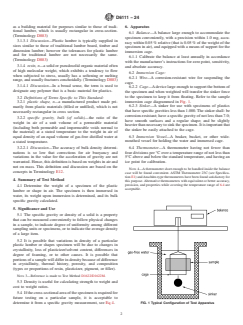
5.2 It is possible that variations in density of a particular plastic lumber or shapes specimen will be due to changes in crystallinity, loss of plasticizer/solvent content, differences in degree of foaming, or to other causes. It is possible that portions of a sample will differ in density because of difference in crystallinity, thermal history, porosity, and composition (types or proportions of resin, plasticizer, pigment, or filler).
Note 3: Reference is made to Test Method D1622/D1622M.
5.3 Density is useful for calculating strength to weight and cost to weight ratios.
5.4 If the cross-sectional area of the specimen is required for future testing on a particular sample, it is acceptable to determine it from a specific gravity measurement, see Eq 4.
SCOPE
1.1 This test method covers the determination of the bulk density and specific gravity of plastic lumber and shapes in their “as manufactured” form. As such, this is a test method for evaluating the properties of plastic lumber or shapes as a product and not a material property test method.
1.2 This test method is suitable for determining the bulk specific gravity or bulk density by immersion of the entire item or a representative cross section in water. This test method involves the weighing of a one piece specimen in water, using a sinker with plastics that are lighter than water. This test method is suitable for products that are wet by, but otherwise not affected by water for the duration of the test.
Note 1: This test method was developed for application to plastic lumber materials, but it is generic enough that it would be equally applicable to other plastic composite materials, including wood-plastic composite materials.
1.3 Plastic lumber and plastic shapes are currently made predominately from recycled plastics. However, this test method would also be applicable to similar manufactured plastic products made from virgin resins where the product is non-homogeneous in the cross-section.
1.4 The values stated in SI units are to be regarded as standard.
1.5 This standard does not purport to address all of the safety concerns, if any, associated with its use. It is the responsibility of the user of this standard to establish appropriate safety, health, and environmental practices and determine the applicability of regulatory limitations prior to use.
Note 2: There is no known ISO equivalent to this test method.
1.6 This international standard was developed in accordance with internationally recognized principles on standardization established in the Decision on Principles for the Development of International Standards, Guides and Recommendations issued by the World Trade Organization Technical Barriers to Trade (TBT) Committee.
- Status
- Published
- Publication Date
- 31-Jan-2024
- Technical Committee
- D20 - Plastics
- Drafting Committee
- D20.20 - Plastic Lumber
Buy Documents
ASTM D6111-24 - Standard Test Method for Bulk Density And Specific Gravity of Plastic Lumber and Shapes by Displacement
REDLINE ASTM D6111-24 - Standard Test Method for Bulk Density And Specific Gravity of Plastic Lumber and Shapes by Displacement
Overview
ASTM D6111-24: Standard Test Method for Bulk Density and Specific Gravity of Plastic Lumber and Shapes by Displacement is an internationally recognized testing standard developed by ASTM International. This standard specifies a method for determining the bulk density and specific gravity of plastic lumber and shapes, including composite and recycled plastic materials, using immersion displacement techniques. The procedure provides a reliable means to evaluate the physical properties of plastic lumber products in their "as manufactured" form, making it highly relevant for manufacturers, quality control labs, and product specifiers in the plastics, construction, and recycling industries.
Key Topics
Bulk Density and Specific Gravity
The standard outlines procedures for determining the bulk density and specific gravity of plastic lumber and plastic shapes. These parameters are essential for quality control, design calculations, and product comparisons.Product Uniformity and Material Variance
Measuring these properties helps identify variations due to changes in crystallinity, thermal history, composition, and the presence of voids, foaming, or differing constituent materials (such as resins, fillers, or plasticizers).Immersion Displacement Method
The test method involves weighing the specimen in air and then immersing it in water to determine its displaced volume. Plastics lighter than water require a sinker to ensure accurate measurement.Specimen Preparation and Handling
The standard addresses proper specimen selection-using representative cross sections or unmachined elements-and how to handle porous or hollow materials to avoid water ingress that could affect results.Calculation and Reporting
Instructions are provided for calculating bulk density and specific gravity, along with recommendations for documenting test conditions, specimen details, and variations within tested samples.
Applications
Quality Assurance in Manufacture
Regular testing of plastic lumber's bulk density and specific gravity supports consistent production quality, revealing irregularities in raw material composition or processing parameters.Product Specification and Design
These measurements are crucial in calculating strength-to-weight and cost-to-weight ratios, informing product selection and engineering decisions in construction, landscaping, and marine sectors.Material Comparison and Control
The method allows comparison between batches, sources, or suppliers, ensuring that the performance characteristics of recycled or composite plastic lumber are maintained.Compliance and Certification
Adherence to ASTM D6111-24 is often required for product certification, especially for recycled plastic and composite building materials in regulated markets.R&D and New Product Development
The test method aids material scientists and developers in monitoring the effects of processing adjustments or new formulations on overall material density and quality.
Related Standards
ASTM D1622/D1622M - Test Method for Apparent Density of Rigid Cellular Plastics
Referenced for guidance when addressing foamed or cellular plastic materials.ASTM D618 - Practice for Conditioning Plastics for Testing
Details specimen conditioning requirements before executing density or specific gravity tests.ASTM D883 - Terminology Relating to Plastics
Provides definitions for terms used within ASTM D6111-24.ASTM D6108 - Test Method for Compressive Properties of Plastic Lumber and Shapes
Applicable specimen geometries and preparation methods can be cross-referenced with D6111-24.ASTM E12 - Terminology Relating to Density and Specific Gravity of Solids, Liquids, and Gases
Offers relevant terminology for interpreting test results.
Summary
ASTM D6111-24 establishes a standardized procedure for determining bulk density and specific gravity of plastic lumber and shapes, ensuring reliable, repeatable measurement of these critical properties. With broad application across manufacturing, quality assurance, research, and regulatory compliance, this standard is essential for those using, producing, or specifying plastic and composite lumber products. Its method supports consistent product performance, quality benchmarking, and informed material selection, contributing to advances in recycled plastic materials and sustainable building practices.
Relations
- Effective Date
- 01-Feb-2024
- Effective Date
- 01-Feb-2024
- Effective Date
- 01-Feb-2024
- Effective Date
- 01-Nov-2023
- Effective Date
- 01-Apr-2022
- Effective Date
- 01-Apr-2022
- Effective Date
- 01-May-2019
- Referred By
ASTM D6117-23 - Standard Test Methods for Mechanical Fasteners in Plastic Lumber and Shapes - Effective Date
- 01-Feb-2024
Buy Documents
ASTM D6111-24 - Standard Test Method for Bulk Density And Specific Gravity of Plastic Lumber and Shapes by Displacement
REDLINE ASTM D6111-24 - Standard Test Method for Bulk Density And Specific Gravity of Plastic Lumber and Shapes by Displacement
Get Certified
Connect with accredited certification bodies for this standard

DIN CERTCO
DIN Group product certification.

Smithers Quality Assessments
US management systems and product certification.
Sponsored listings
Frequently Asked Questions
ASTM D6111-24 is a standard published by ASTM International. Its full title is "Standard Test Method for Bulk Density And Specific Gravity of Plastic Lumber and Shapes by Displacement". This standard covers: SIGNIFICANCE AND USE 5.1 The specific gravity or density of a solid is a property that can be measured conveniently to follow physical changes in a sample, to indicate degree of uniformity among different sampling units or specimens, or to indicate the average density of a large item. 5.2 It is possible that variations in density of a particular plastic lumber or shapes specimen will be due to changes in crystallinity, loss of plasticizer/solvent content, differences in degree of foaming, or to other causes. It is possible that portions of a sample will differ in density because of difference in crystallinity, thermal history, porosity, and composition (types or proportions of resin, plasticizer, pigment, or filler). Note 3: Reference is made to Test Method D1622/D1622M. 5.3 Density is useful for calculating strength to weight and cost to weight ratios. 5.4 If the cross-sectional area of the specimen is required for future testing on a particular sample, it is acceptable to determine it from a specific gravity measurement, see Eq 4. SCOPE 1.1 This test method covers the determination of the bulk density and specific gravity of plastic lumber and shapes in their “as manufactured” form. As such, this is a test method for evaluating the properties of plastic lumber or shapes as a product and not a material property test method. 1.2 This test method is suitable for determining the bulk specific gravity or bulk density by immersion of the entire item or a representative cross section in water. This test method involves the weighing of a one piece specimen in water, using a sinker with plastics that are lighter than water. This test method is suitable for products that are wet by, but otherwise not affected by water for the duration of the test. Note 1: This test method was developed for application to plastic lumber materials, but it is generic enough that it would be equally applicable to other plastic composite materials, including wood-plastic composite materials. 1.3 Plastic lumber and plastic shapes are currently made predominately from recycled plastics. However, this test method would also be applicable to similar manufactured plastic products made from virgin resins where the product is non-homogeneous in the cross-section. 1.4 The values stated in SI units are to be regarded as standard. 1.5 This standard does not purport to address all of the safety concerns, if any, associated with its use. It is the responsibility of the user of this standard to establish appropriate safety, health, and environmental practices and determine the applicability of regulatory limitations prior to use. Note 2: There is no known ISO equivalent to this test method. 1.6 This international standard was developed in accordance with internationally recognized principles on standardization established in the Decision on Principles for the Development of International Standards, Guides and Recommendations issued by the World Trade Organization Technical Barriers to Trade (TBT) Committee.
SIGNIFICANCE AND USE 5.1 The specific gravity or density of a solid is a property that can be measured conveniently to follow physical changes in a sample, to indicate degree of uniformity among different sampling units or specimens, or to indicate the average density of a large item. 5.2 It is possible that variations in density of a particular plastic lumber or shapes specimen will be due to changes in crystallinity, loss of plasticizer/solvent content, differences in degree of foaming, or to other causes. It is possible that portions of a sample will differ in density because of difference in crystallinity, thermal history, porosity, and composition (types or proportions of resin, plasticizer, pigment, or filler). Note 3: Reference is made to Test Method D1622/D1622M. 5.3 Density is useful for calculating strength to weight and cost to weight ratios. 5.4 If the cross-sectional area of the specimen is required for future testing on a particular sample, it is acceptable to determine it from a specific gravity measurement, see Eq 4. SCOPE 1.1 This test method covers the determination of the bulk density and specific gravity of plastic lumber and shapes in their “as manufactured” form. As such, this is a test method for evaluating the properties of plastic lumber or shapes as a product and not a material property test method. 1.2 This test method is suitable for determining the bulk specific gravity or bulk density by immersion of the entire item or a representative cross section in water. This test method involves the weighing of a one piece specimen in water, using a sinker with plastics that are lighter than water. This test method is suitable for products that are wet by, but otherwise not affected by water for the duration of the test. Note 1: This test method was developed for application to plastic lumber materials, but it is generic enough that it would be equally applicable to other plastic composite materials, including wood-plastic composite materials. 1.3 Plastic lumber and plastic shapes are currently made predominately from recycled plastics. However, this test method would also be applicable to similar manufactured plastic products made from virgin resins where the product is non-homogeneous in the cross-section. 1.4 The values stated in SI units are to be regarded as standard. 1.5 This standard does not purport to address all of the safety concerns, if any, associated with its use. It is the responsibility of the user of this standard to establish appropriate safety, health, and environmental practices and determine the applicability of regulatory limitations prior to use. Note 2: There is no known ISO equivalent to this test method. 1.6 This international standard was developed in accordance with internationally recognized principles on standardization established in the Decision on Principles for the Development of International Standards, Guides and Recommendations issued by the World Trade Organization Technical Barriers to Trade (TBT) Committee.
ASTM D6111-24 is classified under the following ICS (International Classification for Standards) categories: 83.140.01 - Rubber and plastics products in general. The ICS classification helps identify the subject area and facilitates finding related standards.
ASTM D6111-24 has the following relationships with other standards: It is inter standard links to ASTM D6111-19a, ASTM D883-24, ASTM D6108-24, ASTM D883-23, ASTM E456-13a(2022)e1, ASTM E456-13a(2022), ASTM D6108-19, ASTM D6117-23. Understanding these relationships helps ensure you are using the most current and applicable version of the standard.
ASTM D6111-24 is available in PDF format for immediate download after purchase. The document can be added to your cart and obtained through the secure checkout process. Digital delivery ensures instant access to the complete standard document.
Standards Content (Sample)
This international standard was developed in accordance with internationally recognized principles on standardization established in the Decision on Principles for the
Development of International Standards, Guides and Recommendations issued by the World Trade Organization Technical Barriers to Trade (TBT) Committee.
Designation: D6111 − 24
Standard Test Method for
Bulk Density And Specific Gravity of Plastic Lumber and
Shapes by Displacement
This standard is issued under the fixed designation D6111; the number immediately following the designation indicates the year of
original adoption or, in the case of revision, the year of last revision. A number in parentheses indicates the year of last reapproval. A
superscript epsilon (´) indicates an editorial change since the last revision or reapproval.
1. Scope* mendations issued by the World Trade Organization Technical
Barriers to Trade (TBT) Committee.
1.1 This test method covers the determination of the bulk
density and specific gravity of plastic lumber and shapes in
2. Referenced Documents
their “as manufactured” form. As such, this is a test method for
2.1 ASTM Standards:
evaluating the properties of plastic lumber or shapes as a
D618 Practice for Conditioning Plastics for Testing
product and not a material property test method.
D883 Terminology Relating to Plastics
1.2 This test method is suitable for determining the bulk
D1622/D1622M Test Method for Apparent Density of Rigid
specific gravity or bulk density by immersion of the entire item
Cellular Plastics
or a representative cross section in water. This test method 3
D1898 Practice for Sampling of Plastics (Withdrawn 1998)
involves the weighing of a one piece specimen in water, using
D5033 Guide for Development of ASTM Standards Relating
a sinker with plastics that are lighter than water. This test
to Recycling and Use of Recycled Plastics (Withdrawn
method is suitable for products that are wet by, but otherwise
2007)
not affected by water for the duration of the test.
D6108 Test Method for Compressive Properties of Plastic
NOTE 1—This test method was developed for application to plastic Lumber and Shapes
lumber materials, but it is generic enough that it would be equally
E1 Specification for ASTM Liquid-in-Glass Thermometers
applicable to other plastic composite materials, including wood-plastic
E12 Terminology Relating to Density and Specific Gravity
composite materials.
of Solids, Liquids, and Gases (Withdrawn 1996)
1.3 Plastic lumber and plastic shapes are currently made
E456 Terminology Relating to Quality and Statistics
predominately from recycled plastics. However, this test
E691 Practice for Conducting an Interlaboratory Study to
method would also be applicable to similar manufactured
Determine the Precision of a Test Method
plastic products made from virgin resins where the product is
E2935 Practice for Evaluating Equivalence of Two Testing
non-homogeneous in the cross-section.
Processes
1.4 The values stated in SI units are to be regarded as
3. Terminology
standard.
3.1 Definitions of Terms:
1.5 This standard does not purport to address all of the
3.1.1 Definitions of terms applying to this test method
safety concerns, if any, associated with its use. It is the
appear in Terminology D883 and Guide D5033. For terms
responsibility of the user of this standard to establish appro-
relating to precision and bias and associated issues, the terms
priate safety, health, and environmental practices and deter-
used in this test method are in accordance with the definitions
mine the applicability of regulatory limitations prior to use.
in Terminology E456.
NOTE 2—There is no known ISO equivalent to this test method.
3.1.2 density, bulk—the weight per unit volume of a material
1.6 This international standard was developed in accor-
including voids inherent in material as tested. (Terminology
dance with internationally recognized principles on standard-
D883)
ization established in the Decision on Principles for the
3.1.3 plastic lumber, n—a manufactured product made pri-
Development of International Standards, Guides and Recom-
marily from plastic materials (filled or unfilled), typically used
1 2
This test method is under the jurisdiction of ASTM Committee D20 on Plastics For referenced ASTM standards, visit the ASTM website, www.astm.org, or
and is the direct responsibility of Subcommittee D20.20 on Plastic Lumber (Section contact ASTM Customer Service at service@astm.org. For Annual Book of ASTM
D20.20.01). Standards volume information, refer to the standard’s Document Summary page on
Current edition approved Feb. 1, 2024. Published February 2024. Originally the ASTM website.
approved in 1997. Last previous edition approved in 2019 as D6111 – 19a. DOI: The last approved version of this historical standard is referenced on
10.1520/D6111-24. www.astm.org.
*A Summary of Changes section appears at the end of this standard
Copyright © ASTM International, 100 Barr Harbor Drive, PO Box C700, West Conshohocken, PA 19428-2959. United States
D6111 − 24
as a building material for purposes similar to those of tradi- 6. Apparatus
tional lumber, which is usually rectangular in cross-section.
6.1 Balance—A balance large enough to accommodate the
(Terminology D883)
specimen conveniently, with a precision within 1.0 mg, accu-
3.1.3.1 Discussion—Plastic lumber is typically supplied in
racy within 0.05 % relative (that is 0.05 % of the weight of the
sizes similar to those of traditional lumber board, timber and
specimen in air), and equipped with a means of support for the
dimension lumber; however the tolerances for plastic lumber
immersion cage.
and for traditional lumber are not necessarily the same.
6.1.1 Calibrate the balance at least annually in accordance
(Terminology D883)
with the manufacturer’s instructions for zero point, sensitivity,
3.1.4 resin, n—a solid or pseudosolid organic material often
and absolute accuracy.
of high molecular weight, which exhibits a tendency to flow
6.2 Immersion Cage:
when subjected to stress, usually has a softening or melting
6.2.1 Wire—A corrosion-resistant wire for suspending the
range, and usually fractures conchoidally. (Terminology D883)
cage.
3.1.4.1 Discussion—In a broad sense, the term is used to
6.2.2 Cage—A device large enough to support the bottom of
designate any polymer that is a basic material for plastics.
the specimen and when weighted will transfer the sinker force
to the specimen to keep it from floating. Refer to the sample
3.2 Definitions of Terms Specific to This Standard:
immersion cage diagrammed in Fig. 1.
3.2.1 plastic shape, n—a manufactured product made pri-
6.2.3 Sinker—A sinker for use with specimens of plastics
marily from plastic materials (filled or unfilled), which is not
that have specific gravities less than 1.000. The sinker shall: be
necessarily rectangular in cross section.
corrosion-resistant; have a specific gravity of not less than 7.0;
3.2.2 specific gravity, bulk (of solids)—the ratio of the
have smooth surfaces and a regular shape; and be slightly
weight in air of a unit volume of a permeable material
heavier than necessary to sink the specimen. It is important that
(including both permeable and impermeable voids normal to
the sinker be easily attached to the cage.
the material) at a stated temperature to the weight in air of
6.3 Immersion Vessel—A beaker, bucket, or other wide-
equal density of an equal volume of gas-free distilled water at
mouthed vessel for holding the water and immersed cage.
a stated temperature.
3.2.2.1 Discussion—The accuracy of bulk density determi- 6.4 Thermometer—A thermometer having not fewer than
nations is so low that corrections for air buoyancy and four divisions per °C over a temperature range of not less than
variations in the value for the acceleration of gravity are not 5°C above and below the standard temperature, and having an
warranted. Hence, this definition is based on weights in air and ice point for calibration.
not on mass. This definition and discussion are based on the
NOTE 4—A thermometer short enough to be handled inside the balance
concepts in Terminology E12.
case will be found convenient. ASTM Thermometer 23C (see Specifica-
tion E1) and Anschütz-type thermometers have been found satisfactory for
4. Summary of Test Method
this purpose. Alternative thermometers with equivalent or better accuracy,
precision, and properties while covering the temperature range of 6.4 are
4.1 Determine the weight of a specimen of the plastic
acceptable.
lumber or shape in air. The specimen is then immersed in
water, its weight upon immersion is determined, and its bulk
specific gravity calculated.
5. Significance and Use
5.1 The specific gravity or density of a solid is a property
that can be measured conveniently to follow physical changes
in a sample, to indicate degree of uniformity among different
sampling units or specimens, or to indicate the average density
of a large item.
5.2 It is possible that variations in density of a particular
plastic lumber or shapes specimen will be due to changes in
crystallinity, loss of plasticizer/solvent content, differences in
degree of foaming, or to other causes. It is possible that
portions of a sample will differ in density because of difference
in crystallinity, thermal history, porosity, and composition
(types or proportions of resin, plasticizer, pigment, or filler).
NOTE 3—Reference is made to Test Method D1622/D1622M.
5.3 Density is useful for calculating strength to weight and
cost to weight ratios.
5.4 If the cross-sectional area of the specimen is required for
future testing on a particular sample, it is acceptable to
determine it from a specific gravity measurement, see Eq 4. FIG. 1 Typical Configuration of Test Apparatus
D6111 − 24
7. Materials laboratory atmosphere of 23 6 2°C and 50 6 5 % relative
humidity. In cases of disagreement, the tolerances shall be
7.1 Water—The water shall be distilled, deionized, or de-
61°C and 62 % relative humidity.
mineralized.
11. Procedure
8. Sampling
11.1 Weigh the specimen in air to the nearest 1.0 mg.
8.1 The sampling units used for the determination of spe-
Record this as a, the weight of the specimen in air.
cific gravity shall be representative of the quantity of product
11.1.1 It is accepta
...
This document is not an ASTM standard and is intended only to provide the user of an ASTM standard an indication of what changes have been made to the previous version. Because
it may not be technically possible to adequately depict all changes accurately, ASTM recommends that users consult prior editions as appropriate. In all cases only the current version
of the standard as published by ASTM is to be considered the official document.
Designation: D6111 − 19a D6111 − 24
Standard Test Method for
Bulk Density And Specific Gravity of Plastic Lumber and
Shapes by Displacement
This standard is issued under the fixed designation D6111; the number immediately following the designation indicates the year of
original adoption or, in the case of revision, the year of last revision. A number in parentheses indicates the year of last reapproval. A
superscript epsilon (´) indicates an editorial change since the last revision or reapproval.
1. Scope*
1.1 This test method covers the determination of the bulk density and specific gravity of plastic lumber and shapes in their “as
manufactured” form. As such, this is a test method for evaluating the properties of plastic lumber or shapes as a product and not
a material property test method.
1.2 This test method is suitable for determining the bulk specific gravity or bulk density by immersion of the entire item or a
representative cross section in water. This test method involves the weighing of a one piece specimen in water, using a sinker with
plastics that are lighter than water. This test method is suitable for products that are wet by, but otherwise not affected by water
for the duration of the test.
NOTE 1—This test method was developed for application to plastic lumber materials, but it is generic enough that it would be equally applicable to other
plastic composite materials, including wood-plastic composite materials.
1.3 Plastic lumber and plastic shapes are currently made predominately from recycled plastics. However, this test method would
also be applicable to similar manufactured plastic products made from virgin resins where the product is non-homogeneous in the
cross-section.
1.4 The values stated in SI units are to be regarded as standard.
1.5 This standard does not purport to address all of the safety concerns, if any, associated with its use. It is the responsibility
of the user of this standard to establish appropriate safety, health, and environmental practices and determine the applicability of
regulatory limitations prior to use.
NOTE 2—There is no known ISO equivalent to this test method.
1.6 This international standard was developed in accordance with internationally recognized principles on standardization
established in the Decision on Principles for the Development of International Standards, Guides and Recommendations issued
by the World Trade Organization Technical Barriers to Trade (TBT) Committee.
This test method is under the jurisdiction of ASTM Committee D20 on Plastics and is the direct responsibility of Subcommittee D20.20 on Plastic Lumber (Section
D20.20.01).
Current edition approved Aug. 1, 2019Feb. 1, 2024. Published August 2019February 2024. Originally approved in 1997. Last previous edition approved in 2019 as
D6111 - 19.D6111 – 19a. DOI: 10.1520/D6111-19A.10.1520/D6111-24.
*A Summary of Changes section appears at the end of this standard
Copyright © ASTM International, 100 Barr Harbor Drive, PO Box C700, West Conshohocken, PA 19428-2959. United States
D6111 − 24
2. Referenced Documents
2.1 ASTM Standards:
D618 Practice for Conditioning Plastics for Testing
D883 Terminology Relating to Plastics
D1622/D1622M Test Method for Apparent Density of Rigid Cellular Plastics
D1898 Practice for Sampling of Plastics (Withdrawn 1998)
D5033 Guide for Development of ASTM Standards Relating to Recycling and Use of Recycled Plastics (Withdrawn 2007)
D6108 Test Method for Compressive Properties of Plastic Lumber and Shapes
E1 Specification for ASTM Liquid-in-Glass Thermometers
E12 Terminology Relating to Density and Specific Gravity of Solids, Liquids, and Gases (Withdrawn 1996)
E456 Terminology Relating to Quality and Statistics
E691 Practice for Conducting an Interlaboratory Study to Determine the Precision of a Test Method
E2935 Practice for Evaluating Equivalence of Two Testing Processes
3. Terminology
3.1 Definitions of Terms:
3.1.1 Definitions of terms applying to this test method appear in Terminology D883 and Guide D5033. For terms relating to
precision and bias and associated issues, the terms used in this test method are in accordance with the definitions in Terminology
E456.
3.1.2 density, bulk—the weight per unit volume of a material including voids inherent in material as tested. (Terminology D883)
3.1.3 plastic lumber, n—a manufactured product made primarily from plastic materials (filled or unfilled), typically used as a
building material for purposes similar to those of traditional lumber, which is usually rectangular in cross-section. (Terminology
D883)
3.1.3.1 Discussion—
Plastic lumber is typically supplied in sizes similar to those of traditional lumber board, timber and dimension lumber; however
the tolerances for plastic lumber and for traditional lumber are not necessarily the same. (Terminology D883)
3.1.4 resin, n—a solid or pseudosolid organic material often of high molecular weight, which exhibits a tendency to flow when
subjected to stress, usually has a softening or melting range, and usually fractures conchoidally. (Terminology D883)
3.1.4.1 Discussion—In a broad sense, the term is used to designate any polymer that is a basic material for plastics.
3.2 Definitions of Terms Specific to This Standard:
3.2.1 plastic shape, n—a manufactured product made primarily from plastic materials (filled or unfilled), which is not necessarily
rectangular in cross section.
3.2.2 specific gravity, bulk (of solids)—the ratio of the weight in air of a unit volume of a permeable material (including both
permeable and impermeable voids normal to the material) at a stated temperature to the weight in air of equal density of an equal
volume of gas-free distilled water at a stated temperature.
3.2.2.1 Discussion—The accuracy of bulk density determinations is so low that corrections for air buoyancy and variations in
the value for the acceleration of gravity are not warranted. Hence, this definition is based on weights in air and not on mass. This
definition and discussion are based on the concepts in Terminology E12.
4. Summary of Test Method
4.1 Determine the weight of a specimen of the plastic lumber or shape in air. The specimen is then immersed in water, its weight
upon immersion is determined, and its bulk specific gravity calculated.
For referenced ASTM standards, visit the ASTM website, www.astm.org, or contact ASTM Customer Service at service@astm.org. For Annual Book of ASTM Standards
volume information, refer to the standard’s Document Summary page on the ASTM website.
The last approved version of this historical standard is referenced on www.astm.org.
D6111 − 24
5. Significance and Use
5.1 The specific gravity or density of a solid is a property that can be measured conveniently to follow physical changes in a
sample, to indicate degree of uniformity among different sampling units or specimens, or to indicate the average density of a large
item.
5.2 It is possible that variations in density of a particular plastic lumber or shapes specimen will be due to changes in crystallinity,
loss of plasticizer/solvent content, differences in degree of foaming, or to other causes. It is possible that portions of a sample will
differ in density because of difference in crystallinity, thermal history, porosity, and composition (types or proportions of resin,
plasticizer, pigment, or filler).
NOTE 3—Reference is made to Test Method D1622/D1622M.
5.3 Density is useful for calculating strength to weight and cost to weight ratios.
5.4 If the cross-sectional area of the specimen is required for future testing on a particular sample, it is acceptable to determine
it from a specific gravity measurement, see Eq 4.
6. Apparatus
6.1 Balance—A balance large enough to accommodate the specimen conveniently, with a precision within 1.0 mg, accuracy within
0.05 % relative (that is 0.05 % of the weight of the specimen in air), and equipped with a means of support for the immersion cage.
6.1.1 Calibrate the balance at least annually in accordance with the manufacturer’s instructions for zero point, sensitivity, and
absolute accuracy.
6.2 Immersion Cage:
6.2.1 Wire—A corrosion-resistant wire for suspending the cage.
6.2.2 Cage—A device large enough to support the bottom of the specimen and when weighted will transfer the sinker force to the
specimen to keep it from floating. Refer to the sample immersion cage diagrammed in Fig. 1.
6.2.3 Sinker—A sinker for use with specimens of plastics that have specific gravities less than 1.000. The sinker shall: be
FIG. 1 Typical Configuration of Test Apparatus
D6111 − 24
corrosion-resistant; have a specific gravity of not less than 7.0; have smooth surfaces and a regular shape; and be slightly heavier
than necessary to sink the specimen. It is important that the sinker be easily attached to the cage.
6.3 Immersion Vessel—A beaker, bucket, or other wide-mouthed vessel for holding the water and immersed cage.
6.4 Thermometer—A thermometer having not fewer than four divisions per °C over a temperature range of not less than 5°C above
and below the standard temperature, and having an ice point for calibration.
NOTE 4—A thermometer short enough to be handled inside the balance case will be found convenient. ASTM Thermometer 23C (see Specification E1)
and Anschütz-type thermometers have been found satisfactory for this purpose. Alternative thermometers with equivalent or better accuracy, precision,
and properties while covering the temperature range of 6.4 are acceptable.
7. Materials
7.1 Water—The water shall be distilled, deionized, or demineralized.
8. Sampling
8.1 The sampling units used for the determination of specific gravity shall be representative of the quantity of product for which
the data are required, in accordance with Practice D1898.
8.2 Plastic lumber and shapes are typically foamed, layered or hollow, varying in material properties over the cross section. To
establish the overall specific gravity for a section, complete unmachined elements or representative cross sections of these elements
shall be used.
9. Test Specimens
9.1 Test specimens for determining the bulk specific gravity or bulk density of plastic lumber and shapes shall be cut from the
“as manufactured” profile. Plastic lumber is generall
...