

ASTM D7211-23
(Specification)Standard Specification for Parts Machined from Polychlorotrifluoroethylene (PCTFE) and Intended for General Use
General Information
- Abstract
ABSTRACT
This specification establishes the requirements for finished parts machined from unplasticized polychlorotrifluoroethylene (PCTFE) homopolymers containing regrind and recycled polymer intended for general commercial use. This specification does not cover parts machined from PCTFE copolymers, PCTFE films or tapes, or modified PCTFE containing pigments or plasticizers. Nor does it cover PCTFE parts used in aerospace applications involving storage and handling of oxygen media, air media, inert media, and certain reactive media (specifically ammonia, gaseous hydrogen, and liquid hydrogen), wherein dimensional stability, high molecular weight, molecular weight retention, and crystallinity control are important considerations. Materials shall be tested on and conform accordingly to the following properties: specific gravity; melting point; deformation under load; zero strength time (ZST); annealing performance; and dimensional stability.
SCOPE
1.1 This specification is intended to be a means of calling out finished machined parts ready for general use.
1.2 This specification establishes requirements for parts machined from polychlorotrifluoroethylene (PCTFE) semifinished parts.
1.3 For aerospace grade, machined PCTFE parts, use Specification D7194.
Note 1: Quick-quenched PCTFE will potentially exhibit dimensional relaxation in the vicinity of Tg = 55°C (131°F).
Note 2: Although no recommendations are made regarding the limiting upper use temperature of PCTFE, the heat deflection temperature of PCTFE as determined by Test Method D648 is 126°C (259°F).
1.4 The values stated in SI units are to be regarded as standard. The values in parentheses are for information only.
1.5 The following precautionary caveat pertains only to the test methods portion, Section 11, of this specification: This standard does not purport to address all of the safety concerns, if any, associated with its use. It is the responsibility of the user of this standard to establish appropriate safety, health, and environmental practices and determine the applicability of regulatory limitations prior to use.
Note 3: There is no known ISO equivalent to this standard.
1.6 This international standard was developed in accordance with internationally recognized principles on standardization established in the Decision on Principles for the Development of International Standards, Guides and Recommendations issued by the World Trade Organization Technical Barriers to Trade (TBT) Committee.
- Status
- Published
- Publication Date
- 30-Apr-2023
- Technical Committee
- D20 - Plastics
- Drafting Committee
- D20.15 - Thermoplastic Materials
Buy Documents
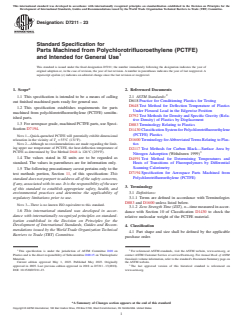

ASTM D7211-23 - Standard Specification for Parts Machined from Polychlorotrifluoroethylene (PCTFE) and Intended for General Use
REDLINE ASTM D7211-23 - Standard Specification for Parts Machined from Polychlorotrifluoroethylene (PCTFE) and Intended for General Use
Overview
ASTM D7211-23 is the internationally recognized standard specification for finished parts machined from polychlorotrifluoroethylene (PCTFE) homopolymers, particularly those containing up to 30% regrind or recycled polymer. Developed by ASTM International, this standard ensures that PCTFE parts intended for general commercial use meet essential physical, mechanical, and performance requirements. ASTM D7211-23 specifically excludes PCTFE copolymers, films, tapes, materials with additives, and aerospace parts requiring specialized performance in oxygen or reactive media.
Key Topics
- Material Scope: Covers general purpose, machined PCTFE finished parts manufactured from semifinished stock, containing only virgin, unplasticized polymer or a blend including recycled content.
- Exclusions: Does not apply to parts for aerospace applications, items fabricated from PCTFE copolymers, thin films, or parts modified with fillers or pigments.
- Physical Properties: Finished parts must comply with requirements for:
- Specific gravity
- Melting point (between 210 and 220°C)
- Deformation under load
- Zero strength time (ZST), indicating molecular weight retention
- Annealing performance and dimensional stability
- Appearance: Parts should exhibit a natural white or gray translucent appearance, free of discoloration, voids, inclusions, and surface defects.
- Grades & Classification: Parts classified by ZST (Grades 0-3), ranging from undetermined ZST to those with high retention times ensuring superior performance.
- Annealing Options: Supports both annealed and unannealed parts, with defined methods (A and B) for achieving dimensional stability.
- Test Conditions: Outlines rigorous procedures for evaluating specific gravity, melting point, ZST, and dimensional stability under controlled laboratory conditions.
Applications
Machined PCTFE parts manufactured according to ASTM D7211-23 serve a broad array of general industrial and commercial needs due to PCTFE’s chemical resistance, low moisture absorption, and electrical insulation properties. Approved applications include:
- Seals and Gaskets: Used in environments requiring chemical inertness and dimensional stability.
- Valve and Pump Components: Suitable for both cryogenic and non-cryogenic operations.
- Translucent Tubing: For process lines requiring visual flow monitoring.
- Laboratory Equipment: Ideal for parts exposed to corrosive media or where purity is paramount.
- Electrical Components: Switches, connector covers, and circuit board parts benefit from PCTFE’s insulating properties.
- Flowmeter Tubes and Sight Glasses: Leverage high clarity and chemical compatibility.
- Bearings and Gears: PCTFE’s mechanical strength enables use in light mechanical assemblies.
The standard’s focus on material purity, dimensional stability, and reproducibility assures long-term performance, making it critical for maintenance parts and replacements in process industries, laboratories, and general manufacturing.
Related Standards
For effective implementation of ASTM D7211-23 and to ensure compatibility across materials and test methodologies, the following referenced ASTM standards are often used in conjunction:
- ASTM D1430: Classification System for PCTFE Plastics
- ASTM D648: Test Method for Deflection Temperature of Plastics
- ASTM D792: Test Methods for Density and Specific Gravity of Plastics
- ASTM D7194: Specification for Aerospace Parts Machined from PCTFE (use for aerospace-grade requirements)
- ASTM D4591: Test Method for Determining Temperatures and Heats of Transitions of Fluoropolymers
- ASTM D618: Practice for Conditioning Plastics for Testing
Note: There is currently no ISO equivalent to ASTM D7211-23. The standard aligns with WTO principles for international standardization, supporting harmonization and transparency in global trade of plastic components.
Summary
Compliance with ASTM D7211-23 enhances the reliability and quality of PCTFE machined parts, providing confidence in their performance across a diverse array of commercial and industrial applications. By adhering to this standard, manufacturers and end-users ensure that their PCTFE components meet rigorous standards for purity, durability, and suitability in demanding environments.
Relations
- Effective Date
- 01-Apr-2024
- Effective Date
- 01-Feb-2024
- Effective Date
- 01-Nov-2023
- Effective Date
- 01-Jan-2020
- Effective Date
- 01-Aug-2019
- Effective Date
- 15-Apr-2019
- Effective Date
- 01-Feb-2019
- Effective Date
- 01-Dec-2018
- Effective Date
- 01-Nov-2018
- Effective Date
- 01-Apr-2018
- Refers
ASTM D1600-18 - Standard Terminology for Abbreviated Terms Relating to Plastics (Withdrawn 2024) - Effective Date
- 01-Jan-2018
- Effective Date
- 15-Aug-2017
- Effective Date
- 01-Dec-2016
- Effective Date
- 01-Feb-2014
- Effective Date
- 15-Apr-2013
Buy Documents
ASTM D7211-23 - Standard Specification for Parts Machined from Polychlorotrifluoroethylene (PCTFE) and Intended for General Use
REDLINE ASTM D7211-23 - Standard Specification for Parts Machined from Polychlorotrifluoroethylene (PCTFE) and Intended for General Use
Get Certified
Connect with accredited certification bodies for this standard

DIN CERTCO
DIN Group product certification.

Smithers Quality Assessments
US management systems and product certification.
Sponsored listings
Frequently Asked Questions
ASTM D7211-23 is a technical specification published by ASTM International. Its full title is "Standard Specification for Parts Machined from Polychlorotrifluoroethylene (PCTFE) and Intended for General Use". This standard covers: ABSTRACT This specification establishes the requirements for finished parts machined from unplasticized polychlorotrifluoroethylene (PCTFE) homopolymers containing regrind and recycled polymer intended for general commercial use. This specification does not cover parts machined from PCTFE copolymers, PCTFE films or tapes, or modified PCTFE containing pigments or plasticizers. Nor does it cover PCTFE parts used in aerospace applications involving storage and handling of oxygen media, air media, inert media, and certain reactive media (specifically ammonia, gaseous hydrogen, and liquid hydrogen), wherein dimensional stability, high molecular weight, molecular weight retention, and crystallinity control are important considerations. Materials shall be tested on and conform accordingly to the following properties: specific gravity; melting point; deformation under load; zero strength time (ZST); annealing performance; and dimensional stability. SCOPE 1.1 This specification is intended to be a means of calling out finished machined parts ready for general use. 1.2 This specification establishes requirements for parts machined from polychlorotrifluoroethylene (PCTFE) semifinished parts. 1.3 For aerospace grade, machined PCTFE parts, use Specification D7194. Note 1: Quick-quenched PCTFE will potentially exhibit dimensional relaxation in the vicinity of Tg = 55°C (131°F). Note 2: Although no recommendations are made regarding the limiting upper use temperature of PCTFE, the heat deflection temperature of PCTFE as determined by Test Method D648 is 126°C (259°F). 1.4 The values stated in SI units are to be regarded as standard. The values in parentheses are for information only. 1.5 The following precautionary caveat pertains only to the test methods portion, Section 11, of this specification: This standard does not purport to address all of the safety concerns, if any, associated with its use. It is the responsibility of the user of this standard to establish appropriate safety, health, and environmental practices and determine the applicability of regulatory limitations prior to use. Note 3: There is no known ISO equivalent to this standard. 1.6 This international standard was developed in accordance with internationally recognized principles on standardization established in the Decision on Principles for the Development of International Standards, Guides and Recommendations issued by the World Trade Organization Technical Barriers to Trade (TBT) Committee.
ABSTRACT This specification establishes the requirements for finished parts machined from unplasticized polychlorotrifluoroethylene (PCTFE) homopolymers containing regrind and recycled polymer intended for general commercial use. This specification does not cover parts machined from PCTFE copolymers, PCTFE films or tapes, or modified PCTFE containing pigments or plasticizers. Nor does it cover PCTFE parts used in aerospace applications involving storage and handling of oxygen media, air media, inert media, and certain reactive media (specifically ammonia, gaseous hydrogen, and liquid hydrogen), wherein dimensional stability, high molecular weight, molecular weight retention, and crystallinity control are important considerations. Materials shall be tested on and conform accordingly to the following properties: specific gravity; melting point; deformation under load; zero strength time (ZST); annealing performance; and dimensional stability. SCOPE 1.1 This specification is intended to be a means of calling out finished machined parts ready for general use. 1.2 This specification establishes requirements for parts machined from polychlorotrifluoroethylene (PCTFE) semifinished parts. 1.3 For aerospace grade, machined PCTFE parts, use Specification D7194. Note 1: Quick-quenched PCTFE will potentially exhibit dimensional relaxation in the vicinity of Tg = 55°C (131°F). Note 2: Although no recommendations are made regarding the limiting upper use temperature of PCTFE, the heat deflection temperature of PCTFE as determined by Test Method D648 is 126°C (259°F). 1.4 The values stated in SI units are to be regarded as standard. The values in parentheses are for information only. 1.5 The following precautionary caveat pertains only to the test methods portion, Section 11, of this specification: This standard does not purport to address all of the safety concerns, if any, associated with its use. It is the responsibility of the user of this standard to establish appropriate safety, health, and environmental practices and determine the applicability of regulatory limitations prior to use. Note 3: There is no known ISO equivalent to this standard. 1.6 This international standard was developed in accordance with internationally recognized principles on standardization established in the Decision on Principles for the Development of International Standards, Guides and Recommendations issued by the World Trade Organization Technical Barriers to Trade (TBT) Committee.
ASTM D7211-23 is classified under the following ICS (International Classification for Standards) categories: 83.140.01 - Rubber and plastics products in general. The ICS classification helps identify the subject area and facilitates finding related standards.
ASTM D7211-23 has the following relationships with other standards: It is inter standard links to ASTM D7194-19(2024), ASTM D883-24, ASTM D883-23, ASTM D883-20, ASTM D883-19c, ASTM D883-19a, ASTM D883-19, ASTM D883-18a, ASTM D883-18, ASTM D648-18, ASTM D1600-18, ASTM D883-17, ASTM D1430-11(2016), ASTM D1600-14, ASTM D1600-13. Understanding these relationships helps ensure you are using the most current and applicable version of the standard.
ASTM D7211-23 is available in PDF format for immediate download after purchase. The document can be added to your cart and obtained through the secure checkout process. Digital delivery ensures instant access to the complete standard document.
Standards Content (Sample)
This international standard was developed in accordance with internationally recognized principles on standardization established in the Decision on Principles for the
Development of International Standards, Guides and Recommendations issued by the World Trade Organization Technical Barriers to Trade (TBT) Committee.
Designation: D7211 − 23
Standard Specification for
Parts Machined from Polychlorotrifluoroethylene (PCTFE)
and Intended for General Use
This standard is issued under the fixed designation D7211; the number immediately following the designation indicates the year of
original adoption or, in the case of revision, the year of last revision. A number in parentheses indicates the year of last reapproval. A
superscript epsilon (´) indicates an editorial change since the last revision or reapproval.
1. Scope* 2. Referenced Documents
2.1 ASTM Standards:
1.1 This specification is intended to be a means of calling
out finished machined parts ready for general use. D618 Practice for Conditioning Plastics for Testing
D648 Test Method for Deflection Temperature of Plastics
1.2 This specification establishes requirements for parts
Under Flexural Load in the Edgewise Position
machined from polychlorotrifluoroethylene (PCTFE) semifin-
D792 Test Methods for Density and Specific Gravity (Rela-
ished parts.
tive Density) of Plastics by Displacement
1.3 For aerospace grade, machined PCTFE parts, use Speci-
D883 Terminology Relating to Plastics
fication D7194.
D1430 Classification System for Polychlorotrifluoroethylene
(PCTFE) Plastics
NOTE 1—Quick-quenched PCTFE will potentially exhibit dimensional
D1600 Terminology for Abbreviated Terms Relating to Plas-
relaxation in the vicinity of T = 55°C (131°F).
g
NOTE 2—Although no recommendations are made regarding the limit- tics
ing upper use temperature of PCTFE, the heat deflection temperature of
D2117 Test Methods for Carbon Black—Surface Area by
PCTFE as determined by Test Method D648 is 126°C (259°F). 3
Nitrogen Adsorption (Withdrawn 1999)
1.4 The values stated in SI units are to be regarded as
D4591 Test Method for Determining Temperatures and
standard. The values in parentheses are for information only. Heats of Transitions of Fluoropolymers by Differential
Scanning Calorimetry
1.5 The following precautionary caveat pertains only to the
D7194 Specification for Aerospace Parts Machined from
test methods portion, Section 11, of this specification: This
Polychlorotrifluoroethylene (PCTFE)
standard does not purport to address all of the safety concerns,
if any, associated with its use. It is the responsibility of the user
3. Terminology
of this standard to establish appropriate safety, health, and
environmental practices and determine the applicability of 3.1 Definitions:
regulatory limitations prior to use. 3.1.1 Terms are defined in accordance with Terminologies
D883 and D1600 unless listed below.
NOTE 3—There is no known ISO equivalent to this standard.
3.1.2 Zero Strength Time (ZST), n—time measured in accor-
1.6 This international standard was developed in accor-
dance with Section 10 of Classification D1430 to check the
dance with internationally recognized principles on standard-
relative molecular weight of the PCTFE material.
ization established in the Decision on Principles for the
Development of International Standards, Guides and Recom-
4. Classification
mendations issued by the World Trade Organization Technical
4.1 Part shape and size shall be defined by the applicable
Barriers to Trade (TBT) Committee.
purchase order.
1 2
This specification is under the jurisdiction of ASTM Committee D20 on For referenced ASTM standards, visit the ASTM website, www.astm.org, or
Plastics and is the direct responsibility of Subcommittee D20.15 on Thermoplastic contact ASTM Customer Service at service@astm.org. For Annual Book of ASTM
Materials. Standards volume information, refer to the standard’s Document Summary page on
Current edition approved May 1, 2023. Published May 2023. Originally the ASTM website.
approved in 2005. Last previous edition approved in 2018 as D7211 - 13(2018). The last approved version of this historical standard is referenced on
DOI: 10.1520/D7211-23. www.astm.org.
*A Summary of Changes section appears at the end of this standard
Copyright © ASTM International, 100 Barr Harbor Drive, PO Box C700, West Conshohocken, PA 19428-2959. United States
D7211 − 23
4.2 General purpose grade PCTFE shall be Class 1 homopo- 8.4 The melting point of finished parts shall be determined
lymer in accordance Classification D1430. to be in the range of 210 to 220°C (410 to 428°F) as
determined in 11.2.
4.3 The grade of product shall be categorized in accordance
with Classification D1430 as follows: 8.5 Finished parts shall be made from semifinished articles
4.3.1 Grade 0 having an undetermined or unspecified ZST. having an as-molded zero strength time (ZST ) of 300 to
stock
4.3.2 Grade 1 having an as-polymerized ZST of 100 to 199 450 s (Grade 3), or 200 to 299 s (Grade 2), or 100 to 199 s
seconds. (Grade 1), as determined in 11.3, or shall be undetermined or
4.3.3 Grade 2 having an as-polymerized ZST of 200 to 299 unspecified (Grade 0).
seconds.
NOTE 5—To ensure that the process route does not cause excessive
4.3.4 Grade 3 having an as-polymerized ZST of 300 to 450
thermal degradation and accompanying molecular weight drop, it is
seconds.
recommended that the maximum allowable ZST drop, ΔZST, shall not
exceed <20 % as determined in 11.3.4.
4.4 The finished part shall be received in an unannealed or
8.6 All finished parts are to be supplied in annealed condi-
annealed state as specified in the applicable purchase order. If
tion in accordance with 11.4, or in an unannealed condition.
annealed, annealing shall be accomplished as described in 11.4.
8.7 No dimension of an annealed, finished part shall change
5. Ordering Information
more than 0.003 mm/mm (0.003 in./in.) measured at 23 6 2°C
(73 6 4°F) before and after being held for 48 6 5 h at 70 6
5.1 All parts covered by this specification shall be ordered
5°C (158 6 9°F), as determined in 11.5.
by grade and annealed state as listed in Section 4.
8.8 If so specified in the purchase contract or order, the
6. Materials and Manufacture
maximum allowable ZST drop, ΔZST, shall be <20 % as
6.1 Annealed and unannealed parts shall be made from determined in 11.3.4.
polymers meeting all requirements of Classification D1430,
9. Number of Tests
Group 01, Class 1, Grades 0, 1, 2, or 3.
9.1 When the number of test specimens is not stated in the
6.2 The base material shall be free of all defects or con-
test method, a single determination is made. If more than single
taminants that would be detrimental to final fabrication or
determinations and separate portions of the same sample are
performance of the finished parts.
made, the results shall be averaged. The final result shall
conform to the requirements prescribed in this specification.
7. Property Requirements
10. Test Conditions
7.1 Specification values listed in this specification are mini-
mum specification values or minimum-maximum specification
10.1 Standard Temperature—The tests shall be conducted at
ranges. Any additional requirement for specific tests or data
the standard laboratory temperature of 23 6 2°C (73 6 4°F)
shall be made at the time of the order.
and 50 6 10 % relative humidity.
11. Test Methods
8. General Requirements
NOTE 4—If so specified in the purchase contract or order, the molder
11.1 Specific Gravity (Sp. Gr.)
producing the semifinished article from which finished parts are made will
11.1.1 Specific gravity of finished parts shall be determined
be responsible for insuring the requirement in 8.8 is met. All other
in accordance with Test Methods D792, Method A, with the
requirements listed in this section pertain to the finished part, and
following modifications: The submersion medium (deionized
therefore, will be the responsibility of the supplier of the finished,
machined part. 18 MΩ cm water) is boiled; then one to two drops of Zonyl
fluorosurfactant (or equivalent) wetting agent is added per 100
8.1 Finished parts shall have a natural translucent appear-
mL of water. A magnifying glass is used to ensure further that
ance. The color shall be white or gray with no yellowing or
no air bubbles cling to submerged parts during weighings.
other unnatural color.
Specimens shall also be free of internal voids in accordance
8.2 Finished parts shall be free of voids, scratches, fissures,
with 8.2. The test temperature shall be 23 6 2°C (73 6 4°F).
inclusions, or entrapped air bubbles that will affect serviceabil- c
11.1.2 If desired, the weight percent crystallinity, W , is
ity. No particles (for example, black specks) shall be visible to
calculated as:
the naked eye.
...
This document is not an ASTM standard and is intended only to provide the user of an ASTM standard an indication of what changes have been made to the previous version. Because
it may not be technically possible to adequately depict all changes accurately, ASTM recommends that users consult prior editions as appropriate. In all cases only the current version
of the standard as published by ASTM is to be considered the official document.
Designation: D7211 − 13 (Reapproved 2018) D7211 − 23
Standard Specification for
Parts Machined from Polychlorotrifluoroethylene (PCTFE)
and Intended for General Use
This standard is issued under the fixed designation D7211; the number immediately following the designation indicates the year of
original adoption or, in the case of revision, the year of last revision. A number in parentheses indicates the year of last reapproval. A
superscript epsilon (´) indicates an editorial change since the last revision or reapproval.
1. Scope Scope*
1.1 This specification is intended to be a means of calling out finished machined parts ready for commercialgeneral use.
1.2 This specification establishes requirements for parts machined from unplasticized, 100 % polychlorotrifluoroethylene
(PCTFE) homopolymers.semifinished parts.
1.3 This specification does not cover parts machined from PCTFE copolymers, PCTFE film or tape less than 0.25-mm (0.010-in.)
thick, or modified PCTFE (containing pigments or plasticizers).
1.4 This specification allows for parts containing regrind and recycled material.
1.5 The specification does not cover PCTFE parts used in aerospace applications involving storage and handling of oxygen media,
air media, inert media, and certain reactive media (specifically ammonia, gaseous hydrogen, and liquid hydrogen), in which
dimensional stability, high molecular weight, molecular weight retention, and crystallinity control are important considerations.
For aerospace grade, machined PCTFE parts, use Specification D7194.
1.3 Application—PCTFE parts covered byFor aerospace grade, machined PCTFE parts, use Specification D7194this specification
are made of 100 % PCTFE resin, free of plasticizers, fillers, or other additives. The parts meet specific physical characteristics
appropriate for their end use, and are typically used in applications requiring good electrical properties or resistance to aggressive
chemical media. General purpose PCTFE parts include seals, gaskets, valve and pump parts (cryogenic and noncryogenic),
translucent tubing, sight glasses, flowmeter tubes, heavy-walled solid pipes and fittings, gears, cams, bearings, laboratory ware,
circuit boards, electrical connector covers and switches, radome covers, and a variety of other stock shapes. They are removed and
replaced during normal maintenance procedures. The parts also experience static or dynamic mechanical loading, and temperatures
ranging from cryogenic to temperatures at or above the glass transition temperature, .T = 55°C (131°F).
g
NOTE 1—Quick-quenched PCTFE will potentially exhibit dimensional relaxation in the vicinity of T . = 55°C (131°F).
g
NOTE 2—Although no recommendations are made regarding the limiting upper use temperature of PCTFE, the heat deflection temperature of PCTFE as
determined by Test Method D648 is 126°C (259°F).
1.4 The values stated in SI units are to be regarded as standard. The values in parentheses are for information only.
This specification is under the jurisdiction of ASTM Committee D20 on Plastics and is the direct responsibility of Subcommittee D20.15 on Thermoplastic Materials.
Current edition approved Nov. 1, 2018May 1, 2023. Published November 2018May 2023. Originally approved in 2005. Last previous edition approved in 20132018 as
D7211 - 13.D7211 - 13(2018). DOI: 10.1520/D7211-13R18.10.1520/D7211-23.
*A Summary of Changes section appears at the end of this standard
Copyright © ASTM International, 100 Barr Harbor Drive, PO Box C700, West Conshohocken, PA 19428-2959. United States
D7211 − 23
1.5 The following precautionary caveat pertains only to the test methods portion, Section 11, of this specification: This standard
does not purport to address all of the safety concerns, if any, associated with its use. It is the responsibility of the user of this
standard to establish appropriate safety, health, and environmental practices and determine the applicability of regulatory
limitations prior to use.
NOTE 3—There is no known ISO equivalent to this standard.
1.6 This international standard was developed in accordance with internationally recognized principles on standardization
established in the Decision on Principles for the Development of International Standards, Guides and Recommendations issued
by the World Trade Organization Technical Barriers to Trade (TBT) Committee.
2. Referenced Documents
2.1 ASTM Standards:
D618 Practice for Conditioning Plastics for Testing
D648 Test Method for Deflection Temperature of Plastics Under Flexural Load in the Edgewise Position
D792 Test Methods for Density and Specific Gravity (Relative Density) of Plastics by Displacement
D883 Terminology Relating to Plastics
D1430 Classification System for Polychlorotrifluoroethylene (PCTFE) Plastics
D1600 Terminology for Abbreviated Terms Relating to Plastics
D2117 Test Methods for Carbon Black—Surface Area by Nitrogen Adsorption (Withdrawn 1999)
D4591 Test Method for Determining Temperatures and Heats of Transitions of Fluoropolymers by Differential Scanning
Calorimetry
D7194 Specification for Aerospace Parts Machined from Polychlorotrifluoroethylene (PCTFE)
3. Terminology
3.1 Definitions:
3.1.1 Terms are defined in accordance with Terminologies D883 and D1600 unless listed below.
3.1.2 oxygen media, n—liquid oxygen and gaseous oxygen.
3.1.3 air media, n—liquid air and pressurized air (including breathing air).
3.1.4 inert media, n—for example, gaseous helium and gaseous nitrogen.
3.1.5 reactive media, n—for example, ammonia, gaseous hydrogen, and liquid hydrogen, nitrous oxide, and nitrogen trifluoride.
3.1.2 Zero Strength Time (ZST), n—time measured in accordance with Section 10 of Classification D1430 to check the relative
molecular weight of the PCTFE material.
4. Classification
4.1 Part shape and size shall be defined by the applicable purchase order.
4.2 General purpose grade PCTFE shall be Class 1 homopolymer in accordance Classification D1430.
4.3 The grade of product shall be categorized in accordance with Classification D1430 as follows:
4.3.1 Grade 0 having an undetermined or unspecified ZST.
4.3.2 Grade 1 having an as-polymerized ZST of 100 to 199 seconds.
For referenced ASTM standards, visit the ASTM website, www.astm.org, or contact ASTM Customer Service at service@astm.org. For Annual Book of ASTM Standards
volume information, refer to the standard’s Document Summary page on the ASTM website.
The last approved version of this historical standard is referenced on www.astm.org.
D7211 − 23
4.3.3 Grade 2 having an as-polymerized ZST of 200 to 299 seconds.
4.3.4 Grade 3 having an as-polymerized ZST of 300 to 450 seconds.
4.4 The finished part shall be received in an unannealed or annealed state as specified in the applicable purchase order. If annealed,
annealing shall be accomplished as described in 11.4.
5. Ordering Information
5.1 All parts covered by this specification shall be ordered by grade and annealed state as listed in Section 4.
6. Materials and Manufacture
6.1 Annealed and unannealed parts shall be made from polymers meeting all requirements of Classification D1430, Group 01,
Class 1, Grades 0, 1, 2, or 3.
6.2 Parts shall be made from virgin, unfilled, unplasticized, 100 % polychlorotrifluoroethylene (PCTFE) homopolymer and up to
30 percent (by volume) regrind or recycled polymer.
6.2 The base material shall be free of all defects or contaminants that would be detrimental to final fabrication or performance of
the finished parts.
7. Property Requirements
7.1 Specification values listed in this specification are minimum specification values or minimum-maximum specification ranges.
Any additional requirement for specific tests or data shall be made at the time of the order.
8. General Requirements
NOTE 4—If so specified in the purchase contract or order, the molder producing the semifinished article from which finished parts are made will be
responsible for insuring the requirement in 8.8 is met. All other requirements listed in this section pertain to the finished part, and therefore, will be the
responsibility of the supplier of the finished, machined part.
8.1 Finished parts shall have a natural translucent appearance. The color shall be white or gray with no yellowing or other
unnatural color.
8.2 Finished parts shall be free of voids, scratches, fissures, inclusions, or entrapped air bubbles that will affect serviceability. No
particles (for example, black specks) shall be visible to the naked eye.
8.3 Depending on commercial resin grade, processing route (for example, extrusion, compression molding, injection molding),
quenching method (water or air cooling), and thickness of the starting semifinished article from which the finished part is made,
the specific gravity, sp. gr. 23/23°C of finished PCTFE parts when determined by 11.1, can vary from 2.11 to 2.17. However, to
ensure consistent properties and performance in the intended application, the specific gravity of a finished part shall not be allowed
to fluctuate freely within the 2.11 to 2.17 range.
8.4 The melting point of finished parts shall be determined to be in the range of 210 to 220°C (410 to 428°F) as determined in
11.2.
8.5 Finished parts shall be made from semifinished articles having an as-molded zero strength time (ZST ) of 300 to 450 s
stock
(Grade 3), or 200 to 299 s (Grade 2), or 100 to 199 s (Grade 1), as determined in 11.3, or shall be undetermined or unspecified
(Grade 0).
NOTE 5—To ensure that the process route does not cause excessive thermal degradation and accompanying molecular weight drop, it is recomme
...