

ASTM D6779-23
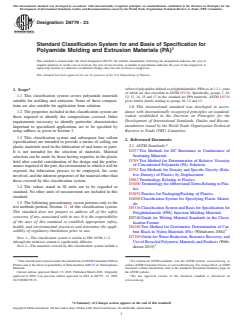
(Specification)Standard Classification System for and Basis of Specification for Polyamide Molding and Extrusion Materials (PA)
General Information
- Abstract
SCOPE
1.1 This classification system covers polyamide materials suitable for molding and extrusion. Some of these compositions are also suitable for application from solution.
1.2 The properties included in this classification system are those required to identify the compositions covered. Other requirements necessary to identify particular characteristics important to specialized applications are to be specified by using suffixes as given in Section 5.
1.3 This classification system and subsequent line callout (specification) are intended to provide a means of calling out plastic materials used in the fabrication of end items or parts. It is not intended for the selection of materials. Material selection can be made by those having expertise in the plastic field after careful consideration of the design and the performance required of the part, the environment to which it will be exposed, the fabrication process to be employed, the costs involved, and the inherent properties of the material other than those covered by this classification system.
1.4 The values stated in SI units are to be regarded as standard. No other units of measurement are included in this standard.
1.5 The following precautionary caveat pertains only to the test methods portion, Section 11, of this classification system. This standard does not purport to address all of the safety concerns, if any, associated with its use. It is the responsibility of the user of this standard to establish appropriate safety, health, and environmental practices and determine the applicability of regulatory limitations prior to use.
Note 1: This classification system is similar to ISO 16396-1/-2,
although the technical content is significantly different.
Note 2: The materials covered by this classification system include a subset of polyamides defined as polyphthalamides (PPA) as in 3.2.1, some of which are also classified in ASTM D5336. Specifically, groups 7, 10, 12, 13, 14, 15 and 17 in this standard are PPA materials. ASTM D5336 gives further details relating to groups 10, 12 and 13.
1.6 This international standard was developed in accordance with internationally recognized principles on standardization established in the Decision on Principles for the Development of International Standards, Guides and Recommendations issued by the World Trade Organization Technical Barriers to Trade (TBT) Committee.
- Status
- Published
- Publication Date
- 14-Mar-2023
- Technical Committee
- D20 - Plastics
- Drafting Committee
- D20.15 - Thermoplastic Materials
Buy Documents
ASTM D6779-23 - Standard Classification System for and Basis of Specification for Polyamide Molding and Extrusion Materials (PA)
REDLINE ASTM D6779-23 - Standard Classification System for and Basis of Specification for Polyamide Molding and Extrusion Materials (PA)
Overview
ASTM D6779-23 is the internationally recognized classification system and basis of specification for polyamide molding and extrusion materials (PA). Developed and maintained by ASTM International, this standard establishes a clear system for identifying polyamides used for molding, extrusion, and, in some cases, solution application. The standard helps manufacturers, fabricators, and specifiers convey consistent material requirements for end products across various industries, with a particular emphasis on uniformity and interoperability. The standard covers a variety of polyamides, including important subsets such as polyphthalamides (PPA).
Key Topics
Material Classification
ASTM D6779-23 outlines a system to classify polyamide materials based on composition, providing group, class, and grade designations. The classification covers workhorse polyamides (such as PA6 and PA66), specialty polyamides, and PPA, with gradations for fillers and reinforcements (e.g., glass, minerals, or carbon).Specification Basis
This standard provides a methodology for specifying detailed material properties, including:- Tensile strength
- Tensile modulus
- Charpy impact resistance
- Deflection temperature under load
Property requirements are presented in SI units, aligning with international measurement standards. Suffixes can be added for special requirements, bringing flexibility for custom specifications.
Test Methods and Sample Preparation
ASTM D6779-23 references relevant ASTM, ISO, and IEC standards for test methods and sample preparation. Standardized injection-molded ISO specimens and dry-as-molded conditioning are required, ensuring reliable, reproducible test results.Systematic Identification and Documentation
The system enables uniform and precise documentation through material callouts, facilitating compliance and traceability in the supply chain. Line callouts (specifications) derived from this system are intended for material identification in manufacturing, not for initial material selection.
Applications
ASTM D6779-23 is widely used in applications where polyamide materials are required for molded or extruded plastic parts. Principal application areas include:
- Automotive: Under-the-hood components, structural assemblies, cable insulation, and connectors.
- Electrical & Electronics: Connectors, housings, cable ties, and insulation materials, where precision and compliance with electrical property standards are critical.
- Consumer Goods: Power tool bodies, appliance parts, sports equipment, and other durable goods that rely on the mechanical strength and thermal stability of polyamides.
- Industrial: Gears, bushings, and machine housings, especially where a combination of strength, wear resistance, and chemical durability is required.
- Specialty Applications: Polyphthalamides (PPA) are specified in high-temperature, chemical-resistant, and demanding structural applications by referencing groups specified within this standard.
The standard’s classification, test, and specification systems provide a clear framework for ensuring material suitability, regulatory compliance, and product consistency, facilitating global sourcing and manufacturing.
Related Standards
Users of ASTM D6779-23 often reference the following standards for complementary information or testing protocols:
- ASTM D4000: Standard Classification System for Specifying Plastic Materials
- ASTM D5336: Classification System and Basis for Specification for Polyphthalamide (PPA) Injection Molding Materials
- ASTM D789: Test Method for Determination of Relative Viscosity of Concentrated Polyamide Solutions
- ASTM D883: Terminology Relating to Plastics
- ISO 16396-1/-2: Polyamide (PA) Molding and Extrusion Materials (note: content differs significantly from ASTM D6779)
- ISO 75, ISO 527, ISO 179: Test methods for determining mechanical and thermal properties of plastics
Employing ASTM D6779-23 ensures global compatibility and supports robust procurement, design, and quality assurance in the plastics industry, especially where polyamide materials are critical to product performance and reliability.
Relations
- Effective Date
- 01-Feb-2024
- Effective Date
- 01-Nov-2023
- Effective Date
- 01-Jan-2020
- Effective Date
- 01-Aug-2019
- Effective Date
- 01-Aug-2019
- Effective Date
- 15-Apr-2019
- Effective Date
- 01-Feb-2019
- Effective Date
- 01-Dec-2018
- Effective Date
- 01-Nov-2018
- Effective Date
- 15-Jun-2018
- Refers
ASTM D1600-18 - Standard Terminology for Abbreviated Terms Relating to Plastics (Withdrawn 2024) - Effective Date
- 01-Jan-2018
- Effective Date
- 15-Aug-2017
- Effective Date
- 01-Sep-2016
- Effective Date
- 01-Sep-2015
- Refers
ASTM D789-15 - Standard Test Methods for Determination of Solution Viscosities of Polyamide (PA) - Effective Date
- 01-Apr-2015
Buy Documents
ASTM D6779-23 - Standard Classification System for and Basis of Specification for Polyamide Molding and Extrusion Materials (PA)
REDLINE ASTM D6779-23 - Standard Classification System for and Basis of Specification for Polyamide Molding and Extrusion Materials (PA)
Get Certified
Connect with accredited certification bodies for this standard

DIN CERTCO
DIN Group product certification.

Smithers Quality Assessments
US management systems and product certification.
Sponsored listings
Frequently Asked Questions
ASTM D6779-23 is a technical specification published by ASTM International. Its full title is "Standard Classification System for and Basis of Specification for Polyamide Molding and Extrusion Materials (PA)". This standard covers: SCOPE 1.1 This classification system covers polyamide materials suitable for molding and extrusion. Some of these compositions are also suitable for application from solution. 1.2 The properties included in this classification system are those required to identify the compositions covered. Other requirements necessary to identify particular characteristics important to specialized applications are to be specified by using suffixes as given in Section 5. 1.3 This classification system and subsequent line callout (specification) are intended to provide a means of calling out plastic materials used in the fabrication of end items or parts. It is not intended for the selection of materials. Material selection can be made by those having expertise in the plastic field after careful consideration of the design and the performance required of the part, the environment to which it will be exposed, the fabrication process to be employed, the costs involved, and the inherent properties of the material other than those covered by this classification system. 1.4 The values stated in SI units are to be regarded as standard. No other units of measurement are included in this standard. 1.5 The following precautionary caveat pertains only to the test methods portion, Section 11, of this classification system. This standard does not purport to address all of the safety concerns, if any, associated with its use. It is the responsibility of the user of this standard to establish appropriate safety, health, and environmental practices and determine the applicability of regulatory limitations prior to use. Note 1: This classification system is similar to ISO 16396-1/-2, although the technical content is significantly different. Note 2: The materials covered by this classification system include a subset of polyamides defined as polyphthalamides (PPA) as in 3.2.1, some of which are also classified in ASTM D5336. Specifically, groups 7, 10, 12, 13, 14, 15 and 17 in this standard are PPA materials. ASTM D5336 gives further details relating to groups 10, 12 and 13. 1.6 This international standard was developed in accordance with internationally recognized principles on standardization established in the Decision on Principles for the Development of International Standards, Guides and Recommendations issued by the World Trade Organization Technical Barriers to Trade (TBT) Committee.
SCOPE 1.1 This classification system covers polyamide materials suitable for molding and extrusion. Some of these compositions are also suitable for application from solution. 1.2 The properties included in this classification system are those required to identify the compositions covered. Other requirements necessary to identify particular characteristics important to specialized applications are to be specified by using suffixes as given in Section 5. 1.3 This classification system and subsequent line callout (specification) are intended to provide a means of calling out plastic materials used in the fabrication of end items or parts. It is not intended for the selection of materials. Material selection can be made by those having expertise in the plastic field after careful consideration of the design and the performance required of the part, the environment to which it will be exposed, the fabrication process to be employed, the costs involved, and the inherent properties of the material other than those covered by this classification system. 1.4 The values stated in SI units are to be regarded as standard. No other units of measurement are included in this standard. 1.5 The following precautionary caveat pertains only to the test methods portion, Section 11, of this classification system. This standard does not purport to address all of the safety concerns, if any, associated with its use. It is the responsibility of the user of this standard to establish appropriate safety, health, and environmental practices and determine the applicability of regulatory limitations prior to use. Note 1: This classification system is similar to ISO 16396-1/-2, although the technical content is significantly different. Note 2: The materials covered by this classification system include a subset of polyamides defined as polyphthalamides (PPA) as in 3.2.1, some of which are also classified in ASTM D5336. Specifically, groups 7, 10, 12, 13, 14, 15 and 17 in this standard are PPA materials. ASTM D5336 gives further details relating to groups 10, 12 and 13. 1.6 This international standard was developed in accordance with internationally recognized principles on standardization established in the Decision on Principles for the Development of International Standards, Guides and Recommendations issued by the World Trade Organization Technical Barriers to Trade (TBT) Committee.
ASTM D6779-23 is classified under the following ICS (International Classification for Standards) categories: 83.140.01 - Rubber and plastics products in general. The ICS classification helps identify the subject area and facilitates finding related standards.
ASTM D6779-23 has the following relationships with other standards: It is inter standard links to ASTM D883-24, ASTM D883-23, ASTM D883-20, ASTM D789-19, ASTM D883-19c, ASTM D883-19a, ASTM D883-19, ASTM D883-18a, ASTM D883-18, ASTM D789-18, ASTM D1600-18, ASTM D883-17, ASTM D5740-16, ASTM D3892-15, ASTM D789-15. Understanding these relationships helps ensure you are using the most current and applicable version of the standard.
ASTM D6779-23 is available in PDF format for immediate download after purchase. The document can be added to your cart and obtained through the secure checkout process. Digital delivery ensures instant access to the complete standard document.
Standards Content (Sample)
This international standard was developed in accordance with internationally recognized principles on standardization established in the Decision on Principles for the
Development of International Standards, Guides and Recommendations issued by the World Trade Organization Technical Barriers to Trade (TBT) Committee.
Designation: D6779 − 23
Standard Classification System for and Basis of Specification for
Polyamide Molding and Extrusion Materials (PA)
This standard is issued under the fixed designation D6779; the number immediately following the designation indicates the year of
original adoption or, in the case of revision, the year of last revision. A number in parentheses indicates the year of last reapproval. A
superscript epsilon (´) indicates an editorial change since the last revision or reapproval.
This standard has been approved for use by agencies of the U.S. Department of Defense.
subset of polyamides defined as polyphthalamides (PPA) as in 3.2.1, some
1. Scope*
of which are also classified in ASTM D5336. Specifically, groups 7, 10,
1.1 This classification system covers polyamide materials
12, 13, 14, 15 and 17 in this standard are PPA materials. ASTM D5336
suitable for molding and extrusion. Some of these composi- gives further details relating to groups 10, 12 and 13.
tions are also suitable for application from solution.
1.6 This international standard was developed in accor-
dance with internationally recognized principles on standard-
1.2 The properties included in this classification system are
ization established in the Decision on Principles for the
those required to identify the compositions covered. Other
Development of International Standards, Guides and Recom-
requirements necessary to identify particular characteristics
mendations issued by the World Trade Organization Technical
important to specialized applications are to be specified by
Barriers to Trade (TBT) Committee.
using suffixes as given in Section 5.
1.3 This classification system and subsequent line callout
2. Referenced Documents
(specification) are intended to provide a means of calling out
2.1 ASTM Standards:
plastic materials used in the fabrication of end items or parts.
D257 Test Methods for DC Resistance or Conductance of
It is not intended for the selection of materials. Material
Insulating Materials
selection can be made by those having expertise in the plastic
D789 Test Method for Determination of Relative Viscosity
field after careful consideration of the design and the perfor-
of Concentrated Polyamide (PA) Solutions
mance required of the part, the environment to which it will be
D792 Test Methods for Density and Specific Gravity (Rela-
exposed, the fabrication process to be employed, the costs
tive Density) of Plastics by Displacement
involved, and the inherent properties of the material other than
D883 Terminology Relating to Plastics
those covered by this classification system.
D1600 Terminology for Abbreviated Terms Relating to Plas-
1.4 The values stated in SI units are to be regarded as
tics
standard. No other units of measurement are included in this
D3892 Practice for Packaging/Packing of Plastics
standard.
D4000 Classification System for Specifying Plastic Materi-
1.5 The following precautionary caveat pertains only to the
als
test methods portion, Section 11, of this classification system.
D5336 Classification System and Basis for Specification for
This standard does not purport to address all of the safety
Polyphthalamide (PPA) Injection Molding Materials
concerns, if any, associated with its use. It is the responsibility
D5740 Guide for Writing Material Standards in the Classi-
of the user of this standard to establish appropriate safety,
fication Format
health, and environmental practices and determine the appli-
D6260 Test Method for Gravimetric Determination of Car-
cability of regulatory limitations prior to use.
bon Black in Nylon Materials (PA) (Withdrawn 2004)
D7209 Guide for Waste Reduction, Resource Recovery, and
NOTE 1—This classification system is similar to ISO 16396-1 ⁄-2,
Use of Recycled Polymeric Materials and Products (With-
although the technical content is significantly different.
NOTE 2—The materials covered by this classification system include a
drawn 2015)
1 2
This classification system is under the jurisdiction of ASTM Committee D20 on For referenced ASTM standards, visit the ASTM website, www.astm.org, or
Plastics and is the direct responsibility of Subcommittee D20.15 on Thermoplastic contact ASTM Customer Service at service@astm.org. For Annual Book of ASTM
Materials. Standards volume information, refer to the standard’s Document Summary page on
Current edition approved March 15, 2023. Published March 2023. Originally the ASTM website.
approved in 2002. Last previous edition approved in 2021 as D6779 - 21. DOI: The last approved version of this historical standard is referenced on
10.1520/D6779-23. www.astm.org.
*A Summary of Changes section appears at the end of this standard
Copyright © ASTM International, 100 Barr Harbor Drive, PO Box C700, West Conshohocken, PA 19428-2959. United States
D6779 − 23
E29 Practice for Using Significant Digits in Test Data to 4. Classification
Determine Conformance with Specifications
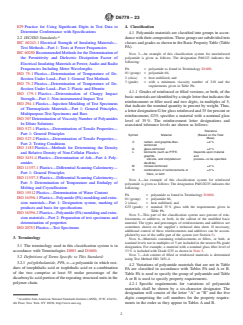
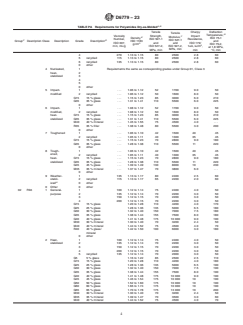
4.1 Polyamide materials are classified into groups in accor-
dance with their composition. These groups are subdivided into
2.2 IEC/ISO Standards:
classes and grades as shown in the Basic Property Table (Table
IEC 60243-1 Electrical Strength of Insulating Materials—
PA).
Test Methods—Part 1: Tests at Power Frequencies
IEC 60250 Recommended Methods for the Determination of
NOTE 3—An example of this classification system for unreinforced
polyamide is given as follows: The designation PA0123 indicates the
the Permittivity and Dielectric Dissipation Factor of
following:
Electrical Insulating Materials at Power, Audio and Radio
Frequencies Including Metre Wavelengths
PA = polyamide as found in Terminology D1600,
ISO 75-1 Plastics—Determination of Temperature of De- 01 (group) = polyamide 66,
2 (class) = heat stabilized, and
flection Under Load—Part 1: General Test Methods
3 (grade) = with a minimum viscosity number of 210 and the
ISO 75-2 Plastics—Determination of Temperature of De-
requirements given in Table PA.
flection Under Load—Part 2: Plastic and Ebonite
4.1.1 Grades of reinforced or filled versions, or both, of the
ISO 179-1 Plastics—Determination of Charpy Impact
basic materials are identified by a single letter that indicates the
Strength—Part 1: Non-instrumented Impact Test
reinforcement or filler used and two digits, in multiples of 5,
ISO 294-1 Plastics—Injection Moulding of Test Specimens
that indicate the nominal quantity in percent by weight. Thus,
of Thermoplastic Materials—Part 1: General Principles,
a letter designation G for glass reinforced and 35 for percent or
Multipurpose-Test Specimens and Bars
reinforcement, G35, specifies a material with a nominal glass
ISO 307 Determination of Viscosity Number of Polyamides
level of 35 %. The reinforcement letter designations and
In Dilute Solutions
associated tolerance levels are shown as follows:
ISO 527-1 Plastics—Determination of Tensile Properties—
Tolerance
Part 1: General Principles
Symbol Material (Based on the Total
Mass)
ISO 527-2 Plastics—Determination of Tensile Properties—
C carbon- and graphite-fiber- ±2 %
Part 2: Testing Conditions
reinforced
ISO 1183 Plastics—Methods for Determining the Density
G glass-reinforced ±2 %
L lubricants (such as PTFE, Depends upon material
and Relative Density of Non-Cellular Plastics
graphite, and
ISO 3451-4 Plastics—Determination of Ash—Part 4: Poly-
silicone, and molybdenum process—to be specified.
disulfide)
amides
M mineral-reinforced ±2 %
ISO 11357-1 Plastics—Differential Scanning Calorimetry—
R combinations of reinforcements or ±3 %
Part 1: General Principles fillers, or both
ISO 11357-3 Plastics—Differential Scanning Calorimetry—
NOTE 4—An example of this classification system for reinforced
Part 3: Determination of Temperature and Enthalpy of polyamide is given as follows: The designation PA012G35 indicates the
following:
Melting and Crystallization
ISO 15512 Plastics—Determination of Water Content
PA = polyamide as found in Terminology D1600,
ISO 16396-1 Plastics—Polyamide (PA) moulding and extru-
01 (group) = polyamide 66,
2 (class) = heat stabilized, and
sion materials—Part 1: Designation system, marking of
G35 (grade) = nominal 35 % glass with the requirements given in
products and basis for specifications
Table PA.
ISO 16396-2 Plastics—Polyamide (PA) moulding and extru-
NOTE 5—This part of the classification system uses percent of rein-
sion materials—Part 2: Preparation of test specimens and
forcements or additives, or both, in the callout of the modified basic
determination of properties material. The types and percentages of reinforcements and additives are
sometimes shown on the supplier’s technical data sheet. If necessary,
ISO 20753 Plastics—Test Specimens
additional control of these reinforcements and additives can be accom-
plished by use of the suffix part of the system (see Section 5).
3. Terminology
NOTE 6—Materials containing reinforcements or fillers, or both, at
nominal levels not in multiples of 5 are included in the nearest PA grade
3.1 The terminology used in this classification system is in
designation. For example, a material with a nominal glass fiber level of
accordance with Terminologies D883 and D1600.
33 % is included with Grade G35 as shown in Note 5.
NOTE 7—Ash content of filled or reinforced materials is determined
3.2 Definitions of Terms Specific to This Standard:
using Test Method ISO 3451-4.
3.2.1 polyphthalamide, PPA, n—a polyamide in which resi-
4.2 Variations of polyamide materials that are not in Table
dues of terephthalic acid or isophthalic acid or a combination
PA are classified in accordance with Tables PA and A or B.
of the two comprise at least 55 molar percentage of the
Table PA is used to specify the group of polyamide and Table
dicarboxylic acid portion of the repeating structural units in the
A or B is used to specify property requirements.
polymer chain.
4.2.1 Specific requirements for variations of polyamide
materials shall be shown by a six-character designator. The
designation will consist of the letter “A” or “B” and the five
digits comprising the cell numbers for the property require-
Available from American National Standards Institute (ANSI), 25 W. 43rd St.,
4th Floor, New York, NY 10036, http://www.ansi.org. ments in the order as they appear in Tables A and B.
D6779 − 23
viscosity PA6 material where K denotes tensile properties, N denotes
4.2.1.1 Although the values listed are necessary to include
tensile modulus with ISO 527 as the test method, and 023 denotes a value
the range of properties available in existing materials, not
of 2300 MPa. This value for tensile modulus overrides the normal table
every possible combination of the properties exists or can be
value. This example can be applied to replace all table values, that is,
obtained.
tensile stress, notched Charpy impact, and heat deflection temperature.
4.2.2 When the grade of the basic material is not known, is
4.3 To facilitate the specification of special materials where
not important or does not meet the Table PA requirements, the
the basic property table does not reflect the properties required,
use of “0” grade classification shall be used for reinforced
Table B has been incorporated into this classification system.
materials in this classification system.
This table will be used in a manner similar to Table A.
NOTE 8—An example of this classification system for a reinforced
NOTE 10—Pigmented or colored polyamides can differ significantly
polyamide material is given as follows. The designation
from the natural polymers in mechanical properties depending on the
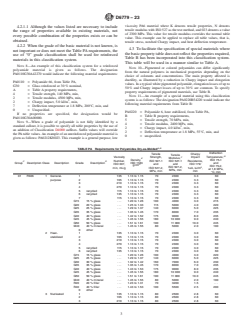
PA0110G30A42270 would indicate the following material requirements:
choice of colorants and concentrations. The main property affected is
ductility, as illustrated by a reduction in Charpy impact and elongation
PA0110 = Polyamide 66, from Table PA,
values. In a typical white pigmented polyamide, elongation losses of up to
G30 = Glass reinforced at 30 % nominal,
50 % and Charpy impact losses of up to 30 % are common. To specify
A = Table A property requirements,
property requirements of pigmented materials, use Table B.
4 = Tensile strength, 140 MPa, min,
NOTE 11—An example of a special material using this classification
2 = Tensile modulus, 4500 MPa, min,
system is as follows: The designation PA0220B54220 would indicate the
2 = Charpy impact, 5.0 kJ/m , min,
following material requirements from Table B:
7 = Deflection temperature at 1.8 MPa, 200°C, min, and
0 = Unspecified.
PA0220 = Polyamide 6, heat stabilized, from Table PA,
If no properties are specified, the designation would be
B = Table B property requirements,
PA0110G30A00000.
5 = Tensile strength, 70 MPa, min,
NOTE 9—When a grade of polyamide is not fully identified by a
4 = Tensile modulus, 2400 MPa, min,
standard callout, it is possible to specify all table properties by the use of 2
2 = Charpy impact, 4.0 kJ/m , min,
an addition of Classification D4000 suffixes. Suffix values will override
2 = Deflection temperature at 1.8 MPa, 55°C, min, and
the PA table values. An example of an unreinforced polyamide material is
0 = unspecified.
given as follows: PA0212KN023. This example is a general purpose, low
A,B
TABLE PA Requirements for Polyamides Dry-as-Molded
Deflection
Tensile Charpy
Tensile
G
Viscosity Strength, F Impact Temperature,
E Modulus,
Density,
ISO 75-1
Number, ISO 527-1 Resistance,
C D ISO 527-1
Group Description Class Description Grade Description ISO 1183
and
ISO 307, 3 and and ISO 179/
g/cm
ISO 75-2,
ISO 527-2,
min, mL/g ISO 527-2, 1eA, kJ/m ,
at 1.8 MPa,
MPa, min
MPa, min min °C, min
01 PA66 1 General- 1 135 1.13 to 1.15 70 2300 3.3 60
purpose 2 165 1.13 to 1.15 70 2300 3.3 60
3 210 1.13 to 1.15 70 2300 3.3 60
4 270 1.13 to 1.15 70 2300 3.3 60
5 recycled 115 1.13 to 1.15 70 2300 3.3 60
6 recycled 135 1.13 to 1.15 70 2300 3.3 60
7 115 1.13 to 1.15 70 2300 3.3 60
G15 15 % glass . . . 1.20 to 1.26 100 4000 3.0 215
G20 20 % glass . . . 1.25 to 1.33 115 5000 4.0 220
G25 25 % glass . . . 1.29 to 1.37 140 6000 5.0 225
G35 35 % glass . . . 1.35 to 1.45 170 8000 7.0 235
G40 40 % glass . . . 1.42 to 1.52 175 9000 8.0 235
G45 45 % glass . . . 1.45 to 1.55 180 10 000 9.0 240
G50 50 % glass . . . 1.51 to 1.61 190 11 000 10.0 245
M40 40 % mineral . . . 1.45 to 1.55 80 5000 2.0 100
0 other
2 Heat- 1 135 1.13 to 1.15 70 2300 3.0 60
stabilized
2 165 1.13 to 1.15 70 2300 3.0 60
3 210 1.13 to 1.15 70 2300 3.0 60
4 270 1.13 to 1.15 70 2300 3.0 60
5 recycled 115 1.13 to 1.15 70 2300 3.0 60
6 recycled 135 1.13 to 1.15 70 2300 3.0 60
G15 15 % glass . . . 1.20 to 1.26 100 4000 3.0 220
G25 25 % glass . . . 1.29 to 1.37 140 6000 5.0 225
G30 30 % glass . . . 1.32 to 1.42 160 7000 6.0 230
G35 35 % glass . . . 1.35 to 1.45 170 8000 7.0 235
G40 40 % glass . . . 1.43 to 1.53 175 9000 8.0 235
G45 45 % glass . . . 1.45 to 1.55 180 10 000 9.0 240
G50 50 % glass . . . 1.51 to 1.61 190 11 000 10.0 245
M40 40 % mineral . . . 1.45 to 1.55 80 5000 2.0 100
R20 20 % filler . . . 1.23 to 1.31 70 3200 1.5 . . .
R40 40 % filler . . . 1.43 to 1.53 100 5500 2.5 200
0 other
3 Nucleated 1 135 1.13 to 1.15 80 2500 2.8 60
2 165 1.13 to 1.15 80 2500 2.8 60
3 210 1.13 to 1.15 80 2500 2.8 60
D6779 − 23
A,B
TABLE PA Requirements for Polyamides Dry-as-Molded
Tensile Charpy Deflection
Tensile
G
Temperature,
Viscosity Strength, F Impact
E Modulus,
Density, ISO 75-1
Number, ISO 527-1 Resistance,
C D ISO 527-1
Group Description Class Description Grade Description ISO 1183 and
ISO 307, 3 and and ISO 179/
g/cm ISO 75-2,
ISO 527-2,
min, mL/g ISO 527-2, 1eA, kJ/m ,
at 1.8 MPa,
MPa, min
MPa, min min °C, min
4 270 1.13 to 1.15 80 2500 2.8 60
5 recycled 115 1.13 to 1.15 80 2500 2.8 60
6 recycled 135 1.13 to 1.15 80 2500 2.8 60
0 other
4 Nucleated, 1 Requirements the same as corresponding grades under Group 01, Class 3
heat- 2
stabilized 3
0 other
5 Impact- 1 . . . 1.06 to 1.12 52 1700 9.0 50
modified 2 recycled . . . 1.06 to 1.12 50 1600 8.0 50
G15 15 % glass . . . 1.15 to 1.23 85 3000 6.0 210
G35 35 % glass . . . 1.31 to 1.41 110 5500 6.0 225
0 other
6 Impact- 1 . . . 1.08 to 1.12 52 1700 9.0 50
modified, 2 recycled . . . 1.08 to 1.12 50 1600 8.0 50
heat- G15 15 % glass . . . 1.15 to 1.23 85 3000 6.0 210
stabilized G35 35 % glass . . . 1.31 to 1.41 110 5500 6.0 225
M40 40 % mineral . . . 1.45 to 1.55 75 4500 4.0 . . .
R35 35 % filler . . . 1.38 to 1.48 80 5500 3.0 200
0 other
7 Toughened 1 . . . 1.06 to 1.10 42 1500 40 45
2 recycled . . . 1.05 to 1.11 40 1300 35 45
G15 15 % glass . . . 1.15 to 1.23 70 2800 9.0 180
G35 35 % glass . . . 1.28 to 1.38 110 5500 11 220
0 other
8 Tough- 1 . . . 1.06 to 1.10 42 1500 40 45
ened,
2 recycled . . . 1.05 to 1.11 40 1300 35 45
heat- G15 15 % glass . . . 1.15 to 1.23 70 2800 9.0 180
stabilized
G35 35 % glass . . . 1.28 to 1.38 110 5500 11 220
G45 45 % glass . . . 1.39 to 1.49 130 8000 10 230
M35 35 % mineral . . . 1.37 to 1.47 70 3800 6.0 . . .
0 other
9 Weather- 1 135 1.13 to 1.17 80 2400 2.5 60
stabil- 2 recycled 115 1.13 to 1.17 65 2200 2.0 60
H
ized 0 other
0 Other 0 other
02 PA6 1 General- 1 100 1.12 to 1.14 75 2400 4.0 50
purpose 2 135 1.12 to 1.14 70 2200 3.0 50
3 150 1.12 to 1.15 70 2200 3.0 50
4 200 1.12 to 1.15 70 2200 3.0 50
G15 15 % glass 1.20 to 1.28 110 4200 4.0 170
G25 25 % glass 1.28 to 1.36 135 5000 6.5 180
G30 30 % glass 1.32 to 1.40 150 7000 7.5 180
G35 35 % glass 1.38 to 1.44 155 7500 8.0 180
G40 40 % glass 1.41 to 1.48 175 10 000 9.0 190
M30 30 % mineral 1.30 to 1.40 70 3200 2.4 50
M40 40 % mineral 1.44 to 1.52 75 4500 4.0 70
R40 40 % glass/ 1.42 to 1.50 100 6000 3.0 180
mineral
0 other
2 Heat- 1 100 1.12 to 1.14 75 2400 4.0 50
stabilized 2 135 1.12 to 1.14 70 2200 3.0 50
3 150 1.12 to 1.15 70 2200 3.0 50
4 200 1.12 to 1.15 70 2200 3.0 50
5 recycled 135 1.12 to 1.14 70 2000 3.0 50
G5 5 % glass 1.16 to 1.22 85 2500 2.5 110
G15 15 % glass 1.20 to 1.28 110 4200 4.0 180
G25 25 % glass 1.28 to 1.36 135 5000 6.5 190
G30 30 % glass 1.32 to 1.40 150 7000 7.5 190
G35 35 % glass 1.38 to 1.44 155 7500 8.0 190
G40 40 % glass 1.41 to 1.48 175 10 000 9.0 190
G45 45 % glass 1.46 to 1.54 175 10 000 10 190
G50 50 % glass 1.52 to 1.60 175 10 000 10 190
G60 60 % glass 1.66 to 1.74 175 10 000 10 190
G65 65 % glass 1.70 to 1.78 175 13 000 10 200
M30 30 % mineral 1.30 to 1.40 70 3200 2.4 50
M35 35 % mineral 1.39 to 1.47 70 3500 3.0 60
M40 40 % mineral 1.44 to 1.52 75 4500 4.0 70
D6779 − 23
A,B
TABLE PA Requirements for Polyamides Dry-as-Molded
Tensile Charpy Deflection
Tensile
G
Temperature,
Viscosity Strength, F Impact
E Modulus,
Density, ISO 75-1
Number, ISO 527-1 Resistance,
C D ISO 527-1
Group Description Class Description Grade Description ISO 1183 and
ISO 307, 3 and and ISO 179/
g/cm ISO 75-2,
ISO 527-2,
min, mL/g ISO 527-2, 1eA, kJ/m ,
at 1.8 MPa,
MPa, min
MPa, min min °C, min
R20 20 % glass/ 1.25 to 1.33 80 3200 2.5 120
mineral
R40 40 % glass/ 1.42 to 1.50 100 6000 3.0 180
mineral
0 other
3 Nucleated 1 100 1.12 to 1.14 70 2300 2.5 50
and 2 135 1.12 to 1.14 70 2300 2.5 50
lubricated
3 150 1.12 to 1.15 75 2300 2.5 50
4 200 1.12 to 1.15 80 2300 2.5 50
0 other
4 Nucleated 1 100 1.12 to 1.14 70 2300 2.5 50
and heat- 2 135 1.12 to 1.14 70 2300 2.5 50
stabilized 3 150 1.12 to 1.15 75 2300 2.5 50
4 200 1.12 to 1.15 80 2300 2.5 50
5 recycled 135 1.12 to 1.14 70 2100 2.5 50
0 other
5 Impact- 1 1.05 to 1.12 45 1700 30 45
modified 2 1.05 to 1.18 55 2000 6.0 45
3 1.05 to 1.18 40 1000 6.0 35
G15 15 % glass 1.15 to 1.24 75 3300 9.0 130
G30 30 % glass 1.30 to 1.40 135 6500 15 180
G35 35 % glass 1.32 to 1.42 135 6800 15 190
G40 40 % glass 1.39 to 1.47 135 8000 10 200
0 other
6 Impact- 1 1.05 to 1.12 45 1700 30 45
modified, 2 1.05 to 1.18 55 2000 6.0 45
heat- 3 1.05 to 1.18 40 1000 6.0 35
stabilized 4 1.05 to 1.18 25 1000 30 30
G15 15 % glass 1.15 to 1.24 75 3300 9.0 130
G30 30 % glass 1.30 to 1.40 135 6500 15 180
G35 35 % glass 1.32 to 1.42 135 6800 10 190
G40 40 % glass 1.39 to 1.47 135 8000 10 200
M35 35 % mineral 1.35 to 1.45 65 3200 3.0 50
M40 40 % mineral 1.39 to 1.47 65 3200 3.0 50
0 other
7 Flexural- 1 injection 1.05 to 1.16 55 2375 max 10 45
modified, molding
heat- 2 extrusion 1.05 to 1.16 30 2000 max 7.0 25
stabilized 3 blends 1.05 to 1.10 35 1700 max 4.5 35
0 other
0 Other 0 other
I
03 PA11 1 General 1 115 to 140 1.01 to 1.06 35 900 4.0 36
purpose 2 160 to 190 1.01 to 1.06 35 900 6.0 36
0 other
2 Heat- 1 115 to 140 1.01 to 1.06 35 900 4.0 36
stabilized 2 160 to 190 1.01 to 1.06 35 900 6.0 36
3 UV 160 to 190 1.01 to 1.06 35 900 4.0 36
Stabilized
4 210 to 255 1.01 to 1.06 35 900 6.0 36
0 other
3 Plasticized 1 170 to 200 1.01 to 1.06 30 370 25 36
0 other
4 Plasticized, Heat 1 180 to 240 1.01 to 1.06 35 500 25 36
Stabilized 2 170 to 200 1.01 to 1.06 35 400 25 36
3 115 to 140 1.01 to 1.06 30 350 25 36
4 UV 175 to 240 1.01 to 1.06 35 400 25 36
Stabilized
5 170 to 190 1.01 to 1.06 30 370 25 36
6 200 to 230 1.01 to 1.06 35 370 25 36
7 UV 160 to 240 1.01 to 1.06 35 340 25 36
Stabilized
0 other
0 Other 0 other
04 PA12 1 General 1 100 to 210 1.00 to 1.06 30 800 2.5 35
purpose 2 100 to 210 1.00 to 1.06 35 1000 2.5 35
3 211 to 270 1.00 to 1.06 35 1000 2.5 35
4 271 to 340 1.00 to 1.06 35 1000 2.5 35
0 other
2 Heat- 1 100 to 150 1.00 to 1.06 35 800 2.5 35
stabilized 2 151 to 210 1.00 to 1.06 35 800 2.5 35
D6779 − 23
A,B
TABLE PA Requirements for Polyamides Dry-as-Molded
Tensile Charpy Deflection
Tensile
G
Temperature,
Viscosity Strength, F Impact
E Modulus,
Density, ISO 75-1
Number, ISO 527-1 Resistance,
C D ISO 527-1
Group Description Class Description Grade Description ISO 1183 and
ISO 307, 3 and and ISO 179/
g/cm ISO 75-2,
ISO 527-2,
min, mL/g ISO 527-2, 1eA, kJ/m ,
at 1.8 MPa,
MPa, min
MPa, min min °C, min
3 211 to 280 1.00 to 1.06 35 1000 2.5 35
G15 15 % glass 1.10 to 1.20 75 3000 10 160
G25 25 % glass 1.10 to 1.25 90 3000 15 160
G30 30 % glass 1.15 to 1.30 95 4000 15 160
G40 40 % glass 1.30 to 1.45 100 4500 15 160
R30 30 % filler 1.18 to 1.32 55 3500 5.0 100
0 other
3 Nucleated 1 100 to 180 1.00 to 1.06 35 800 1.0 35
2 181 to 250 1.00 to 1.06 35 800 1.0 35
0 other
4 Plasticized 1 100 to 280 1.00 to 1.06 30 300 to 550 15
2 100 to 280 1.00 to 1.06 30 450 to 750 10
0 other
5 Plasti- 1 100 to 280 1.00 to 1.06 20 200 to 350 20
cized, 2 100 to 280 1.00 to 1.06 30 300 to 550 15
heat- 3 100 to 280 1.00 to 1.06 30 450 to 750 10
stabilized 4 100 to 280 1.00 to 1.06 35 550 to 950 5.0
0 other
0 Other 0 other
05 PA612 1 General 1 100 to 139 1.05 to 1.07 50 1800 2.0 45
purpose 2 140 to 199 1.05 to 1.07 50 1800 2.5 45
3 200 1.05 to 1.07 50 1800 3.0 45
G35 35 % glass 1.28 to 1.38 140 7000 9.0 175
G45 45 % glass 1.38 to 1.48 150 8500 11 180
0 other
2 Heat- 1 140 1.05 to 1.07 50 1800 2.0 45
stabilized G20 20 % glass 1.17 to 1.25 105 4500 5.0 170
G30 30 % glass 1.25 to 1.33 120 5500 5.0 170
G35 35 % glass 1.28 to 1.38 140 7000 9.0 175
0 other
3 Weather- 1 140 1.05 to 1.07 50 1800 1.5 45
stabi-
H
lized
0 other
0 Other 0 other
06 PA46 1 General- 1 170 1.16 to 1.20 85 2300 6.0
purpose 2 195 1.16 to 1.20 85 2300 6.0 140
0 other
2 Heat- 1 165 1.16 to 1.20 85 2300 6.0 140
stabilized
2 195 1.16 to 1.20 85 2300 6.0 140
G15 15 % glass 1.25 to 1.31 125 5000 3.6 240
G30 30 % glass 1.38 to 1.42 175 8000 7.5 280
G40 40 % glass 1.48 to 1.53 195 10 000 10.0 280
G50 50 % glass 1.58 to 1.63 210 12 000 12.0 280
G60 60 % glass 1.70 to 1.77 215 16 000 10.0 280
R50 50 % filler 1.60 to 1.67 140 9000 4.0 280
0 other
3 Flame- 1 1.32 to 1.36 45 2250 4.0 140
retar- G15 15 % glass 1.55 to 1.59 115 6000 4.5 270
J
dant , G30 30 % glass 1.63 to 1.69 155 10 000 7.5 280
heat-
G40 40 % glass 1.76 to 1.80 145 11 000 8.0 280
stabilized
G45 45 % glass 1.75 to 1.79 165 12 000 8.0 280
0 other
4 Impact- 1 1.08 to 1.12 40 1500 50 70
modified, 0 other
heat-
stabilized
5 Wear- 1 1.16 to 1.20 75 2200 3.0 140
resistant, 0 other
heat-
stabilized
0 Other 0 other
07 PA6T/ 1 Heat- G35 35 % glass 1.42 to 1.52 200 10 000 8.0 250
MPMDT stabilized G45 45 % glass 1.53 to 1.63 210 12 000 8.0 250
0 other
0 Other 0 other
D6779 − 23
A,B
TABLE PA Requirements for Polyamides Dry-as-Molded
Tensile Charpy Deflection
Tensile
G
Temperature,
Viscosity Strength, F Impact
E Modulus,
Density, ISO 75-1
Number, ISO 527-1 Resistance,
C D ISO 527-1
Group Description Class Description Grade Description ISO 1183 and
ISO 307, 3 and and ISO 179/
g/cm ISO 75-2,
ISO 527-2,
min, mL/g ISO 527-2, 1eA, kJ/m ,
at 1.8 MPa,
MPa, min
MPa, min min °C, min
08 PA66 1 PA66/6 G15 15 % glass 1.20 to 1.26 90 3500 3.0 180
copoly- General G35 35 % glass 1.35 to 1.45 160 7500 8.0 190
mers purpose G45 45 % glass 1.45 to 1.55 180 8500 10 200
+ blends
0 other
2 66/6 G15 15 % glass 1.20 to 1.26 90 3500 3.0 180
heat- G25 25 % glass 1.29 to 1.37 115 4500 6.5 190
stabilized
G35 35 % glass 1.35 to 1.45 160 7500 8.0 190
G45 45 % glass 1.45 to 1.55 180 8500 10 200
M20 20 % mineral 1.25 to 1.33 70 3000 4.0
M30 30 % mineral 1.35 to 1.45 75 4000 3.0
M40 40 % mineral 1.45 to 1.55 75 4000 3.0
0 other
3 66 + 6 G15 15 % glass 1.20 to 1.26 100 4000 3.0 200
general G35 35 % glass 1.35 to 1.45 170 8000 9.0 210
purpose G45 45 % glass 1.45 to 1.55 190 10 000 10 220
0 other
4 66 + 6 M20 20 % mineral 1.25 to 1.33 70 3000 3.0
heat- M40 40 % mineral 1.45 to 1.55 75 4500 3.0
stabilized
0 Other 0 other
09 PA6 1 PA6 + 1 1.00 to 1.05 50 2000 7.0 50
copoly- polypropy-
mer lene
+ blends blend
Heat- G35 35 % glass 1.23 to 1.33 150 8500 9.0 200
stabilized R35 35 % filler 1.28 to 1.38 53 6000 2.0 135
0 other
0 Other 0 other
10 PA6T/66 1 Heat- G35 35 % glass 1.41 to 1.51 175 9000 6.0 270
stabilized
G45 45 % glass 1.52 to 1.62 205 12 000 7.5 270
G60 60 % gl
...
This document is not an ASTM standard and is intended only to provide the user of an ASTM standard an indication of what changes have been made to the previous version. Because
it may not be technically possible to adequately depict all changes accurately, ASTM recommends that users consult prior editions as appropriate. In all cases only the current version
of the standard as published by ASTM is to be considered the official document.
Designation: D6779 − 21 D6779 − 23
Standard Classification System for and Basis of Specification for
Polyamide Molding and Extrusion Materials (PA)
This standard is issued under the fixed designation D6779; the number immediately following the designation indicates the year of
original adoption or, in the case of revision, the year of last revision. A number in parentheses indicates the year of last reapproval. A
superscript epsilon (´) indicates an editorial change since the last revision or reapproval.
This standard has been approved for use by agencies of the U.S. Department of Defense.
1. Scope*
1.1 This classification system covers polyamide materials suitable for molding and extrusion. Some of these compositions are also
suitable for application from solution.
1.2 The properties included in this classification system are those required to identify the compositions covered. Other
requirements necessary to identify particular characteristics important to specialized applications are to be specified by using
suffixes as given in Section 5.
1.3 This classification system and subsequent line callout (specification) are intended to provide a means of calling out plastic
materials used in the fabrication of end items or parts. It is not intended for the selection of materials. Material selection can be
made by those having expertise in the plastic field after careful consideration of the design and the performance required of the
part, the environment to which it will be exposed, the fabrication process to be employed, the costs involved, and the inherent
properties of the material other than those covered by this classification system.
1.4 The values stated in SI units are to be regarded as standard. No other units of measurement are included in this standard.
1.5 The following precautionary caveat pertains only to the test methods portion, Section 11, of this classification system. This
standard does not purport to address all of the safety concerns, if any, associated with its use. It is the responsibility of the user
of this standard to establish appropriate safety, health, and environmental practices and determine the applicability of regulatory
limitations prior to use.
NOTE 1—This classification system is similar to ISO 16396-1 ⁄-2,
although the technical content is significantly different.
NOTE 2—The materials covered by this classification system include a subset of polyamides defined as polyphthalamides (PPA) as in 3.2.1, some of which
are also classified in ASTM D5336. Specifically, groups 7, 10, 12, 13, 14, 15 and 17 in this standard are PPA materials. ASTM D5336 gives further details
relating to groups 10, 12 and 13.
1.6 This international standard was developed in accordance with internationally recognized principles on standardization
established in the Decision on Principles for the Development of International Standards, Guides and Recommendations issued
by the World Trade Organization Technical Barriers to Trade (TBT) Committee.
This classification system is under the jurisdiction of ASTM Committee D20 on Plastics and is the direct responsibility of Subcommittee D20.15 on Thermoplastic
Materials.
Current edition approved July 1, 2021March 15, 2023. Published July 2021March 2023. Originally approved in 2002. Last previous edition approved in 20202021 as
D6779 - 20. DOI: 10.1520/D6779-21.- 21. DOI: 10.1520/D6779-23.
*A Summary of Changes section appears at the end of this standard
Copyright © ASTM International, 100 Barr Harbor Drive, PO Box C700, West Conshohocken, PA 19428-2959. United States
D6779 − 23
2. Referenced Documents
2.1 ASTM Standards:
D257 Test Methods for DC Resistance or Conductance of Insulating Materials
D789 Test Method for Determination of Relative Viscosity of Concentrated Polyamide (PA) Solutions
D792 Test Methods for Density and Specific Gravity (Relative Density) of Plastics by Displacement
D883 Terminology Relating to Plastics
D1600 Terminology for Abbreviated Terms Relating to Plastics
D3892 Practice for Packaging/Packing of Plastics
D4000 Classification System for Specifying Plastic Materials
D5336 Classification System and Basis for Specification for Polyphthalamide (PPA) Injection Molding Materials
D5740 Guide for Writing Material Standards in the Classification D4000 Format
D6260 Test Method for Gravimetric Determination of Carbon Black in Nylon Materials (PA) (Withdrawn 2004)
D7209 Guide for Waste Reduction, Resource Recovery, and Use of Recycled Polymeric Materials and Products (Withdrawn
2015)
E29 Practice for Using Significant Digits in Test Data to Determine Conformance with Specifications
2.2 IEC/ISO Standards:
IEC 60243-1 Electrical Strength of Insulating Materials—Test Methods—Part 1: Tests at Power Frequencies
IEC 60250 Recommended Methods for the Determination of the Permittivity and Dielectric Dissipation Factor of Electrical
Insulating Materials at Power, Audio and Radio Frequencies Including Metre Wavelengths
ISO 75-1 Plastics—Determination of Temperature of Deflection Under Load—Part 1: General Test Methods
ISO 75-2 Plastics—Determination of Temperature of Deflection Under Load—Part 2: Plastic and Ebonite
ISO 179-1 Plastics—Determination of Charpy Impact Strength—Part 1: Non-instrumented Impact Test
ISO 294-1 Plastics—Injection Moulding of Test Specimens of Thermoplastic Materials—Part 1: General Principles,
Multipurpose-Test Specimens and Bars
ISO 307 Determination of Viscosity Number of Polyamides In Dilute Solutions
ISO 527-1 Plastics—Determination of Tensile Properties—Part 1: General Principles
ISO 527-2 Plastics—Determination of Tensile Properties—Part 2: Testing Conditions
ISO 1183 Plastics—Methods for Determining the Density and Relative Density of Non-Cellular Plastics
ISO 3451-4 Plastics—Determination of Ash—Part 4: Polyamides
ISO 11357-1 Plastics—Differential Scanning Calorimetry—Part 1: General Principles
ISO 11357-3 Plastics—Differential Scanning Calorimetry—Part 3: Determination of Temperature and Enthalpy of Melting and
Crystallization
ISO 15512 Plastics—Determination of Water Content
ISO 16396-1 Plastics—Polyamide (PA) moulding and extrusion materials—Part 1: Designation system, marking of products and
basis for specifications
ISO 16396-2 Plastics—Polyamide (PA) moulding and extrusion materials—Part 2: Preparation of test specimens and
determination of properties
ISO 20753 Plastics—Test Specimens
3. Terminology
3.1 The terminology used in this classification system is in accordance with Terminologies D883 and D1600.
3.2 Definitions of Terms Specific to This Standard:
3.2.1 polyphthalamide, PPA, n—a polyamide in which residues of terephthalic acid or isophthalic acid or a combination of the two
comprise at least 55 molar percentage of the dicarboxylic acid portion of the repeating structural units in the polymer chain.
4. Classification
4.1 Polyamide materials are classified into groups in accordance with their composition. These groups are subdivided into classes
and grades as shown in the Basic Property Table (Table PA).
For referenced ASTM standards, visit the ASTM website, www.astm.org, or contact ASTM Customer Service at service@astm.org. For Annual Book of ASTM Standards
volume information, refer to the standard’s Document Summary page on the ASTM website.
The last approved version of this historical standard is referenced on www.astm.org.
Available from American National Standards Institute (ANSI), 25 W. 43rd St., 4th Floor, New York, NY 10036, http://www.ansi.org.
D6779 − 23
NOTE 3—An example of this classification system for unreinforced polyamide is given as follows: The designation PA0123 indicates the following:
PA = polyamide as found in Terminology D1600,
01 (group) = polyamide 66,
2 (class) = heat stabilized, and
3 (grade) = with a minimum viscosity number of 210 and the requirements given in Table PA.
4.1.1 Grades of reinforced or filled versions, or both, of the basic materials are identified by a single letter that indicates the
reinforcement or filler used and two digits, in multiples of 5, that indicate the nominal quantity in percent by weight. Thus, a letter
designation G for glass reinforced and 35 for percent or reinforcement, G35, specifies a material with a nominal glass level of
35 %. The reinforcement letter designations and associated tolerance levels are shown as follows:
Tolerance
Symbol Material (Based on the Total
Mass)
C carbon- and graphite-fiber- ±2 %
reinforced
G glass-reinforced ±2 %
L lubricants (such as PTFE, Depends upon material
graphite, and
silicone, and molybdenum process—to be specified.
disulfide)
M mineral-reinforced ±2 %
R combinations of reinforcements or ±3 %
fillers, or both
NOTE 4—An example of this classification system for reinforced polyamide is given as follows: The designation PA012G35 indicates the following:
PA = polyamide as found in Terminology D1600,
01 (group) = polyamide 66,
2 (class) = heat stabilized, and
G35 (grade) = nominal 35 % glass with the requirements given in Table PA.
NOTE 5—This part of the classification system uses percent of reinforcements or additives, or both, in the callout of the modified basic material. The types
and percentages of reinforcements and additives are sometimes shown on the supplier’s technical data sheet. If necessary, additional control of these
reinforcements and additives can be accomplished by use of the suffix part of the system (see Section 5).
NOTE 6—Materials containing reinforcements or fillers, or both, at nominal levels not in multiples of 5 are included in the nearest PA grade designation.
For example, a material with a nominal glass fiber level of 33 % is included with Grade G35 as shown in Note 45.
NOTE 7—Ash content of filled or reinforced materials is determined using Test Method ISO 3451-4.
4.2 Variations of polyamide materials that are not in Table PA are classified in accordance with Tables PA and A or B. Table PA
is used to specify the group of polyamide and Table A or B is used to specify property requirements.
4.2.1 Specific requirements for variations of polyamide materials shall be shown by a six-character designator. The designation
will consist of the letter “A” or “B” and the five digits comprising the cell numbers for the property requirements in the order as
they appear in Tables A and B.
4.2.1.1 Although the values listed are necessary to include the range of properties available in existing materials, not every
possible combination of the properties exists or can be obtained.
4.2.2 When the grade of the basic material is not known, is not important or does not meet the Table PA requirements, the use
of “0” grade classification shall be used for reinforced materials in this classification system.
NOTE 8—An example of this classification system for a reinforced polyamide material is given as follows. The designation PA0110G30A42270 would
indicate the following material requirements:
PA0110 = Polyamide 66, from Table PA,
G30 = Glass reinforced at 30 % nominal,
A = Table A property requirements,
4 = Tensile strength, 140 MPa, min,
D6779 − 23
2 = Tensile modulus, 4500 MPa, min,
2 = Charpy impact, 5.0 kJ/m , min,
7 = Deflection temperature at 1.8 MPa, 200°C, min, and
0 = Unspecified.
If no properties are specified, the designation would be PA0110G30A00000.
NOTE 9—When a grade of polyamide is not fully identified by a standard callout, it is possible to specify all table properties by the use of an addition
of Classification D4000 suffixes. Suffix values will override the PA table values. An example of an unreinforced polyamide material is given as follows:
PA0212KN023. This example is a general purpose, low viscosity PA6 material where K denotes tensile properties, N denotes tensile modulus with ISO
527 as the test method, and 023 denotes a value of 2300 MPa. This value for tensile modulus overrides the normal table value. This example can be applied
to replace all table values, that is, tensile stress, notched Charpy impact, and heat deflection temperature.
4.3 To facilitate the specification of special materials where the basic property table does not reflect the properties required, Table
B has been incorporated into this classification system. This table will be used in a manner similar to Table A.
NOTE 10—Pigmented or colored polyamides can differ significantly from the natural polymers in mechanical properties depending on the choice of
colorants and concentrations. The main property affected is ductility, as illustrated by a reduction in Charpy impact and elongation values. In a typical
white pigmented polyamide, elongation losses of up to 50 % and Charpy impact losses of up to 30 % are common. To specify property requirements of
pigmented materials, use Table B.
NOTE 11—An example of a special material using this classification system is as follows: The designation PA0220B54220 would indicate the following
material requirements from Table B:
PA0220 = Polyamide 6, heat stabilized, from Table PA,
B = Table B property requirements,
5 = Tensile strength, 70 MPa, min,
4 = Tensile modulus, 2400 MPa, min,
2 = Charpy impact, 4.0 kJ/m , min,
2 = Deflection temperature at 1.8 MPa, 55°C, min, and
0 = unspecified.
A,B
TABLE PA Requirements for Polyamides Dry-as-Molded
Deflection
Tensile Charpy
Tensile
FG
Viscosity Strength, Impact Temperature,
EF
DE Modulus,
Density,
ISO 75-1
Number, ISO 527-1 Resistance,
C CD ISO 527-1
Group Description Class Description Grade Description ISO 1183
and
ISO 307, 3 and and ISO 179/
g/cm
ISO 75-2,
ISO 527-2,
min, mL/g ISO 527-2, 1eA, kJ/m ,
at 1.8 MPa,
MPa, min
MPa, min min
°C, min
01 PA66 1 General- 1 135 1.13 to 1.15 70 2300 3.3 60
purpose 2 165 1.13 to 1.15 70 2300 3.3 60
3 210 1.13 to 1.15 70 2300 3.3 60
4 270 1.13 to 1.15 70 2300 3.3 60
5 recycled 115 1.13 to 1.15 70 2300 3.3 60
6 recycled 135 1.13 to 1.15 70 2300 3.3 60
7 115 1.13 to 1.15 70 2300 3.3 60
G15 15 % glass . . . 1.20 to 1.26 100 4000 3.0 215
G20 20 % glass . . . 1.25 to 1.33 115 5000 4.0 220
G25 25 % glass . . . 1.29 to 1.37 140 6000 5.0 225
G35 35 % glass . . . 1.35 to 1.45 170 8000 7.0 235
G40 40 % glass . . . 1.42 to 1.52 175 9000 8.0 235
G45 45 % glass . . . 1.45 to 1.55 180 10 000 9.0 240
G50 50 % glass . . . 1.51 to 1.61 190 11 000 10.0 245
M40 40 % mineral . . . 1.45 to 1.55 80 5000 2.0 100
0 other
2 Heat- 1 135 1.13 to 1.15 70 2300 3.0 60
stabilized 2 165 1.13 to 1.15 70 2300 3.0 60
3 210 1.13 to 1.15 70 2300 3.0 60
4 270 1.13 to 1.15 70 2300 3.0 60
5 recycled 115 1.13 to 1.15 70 2300 3.0 60
6 recycled 135 1.13 to 1.15 70 2300 3.0 60
G15 15 % glass . . . 1.20 to 1.26 100 4000 3.0 220
G25 25 % glass . . . 1.29 to 1.37 140 6000 5.0 225
G30 30 % glass . . . 1.32 to 1.42 160 7000 6.0 230
G35 35 % glass . . . 1.35 to 1.45 170 8000 7.0 235
G40 40 % glass . . . 1.43 to 1.53 175 9000 8.0 235
G45 45 % glass . . . 1.45 to 1.55 180 10 000 9.0 240
G50 50 % glass . . . 1.51 to 1.61 190 11 000 10.0 245
M40 40 % mineral . . . 1.45 to 1.55 80 5000 2.0 100
R20 20 % filler . . . 1.23 to 1.31 70 3200 1.5 . . .
D6779 − 23
A,B
TABLE PA Requirements for Polyamides Dry-as-Molded
Deflection
Tensile Charpy
Tensile
FG
Temperature,
Viscosity Strength, EF Impact
DE Modulus,
Density, ISO 75-1
Number, ISO 527-1 Resistance,
C CD ISO 527-1
Group Description Class Description Grade Description ISO 1183 and
ISO 307, 3 and and ISO 179/
g/cm ISO 75-2,
ISO 527-2,
min, mL/g ISO 527-2, 1eA, kJ/m ,
at 1.8 MPa,
MPa, min
MPa, min min °C, min
R40 40 % filler . . . 1.43 to 1.53 100 5500 2.5 200
0 other
3 Nucleated 1 135 1.13 to 1.15 80 2500 2.8 60
2 165 1.13 to 1.15 80 2500 2.8 60
3 210 1.13 to 1.15 80 2500 2.8 60
4 270 1.13 to 1.15 80 2500 2.8 60
5 recycled 115 1.13 to 1.15 80 2500 2.8 60
6 recycled 135 1.13 to 1.15 80 2500 2.8 60
0 other
4 Nucleated, 1 Requirements the same as corresponding grades under Group 01, Class 3
heat- 2
stabilized 3
0 other
5 Impact- 1 . . . 1.06 to 1.12 52 1700 9.0 50
modified 2 recycled . . . 1.06 to 1.12 50 1600 8.0 50
G15 15 % glass . . . 1.15 to 1.23 85 3000 6.0 210
G35 35 % glass . . . 1.31 to 1.41 110 5500 6.0 225
0 other
6 Impact- 1 . . . 1.08 to 1.12 52 1700 9.0 50
modified, 2 recycled . . . 1.08 to 1.12 50 1600 8.0 50
heat- G15 15 % glass . . . 1.15 to 1.23 85 3000 6.0 210
stabilized G35 35 % glass . . . 1.31 to 1.41 110 5500 6.0 225
M40 40 % mineral . . . 1.45 to 1.55 75 4500 4.0 . . .
R35 35 % filler . . . 1.38 to 1.48 80 5500 3.0 200
0 other
7 Toughened 1 . . . 1.06 to 1.10 42 1500 40 45
2 recycled . . . 1.05 to 1.11 40 1300 35 45
G15 15 % glass . . . 1.15 to 1.23 70 2800 9.0 180
G35 35 % glass . . . 1.28 to 1.38 110 5500 11 220
0 other
8 Tough- 1 . . . 1.06 to 1.10 42 1500 40 45
ened, 2 recycled . . . 1.05 to 1.11 40 1300 35 45
heat- G15 15 % glass . . . 1.15 to 1.23 70 2800 9.0 180
stabilized
G35 35 % glass . . . 1.28 to 1.38 110 5500 11 220
G45 45 % glass . . . 1.39 to 1.49 130 8000 10 230
M35 35 % mineral . . . 1.37 to 1.47 70 3800 6.0 . . .
0 other
9 Weather- 1 135 1.13 to 1.17 80 2400 2.5 60
9 stabil- Weather- 1 135 1.13 to 1.17 80 2400 2.5 60
G
ized stabil- 2 recycled 115 1.13 to 1.17 65 2200 2.0 60
H
ized
0 other
0 Other 0 other
02 PA6 1 General- 1 100 1.12 to 1.14 75 2400 4.0 50
purpose 2 135 1.12 to 1.14 70 2200 3.0 50
3 150 1.12 to 1.15 70 2200 3.0 50
4 200 1.12 to 1.15 70 2200 3.0 50
G15 15 % glass 1.20 to 1.28 110 4200 4.0 170
G25 25 % glass 1.28 to 1.36 135 5000 6.5 180
G30 30 % glass 1.32 to 1.40 150 7000 7.5 180
G35 35 % glass 1.38 to 1.44 155 7500 8.0 180
G40 40 % glass 1.41 to 1.48 175 10 000 9.0 190
M30 30 % mineral 1.30 to 1.40 70 3200 2.4 50
M40 40 % mineral 1.44 to 1.52 75 4500 4.0 70
R40 40 % glass/ 1.42 to 1.50 100 6000 3.0 180
mineral
0 other
2 Heat- 1 100 1.12 to 1.14 75 2400 4.0 50
stabilized 2 135 1.12 to 1.14 70 2200 3.0 50
3 150 1.12 to 1.15 70 2200 3.0 50
4 200 1.12 to 1.15 70 2200 3.0 50
5 recycled 135 1.12 to 1.14 70 2000 3.0 50
G5 5 % glass 1.16 to 1.22 85 2500 2.5 110
G15 15 % glass 1.20 to 1.28 110 4200 4.0 180
G25 25 % glass 1.28 to 1.36 135 5000 6.5 190
G30 30 % glass 1.32 to 1.40 150 7000 7.5 190
G35 35 % glass 1.38 to 1.44 155 7500 8.0 190
G40 40 % glass 1.41 to 1.48 175 10 000 9.0 190
G45 45 % glass 1.46 to 1.54 175 10 000 10 190
D6779 − 23
A,B
TABLE PA Requirements for Polyamides Dry-as-Molded
Deflection
Tensile Charpy
Tensile
FG
Temperature,
Viscosity Strength, EF Impact
DE Modulus,
Density, ISO 75-1
Number, ISO 527-1 Resistance,
C CD ISO 527-1
Group Description Class Description Grade Description ISO 1183 and
ISO 307, 3 and and ISO 179/
g/cm ISO 75-2,
ISO 527-2,
min, mL/g ISO 527-2, 1eA, kJ/m ,
at 1.8 MPa,
MPa, min
MPa, min min °C, min
G50 50 % glass 1.52 to 1.60 175 10 000 10 190
G60 60 % glass 1.66 to 1.74 175 10 000 10 190
G65 65 % glass 1.70 to 1.78 175 13 000 10 200
M30 30 % mineral 1.30 to 1.40 70 3200 2.4 50
M35 35 % mineral 1.39 to 1.47 70 3500 3.0 60
M40 40 % mineral 1.44 to 1.52 75 4500 4.0 70
R20 20 % glass/ 1.25 to 1.33 80 3200 2.5 120
mineral
R40 40 % glass/ 1.42 to 1.50 100 6000 3.0 180
mineral
0 other
3 Nucleated 1 100 1.12 to 1.14 70 2300 2.5 50
and
2 135 1.12 to 1.14 70 2300 2.5 50
lubricated 3 150 1.12 to 1.15 75 2300 2.5 50
4 200 1.12 to 1.15 80 2300 2.5 50
0 other
4 Nucleated 1 100 1.12 to 1.14 70 2300 2.5 50
and heat- 2 135 1.12 to 1.14 70 2300 2.5 50
stabilized 3 150 1.12 to 1.15 75 2300 2.5 50
4 200 1.12 to 1.15 80 2300 2.5 50
5 recycled 135 1.12 to 1.14 70 2100 2.5 50
0 other
5 Impact- 1 1.05 to 1.12 45 1700 30 45
modified 2 1.05 to 1.18 55 2000 6.0 45
3 1.05 to 1.18 40 1000 6.0 35
G15 15 % glass 1.15 to 1.24 75 3300 9.0 130
G30 30 % glass 1.30 to 1.40 135 6500 15 180
G35 35 % glass 1.32 to 1.42 135 6800 15 190
G40 40 % glass 1.39 to 1.47 135 8000 10 200
0 other
6 Impact- 1 1.05 to 1.12 45 1700 30 45
modified, 2 1.05 to 1.18 55 2000 6.0 45
heat- 3 1.05 to 1.18 40 1000 6.0 35
stabilized 4 1.05 to 1.18 25 1000 30 30
G15 15 % glass 1.15 to 1.24 75 3300 9.0 130
G30 30 % glass 1.30 to 1.40 135 6500 15 180
G35 35 % glass 1.32 to 1.42 135 6800 10 190
G40 40 % glass 1.39 to 1.47 135 8000 10 200
M35 35 % mineral 1.35 to 1.45 65 3200 3.0 50
M40 40 % mineral 1.39 to 1.47 65 3200 3.0 50
0 other
7 Flexural- 1 injection 1.05 to 1.16 55 2375 max 10 45
modified, molding
heat- 2 extrusion 1.05 to 1.16 30 2000 max 7.0 25
stabilized 3 blends 1.05 to 1.10 35 1700 max 4.5 35
0 other
0 Other 0 other
H
03 PA11 1 General 1 115 to 140 1.01 to 1.06 35 900 4.0 36
I
03 PA11 1 purpose General 1 115 to 140 1.01 to 1.06 35 900 4.0 36
purpose2 160 to 190 1.01 to 1.06 35 900 6.0 36
0 other
2 Heat- 1 115 to 140 1.01 to 1.06 35 900 4.0 36
stabilized 2 160 to 190 1.01 to 1.06 35 900 6.0 36
3 UV 160 to 190 1.01 to 1.06 35 900 4.0 36
Stabilized
4 210 to 255 1.01 to 1.06 35 900 6.0 36
0 other
3 Plasticized 1 170 to 200 1.01 to 1.06 30 370 25 36
0 other
4 Plasticized, Heat 1 180 to 240 1.01 to 1.06 35 500 25 36
Stabilized 2 170 to 200 1.01 to 1.06 35 400 25 36
3 115 to 140 1.01 to 1.06 30 350 25 36
4 UV 175 to 240 1.01 to 1.06 35 400 25 36
Stabilized
5 170 to 190 1.01 to 1.06 30 370 25 36
6 200 to 230 1.01 to 1.06 35 370 25 36
7 UV 160 to 240 1.01 to 1.06 35 340 25 36
Stabilized
0 other
0 Other 0 other
D6779 − 23
A,B
TABLE PA Requirements for Polyamides Dry-as-Molded
Deflection
Tensile Charpy
Tensile
FG
Temperature,
Viscosity Strength, EF Impact
DE Modulus,
Density, ISO 75-1
Number, ISO 527-1 Resistance,
C CD ISO 527-1
Group Description Class Description Grade Description ISO 1183 and
ISO 307, 3 and and ISO 179/
g/cm ISO 75-2,
ISO 527-2,
min, mL/g ISO 527-2, 1eA, kJ/m ,
at 1.8 MPa,
MPa, min
MPa, min min °C, min
04 PA12 1 General 1 100 to 210 1.00 to 1.06 30 800 2.5 35
purpose
2 100 to 210 1.00 to 1.06 35 1000 2.5 35
3 211 to 270 1.00 to 1.06 35 1000 2.5 35
4 271 to 340 1.00 to 1.06 35 1000 2.5 35
0 other
2 Heat- 1 100 to 150 1.00 to 1.06 35 800 2.5 35
stabilized 2 151 to 210 1.00 to 1.06 35 800 2.5 35
3 211 to 280 1.00 to 1.06 35 1000 2.5 35
G15 15 % glass 1.10 to 1.20 75 3000 10 160
G25 25 % glass 1.10 to 1.25 90 3000 15 160
G30 30 % glass 1.15 to 1.30 95 4000 15 160
G40 40 % glass 1.30 to 1.45 100 4500 15 160
R30 30 % filler 1.18 to 1.32 55 3500 5.0 100
0 other
3 Nucleated 1 100 to 180 1.00 to 1.06 35 800 1.0 35
2 181 to 250 1.00 to 1.06 35 800 1.0 35
0 other
4 Plasticized 1 100 to 280 1.00 to 1.06 30 300 to 550 15
2 100 to 280 1.00 to 1.06 30 450 to 750 10
0 other
5 Plasti- 1 100 to 280 1.00 to 1.06 20 200 to 350 20
cized, 2 100 to 280 1.00 to 1.06 30 300 to 550 15
heat- 3 100 to 280 1.00 to 1.06 30 450 to 750 10
stabilized 4 100 to 280 1.00 to 1.06 35 550 to 950 5.0
0 other
0 Other 0 other
05 PA612 1 General 1 100 to 139 1.05 to 1.07 50 1800 2.0 45
purpose 2 140 to 199 1.05 to 1.07 50 1800 2.5 45
3 200 1.05 to 1.07 50 1800 3.0 45
G35 35 % glass 1.28 to 1.38 140 7000 9.0 175
G45 45 % glass 1.38 to 1.48 150 8500 11 180
0 other
2 Heat- 1 140 1.05 to 1.07 50 1800 2.0 45
stabilized G20 20 % glass 1.17 to 1.25 105 4500 5.0 170
G30 30 % glass 1.25 to 1.33 120 5500 5.0 170
G35 35 % glass 1.28 to 1.38 140 7000 9.0 175
0 other
3 Weather- 1 140 1.05 to 1.07 50 1800 1.5 45
stabi-
G
lized
3 Weather- 1 140 1.05 to 1.07 50 1800 1.5 45
stabi-
H
lized
0 other
0 Other 0 other
06 PA46 1 General- 1 170 1.16 to 1.20 85 2300 6.0
purpose 2 195 1.16 to 1.20 85 2300 6.0 140
0 other
2 Heat- 1 165 1.16 to 1.20 85 2300 6.0 140
stabilized 2 195 1.16 to 1.20 85 2300 6.0 140
G15 15 % glass 1.25 to 1.31 125 5000 3.6 240
G30 30 % glass 1.38 to 1.42 175 8000 7.5 280
G40 40 % glass 1.48 to 1.53 195 10 000 10.0 280
G50 50 % glass 1.58 to 1.63 210 12 000 12.0 280
G60 60 % glass 1.70 to 1.77 215 16 000 10.0 280
R50 50 % filler 1.60 to 1.67 140 9000 4.0 280
0 other
3 Flame- 1 1.32 to 1.36 45 2250 4.0 140
3 retar- Flame- 1 1.32 to 1.36 45 2250 4.0 140
I
dant , retar- G15 15 % glass 1.55 to 1.59 115 6000 4.5 270
J
heat-
dant , G30 30 % glass 1.63 to 1.69 155 10 000 7.5 280
stabilized
heat-
G40 stabilized 40 % glass 1.76 to 1.80 145 11 000 8.0 280
G45 45 % glass 1.75 to 1.79 165 12 000 8.0 280
0 other
4 Impact- 1 1.08 to 1.12 40 1500 50 70
modified, 0 other
heat-
stabilized
D6779 − 23
A,B
TABLE PA Requirements for Polyamides Dry-as-Molded
Deflection
Tensile Charpy
Tensile
FG
Temperature,
Viscosity Strength, EF Impact
DE Modulus,
Density, ISO 75-1
Number, ISO 527-1 Resistance,
C CD ISO 527-1
Group Description Class Description Grade Description ISO 1183 and
ISO 307, 3 and and ISO 179/
g/cm ISO 75-2,
ISO 527-2,
min, mL/g ISO 527-2, 1eA, kJ/m ,
at 1.8 MPa,
MPa, min
MPa, min min °C, min
5 Wear- 1 1.16 to 1.20 75 2200 3.0 140
resistant,
0 other
heat-
stabilized
0 Other 0 other
07 PA6T/ 1 Heat- G35 35 % glass 1.42 to 1.52 200 10 000 8.0 250
MPMDT stabilized G45 45 % glass 1.53 to 1.63 210 12 000 8.0 250
0 other
0 Other 0 other
08 PA66 1 PA66/6 G15 15 % glass 1.20 to 1.26 90 3500 3.0 180
copoly- General G35 35 % glass 1.35 to 1.45 160 7500 8.0 190
mers purpose G45 45 % glass 1.45 to 1.55 180 8500 10 200
+ blends
0 other
2 66/6 G15 15 % glass 1.20 to 1.26 90 3500 3.0 180
heat- G25 25 % glass 1.29 to 1.37 115 4500 6.5 190
stabilized G35 35 % glass 1.35 to 1.45 160 7500 8.0 190
G45 45 % glass 1.45 to 1.55 180 8500 10 200
M20 20 % mineral 1.25 to 1.33 70 3000 4.0
M30 30 % mineral 1.35 to 1.45 75 4000 3.0
M40 40 % mineral 1.45 to 1.55 75 4000 3.0
0 other
3 66 + 6 G15 15 % glass 1.20 to 1.26 100 4000 3.0 200
general G35 35 % glass 1.35 to 1.45 170 8000 9.0 210
purpose G45 45 % glass 1.45 to 1.55 190 10 000 10 220
0 other
4 66 + 6 M20 20 % mineral 1.25 to 1.33 70 3000 3.0
heat- M40 40 % mineral 1.45 to 1.55 75 4500 3.0
stabilized
0 Other 0 other
09 PA6 1 PA6 + 1 1.00 to 1.05 50 2000 7.0 50
copoly- polypropy-
mer lene
+ blends blend
Heat- G35 35 % glass 1.23 to 1.33 150 8500 9.0 200
stabilized R35 35 % filler 1.28 to 1.38 53 6000 2.0 135
0 other
0 Other 0 other
10 PA6T/66 1 Heat- G35 35 % glass 1.41 to 1.51 175 9000 6.0 270
stabilized
G45 45 % glass 1.52 to 1.62 205 12 000 7.5 270
G60 60 % glass 1.72 to 1.82 230 19 000 8.0 270
0 other
2 High heat, G35 35 % glass 1.39 to 1.49 180 9000 6.0 28
...