


ASTM D5924-96(2004)
(Guide)Standard Guide for Selection of Simulation Approaches in Geostatistical Site Investigations
Standard Guide for Selection of Simulation Approaches in Geostatistical Site Investigations
SIGNIFICANCE AND USE
This guide is intended to encourage consistency and thoroughness in the application of geostatistical simulation to environmental, geotechnical, and hydrogeological site investigations.
This guide may be used to assist those performing a simulation study or as an explanation of procedures for qualified nonparticipants who may be reviewing or auditing the study.
This guide should be used in conjunction with Guides D 5549, D 5922, and D 5923.
This guide describes conditions for which simulation or particular simulation approaches are recommended. However, these approaches are not necessarily inappropriate if the stated conditions are not encountered.
SCOPE
1.1 This guide covers the conditions that determine the selection of a suitable simulation approach for a site investigation problem. Alternative simulation approaches considered here are conditional and nonconditional, indicator and Gaussian, single and multiple realization, point, and block.
1.2 This guide describes the conditions for which the use of simulation is an appropriate alternative to the use of estimation in geostatistical site investigations.
1.3 This guide does not discuss the basic principles of geostatistics. Introductions to geostatistics may be found in numerous texts including Refs (1), (2), and (3).
1.4 This guide is concerned with general simulation approaches only and does not discuss particular simulation algorithms currently in use. These are described in Refs (4), (5), and (6).
General Information
Relations
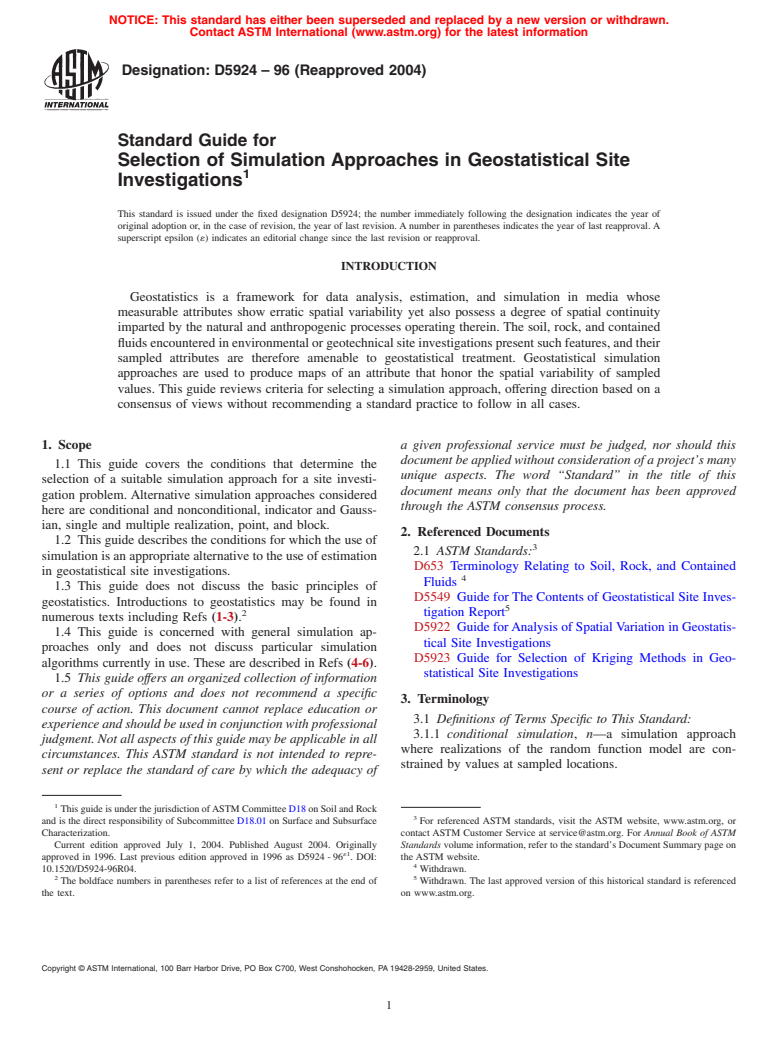
Standards Content (Sample)
NOTICE: This standard has either been superseded and replaced by a new version or withdrawn.
Contact ASTM International (www.astm.org) for the latest information
Designation:D5924–96 (Reapproved 2004)
Standard Guide for
Selection of Simulation Approaches in Geostatistical Site
Investigations
This standard is issued under the fixed designation D5924; the number immediately following the designation indicates the year of
original adoption or, in the case of revision, the year of last revision. A number in parentheses indicates the year of last reapproval. A
superscript epsilon (´) indicates an editorial change since the last revision or reapproval.
INTRODUCTION
Geostatistics is a framework for data analysis, estimation, and simulation in media whose
measurable attributes show erratic spatial variability yet also possess a degree of spatial continuity
imparted by the natural and anthropogenic processes operating therein. The soil, rock, and contained
fluids encountered in environmental or geotechnical site investigations present such features, and their
sampled attributes are therefore amenable to geostatistical treatment. Geostatistical simulation
approaches are used to produce maps of an attribute that honor the spatial variability of sampled
values. This guide reviews criteria for selecting a simulation approach, offering direction based on a
consensus of views without recommending a standard practice to follow in all cases.
1. Scope a given professional service must be judged, nor should this
document be applied without consideration of a project’s many
1.1 This guide covers the conditions that determine the
unique aspects. The word “Standard” in the title of this
selection of a suitable simulation approach for a site investi-
document means only that the document has been approved
gation problem. Alternative simulation approaches considered
through the ASTM consensus process.
here are conditional and nonconditional, indicator and Gauss-
ian, single and multiple realization, point, and block.
2. Referenced Documents
1.2 This guide describes the conditions for which the use of
2.1 ASTM Standards:
simulation is an appropriate alternative to the use of estimation
D653 Terminology Relating to Soil, Rock, and Contained
in geostatistical site investigations.
Fluids
1.3 This guide does not discuss the basic principles of
D5549 Guide for The Contents of Geostatistical Site Inves-
geostatistics. Introductions to geostatistics may be found in
2 tigation Report
numerous texts including Refs (1-3).
D5922 Guide forAnalysis of Spatial Variation in Geostatis-
1.4 This guide is concerned with general simulation ap-
tical Site Investigations
proaches only and does not discuss particular simulation
D5923 Guide for Selection of Kriging Methods in Geo-
algorithms currently in use. These are described in Refs (4-6).
statistical Site Investigations
1.5 This guide offers an organized collection of information
or a series of options and does not recommend a specific
3. Terminology
course of action. This document cannot replace education or
3.1 Definitions of Terms Specific to This Standard:
experience and should be used in conjunction with professional
3.1.1 conditional simulation, n—a simulation approach
judgment. Not all aspects of this guide may be applicable in all
where realizations of the random function model are con-
circumstances. This ASTM standard is not intended to repre-
strained by values at sampled locations.
sent or replace the standard of care by which the adequacy of
This guide is under the jurisdiction ofASTM Committee D18 on Soil and Rock
and is the direct responsibility of Subcommittee D18.01 on Surface and Subsurface For referenced ASTM standards, visit the ASTM website, www.astm.org, or
Characterization. contact ASTM Customer Service at service@astm.org. For Annual Book of ASTM
Current edition approved July 1, 2004. Published August 2004. Originally Standards volume information, refer to the standard’s Document Summary page on
´1
approved in 1996. Last previous edition approved in 1996 as D5924 - 96 . DOI: the ASTM website.
10.1520/D5924-96R04. Withdrawn.
2 5
The boldface numbers in parentheses refer to a list of references at the end of Withdrawn. The last approved version of this historical standard is referenced
the text. on www.astm.org.
Copyright © ASTM International, 100 Barr Harbor Drive, PO Box C700, West Conshohocken, PA 19428-2959, United States.
D5924–96 (2004)
3.1.2 drift, n—in geostatistics, a systematic spatial variation 5. Selection of Simulation Approaches
of the local mean of a variable, usually expressed as a
5.1 Simulation Versus Estimation—A common objective of
polynomial function of location coordinates.
geostatistical site investigations is to produce a two- or
3.1.3 field, n—in geostatistics, the region of one-, two- or
three-dimensional spatial representation of a regionalized vari-
three-dimensional space within which a regionalized variable
able field from a set of measured values at different locations.
is defined.
Such spatial representations are referred to here as maps.
3.1.4 indicator variable, n—a regionalized variable that can
Estimation approaches, including all forms of kriging, yield
have only two possible values, zero or one.
maps that exhibit a smoothing effect, whereas simulation
3.1.5 kriging, n—an estimation method where sample
approaches yield maps that preserve the spatial variability of
weights are obtained using a linear least-squares optimization the regionalized variable.
procedure based on a mathematical model of spatial variability
5.1.1 If mapped values of the regionalized variable are
and where the unknown variable and the available sample
required to provide an estimate of actual values at unsampled
values may have a point or block support.
points, then an estimation approach such as kriging is appro-
3.1.6 nonconditional simulation, n—a simulation approach
priate.
where realizations of the random function model are uncon-
5.1.2 If mapped values of the regionalized variable are to
strained by sample data.
preserve the spatial variability of values at unsampled points,
3.1.7 nugget effect, n—the component of spatial variance then simulation rather than estimation should be used.
unresolved by the sample spacing and the additional variance
NOTE 1—Preservation of in-situ spatial variability is important if
due to measurement error.
mapped values of the regionalized variable are to be entered in a
3.1.8 point, n—in geostatistics, the location in the field at
numerical model of a dynamic process, and therefore, simulation should
which a regionalized variable is defined. It also commonly generally be used. For example, mapped values of transmissivity to be
enteredinanumericalmodelofgroundwaterflowshouldbegeneratedby
refers to the support of sample-scale variables.
simulation (8). However, if the numerical process model is insensitive to
3.1.9 realization, n—an outcome of a spatial random func-
spatialvariationsoftheregionalizedvariable,thenanestimationapproach
tion or a random variable.
may also be used.
3.1.10 regionalized variable, n—a measured quantity or a
5.2 Conditional Versus Nonconditional Simulation—
numerical attribute characterizing a spatially variable phenom-
Geostatistical simulation methods are able to produce maps of
enon at a location in the field.
a regionalized variable that honor values observed at sampled
3.1.11 simulation, n—in geostatistics, a numerical proce-
points, a selected univariate distribution model, and a selected
dure for generating realizations of fields based on the random
model of spatial variation. The univariate distribution model
function model chosen to represent a regionalized variable.
may be that of the observed sample values or a model that is
3.1.12 smoothing effect, n—in geostatistics, the reduction in
deemed more appropriate. The model of spatial variation may
spatial variance of estimated values com
...
Questions, Comments and Discussion
Ask us and Technical Secretary will try to provide an answer. You can facilitate discussion about the standard in here.