

ASTM A522/A522M-22
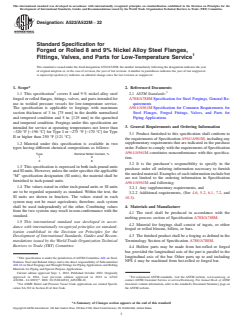
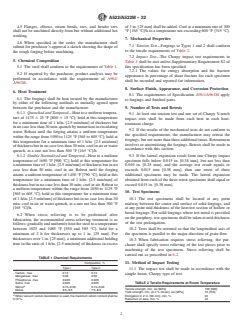
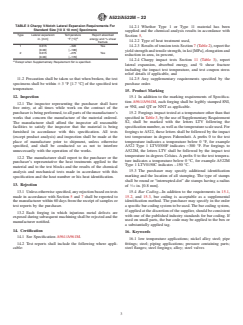
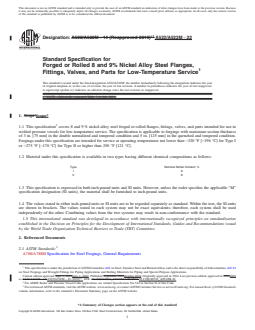
(Specification)Standard Specification for Forged or Rolled 8 and 9% Nickel Alloy Steel Flanges, Fittings, Valves, and Parts for Low-Temperature Service
General Information
- Abstract
ABSTRACT
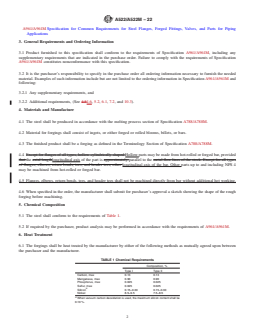
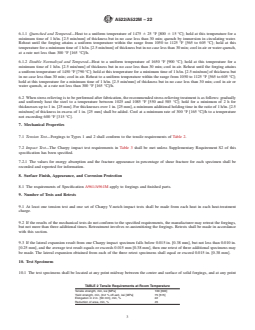
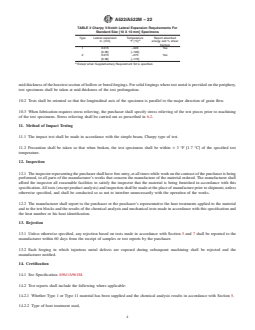
This specification covers the 8 and 9% nickel-alloy steel forged or rolled flanges, fittings, valves, and parts intended for use in welded pressure vessels for low-temperature service. Two types of materials are specified according to the chemical composition: type I and type II. Materials for forgings shall consist of ingots, or either forged or rolled blooms, billets, or bars. Except for all types of flanges, elbows, return bends, tees, and header tees, other parts including NPS 4 may be machined from hot-rolled or forged bar. The steel shall conform to the specified chemical requirements for carbon, manganese, phosphorus, sulfur, silicon, and nickel. The following methods of heat treatment shall be used: quenched and tempered and double normalized and tempered. Two tests shall be done to meet the mechanical requirements of the material: tension test and Charpy impact test.
SCOPE
1.1 This specification2 covers 8 and 9 % nickel-alloy steel forged or rolled flanges, fittings, valves, and parts intended for use in welded pressure vessels for low-temperature service. The specification is applicable to forgings with maximum section thickness of 3 in. [75 mm] in the double normalized and tempered condition and 5 in. [125 mm] in the quenched and tempered condition. Forgings under this specification are intended for service at operating temperatures not lower than −320 °F [−196 °C] for Type I or −275 °F [−170 °C] for Type II or higher than 250 °F [121 °C].
1.2 Material under this specification is available in two types having different chemical compositions as follows:
Type
Nominal Nickel Content, %
I
II
9
8
1.3 This specification is expressed in both inch-pound units and SI units. However, unless the order specifies the applicable “M” specification designation (SI units), the material shall be furnished to inch-pound units.
1.4 The values stated in either inch-pound units or SI units are to be regarded separately as standard. Within the text, the SI units are shown in brackets. The values stated in each system may not be exact equivalents; therefore, each system shall be used independently of the other. Combining values from the two systems may result in non-conformance with the standard.
1.5 This international standard was developed in accordance with internationally recognized principles on standardization established in the Decision on Principles for the Development of International Standards, Guides and Recommendations issued by the World Trade Organization Technical Barriers to Trade (TBT) Committee.
- Status
- Published
- Publication Date
- 31-Aug-2022
- Technical Committee
- A01 - Steel, Stainless Steel and Related Alloys
Buy Documents

ASTM A522/A522M-22 - Standard Specification for Forged or Rolled 8 and 9% Nickel Alloy Steel Flanges, Fittings, Valves, and Parts for Low-Temperature Service
REDLINE ASTM A522/A522M-22 - Standard Specification for Forged or Rolled 8 and 9% Nickel Alloy Steel Flanges, Fittings, Valves, and Parts for Low-Temperature Service
Overview
ASTM A522/A522M-22 is the internationally recognized standard specification for forged or rolled 8% and 9% nickel alloy steel flanges, fittings, valves, and parts, developed by ASTM International. These components are specifically intended for use in welded pressure vessels and assemblies designed for low-temperature service. The document defines material composition, manufacturing processes, mechanical requirements, and testing procedures to ensure component reliability and safety under extreme cold conditions commonly found in cryogenic or liquefied gas applications.
This standard applies to materials with a maximum section thickness of 3 in. [75 mm] in the double normalized and tempered condition and up to 5 in. [125 mm] if quenched and tempered. The specification covers two material types based on nickel content: Type I (9% Nickel) and Type II (8% Nickel), both tailored for durability and strength at harsh subzero temperatures.
Key Topics
Material Types
- Type I: 9% nominal nickel content, suitable for service as low as −320 °F [−196 °C].
- Type II: 8% nominal nickel content, suitable for service as low as −275 °F [−170 °C].
Product Forms
- Flanges, fittings, valves, and various pressure-containing parts.
- Components manufactured from ingots, forged or rolled blooms, billets, or bars.
- Machining from hot-rolled or forged bar allowed for certain parts up to NPS 4, with restrictions for flanges and specific shapes.
Manufacturing and Heat Treatment
- Two main heat treatment methods: Quenched and Tempered or Double Normalized and Tempered.
- Strict adherence to heat treatment procedures and cooling rates to ensure consistency and mechanical integrity.
Mechanical and Chemical Requirements
- Conformance to specified limits on carbon, manganese, phosphorus, sulfur, silicon, and nickel.
- Rigorous mechanical testing, including tension and Charpy V-notch impact tests, to ensure high toughness and strength at low temperatures.
Testing and Certification
- Mandatory reporting of chemical composition, heat treatment, tensile and impact test results.
- Supplementary requirements for non-destructive testing available by purchaser request.
Applications
ASTM A522/A522M-22-compliant components are essential in industries where structural integrity at low temperatures is critical. Typical applications include:
- Welded Pressure Vessels: Storage and processing tanks for liquefied gases, such as LNG and liquid nitrogen, requiring materials capable of withstanding extreme cold.
- Cryogenic Piping: Transport lines and fittings used in refrigeration plants, petrochemical facilities, and natural gas infrastructure.
- Valves and Fittings: Control and safety devices operating under low temperatures in process industries.
- Low-Temperature Service Parts: Structural or pressure components in power generation, shipping, or industrial gas sectors that encounter temperatures far below freezing.
Using 8% and 9% nickel alloy steel helps maintain material ductility and toughness, preventing brittle fracture and ensuring operational safety in mission-critical applications under severe environmental conditions.
Related Standards
Organizations and professionals specifying or working with ASTM A522/A522M-22 should also reference these related standards:
- ASTM A788/A788M: Specification for Steel Forgings, General Requirements
- ASTM A961/A961M: Common Requirements for Steel Flanges, Forged Fittings, Valves, and Parts for Piping Applications
- ASME SA-522: Pressure vessel code-compatible specification
- ASTM Standards for Material Testing: For additional guidance on inspection, testing, and mechanical property requirements
Keywords: ASTM A522, A522M-22, nickel alloy steel, low temperature steel, cryogenic vessels, steel flanges, forged fittings, steel valves, pressure vessel standards, piping components, impact test requirements, low temperature applications, steel standard.
Relations
- Effective Date
- 01-Nov-2019
- Effective Date
- 01-May-2019
- Effective Date
- 01-Nov-2018
- Effective Date
- 01-Sep-2018
- Effective Date
- 01-Mar-2018
- Effective Date
- 01-Nov-2017
- Effective Date
- 01-May-2017
- Effective Date
- 01-Dec-2016
- Effective Date
- 01-Jun-2016
- Effective Date
- 01-Nov-2015
- Effective Date
- 01-May-2015
- Effective Date
- 01-Nov-2014
- Effective Date
- 01-Oct-2014
- Effective Date
- 15-May-2014
- Effective Date
- 01-Nov-2013
Buy Documents
ASTM A522/A522M-22 - Standard Specification for Forged or Rolled 8 and 9% Nickel Alloy Steel Flanges, Fittings, Valves, and Parts for Low-Temperature Service
REDLINE ASTM A522/A522M-22 - Standard Specification for Forged or Rolled 8 and 9% Nickel Alloy Steel Flanges, Fittings, Valves, and Parts for Low-Temperature Service
Get Certified
Connect with accredited certification bodies for this standard

Institut za varilstvo d.o.o. (Welding Institute)
Slovenia's leading welding institute since 1952. ISO 3834, EN 1090, pressure equipment certification, NDT personnel, welder qualification. Only IIW Au
Sponsored listings
Frequently Asked Questions
ASTM A522/A522M-22 is a technical specification published by ASTM International. Its full title is "Standard Specification for Forged or Rolled 8 and 9% Nickel Alloy Steel Flanges, Fittings, Valves, and Parts for Low-Temperature Service". This standard covers: ABSTRACT This specification covers the 8 and 9% nickel-alloy steel forged or rolled flanges, fittings, valves, and parts intended for use in welded pressure vessels for low-temperature service. Two types of materials are specified according to the chemical composition: type I and type II. Materials for forgings shall consist of ingots, or either forged or rolled blooms, billets, or bars. Except for all types of flanges, elbows, return bends, tees, and header tees, other parts including NPS 4 may be machined from hot-rolled or forged bar. The steel shall conform to the specified chemical requirements for carbon, manganese, phosphorus, sulfur, silicon, and nickel. The following methods of heat treatment shall be used: quenched and tempered and double normalized and tempered. Two tests shall be done to meet the mechanical requirements of the material: tension test and Charpy impact test. SCOPE 1.1 This specification2 covers 8 and 9 % nickel-alloy steel forged or rolled flanges, fittings, valves, and parts intended for use in welded pressure vessels for low-temperature service. The specification is applicable to forgings with maximum section thickness of 3 in. [75 mm] in the double normalized and tempered condition and 5 in. [125 mm] in the quenched and tempered condition. Forgings under this specification are intended for service at operating temperatures not lower than −320 °F [−196 °C] for Type I or −275 °F [−170 °C] for Type II or higher than 250 °F [121 °C]. 1.2 Material under this specification is available in two types having different chemical compositions as follows: Type Nominal Nickel Content, % I II 9 8 1.3 This specification is expressed in both inch-pound units and SI units. However, unless the order specifies the applicable “M” specification designation (SI units), the material shall be furnished to inch-pound units. 1.4 The values stated in either inch-pound units or SI units are to be regarded separately as standard. Within the text, the SI units are shown in brackets. The values stated in each system may not be exact equivalents; therefore, each system shall be used independently of the other. Combining values from the two systems may result in non-conformance with the standard. 1.5 This international standard was developed in accordance with internationally recognized principles on standardization established in the Decision on Principles for the Development of International Standards, Guides and Recommendations issued by the World Trade Organization Technical Barriers to Trade (TBT) Committee.
ABSTRACT This specification covers the 8 and 9% nickel-alloy steel forged or rolled flanges, fittings, valves, and parts intended for use in welded pressure vessels for low-temperature service. Two types of materials are specified according to the chemical composition: type I and type II. Materials for forgings shall consist of ingots, or either forged or rolled blooms, billets, or bars. Except for all types of flanges, elbows, return bends, tees, and header tees, other parts including NPS 4 may be machined from hot-rolled or forged bar. The steel shall conform to the specified chemical requirements for carbon, manganese, phosphorus, sulfur, silicon, and nickel. The following methods of heat treatment shall be used: quenched and tempered and double normalized and tempered. Two tests shall be done to meet the mechanical requirements of the material: tension test and Charpy impact test. SCOPE 1.1 This specification2 covers 8 and 9 % nickel-alloy steel forged or rolled flanges, fittings, valves, and parts intended for use in welded pressure vessels for low-temperature service. The specification is applicable to forgings with maximum section thickness of 3 in. [75 mm] in the double normalized and tempered condition and 5 in. [125 mm] in the quenched and tempered condition. Forgings under this specification are intended for service at operating temperatures not lower than −320 °F [−196 °C] for Type I or −275 °F [−170 °C] for Type II or higher than 250 °F [121 °C]. 1.2 Material under this specification is available in two types having different chemical compositions as follows: Type Nominal Nickel Content, % I II 9 8 1.3 This specification is expressed in both inch-pound units and SI units. However, unless the order specifies the applicable “M” specification designation (SI units), the material shall be furnished to inch-pound units. 1.4 The values stated in either inch-pound units or SI units are to be regarded separately as standard. Within the text, the SI units are shown in brackets. The values stated in each system may not be exact equivalents; therefore, each system shall be used independently of the other. Combining values from the two systems may result in non-conformance with the standard. 1.5 This international standard was developed in accordance with internationally recognized principles on standardization established in the Decision on Principles for the Development of International Standards, Guides and Recommendations issued by the World Trade Organization Technical Barriers to Trade (TBT) Committee.
ASTM A522/A522M-22 is classified under the following ICS (International Classification for Standards) categories: 23.040.40 - Metal fittings. The ICS classification helps identify the subject area and facilitates finding related standards.
ASTM A522/A522M-22 has the following relationships with other standards: It is inter standard links to ASTM A961/A961M-19a, ASTM A788/A788M-19, ASTM A788/A788M-18b, ASTM A788/A788M-18a, ASTM A788/A788M-18, ASTM A788/A788M-17a, ASTM A788/A788M-17, ASTM A788/A788M-16a, ASTM A961/A961M-16, ASTM A961/A961M-15, ASTM A788/A788M-15, ASTM A961/A961M-14, ASTM A788/A788M-14a, ASTM A788/A788M-14, ASTM A788/A788M-13. Understanding these relationships helps ensure you are using the most current and applicable version of the standard.
ASTM A522/A522M-22 is available in PDF format for immediate download after purchase. The document can be added to your cart and obtained through the secure checkout process. Digital delivery ensures instant access to the complete standard document.
Standards Content (Sample)
This international standard was developed in accordance with internationally recognized principles on standardization established in the Decision on Principles for the
Development of International Standards, Guides and Recommendations issued by the World Trade Organization Technical Barriers to Trade (TBT) Committee.
Designation:A522/A522M −22
Standard Specification for
Forged or Rolled 8 and 9% Nickel Alloy Steel Flanges,
Fittings, Valves, and Parts for Low-Temperature Service
This standard is issued under the fixed designationA522/A522M; the number immediately following the designation indicates the year
of original adoption or, in the case of revision, the year of last revision.Anumber in parentheses indicates the year of last reapproval.
A superscript epsilon (´) indicates an editorial change since the last revision or reapproval.
1. Scope* 2. Referenced Documents
2 3
1.1 This specification covers 8 and 9% nickel-alloy steel 2.1 ASTM Standards:
forged or rolled flanges, fittings, valves, and parts intended for A788/A788MSpecification for Steel Forgings, General Re-
use in welded pressure vessels for low-temperature service. quirements
The specification is applicable to forgings with maximum A961/A961MSpecification for Common Requirements for
section thickness of 3 in. [75 mm] in the double normalized Steel Flanges, Forged Fittings, Valves, and Parts for
and tempered condition and 5 in. [125 mm] in the quenched Piping Applications
and tempered condition. Forgings under this specification are
3. General Requirements and Ordering Information
intended for service at operating temperatures not lower than
−320 °F [−196 °C] for Type I or −275 °F [−170 °C] for Type
3.1 Product furnished to this specification shall conform to
II or higher than 250 °F [121 °C].
the requirements of Specification A961/A961M, including any
1.2 Material under this specification is available in two supplementary requirements that are indicated in the purchase
order.FailuretocomplywiththerequirementsofSpecification
types having different chemical compositions as follows:
A961/A961M constitutes nonconformance with this specifica-
Type Nominal Nickel Content, %
I 9 tion.
II 8
3.2 It is the purchaser’s responsibility to specify in the
1.3 This specification is expressed in both inch-pound units
purchase order all ordering information necessary to furnish
andSIunits.However,unlesstheorderspecifiestheapplicable
the needed material. Examples of such information include but
“M” specification designation (SI units), the material shall be
are not limited to the ordering information in Specification
furnished to inch-pound units.
A961/A961M and following:
1.4 The values stated in either inch-pound units or SI units
3.2.1 Any supplementary requirements, and
are to be regarded separately as standard. Within the text, the
3.2.2 Additional requirements, (See 4.6, 5.2, 6.1, 7.2, and
SI units are shown in brackets. The values stated in each
10.3).
system may not be exact equivalents; therefore, each system
shall be used independently of the other. Combining values
4. Materials and Manufacture
from the two systems may result in non-conformance with the
4.1 The steel shall be produced in accordance with the
standard.
melting process section of Specification A788/A788M.
1.5 This international standard was developed in accor-
4.2 Material for forgings shall consist of ingots, or either
dance with internationally recognized principles on standard-
forged or rolled blooms, billets, or bars.
ization established in the Decision on Principles for the
4.3 The finished product shall be a forging as defined in the
Development of International Standards, Guides and Recom-
Terminology Section of Specification A788/A788M.
mendations issued by the World Trade Organization Technical
Barriers to Trade (TBT) Committee.
4.4 Hollow parts may be made from hot-rolled or forged
bar, provided the longitudinal axis of the part is parallel to the
longitudinal axis of the bar. Other parts up to and including
This specification is under the jurisdiction ofASTM Committee A01 on Steel,
NPS 4 may be machined from hot-rolled or forged bar.
Stainless Steel and RelatedAlloys and is the direct responsibility of Subcommittee
A01.22onSteelForgingsandWroughtFittingsforPipingApplicationsandBolting
Materials for Piping and Special Purpose Applications.
Current edition approved Sept. 1, 2022. Published October 2022. Originally
approved in 1964. Last previous edition approved in 2019 as A522/ For referenced ASTM standards, visit the ASTM website, www.astm.org, or
ε1
A522M–14(2019) . DOI: 10.1520/A0522_A0522M-22. contact ASTM Customer Service at service@astm.org. For Annual Book of ASTM
For ASME Boiler and Pressure Vessel Code applications see related Specifi- Standards volume information, refer to the standard’s Document Summary page on
cation SA-522 in Section II of that Code. the ASTM website.
*A Summary of Changes section appears at the end of this standard
Copyright © ASTM International, 100 Barr Harbor Drive, PO Box C700, West Conshohocken, PA 19428-2959. United States
A522/A522M−22
4.5 Flanges, elbows, return bends, tees, and header tees of1in.[25mm]shallbeadded.Coolataminimumrateof300
shall not be machined directly from bar without additional hot °F [165 °C]/h to a temperature not exceeding 600 °F [315 °C].
working.
7. Mechanical Properties
4.6 When specified in the order, the manufacturer shall
7.1 Tension Test—Forgings to Types 1 and 2 shall conform
submit for purchaser’s approval a sketch showing the shape of
to the tensile requirements of Table 2.
the rough forging before machining.
7.2 Impact Test—The Charpy impact test requirements in
5. Chemical Composition
Table 3 shall be met unless Supplementary Requirement S2 of
this specification has been specified.
5.1 The steel shall conform to the requirements of Table 1.
7.2.1 The values for energy absorption and the fracture
5.2 If required by the purchaser, product analysis may be
appearance in percentage of shear fracture for each specimen
performed in accordance with the requirements of A961/
shall be recorded and reported for information.
A961M.
8. Surface Finish, Appearance, and Corrosion Protection
6. Heat Treatment
8.1 The requirements of Specification A961/A961M apply
6.1 The forgings shall be heat treated by the manufacturer
to forgings and finished parts.
by either of the following methods as mutually agreed upon
between the purchaser and the manufacturer. 9. Number of Tests and Retests
6.1.1 Quenched and Tempered—Heat to a uniform tempera-
9.1 At least one tension test and one set of Charpy V-notch
ture of 1475 6 25 °F [800 6 15 °C]; hold at this temperature
impact tests shall be made from each heat in each heat-
for a minimum time of 1 h/in. [2.5 min/mm] of thickness but
treatment charge.
innocaselessthan30min;quenchbyimmersionincirculating
9.2 If the results of the mechanical tests do not conform to
water. Reheat until the forging attains a uniform temperature
the specified requirements, the manufacturer may retreat the
withintherangefrom1050to1125°F[565to605°C];holdat
forgings,butnotmorethanthreeadditionaltimes.Retreatment
this temperature for a minimum time of 1 h/in. [2.5 min/mm]
involves re-austenitizing the forgings. Retests shall be made in
ofthicknessbutinnocaselessthan30min;coolinairorwater
accordance with this section.
quench, at a rate not less than 300 °F [165 °C]/h.
6.1.2 Double Normalized and Tempered—Heat to a uniform 9.3 If the lateral expansion result from one Charpy impact
specimen falls below 0.015 in. [0.38 mm], but not less than
temperature of 1650 °F [900 °C]; hold at this temperature for
aminimumtimeof1h/in.[2.5min/mm]ofthicknessbutinno 0.010 in. [0.25 mm], and the average test result equals or
case less than 30 min; cool in air. Reheat until the forging exceeds 0.015 mm [0.38 mm], then one retest of three
attains a uniform temperature of 1450 °F [790 °C]; hold at this additional specimens may be made. The lateral expansion
temperature for a minimum time of 1 h/in. [2.5 min/mm] of obtained from each of the three retest specimens shall equal or
thickness but in no case less than 30 min; cool in air. Reheat to exceed 0.015 in. [0.38 mm].
a uniform temperature within the range from 1050 to 1125 °F
10. Test Specimens
[565 to 605 °C]; hold at this temperature for a minimum time
of1h/in.[2.5min/mm]ofthicknessbutinnocaselessthan30 10.1 The test specimens shall be located at any point
min; cool in air or water quench, at a rate not less than 300 °F midway between the center and surface of solid forgings, and
[165 °C]/h. at any point mid-thi
...
This document is not an ASTM standard and is intended only to provide the user of an ASTM standard an indication of what changes have been made to the previous version. Because
it may not be technically possible to adequately depict all changes accurately, ASTM recommends that users consult prior editions as appropriate. In all cases only the current version
of the standard as published by ASTM is to be considered the official document.
´1
Designation: A522/A522M − 14 (Reapproved 2019) A522/A522M − 22
Standard Specification for
Forged or Rolled 8 and 9% Nickel Alloy Steel Flanges,
Fittings, Valves, and Parts for Low-Temperature Service
This standard is issued under the fixed designation A522/A522M; the number immediately following the designation indicates the year
of original adoption or, in the case of revision, the year of last revision. A number in parentheses indicates the year of last reapproval.
A superscript epsilon (´) indicates an editorial change since the last revision or reapproval.
ε NOTE—Editorially corrected Table 3 in July 2021.
1. Scope Scope*
1.1 This specification covers 8 and 9 % nickel-alloy steel forged or rolled flanges, fittings, valves, and parts intended for use in
welded pressure vessels for low-temperature service. The specification is applicable to forgings with maximum section thickness
of 3 in. [75 mm] in the double normalized and tempered condition and 5 in. [125 mm] in the quenched and tempered condition.
Forgings under this specification are intended for service at operating temperatures not lower than −320 °F [−196 °C] for Type I
or −275 °F [−170 °C] for Type II or higher than 250 °F [121 °C].
1.2 Material under this specification is available in two types having different chemical compositions as follows:
Type Nominal Nickel Content, %
I 9
II 8
1.3 This specification is expressed in both inch-pound units and SI units. However, unless the order specifies the applicable “M”
specification designation (SI units), the material shall be furnished to inch-pound units.
1.4 The values stated in either inch-pound units or SI units are to be regarded separately as standard. Within the text, the SI units
are shown in brackets. The values stated in each system may not be exact equivalents; therefore, each system shall be used
independently of the other. Combining values from the two systems may result in non-conformance with the standard.
1.5 This international standard was developed in accordance with internationally recognized principles on standardization
established in the Decision on Principles for the Development of International Standards, Guides and Recommendations issued
by the World Trade Organization Technical Barriers to Trade (TBT) Committee.
2. Referenced Documents
2.1 ASTM Standards:
A788/A788M Specification for Steel Forgings, General Requirements
This specification is under the jurisdiction of ASTM Committee A01 on Steel, Stainless Steel and Related Alloys and is the direct responsibility of Subcommittee A01.22
on Steel Forgings and Wrought Fittings for Piping Applications and Bolting Materials for Piping and Special Purpose Applications.
Current edition approved Sept. 1, 2019Sept. 1, 2022. Published September 2019October 2022. Originally approved in 1964. Last previous edition approved in 20142019
ε1
as A522/A522M – 14.A522/A522M – 14 (2019) . DOI: 10.1520/A0522_A0522M-14R19E01.10.1520/A0522_A0522M-22.
For ASME Boiler and Pressure Vessel Code applications see related Specification SA-522 in Section II of that Code.
For referenced ASTM standards, visit the ASTM website, www.astm.org, or contact ASTM Customer Service at service@astm.org. For Annual Book of ASTM Standards
volume information, refer to the standard’s Document Summary page on the ASTM website.
*A Summary of Changes section appears at the end of this standard
Copyright © ASTM International, 100 Barr Harbor Drive, PO Box C700, West Conshohocken, PA 19428-2959. United States
A522/A522M − 22
A961/A961M Specification for Common Requirements for Steel Flanges, Forged Fittings, Valves, and Parts for Piping
Applications
3. General Requirements and Ordering Information
3.1 Product furnished to this specification shall conform to the requirements of Specification A961/A961M, including any
supplementary requirements that are indicated in the purchase order. Failure to comply with the requirements of Specification
A961/A961M constitutes nonconformance with this specification.
3.2 It is the purchaser’s responsibility to specify in the purchase order all ordering information necessary to furnish the needed
material. Examples of such information include but are not limited to the ordering information in Specification A961/A961M and
following:
3.2.1 Any supplementary requirements, and
3.2.2 Additional requirements, (See 4.54.6, 5.2, 6.1, 7.2, and 10.3).
4. Materials and Manufacture
4.1 The steel shall be produced in accordance with the melting process section of Specification A788/A788M.
4.2 Material for forgings shall consist of ingots, or either forged or rolled blooms, billets, or bars.
4.3 The finished product shall be a forging as defined in the Terminology Section of Specification A788/A788M.
4.4 Except for flanges of all types, hollow cylindrically shaped Hollow parts may be made from hot-rolled or forged bar, provided
that the axial lengthlongitudinal axis of the part is approximately parallel to the metal flow lines of the stock. Except for all types
of flanges, elbows, return bends, tees, and header tees, other longitudinal axis of the bar. Other parts up to and including NPS 4
may be machined from hot-rolled or forged bar.
4.5 Flanges, elbows, return bends, tees, and header tees shall not be machined directly from bar without additional hot working.
4.6 When specified in the order, the manufacturer shall submit for purchaser’s approval a sketch showing the shape of the rough
forging before machining.
5. Chemical Composition
5.1 The steel shall conform to the requirements of Table 1.
5.2 If required by the purchaser, product analysis may be performed in accordance with the requirements of A961/A961M.
6. Heat Treatment
6.1 The forgings shall be heat treated by the manufacturer by either of the following methods as mutually agreed upon between
the purchaser and the manufacturer.
TABLE 1 Chemical Requirements
Composition, %
Type I Type II
Carbon, max 0.13 0.13
Manganese, max 0.90 0.90
Phosphorus, max 0.025 0.025
Sulfur, max 0.025 0.025
A
Silicon 0.15–0.30 0.15–0.30
Nickel 8.5–9.5 7.5–8.5
A
When vacuum carbon deoxidation is used, the maximum silicon content shall be
0.10 %.
A522/A522M − 22
6.1.1 Quenched and Tempered—Heat to a uniform temperature of 1475 6 25 °F [800 6 15 °C]; hold at this temperature for a
minimum time of 1 h/in. [2.5 min/mm] of thickness but in no case less than 30 min; quench by immersion in circulating water.
Reheat until the forging attains a uniform temperature within the range from 1050 to 1125 °F [565 to 605 °C]; hold at this
temperature for a minimum time of 1 h/in. [2.5 min/mm] of thickness but in no case less than 30 min; cool in air or water quench,
at a rate not less than 300 °F [165 °C]/h.
6.1.2 Double Normalized and Tempered—Heat to a uniform temperature of 1650 °F [900 °C]; hold at this temperature for a
minimum time of 1 h/in. [2.5 min/mm] of thickness but in no case less than 30 min; cool in air. Reheat until the forging attains
a uniform temperature of 1450 °F [790 °C]; hold at this temperature for a minimum time of 1 h/in. [2.5 min/mm] of thickness but
in no case less than 30 min; cool in air. Reheat to a uniform temperature within the range from 1050 to 1125 °F [565 to 605 °C];
hold at this temperature for a minimum time of 1 h/in. [2.5 min/mm] of thickness but in no case less than 30 min; cool in air or
water quench, at a rate not less than 300 °F [165 °C]/h.
6.2 When stress relieving is to be performed after fabrication, the recommended stress-relieving treatment is as follows: gradually
and uniformly heat the steel to a temperature between 1025 and 1085 °F [550 and 585 °C]; hold for a minimum of 2 h for
thicknesses up to 1 in. [25 mm]. For thicknesses over 1 in. [25 mm], a minimum additional holding time in the ratio of 1 h/in. [2.5
min/mm] of thickness in excess of 1 in. [25 mm] shall be added. Cool at a minimum rate of 300 °F [165 °C]/h to a temperature
not exceeding 600 °F [315 °C].
7. Mechanical Properties
7.1 Tension Test—Forgings to Types 1 and 2 shall conform to the tensile requirements of Table 2.
7.2 Impact Test—The Charpy impact test requirements in Table 3 shall be met unless Supplementary Requirement S2 of this
specification has been specified.
7.2.1 The values for energy absorption and the fracture appearance in percentage of shear fracture for each specimen shall be
recorded and reported for information.
8. Surface Finish, Appearance, and Corrosion Protection
8.1 The requirements of Specification A961/A961M apply to forgings and finished parts.
9. Number of Tests
...