


ASTM D6800-18
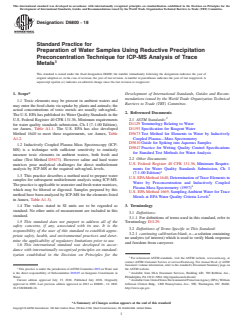
(Practice)Standard Practice for Preparation of Water Samples Using Reductive Precipitation Preconcentration Technique for ICP-MS Analysis of Trace Metals
Standard Practice for Preparation of Water Samples Using Reductive Precipitation Preconcentration Technique for ICP-MS Analysis of Trace Metals
SIGNIFICANCE AND USE
5.1 Ambient marine waters generally contain very low concentrations of toxic metals that require sensitive analytical methods, such as ICP-MS, to detect and measure the metal's concentrations.
5.2 Due to the high dissolved salt concentrations present in seawater, sample pretreatment is required to remove signal suppression and significant polyatomic interferences due to the matrix both of which compromise detection limits.
SCOPE
1.1 Toxic elements may be present in ambient waters and may enter the food chain via uptake by plants and animals; the actual concentrations of toxic metals are usually sub-ng/mL. The U.S. EPA has published its Water Quality Standards in the U.S. Federal Register 40 CFR 131.36, Minimum requirements for water quality standards submission, Ch. I (7-1-00 Edition), see Annex, Table A1.1. The U.S. EPA has also developed Method 1640 to meet these requirements, see Annex, Table A1.2.
1.2 Inductively Coupled Plasma Mass Spectroscopy (ICP-MS) is a technique with sufficient sensitivity to routinely measure toxic elements in ambient waters, both fresh and saline (Test Method D5673). However saline and hard water matrices pose analytical challenges for direct multielement analysis by ICP-MS at the required sub-ng/mL levels.
1.3 This practice describes a method used to prepare water samples for subsequent multielement analysis using ICP-MS. The practice is applicable to seawater and fresh water matrices, which may be filtered or digested. Samples prepared by this method have been analyzed by ICP-MS for the elements listed in Annex, Table A1.3).
1.4 The values stated in SI units are to be regarded as standard. No other units of measurement are included in this standard.
1.5 This standard does not purport to address all of the safety concerns, if any, associated with its use. It is the responsibility of the user of this standard to establish appropriate safety, health, and environmental practices and determine the applicability of regulatory limitations prior to use.
1.6 This international standard was developed in accordance with internationally recognized principles on standardization established in the Decision on Principles for the Development of International Standards, Guides and Recommendations issued by the World Trade Organization Technical Barriers to Trade (TBT) Committee.
General Information
- Status
- Published
- Publication Date
- 14-Jul-2018
- Technical Committee
- D19 - Water
- Drafting Committee
- D19.05 - Inorganic Constituents in Water
Relations
- Effective Date
- 15-Jul-2018
- Effective Date
- 01-May-2020
- Effective Date
- 01-Jul-2015
- Effective Date
- 01-May-2011
- Effective Date
- 01-Aug-2010
- Effective Date
- 01-Mar-2010
- Effective Date
- 01-Sep-2006
- Effective Date
- 01-Sep-2006
- Effective Date
- 15-Aug-2006
- Effective Date
- 01-Mar-2006
- Effective Date
- 15-Feb-2006
- Effective Date
- 01-Jul-2005
- Effective Date
- 01-Mar-2004
- Effective Date
- 01-Mar-2004
- Effective Date
- 01-Dec-2003
Overview
ASTM D6800-18 provides a standardized practice for the preparation of water samples using a reductive precipitation preconcentration technique for ICP-MS (Inductively Coupled Plasma Mass Spectrometry) analysis of trace metals. Published by ASTM International, this method is applicable to both fresh and saline (marine or estuarine) waters, where trace toxic elements may be present at sub-ng/mL concentrations. Due to high salt content and complexity of many environmental water matrices, sensitive and interference-free analytical methods are essential for accurate measurement of trace metals.
Key Topics
- Sample Pre-Treatment: Addresses the need for specialized methods to remove salt matrix interferences and prevent signal suppression during ICP-MS analysis.
- Reductive Precipitation Preconcentration: Details the procedure for separating target trace elements from the sample matrix by co-precipitation using sodium borohydride as a reducing agent, along with iron and palladium for enhanced precipitation.
- Contamination Control: Highlights procedures and equipment cleaning protocols to avoid contamination during sampling and preparation, which is critical due to the ultra-trace levels measured.
- Quality Control: Covers the use of blanks, laboratory control samples, duplicates, and matrix spikes to ensure accuracy and precision throughout sample processing and analysis.
- Sample Preservation: Describes proper methods for acidification, filtration, and storage of water samples to maintain the integrity of trace metal concentrations before analysis.
Applications
ASTM D6800-18 is designed for laboratories involved in environmental monitoring, particularly those analyzing:
- Ambient marine and freshwater for trace toxic metals as part of regulatory compliance, research, or risk assessment projects.
- Estuarine and brine samples, where high concentrations of dissolved salts pose analytical challenges.
- Assessment of water quality according to U.S. EPA Water Quality Standards and similar international guidelines.
- Supporting the food chain assessments, since trace metals in water can enter biota through bioaccumulation.
This practice is particularly valuable for:
- Government and academic laboratories monitoring environmental health.
- Industrial environmental testing for regulatory reporting.
- Supporting analytical methods such as U.S. EPA Method 1640 for trace element determination.
- Situations requiring accurate detection of sub-ng/mL concentrations of metals like arsenic, cadmium, lead, mercury, and others in complex water matrices.
Related Standards
ASTM D6800-18 references and is complemented by several other important standards and methods, including:
- ASTM D5673: Test Method for Elements in Water by Inductively Coupled Plasma - Mass Spectrometry (ICP-MS).
- ASTM D1129: Terminology Relating to Water.
- ASTM D1193: Specification for Reagent Water.
- ASTM D5810 and D5847: Quality control practices relevant to water analysis.
- U.S. EPA Method 1640: Determination of Trace Elements in Water by Preconcentration and ICP-MS.
- U.S. EPA Method 1669: Contamination control and clean sampling protocols for trace metals in water.
Practical Value
Utilizing ASTM D6800-18 ensures:
- Reliable trace metals data even in waters with high dissolved salt content, by overcoming matrix interferences through robust preconcentration.
- Data integrity and confidence, meeting regulatory and scientific standards for environmental monitoring of water quality.
- Consistency in laboratory practices, applicable to both routine compliance monitoring and specialized research studies.
Keywords: trace metals, ICP-MS, water quality, seawater, preconcentration, reductive precipitation, sample preparation, environmental analysis, ASTM D6800-18, contamination control, U.S. EPA standards.
Buy Documents
ASTM D6800-18 - Standard Practice for Preparation of Water Samples Using Reductive Precipitation Preconcentration Technique for ICP-MS Analysis of Trace Metals
REDLINE ASTM D6800-18 - Standard Practice for Preparation of Water Samples Using Reductive Precipitation Preconcentration Technique for ICP-MS Analysis of Trace Metals
Get Certified
Connect with accredited certification bodies for this standard

NSF International
Global independent organization facilitating standards development and certification.

CIS Institut d.o.o.
Personal Protective Equipment (PPE) certification body. Notified Body NB-2890 for EU Regulation 2016/425 PPE.

Kiwa BDA Testing
Building and construction product certification.
Sponsored listings
Frequently Asked Questions
ASTM D6800-18 is a standard published by ASTM International. Its full title is "Standard Practice for Preparation of Water Samples Using Reductive Precipitation Preconcentration Technique for ICP-MS Analysis of Trace Metals". This standard covers: SIGNIFICANCE AND USE 5.1 Ambient marine waters generally contain very low concentrations of toxic metals that require sensitive analytical methods, such as ICP-MS, to detect and measure the metal's concentrations. 5.2 Due to the high dissolved salt concentrations present in seawater, sample pretreatment is required to remove signal suppression and significant polyatomic interferences due to the matrix both of which compromise detection limits. SCOPE 1.1 Toxic elements may be present in ambient waters and may enter the food chain via uptake by plants and animals; the actual concentrations of toxic metals are usually sub-ng/mL. The U.S. EPA has published its Water Quality Standards in the U.S. Federal Register 40 CFR 131.36, Minimum requirements for water quality standards submission, Ch. I (7-1-00 Edition), see Annex, Table A1.1. The U.S. EPA has also developed Method 1640 to meet these requirements, see Annex, Table A1.2. 1.2 Inductively Coupled Plasma Mass Spectroscopy (ICP-MS) is a technique with sufficient sensitivity to routinely measure toxic elements in ambient waters, both fresh and saline (Test Method D5673). However saline and hard water matrices pose analytical challenges for direct multielement analysis by ICP-MS at the required sub-ng/mL levels. 1.3 This practice describes a method used to prepare water samples for subsequent multielement analysis using ICP-MS. The practice is applicable to seawater and fresh water matrices, which may be filtered or digested. Samples prepared by this method have been analyzed by ICP-MS for the elements listed in Annex, Table A1.3). 1.4 The values stated in SI units are to be regarded as standard. No other units of measurement are included in this standard. 1.5 This standard does not purport to address all of the safety concerns, if any, associated with its use. It is the responsibility of the user of this standard to establish appropriate safety, health, and environmental practices and determine the applicability of regulatory limitations prior to use. 1.6 This international standard was developed in accordance with internationally recognized principles on standardization established in the Decision on Principles for the Development of International Standards, Guides and Recommendations issued by the World Trade Organization Technical Barriers to Trade (TBT) Committee.
SIGNIFICANCE AND USE 5.1 Ambient marine waters generally contain very low concentrations of toxic metals that require sensitive analytical methods, such as ICP-MS, to detect and measure the metal's concentrations. 5.2 Due to the high dissolved salt concentrations present in seawater, sample pretreatment is required to remove signal suppression and significant polyatomic interferences due to the matrix both of which compromise detection limits. SCOPE 1.1 Toxic elements may be present in ambient waters and may enter the food chain via uptake by plants and animals; the actual concentrations of toxic metals are usually sub-ng/mL. The U.S. EPA has published its Water Quality Standards in the U.S. Federal Register 40 CFR 131.36, Minimum requirements for water quality standards submission, Ch. I (7-1-00 Edition), see Annex, Table A1.1. The U.S. EPA has also developed Method 1640 to meet these requirements, see Annex, Table A1.2. 1.2 Inductively Coupled Plasma Mass Spectroscopy (ICP-MS) is a technique with sufficient sensitivity to routinely measure toxic elements in ambient waters, both fresh and saline (Test Method D5673). However saline and hard water matrices pose analytical challenges for direct multielement analysis by ICP-MS at the required sub-ng/mL levels. 1.3 This practice describes a method used to prepare water samples for subsequent multielement analysis using ICP-MS. The practice is applicable to seawater and fresh water matrices, which may be filtered or digested. Samples prepared by this method have been analyzed by ICP-MS for the elements listed in Annex, Table A1.3). 1.4 The values stated in SI units are to be regarded as standard. No other units of measurement are included in this standard. 1.5 This standard does not purport to address all of the safety concerns, if any, associated with its use. It is the responsibility of the user of this standard to establish appropriate safety, health, and environmental practices and determine the applicability of regulatory limitations prior to use. 1.6 This international standard was developed in accordance with internationally recognized principles on standardization established in the Decision on Principles for the Development of International Standards, Guides and Recommendations issued by the World Trade Organization Technical Barriers to Trade (TBT) Committee.
ASTM D6800-18 is classified under the following ICS (International Classification for Standards) categories: 13.060.45 - Examination of water in general. The ICS classification helps identify the subject area and facilitates finding related standards.
ASTM D6800-18 has the following relationships with other standards: It is inter standard links to ASTM D6800-12, ASTM D1129-13(2020)e2, ASTM D5673-15, ASTM D5810-96(2011), ASTM D5673-10, ASTM D1129-10, ASTM D1129-06ae1, ASTM D1129-06a, ASTM D5810-96(2006), ASTM D1193-06, ASTM D1129-06, ASTM D5673-05, ASTM D1129-04e1, ASTM D1129-04, ASTM D5673-03. Understanding these relationships helps ensure you are using the most current and applicable version of the standard.
ASTM D6800-18 is available in PDF format for immediate download after purchase. The document can be added to your cart and obtained through the secure checkout process. Digital delivery ensures instant access to the complete standard document.
Standards Content (Sample)
This international standard was developed in accordance with internationally recognized principles on standardization established in the Decision on Principles for the
Development of International Standards, Guides and Recommendations issued by the World Trade Organization Technical Barriers to Trade (TBT) Committee.
Designation: D6800 − 18
Standard Practice for
Preparation of Water Samples Using Reductive Precipitation
Preconcentration Technique for ICP-MS Analysis of Trace
Metals
This standard is issued under the fixed designation D6800; the number immediately following the designation indicates the year of
original adoption or, in the case of revision, the year of last revision. A number in parentheses indicates the year of last reapproval. A
superscript epsilon (´) indicates an editorial change since the last revision or reapproval.
1. Scope* Development of International Standards, Guides and Recom-
mendations issued by the World Trade Organization Technical
1.1 Toxic elements may be present in ambient waters and
Barriers to Trade (TBT) Committee.
may enter the food chain via uptake by plants and animals; the
actual concentrations of toxic metals are usually sub-ng/mL.
2. Referenced Documents
The U.S. EPAhas published its Water Quality Standards in the
U.S. Federal Register 40 CFR 131.36, Minimum requirements 2.1 ASTM Standards:
D1129 Terminology Relating to Water
for water quality standards submission, Ch. I (7-1-00 Edition),
see Annex, Table A1.1. The U.S. EPA has also developed D1193 Specification for Reagent Water
D5673 Test Method for Elements in Water by Inductively
Method 1640 to meet these requirements, see Annex, Table
A1.2. Coupled Plasma—Mass Spectrometry
D5810 Guide for Spiking into Aqueous Samples
1.2 Inductively Coupled Plasma Mass Spectroscopy (ICP-
D5847 Practice for Writing Quality Control Specifications
MS) is a technique with sufficient sensitivity to routinely
for Standard Test Methods for Water Analysis
measure toxic elements in ambient waters, both fresh and
2.2 Other Documents:
saline (Test Method D5673). However saline and hard water
U.S. Federal Register 40 CFR 131.36, Minimum Require-
matrices pose analytical challenges for direct multielement
ments for Water Quality Standards Submission, Ch. I
analysis by ICP-MS at the required sub-ng/mL levels.
(7-1-00 Edition)
1.3 This practice describes a method used to prepare water
U.S. EPAMethod 1640, Determination ofTrace Elements in
samples for subsequent multielement analysis using ICP-MS.
Water by Preconcentration and Inductively Coupled
Thepracticeisapplicabletoseawaterandfreshwatermatrices,
Plasma-Mass Spectrometry (1997)
which may be filtered or digested. Samples prepared by this
U.S. EPA Method 1669, Sampling Ambient Water for Trace
method have been analyzed by ICP-MS for the elements listed
Metals at EPA Water Quality Criteria Levels
in Annex, Table A1.3).
1.4 The values stated in SI units are to be regarded as
3. Terminology
standard. No other units of measurement are included in this
3.1 Definitions:
standard.
3.1.1 For definitions of terms used in this standard, refer to
1.5 This standard does not purport to address all of the
Terminology D1129.
safety concerns, if any, associated with its use. It is the
3.2 Definitions of Terms Specific to This Standard:
responsibility of the user of this standard to establish appro-
3.2.1 continuing calibration blank, n—a solution containing
priate safety, health, and environmental practices and deter-
no analytes (of interest) which is used to verify blank response
mine the applicability of regulatory limitations prior to use.
and freedom from carryover.
1.6 This international standard was developed in accor-
dance with internationally recognized principles on standard-
ization established in the Decision on Principles for the
For referenced ASTM standards, visit the ASTM website, www.astm.org, or
contact ASTM Customer Service at service@astm.org. For Annual Book of ASTM
Standards volume information, refer to the standard’s Document Summary page on
This practice is under the jurisdiction of ASTM Committee D19 on Water and the ASTM website.
is the direct responsibility of Subcommittee D19.05 on Inorganic Constituents in Available from DLA Document Services, Building 4/D, 700 Robbins Ave.,
Water. Philadelphia, PA 19111-5094, http://quicksearch.dla.mil.
Current edition approved July 15, 2018. Published July 2018. Originally AvailablefromUnitedStatesEnvironmentalProtectionAgency(EPA),William
approved in 2002. Last previous edition approved in 2012 as D6800 – 12. DOI: Jefferson Clinton Bldg., 1200 Pennsylvania Ave., NW, Washington, DC 20460,
10.1520/D6800-18. http://www.epa.gov.
*A Summary of Changes section appears at the end of this standard
Copyright © ASTM International, 100 Barr Harbor Drive, PO Box C700, West Conshohocken, PA 19428-2959. United States
D6800 − 18
3.2.2 continuing calibration verification, n—a solution (or to determine whether method performance is within acceptable
setofsolutions)ofknownconcentrationusedtoverifyfreedom limits. The spike blank is also useful for troubleshooting
from excessive instrumental drift; the concentration is to cover matrix-spike results that are outside the acceptance limits, by
the range of calibration curve. allowingtheanalysttodifferentiatebetween:(1)spike-solution
and spiking-technique problems, and (2) matrix interferences.
3.2.3 intermediate stock-standard solution, n—a diluted so-
Recommended spike levels are listed in Annex, Table A1.3.
lution prepared from one or more of the stock-standard
solutions.
3.2.12 stock-standard solution, n—a concentrated solution
(containing one or more analytes), obtained as a certified
3.2.4 laboratory control sample (LCS), n—an aliquot of
solution from a reputable source.
solution with known concentrations of method analytes.
3.2.4.1 Discussion—The LCS should be obtained from a
3.2.13 surrogate spikes, n—lanthanum and terbium are
reputable source or prepared at the laboratory from a separate added at a concentration of 5 ng/mL (each) in the initial
source from the calibration standards. The LCS is analyzed
100-mL sample.
using the same sample preparation, analytical method and
3.2.13.1 Discussion—The surrogate spikes are then precon-
QA/QC procedure used for test samples. Its purpose is to
centratedtoapproximately50ng/mLinthefinal10-mLsample
determine whether method performance is within accepted without correcting for the final preconcentration.The surrogate
control limits.
spikesareusedtodeterminepotentialmethodproblemssuchas
improper pH adjustment or faulty filters used when collecting
3.2.5 laboratoryduplicate(LD),n—asecondsamplealiquot
the precipitate.
that is analyzed using the same sample preparation, analytical
method and QA/QC procedure used for test samples.
3.2.14 total recoverable, n—the concentration of analyte
3.2.5.1 Discussion—The purpose of the LD is to determine determined on a whole, unfiltered water or solid sample
whether method performance is within accepted control limits.
following vigorous digestion as described in U.S. EPAMethod
1640.
3.2.6 matrix spike (MS), n—a second sample aliquot to
which known concentrations of target analyte(s) are added in
4. Summary of Practice
the laboratory and which are analyzed using the same sample
preparation and analytical method used for test samples.
4.1 In this practice, trace elements are separated from
3.2.6.1 Discussion—The purpose of the MS is to determine
seawater matrix elements (in particular Na, Ca, and Mg) and
whether the sample matrix contributes bias to the analytical
preconcentrated by a factor of 10 by reductive precipitation
results. The background concentration of the matrix must be
using sodium borohydride as a reducing agent.
determinedinaseparatealiquotandthemeasuredvaluesinthe
4.2 Iron(Fe)andpalladium(Pd)areaddedtothesamplesto
MS corrected for the concentrations found. Recommended
aid co-precipitation of metal borides and to enhance the
spike levels are listed in Annex, Table A1.3.
precipitation of metals in their elemental form.
3.2.7 method blank (MB), n—suitable reagent-water ali-
4.3 For total metals, the whole sample is acidified at the
quots that are analyzed using the same sample preparation,
time of collection with ultrapure nitric acid at an equivalent
analytical method, and QA/QC procedure used for test
concentration of 0.20 % to a pH < 2.
samples.
3.2.7.1 Discussion—The MB is used to determine if method 4.4 Fordissolvedmetals,thesampleisfilteredthrougha0.4
analytes or other interferences are present in the laboratory µm filter at the time of collection then acidified with ultrapure
environment, the reagents or apparatus. nitric acid at an equivalent concentration of 0.20 % to a pH <
2.
3.2.8 method detection limit (MDL), n—a limit determined
NOTE 1—It is important to minimize the amount of nitric acid used to
asdescribedintheU.S.FederalRegister(see40CFRPart136,
preserve the samples. A pH adjustment to a pH between 8 and 10 using
Appendix B).
ammonium hydroxide is performed during the co-precipitation reaction
and it is important to minimize the amount of ammonium hydroxide
3.2.9 reagentwater,n—standardlaboratorywaterpurifiedto
required for this adjustment to reduce potential contamination of the
meet Specification D1193 Type I or better.
samples.
3.2.10 reporting detection limit (RDL), n—the lowest con-
4.5 The precipitate is collected by filtration through a 0.4
centration at which an analyte can be reliably quantified.
µm filter and the salt matrix is eliminated with the filtrate. The
3.2.10.1 Discussion—The RDL represents the minimum
filter and precipitate are digested with nitric acid and hydrogen
concentration at which method performance becomes quanti-
peroxide for analysis by ICP-MS.
tative and is not subject to the degree of variation observed at
concentrations between the MDL and the RDL
5. Significance and Use
3.2.11 spiked blank (SB), n—a reagent-water aliquot to
5.1 Ambient marine waters generally contain very low
which known concentrations of analyte(s) are added in the
concentrations of toxic metals that require sensitive analytical
laboratory, using the same solution as used to prepare the
methods, such as ICP-MS, to detect and measure the metal’s
matrix spike.
concentrations.
3.2.11.1 Discussion—The spike blank is analyzed using the
same sample preparation, analytical method and QA/QC pro- 5.2 Due to the high dissolved salt concentrations present in
cedure used for test samples. The purpose of the spike blank is seawater, sample pretreatment is required to remove signal
D6800 − 18
suppression and significant polyatomic interferences due to the sample by adding ultra pure nitric acid to pH < 2 (normally 1
matrix both of which compromise detection limits. mL per 500 mL of sample) at the time of collection or upon
receipt with an equivalent concentration of 0.2 % ultrapure
6. Interferences
nitric acid (that is, 1 mL HNO to 500-mL sample).
6.1 Contamination—Concentrations of trace metals in am-
NOTE2—Samplesthatcannotbeacidpreservedatthetimeofcollection
bient marine waters may be very low and it is imperative that
because of sampling limitations or transport restrictions, should be
extreme care be taken to avoid contamination when collecting,
acidified with ultra pure acid to pH < 2 upon receipt in the laboratory.
These samples must be then held for 16 h prior to sample preparation.
preparing and analyzing ambient water samples. U.S. EPA
Method 1669 details appropriate clean sampling protocols.
8.4.2 Dissolved Metals—For the determination of dissolved
elements, the samples are filtered through a 0.4 µm membrane
6.2 Isobaric polyatomic ion interferences are caused by ions
filter or equivalent. Acidify the filtrate with ultra pure nitric
consistingofmorethanoneatomwhichhavethesamenominal
acid to pH < 2 immediately following filtration.
mass-to-charge ratio as the isotope of interest, and which may
notberesolvedbythemassspectrometerinuse.Theseionsare
9. Apparatus and Equipment
commonly formed in the plasma or interface system from
support gases or sample components. Most of the common
9.1 Laboratory Equipment—For the determination of trace
interferences have been identified, and are listed in Test
levels of elements, contamination and loss are of primary
Method D5673. Such interferences must be recognized, and
consideration.Potentialcontaminationsourcesincludeimprop-
when they cannot be avoided by the selection of alternative
erly cleaned laboratory apparatus and general contamination
analytical isotopes, appropriate corrections must be made to
within the laboratory environment from dust, etc. A clean
the data. Equations for the correction of data should be
laboratory work area, designated for trace element sample
established at the time of the analytical run sequence, as the
handling must be used. Sample containers can introduce
polyatomic ion interferences will be highly dependent on the
positive and negative errors in the determination of trace
sample matrix and chosen instrument operating parameters.
elements by (1) contributing contaminants through surface
Majorinterferingionsfromseawatermatrixesareeliminatedin
desorption or leaching, (2) depleting element concentrations
this practice by the selective precipitation of metals.
through adsorption process. Equipment should be dedicated to
trace metals analysis and thorough cleaning procedures will
6.3 Palladium reagent in the analyzed samples interferes
107 109
with both silver masses Ag and Ag due to the formation minimizecontamination.Allequipmentusedforsampleprepa-
+
ration is cleaned by first soaking in a 2 % detergent solution,
of the PdH ion.
second in 20 % hydrochloric acid, third in 20 % nitric acid
7. Hazards
followed by rinsing copiously with reagent water. Equipment
7.1 The toxicity or carcinogenicity of reagents used in this cleanliness is monitored by the method blanks. Refer to U.S.
EPA Method 1669 for guidance.
method has not been fully established. Each chemical should
be regarded as a potential health hazard and exposure to these
9.2 Hot Block, capable of 70°C.
compounds should be as low as reasonably achievable. A
9.3 Vacuum Filter Holder, with a viton o-ring and a silicone
reference file of safety data sheets (SDS) for each chemical
stopper.
used in this procedure should be available to all personnel
involved in the chemical analysis.
9.4 25-mm Polysulphone Filter Funnel, 200-mL capacity.
9.5 PVC Vacuum Manifold.
8. Sample Collection, Containers, Preservation, and
Storage
9.6 Filter Dome, 2000-mL capacity.
8.1 Allsamplesmustbecollectedusingasamplingplanthat
9.7 Oil-Free Vacuum Pump.
addresses the considerations discussed in U.S. EPA Method
9.8 Analytical Balance.
1669. Contamination control is critical at all steps of sample
handling due to the low measurement limit goals of this
9.9 Metal-Free Pipettes, capable of delivering varying
method.
amounts from microlitres (µL) to millilitres (mL).
8.2 Water samples must be acidified with an equivalent
9.10 500-mL Fluoropolymer Separatory Funnel.
concentration of 0.2 % ultrapure nitric acid (that is, 1 mL
9.11 125-mL High-Density Polyethylene (HDPE) Bottles.
HNO to 500-mL sample). Samples are kept at room tempera-
tureinplasticbins.Usetheminimumamountofacidnecessary
9.12 125-mL and 250-mL Wide-Mouth Fluoropolymer
to reduce the sample pH < 2. Excess acid will complicate the Bottles.
pH adjustment during the reductive precipitation reaction.
9.13 Fluoropolymer Tweezers.
8.3 Use only acid washed sample containers prepared as
9.14 Automated Pipette, for acid dispensing. Capable of
described in U.S. EPA Method 1669. High-density polyethyl-
accurately delivering 0.25 to 5.0 mL.
ene (HDPE) is preferred.
9.15 Polypropylene Specimen Cups and Polypropylene
8.4 Sample Preservation:
Lids.
8.4.1 Total Recoverable Metals—For determination of total
recoverable elements in aqueous samples, preserve the whole 9.16 250-mL Polypropylene Graduated Cylinders.
D6800 − 18
9.17 100 mL Polymethylpentene (PMP) Graduated Cylin- 10.15 Iron 1000 µg/mL Stock Standard ICP-MS Grade
ders. Solution.
9.18 Laminar Flow Polypropylene Fume Hood.
10.16 Lutetium 1000 µg/mL Stock Standard ICP-MS Grade
Solution.
10. Standards, Reagents, and Consumables
10.17 Lanthanum 1000 µg/mL Stock Standard ICP-MS
10.1 Consumables:
Grade Solution.
10.1.1 125-mL environmental sampling bottles, high-
10.18 Palladium 1000 µg/mL Stock Standard ICP-MS
density polyethylene (HDPE), wide mouth.
Grade Solution.
10.1.2 15-mL calibrated disposable polypropylene centri-
fuge tubes.
10.19 Scandium1000µg/mLStockStandardICP-MSGrade
10.1.3 20-mm polypropylene caps.
Solution.
10.1.4 50-mL or 100-mL volumetric flask, polypropylene.
10.20 Terbium 1000 µg/mL Stock Standard ICP-MS Grade
10.1.5 pH test papers, dual tint, pH range 7.0 to 10.0,
Solution.
accurate to 0.1.
10.21 Mixed Standard Solutions—Prepare standard solu-
10.1.6 Polycarbonate Filters:
tions containing antimony, arsenic, beryllium, cadmium,
10.1.6.1 25-mm diameter, 0.4-µm pore size.
chromium, cobalt, copper, lead, nickel, selenium, thallium,
10.1.6.2 47-mm diameter, 0.4-µm pore size.
vanadium and zinc can be made from single element 1000
10.1.6.3 47-mm diameter, 0.2-µm pore size.
mg/mL ICP-MS grade stock standards or appropriate mixed
10.1.7 Metal-Free Laboratory Gloves.
ICP-MS grade standard solutions.
10.2 Purity of Reagents—All reagents may contain impuri-
10.22 Standard Solutions—Prepare standard solutions for
ties that may affect the integrity of the analytical results. Due
silver from a 1000 µg/mL ICP-MS grade stock standard.
to the high sensitivity of ICP-MS, high-purity reagents, water,
and acids must be used whenever possible. All acids used for
10.23 Reductive Precipitation Solution—Prepare an iron/
this method must be of ultra high-purity grade. Nitric acid is
palladium/lanthanum/terbium mixed solution. Prepare 500
preferred for the ICPMS in order to minimize polyatomic
µg/mL Fe, Pd, 0.500 µg/mL La, Tb in 5 % HCl, 1 % HNO .
interferences.
Lanthanum and terbium are used as surrogate spikes for this
10.3 Reagent Water, equivalent to ASTM Type I water (see method.
Specification D1193).
10.24 2 % Ammonium 1-Pyrrolidinedithiocarbamate
10.4 Nitric Acid, Concentrated—Ultra-pure from sub- (APDC) Solution—Weigh out 4.0 g of APDC into a 250-mL
boiling distillation is preferred. acid-washed container. Add approximately 200 mL of reagent
water into the bottle. Gently heat the bottle in a water bath to
10.5 2 % Nitric Acid Rinse Solution—Fill an acid washed
facilitate salt dissolution. Cleanse the solution of chelated
100-mLpolypropylene volumetric flask with approximately 90
impurities using an acid-washed 500-mLseparatory funnel and
mL of reagent water. Add 2 mL of concentrated nitric acid.
MIBK as follows:Add approximately 200 mLof the MIBK to
Dilute to 100 mLwith reagent water and mix well. Transfer to
the APDC solution in a 500-mL fluoropolymer separatory
an acid washed 125-mL HPDE bottle and label.
funnel. Shake for one minute and allow at least 30 min for
NOTE 3—Use this 2 % nitric acid rinse solution to rinse pipette tips.
complete separation. TheAPDC forms the layer on the bottom
Prior to using a pipette tip, pick up a volume of the 2 % HNO solution
and then dispense it to waste.
of the separatory funnel and the MIBK is the top layer.
Withdraw the APDC solution into the initial mixing bottle.
10.6 Hydrogen Peroxide, ultra-pure.
Withdraw the MIBK into a waste jar and repeat the extraction
10.7 Ammonium Hydroxide, ultra-pure.
with200mLoffreshMIBK.WithdrawtheAPDCsolutioninto
10.8 Sodium Borohydride, 99 %.
a new acid-washed bottle. Allow the solution to sit for 24 h,
then further cleanse the APDC solution of impurities by
10.9 Pyrrolidinecarbodithioic Acid, Ammonium Salt
filtering through a 47-mm diameter, 0.4-µm pore size acid-
(APDC).
washed polycarbonate filter.
10.10 Methyl Isobutyl Ketone (MIBK).
10.25 5 % Sodium Borohydride Solution—Weigh out 5.0 g
6 5
10.11 Lithium Carbonate 95 Atom % Li.
per 100 mL solution volume needed of 99 % pure sodium
10.12 Li Internal Standard Solution—Dissolve 0.6312 g
borohydride into a 250-mLacid washed, wide mouth fluoropo-
lithium carbonate 95 atom % enriched Li in 100 mL of 2 %
lymer bottle. Slowly add 100 mL reagent water to the fluo-
nitric acid.
ropolymer bottle. Let the solution stand for at least one hour
before filtration to allow impurities to precipitate. Keep cap
10.13 Gallium 1000 µg/mL Stock Standard ICP-MS Grade
loose to allow gases to escape preventing pressure build up.
Solution.
Purify by filtering solution through a 47-mm diameter, 0.2-µm
10.14 Indium 1000 µg/mL Stock Standard ICP-MS Grade
pore size acid-washed polycarbonate filter and collect the
Solution.
filtrate in a clean bottle. Dispose of sodium borohydride
solution after use. Do not store. Always keep cap loose to
5 6
Li is available from ICP-MS standards suppliers. prevent pressure build up.
D6800 − 18
10.26 Quality Control Solutions—Prepare solutions at con- the bottle to rinse all inner surfaces of bottle and cap. Discard
centrations within the instrument calibration range from an the 20 mL of 5 % sodium borohydride. Fill the container with
alternativesupplierfromthesourceofthecalibrationsolutions. 5 % sodium borohydride, cap loosely and let stand 4 h. Each
Recommended spike levels are listed in Table A1.3. tip should be pre-rinsed at least 10 times. Pre-rinse pipette tips
by picking up an aliquot of the 5 % sodium borohydride from
10.27 Internal Standard Stock Solution—Prepare 20 mg/L
6 the bottle and discard
...
This document is not an ASTM standard and is intended only to provide the user of an ASTM standard an indication of what changes have been made to the previous version. Because
it may not be technically possible to adequately depict all changes accurately, ASTM recommends that users consult prior editions as appropriate. In all cases only the current version
of the standard as published by ASTM is to be considered the official document.
Designation: D6800 − 12 D6800 − 18
Standard Practice for
Preparation of Water Samples Using Reductive Precipitation
Preconcentration Technique for ICP-MS Analysis of Trace
Metals
This standard is issued under the fixed designation D6800; the number immediately following the designation indicates the year of
original adoption or, in the case of revision, the year of last revision. A number in parentheses indicates the year of last reapproval. A
superscript epsilon (´) indicates an editorial change since the last revision or reapproval.
1. Scope*
1.1 Toxic elements may be present in ambient waters and may enter the food chain via uptake by plants and animals; the actual
concentrations of toxic metals are usually sub-ng/mL. The U.S. EPA has published its Water Quality Standards in the U.S. Federal
Register 40 CFR 131.36, Minimum requirements for water quality standards submission, Ch. I (7-1-00 Edition), see Annex, Table
A1.1. The U.S. EPA has also developed Method 1640 to meet these requirements, see Annex, Table A1.2.
1.2 Inductively Coupled Plasma Mass Spectroscopy (ICP-MS) is a technique with sufficient sensitivity to routinely measure
toxic elements in ambient waters, both fresh and saline (Test Method D5673). However saline and hard water matrices pose
analytical challenges for direct multielement analysis by ICP-MS at the required sub-ng/mL levels.
1.3 This standard practice describes a method used to prepare water samples for subsequent multielement analysis using
ICP-MS. The practice is applicable to seawater and fresh water matrices, which may be filtered or digested. Samples prepared by
this method have been analyzed by ICP-MS for the elements listed in Annex, Table A1.3).
1.4 The values stated in SI units are to be regarded as standard. No other units of measurement are included in this standard.
1.5 This standard does not purport to address all of the safety concerns, if any, associated with its use. It is the responsibility
of the user of this standard to establish appropriate safety, health, and environmental practices and determine the applicability of
regulatory limitations prior to use.
1.6 This international standard was developed in accordance with internationally recognized principles on standardization
established in the Decision on Principles for the Development of International Standards, Guides and Recommendations issued
by the World Trade Organization Technical Barriers to Trade (TBT) Committee.
2. Referenced Documents
2.1 ASTM Standards:
D1129 Terminology Relating to Water
D1193 Specification for Reagent Water
D5673 Test Method for Elements in Water by Inductively Coupled Plasma—Mass Spectrometry
D5810 Guide for Spiking into Aqueous Samples
D5847 Practice for Writing Quality Control Specifications for Standard Test Methods for Water Analysis
2.2 Other Documents:
U.S. Federal Register 40 CFR 131.36, Minimum Requirements for Water Quality Standards Submission, Ch. I (7-1-00 Edition)
U.S. EPA Method 1640, Determination of Trace Elements in Water by Preconcentration and Inductively Coupled Plasma-Mass
Spectrometry (1997)
U.S. EPA Method 1669, Sampling Ambient Water for Trace Metals at EPA Water Quality Criteria Levels
This practice is under the jurisdiction of ASTM Committee D19 on Water and is the direct responsibility of Subcommittee D19.05 on Inorganic Constituents in Water.
Current edition approved March 1, 2012July 15, 2018. Published March 2012July 2018. Originally approved in 2002. Last previous edition approved in 20072012 as
ɛ1
D6800 – 02 (2007)D6800 . – 12. DOI: 10.1520/D6800-12.10.1520/D6800-18.
For referenced ASTM standards, visit the ASTM website, www.astm.org, or contact ASTM Customer Service at service@astm.org. For Annual Book of ASTM Standards
volume information, refer to the standard’s Document Summary page on the ASTM website.
Available from DODSSP, Bldg. 4, Section D,DLA Document Services, Building 4/D, 700 Robbins Ave., Philadelphia, PA 19111–5098.19111-5094, http://
quicksearch.dla.mil.
Available from United States Environmental Protection Agency (EPA), Ariel Rios William Jefferson Clinton Bldg., 1200 Pennsylvania Ave., NW, Washington, DC 20460,
http://www.epa.gov.
*A Summary of Changes section appears at the end of this standard
Copyright © ASTM International, 100 Barr Harbor Drive, PO Box C700, West Conshohocken, PA 19428-2959. United States
D6800 − 18
3. Terminology
3.1 Definitions—Definitions: For definitions of terms used in this test method refer to Terminology D1129.
3.1.1 For definitions of terms used in this standard, refer to Terminology D1129.
3.2 Definitions of Terms Specific to This Standard:
3.2.1 continuing calibration blank, n—a solution containing no analytes (of interest) which is used to verify blank response and
freedom from carryover.
3.2.2 continuing calibration verification, n—a solution (or set of solutions) of known concentration used to verify freedom from
excessive instrumental drift; the concentration is to cover the range of calibration curve.
3.2.3 intermediate stock-standard solution, n—a diluted solution prepared from one or more of the stock-standard solutions.
3.2.4 laboratory control sample (LCS), n—an aliquot of solution with known concentrations of method analytes.
3.2.4.1 Discussion—
The LCS should be obtained from a reputable source or prepared at the laboratory from a separate source from the calibration
standards. The LCS is analyzed using the same sample preparation, analytical method and QA/QC procedure used for test samples.
Its purpose is to determine whether method performance is within accepted control limits.
3.2.5 laboratory duplicate (LD), n—a second sample aliquot that is analyzed using the same sample preparation, analytical
method and QA/QC procedure used for test samples.
3.2.5.1 Discussion—
The purpose of the LD is to determine whether method performance is within accepted control limits.
3.2.6 matrix spike (MS), n—a second sample aliquot to which known concentrations of target analyte(s) are added in the
laboratory and which are analyzed using the same sample preparation and analytical method used for test samples.
3.2.6.1 Discussion—
The purpose of the MS is to determine whether the sample matrix contributes bias to the analytical results. The background
concentration of the matrix must be determined in a separate aliquot and the measured values in the MS corrected for the
concentrations found. Recommended spike levels are listed in Annex, Table A1.3.
3.2.7 method blank (MB), n—suitable reagent-water aliquots that are analyzed using the same sample preparation, analytical
method, and QA/QC procedure used for test samples.
3.2.7.1 Discussion—
The MB is used to determine if method analytes or other interferences are present in the laboratory environment, the reagents or
apparatus.
3.2.8 method detection limit (MDL), n—a limit determined as described in the U.S. Federal Register (see 40 CFR Part 136,
Appendix B).
3.2.9 reagent water, n—standard laboratory water purified to meet Specification D1193 Type I or better.
3.2.10 reporting detection limit (RDL), n—the lowest concentration at which an analyte can be reliably quantified.
3.2.10.1 Discussion—
The RDL represents the minimum concentration at which method performance becomes quantitative and is not subject to the
degree of variation observed at concentrations between the MDL and the RDL
3.2.11 spiked blank (SB), n—a reagent-water aliquot to which known concentrations of analyte(s) are added in the laboratory,
using the same solution as used to prepare the matrix spike.
3.2.11.1 Discussion—
The spike blank is analyzed using the same sample preparation, analytical method and QA/QC procedure used for test samples.
The purpose of the spike blank is to determine whether method performance is within acceptable limits. The spike blank is also
D6800 − 18
useful for troubleshooting matrix-spike results that are outside the acceptance limits, by allowing the analyst to differentiate
between: 1)(1) spike-solution and spiking-technique problems, and 2.)(2) matrix interferences. Recommended spike levels are
listed in Annex, Table A1.3.
3.2.12 stock-standard solution, n—a concentrated solution (containing one or more analytes), obtained as a certified solution
from a reputable source.
3.2.13 surrogate spikes, n—lanthanum and terbium are added at a concentration of 5 ng/mL (each) in the initial 100-mL sample.
3.2.13.1 Discussion—
The surrogate spikes are then preconcentrated to approximately 50 ng/mL in the final 10-mL sample without correcting for the final
preconcentration. The surrogate spikes are used to determine potential method problems such as improper pH adjustment or faulty
filters used when collecting the precipitate.
3.2.14 total recoverable, n—the concentration of analyte determined on a whole, unfiltered water or solid sample following
vigorous digestion as described in USU.S. EPA Method 1640.
4. Summary of Practice
4.1 In this practice, trace elements are separated from seawater matrix elements (in particular Na, Ca, and Mg) and
preconcentrated by a factor of 10 by reductive precipitation using sodium borohydride as a reducing agent.
4.2 Iron (Fe) and palladium (Pd) are added to the samples to aid co-precipitation of metal borides and to enhance the
precipitation of metals in their elemental form.
4.3 For total metals, the whole sample is acidified at the time of collection with ultrapure nitric acid at an equivalent
concentration of 0.20 % to a pH < 2.
4.4 For dissolved metals, the sample is filtered through a 0.450.4 μm filter at the time of collection then acidified with ultrapure
nitric acid at an equivalent concentration of 0.20 % to a pH < 2.
NOTE 1—It is important to minimize the amount of nitric acid used to preserve the samples. A pH adjustment to a pH between 8 and 10 using
ammonium hydroxide is performed during the co-precipitation reaction and it is important to minimize the amount of ammonium hydroxide required for
this adjustment to reduce potential contamination of the samples.
4.5 The precipitate is collected by filtration through a 0.4 mmμm filter and the salt matrix is eliminated with the filtrate. The
filter and precipitate are digested with nitric acid and hydrogen peroxide for analysis by ICP-MS.
5. Significance and Use
5.1 Ambient marine waters generally contain very low concentrations of toxic metals that require sensitive analytical methods,
such as ICP-MS, to detect and measure the metal’s concentrations.
5.2 Due to the high dissolved salt concentrations present in seawater, sample pretreatment is required to remove signal
suppression and significant polyatomic interferences due to the matrix both of which compromise detection limits.
6. Interferences
6.1 Contamination—Concentrations of trace metals in ambient marine waters may be very low and it is imperative that extreme
care be taken to avoid contamination when collecting, preparing and analyzing ambient water samples. U.S. EPA Method 1669
details appropriate clean sampling protocols.
6.2 Isobaric polyatomic ion interferences are caused by ions consisting of more than one atom which have the same nominal
mass-to-charge ratio as the isotope of interest, and which may not be resolved by the mass spectrometer in use. These ions are
commonly formed in the plasma or interface system from support gases or sample components. Most of the common interferences
have been identified, and are listed in Test Method D5673. Such interferences must be recognized, and when they cannot be
avoided by the selection of alternative analytical isotopes, appropriate corrections must be made to the data. Equations for the
correction of data should be established at the time of the analytical run sequence, as the polyatomic ion interferences will be highly
dependent on the sample matrix and chosen instrument operating parameters. Major interfering ions from seawater matrixes are
eliminated in this practice by the selective precipitation of metals.
107 109
6.3 Palladium reagent in the analyzed samples interferes with both silver masses Ag and Ag due to the formation of the
+
PdH ion.
7. Hazards
7.1 The toxicity or carcinogenicity of reagents used in this method has not been fully established. Each chemical should be
regarded as a potential health hazard and exposure to these compounds should be as low as reasonably achievable. A reference file
of materialsafety data handling sheets (MSDS)(SDS) for each chemical used in this procedure should be available to all personnel
involved in the chemical analysis.
D6800 − 18
8. Sample Collection, Containers, Preservation, and Storage
8.1 All samples must be collected using a sampling plan that addresses the considerations discussed in U.S. EPA Method 1669.
Contamination control is critical at all steps of sample handling due to the low measurement limit goals of this method.
8.2 Water samples must be acidified with an equivalent concentration of 0.2 % ultrapure nitric acid (that is, 1 mL HNO to 500
mL 500-mL sample). Samples are kept at room temperature in plastic bins. Use the minimum amount of acid necessary to reduce
the sample pH < 2. Excess acid will complicate the pH adjustment during the reductive precipitation reaction.
8.3 Use only acid washed sample containers prepared as described in USU.S. EPA Method 1669. High-density polyethylene
(HDPE) is preferred.
8.4 Sample Preservation:
8.4.1 Total Recoverable Metals—For determination of total recoverable elements in aqueous samples, preserve the whole
sample by adding ultra pure nitric acid to pH < 2 (normally 1 mL per 500 mL of sample) at the time of collection or upon receipt
with an equivalent concentration of 0.2 % ultrapure nitric acid (that is, 1 mL HNO to 500 mL 500-mL sample).
NOTE 2—Samples that cannot be acid preserved at the time of collection because of sampling limitations or transport restrictions, should be acidified
with ultra pure acid to pH < 2 upon receipt in the laboratory. These samples must be then held for 16 h prior to sample preparation.
8.4.2 Dissolved Metals—For the determination of dissolved elements, the samples are filtered through a 0.450.4 μm membrane
filter or equivalent. Acidify the filtrate with ultra pure nitric acid to pH < 2 immediately following filtration.
9. Apparatus and Equipment
9.1 Laboratory Equipment—For the determination of trace levels of elements, contamination and loss are of primary
consideration. Potential contamination sources include improperly cleaned laboratory apparatus and general contamination within
the laboratory environment from dust, etc. A clean laboratory work area, designated for trace element sample handling must be
used. Sample containers can introduce positive and negative errors in the determination of trace elements by (1) contributing
contaminants through surface desorption or leaching, (2) depleting element concentrations through adsorption process. Equipment
should be dedicated to trace metals analysis and thorough cleaning procedures will minimize contamination. All equipment used
for sample preparation is cleaned by first soaking in a 2 % detergent solution, second in 20 % hydrochloric acid, third in 20 % nitric
acid followed by rinsing copiously with reagent water. Equipment cleanliness is monitored by the method blanks. Refer to U.S.
EPA Method 1669 for guidance.
9.2 Hot Block, capable of 70°C.
9.3 Vacuum Filter Holder, with a viton o-ring and a silicone stopper.
9.4 25 mm 25-mm Polysulphone Filter Funnel, 200 mL 200-mL capacity.
9.5 PVC Vacuum Manifold.
9.6 Filter Dome, 2000 mL 2000-mL capacity.
9.7 Oil-Free Vacuum Pump.
9.8 Analytical Balance.
9.9 Metal-Free Pipettes, capable of delivering varying amounts from microlitres (μL) to millilitres (mL).
9.10 500 mL 500-mL Fluoropolymer Separatory Funnel.
9.11 125 mL 125-mL High-Density Polyethylene (HDPE) Bottles.
9.12 125 mL and 250 mL 125-mL and 250-mL Wide-Mouth Fluoropolymer Bottles.
9.13 Fluoropolymer Tweezers.
9.14 Automated Pipette, for acid dispensing. Capable of accurately delivering 0.25 to 5.0 mL.
9.15 Polypropylene Specimen Cups and Polypropylene Lids.
9.16 250 mL 250-mL Polypropylene Graduated Cylinders.
9.17 100 mL Polymethylpentene (PMP) Graduated Cylinders.
9.18 Laminar Flow Polypropylene Fume Hood.
10. Standards, Reagents, and Consumables
10.1 Consumables:
10.1.1 125 mL 125-mL environmental sampling bottles, high-density polyethylene (HDPE), wide mouth.
10.1.2 15 mL 15-mL calibrated disposable polypropylene centrifuge tubes.
10.1.3 20 mm 20-mm polypropylene caps.
10.1.4 50 mL or 100 mL 50-mL or 100-mL volumetric flask, polypropylene.
D6800 − 18
10.1.5 pH test papers, dual tint, pH range 7.0 to 10.0, accurate to 0.1.
10.1.6 Polycarbonate Filters:
10.1.6.1 25 mm diameter, 0.4 μm 25-mm diameter, 0.4-μm pore size.
10.1.6.2 47 mm diameter, 0.4 μm 47-mm diameter, 0.4-μm pore size.
10.1.6.3 47 mm diameter, 0.2 μm 47-mm diameter, 0.2-μm pore size.
10.1.7 Metal-Free Laboratory Gloves.
10.2 Purity of Reagents—All reagents may contain impurities that may affect the integrity of the analytical results. Due to the
high sensitivity of ICP-MS, high-purity reagents, water, and acids must be used whenever possible. All acids used for this method
must be of ultra high-purity grade. Nitric acid is preferred for the ICPMS in order to minimize polyatomic interferences.
10.3 Reagent Water, equivalent to ASTM Type I water (see Specification D1193).
10.4 Nitric Acid, Concentrated—Ultra-pure from sub-boiling distillation is preferred.
10.5 2 % Nitric Acid Rinse Solution—Fill an acid washed 100 mL 100-mL polypropylene volumetric flask with approximately
90 mL of reagent water. Add 2 mL of concentrated nitric acid. Dilute to 100 mL with reagent water and mix well. Transfer to an
acid washed 125 mL 125-mL HPDE bottle and label.
NOTE 3—Use this 2 % nitric acid rinse solution to rinse pipette tips. Prior to using a pipette tip, pick up a volume of the 2 % HNO solution and then
dispense it to waste.
10.6 Hydrogen Peroxide, ultra-pure.
10.7 Ammonium Hydroxide, ultra-pure.
10.8 Sodium Borohydride, 99 %.
10.9 Pyrrolidinecarbodithioic Acid, Ammonium Salt (APDC).
10.10 Methyl Isobutyl Ketone (MIBK).
6 5
10.11 Lithium Carbonate 95 Atom % Li.
6 6
10.12 Li Internal Standard Solution—Dissolve 0.6312 g lithium carbonate 95 atom % enriched Li in 100 mL of 2 % nitric acid.
10.13 Gallium 1000 μg/mL Stock Standard ICP-MS Grade Solution.
10.14 Indium 1000 μg/mL Stock Standard ICP-MS Grade Solution.
10.15 Iron 1000 μg/mL Stock Standard ICP-MS Grade Solution.
10.16 Lutetium 1000 μg/mL Stock Standard ICP-MS Grade Solution.
10.17 Lanthanum 1000 μg/mL Stock Standard ICP-MS Grade Solution.
10.18 Palladium 1000 μg/mL Stock Standard ICP-MS Grade Solution.
10.19 Scandium 1000 μg/mL Stock Standard ICP-MS Grade Solution.
10.20 Terbium 1000 μg/mL Stock Standard ICP-MS Grade Solution.
10.21 Mixed Standard Solutions—Prepare standard solutions containing antimony, arsenic, beryllium, cadmium, chromium,
cobalt, copper, lead, nickel, selenium, thallium, vanadium and zinc can be made from single element 1000 mg/mL ICP-MS grade
stock standards or appropriate mixed ICP-MS grade standard solutions.
10.22 Standard Solutions—Prepare standard solutions for silver from a 1000 μg/mL ICP-MS grade stock standard.
10.23 Reductive Precipitation Solution—Prepare an iron/palladium/lanthanum/terbium mixed solution. Prepare 500 μg/mL Fe,
Pd, 0.500 μg/mL La, Tb in 5 % HCl, 1 % HNO . Lanthanum and terbium are used as surrogate spikes for this method.
10.24 2 % Ammonium 1-Pyrrolidinedithiocarbamate (APDC) Solution—Weigh out 4.0 g of APDC into a 250 mL 250-mL
acid-washed container. Add approximately 200 mL of reagent water into the bottle. Gently heat the bottle in a water bath to
facilitate salt dissolution. Cleanse the solution of chelated impurities using an acid-washed 500 mL 500-mL separatory funnel and
MIBK as follows: Add approximately 200 mL of the MIBK to the APDC solution in a 500 mL 500-mL fluoropolymer separatory
funnel. Shake for one minute and allow at least 30 min for complete separation. The APDC forms the layer on the bottom of the
separatory funnel and the MIBK is the top layer. Withdraw the APDC solution into the initial mixing bottle. Withdraw the MIBK
into a waste jar and repeat the extraction with 200 mL of fresh MIBK. Withdraw the APDC solution into a new acid-washed bottle.
Allow the solution to sit for 24 h, then further cleanse the APDC solution of impurities by filtering through a 47 mm diameter,
0.4 μm 47-mm diameter, 0.4-μm pore size acid-washed polycarbonate filter.
10.25 5 % Sodium Borohydride Solution—Weigh out 5.0 g per 100 mL solution volume needed of 99 % pure sodium
borohydride into a 250 mL 250-mL acid washed, wide mouth fluoropolymer bottle. Slowly add 100 mL reagent water to the
Li is available from ICP-MS standards suppliers.
D6800 − 18
fluoropolymer bottle. Let the solution stand for at least one hour before filtration to allow impurities to precipitate. Keep cap loose
to allow gases to escape preventing pressure build up. Purify by filtering solution through a 47 mm diameter, 0.2 μm 47-mm
diameter, 0.2-μm pore size acid-washed polycarbonate filter and collect the filtrate in a clean bottle. Dispose of sodium borohydride
solution after use. Do not store. Always keep cap loose to prevent pressure build up.
10.26 Quality Control Solutions—Prepare solutions at concentrations within the instrument calibration range from an alternative
supplier from the source of the calibration solutions. Recommended spike levels are listed in Table A1.3.
10.27 Internal Standard Stock Solution—Prepare 20 mg/L Li, In, Lu, Sc, and 40 mg/L Ga in 5 % nitric acid in an acid-washed
HDPE bottle.
10.28 Certified Reference Materials:
10.28.1 National Research Council Canada (NRCC) SLEW-2 Estuarine Water.
10.28.2 NRCC CASS-4 Coastal Seawater.
11. Procedure
11.1 Prior to sample pr
...
Questions, Comments and Discussion
Ask us and Technical Secretary will try to provide an answer. You can facilitate discussion about the standard in here.
Loading comments...