

ASTM D6301-21
(Practice)Standard Practice for Collection of On-Line Composite Samples of Suspended Solids and Ionic Solids in Process Water
General Information
- Abstract
SIGNIFICANCE AND USE
5.1 The transport of any suspended solids or corrosion products from the preboiler cycle has been shown to be detrimental to all types of steam generating equipment. Corrosion product transport as low as 10 ppb can have significant impact on steam generators performance.
5.2 Deposited corrosion products on pressurized water reactor (PWR) steam generator tubes can reduce heat transfer, and, if the deposit is sufficiently thick, can provide a local area for impurities in the bulk water to concentrate, resulting in a corrosive environment. In boiling water reactor (BWR) plants, the transport of corrosion products can cause fuel failure, out of core radiation problems from activation reactions, and other material related problems.
5.3 In fossil plants, the transport of corrosion products can reduce heat transfer in the boilers leading to tube failures from overheating. The removal of these corrosion products by chemical cleaning is expensive and potentially harmful to the boiler tubes.
5.4 Normally, grab samples are not sensitive enough to detect changes in the level of corrosion product transport. Also, system transients may be missed by only taking grab samples. An integrated sample over time will increase the sensitivity for detecting the corrosion products and provide a better understanding of the total corrosion product transport to steam generators.
SCOPE
1.1 This practice is applicable for sampling condensed steam or water, such as boiler feedwater, for the collection of suspended solids and (optional) ionic solids using a 0.45-μm membrane filter (suspended solids) and ion exchange media (ionic solids). As the major suspended component found in most boiler feedwaters is some form of corrosion product from the preboiler system, the device used for this practice is commonly called a corrosion product sampler.
1.2 The values stated in SI units are to be regarded as standard. No other units of measurement are included in this standard.
1.3 This standard does not purport to address all of the safety concerns, if any, associated with its use. It is the responsibility of the user of this standard to establish appropriate safety, health, and environmental practices and determine the applicability of regulatory limitations prior to use.
1.4 This international standard was developed in accordance with internationally recognized principles on standardization established in the Decision on Principles for the Development of International Standards, Guides and Recommendations issued by the World Trade Organization Technical Barriers to Trade (TBT) Committee.
- Status
- Published
- Publication Date
- 30-Nov-2021
- Technical Committee
- D19 - Water
Buy Documents
ASTM D6301-21 - Standard Practice for Collection of On-Line Composite Samples of Suspended Solids and Ionic Solids in Process Water
REDLINE ASTM D6301-21 - Standard Practice for Collection of On-Line Composite Samples of Suspended Solids and Ionic Solids in Process Water
Overview
ASTM D6301-21: Standard Practice for Collection of On-Line Composite Samples of Suspended Solids and Ionic Solids in Process Water is a widely recognized methodology developed by ASTM International for accurately sampling process water-such as boiler feedwater and condensed steam-for the analysis of suspended and ionic solids. Maintaining water quality in industrial power plants and related facilities is vital to ensuring equipment longevity and system performance. This standard outlines procedures for collecting integrated samples over time, significantly improving sensitivity to changes in corrosion product transport compared to traditional grab sampling methods.
Key Topics
- Suspended and Ionic Solids Sampling: ASTM D6301-21 specifies the use of a 0.45-μm membrane filter to capture suspended solids and, optionally, ion exchange media to collect ionic solids. This focus makes the standard critical for monitoring corrosion products in process streams.
- Corrosion Product Sampler: The corrosion product sampler is an apparatus designed to collect representative samples of corrosion products and ionic contaminants from process water using precise flow monitoring and filtration.
- Integrated Sampling Benefits: Unlike spot sampling, continuous composite sampling captures time-based variations and system transients, providing a more accurate assessment of corrosion product loads and water quality.
- Applicability: The practice is suitable for high-pressure systems, such as boiler feedwater cycles in fossil and nuclear power plants, where corrosion product transport can have detrimental effects, including reduced heat transfer and localized corrosive environments.
- Quality Control: The standard emphasizes calibration of measurement devices, use of sample blanks, quality control checks, and alignment with referenced analytical procedures for data reliability.
Applications
ASTM D6301-21 is directly relevant to:
- Power Generation Facilities: Steam generating equipment in nuclear (PWR and BWR) and fossil fuel power plants benefit from accurate monitoring of corrosion products to prevent problems such as reduced efficiency, tube failures, radiation concerns, and expensive chemical cleanings.
- Process Water Quality Management: The standard supports ongoing monitoring for utilities and industrial water systems seeking to minimize solid transport, scaling, and corrosion impacts.
- Research and Regulatory Compliance: Integrated sampling practices help organizations meet regulatory and internal requirements for process water analysis and system diagnostics.
The use of a corrosion product sampler and supporting procedures as specified in ASTM D6301-21 enables organizations to:
- Detect low levels (e.g., as low as 10 ppb) of corrosion product transport that can significantly impact system performance
- Address both suspended and dissolved ionic solids, improving the thoroughness of water analysis
- Gather comprehensive composite samples over time, rather than relying solely on less sensitive grab samples
Related Standards
ASTM D6301-21 builds on and references several key ASTM water analysis standards:
- ASTM D1066: Practice for Sampling Steam
- ASTM D1129: Terminology Relating to Water
- ASTM D1193: Specification for Reagent Water
- ASTM D1971: Practices for Digestion of Water Samples for Metal Determination
- ASTM D2332: Analysis of Water-Formed Deposits by Wavelength-Dispersive X-Ray Fluorescence
- ASTM D2777: Practices for Determination of Precision and Bias of Applicable Test Methods of Committee D19 on Water
- ASTM D3370: Practices for Sampling Water from Flowing Process Streams
- ASTM D3864: Guide for On-Line Monitoring Systems for Water Analysis
Practical Value
Implementing ASTM D6301-21 enhances process optimization, supports plant safety, and reduces costs associated with maintenance and equipment failure. By standardizing the collection of on-line composite samples using approved filtration and ion exchange media, organizations can better control process water quality, anticipating and mitigating corrosion and scaling issues before they escalate. This standard is an essential tool for water chemists, plant operators, and engineers involved in high-purity process water management across industries.
Relations
- Effective Date
- 01-May-2020
- Effective Date
- 01-Aug-2018
- Effective Date
- 01-Aug-2018
- Effective Date
- 15-Jun-2012
- Effective Date
- 15-Jun-2011
- Effective Date
- 01-Apr-2011
- Effective Date
- 01-Dec-2010
- Effective Date
- 01-Mar-2010
- Effective Date
- 01-Oct-2008
- Effective Date
- 01-Oct-2008
- Effective Date
- 15-Jan-2008
- Effective Date
- 01-Dec-2007
- Effective Date
- 15-Dec-2006
- Effective Date
- 01-Sep-2006
- Effective Date
- 01-Sep-2006
Buy Documents
ASTM D6301-21 - Standard Practice for Collection of On-Line Composite Samples of Suspended Solids and Ionic Solids in Process Water
REDLINE ASTM D6301-21 - Standard Practice for Collection of On-Line Composite Samples of Suspended Solids and Ionic Solids in Process Water
Get Certified
Connect with accredited certification bodies for this standard

CIS Institut d.o.o.
Personal Protective Equipment (PPE) certification body. Notified Body NB-2890 for EU Regulation 2016/425 PPE.

Kiwa BDA Testing
Building and construction product certification.
Kmetijski inštitut Slovenije
Agricultural Institute of Slovenia. Soil testing, plant health, agricultural product analysis.
Sponsored listings
Frequently Asked Questions
ASTM D6301-21 is a standard published by ASTM International. Its full title is "Standard Practice for Collection of On-Line Composite Samples of Suspended Solids and Ionic Solids in Process Water". This standard covers: SIGNIFICANCE AND USE 5.1 The transport of any suspended solids or corrosion products from the preboiler cycle has been shown to be detrimental to all types of steam generating equipment. Corrosion product transport as low as 10 ppb can have significant impact on steam generators performance. 5.2 Deposited corrosion products on pressurized water reactor (PWR) steam generator tubes can reduce heat transfer, and, if the deposit is sufficiently thick, can provide a local area for impurities in the bulk water to concentrate, resulting in a corrosive environment. In boiling water reactor (BWR) plants, the transport of corrosion products can cause fuel failure, out of core radiation problems from activation reactions, and other material related problems. 5.3 In fossil plants, the transport of corrosion products can reduce heat transfer in the boilers leading to tube failures from overheating. The removal of these corrosion products by chemical cleaning is expensive and potentially harmful to the boiler tubes. 5.4 Normally, grab samples are not sensitive enough to detect changes in the level of corrosion product transport. Also, system transients may be missed by only taking grab samples. An integrated sample over time will increase the sensitivity for detecting the corrosion products and provide a better understanding of the total corrosion product transport to steam generators. SCOPE 1.1 This practice is applicable for sampling condensed steam or water, such as boiler feedwater, for the collection of suspended solids and (optional) ionic solids using a 0.45-μm membrane filter (suspended solids) and ion exchange media (ionic solids). As the major suspended component found in most boiler feedwaters is some form of corrosion product from the preboiler system, the device used for this practice is commonly called a corrosion product sampler. 1.2 The values stated in SI units are to be regarded as standard. No other units of measurement are included in this standard. 1.3 This standard does not purport to address all of the safety concerns, if any, associated with its use. It is the responsibility of the user of this standard to establish appropriate safety, health, and environmental practices and determine the applicability of regulatory limitations prior to use. 1.4 This international standard was developed in accordance with internationally recognized principles on standardization established in the Decision on Principles for the Development of International Standards, Guides and Recommendations issued by the World Trade Organization Technical Barriers to Trade (TBT) Committee.
SIGNIFICANCE AND USE 5.1 The transport of any suspended solids or corrosion products from the preboiler cycle has been shown to be detrimental to all types of steam generating equipment. Corrosion product transport as low as 10 ppb can have significant impact on steam generators performance. 5.2 Deposited corrosion products on pressurized water reactor (PWR) steam generator tubes can reduce heat transfer, and, if the deposit is sufficiently thick, can provide a local area for impurities in the bulk water to concentrate, resulting in a corrosive environment. In boiling water reactor (BWR) plants, the transport of corrosion products can cause fuel failure, out of core radiation problems from activation reactions, and other material related problems. 5.3 In fossil plants, the transport of corrosion products can reduce heat transfer in the boilers leading to tube failures from overheating. The removal of these corrosion products by chemical cleaning is expensive and potentially harmful to the boiler tubes. 5.4 Normally, grab samples are not sensitive enough to detect changes in the level of corrosion product transport. Also, system transients may be missed by only taking grab samples. An integrated sample over time will increase the sensitivity for detecting the corrosion products and provide a better understanding of the total corrosion product transport to steam generators. SCOPE 1.1 This practice is applicable for sampling condensed steam or water, such as boiler feedwater, for the collection of suspended solids and (optional) ionic solids using a 0.45-μm membrane filter (suspended solids) and ion exchange media (ionic solids). As the major suspended component found in most boiler feedwaters is some form of corrosion product from the preboiler system, the device used for this practice is commonly called a corrosion product sampler. 1.2 The values stated in SI units are to be regarded as standard. No other units of measurement are included in this standard. 1.3 This standard does not purport to address all of the safety concerns, if any, associated with its use. It is the responsibility of the user of this standard to establish appropriate safety, health, and environmental practices and determine the applicability of regulatory limitations prior to use. 1.4 This international standard was developed in accordance with internationally recognized principles on standardization established in the Decision on Principles for the Development of International Standards, Guides and Recommendations issued by the World Trade Organization Technical Barriers to Trade (TBT) Committee.
ASTM D6301-21 is classified under the following ICS (International Classification for Standards) categories: 13.060.45 - Examination of water in general. The ICS classification helps identify the subject area and facilitates finding related standards.
ASTM D6301-21 has the following relationships with other standards: It is inter standard links to ASTM D1129-13(2020)e2, ASTM D1066-18, ASTM D1066-18e1, ASTM D2777-12, ASTM D1066-11, ASTM D1971-11, ASTM D3370-10, ASTM D1129-10, ASTM D3370-08, ASTM D2332-08, ASTM D2777-08, ASTM D3370-07, ASTM D1066-06, ASTM D1129-06ae1, ASTM D1129-06a. Understanding these relationships helps ensure you are using the most current and applicable version of the standard.
ASTM D6301-21 is available in PDF format for immediate download after purchase. The document can be added to your cart and obtained through the secure checkout process. Digital delivery ensures instant access to the complete standard document.
Standards Content (Sample)
This international standard was developed in accordance with internationally recognized principles on standardization established in the Decision on Principles for the
Development of International Standards, Guides and Recommendations issued by the World Trade Organization Technical Barriers to Trade (TBT) Committee.
Designation:D6301 −21
Standard Practice for
Collection of On-Line Composite Samples of Suspended
Solids and Ionic Solids in Process Water
This standard is issued under the fixed designation D6301; the number immediately following the designation indicates the year of
original adoption or, in the case of revision, the year of last revision. A number in parentheses indicates the year of last reapproval. A
superscript epsilon (´) indicates an editorial change since the last revision or reapproval.
1. Scope Furnace Atomic Absorption, Plasma Emission
Spectroscopy, or Plasma Mass Spectrometry
1.1 This practice is applicable for sampling condensed
D2332 Practice for Analysis of Water-Formed Deposits by
steam or water, such as boiler feedwater, for the collection of
Wavelength-Dispersive X-Ray Fluorescence
suspended solids and (optional) ionic solids using a 0.45-µm
D2777 Practice for Determination of Precision and Bias of
membrane filter (suspended solids) and ion exchange media
Applicable Test Methods of Committee D19 on Water
(ionic solids). As the major suspended component found in
D3370 Practices for Sampling Water from Flowing Process
most boiler feedwaters is some form of corrosion product from
Streams
the preboiler system, the device used for this practice is
D3864 Guide for On-Line Monitoring Systems for Water
commonly called a corrosion product sampler.
Analysis
1.2 The values stated in SI units are to be regarded as
standard. No other units of measurement are included in this 3. Terminology
standard.
3.1 Definitions:
1.3 This standard does not purport to address all of the
3.1.1 For definitions of terms used in this standard, refer to
safety concerns, if any, associated with its use. It is the
Terminology D1129.
responsibility of the user of this standard to establish appro-
3.2 Definitions of Terms Specific to This Standard:
priate safety, health, and environmental practices and deter-
3.2.1 corrosion product sampler, n—a device used to collect
mine the applicability of regulatory limitations prior to use.
integrated samples of suspended solids and (as an option) ionic
1.4 This international standard was developed in accor-
solids.
dance with internationally recognized principles on standard-
3.2.1.1 Discussion—It consists of a flow totalizer that accu-
ization established in the Decision on Principles for the
rately measures the amount of sample passing through the
Development of International Standards, Guides and Recom-
device and a 0.45-µm pore size membrane filter. Adding a
mendations issued by the World Trade Organization Technical
second filter for ion exchange resin impregnated membranes
Barriers to Trade (TBT) Committee.
allows for collecting ionic solids.
3.2.2 ionic solids, n—includes all matter that will pass
2. Referenced Documents
through a 0.45-µm pore size filter and may be captured on
2.1 ASTM Standards:
anion, or cation ion exchange membranes, or both.
D1066 Practice for Sampling Steam
3.2.3 suspended solids, n—includes all matter that is re-
D1129 Terminology Relating to Water
moved by a 0.45-µm pore size filter.
D1193 Specification for Reagent Water
D1971 Practices for Digestion of Water Samples for Deter-
4. Summary of Practice
minationofMetalsbyFlameAtomicAbsorption,Graphite
4.1 A typical sampling apparatus, or corrosion product
sampler, is used to obtain integrated, representative samples of
1 suspended solids and ionic solids using a 0.45-µm membrane
This practice is under the jurisdiction ofASTM Committee D19 on Water and
is the direct responsibility of Subcommittee D19.03 on Sampling Water and
filter and ion exchange membranes. The sampling is accom-
Water-Formed Deposits, Analysis of Water for Power Generation and Process Use,
plished at system operating pressure or after pressure
On-Line Water Analysis, and Surveillance of Water.
reduction, and sample temperature of ≤50°C. The practice
Current edition approved Dec. 1, 2021. Published December 2021. Originally
utilizesamodifiedstainlesssteelhighpressurefilterhousingto
approved in 1998. Last previous edition approved in 2013 as D6301 – 13. DOI:
10.1520/D6301-21.
accommodate a 47-mm diameter filter (for suspended solids)
For referenced ASTM standards, visit the ASTM website, www.astm.org, or
and if desired, ion exchange membranes (for ionic solids). The
contact ASTM Customer Service at service@astm.org. For Annual Book of ASTM
sample collection system (corrosion product sampler) is de-
Standards volume information, refer to the standard’s Document Summary page on
the ASTM website. signed and operated specifically for quantitative collection of
Copyright © ASTM International, 100 Barr Harbor Drive, PO Box C700, West Conshohocken, PA 19428-2959. United States
D6301−21
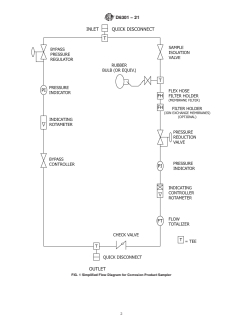
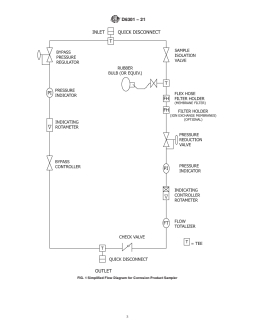
FIG. 1 Simplified Flow Diagram for Corrosion Product Sampler
D6301−21
suspended solids and ionic solids. An important feature of the 7. Apparatus
sampler is the flow totalizer, which accurately determines the
7.1 Sample heat exchanger, made of such material that full
total volume of sample that has passed through the sampler,
system pressure can be maintained within the coil, and of such
regardless of changes in flowrate or pressure during the
capacity that the water being sampled will be cooled to less
collection period. Control and pressure reducing valves and
than 50°C when the sampling flow rate is established (see
metering devices are downstream of the filter housing to
Practices D3370).
eliminate the possible contribution of suspended solids and
7.2 Corrosion Product Sampler—See Fig. 1.
ionic solids from these components to the sample stream.
Additional flow may bypass the filter housing, so that flows
7.3 Flow Totalizer—Water meter that will maintain 65%
within the sample lines are maintained within required range accuracy over full range.
(see Guide D3864). If a single sampling point is not represen-
tativeduetolackofhomogeneityintheprocessfluid(thewater 8. Reagents and Materials
being sampled), multiple point sampling may be required.
8.1 Reagent Water—References to water shall be under-
stood to mean water that meets or exceeds the quantitative
5. Significance and Use
specifications for Type III reagent water conforming to Speci-
5.1 The transport of any suspended solids or corrosion
fication D1193, Section 1.1.
products from the preboiler cycle has been shown to be
8.2 Anionresinimpregnatedmembranes(47-mmdiameter),
detrimental to all types of steam generating equipment. Cor-
optional.
rosion product transport as low as 10 ppb can have significant
8.3 Cation resin impregnated membranes (47-mm
impact on steam generators performance.
diameter), optional.
5.2 Deposited corrosion products on pressurized water re-
8.4 Membrane Filters, (47-mm diameter), 0.45-µm pore
actor (PWR) steam generator tubes can reduce heat transfer,
size, without grid.
and, if the deposit is sufficiently thick, can provide a local area
for impurities in the bulk water to concentrate, resulting in a
8.5 Petri Dishes, large enough to hold the 47-mm filters.
corrosive environment. In boiling water reactor (BWR) plants,
thetransportofcorrosionproductscancausefuelfailure,outof
9. Calibration
core radiation problems from activation reactions, and other
9.1 Calibratetheflowtotalizerfollowingthemanufacturer’s
material related problems.
recommendation.
5.3 In fossil plants, the transport of corrosion products can
reduce heat transfer in the boilers leading to tube failures from
10. Procedure
overheating. The removal of these corrosion products by
10.1 Ifsubsequentchemicalanalysisofcollectedsuspended
chemical cleaning is expensive and potentially harmful to the
solids/ionic solids is desired, r
...
This document is not an ASTM standard and is intended only to provide the user of an ASTM standard an indication of what changes have been made to the previous version. Because
it may not be technically possible to adequately depict all changes accurately, ASTM recommends that users consult prior editions as appropriate. In all cases only the current version
of the standard as published by ASTM is to be considered the official document.
Designation: D6301 − 13 D6301 − 21
Standard Practice for
Collection of On-Line Composite Samples of Suspended
Solids and Ionic Solids in Process Water
This standard is issued under the fixed designation D6301; the number immediately following the designation indicates the year of
original adoption or, in the case of revision, the year of last revision. A number in parentheses indicates the year of last reapproval. A
superscript epsilon (´) indicates an editorial change since the last revision or reapproval.
1. Scope
1.1 This practice is applicable for sampling condensed steam or water, such as boiler feedwater, for the collection of suspended
solids and (optional) ionic solids using a 0.45-μm membrane filter (suspended solids) and ion exchange media (ionic solids). As
the major suspended component found in most boiler feedwaters is some form of corrosion product from the preboiler system, the
device used for this practice is commonly called a corrosion product sampler.
1.2 The values stated in SI units are to be regarded as standard. No other units of measurement are included in this standard.
1.3 This standard does not purport to address all of the safety concerns, if any, associated with its use. It is the responsibility
of the user of this standard to establish appropriate safety safety, health, and healthenvironmental practices and determine the
applicability of regulatory limitations prior to use.
1.4 This international standard was developed in accordance with internationally recognized principles on standardization
established in the Decision on Principles for the Development of International Standards, Guides and Recommendations issued
by the World Trade Organization Technical Barriers to Trade (TBT) Committee.
2. Referenced Documents
2.1 ASTM Standards:
D1066 Practice for Sampling Steam
D1129 Terminology Relating to Water
D1193 Specification for Reagent Water
D1971 Practices for Digestion of Water Samples for Determination of Metals by Flame Atomic Absorption, Graphite Furnace
Atomic Absorption, Plasma Emission Spectroscopy, or Plasma Mass Spectrometry
D2332 Practice for Analysis of Water-Formed Deposits by Wavelength-Dispersive X-Ray Fluorescence
D2777 Practice for Determination of Precision and Bias of Applicable Test Methods of Committee D19 on Water
D3370 Practices for Sampling Water from Flowing Process Streams
D3864 Guide for On-Line Monitoring Systems for Water Analysis
3. Terminology
3.1 Definitions—Definitions: For definitions of terms used in this practice, refer to Terminology D1129.
This practice is under the jurisdiction of ASTM Committee D19 on Water and is the direct responsibility of Subcommittee D19.03 on Sampling Water and Water-Formed
Deposits, Analysis of Water for Power Generation and Process Use, On-Line Water Analysis, and Surveillance of Water.
Current edition approved July 15, 2013Dec. 1, 2021. Published August 2013December 2021. Originally approved in 1998. Last previous edition approved in 20082013
as D6301 – 08.D6301 – 13. DOI: 10.1520/D6301-13.10.1520/D6301-21.
For referenced ASTM standards, visit the ASTM website, www.astm.org, or contact ASTM Customer Service at service@astm.org. For Annual Book of ASTM Standards
volume information, refer to the standard’s Document Summary page on the ASTM website.
Copyright © ASTM International, 100 Barr Harbor Drive, PO Box C700, West Conshohocken, PA 19428-2959. United States
D6301 − 21
3.1.1 For definitions of terms used in this standard, refer to Terminology D1129.
3.2 Definitions of Terms Specific to This Standard:
3.2.1 corrosion product sampler, n—a device used to collect integrated samples of suspended solids and (as an option) ionic solids.
3.2.1.1 Discussion—
It consists of a flow totalizer that accurately measures the amount of sample passing through the device and a 0.45-μm pore size
membrane filter. Adding a second filter for ion exchange resin impregnated membranes allows for collecting ionic solids.
3.2.2 ionic solids, n—includes all matter that will pass through a 0.45-μm pore size filter and may be captured on anion, or cation
ion exchange membranes, or both.
3.2.3 suspended solids, n—includes all matter that is removed by a 0.45-μm pore size filter.
4. Summary of Practice
4.1 A typical sampling apparatus, or corrosion product sampler, is used to obtain integrated, representative samples of suspended
solids and ionic solids using a 0.45-μm membrane filter and ion exchange membranes. The sampling is accomplished at system
operating pressure or after pressure reduction, and sample temperature of ≤50°C. The practice utilizes a modified stainless steel
high pressure filter housing to accommodate a 47-mm diameter filter (for suspended solids) and if desired, ion exchange
membranes (for ionic solids). The sample collection system (corrosion product sampler) is designed and operated specifically for
quantitative collection of suspended solids and ionic solids. An important feature of the sampler is the flow totalizer, which
accurately determines the total volume of sample that has passed through the sampler, regardless of changes in flowrate or pressure
during the collection period. Control and pressure reducing valves and metering devices are downstream of the filter housing to
eliminate the possible contribution of suspended solids and ionic solids from these components to the sample stream. Additional
flow may bypass the filter housing, so that flows within the sample lines are maintained within required range (see Guide D3864).
If a single sampling point is not representative due to lack of homogeneity in the process fluid (the water being sampled), multiple
point sampling may be required.
5. Significance and Use
5.1 The transport of any suspended solids or corrosion products from the preboiler cycle has been shown to be detrimental to all
types of steam generating equipment. Corrosion product transport as low as 10 ppb can have significant impact on steam generators
performance.
5.2 Deposited corrosion products on PWR pressurized water reactor (PWR) steam generator tubes can reduce heat transfer, and,
if the deposit is sufficiently thick, can provide a local area for impurities in the bulk water to concentrate, resulting in a corrosive
environment. In BWR boiling water reactor (BWR) plants, the transport of corrosion products can cause fuel failure, out of core
radiation problems from activation reactions, and other material related problems.
5.3 In fossil plants, the transport of corrosion products can reduce heat transfer in the boilers leading to tube failures from
overheating. The removal of these corrosion products by chemical cleaning is expensive and potentially harmful to the boiler tubes.
5.4 Normally, grab samples are not sensitive enough to detect changes in the level of corrosion product transport. Also, system
transients may be missed by only taking grab samples. An integrated sample over time will increase the sensitivity for detecting
the corrosion products and provide a better understanding of the total corrosion product transport to steam generators.
6. Interferences
6.1 The ion exchange capacity may be exceeded if an excessive volume of sample is passed through the ion exchange media.
6.2 The removal efficiency of the ion exchange media is flowrate and matrix dependent and could show variations from lot to lot.
6.3 Sample temperature greater than 50°C may have deleterious effects on the ion exchange media.
6.4 The corrosion products collected on the 0.45-μm filter may be loose so care should be taken to prevent loss of sample.
D6301 − 21
FIG. 1 Simplified Flow Diagram for Corrosion Product Sampler
D6301 − 21
6.5 Due to settling, or deposition, or both, in sampling lines with low velocity, flow in sampling lines must be turbulent and
maintained at a velocity of 1.8 m/s (6 ft/s) (see also Practices D3370).
7. Apparatus
7.1 Sample heat exchanger, made of such material that full system pressure can be maintained within the coil, and of such capacity
...