

ASTM D3976-22
(Practice)Standard Practice for Preparation of Sediment Samples for Chemical Analysis
General Information
- Abstract
SIGNIFICANCE AND USE
5.1 The chemical analysis of sediments, collected from such locations as streams, rivers, ponds, lakes, and oceans can provide information of environmental significance.
5.2 Sediment samples are inherently heterogeneous in that they contain occluded water in varying and unpredictable amounts and may contain foreign objects or material not ordinarily considered as sediment, the inclusion of which would result in inaccurate analysis.
5.3 Standard methods for separating foreign objects to facilitate homogenization will minimize errors due to poor mixing and inclusion of extraneous material.
5.4 Standardized procedures for drying provide a means for reporting analytical values to a common dry weight basis.
SCOPE
1.1 This practice describes standard procedures for preparation of test samples (including the removal of occluded water and moisture) of field samples collected from locations such as streams, rivers, ponds, lakes, and oceans.
1.2 These procedures are applicable to the determination of volatile, semivolatile, and nonvolatile constituents of sediments.
1.3 The values stated in SI units are to be regarded as standard. No other units of measurement are included in this standard.
1.4 This standard does not purport to address all of the safety concerns, if any, associated with its use. It is the responsibility of the user of this standard to establish appropriate safety, health, and environmental practices and determine the applicability of regulatory limitations prior to use. For a specific precautionary statement, see Note 3.
1.5 This international standard was developed in accordance with internationally recognized principles on standardization established in the Decision on Principles for the Development of International Standards, Guides and Recommendations issued by the World Trade Organization Technical Barriers to Trade (TBT) Committee.
- Status
- Published
- Publication Date
- 30-Apr-2022
- Technical Committee
- D19 - Water
- Drafting Committee
- D19.07 - Sediments, Geomorphology, and Open-Channel Flow


Overview
ASTM D3976-22: Standard Practice for Preparation of Sediment Samples for Chemical Analysis provides standardized procedures for the preparation of sediment samples collected from diverse aquatic environments, such as streams, rivers, ponds, lakes, and oceans. This standard ensures consistency and reliability in the preparation of samples for the determination of volatile, semivolatile, and nonvolatile constituents. By following ASTM D3976-22, laboratories and environmental professionals can minimize analytical errors caused by sample heterogeneity and inconsistencies in moisture or contamination with foreign objects.
Key Topics
Sample Collection and Heterogeneity
- Sediment samples are inherently heterogeneous, with variations in moisture and the potential presence of non-sediment materials such as stones, organic debris, or man-made objects.
- The standard outlines the use of specific sieves (generally 10-mesh or 2 mm openings) to separate legitimate sediment from extraneous materials, ensuring that the analytical sample accurately represents the sediment matrix.
Sample Homogenization and Drying
- After sieving, samples are homogenized to minimize segregation or stratification. Homogenization is crucial to ensure consistent results in chemical analysis.
- Standardized drying procedures are provided to remove occluded water. This step is essential for reporting analytical values on a common dry weight basis, allowing for comparability across samples and laboratories.
Determination of Chemical Constituents
- The standard supports preparation for the measurement of volatile, semivolatile, and nonvolatile contaminants.
- Specific procedures address moisture determination and correction of analytical results to a consistent dry weight standard.
Safety and Regulatory Considerations
- Users of ASTM D3976-22 must ensure proper health, safety, and environmental controls and comply with applicable regulatory requirements during sample collection, handling, and analysis.
Applications
ASTM D3976-22 is widely applicable in environmental monitoring, regulatory compliance, and research:
Environmental Impact Assessments
- Sediment sample preparation is a foundational step in assessing chemical contamination and ecological health in aquatic systems. Accurate sample preparation enables reliable determination of pollutants, including heavy metals, pesticides, and organic contaminants.
Regulatory Compliance
- Agencies and laboratories employ this standard to ensure that analytical results meet the comparability and reproducibility required by regulatory frameworks.
Laboratory Quality Control
- The standard supports internal quality assurance programs by providing validated sample preparation protocols for sediments, improving overall data quality.
Research and Ecological Studies
- Consistent sediment sample preparation is crucial in long-term monitoring and research studies that compare contaminant levels across sites or over time.
Related Standards
For comprehensive chemical analysis of aquatic environments, ASTM D3976-22 references and complements several other ASTM standards:
- ASTM D1129 - Terminology Relating to Water
- ASTM D3370 - Practices for Sampling Water from Flowing Process Streams
- ASTM D596 - Guide for Reporting Results of Analysis of Water
- ASTM D4410 - Terminology for Fluvial Sediment
Together, these standards establish a robust framework for the accurate and consistent analysis of water and sediment samples, supporting environmental protection, compliance, and high-quality research.
Keywords: ASTM D3976-22, sediment sample preparation, chemical analysis, environmental monitoring, sediment homogenization, analytical standards, volatile constituents, nonvolatile constituents, moisture correction, laboratory procedures, environmental compliance
Relations
- Effective Date
- 01-May-2020
- Effective Date
- 01-Jan-2016
- Effective Date
- 01-May-2011
- Effective Date
- 01-Dec-2010
- Effective Date
- 01-Mar-2010
- Effective Date
- 01-Feb-2010
- Effective Date
- 01-Oct-2008
- Effective Date
- 01-Dec-2007
- Effective Date
- 01-Sep-2006
- Effective Date
- 01-Sep-2006
- Effective Date
- 15-Aug-2006
- Effective Date
- 15-Feb-2006
- Effective Date
- 01-Mar-2004
- Effective Date
- 01-Mar-2004
- Effective Date
- 10-Aug-2003
Get Certified
Connect with accredited certification bodies for this standard

CIS Institut d.o.o.
Personal Protective Equipment (PPE) certification body. Notified Body NB-2890 for EU Regulation 2016/425 PPE.

Kiwa BDA Testing
Building and construction product certification.
Kmetijski inštitut Slovenije
Agricultural Institute of Slovenia. Soil testing, plant health, agricultural product analysis.
Sponsored listings
Frequently Asked Questions
ASTM D3976-22 is a standard published by ASTM International. Its full title is "Standard Practice for Preparation of Sediment Samples for Chemical Analysis". This standard covers: SIGNIFICANCE AND USE 5.1 The chemical analysis of sediments, collected from such locations as streams, rivers, ponds, lakes, and oceans can provide information of environmental significance. 5.2 Sediment samples are inherently heterogeneous in that they contain occluded water in varying and unpredictable amounts and may contain foreign objects or material not ordinarily considered as sediment, the inclusion of which would result in inaccurate analysis. 5.3 Standard methods for separating foreign objects to facilitate homogenization will minimize errors due to poor mixing and inclusion of extraneous material. 5.4 Standardized procedures for drying provide a means for reporting analytical values to a common dry weight basis. SCOPE 1.1 This practice describes standard procedures for preparation of test samples (including the removal of occluded water and moisture) of field samples collected from locations such as streams, rivers, ponds, lakes, and oceans. 1.2 These procedures are applicable to the determination of volatile, semivolatile, and nonvolatile constituents of sediments. 1.3 The values stated in SI units are to be regarded as standard. No other units of measurement are included in this standard. 1.4 This standard does not purport to address all of the safety concerns, if any, associated with its use. It is the responsibility of the user of this standard to establish appropriate safety, health, and environmental practices and determine the applicability of regulatory limitations prior to use. For a specific precautionary statement, see Note 3. 1.5 This international standard was developed in accordance with internationally recognized principles on standardization established in the Decision on Principles for the Development of International Standards, Guides and Recommendations issued by the World Trade Organization Technical Barriers to Trade (TBT) Committee.
SIGNIFICANCE AND USE 5.1 The chemical analysis of sediments, collected from such locations as streams, rivers, ponds, lakes, and oceans can provide information of environmental significance. 5.2 Sediment samples are inherently heterogeneous in that they contain occluded water in varying and unpredictable amounts and may contain foreign objects or material not ordinarily considered as sediment, the inclusion of which would result in inaccurate analysis. 5.3 Standard methods for separating foreign objects to facilitate homogenization will minimize errors due to poor mixing and inclusion of extraneous material. 5.4 Standardized procedures for drying provide a means for reporting analytical values to a common dry weight basis. SCOPE 1.1 This practice describes standard procedures for preparation of test samples (including the removal of occluded water and moisture) of field samples collected from locations such as streams, rivers, ponds, lakes, and oceans. 1.2 These procedures are applicable to the determination of volatile, semivolatile, and nonvolatile constituents of sediments. 1.3 The values stated in SI units are to be regarded as standard. No other units of measurement are included in this standard. 1.4 This standard does not purport to address all of the safety concerns, if any, associated with its use. It is the responsibility of the user of this standard to establish appropriate safety, health, and environmental practices and determine the applicability of regulatory limitations prior to use. For a specific precautionary statement, see Note 3. 1.5 This international standard was developed in accordance with internationally recognized principles on standardization established in the Decision on Principles for the Development of International Standards, Guides and Recommendations issued by the World Trade Organization Technical Barriers to Trade (TBT) Committee.
ASTM D3976-22 is classified under the following ICS (International Classification for Standards) categories: 13.060.45 - Examination of water in general. The ICS classification helps identify the subject area and facilitates finding related standards.
ASTM D3976-22 has the following relationships with other standards: It is inter standard links to ASTM D1129-13(2020)e2, ASTM D4410-16, ASTM D596-01(2011), ASTM D3370-10, ASTM D1129-10, ASTM D4410-10, ASTM D3370-08, ASTM D3370-07, ASTM D1129-06a, ASTM D1129-06ae1, ASTM D596-01(2006), ASTM D1129-06, ASTM D1129-04e1, ASTM D1129-04, ASTM D1129-03a. Understanding these relationships helps ensure you are using the most current and applicable version of the standard.
ASTM D3976-22 is available in PDF format for immediate download after purchase. The document can be added to your cart and obtained through the secure checkout process. Digital delivery ensures instant access to the complete standard document.
Standards Content (Sample)
This international standard was developed in accordance with internationally recognized principles on standardization established in the Decision on Principles for the
Development of International Standards, Guides and Recommendations issued by the World Trade Organization Technical Barriers to Trade (TBT) Committee.
Designation: D3976 − 22
Standard Practice for
Preparation of Sediment Samples for Chemical Analysis
This standard is issued under the fixed designation D3976; the number immediately following the designation indicates the year of
original adoption or, in the case of revision, the year of last revision. A number in parentheses indicates the year of last reapproval. A
superscript epsilon (´) indicates an editorial change since the last revision or reapproval.
1. Scope D4410 Terminology for Fluvial Sediment
1.1 This practice describes standard procedures for prepa-
3. Terminology
ration of test samples (including the removal of occluded water
3.1 Definitions—For definitions of terms used in this
and moisture) of field samples collected from locations such as
practice, refer to Terminologies D1129 and D4410.
streams, rivers, ponds, lakes, and oceans.
4. Summary of Practice
1.2 These procedures are applicable to the determination of
volatile, semivolatile, and nonvolatile constituents of sedi-
4.1 Samples collected (see Practice D3370 and Guide
ments.
D1192)inthefieldarescreenedtoremoveforeignobjectsprior
to homogenization for chemical examination and analysis.
1.3 The values stated in SI units are to be regarded as
Large objects are mechanically removed and small ones are
standard. No other units of measurement are included in this
eliminated by sieving the sample through a 10-mesh (2 mm
standard.
openings) sieve.
1.4 This standard does not purport to address all of the
4.2 Wet, sieved samples are mixed for preliminary
safety concerns, if any, associated with its use. It is the
responsibility of the user of this standard to establish appro- homogenization, then allowed to settle to remove most of the
occluded water.
priate safety, health, and environmental practices and deter-
mine the applicability of regulatory limitations prior to use.
4.3 Moisture determinations are made on separate samples
For a specific precautionary statement, see Note 3.
from those analyzed for volatile or semivolatile constituents.
1.5 This international standard was developed in accor-
4.4 Analyses for volatile constituents are made using wet,
dance with internationally recognized principles on standard-
settled samples from which supernatant liquid has been re-
ization established in the Decision on Principles for the
moved by decantation. The results are corrected to those that
Development of International Standards, Guides and Recom-
would have been obtained on samples dried to constant weight
mendations issued by the World Trade Organization Technical
at 105 °C 6 2 °C, on the basis of a moisture determination
Barriers to Trade (TBT) Committee.
using a separate sample.
2. Referenced Documents
4.5 Analyses for semivolatile constituents (for example,
2.1 ASTM Standards: mercury) are made on samples previously dried at a tempera-
D596 Guide for Reporting Results of Analysis of Water ture found to be adequate for the purpose, and specified in the
D1129 Terminology Relating to Water corresponding analytical procedure.
D1192 Guide for Equipment for Sampling Water and Steam
4.6 Analyses for nonvolatile constituents are made on
in Closed Conduits (Withdrawn 2003)
samples previously dried to constant weight at 105 °C 6 2 °C.
D3370 Practices for Sampling Water from Flowing Process
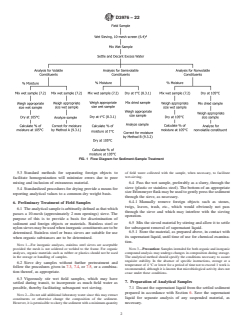
4.7 A flow diagram, outlining typical procedures, is shown
Streams
in Fig. 1.
5. Significance and Use
This practice is under the jurisdiction of ASTM Committee D19 on Water and
is the direct responsibility of Subcommittee D19.07 on Sediments, Geomorphology,
5.1 Thechemicalanalysisofsediments,collectedfromsuch
and Open-Channel Flow.
locations as streams, rivers, ponds, lakes, and oceans can
Current edition approved May 1, 2022. Published June 2022. Originally
approved in 1980. Last previous edition approved in 2015 as D3976 – 92 (2015).
provide information of environmental significance.
DOI: 10.1520/D3976-22.
5.2 Sediment samples are inherently heterogeneous in that
For referenced ASTM standards, visit the ASTM website, www.astm.org, or
contact ASTM Customer Service at service@astm.org. For Annual Book of ASTM
they contain occluded water in varying and unpredictable
Standards volume information, refer to the standard’s Document Summary page on
amounts and may contain foreign objects or material not
the ASTM website.
ordinarily considered as sediment, the inclusion of which
The last approved version of this historical standard is referenced on
www.astm.org. would result in inaccurate analysis.
Copyright © ASTM International, 100 Barr Harbor Drive, PO Box C700, West Conshohocken, PA 19428-2959. United States
D3976 − 22
FIG. 1 Flow Diagram for Sediment-Sample Treatment
of field water collected with the sample, when necessary, to facilitate
5.3 Standard methods for separating foreign objects to
wet-sieving.
facilitate homogenization will minimize errors due to poor
mixing and inclusion of extraneous material. 6.4 Pass the wet sample, preferably as a slurry, through the
sieve (plastic or stainless steel). The bottom of an appropriate
5.4 Standardized procedures for drying provide a means for
size Erlenmeyer flask may be used to gently press the sediment
reporting analytical values to a common dry weight basis.
through the sieve, as necessary.
6.4.1 Manually remove foreign objects such as stones,
6. Preliminary Treatment of Field Samples
twigs, leaves, trash, etc., which would obviously not pass
6.1 Theanalyticalsampleisarbitrarilydefinedasthatwhich
through the sieve and which may interfere with the sieving
passes a 10-mesh (approximately 2 mm openings) sieve. The
operation.
purpose of this is to provide a basis for discrimination of
6.5 Mix the sieved material by stirring and allow it to settle
sediment and foreign objects or materials. Stainless steel or
for subsequent removal of supernatant liquid.
nylonsievesmaybeusedwheninorganicconstituentsaretobe
6.5.1 Store the material, as prepared above, in contact with
determined. Stainless steel or
...
This document is not an ASTM standard and is intended only to provide the user of an ASTM standard an indication of what changes have been made to the previous version. Because
it may not be technically possible to adequately depict all changes accurately, ASTM recommends that users consult prior editions as appropriate. In all cases only the current version
of the standard as published by ASTM is to be considered the official document.
Designation: D3976 − 92 (Reapproved 2015) D3976 − 22
Standard Practice for
Preparation of Sediment Samples for Chemical
Analysis Analysis
This standard is issued under the fixed designation D3976; the number immediately following the designation indicates the year of
original adoption or, in the case of revision, the year of last revision. A number in parentheses indicates the year of last reapproval. A
superscript epsilon (´) indicates an editorial change since the last revision or reapproval.
1. Scope
1.1 This practice describes standard procedures for preparation of test samples (including the removal of occluded water and
moisture) of field samples collected from locations such as streams, rivers, ponds, lakes, and oceans.
1.2 These procedures are applicable to the determination of volatile, semivolatile, and nonvolatile constituents of sediments.
1.3 The values stated in SI units are to be regarded as standard. No other units of measurement are included in this standard.
1.4 This standard does not purport to address all of the safety concerns, if any, associated with its use. It is the responsibility
of the user of this standard to establish appropriate safety safety, health, and healthenvironmental practices and determine the
applicability of regulatory limitations prior to use. For a specific precautionary statement, see Note 3.
1.5 This international standard was developed in accordance with internationally recognized principles on standardization
established in the Decision on Principles for the Development of International Standards, Guides and Recommendations issued
by the World Trade Organization Technical Barriers to Trade (TBT) Committee.
2. Referenced Documents
2.1 ASTM Standards:
D596 Guide for Reporting Results of Analysis of Water
D1129 Terminology Relating to Water
D1192 Guide for Equipment for Sampling Water and Steam in Closed Conduits (Withdrawn 2003)
D3370 Practices for Sampling Water from Flowing Process Streams
D4410 Terminology for Fluvial Sediment
3. Terminology
3.1 Definitions—For definitions of terms used in this practice, refer to Terminologies D1129 and D4410.
4. Summary of Practice
4.1 Samples collected (see Practice D3370 and SpecificationGuide D1192) in the field are screened to remove foreign objects prior
This practice is under the jurisdiction of ASTM Committee D19 on Water and is the direct responsibility of Subcommittee D19.07 on Sediments, Geomorphology, and
Open-Channel Flow.
Current edition approved Jan. 1, 2015May 1, 2022. Published January 2015June 2022. Originally approved in 1980. Last previous edition approved in 20102015 as
D3976 – 92 (2010).(2015). DOI: 10.1520/D3976-92R15.10.1520/D3976-22.
For referenced ASTM standards, visit the ASTM website, www.astm.org, or contact ASTM Customer Service at service@astm.org. For Annual Book of ASTM Standards
volume information, refer to the standard’s Document Summary page on the ASTM website.
The last approved version of this historical standard is referenced on www.astm.org.
Copyright © ASTM International, 100 Barr Harbor Drive, PO Box C700, West Conshohocken, PA 19428-2959. United States
D3976 − 22
to homogenization for chemical examination and analysis. Large objects are mechanically removed and small ones are eliminated
by sieving the sample through a 10-mesh (2 mm openings) sieve.
4.2 Wet, sieved samples are mixed for preliminary homogenization, then allowed to settle to remove most of the occluded water.
4.3 Moisture determinations are made on separate samples from those analyzed for volatile or semivolatile constituents.
4.4 Analyses for volatile constituents are made using wet, settled samples from which supernatant liquid has been removed by
decantation. The results are corrected to those that would have been obtained on samples dried to constant weight at 105105 °C
6 2°C,2 °C, on the basis of a moisture determination using a separate sample.
4.5 Analyses for semivolatile constituents (for example, mercury) are made on samples previously dried at a temperature found
to be adequate for the purpose, and specified in the corresponding analytical procedure.
4.6 Analyses for nonvolatile constituents are made on samples previously dried to constant weight at 105105 °C 6 2°C.2 °C.
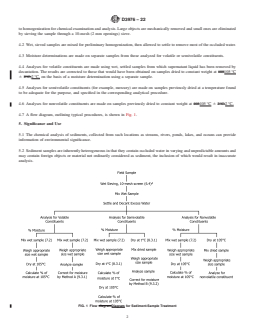
4.7 A flow diagram, outlining typical procedures, is shown in Fig. 1.
5. Significance and Use
5.1 The chemical analysis of sediments, collected from such locations as streams, rivers, ponds, lakes, and oceans can provide
information of environmental significance.
5.2 Sediment samples are inherently heterogeneous in that they contain occluded water in varying and unpredictable amounts and
may contain foreign objects or material not ordinarily considered as sediment, the inclusion of which would result in inaccurate
analysis.
FIG. 1 Flow diagramDiagram for Sediment-Sample Treatment
D3976 − 22
5.3 Standard methods for separating foreign objects to facilitate homogenization will minimize errors due to poor mixing and
inclusion of extraneous material.
5.4 Standardized procedures for drying provide a means for reporting analytical values to a common dry weight basis.
6. Preliminary Treatment of Field Samples
6.1 The analytical sample is arbitrarily defined as that which passes a 10-mesh (approximately 2 mm openings) sieve. The purpose
of this is to provide a basis for discrimination of sediment and foreign objects or materials. Stainless steel or nylon sieves may be
used when inorganic constituents are to be determined. Stainless steel or brass sieves are suitable for use when organic substances
are to be determined.
NOTE 1—For inorganic analyses, stainless steel sieves are acceptable provided the mesh is not soldered or welded to the frame. For organic analyses,
organic materials such as rubber or plastics should not be used in the storage or handling of samples.
6.2 Sieve dry samples without further pretreatment and follow the procedures given in 7.3, 7.4, or 7.5, or a combination thereof,
as appropriate.
6.3 Vigorously stir wet field samples, which may have settled du
...