

ASTM E1584-23
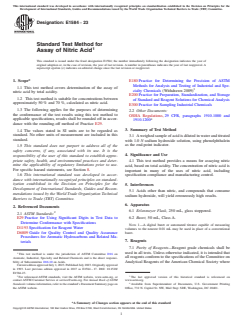
(Test Method)Standard Test Method for Assay of Nitric Acid
General Information
- Abstract
SIGNIFICANCE AND USE
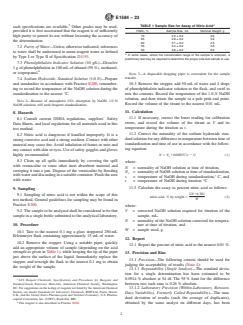
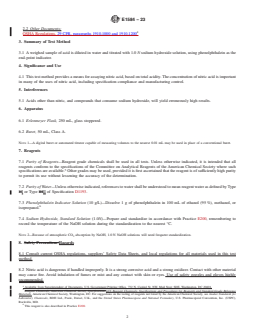
4.1 This test method provides a means for assaying nitric acid, based on total acidity. The concentration of nitric acid is important in many of the uses of nitric acid, including specification compliance and manufacturing control.
SCOPE
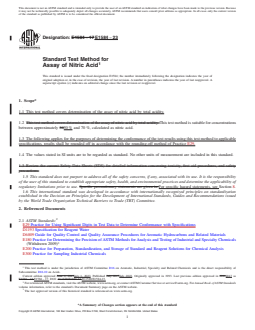
1.1 This test method covers determination of the assay of nitric acid by total acidity.
1.2 This test method is suitable for concentrations between approximately 50 % and 70 %, calculated as nitric acid.
1.3 The following applies for the purposes of determining the conformance of the test results using this test method to applicable specifications, results shall be rounded off in accordance with the rounding-off method of Practice E29.
1.4 The values stated in SI units are to be regarded as standard. No other units of measurement are included in this standard.
1.5 This standard does not purport to address all of the safety concerns, if any, associated with its use. It is the responsibility of the user of this standard to establish appropriate safety, health, and environmental practices and determine the applicability of regulatory limitations prior to use. For specific hazard statements, see Section 8.
1.6 This international standard was developed in accordance with internationally recognized principles on standardization established in the Decision on Principles for the Development of International Standards, Guides and Recommendations issued by the World Trade Organization Technical Barriers to Trade (TBT) Committee.
- Status
- Published
- Publication Date
- 30-Jun-2023
- Technical Committee
- D16 - Aromatic, Industrial, Specialty and Related Chemicals
- Drafting Committee
- D16.10 - Acids


Overview
ASTM E1584-23: Standard Test Method for Assay of Nitric Acid is a widely recognized analytical standard developed by ASTM International. This method provides laboratories and industrial users with a reliable procedure for determining the assay (concentration) of nitric acid based on total acidity. Precise quantification of nitric acid is essential for specification compliance, process control, and safe handling across industries. Applicable for nitric acid concentrations between approximately 50% and 70%, this standard ensures accuracy and repeatability in quality assurance and regulatory settings.
Key Topics
- Assay of Nitric Acid: Specifies a titrimetric method using sodium hydroxide and phenolphthalein to determine total acidity, directly correlating to nitric acid concentration.
- Applicable Concentration Range: Suitable for nitric acid solutions with concentrations from 50% to 70%.
- Compliant Reporting: Results must be reported and rounded according to ASTM E29, ensuring consistency in specification compliance.
- Precision and Bias: Provides reproducibility and repeatability estimates across single- and multi-laboratory settings, supporting effective quality control.
- Quality Assurance: Encourages rigorous laboratory quality control and participation in interlaboratory testing for reliable results across different facilities.
- Safety Considerations: Outlines the importance of appropriate safety, health, and environmental practices, referencing OSHA regulations and emphasizing the handling hazards of nitric acid.
Applications
- Industrial Manufacturing: Widely used in quality control labs and production lines to monitor nitric acid strength for chemicals manufacturing, etching processes, fertilizers, and explosives.
- Regulatory Compliance: Assures that supplied nitric acid meets industry and customer specifications by providing standardized assay results.
- Research Laboratories: Supports academic and industrial research that requires precise nitric acid quantification for reproducible experimental outcomes.
- Supplier and Customer Verification: Establishes confidence in traded nitric acid, as results from different labs are directly comparable when following this method.
- Product Development: Enables formulators to verify acid concentration during development and scale-up of chemical products.
Related Standards
- ASTM E29: Practice for Using Significant Digits in Test Data to Determine Conformance with Specifications - required for rounding and reporting results.
- ASTM D1193: Specification for Reagent Water - outlines water purity requirements for analytical methods.
- ASTM D6809: Guide for Quality Control and Quality Assurance Procedures for Aromatic Hydrocarbons and Related Materials - referenced for laboratory quality protocols.
- ASTM E200: Practice for Preparation, Standardization, and Storage of Standard and Reagent Solutions for Chemical Analysis - guidance for standard solution preparation.
- ASTM E300: Practice for Sampling Industrial Chemicals - provides general guidance on sampling procedures.
- OSHA Regulations (29 CFR 1910.1000 and 1910.1200): Reference for safety, health, and hazard communication regulations essential when handling nitric acid.
Practical Value
Using ASTM E1584-23 for the assay of nitric acid brings several advantages:
- Consistency: Standardized titrimetric method improves the reliability and uniformity of results.
- Traceability: Aligns with international quality systems and laboratory accreditation requirements.
- Safety: Encourages adherence to best practices for chemical safety and environmental compliance.
- Interoperability: Facilitates mutual recognition of results among suppliers, customers, and regulators.
Regular use of this standard supports the safe, efficient, and transparent handling of nitric acid in industry, driving both operational excellence and regulatory compliance. For organizations seeking robust nitric acid assay methods, ASTM E1584-23 remains the authoritative reference.
Relations
- Effective Date
- 01-Nov-2016
- Effective Date
- 01-Oct-2008
- Effective Date
- 01-Jun-2007
- Effective Date
- 15-Nov-2006
- Effective Date
- 15-Sep-2006
- Effective Date
- 01-May-2006
- Effective Date
- 01-Mar-2006
- Effective Date
- 01-Dec-2004
- Effective Date
- 10-Jun-2002
- Effective Date
- 10-May-2002
- Effective Date
- 10-May-1999
- Effective Date
- 10-Feb-1999
- Effective Date
- 10-Feb-1999
Get Certified
Connect with accredited certification bodies for this standard

ECOCERT
Organic and sustainability certification.

Eurofins Food Testing Global
Global leader in food, environment, and pharmaceutical product testing.

Intertek Bangladesh
Intertek certification and testing services in Bangladesh.
Sponsored listings
Frequently Asked Questions
ASTM E1584-23 is a standard published by ASTM International. Its full title is "Standard Test Method for Assay of Nitric Acid". This standard covers: SIGNIFICANCE AND USE 4.1 This test method provides a means for assaying nitric acid, based on total acidity. The concentration of nitric acid is important in many of the uses of nitric acid, including specification compliance and manufacturing control. SCOPE 1.1 This test method covers determination of the assay of nitric acid by total acidity. 1.2 This test method is suitable for concentrations between approximately 50 % and 70 %, calculated as nitric acid. 1.3 The following applies for the purposes of determining the conformance of the test results using this test method to applicable specifications, results shall be rounded off in accordance with the rounding-off method of Practice E29. 1.4 The values stated in SI units are to be regarded as standard. No other units of measurement are included in this standard. 1.5 This standard does not purport to address all of the safety concerns, if any, associated with its use. It is the responsibility of the user of this standard to establish appropriate safety, health, and environmental practices and determine the applicability of regulatory limitations prior to use. For specific hazard statements, see Section 8. 1.6 This international standard was developed in accordance with internationally recognized principles on standardization established in the Decision on Principles for the Development of International Standards, Guides and Recommendations issued by the World Trade Organization Technical Barriers to Trade (TBT) Committee.
SIGNIFICANCE AND USE 4.1 This test method provides a means for assaying nitric acid, based on total acidity. The concentration of nitric acid is important in many of the uses of nitric acid, including specification compliance and manufacturing control. SCOPE 1.1 This test method covers determination of the assay of nitric acid by total acidity. 1.2 This test method is suitable for concentrations between approximately 50 % and 70 %, calculated as nitric acid. 1.3 The following applies for the purposes of determining the conformance of the test results using this test method to applicable specifications, results shall be rounded off in accordance with the rounding-off method of Practice E29. 1.4 The values stated in SI units are to be regarded as standard. No other units of measurement are included in this standard. 1.5 This standard does not purport to address all of the safety concerns, if any, associated with its use. It is the responsibility of the user of this standard to establish appropriate safety, health, and environmental practices and determine the applicability of regulatory limitations prior to use. For specific hazard statements, see Section 8. 1.6 This international standard was developed in accordance with internationally recognized principles on standardization established in the Decision on Principles for the Development of International Standards, Guides and Recommendations issued by the World Trade Organization Technical Barriers to Trade (TBT) Committee.
ASTM E1584-23 is classified under the following ICS (International Classification for Standards) categories: 71.060.30 - Acids. The ICS classification helps identify the subject area and facilitates finding related standards.
ASTM E1584-23 has the following relationships with other standards: It is inter standard links to ASTM D6809-02(2016), ASTM E29-08, ASTM D6809-02(2007), ASTM E29-06b, ASTM E29-06a, ASTM E29-06, ASTM D1193-06, ASTM E29-04, ASTM D6809-02, ASTM E29-02e1, ASTM E29-93a(1999), ASTM D1193-99e1, ASTM D1193-99. Understanding these relationships helps ensure you are using the most current and applicable version of the standard.
ASTM E1584-23 is available in PDF format for immediate download after purchase. The document can be added to your cart and obtained through the secure checkout process. Digital delivery ensures instant access to the complete standard document.
Standards Content (Sample)
This international standard was developed in accordance with internationally recognized principles on standardization established in the Decision on Principles for the
Development of International Standards, Guides and Recommendations issued by the World Trade Organization Technical Barriers to Trade (TBT) Committee.
Designation: E1584 − 23
Standard Test Method for
Assay of Nitric Acid
This standard is issued under the fixed designation E1584; the number immediately following the designation indicates the year of
original adoption or, in the case of revision, the year of last revision. A number in parentheses indicates the year of last reapproval. A
superscript epsilon (´) indicates an editorial change since the last revision or reapproval.
1. Scope* E180 Practice for Determining the Precision of ASTM
Methods for Analysis and Testing of Industrial and Spe-
1.1 This test method covers determination of the assay of
cialty Chemicals (Withdrawn 2009)
nitric acid by total acidity.
E200 Practice for Preparation, Standardization, and Storage
1.2 This test method is suitable for concentrations between
of Standard and Reagent Solutions for Chemical Analysis
approximately 50 % and 70 %, calculated as nitric acid.
E300 Practice for Sampling Industrial Chemicals
1.3 The following applies for the purposes of determining
2.2 Other Documents:
the conformance of the test results using this test method to
OSHA Regulations, 29 CFR, paragraphs 1910.1000 and
applicable specifications, results shall be rounded off in accor-
1910.1200
dance with the rounding-off method of Practice E29.
3. Summary of Test Method
1.4 The values stated in SI units are to be regarded as
standard. No other units of measurement are included in this
3.1 A weighed sample of acid is diluted in water and titrated
standard.
with 1.0 N sodium hydroxide solution, using phenolphthalein
as the end-point indicator.
1.5 This standard does not purport to address all of the
safety concerns, if any, associated with its use. It is the
4. Significance and Use
responsibility of the user of this standard to establish appro-
priate safety, health, and environmental practices and deter-
4.1 This test method provides a means for assaying nitric
mine the applicability of regulatory limitations prior to use.
acid, based on total acidity. The concentration of nitric acid is
For specific hazard statements, see Section 8.
important in many of the uses of nitric acid, including
1.6 This international standard was developed in accor-
specification compliance and manufacturing control.
dance with internationally recognized principles on standard-
ization established in the Decision on Principles for the 5. Interferences
Development of International Standards, Guides and Recom-
5.1 Acids other than nitric, and compounds that consume
mendations issued by the World Trade Organization Technical
sodium hydroxide, will yield erroneously high results.
Barriers to Trade (TBT) Committee.
6. Apparatus
2. Referenced Documents
6.1 Erlenmeyer Flask, 250 mL, glass stoppered.
2.1 ASTM Standards:
6.2 Buret, 50 mL, Class A.
E29 Practice for Using Significant Digits in Test Data to
Determine Conformance with Specifications
NOTE 1—A digital buret or automated titrator capable of measuring
D1193 Specification for Reagent Water
volumes to the nearest 0.01 mL may be used in place of a conventional
D6809 Guide for Quality Control and Quality Assurance buret.
Procedures for Aromatic Hydrocarbons and Related Ma-
7. Reagents
terials
7.1 Purity of Reagents—Reagent grade chemicals shall be
used in all tests. Unless otherwise indicated, it is intended that
This test method is under the jurisdiction of ASTM Committee D16 on
all reagents conform to the specifications of the Committee on
Aromatic, Industrial, Specialty and Related Chemicals and is the direct responsi-
bility of Subcommittee D16.10 on Acids.
Analytical Reagents of the American Chemical Society where
Current edition approved July 1, 2023. Published July 2023. Originally approved
in 1993. Last previous edition approved in 2017 as E1584 – 17. DOI: 10.1520/
E1584-23.
2 3
For referenced ASTM standards, visit the ASTM website, www.astm.org, or The last approved version of this historical standard is referenced on
contact ASTM Customer Service at service@astm.org. For Annual Book of ASTM www.astm.org.
Standards volume information, refer to the standard’s Document Summary page on Available from Superintendent of Documents, U.S. Government Printing
the ASTM website. Office, 732 N. Capitol St. NW, Mail Stop: SDE, Washington, DC 20401.
*A Summary of Changes section appears at the end of this standard
Copyright © ASTM International, 100 Barr Harbor Drive, PO Box C700, West Conshohocken, PA 19428-2959. United States
E1584 − 23
5 A
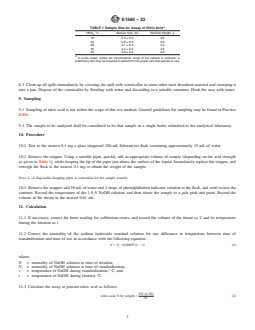
TABLE 1 Sample Size for Assay of Nitric Acid
such specifications are available. Other grades may be used,
HNO , % Sample Size, mL Nominal Weight, g
provided it is first ascertained that the reagent is of sufficiently 3
70 2.5 ± 0.2 3.6
high purity to permit its use without lessening the accuracy of
65 2.8 ± 0.2 3.9
the determination.
60 3.1 ± 0.2 4.3
55 3.4 ± 0.2 4.6
7.2 Purity of Water—Unless otherwise indicated, references
50 3.8 ± 0.2 5.0
to water shall be understood to mean reagent water as defined
A
In some cases, where the concentration range of the sample is unknown, a
by Type I or Type II of Specification D1193.
preliminary test may be required to determine the proper size test sample to use.
7.3 Phenolphthalein Indicator Solution (10 g/L)—Dissolve
1 g of phenolphthalein in 100 mL of ethanol (95 %), methanol,
or isopropanol.
NOTE 3—A disposable dropping pipet is convenient for the sample
transfer.
7.4 Sodium Hydroxide, Standard Solution (1.0 N)—Prepare
and standardize in accordance with Practice E200, remember- 10.3 Remove the stopper, add 50 mL of water and 4 drops
ing to record the temperature of the NaOH solution during the
of phenolphthalein indicator solution to the flask, and swirl to
standardization to the nearest °C.
mix the contents. Record the temperature of the 1.0 N NaOH
solution, and then titrate the sample to a pale pink end point.
NOTE 2—Because of atmospheric CO absorption by NaOH, 1.0 N
Record the volume of the titrant to the nearest 0.01 mL.
NaOH solutions will need frequent standardization.
11. Calculation
8. Hazards
11.1 If necessary, correct the buret reading for calibration
8.1 Consult current OSHA regulations, suppliers’ Safety
errors, and record the volume of the titrant as V and its
Data Sheets, and local regulations for all materials used in this
temperature during the titration as t.
test method.
11.2 Correct the normality of the sodium hydroxide stan-
8.2 Nitric acid is dangerous if handled improperly. It is a
dard solution for any difference in temperature between time of
strong corrosive acid and a strong oxidizer. Contact with other
standardization and time of use in accordance with the follow-
material may cause fire. Avoid inhalation of fumes or mist and
ing equation:
any contact with skin or eyes. Use of safety goggles and gloves
highly recommended.
N 5 N 10.00035 ~s 2 t! (1)
s
8.3 Clean up all spills immediately by covering the spill
where:
with vermiculite or some other inert absorbent material and
N = normality of NaOH
...
This document is not an ASTM standard and is intended only to provide the user of an ASTM standard an indication of what changes have been made to the previous version. Because
it may not be technically possible to adequately depict all changes accurately, ASTM recommends that users consult prior editions as appropriate. In all cases only the current version
of the standard as published by ASTM is to be considered the official document.
Designation: E1584 − 17 E1584 − 23
Standard Test Method for
Assay of Nitric Acid
This standard is issued under the fixed designation E1584; the number immediately following the designation indicates the year of
original adoption or, in the case of revision, the year of last revision. A number in parentheses indicates the year of last reapproval. A
superscript epsilon (´) indicates an editorial change since the last revision or reapproval.
1. Scope*
1.1 This test method covers determination of the assay of nitric acid by total acidity.
1.2 This test method covers determination of the assay of nitric acid by total acidity. This test method is suitable for concentrations
between approximately 5050 % and 70 %, calculated as nitric acid.
1.3 The following applies for the purposes of determining the conformance of the test results using this test method to applicable
specifications, results shall be rounded off in accordance with the rounding-off method of Practice E29.
1.4 The values stated in SI units are to be regarded as standard. No other units of measurement are included in this standard.
1.3 Review the current Safety Data Sheets (SDS) for detailed information concerning toxicity, first aid procedures, and safety
precautions.
1.5 This standard does not purport to address all of the safety concerns, if any, associated with its use. It is the responsibility
of the user of this standard to establish appropriate safety, health, and environmental practices and determine the applicability of
regulatory limitations prior to use. Specific precautionary statements are given in For specific hazard statements, see Section 8.
1.6 This international standard was developed in accordance with internationally recognized principles on standardization
established in the Decision on Principles for the Development of International Standards, Guides and Recommendations issued
by the World Trade Organization Technical Barriers to Trade (TBT) Committee.
2. Referenced Documents
2.1 ASTM Standards:
E29 Practice for Using Significant Digits in Test Data to Determine Conformance with Specifications
D1193 Specification for Reagent Water
D6809 Guide for Quality Control and Quality Assurance Procedures for Aromatic Hydrocarbons and Related Materials
E180 Practice for Determining the Precision of ASTM Methods for Analysis and Testing of Industrial and Specialty Chemicals
(Withdrawn 2009)
E200 Practice for Preparation, Standardization, and Storage of Standard and Reagent Solutions for Chemical Analysis
E300 Practice for Sampling Industrial Chemicals
This test method is under the jurisdiction of ASTM Committee D16 on Aromatic, Industrial, Specialty and Related Chemicals and is the direct responsibility of
Subcommittee D16.10 on Acids.
Current edition approved June 1, 2017July 1, 2023. Published July 2017July 2023. Originally approved in 1993. Last previous edition approved in 20112017 as
E1584 – 11.E1584 – 17. DOI: 10.1520/E1584-17.10.1520/E1584-23.
For referenced ASTM standards, visit the ASTM website, www.astm.org, or contact ASTM Customer Service at service@astm.org. For Annual Book of ASTM Standards
volume information, refer to the standard’s Document Summary page on the ASTM website.
The last approved version of this historical standard is referenced on www.astm.org.
*A Summary of Changes section appears at the end of this standard
Copyright © ASTM International, 100 Barr Harbor Drive, PO Box C700, West Conshohocken, PA 19428-2959. United States
E1584 − 23
2.2 Other Documents:
OSHA Regulations, 29 CFR, paragraphs 1910.1000 and 1910.1200
3. Summary of Test Method
3.1 A weighed sample of acid is diluted in water and titrated with 1.0 N sodium hydroxide solution, using phenolphthalein as the
end-point indicator.
4. Significance and Use
4.1 This test method provides a means for assaying nitric acid, based on total acidity. The concentration of nitric acid is important
in many of the uses of nitric acid, including specification compliance and manufacturing control.
5. Interferences
5.1 Acids other than nitric, and compounds that consume sodium hydroxide, will yield erroneously high results.
6. Apparatus
6.1 Erlenmeyer Flask, 250 mL, glass stoppered.
6.2 Buret, 50 mL, Class A.
NOTE 1—A digital buret or automated titrator capable of measuring volumes to the nearest 0.01 mL may be used in place of a conventional buret.
7. Reagents
7.1 Purity of Reagents—Reagent grade chemicals shall be used in all tests. Unless otherwise indicated, it is intended that all
reagents conform to the specifications of the Committee on Analytical Reagents of the American Chemical Society where such
specifications are available. Other grades may be used, provided it is first ascertained that the reagent is of sufficiently high purity
to permit its use without lessening the accuracy of the determination.
7.2 Purity of Water—Unless otherwise indicated, references to water shall be understood to mean reagent water as defined by Type
III or Type IIIII of Specification D1193.
7.3 Phenolphthalein Indicator Solution (10 g/L)—Dissolve 1 g of phenolphthalein in 100 mL of ethanol (95 %), methanol, or
isopropanol.
7.4 Sodium Hydroxide, Standard Solution (1.0N)—Prepare and standardize in accordance with Practice E200, remembering to
record the temperature of the NaOH solution during the standardization to the nearest °C.
NOTE 2—Because of atmospheric CO absorption by NaOH, 1.0 N NaOH solutions will need frequent standardization.
8. Safety Precautions Hazards
8.1 Consult current OSHA regulations, suppliers’ Safety Data Sheets, and local regulations for all materials used in this test
method.
8.2 Nitric acid is dangerous if handled improperly. It is a strong corrosive acid and a strong oxidizer. Contact with other material
may cause fire. Avoid inhalation of fumes or mist and any contact with skin or eyes. Use of safety goggles and gloves highly
recommended.
Available from Superintendent of Documents, U.S. Government Printing Office, 732 N. Capitol St. NW, Mail Stop: SDE, Washington, DC 20401.
Reagent Chemicals, American Chemical Society Specifications,ACS Reagent Chemicals, Specifications and Procedures for Reagents and Standard-Grade Reference
Materials, American Chemical Society, Washington, DC. For suggestions on the testing of reagents not listed by the American Chemical Society, see Analar Standards for
Laboratory Chemicals, BDH Ltd., Poole, Dorset, U.K., and the United States Pharmacopeia and National Formulary, U.S. Pharmacopeial Convention, Inc. (USPC),
Rockville, MD.
This reagent is also described in Practice E200.
E1584 − 23
A
TABLE 1 Sample Size for Assay of Nitric Acid
HNO , % Sample Size, mL Nominal Weight, g
70 2.5 ± 0.2 3.6
65 2.8 ± 0.2 3.9
60 3.1 ± 0.2 4.3
55 3.4 ± 0.2 4.6
50 3.8 ± 0.2 5.0
A
In some cases, where the concentration range of the sample is unknown, a
preliminary test may be required to determine the proper size test sample to use.
8.3 Clean up all spills immediately by covering the spill with vermiculite or some other inert absorbent material and sweeping it
into a pan. Dispose of the vermiculite by flooding with water and d
...