

ASTM A541/A541M-05(2020)
(Specification)Standard Specification for Quenched and Tempered Carbon and Alloy Steel Forgings for Pressure Vessel Components
General Information
- Abstract
ABSTRACT
This specification covers quenched and tempered carbon and alloy steel forgings for pressure vessel components. Heat and product analyses shall be performed to evaluate material conformance with chemical composition requirements. Tension and Charpy V-notch tests shall also be carried out to assess material conformance with mechanical property requirements such as, tensile strength, yield strength, elongation, reduction of area, and Charpy value. Sampling of test specimens for mechanical examination shall be done by either one of four methods specified by the purchaser. Repair welding may also be made at the option of the purchaser.
SCOPE
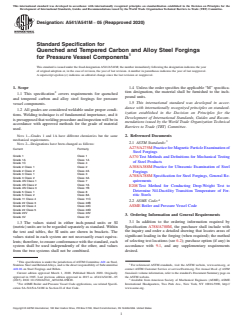
1.1 This specification2 covers requirements for quenched and tempered carbon and alloy steel forgings for pressure vessel components.
1.2 All grades are considered weldable under proper conditions. Welding technique is of fundamental importance, and it is presupposed that welding procedure and inspection will be in accordance with approved methods for the grade of material used.
Note 1: Grades 1 and 1A have different chemistries but the same mechanical requirements.
Note 2: Designations have been changed as follows:
Current
Formerly
Grade 1
Class 1
Grade 1A
Class 1A
Grade 1C
Class 4
Grade 2 Class 1
Class 2
Grade 2 Class 2
Class 2A
Grade 3 Class 1
Class 3
Grade 3 Class 2
Class 3A
Grade 4N Class 1
Class 7
Grade 4N Class 2
Class 7A
Grade 4N Class 3
Class 7B
Grade 5 Class 1
Class 8
Grade 5 Class 2
Class 8A
Grade 11 Class 4
Class 11C
Grade 22 Class 3
Class 22B
Grade 22 Class 4
Class 22C
Grade 22 Class 5
Class 22D
Grade 22V
Class 22V
Grade 3V
Class 3V
1.3 The values stated in either inch-pound units or SI (metric) units are to be regarded separately as standard. Within the text and tables, the SI units are shown in brackets. The values stated in each system are not necessarily exact equivalents; therefore, to ensure conformance with the standard, each system shall be used independently of the other, and values from the two systems shall not be combined.
1.4 Unless the order specifies the applicable “M” specification designation, the material shall be furnished to the inch-pound units.
1.5 This international standard was developed in accordance with internationally recognized principles on standardization established in the Decision on Principles for the Development of International Standards, Guides and Recommendations issued by the World Trade Organization Technical Barriers to Trade (TBT) Committee.
- Status
- Published
- Publication Date
- 29-Feb-2020
- Technical Committee
- A01 - Steel, Stainless Steel and Related Alloys
- Drafting Committee
- A01.06 - Steel Forgings and Billets
Overview
ASTM A541/A541M-05(2020) is the internationally recognized standard specification developed by ASTM International for quenched and tempered carbon and alloy steel forgings used in pressure vessel components. The standard outlines material requirements, heat treatment procedures, testing methods, mechanical properties, and quality assurance for forged components intended for high-pressure and critical applications, including those found in power generation, chemical processing, and petrochemical industries.
This specification is vital for ensuring consistency and safety in pressure vessel construction. Adherence to ASTM A541/A541M-05(2020) supports compliance with the ASME Boiler and Pressure Vessel Code and facilitates global trade and acceptance.
Key Topics
- Material Scope: Applies to various grades of carbon and alloy steel forgings subjected to quenching and tempering to achieve optimal mechanical properties for pressure vessel service.
- Heat Treatment: Defines procedures for full austenitization, quenching in a suitable liquid medium, and tempering at controlled subcritical temperatures to achieve specified strength and toughness.
- Mechanical and Chemical Requirements: Specifies mandatory heat and product analyses to verify chemical composition conformance, as well as tensile and Charpy V-notch impact tests to ensure each forging meets mechanical property targets, including tensile strength, yield strength, elongation, and impact energy.
- Sampling and Testing: Outlines four methods for test sampling, allowing customization based on purchaser requirements and forging geometry, including representative test forgings or bars, location of test specimens, and number of tests based on forging mass.
- Quality Assurance: Includes requirements for repair welding, product marking, dimensional inspection, non-destructive examination (ultrasonic and magnetic particle testing), and comprehensive certification.
Applications
ASTM A541/A541M-05(2020) is essential for manufacturers, engineers, and inspectors involved with the production and assessment of pressure vessel components such as:
- Pressure Vessel Shells and Heads: Ensures main body and closure parts withstand high internal pressures and cyclic loading.
- Flanges, Rings, and Nozzles: Defines properties for complex forged components exposed to severe operating conditions and thermal stresses.
- Disks and Hollow Cylinders: Supports safety and durability in high-stress or high-temperature applications, such as turbine rotors, steam generator parts, and chemical processing reactors.
The standard’s emphasis on toughness (via Charpy V-notch testing), weldability, and strict mechanical and chemical limits makes it a reference for critical installations where failure prevention is crucial.
Related Standards
For holistic compliance and enhanced assurance, ASTM A541/A541M-05(2020) is commonly used alongside related documents, including:
- ASTM A788/A788M: Specification for general requirements of steel forgings, which must be met in addition to A541/A541M.
- ASTM A370: Test methods for mechanical testing of steel products, including tensile and Charpy impact testing.
- ASTM A388/A388M: Practice for ultrasonic examination of steel forgings for additional non-destructive testing (NDT) requirements.
- ASTM A275/A275M: Practice for magnetic particle examination of steel forgings.
- ASME Boiler and Pressure Vessel Code: Incorporates equivalent material specifications and outlines welding and inspection protocols.
Practical Value
By specifying rigorous requirements for quenched and tempered carbon and alloy steel forgings, ASTM A541/A541M-05(2020) facilitates:
- Improved safety and reliability of pressure equipment in demanding environments.
- Assured material traceability, consistency, and code compliance for global pressure vessel manufacturers.
- Reduced risk of mechanical failure due to precise control of chemistry, heat treatment, and thorough testing protocols.
- Enhanced acceptance in international markets through use of harmonized inch-pound and SI units and synchronization with WTO principles.
Keywords: ASTM A541, quenched and tempered steel, alloy steel forgings, pressure vessel components, mechanical testing, Charpy impact, heat treatment, ASME code, non-destructive testing, steel specifications.
Relations
- Effective Date
- 01-Mar-2020
- Effective Date
- 01-Mar-2024
- Effective Date
- 01-Nov-2023
- Effective Date
- 01-Nov-2023
- Effective Date
- 01-Jul-2019
- Effective Date
- 01-May-2019
- Effective Date
- 01-Nov-2018
- Effective Date
- 01-Sep-2018
- Effective Date
- 01-Mar-2018
- Effective Date
- 01-Dec-2017
- Refers
ASTM A370-17a - Standard Test Methods and Definitions for Mechanical Testing of Steel Products - Effective Date
- 15-Nov-2017
- Effective Date
- 01-Nov-2017
- Effective Date
- 01-May-2017
- Effective Date
- 01-Jan-2017
- Effective Date
- 01-Dec-2016
Get Certified
Connect with accredited certification bodies for this standard

Element Materials Technology
Materials testing and product certification.

Inštitut za kovinske materiale in tehnologije
Institute of Metals and Technology. Materials testing, metallurgical analysis, NDT.
Sponsored listings
Frequently Asked Questions
ASTM A541/A541M-05(2020) is a technical specification published by ASTM International. Its full title is "Standard Specification for Quenched and Tempered Carbon and Alloy Steel Forgings for Pressure Vessel Components". This standard covers: ABSTRACT This specification covers quenched and tempered carbon and alloy steel forgings for pressure vessel components. Heat and product analyses shall be performed to evaluate material conformance with chemical composition requirements. Tension and Charpy V-notch tests shall also be carried out to assess material conformance with mechanical property requirements such as, tensile strength, yield strength, elongation, reduction of area, and Charpy value. Sampling of test specimens for mechanical examination shall be done by either one of four methods specified by the purchaser. Repair welding may also be made at the option of the purchaser. SCOPE 1.1 This specification2 covers requirements for quenched and tempered carbon and alloy steel forgings for pressure vessel components. 1.2 All grades are considered weldable under proper conditions. Welding technique is of fundamental importance, and it is presupposed that welding procedure and inspection will be in accordance with approved methods for the grade of material used. Note 1: Grades 1 and 1A have different chemistries but the same mechanical requirements. Note 2: Designations have been changed as follows: Current Formerly Grade 1 Class 1 Grade 1A Class 1A Grade 1C Class 4 Grade 2 Class 1 Class 2 Grade 2 Class 2 Class 2A Grade 3 Class 1 Class 3 Grade 3 Class 2 Class 3A Grade 4N Class 1 Class 7 Grade 4N Class 2 Class 7A Grade 4N Class 3 Class 7B Grade 5 Class 1 Class 8 Grade 5 Class 2 Class 8A Grade 11 Class 4 Class 11C Grade 22 Class 3 Class 22B Grade 22 Class 4 Class 22C Grade 22 Class 5 Class 22D Grade 22V Class 22V Grade 3V Class 3V 1.3 The values stated in either inch-pound units or SI (metric) units are to be regarded separately as standard. Within the text and tables, the SI units are shown in brackets. The values stated in each system are not necessarily exact equivalents; therefore, to ensure conformance with the standard, each system shall be used independently of the other, and values from the two systems shall not be combined. 1.4 Unless the order specifies the applicable “M” specification designation, the material shall be furnished to the inch-pound units. 1.5 This international standard was developed in accordance with internationally recognized principles on standardization established in the Decision on Principles for the Development of International Standards, Guides and Recommendations issued by the World Trade Organization Technical Barriers to Trade (TBT) Committee.
ABSTRACT This specification covers quenched and tempered carbon and alloy steel forgings for pressure vessel components. Heat and product analyses shall be performed to evaluate material conformance with chemical composition requirements. Tension and Charpy V-notch tests shall also be carried out to assess material conformance with mechanical property requirements such as, tensile strength, yield strength, elongation, reduction of area, and Charpy value. Sampling of test specimens for mechanical examination shall be done by either one of four methods specified by the purchaser. Repair welding may also be made at the option of the purchaser. SCOPE 1.1 This specification2 covers requirements for quenched and tempered carbon and alloy steel forgings for pressure vessel components. 1.2 All grades are considered weldable under proper conditions. Welding technique is of fundamental importance, and it is presupposed that welding procedure and inspection will be in accordance with approved methods for the grade of material used. Note 1: Grades 1 and 1A have different chemistries but the same mechanical requirements. Note 2: Designations have been changed as follows: Current Formerly Grade 1 Class 1 Grade 1A Class 1A Grade 1C Class 4 Grade 2 Class 1 Class 2 Grade 2 Class 2 Class 2A Grade 3 Class 1 Class 3 Grade 3 Class 2 Class 3A Grade 4N Class 1 Class 7 Grade 4N Class 2 Class 7A Grade 4N Class 3 Class 7B Grade 5 Class 1 Class 8 Grade 5 Class 2 Class 8A Grade 11 Class 4 Class 11C Grade 22 Class 3 Class 22B Grade 22 Class 4 Class 22C Grade 22 Class 5 Class 22D Grade 22V Class 22V Grade 3V Class 3V 1.3 The values stated in either inch-pound units or SI (metric) units are to be regarded separately as standard. Within the text and tables, the SI units are shown in brackets. The values stated in each system are not necessarily exact equivalents; therefore, to ensure conformance with the standard, each system shall be used independently of the other, and values from the two systems shall not be combined. 1.4 Unless the order specifies the applicable “M” specification designation, the material shall be furnished to the inch-pound units. 1.5 This international standard was developed in accordance with internationally recognized principles on standardization established in the Decision on Principles for the Development of International Standards, Guides and Recommendations issued by the World Trade Organization Technical Barriers to Trade (TBT) Committee.
ASTM A541/A541M-05(2020) is classified under the following ICS (International Classification for Standards) categories: 77.140.30 - Steels for pressure purposes. The ICS classification helps identify the subject area and facilitates finding related standards.
ASTM A541/A541M-05(2020) has the following relationships with other standards: It is inter standard links to ASTM A541/A541M-05(2015), ASTM A370-24, ASTM A275/A275M-23, ASTM A388/A388M-23, ASTM A370-19, ASTM A788/A788M-19, ASTM A788/A788M-18b, ASTM A788/A788M-18a, ASTM A788/A788M-18, ASTM E208-17, ASTM A370-17a, ASTM A788/A788M-17a, ASTM A788/A788M-17, ASTM A370-17, ASTM A788/A788M-16a. Understanding these relationships helps ensure you are using the most current and applicable version of the standard.
ASTM A541/A541M-05(2020) is available in PDF format for immediate download after purchase. The document can be added to your cart and obtained through the secure checkout process. Digital delivery ensures instant access to the complete standard document.
Standards Content (Sample)
This international standard was developed in accordance with internationally recognized principles on standardization established in the Decision on Principles for the
Development of International Standards, Guides and Recommendations issued by the World Trade Organization Technical Barriers to Trade (TBT) Committee.
Designation:A541/A541M −05 (Reapproved 2020)
Standard Specification for
Quenched and Tempered Carbon and Alloy Steel Forgings
for Pressure Vessel Components
This standard is issued under the fixed designationA541/A541M; the number immediately following the designation indicates the year
of original adoption or, in the case of revision, the year of last revision. A number in parentheses indicates the year of last reapproval.
A superscript epsilon (´) indicates an editorial change since the last revision or reapproval.
1. Scope 1.4 Unless the order specifies the applicable “M” specifica-
2 tion designation, the material shall be furnished to the inch-
1.1 This specification covers requirements for quenched
pound units.
and tempered carbon and alloy steel forgings for pressure
1.5 This international standard was developed in accor-
vessel components.
dance with internationally recognized principles on standard-
1.2 All grades are considered weldable under proper condi-
ization established in the Decision on Principles for the
tions. Welding technique is of fundamental importance, and it
Development of International Standards, Guides and Recom-
ispresupposedthatweldingprocedureandinspectionwillbein
mendations issued by the World Trade Organization Technical
accordance with approved methods for the grade of material
Barriers to Trade (TBT) Committee.
used.
NOTE 1—Grades 1 and 1A have different chemistries but the same
2. Referenced Documents
mechanical requirements.
2.1 ASTM Standards:
NOTE 2—Designations have been changed as follows:
A275/A275M Practice for Magnetic Particle Examination of
Current Formerly
Steel Forgings
Grade 1 Class 1
A370 Test Methods and Definitions for Mechanical Testing
Grade 1A Class 1A
of Steel Products
Grade 1C Class 4
Grade 2 Class 1 Class 2 A388/A388M Practice for Ultrasonic Examination of Steel
Grade 2 Class 2 Class 2A
Forgings
Grade 3 Class 1 Class 3
A788/A788M Specification for Steel Forgings, General Re-
Grade 3 Class 2 Class 3A
quirements
Grade 4N Class 1 Class 7
Grade 4N Class 2 Class 7A
E208 Test Method for Conducting Drop-Weight Test to
Grade 4N Class 3 Class 7B
Determine Nil-Ductility Transition Temperature of Fer-
Grade 5 Class 1 Class 8
Grade 5 Class 2 Class 8A ritic Steels
Grade 11 Class 4 Class 11C
2.2 ASME Code:
Grade 22 Class 3 Class 22B
Grade 22 Class 4 Class 22C ASME Boiler and Pressure Vessel Code
Grade 22 Class 5 Class 22D
Grade 22V Class 22V
3. Ordering Information and General Requirements
Grade 3V Class 3V
3.1 In addition to the ordering information required by
1.3 The values stated in either inch-pound units or SI
Specification A788/A788M, the purchaser shall include with
(metric) units are to be regarded separately as standard. Within
the inquiry and order a detailed drawing that locates areas of
the text and tables, the SI units are shown in brackets. The
significant loading in the forging (when required); the method
values stated in each system are not necessarily exact equiva-
of selecting test locations (see 6.2); purchase option (if any) in
lents; therefore, to ensure conformance with the standard, each
accordance with 9.1, and any supplementary requirements
system shall be used independently of the other, and values
desired.
from the two systems shall not be combined.
This specification is under the jurisdiction ofASTM Committee A01 on Steel,
Stainless Steel and RelatedAlloys, and is the direct responsibility of Subcommittee For referenced ASTM standards, visit the ASTM website, www.astm.org, or
A01.06 on Steel Forgings and Billets. contact ASTM Customer Service at service@astm.org. For Annual Book of ASTM
Current edition approved March 1, 2020. Published March 2020. Originally Standards volume information, refer to the standard’s Document Summary page on
approved in 1965. Last previous edition approved in 2015 as A541/A541M – 05 the ASTM website.
(2015). DOI: 10.1520/A0541_A0541M–05R20. Available from American Society of Mechanical Engineers (ASME), ASME
For ASME Boiler and Pressure Vessel Code applications, see related Specifi- International Headquarters, Two Park Ave., New York, NY 10016-5990, http://
cation SA-541/SA-541M in Section II of that Code. www.asme.org.
Copyright © ASTM International, 100 Barr Harbor Drive, PO Box C700, West Conshohocken, PA 19428-2959. United States
A541/A541M−05 (2020)
3.2 Material supplied to this specification shall conform to
Grade °F [°C]
the requirements of Specification A788/A788M, which out-
1, 1A, 2 Class 2, 3 Class 2 1150 [620]
lines additional ordering information, manufacturing
2, 3 Class 1, 22 Class 3 1200 [650]
requirements, testing and retesting methods and procedures,
1C, 11 Class 4, 22 Class 4, 4N Class 1, 4N 1100 [595]
Class 2, 5 Class 1, 5 Class 2
marking, certification, product analysis variations, and addi-
22 Class 15 1050 [565]
tional supplementary requirements.
4N Class 3 1125 [605]
3V, 3VCb 1250 [675]
3.3 If the requirements of this specification are in conflict
22V 1250 [675]
with the requirements of Specification A788/A788M, the
5.2 For Classes 1, 1A, 2, 2A, 3, or 3A, a multiple stage
requirements of this specification shall prevail.
austenitizing procedure may be used whereby the forging is
first fully austenitized and liquid quenched, followed by
4. Chemical Composition
reheating within the intercritical temperature range to partially
4.1 Heat Analysis—The heat analysis obtained from sam-
reaustenitize, and again liquid quenched. On completion of the
pling in accordance with Specification A788/A788M shall
austenitizing/quenching cycles, the forgings shall be tempered
comply with Table 1 except that the additional features of
at a subcritical temperature as described in 5.1.
Supplementary Requirements S8, S9, S10, S12, and S15 shall
alsoapplyasindividuallyspecifiedintheorderinginformation. 6. Mechanical Properties
4.2 ProductAnalysis—The manufacturer shall use the prod- 6.1 General Requirements—The forgings shall conform to
uct analysis provision of Specification A788/A788M to obtain the requirements of Table 2.The forgings shall also conform to
a product analysis from a forging representing each heat or the requirements of Table 3 unless either Supplementary
multiple heat. The permissible variations of Table 1 of Speci- Requirement S6 or S13 is specified, in which case the
fication A788/A788M do not apply to carbon, phosphorus, requirements of those sections shall apply. The largest obtain-
silicon,andsulphurforallclasses,vanadiumforGrade1C,and able tension test specimen as specified in Fig. 4 of Test
columbium and calcium for Grades 22V and 3VCb. Boron is Methods and Definitions A370 shall be used. Impact speci-
not subject to product analysis. The purchaser may also make mens shall be Charpy V-notch, as shown in Fig. 10 of Test
this determination in accordance with Specification A788/ Methods and Definitions A370. The usage of subsize impact
A788M.
specimens due to material limitations must have prior pur-
chaser approval.
5. Heat Treatment for Mechanical Properties
6.2 Sampling—The longitudinal axis and mid-length of
5.1 After complete austenitization, the forgings shall be tension and impact test specimens shall be positioned in
quenched in a suitable liquid medium by spraying or immer- accordance with one of the following methods as specified by
sion. For Grade 22V forgings, the minimum austenitizing the purchaser:
temperature shall be 1650 °F [900 °C]. Quenching shall be 6.2.1 Method 1—This method shall always be used when
followed by tempering at a subcritical temperature and holding the maximum quenched thickness does not exceed 2 in. [50
at this temperature for a minimum time of ⁄2 h/in. [25 mm] of mm]. Specimens shall be located in the production forging or
maximumsectionthickness.Minimumtemperingtemperatures test forging (as described in Method 4) at mid-thickness and at
shall be: least 2 in. from other quenched surfaces.
TABLE 1 Chemical Requirements Composition, %
Grade 1 Grade 1A Grade 2 Grade 3 Grade 1C Grade 11 Grade 22 Grade 4N Grade 5 Grade 3V Grade 22 Grade 22V Grade
Class 4 Classes 4 Class 3 3VCb
and 5
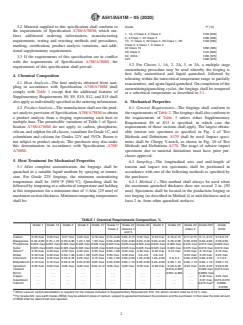
Carbon 0.35 max 0.30 max 0.27 max 0.25 max 0.18 max 0.10–0.20 0.05–0.15 0.23 max 0.23 max 0.10–0.15 0.11–0.15 0.11–0.15 0.10-0.15
Manganese 0.40–0.90 0.70–1.35 0.50–0.90 1.20–1.50 1.30 max 0.30–0.80 0.30–0.60 0.20–0.40 0.20–0.40 0.30–0.60 0.30–0.60 0.30–0.60 0.30-0.60
Phosphorus 0.025 max 0.025 max 0.025 max 0.025 max 0.025 max 0.025 max 0.025 max 0.025 max 0.025 max 0.020 max 0.015 max 0.015 max 0.020 max
Sulfur 0.025 max 0.025 max 0.025 max 0.025 max 0.025 max 0.025 max 0.025 max 0.025 max 0.025 max 0.020 max 0.015 max 0.010 max 0.010 max
A
Silicon 0.35 max 0.40 max 0.35 max 0.35 max 0.35 max 0.50–1.00 0.50 max 0.30 max 0.30 max 0.10 max 0.50 max 0.10 max 0.10 max
Nickel 0.40 max 0.40 max 0.50–1.00 0.40–1.00 0.25 max 0.50 max 0.50 max 2.8–3.9 2.8–3.9 . . . 0.25 max 0.25 max 0.25 max
Chromium 0.25 max 0.25 max 0.25–0.45 0.25 max 0.15 max 1.00–1.50 2.00–2.50 1.25–2.00 1.25–2.00 2.8–3.3 2.00–2.50 2.00–2.50 2.7-3.3
Molybdenum 0.10 max 0.10 max 0.55–0.70 0.45–0.60 0.05 max 0.45–0.65 0.90–1.10 0.40–0.60 0.40–0.60 0.90–1.10 0.90–1.10 0.90–1.10 0.90-1.10
Vanadium 0.05 max 0.05 max 0.05 max 0.05 max 0.02–0.12 0.05 max 0.05 max 0.03 max 0.08 max 0.20–0.30 0.02 max 0.25–0.35 0.20-0.30
Titanium . . . . . . . . . . . . . . . . . . . . . . . . . . . 0.015–0.035 . . . 0.030 max 0.015 max
Boron . . . . . . . . . . . . . . . . . . . . . . . . . . . 0.001–0.003 . . . 0.0020 max . . .
Copper . . . . . . . . . . . . . . . . . . . . . . . . . . . . . . . . . 0.20 max 0.25 max
Columbium . . . . . . . . . . . . . . . . . . . . . . . . . . . . . . . . . 0.07 max 0.015-0.070
B
Calcium . . . . . . . . . . . 0.015 max 0.0005-
0.0150
A
When vacuum carbon-deoxidation is required for the classes included in Supplementary Requirement S10, the silicon content shall be 0.10 % max.
B
For Grade 22V, rare earth metals (REM) may be added in place of calcium, subject to agreement between the producer and the purchaser. In that case the total amount
of REM shall be determined and reported.
A541/A541M−05 (2020)
TABLE 2 Tensile Requirements
Grades 2 Grade 2 Grade 4N Grades 4N
Class 1, Class 2 and Class 1 and Class 2 and
Grade 1 Grade 22 Grade 22 Grade 4N Grades 3V Grade 22 Grade
3 Class 1, Grade 3 Grade 5 5 Class 2
and 1A Class 4 Class 5 Class 3 and 22V Class 3 3VCb
1C and Class 2 Class 1
11 Class 4
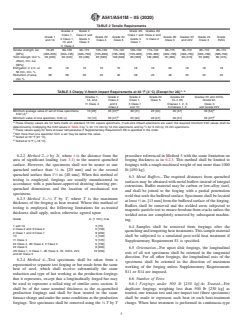
Tensile strength, ksi 70–95 80–105 90–115 105–130 115–140 105–130 115–140 90–115 85–110 85–110 85–110
[MPa] [485–655] [550–725] [620–795] [725–895] [795–965] [725–895] [795–965] [620–795] [585–760] [585–760] [585-760]
Yield strength (0.2 % 36 [250] 50 [345] 65 [450] 85 [585] 100 [690] 85 [585] 100 [690] 70 [485] 60 [415] 55 [380] 60 [415]
offset), min, ksi
[MPa]
Elongation in 2 in. or 20 18 16 16 15 18 16 20 18 18 18
50 mm, min, %
Reduction of area, 38 38 35 45 40 48 45 48 45 45 45
min, %
A, B
TABLE 3 Charpy V-Notch Impact Requirements at 40 °F (4 °C) (Except for 2A)
Grades 1, Grade 2 Grade 2 Grade 22 Grades 22 Grades 3V and 3VCb,
1A, and Class 2 Class 1, Class 5 CL 4 4N Grade 22,
11 Class 4 and 3 3 Class 1 Classes 1, 2, 3 Class 3
Class 2 and 1C 5 Classes 1, 2 and Grade 22V
D E
Minimum average value of set of three specimens, 15 [20] 35 [47] 30 [41] 25 [34] 35 [47] 40 [54]
C
ft·lbf (J)
D E
Minimum value of one specimen, ft·lbf (J) 10 [14] 30 [41] 25 [34] 20 [27] 30 [41] 35 [47]
A
These Charpy values are for tests made on standard 10 mm square specimens. If sub-size impact specimens are used, the required minimum ft·lbf values shall be
5 2
determined by multiplying the ft·lbf values in Table 3 by ⁄6 for 7.5 mm by 10 mm specimens, and by ⁄3 for 5 mm by 10 mm specimens.
B
These values apply for tests at lower temperatures if Supplementary Requirement S6 is specified in the order.
C
Not more than one specimen from a set may be below this value.
D
Tested at 70 °F [21 °C].
E
Tested at 0 °F [−18 °C].
6.2.2 Method 2—t by 2t, where t is the dis
...