

ASTM D7650-21
(Practice)Standard Practice for Sampling of Particulate Matter in High Pressure Gaseous Fuels with an In-Stream Filter
General Information
- Abstract
SIGNIFICANCE AND USE
5.1 This sampling procedure is used to collect a particulate filter sample containing particulates 0.2 µm or larger in size to be used to measure the size and concentration of particulates in a gaseous fuel stream.
SCOPE
1.1 This practice is primarily for sampling particulates in gaseous fuels up to a nominal working pressure (NWP) of 70 MPa (10 152 psi) using an in-stream filter. This practice describes sampling apparatus design, operating procedures, and quality control procedures required to obtain the stated levels of precision and accuracy.
1.2 Units—The values stated in SI units are to be regarded as standard. The values given in parentheses after SI units are provided for information only and are not considered standard.
1.3 This standard does not purport to address all of the safety concerns, if any, associated with its use. It is the responsibility of the user of this standard to establish appropriate safety, health, and environmental practices and determine the applicability of regulatory limitations prior to use.
1.4 This international standard was developed in accordance with internationally recognized principles on standardization established in the Decision on Principles for the Development of International Standards, Guides and Recommendations issued by the World Trade Organization Technical Barriers to Trade (TBT) Committee.
- Status
- Published
- Publication Date
- 30-Nov-2021
- Technical Committee
- D03 - Gaseous Fuels
- Drafting Committee
- D03.14 - Hydrogen and Fuel Cells
Buy Documents
ASTM D7650-21 - Standard Practice for Sampling of Particulate Matter in High Pressure Gaseous Fuels with an In-Stream Filter
REDLINE ASTM D7650-21 - Standard Practice for Sampling of Particulate Matter in High Pressure Gaseous Fuels with an In-Stream Filter
Overview
ASTM D7650-21 is the standard practice developed by ASTM International for the sampling of particulate matter in high pressure gaseous fuels using an in-stream filter. This standard provides detailed guidance on apparatus design, procedures, and quality control for effectively collecting particulates of 0.2 μm or larger from gaseous fuel streams. Sampling is typically performed at pressures up to 70 MPa (10,152 psi), making the standard especially relevant to high-pressure applications such as hydrogen fueling for fuel cell vehicles and high-pressure natural gas systems.
Accurate measurement of particulate content is crucial for maintaining fuel quality, protecting sensitive equipment, and ensuring safe operation in fuel delivery and use. The procedures outlined help achieve the necessary precision and minimize contamination risks, aligning with internationally recognized principles for standardization.
Key Topics
Sampling Apparatus Design
- Requirements for in-stream filter holders (e.g., PSA-H70) compatible with high-pressure hydrogen and other gaseous fuels
- Materials compatibility, pressure ratings, and safety features including grounding, pressure relief devices, and anti-static measures
Sampling Procedures
- Methods for collecting particulates using the Tank Approach and Atmosphere Approach
- Procedures for filter preparation, installation, and removal
Quality Control and Contamination Prevention
- Detailed cleaning, conditioning, and handling processes for apparatus and filter elements
- Use of glove boxes, mini-clean rooms, and HEPA filtration to ensure sample integrity
Measurement and Analysis
- Use of mass flow measurement devices and data logging for accurate characterization of collected samples
- Recommended handling and weighing practices to maintain precision
Safety and Hazards
- Essential safety precautions for working with high-pressure hydrogen and other gaseous fuels
- Personal protective equipment (PPE) and hazard avoidance, including prevention of static discharge and hydrogen embrittlement
Applications
This standard is primarily used for:
Hydrogen Fuel Infrastructure
Sampling particulates from hydrogen used in fuel cell vehicles, ensuring compliance with strict purity requirements for fuel cell protection and performance.Natural Gas and Alternative Fuel Systems
Application extends to other high-pressure gaseous fuels where particulate contamination could impact system reliability or compliance with end-use requirements.Component and System Validation
Provides methods for verifying particulate contamination levels in supply and dispensing infrastructure, protecting downstream components (e.g., valves, pneumatic controls) from premature failure.Quality Assurance and Regulatory Compliance
Supports manufacturers, operators, and laboratories in meeting fuel quality standards and regulatory mandates for gaseous fuels at high pressure.
Related Standards
For comprehensive practice, ASTM D7650-21 should be applied in conjunction with the following related standards and codes:
- ASTM D4150 – Terminology Relating to Gaseous Fuels
- ASTM D7651 – Gravimetric Measurement of Particulate Concentration of Hydrogen Fuel
- NFPA 2 – Hydrogen Technologies Code
- CSA HGV 4.1 / NGV 4.1 / NGV 1 – Standards for hydrogen and natural gas vehicle dispensing systems
- SAE J2719 / J2600 / J2579 – Hydrogen fuel quality and fueling connection requirements
- ISO 14687 – Hydrogen fuel product specification
- ASME Boiler and Pressure Vessel Code – Pressure relief and equipment integrity
- DIN EN 12266-1 / API 598 – Valve testing and inspection standards
- UN GTR 13 – Technical regulations for hydrogen and fuel cell vehicles
By adhering to ASTM D7650-21 and its associated references, organizations can ensure robust, repeatable, and internationally compliant sampling of particulate matter from high-pressure gaseous fuel streams-supporting enhanced safety, fuel quality, and longevity of critical infrastructure.
Relations
- Effective Date
- 15-Dec-2019
- Effective Date
- 01-Jul-2016
- Effective Date
- 01-Jul-2010
- Effective Date
- 01-Dec-2008
- Effective Date
- 10-Aug-2003
- Effective Date
- 10-Jun-2000
Buy Documents
ASTM D7650-21 - Standard Practice for Sampling of Particulate Matter in High Pressure Gaseous Fuels with an In-Stream Filter
REDLINE ASTM D7650-21 - Standard Practice for Sampling of Particulate Matter in High Pressure Gaseous Fuels with an In-Stream Filter
Get Certified
Connect with accredited certification bodies for this standard

DNV
DNV is an independent assurance and risk management provider.

Lloyd's Register
Lloyd's Register is a global professional services organisation specialising in engineering and technology.
DNV Energy Systems
Energy and renewable energy certification.
Sponsored listings
Frequently Asked Questions
ASTM D7650-21 is a standard published by ASTM International. Its full title is "Standard Practice for Sampling of Particulate Matter in High Pressure Gaseous Fuels with an In-Stream Filter". This standard covers: SIGNIFICANCE AND USE 5.1 This sampling procedure is used to collect a particulate filter sample containing particulates 0.2 µm or larger in size to be used to measure the size and concentration of particulates in a gaseous fuel stream. SCOPE 1.1 This practice is primarily for sampling particulates in gaseous fuels up to a nominal working pressure (NWP) of 70 MPa (10 152 psi) using an in-stream filter. This practice describes sampling apparatus design, operating procedures, and quality control procedures required to obtain the stated levels of precision and accuracy. 1.2 Units—The values stated in SI units are to be regarded as standard. The values given in parentheses after SI units are provided for information only and are not considered standard. 1.3 This standard does not purport to address all of the safety concerns, if any, associated with its use. It is the responsibility of the user of this standard to establish appropriate safety, health, and environmental practices and determine the applicability of regulatory limitations prior to use. 1.4 This international standard was developed in accordance with internationally recognized principles on standardization established in the Decision on Principles for the Development of International Standards, Guides and Recommendations issued by the World Trade Organization Technical Barriers to Trade (TBT) Committee.
SIGNIFICANCE AND USE 5.1 This sampling procedure is used to collect a particulate filter sample containing particulates 0.2 µm or larger in size to be used to measure the size and concentration of particulates in a gaseous fuel stream. SCOPE 1.1 This practice is primarily for sampling particulates in gaseous fuels up to a nominal working pressure (NWP) of 70 MPa (10 152 psi) using an in-stream filter. This practice describes sampling apparatus design, operating procedures, and quality control procedures required to obtain the stated levels of precision and accuracy. 1.2 Units—The values stated in SI units are to be regarded as standard. The values given in parentheses after SI units are provided for information only and are not considered standard. 1.3 This standard does not purport to address all of the safety concerns, if any, associated with its use. It is the responsibility of the user of this standard to establish appropriate safety, health, and environmental practices and determine the applicability of regulatory limitations prior to use. 1.4 This international standard was developed in accordance with internationally recognized principles on standardization established in the Decision on Principles for the Development of International Standards, Guides and Recommendations issued by the World Trade Organization Technical Barriers to Trade (TBT) Committee.
ASTM D7650-21 is classified under the following ICS (International Classification for Standards) categories: 27.075 - Hydrogen technologies. The ICS classification helps identify the subject area and facilitates finding related standards.
ASTM D7650-21 has the following relationships with other standards: It is inter standard links to ASTM D4150-19, ASTM D4150-08(2016), ASTM D7651-10, ASTM D4150-08, ASTM D4150-03, ASTM D4150-00. Understanding these relationships helps ensure you are using the most current and applicable version of the standard.
ASTM D7650-21 is available in PDF format for immediate download after purchase. The document can be added to your cart and obtained through the secure checkout process. Digital delivery ensures instant access to the complete standard document.
Standards Content (Sample)
This international standard was developed in accordance with internationally recognized principles on standardization established in the Decision on Principles for the
Development of International Standards, Guides and Recommendations issued by the World Trade Organization Technical Barriers to Trade (TBT) Committee.
Designation: D7650 − 21
Standard Practice for
Sampling of Particulate Matter in High Pressure Gaseous
Fuels with an In-Stream Filter
This standard is issued under the fixed designation D7650; the number immediately following the designation indicates the year of
original adoption or, in the case of revision, the year of last revision.Anumber in parentheses indicates the year of last reapproval.A
superscript epsilon (´) indicates an editorial change since the last revision or reapproval.
4,5
1. Scope 2.3 CSA/ANSI/NGV Standards:
HGV 4.1Hydrogen Dispensing Systems
1.1 This practice is primarily for sampling particulates in
NGV 1Fueling Connection Devices
gaseous fuels up to a nominal working pressure (NWP) of 70
NGV 4.1Natural Gas Vehicle (NGV) Dispensing Systems
MPa (10152 psi) using an in-stream filter. This practice
2.4 SAE Standards:
describes sampling apparatus design, operating procedures,
SAE J2579 Standard for Fuel Systems in Fuel Cell and
and quality control procedures required to obtain the stated
Other Hydrogen Vehicles
levels of precision and accuracy.
SAE J2600Compressed Hydrogen Surface Vehicle Fueling
1.2 Units—The values stated in SI units are to be regarded
Connection Devices
as standard. The values given in parentheses after SI units are
SAE J2719Hydrogen Fuel Quality for Fuel Cell Vehicles
providedforinformationonlyandarenotconsideredstandard.
2.5 ISO Standard:
ISO 14687Hydrogen Fuel Quality— Product Specification
1.3 This standard does not purport to address all of the
2.6 ASME Standard:
safety concerns, if any, associated with its use. It is the
Boiler and Pressure Vessel Code
responsibility of the user of this standard to establish appro-
2.7 UN Global Technical Regulation:
priate safety, health, and environmental practices and deter-
No. 13Global Technical Regulation on Hydrogen and Fuel
mine the applicability of regulatory limitations prior to use.
Cell Vehicles
1.4 This international standard was developed in accor-
2.8 NIST Standard:
dance with internationally recognized principles on standard-
Handbook 44 Specifications,Tolerances, and OtherTechni-
ization established in the Decision on Principles for the
cal Requirements for Weighing and Measuring Devices
Development of International Standards, Guides and Recom-
mendations issued by the World Trade Organization Technical
3. Terminology
Barriers to Trade (TBT) Committee.
3.1 Definitions—For definitions of general terms used in
D03 Gaseous Fuels standards, refer to Terminology D4150.
2. Referenced Documents
3.2 Definitions of Terms Specific to This Standard:
2.1 ASTM Standards:
3.2.1 maximum allowable working pressure (MAWP),
D4150Terminology Relating to Gaseous Fuels
n—the maximum gauge pressure of the working fluid (gas or
D7651Test Method for Gravimetric Measurement of Par-
liquid)towhichapieceofprocessequipmentorsystemisrated
ticulate Concentration of Hydrogen Fuel
with consideration for initiating fault management above
2.2 NFPA Standard:
normal operation.
NFPA 2Hydrogen Technologies Code
Available from Canadian Standards Association (CSA), 178 Rexdale Blvd.,
Toronto, ON M9W 1R3, Canada, http://www.csagroup.org.
1 5
This practice is under the jurisdiction of ASTM Committee D03 on Gaseous Available fromAmerican National Standards Institute (ANSI), 25 W. 43rd St.,
Fuels and is the direct responsibility of Subcommittee D03.14 on Hydrogen and 4th Floor, New York, NY 10036, http://www.ansi.org.
Fuel Cells. AvailablefromSAEInternational(SAE),400CommonwealthDr.,Warrendale,
Current edition approved Dec. 1, 2021. Published January 2022. Originally PA 15096-0001, http://www.sae.org.
approved in 2010. Last previous edition approved in 2013 as D7650–13. DOI: Available from International Organization for Standardization (ISO), 1, ch. de
10.1520/D7650-21. la Voie-Creuse, CP 56, CH-1211 Geneva 20, Switzerland, http://www.iso.org.
2 8
For referenced ASTM standards, visit the ASTM website, www.astm.org, or Available from American Society of Mechanical Engineers (ASME), ASME
contact ASTM Customer Service at service@astm.org. For Annual Book of ASTM International Headquarters, Two Park Ave., New York, NY 10016-5990, http://
Standards volume information, refer to the standard’s Document Summary page on www.asme.org.
the ASTM website. Available from UNECE, https://unece.org/.
3 10
Available from National Fire Protection Association (NFPA), 1 Batterymarch Available from National Institute of Standards and Technology (NIST), 100
Park, Quincy, MA 02169-7471, http://www.nfpa.org. Bureau Dr., Stop 1070, Gaithersburg, MD 20899-1070, http://www.nist.gov.
Copyright © ASTM International, 100 Barr Harbor Drive, PO Box C700, West Conshohocken, PA 19428-2959. United States
D7650 − 21
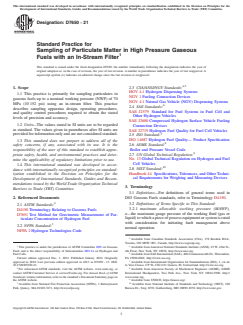
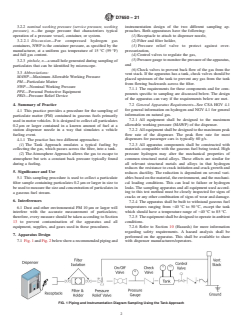
3.2.2 nominal working pressure (service pressure, working instrumentation design of the two different sampling ap-
pressure), n—the gauge pressure that characterizes typical proaches. Both apparatuses have the following:
operation of a pressure vessel, container, or system. (1)Receptacle to attach to dispenser nozzle,
3.2.2.1 Discussion—For compressed hydrogen gas (2)Filter and filter holder,
containers, NWP is the container pressure, as specified by the (3) Pressure relief valve to protect against over-
manufacturer, at a uniform gas temperature of 15°C (59°F) pressurization,
and full gas content. (4)Control valves to regulate the gas,
(5)Pressuregaugetomonitorthepressureoftheapparatus,
3.2.3 pinhole, n—asmallholegeneratedduringsamplingof
and
particulates that can be identified by microscope.
(6)Check valves to prevent back flow of the gas from the
3.3 Abbreviations:
vent stack. If the apparatus has a tank, check valves should be
MAWP—Maximum Allowable Working Pressure
placed upstream of the tank to prevent any gas from the tank
PM—Particulate Matter
from flowing backwards across the filter.
NWP—Nominal Working Pressure
7.1.1 The requirements for these components and for com-
PPE—Personal Protective Equipment
ponents specific to sampling are discussed below. The design
PRD—Pressure Relief Device
of the apparatus can vary if the requirements below are met.
4. Summary of Practice
7.2 General Apparatus Requirements—See CSA HGV 4.1
for general information on hydrogen and NGV 4.1 for general
4.1 This practice provides a procedure for the sampling of
information on natural gas.
particulate matter (PM) contained in gaseous fuels primarily
7.2.1 All equipment shall be designed to the maximum
used in motor vehicles. It is designed to collect all particulates
allowable working pressure (MAWP) of the dispenser.
0.2µm or larger contained in a known amount of fuel at a
7.2.2 Allequipmentshallbedesignedtothemaximumpeak
station dispenser nozzle in a way that simulates a vehicle
flow rate of the dispenser. The peak flow rate for most
fueling event.
dispensers for passenger cars is typically 60 g/s.
4.1.1 The practice has two different approaches:
(1)The Tank Approach emulates a typical fueling by 7.2.3 All apparatus components shall be constructed with
collecting the gas, which passes across the filter, into a tank. materials compatible with the gaseous fuel being tested. High
(2)The Atmosphere Approach allows the gas to escape to pressure hydrogen may alter the mechanical properties of
atmosphere but sets a constant back pressure typically found common structural metal alloys. These effects are similar for
during a fueling. all relevant structural metals and alloys in that hydrogen
reduces the resistance to crack initiation and crack growth and
5. Significance and Use
reduces ductility. The reduction is dependent on several vari-
ablesbasedonthematerial,theenvironment,andthemechani-
5.1 This sampling procedure is used to collect a particulate
cal loading conditions. This can lead to failure or hydrogen
filter sample containing particulates 0.2µm or larger in size to
leaks. The sampling apparatus and all equipment used accord-
beusedtomeasurethesizeandconcentrationofparticulatesin
ing to this test method must be closely inspected for signs of
a gaseous fuel stream.
cracks or any other combination of signs of wear and damage.
6. Interferences
7.2.4 The apparatus shall be built to withstand gaseous fuel
temperatures ranging from −40°C to 50°C, except the tank
6.1 Dust and other environmental PM 10 µm or larger will
which should have a temperature range of −40°C to 85°C.
interfere with the accurate measurement of particulates;
therefore, every measure should be taken according to Section 7.2.5 Theequipmentshallbedesignedtooperateinambient
13 to prevent contamination of the apparatus and all conditions.
equipment, supplies, and gases used in these procedures.
7.2.6 Refer to Section 10 (Hazards) for more information
regarding safety requirements. A hazard analysis shall be
7. Apparatus Design
performed on the apparatus. This shall be available to share
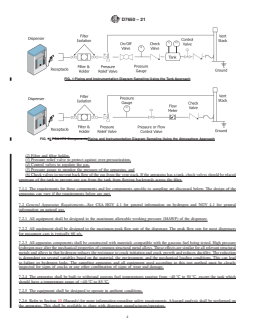
7.1 Fig.1andFig.2belowshowarecommendedpipingand with dispenser manufacturers/operators.
FIG. 1 Piping and Instrumentation Diagram Sampling Using the Tank Approach
D7650 − 21
FIG. 2 Piping and Instrumentation Diagram Sampling Using the Atmosphere Approach
7.2.7 The flow path from the nozzle to the filter shall be andensuresitisnotrupturedduringahigh-pressurepulse.The
designed to minimize trapping particulates on any surface. inletandoutletadaptersshallhaveaprotectivecaptomaintain
7.2.8 All hose assemblies shall have an anti-whip that is the sample integrity and keep particulates from entering the
attached to a suitable anchor point during sampling to prevent filter holder during transport.
the hose from whipping should the connection become un-
7.4.1 Filter Holder Support—The filter holder support must
coupled.
be designed to securely hold the filter holder and dispenser
hose nozzle in a downward vertical position. The nozzle shall
7.3 Receptacle—The receptacles shall be designed in accor-
be held firmly and not move or shake during particulate
dance with SAE J2600 or ISO 17268 for hydrogen or NGV1
sampling.
for natural gas. Most receptacles have an integrated particulate
filter installed in them. Receptacles for testing purposes shall
7.5 Pressure Relief Device (PRD)—Theapparatusshouldbe
not contain a filter.
equipped with a PRD to avoid over-pressurization. The PRD,
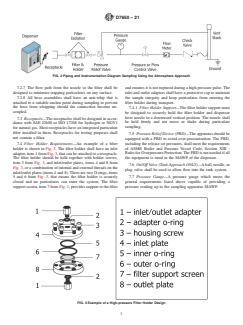
7.4 Filter Holder Requirements—An example of a filter includingthereleasesetpressures,shallmeettherequirements
holder is shown in Fig. 3. The filter holder shall have an inlet of ASME Boiler and Pressure Vessel Code, Section XIII -
adapter,item1fromFig.3,thatcanbeattachedtoareceptacle. RulesforOverpressureProtection.ThePRDisnotneededifall
The filter holder should be held together with holder screws, the equipment is rated to the MAWP of the dispenser.
item 3 from Fig. 3, and inlet/outlet plates, items 4 and 8 from
7.6 On/Off Valve (Tank Approach ONLY)—Aball,needle,or
Fig. 3, or a combination of internal and external threads on the
plug valve shall be used to allow flow into the tank system.
inlet/outletplates(items4and8).TherearetwoO-rings,items
5 and 6 from Fig. 3, that ensure the filter holder is securely 7.7 Pressure Gauge—A pressure gauge which meets the
closed and no particulates can enter the system. The filter general requirements listed above capable of providing a
supportscreen,item7fromFig.3,providessupporttothefilter pressure reading up to the sampling apparatus MAWP.
FIG. 3 Example of a High-pressure Filter Holder Design
D7650 − 21
7.8 Pressure or Flow Control Valv
...
This document is not an ASTM standard and is intended only to provide the user of an ASTM standard an indication of what changes have been made to the previous version. Because
it may not be technically possible to adequately depict all changes accurately, ASTM recommends that users consult prior editions as appropriate. In all cases only the current version
of the standard as published by ASTM is to be considered the official document.
Designation: D7650 − 13 D7650 − 21
Standard Test Method Practice for
Sampling of Particulate Matter in High Pressure Hydrogen
used as a Gaseous FuelGaseous Fuels with an In-Stream
Filter
This standard is issued under the fixed designation D7650; the number immediately following the designation indicates the year of
original adoption or, in the case of revision, the year of last revision. A number in parentheses indicates the year of last reapproval. A
superscript epsilon (´) indicates an editorial change since the last revision or reapproval.
1. Scope
1.1 This test method practice is primarily for sampling particulates in hydrogen fuel used in hydrogen fuel cell vehicles or gaseous
hydrogen powered internal combustion vehicle engines up to pressures gaseous fuels up to a nominal working pressure (NWP)
of 70 MPa (700 bars)(10 152 psi) using an in-stream filter. This test method practice describes sampling apparatus design,
operating procedures, and quality control procedures required to obtain the stated levels of precision and accuracy.
1.2 Units—The values stated in SI units are to be regarded as standard. No other units of measurement are included in this The
values given in parentheses after SI units are provided for information only and are not considered standard.
1.2.1 Exception—In 7.1 and 10.1.1 the values stated in psi are for information only.
1.3 This standard does not purport to address all of the safety concerns, if any, associated with its use. It is the responsibility of
the user of this standard to establish appropriate safety and health practices and determine the applicability of regulatory
limitations prior to use.
1.3 This standard does not purport to address all of the safety concerns, if any, associated with its use. It is the responsibility
of the user of this standard to establish appropriate safety, health, and environmental practices and determine the applicability of
regulatory limitations prior to use.
1.4 This international standard was developed in accordance with internationally recognized principles on standardization
established in the Decision on Principles for the Development of International Standards, Guides and Recommendations issued
by the World Trade Organization Technical Barriers to Trade (TBT) Committee.
2. Referenced Documents
2.1 ASTM Standards:
D4150 Terminology Relating to Gaseous Fuels
D7651 Test Method for Gravimetric Measurement of Particulate Concentration of Hydrogen Fuel
2.2 NFPA Standard:
NFPA 2 Hydrogen Technologies Code
This test method practice is under the jurisdiction of ASTM Committee D03 on Gaseous Fuels and is the direct responsibility of Subcommittee D03.14 on Hydrogen
and Fuel Cells.
Current edition approved May 1, 2013Dec. 1, 2021. Published June 2013January 2022. Originally approved in 2010. Last previous edition approved in 20102013 as
D7650D7650 – 13.–10. DOI: 10.1520/D7650–13.10.1520/D7650-21.
For referenced ASTM standards, visit the ASTM website, www.astm.org, or contact ASTM Customer Service at service@astm.org. For Annual Book of ASTM Standards
volume information, refer to the standard’s Document Summary page on the ASTM website.
Available from National Fire Protection Association (NFPA), 1 Batterymarch Park, Quincy, MA 02169-7471, http://www.nfpa.org.
Copyright © ASTM International, 100 Barr Harbor Drive, PO Box C700, West Conshohocken, PA 19428-2959. United States
D7650 − 21
4,5
2.3 CSA/ANSI/NGV Standards:
HGV 4.1 Hydrogen Dispensing Systems
NGV 1 Fueling Connection Devices
NGV 4.1 Natural Gas Vehicle (NGV) Dispensing Systems
2.4 SAE Standards:
SAE J2719J2579 Hydrogen Fuel Quality Standard for Fuel Cell Systems in Fuel Cell and Other Hydrogen Vehicles
SAE J2600 Compressed Hydrogen Surface Vehicle RefuelingFueling Connection Devices
SAE J2719 Hydrogen Fuel Quality for Fuel Cell Vehicles
2.5 ISO Standard:
ISO/CD 14687–2ISO 14687 Hydrogen fuel — Product Specification — Part 2: Proton exchange membrane (PEM) fuel cell
applications for road vehicles.Fuel Quality— Product Specification
2.6 EUASME Standard:
97/23/EC Pressure Equipment Directive of the EU set out the standards for the design and fabrication of pressure
equipmentBoiler and Pressure Vessel Code
2.7 DIN Standard:UN Global Technical Regulation:
DIN EN 12266-1No. 13 Industrial valves-Testing of metallic valves-Part 1: Pressure test, test procedures and acceptance criteria
Mandatory RequirementsGlobal Technical Regulation on Hydrogen and Fuel Cell Vehicles
2.8 APINIST Standard:
API 598Handbook 44 Valve Inspection and TestingSpecifications, Tolerances, and Other Technical Requirements for Weighing
and Measuring Devices
3. Terminology
3.1 Acronyms:
3.1.1 FCV—Hydrogen Fuel Cell Vehicle.
3.1.2 HQSA—Hydrogen quality sampling assembly for sampling gaseous hydrogen fuel.
3.1.3 PEM—Polymer Electrolyte Membrane or Proton Exchange Membrane
3.1.4 PSA-H70—Particulate sampling adapter for sampling particulate in hydrogen fuel up to pressures of 70 MPa.
3.1.5 SAE International—Society of Automotive Engineering
3.1 Definitions—For definitions of general terms used in D03 Gaseous Fuels standards, refer to Terminology D4150.
3.2 Definitions:Definitions of Terms Specific to This Standard:
3.2.1 maximum allowable working pressure (MAWP), n—the maximum gauge pressure of the working fluid (gas or liquid) to
which a piece of process equipment or system is rated with consideration for initiating fault management above normal operation.
3.2.2 nominal working pressure (service pressure, working pressure), n—the gauge pressure that characterizes typical operation
of a pressure vessel, container, or system.
3.2.2.1 Discussion—
For compressed hydrogen gas containers, NWP is the container pressure, as specified by the manufacturer, at a uniform gas
temperature of 15 °C (59 °F) and full gas content.
Available from Canadian Standards Association (CSA), 178 Rexdale Blvd., Toronto, ON M9W 1R3, Canada, http://www.csagroup.org.
Available from American National Standards Institute (ANSI), 25 W. 43rd St., 4th Floor, New York, NY 10036, http://www.ansi.org.
Available from SAE International (SAE), 400 Commonwealth Dr., Warrendale, PA 15096-0001, http://www.sae.org.
Available from International Organization for Standardization (ISO), 1, ch. de la Voie-Creuse, CP 56, CH-1211 Geneva 20, Switzerland, http://www.iso.org.
Available from European Committee for Standardization (CEN), Avenue Marnix 17, B-1000, Brussels, Belgium, http://www.cen.eu.American Society of Mechanical
Engineers (ASME), ASME International Headquarters, Two Park Ave., New York, NY 10016-5990, http://www.asme.org.
Available from Deutsches Institut fur Normung e.V.(DIN), Burggrafenstrasse 6, 10787 Berlin, Germany, http://www.din.de.
Available from American Petroleum Institute (API), 1220 L. St., NW, Washington, DC 20005-4070, http://www.api.org.
HEPA is a trademark of the HEPA Corporation, 3071 East Coronado Street Anaheim, CA 92806.
The mention of trade names in this test method does not constitute endorsement or recommendation. Other manufacturers of equipment or equipment models can be
used.Available from UNECE, https://unece.org/.
Microsoft Excel is a trademark of the Microsoft Corporation, One Microsoft Way Redmond, WA 98052-6399.Available from National Institute of Standards and
Technology (NIST), 100 Bureau Dr., Stop 1070, Gaithersburg, MD 20899-1070, http://www.nist.gov.
D7650 − 21
3.2.3 pinhole—pinhole, n—a small hole generated during sampling of particulate in hydrogen particulates that can be identified
by microscope.
3.3 SAE J2719 Hydrogen Fuel Quality for Fuel Cell Vehicles—Abbreviations:
This MAWP document specifies allowable levels of constituents in the hydrogen fuel at the vehicle/station interface.—Maximum
Allowable Working Pressure
PM—Particulate Matter
NWP—Nominal Working Pressure
PPE—Personal Protective Equipment
PRD—Pressure Relief Device
3.4 SAE J2600–Compressed Hydrogen Surface Vehicle Refueling Connection Devices—This document specifies the design
requirements for nozzles and receptacles used in high pressure hydrogen applications such as delivery from a fueling station to a
FCV.
4. Summary of Test MethodPractice
4.1 This test method practice provides a procedure for the sampling of particulate matter (PM) contained in hydrogen used as a
FCV fuel. gaseous fuels primarily used in motor vehicles. It is designed to collect all particulates 0.2 μm 0.2 μm or larger contained
in a known amount of hydrogenfuel at a station dispenser nozzle in a way that simulates a FCV or a gaseous hydrogen powered
internal combustion vehicle engine fueling event. The adapter used for sampling particulates in hydrogen fuel is called a Particulate
Sampling Adapter for pressures up to 70 MPa (PSA-H70) and is described in Section vehicle fueling event. 7. Great care should
be taken to avoid contamination and exposure of the PSA-H70, filters, and other equipment with particles sized 10 μm or larger
prior to use.
4.1.1 The practice has two different approaches:
(1) The Tank Approach emulates a typical fueling by collecting the gas, which passes across the filter, into a tank.
(2) The Atmosphere Approach allows the gas to escape to atmosphere but sets a constant back pressure typically found during
a fueling.
5. Significance and Use
5.1 Fuel cells such as proton exchange membrane fuel cells require high purity hydrogen for maximum material performance and
lifetime. Collection and measurement of particulate matter 0.2 μm or larger is necessary for assuring a feed gas of sufficient quality
to satisfy fuel cell system needs. In addition, internal combustion engines using high pressure hydrogen fuel also require low
particulate levels. Specifically, particulate matter has been implicated in the premature failure of pneumatic control components,
such as valves within vehicles. This sampling procedure is used to collect and measure samples containing particles 0.2 μm a
particulate filter sample containing particulates 0.2 μm or larger in size.size to be used to measure the size and concentration of
particulates in a gaseous fuel stream.
5.2 Although not intended for application to gases other than hydrogen and related fuel cell supply gases, the techniques within
this sampling procedure can be applied to other high pressure gaseous samples requiring particulate collection and measurement.
6. Interferences
6.1 Dust and other environmental particulate matter PM 10 μm or larger will interfere with the accurate measurement of
particulates contained in FCV quality hydrogen; particulates; therefore, every measure should be taken according to Section 1413
to avoidprevent contamination of the apparatus and all equipment, supplies, and gases used in these procedures.
7. Apparatus Design
NOTE 1—The use of trade names in this section are not intended as an endorsement for use.
7.1 Fig. 1 and Fig. 2 below show a recommended piping and instrumentation design of the two different sampling approaches.
Both apparatuses have the following:
(1) Receptacle to attach to dispenser nozzle,
D7650 − 21
FIG. 1 Piping and Instrumentation Diagram Sampling Using the Tank Approach
FIG. 12 PSA-H70 ComponentsPiping and Instrumentation Diagram Sampling Using the Atmosphere Approach
(2) Filter and filter holder,
(3) Pressure relief valve to protect against over-pressurization,
(4) Control valves to regulate the gas,
(5) Pressure gauge to monitor the pressure of the apparatus, and
(6) Check valves to prevent back flow of the gas from the vent stack. If the apparatus has a tank, check valves should be placed
upstream of the tank to prevent any gas from the tank from flowing backwards across the filter.
7.1.1 The requirements for these components and for components specific to sampling are discussed below. The design of the
apparatus can vary if the requirements below are met.
7.2 General Apparatus Requirements—See CSA HGV 4.1 for general information on hydrogen and NGV 4.1 for general
information on natural gas.
7.2.1 All equipment shall be designed to the maximum allowable working pressure (MAWP) of the dispenser.
7.2.2 All equipment shall be designed to the maximum peak flow rate of the dispenser. The peak flow rate for most dispensers
for passenger cars is typically 60 g/s.
7.2.3 All apparatus components shall be constructed with materials compatible with the gaseous fuel being tested. High pressure
hydrogen may alter the mechanical properties of common structural metal alloys. These effects are similar for all relevant structural
metals and alloys in that hydrogen reduces the resistance to crack initiation and crack growth and reduces ductility. The reduction
is dependent on several variables based on the material, the environment, and the mechanical loading conditions. This can lead
to failure or hydrogen leaks. The sampling apparatus and all equipment used according to this test method must be closely
inspected for signs of cracks or any other combination of signs of wear and damage.
7.2.4 The apparatus shall be built to withstand gaseous fuel temperatures ranging from −40 °C to 50 °C, except the tank which
should have a temperature range of −40 °C to 85 °C.
7.2.5 The equipment shall be designed to operate in ambient conditions.
7.2.6 Refer to Section 10 (Hazards) for more information regarding safety requirements. A hazard analysis shall be performed on
the apparatus. This shall be available to share with dispenser manufacturers/operators.
D7650 − 21
7.2.7 The flow path from the nozzle to the filter shall be designed to minimize trapping particulates on any surface.
7.2.8 All hose assemblies shall have an anti-whip that is attached to a suitable anchor point during sampling to prevent the hose
from whipping should the connection become uncoupled.
7.3 Receptacle—The receptacles shall be designed in accordance with SAE J2600 or ISO 17268 for hydrogen or NGV1 for natural
gas. Most receptacles have an integrated particulate filter installed in them. Receptacles for testing purposes shall not contain a
filter.
7.4 Filter Holder Requirements—The PSA-H70 has a design pressure of 800 Bar (11600 psi) and is certified after 97/23/EC and
API 598 (conform to DIN EN 12266-1) up to 1200 bar (17400 psi) shell test pressures with appropriate safety factors built in. It
is designed for a flow rate of 60 g per second of hydrogen without damage to the filter or leakage from the PSA-H70. The PSA-H70
possesses a receptacle as per SAE J2600 followed by a rotary valve which is directly integratedAn example of a filter holder is
shown in Fig. 3to the filter housing inlet. The rotary valve provides the possibility to switch the inner diameter of the filter housing
inlet . The filter holder shall have an inlet adapter, item 1 from Fig. 34 mm to 1 mm. That prevents the filter element from high
pressure pulse damage. , that can be attached to a receptacle. The filter holder contains should be held together with holder screws,
item 3 from Fig. 3, and inlet/outlet plates, items 4 and 8 from Fig. 3a standard 47 mm diameter filter element (≥ 0.2 μm pore size)
for particle collection, supported by a sinter metal frit with a pore size of 150 μm. Downstream the sinter metal frit a high pressure
bleed plug is integrated into , or a combination of internal and external threads on the inlet/outlet plates (items 4 and 8). There are
two O-rings, items 5 and 6 from Fig. 3, that ensure the filter holder followed by a standard hydrogen refueling hose and nozzle
as per SAE J2600 to be connected to a FCV during sample collection. In summary, the configuration of the PSA-H70, as shown
in is securely closed and no particulates can enter the system. The filter support screen, item 7 from Fig. 13, is:provides
A SAE J2600 compliant Receptacle → Filter Holder with integrated rotary valve, the Filter Element supported by a Sinter Metal
Frit and a an integrated high pressure Bleed Plug→Refueling Hose→ a SAE J2600 compliant Fueling Nozzle. support to the filter
and ensures it is not ruptured during a high-pressure pulse. The inlet and outlet adapters shall have a protective cap to maintain
the sample integrity and keep particulates from entering the filter holder during transport.
Fig. 1 illustrates a PSA-H70 design that has been successfully used to collect particulate samples from 875 bar (12691 psi) fuel
cell quality hydrogen. The PSA-H70 should be rated above the operating pressure, and all materials used must be rated for high
pressure hydrogen applications at a 1.5 times minimum margin of safety at the maximum operating pressure. The recommended
working pressure of the PSA-H70 and associated materials is 80 MPa. Contamination from lubrication or other sources must be
avoided and the apparatus must be cleaned prior to use using appropriate cleaning techniques for high pressure hydrogen
applications. The design of the PSA-H70 should include minimizing the distance and surface area between the nozzle and filter
to minimize the particulates generated from the surface of this area by fast flow and high pressure hydrogen
FIG. 3 Example of a High-pressure Filter Holder Design
D7650 − 21
7.1.1 High Pressure Filter Holder—The high pressure filter holder is a 47 mm, stainless steel housing with maximum inlet
pressure of 120 MPa a polytetrafluoroethylene (PTFE) inner 40.94 mm diameter PTFE-O ring and a hydrogenated acrylnitrilb-
utadiene caoutchouc as high pressure sealing. The filter holder must be equivalent, similar or exceed performance characteristics
of the filter holder described in this test method, that is burst strength.
7.1.2 Filter—A polytetrafluoroethylene (PTFE) filter that tolerates flow rates of up to 60 g per s without damage and collects
particulates with a minimum size of 0.2 μm.
NOTE 2—Hydrogen back flow must be avoided since the backflow of hydrogen can cause pinhole formation or other damage to filters. The design of the
apparatus and sampling procedures must prevent fuel backflow.
7.4.1 PSA-H70 Filter Holder Support—The mechanical PSA-H70filter holder support must be designed to securely hold the
PSA-H70 and a J2600 nozzle. The nozzle shouldfilter holder and dispenser hose nozzle in a downward vertical position. The nozzle
shall be held firmly and not move or shake during particulate sampling.
7.1.4 PSA-H70 design for flowing hydrogen to gaseous hydrogen vehicle tank—As sampling during refueling into a vehicle tank
collects a sample most representative of the particulates seen by vehicles in service, the PSA-H70 is designed for this purpose.
Therefore, for particulates collection the refueling nozzle of the station is connected to the SAE J2600 receptacle of the PSA-H70
and the SAE J2600 nozzle of the PSA-H70 is attached to the FCV receptacle. While sampling, the hydrogen fuel flows from station
SAE J2600 nozzle (1st nozzle) → PSA-H70 → with hose and a 2nd SAE J2600 nozzle → receptacle of FCV tank.
7.5 Pressure Relief Device (PRD)—The apparatus should be equipped with a PRD to avoid over-pressurization. The PRD,
including the release set pressures, shall meet the requirements of ASME Boiler and Pressure Vessel Code, Section XIII - Rules
for Overpressure Protection. The PRD is not needed if all the equipment is rated to the MAWP of the dispenser.
7.6 On/Off Valve (Tank Approach ONLY)—A ball, needle, or plug valve shall be used to allow flow into the tank system.
7.7 Pressure Gauge—A pressure gauge which meets the general requirements listed above capable of providing a pressure reading
up to the sampling apparatus MAWP.
7.8 Pressure or Flow Control Valve (Atmosphere Approach ONLY)—A pressure or flow control valve that can regulate the pressure
during sampling to 20 MPa (2900 psi).
7.9 Tank System (Tank Approach ONLY)—For systems which use the Tank Approach, the tank shall meet the minimum
requirements in one of the following standards: SAE J2579 or UN GTR 13. The high-pressure filter holder shall connect to the
tank using a fueling hose made of material that conforms to the general requirements listed in 7.2. Unless the tank is Hazmat
certified by local and government agencies, then it shall be exhausted completely before leaving the station.
7.10 Vent Stack—For systems which use the Atmosphere or Tank Approach, a portable vent stack or the refueling station vent stack
shall be connected after the outlet of the particulate sampling holder for the atmosphere approach or used to exhaust the tank
system; see 7.9.
7.10.1 Location of Vent Stack—Gaseous fuel must be vented at a safe distance from personnel and equipment. The ventilation
outlet should be at a minimum distance from the sampling and the ground as calculated using NFPA 2, Chapter 7.3.2.3.1.1 tables
based on the diameter of the vent stack. The vent stack should be placed clear of any overhead or nearby objects that may trap
gas. Depending on the ambient and gas conditions, the gaseous fuel may not always flow upward. Ensure that venting is performed
in accordance with applicable national, regional, and local laws and regulations. It is recommended to set the vent downwind of
the dispenser and sampling event.
7.11 Grounding—All components of the apparatus shall always be electrically grounded to earth. Grounding using the nozzle and
hose of the dispenser is not sufficient.
7.12 Mass Flow Measurement Requirements—The mass of gas which passes across the filter can be measured using
...