

ASTM D3978-21a
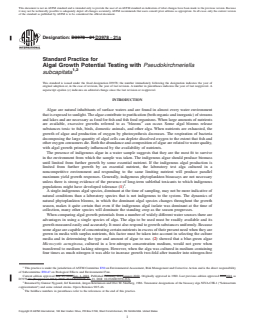
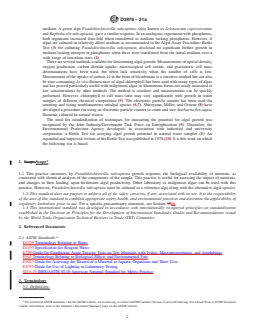
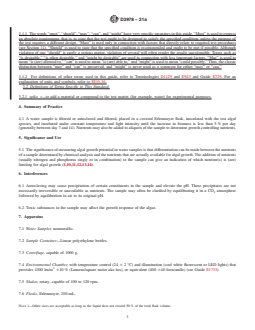
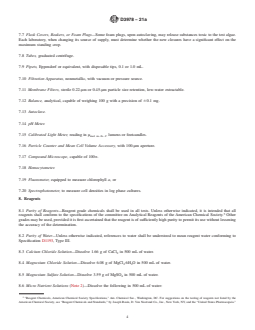
(Practice)Standard Practice for Algal Growth Potential Testing with Pseudokirchneriella subcapitata
General Information
- Abstract
SIGNIFICANCE AND USE
5.1 The significance of measuring algal growth potential in water samples is that differentiation can be made between the nutrients of a sample determined by chemical analysis and the nutrients that are actually available for algal growth. The addition of nutrients (usually nitrogen and phosphorus singly or in combination) to the sample can give an indication of which nutrient(s) is (are) limiting for algal growth (1,10,11,12,13,14).
SCOPE
1.1 This practice measures, by Pseudokirchnereilla subcapitata growth response, the biological availability of nutrients, as contrasted with chemical analysis of the components of the sample. This practice is useful for assessing the impact of nutrients, and changes in their loading, upon freshwater algal productivity. Other laboratory or indigenous algae can be used with this practice. However, Pseudokirchnereilla subcapitata must be cultured as a reference alga along with the alternative algal species.
1.2 This standard does not purport to address all of the safety concerns, if any, associated with its use. It is the responsibility of the user of this standard to establish appropriate safety, health, and environmental practices and determine the applicability of regulatory limitations prior to use. For a specific precautionary statement, see Section 16.
1.3 This international standard was developed in accordance with internationally recognized principles on standardization established in the Decision on Principles for the Development of International Standards, Guides and Recommendations issued by the World Trade Organization Technical Barriers to Trade (TBT) Committee.
- Status
- Published
- Publication Date
- 31-Oct-2021
- Technical Committee
- E50 - Environmental Assessment, Risk Management and Corrective Action
- Drafting Committee
- E50.47 - Biological Effects and Environmental Fate
Buy Documents
ASTM D3978-21a - Standard Practice for Algal Growth Potential Testing with <emph type="ital">Pseudokirchneriella subcapitata</emph>
REDLINE ASTM D3978-21a - Standard Practice for Algal Growth Potential Testing with <emph type="ital">Pseudokirchneriella subcapitata</emph>
Overview
ASTM D3978-21a is the Standard Practice for Algal Growth Potential Testing with Pseudokirchneriella subcapitata issued by ASTM International. This practice provides a laboratory-based approach to assess the biological availability of nutrients in water samples by observing the growth response of the reference green alga Pseudokirchneriella subcapitata. Unlike chemical analyses that only measure total nutrient content, this method evaluates which nutrients are available for algal uptake, an important factor in freshwater algal productivity and eutrophication studies.
The standard supports environmental monitoring, water quality management, and research on nutrient dynamics in diverse water bodies, including lakes, rivers, effluents, and various surface waters.
Key Topics
- Biological Assessment of Nutrient Availability: Unlike solely chemical approaches, this test measures how much of the nutrients in a water sample can support algal growth. It reflects real-world ecological impacts by using a standardized bioindicator organism.
- Nutrient Limitation Identification: Addition of specific nutrients (typically nitrogen or phosphorus) during the assay helps determine which elements limit algal productivity.
- Test Organism: Pseudokirchneriella subcapitata is the reference species, selected for its sensitivity and ease of culturing, but alternative or indigenous algae can be applied with proper controls.
- Controlled Growth Conditions: The test involves incubating algae in flasks under set temperature and lighting, tracking growth until it stabilizes.
- Sample Preparation and Handling: Proper pretreatment, storage, and handling of water samples are crucial to ensure accuracy.
- Measurement Techniques: Biomass and growth are measured through methods such as optical density, cell counts, dry weight calculations, or chlorophyll fluorescence.
Applications
- Water Quality Assessment: Used by environmental laboratories, utilities, and regulatory agencies to evaluate nutrient pollution in surface waters, wastewater effluents, and industrial discharges.
- Eutrophication Studies: Supports the identification of nutrient loading impacts on freshwater systems, aiding the development of management strategies for algal blooms.
- Toxicity Assessment: Helps detect the presence of substances in water that could inhibit or promote algal growth, offering insight into potential ecological risks.
- Nutrient Management: Informs decision-making by indicating which nutrients most limit algal productivity in a given water body, enhancing targeting of mitigation actions.
- Comparative Studies: Facilitates standardized comparison of algal growth potential across different water sources or over time, supporting environmental monitoring programs.
Related Standards
For those implementing astm D3978-21a or seeking deeper integration, the following ASTM standards are commonly referenced within the document:
- ASTM D1129 - Terminology Relating to Water
- ASTM D1193 - Specification for Reagent Water
- ASTM E729 - Guide for Conducting Acute Toxicity Tests on Test Materials with Fishes, Macroinvertebrates, and Amphibians
- ASTM E943 - Terminology Relating to Biological Effects and Environmental Fate
- ASTM E1023 - Guide for Assessing the Hazard of a Material to Aquatic Organisms and Their Uses
- ASTM E1733 - Guide for Use of Lighting in Laboratory Testing
- SI10–16 - IEEE/ASTM SI-10 American National Standard for Metric Practice
Keywords: algal growth potential, Pseudokirchneriella subcapitata, nutrient bioavailability, water quality assessment, ASTM D3978, aquatic bioassay, eutrophication, environmental monitoring, nutrient limitation, freshwater ecosystem testing.
Relations
- Effective Date
- 01-May-2020
- Effective Date
- 01-Mar-2010
- Effective Date
- 01-Mar-2008
- Effective Date
- 01-Feb-2008
- Effective Date
- 01-Oct-2007
- Effective Date
- 01-Oct-2007
- Effective Date
- 01-Sep-2006
- Effective Date
- 01-Sep-2006
- Effective Date
- 01-Mar-2006
- Effective Date
- 15-Feb-2006
- Effective Date
- 01-Mar-2004
- Effective Date
- 01-Mar-2004
- Effective Date
- 10-Aug-2003
- Effective Date
- 10-Mar-2003
- Effective Date
- 10-Jul-2002
Buy Documents
ASTM D3978-21a - Standard Practice for Algal Growth Potential Testing with <emph type="ital">Pseudokirchneriella subcapitata</emph>
REDLINE ASTM D3978-21a - Standard Practice for Algal Growth Potential Testing with <emph type="ital">Pseudokirchneriella subcapitata</emph>
Get Certified
Connect with accredited certification bodies for this standard

CIS Institut d.o.o.
Personal Protective Equipment (PPE) certification body. Notified Body NB-2890 for EU Regulation 2016/425 PPE.

Kiwa BDA Testing
Building and construction product certification.
Kmetijski inštitut Slovenije
Agricultural Institute of Slovenia. Soil testing, plant health, agricultural product analysis.
Sponsored listings
Frequently Asked Questions
ASTM D3978-21a is a standard published by ASTM International. Its full title is "Standard Practice for Algal Growth Potential Testing with <emph type="ital">Pseudokirchneriella subcapitata</emph>". This standard covers: SIGNIFICANCE AND USE 5.1 The significance of measuring algal growth potential in water samples is that differentiation can be made between the nutrients of a sample determined by chemical analysis and the nutrients that are actually available for algal growth. The addition of nutrients (usually nitrogen and phosphorus singly or in combination) to the sample can give an indication of which nutrient(s) is (are) limiting for algal growth (1,10,11,12,13,14). SCOPE 1.1 This practice measures, by Pseudokirchnereilla subcapitata growth response, the biological availability of nutrients, as contrasted with chemical analysis of the components of the sample. This practice is useful for assessing the impact of nutrients, and changes in their loading, upon freshwater algal productivity. Other laboratory or indigenous algae can be used with this practice. However, Pseudokirchnereilla subcapitata must be cultured as a reference alga along with the alternative algal species. 1.2 This standard does not purport to address all of the safety concerns, if any, associated with its use. It is the responsibility of the user of this standard to establish appropriate safety, health, and environmental practices and determine the applicability of regulatory limitations prior to use. For a specific precautionary statement, see Section 16. 1.3 This international standard was developed in accordance with internationally recognized principles on standardization established in the Decision on Principles for the Development of International Standards, Guides and Recommendations issued by the World Trade Organization Technical Barriers to Trade (TBT) Committee.
SIGNIFICANCE AND USE 5.1 The significance of measuring algal growth potential in water samples is that differentiation can be made between the nutrients of a sample determined by chemical analysis and the nutrients that are actually available for algal growth. The addition of nutrients (usually nitrogen and phosphorus singly or in combination) to the sample can give an indication of which nutrient(s) is (are) limiting for algal growth (1,10,11,12,13,14). SCOPE 1.1 This practice measures, by Pseudokirchnereilla subcapitata growth response, the biological availability of nutrients, as contrasted with chemical analysis of the components of the sample. This practice is useful for assessing the impact of nutrients, and changes in their loading, upon freshwater algal productivity. Other laboratory or indigenous algae can be used with this practice. However, Pseudokirchnereilla subcapitata must be cultured as a reference alga along with the alternative algal species. 1.2 This standard does not purport to address all of the safety concerns, if any, associated with its use. It is the responsibility of the user of this standard to establish appropriate safety, health, and environmental practices and determine the applicability of regulatory limitations prior to use. For a specific precautionary statement, see Section 16. 1.3 This international standard was developed in accordance with internationally recognized principles on standardization established in the Decision on Principles for the Development of International Standards, Guides and Recommendations issued by the World Trade Organization Technical Barriers to Trade (TBT) Committee.
ASTM D3978-21a is classified under the following ICS (International Classification for Standards) categories: 13.060.70 - Examination of biological properties of water. The ICS classification helps identify the subject area and facilitates finding related standards.
ASTM D3978-21a has the following relationships with other standards: It is inter standard links to ASTM D1129-13(2020)e2, ASTM D1129-10, ASTM E943-08, ASTM E1733-95(2008), ASTM E1023-84(2007), ASTM E729-96(2007), ASTM D1129-06a, ASTM D1129-06ae1, ASTM D1193-06, ASTM D1129-06, ASTM D1129-04e1, ASTM D1129-04, ASTM D1129-03a, ASTM D1129-03, ASTM D1129-01. Understanding these relationships helps ensure you are using the most current and applicable version of the standard.
ASTM D3978-21a is available in PDF format for immediate download after purchase. The document can be added to your cart and obtained through the secure checkout process. Digital delivery ensures instant access to the complete standard document.
Standards Content (Sample)
This international standard was developed in accordance with internationally recognized principles on standardization established in the Decision on Principles for the
Development of International Standards, Guides and Recommendations issued by the World Trade Organization Technical Barriers to Trade (TBT) Committee.
Designation: D3978 − 21a
Standard Practice for
Algal Growth Potential Testing with Pseudokirchneriella
1,2
subcapitata
This standard is issued under the fixed designation D3978; the number immediately following the designation indicates the year of
original adoption or, in the case of revision, the year of last revision.Anumber in parentheses indicates the year of last reapproval.A
superscript epsilon (´) indicates an editorial change since the last revision or reapproval.
INTRODUCTION
Algae are natural inhabitants of surface waters and are found in almost every water environment
thatisexposedtosunlight.Thealgaecontributetopurification(bothorganicandinorganic)ofstreams
andlakesandarenecessaryasfoodforfishandfishfoodorganisms.Whenlargeamountsofnutrients
are available, excessive growths referred to as “blooms” can occur. Some algal blooms release
substances toxic to fish, birds, domestic animals, and other alga. When nutrients are exhausted, the
growth of algae and production of oxygen by photosynthesis decreases. The respiration of bacteria
decomposing the large quantity of algal cells can deplete dissolved oxygen to the extent that fish and
otheroxygenconsumersdie.Boththeabundanceandcompositionofalgaearerelatedtowaterquality,
with algal growth primarily influenced by the availability of nutrients.
The presence of indigenous algae in a water sample suggests that they are the most fit to survive
in the environment from which the sample was taken. The indigenous algae should produce biomass
until limited from further growth by some essential nutrient. If the indigenous algal production is
limited from further growth by an essential nutrient, the laboratory test alga cultured in a
noncompetitive environment and responding to the same limiting nutrient will produce parallel
maximum yield growth responses. Generally, indigenous phytoplankton bioassays are not necessary
unless there is strong evidence of the presence of long-term sublethal toxicants to which indigenous
populations might have developed tolerance (1) .
Asingle-indigenous algal species, dominant at the time of sampling, may not be more indicative of
natural conditions than a laboratory species that is not indigenous to the system. The dynamics of
natural phytoplankton blooms, in which the dominant algal species changes throughout the growth
season, makes it quite certain that even if the indigenous algal isolate was dominant at the time of
collection, many other species will dominate the standing crop as the season progresses.
When comparing algal growth potentials from a number of widely different water sources there are
advantages in using a single species of alga. The alga to be used must be readily available and its
growthmeasuredeasilyandaccurately.Itmustalsorespondtogrowthsubstancesuniformly.Because
somealgaearecapableofconcentratingcertainnutrientsinexcessoftheirpresentneedwhentheyare
grown in media with surplus nutrients, this factor must be taken into account in selecting the culture
media and in determining the type and amount of algae to use. (2) showed that a blue-green algae
Microcystis aeruginosa, cultured in a low-nitrogen concentration medium, would not grow when
transferred to medium lacking nitrogen. However, when the alga was cultured in medium containing
four times as much nitrogen it was able to increase growth two-fold after transfer into nitrogen-free
medium. A green alga Pseudokirchnereilla subcapitata (also known as Selenastrum capricornutum
and Raphidocelis subcapitata),gaveasimilarresponse.Inananalogousexperimentwithphosphorus,
both organisms increased four-fold when transferred to medium lacking phosphorus. However, if
algae are cultured in relatively dilute medium as recommended in theAlgalAssay Procedure: Bottle
Test (3) for culturing Pseudokirchnereilla subcapitata, disclosed no significant further growth in
medium lacking nitrogen or phosphorus when these were transferred from the initial medium over a
wide range of inoculum sizes (4).
Thereareseveralmethodsavailablefordeterminingalgalgrowth.Measurementsofopticaldensity,
oxygen production, carbon dioxide uptake, microscopical cell counts, and gravimetric cell mass
determinations have been used, but often lack sensitivity when the number of cells is low.
Measurement of the uptake of carbon-14 in the form of bicarbonate is a sensitive method but can also
Copyright © ASTM International, 100 Barr Harbor Drive, PO Box C700, West Conshohocken, PA 19428-2959. United States
D3978 − 21a
be time-consuming. In vivo fluorescence of algal chlorophyll has been used with many types of algae
and has proved particularly useful with indigenous algae or filamentous forms not easily measured at
low concentrations by other methods. The method is sensitive and measurements can be quickly
performed. However, chlorophyll to cell mass ratio may vary significantly with growth in water
samples of different chemical composition (5). The electronic particle counter has been used for
counting and sizing nonfilamentous unialgal species (6,7). Shiroyama, Miller, and Greene (8) have
developed a procedure for using an electronic particle counter to count and size Anabaena flos-aquae
filaments cultured in natural waters.
The need for standardization of techniques for measuring the potential for algal growth was
recognized by the Joint Industry/Government Task Force on Eutrophication (9). Thereafter, the
Environmental Protection Agency developed, in association with industrial and university
cooperation, a Bottle Test for assaying algal growth potential in natural water samples (3).An
expandedandimprovedversionoftheBottleTestwaspublishedin1978 (10).Itisthisworkonwhich
the following test is based.
This practice is under the jurisdiction ofASTM Committee E50 on EnvironmentalAssessment, Risk Management and CorrectiveAction and is the direct responsibility
of Subcommittee E50.47 on Biological Effects and Environmental Fate.
Current edition approved Nov. 1, 2021. Published January 2022. Originally approved in 1980. Last previous edition approved 2021 as D3978-21. DOI:
10.1520/D3978-21A.
Renamed by Gunnar Nygaard, Jirf Komárek, Jørgen Kristiansen and Olav M. Skulberg, 1986. Taxonomic designations of the bioassay alga NIVA-CHL1 ("Selenastrum
capricornutum") and some related strains. Opera Botanica 90:5-46.
The boldface numbers in parentheses refer to the references at the end of this practice.
1. Scope* Materials with Fishes, Macroinvertebrates, and Amphib-
ians
1.1 Thispracticemeasures,byPseudokirchnereillasubcapi-
E943Terminology Relating to Biological Effects and Envi-
tatagrowthresponse,thebiologicalavailabilityofnutrients,as
ronmental Fate
contrasted with chemical analysis of the components of the
E1023Guide for Assessing the Hazard of a Material to
sample. This practice is useful for assessing the impact of
Aquatic Organisms and Their Uses
nutrients, and changes in their loading, upon freshwater algal
E1733Guide for Use of Lighting in Laboratory Testing
productivity. Other laboratory or indigenous algae can be used
SI10–16IEEE/ASTMSI-10AmericanNationalStandardfor
with this practice. However, Pseudokirchnereilla subcapitata
Metric Practice
must be cultured as a reference alga along with the alternative
algal species.
3. Terminology
1.2 This standard does not purport to address all of the
safety concerns, if any, associated with its use. It is the 3.1 Definitions:
responsibility of the user of this standard to establish appro-
3.1.1 The words “must”, “should”, “may”, “can”, and
priate safety, health, and environmental practices and deter-
“might” have very specific meanings in this guide. “Must” is
mine the applicability of regulatory limitations prior to use.
usedtoexpressanabsoluterequirement,thatis,tostatethatthe
For a specific precautionary statement, see Section 16.
test ought to be designed to satisfy the specified condition,
1.3 This international standard was developed in accor-
unless the purpose of the test requires a different design.
dance with internationally recognized principles on standard-
“Must” is used only in connection with factors that directly
ization established in the Decision on Principles for the
relate to required test procedures (see Section 14). “Should” is
Development of International Standards, Guides and Recom-
used to state that the specified condition is recommended and
mendations issued by the World Trade Organization Technical
oughttobemetifpossible.Althoughviolationofone“should”
Barriers to Trade (TBT) Committee.
is rarely a serious matter, violation of several will often render
the results questionable.Terms such as “is desirable,” “is often
2. Referenced Documents
desirable,” and “might be desirable” are used in connection
2.1 ASTM Standards:
with less important factors. “May” is used to mean “is (are)
D1129Terminology Relating to Water
allowed to,” “can” is used to mean “is (are) able to,” and
D1193Specification for Reagent Water
“might” is used to mean “could possibly.” Thus, the classic
E729Guide for Conducting Acute Toxicity Tests on Test
distinctionbetween“may”and“can”ispreserved,and“might”
is never used as a synonym for either “may” or “can.”
3.1.2 For definitions of other terms used in this guide, refer
For referenced ASTM standards, visit the ASTM website, www.astm.org, or
to Terminologies D1129 and E943 and Guide E729. For an
contact ASTM Customer Service at service@astm.org. For Annual Book of ASTM
explanation of units and symbols, refer to SI10–16.
Standards volume information, refer to the standard’s Document Summary page on
the ASTM website. 3.2 Definitions of Terms Specific to This Standard:
D3978 − 21a
3.2.1 spike, v—to add a material or compound to the test 7.11 Membrane Filters, sterile 0.22-µm or 0.45-µm particle
matrix (for example, water) for experimental purposes. size retention, low-water extractable.
7.12 Balance, analytical, capable of weighing 100 g with a
4. Summary of Practice
precision of 60.1 mg.
4.1 A water sample is filtered or autoclaved and filtered,
7.13 Autoclave.
placed in a covered Erlenmeyer flask, inoculated with the test
7.14 pH Meter.
algal species, and incubated under constant temperature and
lightintensityuntiltheincreaseinbiomassislessthan5%per
7.15 Calibrated Light Meter, reading in µ , lumens
mol m–2s–1
day (generally between day 7 and 14). Nutrients may also be
or footcandles.
addedtoaliquotsofthesampletodeterminegrowthcontrolling
7.16 Particle Counter and Mean Cell Volume Accessory,
nutrients.
with 100-µm aperture.
7.17 Compound Microscope, capable of 100×.
5. Significance and Use
7.18 Hemocytometer.
5.1 The significance of measuring algal growth potential in
water samples is that differentiation can be made between the
7.19 Fluorometer, equipped to measure chlorophyll a,or
nutrients of a sample determined by chemical analysis and the
7.20 Spectrophotometer, to measure cell densities in log
nutrients that are actually available for algal growth. The
phase cultures.
addition of nutrients (usually nitrogen and phosphorus singly
or in combination) to the sample can give an indication of
8. Reagents
which nutrient(s) is (are) limiting for algal growth (1,10,11,12,
8.1 Purity of Reagents—Reagent grade chemicals shall be
13,14).
used in all tests. Unless otherwise indicated, it is intended that
all reagents shall conform to the specifications of the commit-
6. Interferences
teeonAnalyticalReagentsoftheAmericanChemicalSociety.
6.1 Autoclavingmaycauseprecipitationofcertainconstitu-
Other grades may be used, provided it is first ascertained that
ents in the sample and elevate the pH. These precipitates are
the reagent is of sufficiently high purity to permit its use
not necessarily irreversible or unavailable as nutrients. The
without lessening the accuracy of the determination.
sample may often be clarified by equilibrating it in a CO
8.2 Purity of Water—Unless otherwise indicated, references
atmosphere followed by equilibration in air to its original pH.
towatershallbeunderstoodtomeanreagentwaterconforming
6.2 Toxic substances in the sample may affect the growth
to Specification D1193, Type III.
response of the algae.
8.3 CalciumChlorideSolution—Dissolve1.66gofCaCl in
500 mL of water.
7. Apparatus
8.4 Magnesium Chloride Solution—Dissolve 6.08 g of
7.1 Water Sampler, nonmetallic.
MgCl ·6H O in 500 mL of water.
2 2
7.2 Sample Container—Linear polyethylene bottles.
8.5 Magnesium Sulfate Solution—Dissolve 3.59 g of
7.3 Centrifuge, capable of 1000 g.
MgSO in 500 mL of water.
7.4 Environmental Chamber, with temperature control (24
8.6 Micro Nutrient Solutions(Note2)—Dissolvethefollow-
6 2°C) and illumination (cool white fluorescent or LED
ing in 500 mL of water:
lights)thatprovides4300lm/m 610%(Lumens/squaremeter
NOTE2—Reagents8.3,8.4,8.6,and8.9canbecombinedintoonestock
aka lux), or equivalent (400 640 footcandle) (see Guide
solution.
E1733).
7.5 Shaker, rotary, capable of 100 to 120 rpm.
93 mg of boric acid (H BO )
3 3
208 mg of manganous chloride (MnCl ·4H O)
2 2
7.6 Flasks, Erlenmeyer, 250-mL.
1.6 mg of zinc chloride (ZnCl )
80 mg of ferric chloride (FeCl ·6H O)
3 2
NOTE 1—Other sizes are acceptable as long as the liquid does not
0.39 mg of cobalt chloride (CoCl )
exceed 50% of the total flask volume. 2
3.63 mg of sodium molybdate (NaMoO ·2H O)
4 2
7.7 Flask Covers, Beakers, or Foam Plugs—Some foam
0.006 mg of cupric chloride (CuCl ·2H O)
2 2
plugs, upon autoclaving, may release substances toxic to the 150 mg of ethylenediaminetetraacetic acid
(HOCOCH ) N(CH ) H(HOCOCH )
2 2 2 2 2 2
testalgae.Eachlaboratory,whenchangingitssourceofsupply,
must determine whether the new closures have a significant
8.7 Potassium Phosphate Solution—Dissolve 0.52 g of
effect on the maximum standing crop. K HPO in 500 mL of water.
2 4
7.8 Tubes, graduated centrifuge.
7.9 Pipets, Eppendorf or equivalent, with disposable tips,
“Reagent Chemicals,American Chemical Society Specifications,”Am. Chemi-
0.1 or 1.0 mL. cal Soc., Washington, DC. For suggestions on the testing of reagents not listed by
theAmericanChemicalSociety,see“ReagentChemicalsandStandards,”byJoseph
7.10 Filtration Apparatus, nonmetallic, with vacuum or
Rosin, D. Van Nostrand Co., Inc., New York, NY, and the “United States
pressure source. Pharmacopeia.”
D3978 − 21a
8.8 Sodium Bicarbonate Solution—Dissolve 7.50 g of should be subsampled for chemical and biological study.
NaHCO in 500 mL of water. Sample collection may include a range of media such as
effluents, materials or products, specific chemicals, solvents,
8.9 Sodium Nitrate Solution—Dissolve12.75gofNaNO in
oils, surface waters, drilling fluids, stormwater, and sediments
500 mL of water.
(see G
...
This document is not an ASTM standard and is intended only to provide the user of an ASTM standard an indication of what changes have been made to the previous version. Because
it may not be technically possible to adequately depict all changes accurately, ASTM recommends that users consult prior editions as appropriate. In all cases only the current version
of the standard as published by ASTM is to be considered the official document.
Designation: D3978 − 21 D3978 − 21a
Standard Practice for
Algal Growth Potential Testing with Pseudokirchneriella
1,2
subcapitata
This standard is issued under the fixed designation D3978; the number immediately following the designation indicates the year of
original adoption or, in the case of revision, the year of last revision. A number in parentheses indicates the year of last reapproval. A
superscript epsilon (´) indicates an editorial change since the last revision or reapproval.
INTRODUCTION
Algae are natural inhabitants of surface waters and are found in almost every water environment
that is exposed to sunlight. The algae contribute to purification (both organic and inorganic) of streams
and lakes and are necessary as food for fish and fish food organisms. When large amounts of nutrients
are available, excessive growths referred to as “blooms” can occur. Some algal blooms release
substances toxic to fish, birds, domestic animals, and other alga. When nutrients are exhausted, the
growth of algae and production of oxygen by photosynthesis decreases. The respiration of bacteria
decomposing the large quantity of algal cells can deplete dissolved oxygen to the extent that fish and
other oxygen consumers die. Both the abundance and composition of algae are related to water quality,
with algal growth primarily influenced by the availability of nutrients.
The presence of indigenous algae in a water sample suggests that they are the most fit to survive
in the environment from which the sample was taken. The indigenous algae should produce biomass
until limited from further growth by some essential nutrient. If the indigenous algal production is
limited from further growth by an essential nutrient, the laboratory test alga cultured in a
noncompetitive environment and responding to the same limiting nutrient will produce parallel
maximum yield growth responses. Generally, indigenous phytoplankton bioassays are not necessary
unless there is strong evidence of the presence of long-term sublethal toxicants to which indigenous
populations might have developed tolerance (1) .
A single-indigenous algal species, dominant at the time of sampling, may not be more indicative of
natural conditions than a laboratory species that is not indigenous to the system. The dynamics of
natural phytoplankton blooms, in which the dominant algal species changes throughout the growth
season, makes it quite certain that even if the indigenous algal isolate was dominant at the time of
collection, many other species will dominate the standing crop as the season progresses.
When comparing algal growth potentials from a number of widely different water sources there are
advantages in using a single species of alga. The alga to be used must be readily available and its
growth measured easily and accurately. It must also respond to growth substances uniformly. Because
some algae are capable of concentrating certain nutrients in excess of their present need when they are
grown in media with surplus nutrients, this factor must be taken into account in selecting the culture
media and in determining the type and amount of algae to use. (2) showed that a blue-green algae
Microcystis aeruginosa, cultured in a low-nitrogen concentration medium, would not grow when
transferred to medium lacking nitrogen. However, when the alga was cultured in medium containing
four times as much nitrogen it was able to increase growth two-fold after transfer into nitrogen-free
This practice is under the jurisdiction of ASTM Committee E50 on Environmental Assessment, Risk Management and Corrective Action and is the direct responsibility
of Subcommittee E50.47 on Biological Effects and Environmental Fate.
Current edition approved Jan. 15, 2021Nov. 1, 2021. Published February 2021January 2022. Originally approved in 1980. Last previous edition approved 20122021 as
D3978-04 (Reapproved 2012). DOI: 10.1520/D3978-21.-21. DOI: 10.1520/D3978-21A.
Renamed by Gunnar Nygaard, Jirf Komárek, Jørgen Kristiansen and Olav M. Skulberg, 1986. Taxonomic designations of the bioassay alga NIVA-CHL1 ("Selenastrum
capricornutum") and some related strains. Opera Botanica 90:5-46.
The boldface numbers in parentheses refer to the references at the end of this practice.
Copyright © ASTM International, 100 Barr Harbor Drive, PO Box C700, West Conshohocken, PA 19428-2959. United States
D3978 − 21a
medium. A green alga Pseudokirchnereilla subcapitata (also known as Selenastrum capricornutum
and Raphidocelis subcapitata), gave a similar response. In an analogous experiment with phosphorus,
both organisms increased four-fold when transferred to medium lacking phosphorus. However, if
algae are cultured in relatively dilute medium as recommended in the Algal Assay Procedure: Bottle
Test (3) for culturing Pseudokirchnereilla subcapitata, disclosed no significant further growth in
medium lacking nitrogen or phosphorus when these were transferred from the initial medium over a
wide range of inoculum sizes (4).
There are several methods available for determining algal growth. Measurements of optical density,
oxygen production, carbon dioxide uptake, microscopical cell counts, and gravimetric cell mass
determinations have been used, but often lack sensitivity when the number of cells is low.
Measurement of the uptake of carbon-14 in the form of bicarbonate is a sensitive method but can also
be time-consuming. In vivo fluorescence of algal chlorophyll has been used with many types of algae
and has proved particularly useful with indigenous algae or filamentous forms not easily measured at
low concentrations by other methods. The method is sensitive and measurements can be quickly
performed. However, chlorophyll to cell mass ratio may vary significantly with growth in water
samples of different chemical composition (5). The electronic particle counter has been used for
counting and sizing nonfilamentous unialgal species (6,7). Shiroyama, Miller, and Greene (8) have
developed a procedure for using an electronic particle counter to count and size Anabaena flos-aquae
filaments cultured in natural waters.
The need for standardization of techniques for measuring the potential for algal growth was
recognized by the Joint Industry/Government Task Force on Eutrophication (9). Thereafter, the
Environmental Protection Agency developed, in association with industrial and university
cooperation, a Bottle Test for assaying algal growth potential in natural water samples (3). An
expanded and improved version of the Bottle Test was published in 1978 (10). It is this work on which
the following test is based.
1. Scope Scope*
1.1 This practice measures, by Pseudokirchnereilla subcapitata growth response, the biological availability of nutrients, as
contrasted with chemical analysis of the components of the sample. This practice is useful for assessing the impact of nutrients,
and changes in their loading, upon freshwater algal productivity. Other laboratory or indigenous algae can be used with this
practice. However, Pseudokirchnereilla subcapitata must be cultured as a reference alga along with the alternative algal species.
1.2 This standard does not purport to address all of the safety concerns, if any, associated with its use. It is the responsibility
of the user of this standard to establish appropriate safety, health, and environmental practices and determine the applicability of
regulatory limitations prior to use. For a specific precautionary statement, see Section 1516.
1.3 This international standard was developed in accordance with internationally recognized principles on standardization
established in the Decision on Principles for the Development of International Standards, Guides and Recommendations issued
by the World Trade Organization Technical Barriers to Trade (TBT) Committee.
2. Referenced Documents
2.1 ASTM Standards:
D1129 Terminology Relating to Water
D1193 Specification for Reagent Water
E729 Guide for Conducting Acute Toxicity Tests on Test Materials with Fishes, Macroinvertebrates, and Amphibians
E943 Terminology Relating to Biological Effects and Environmental Fate
E1023 Guide for Assessing the Hazard of a Material to Aquatic Organisms and Their Uses
E1733 Guide for Use of Lighting in Laboratory Testing
SI10–16 IEEE/ASTM SI-10 American National Standard for Metric Practice
3. Terminology
3.1 Definitions:
For referenced ASTM standards, visit the ASTM website, www.astm.org, or contact ASTM Customer Service at service@astm.org. For Annual Book of ASTM Standards
volume information, refer to the standard’s Document Summary page on the ASTM website.
D3978 − 21a
3.1.1 The words “must”, “should”, “may”, “can”, and “might” have very specific meanings in this guide. “Must” is used to express
an absolute requirement, that is, to state that the test ought to be designed to satisfy the specified condition, unless the purpose of
the test requires a different design. “Must” is used only in connection with factors that directly relate to required test procedures
(see Section 14). “Should” is used to state that the specified condition is recommended and ought to be met if possible. Although
violation of one “should” is rarely a serious matter, violation of several will often render the results questionable. Terms such as
“is desirable,” “is often desirable,” and “might be desirable” are used in connection with less important factors. “May” is used to
mean “is (are) allowed to,” “can” is used to mean “is (are) able to,” and “might” is used to mean “could possibly.” Thus, the classic
distinction between “may” and “can” is preserved, and “might” is never used as a synonym for either “may” or “can.”
3.1.2 For definitions of other terms used in this guide, refer to Terminologies D1129 and E943 and Guide E729. For an
explanation of units and symbols, refer to SI10–16.
3.2 Definitions of Terms Specific to This Standard:
3.2.1 spike, v—to add a material or compound to the test matrix (for example, water) for experimental purposes.
4. Summary of Practice
4.1 A water sample is filtered or autoclaved and filtered, placed in a covered Erlenmeyer flask, inoculated with the test algal
species, and incubated under constant temperature and light intensity until the increase in biomass is less than 5 % per day
(generally between day 7 and 14). Nutrients may also be added to aliquots of the sample to determine growth controlling nutrients.
5. Significance and Use
5.1 The significance of measuring algal growth potential in water samples is that differentiation can be made between the nutrients
of a sample determined by chemical analysis and the nutrients that are actually available for algal growth. The addition of nutrients
(usually nitrogen and phosphorus singly or in combination) to the sample can give an indication of which nutrient(s) is (are)
limiting for algal growth (1,10,11,12,13,14).
6. Interferences
6.1 Autoclaving may cause precipitation of certain constituents in the sample and elevate the pH. These precipitates are not
necessarily irreversible or unavailable as nutrients. The sample may often be clarified by equilibrating it in a CO atmosphere
followed by equilibration in air to its original pH.
6.2 Toxic substances in the sample may affect the growth response of the algae.
7. Apparatus
7.1 Water Sampler, nonmetallic.
7.2 Sample Container—Linear polyethylene bottles.
7.3 Centrifuge, capable of 1000 g.
7.4 Environmental Chamber, with temperature control (24 6 2 °C) and illumination (cool white fluorescent or LED lights) that
provides 4300 lm/m 610 % (Lumens/square meter aka lux), or equivalent (400 640 footcandle) (see Guide E1733).
7.5 Shaker, rotary, capable of 100 to 120 rpm.
7.6 Flasks, Erlenmeyer, 250-mL.
NOTE 1—Other sizes are acceptable as long as the liquid does not exceed 50 % of the total flask volume.
D3978 − 21a
7.7 Flask Covers, Beakers, or Foam Plugs—Some foam plugs, upon autoclaving, may release substances toxic to the test algae.
Each laboratory, when changing its source of supply, must determine whether the new closures have a significant effect on the
maximum standing crop.
7.8 Tubes, graduated centrifuge.
7.9 Pipets, Eppendorf or equivalent, with disposable tips, 0.1 or 1.0 mL.
7.10 Filtration Apparatus, nonmetallic, with vacuum or pressure source.
7.11 Membrane Filters, sterile 0.22-μm or 0.45-μm particle size retention, low-water extractable.
7.12 Balance, analytical, capable of weighing 100 g with a precision of 60.1 mg.
7.13 Autoclave.
7.14 pH Meter.
7.15 Calibrated Light Meter, reading in μ , lumens or footcandles.
mol m–2s–1
7.16 Particle Counter and Mean Cell Volume Accessory, with 100-μm aperture.
7.17 Compound Microscope, capable of 100×.
7.18 Hemocytometer.
7.19 Fluorometer, equipped to measure chlorophyll a, or
7.20 Spectrophotometer, to measure cell densities in log phase cultures.
8. Reagents
8.1 Purity of Reagents—Reagent grade chemicals shall be used in all tests. Unless otherwise indicated, it is intended that all
reagents shall conform to the specifications of the committee on Analytical Reagents of the American Chemical Society. Other
grades may be used, provided it is first ascertained that the reagent is of sufficiently high purity to permit its use without lessening
the accuracy of the determination.
8.2 Purity of Water—Unless otherwise indicated, references to water shall be understood to mean reagent water conforming to
Specification D1193, Type III.
8.3 Calcium Chloride Solution—Dissolve 1.66 g of CaCl in 500 mL of water.
8.4 Magnesium Chloride Solution—Dissolve 6.08 g of MgCl ·6H O in 500 mL of water.
2 2
8.5 Magnesium Sulfate Solution—Dissolve 3.59 g of MgSO in 500 mL of water.
8.6 Micro Nutrient Solutions (Note 2)—Dissolve the following in 500 mL of water:
“Reagent Chemicals, American Chemical Society Specifications,” Am. Chemical Soc., Washington, DC. For suggestions on the testing of reagents not listed by the
American Chemical Society, see “Reagent Chemicals and Standards,” by Joseph Rosin, D. Van Nostrand Co., Inc., New York, NY, and the “United States Pharmacopeia.”
D3978 − 21a
NOTE 2—Reagents 7.38.3, 7.48.4, 7.68.6, and 7.98.9 can be combined into one stock solution.
93 mg of boric acid (H BO )
3 3
208 mg of manganous chloride (MnCl ·4H O)
2 2
1.6 mg of zinc chloride (ZnCl )
80 mg of ferric chloride (FeCl ·6H O)
3 2
0.39 mg of cobalt chloride (CoCl )
3.63 mg of sodium molybdate (NaMoO ·2H O)
4 2
0.006 mg of cupric chloride (CuCl ·2H O)
2 2
150 mg of ethylenediaminetetraacetic acid
(HOCOCH ) N(CH ) H(HOCOCH )
2 2 2 2 2 2
8.7 Potassium Phosphate Solution—Dissolve 0.52 g of K HPO in 500 mL of water.
2 4
8.8 Sodium Bicarbonate Solution—Dissolve 7.50 g of NaHCO in 500 mL of water.
8.9 Sodium Nitrate Solution—Dissolve 12.75 g of NaNO in 500 mL of water.
9. Preparation of Culture Flasks
9.1 Brush the inside of flasks with a stiff bristle brush to loosen any attached materials.
9.2
...