

ASTM C586-19
(Test Method)Standard Test Method for Potential Alkali Reactivity of Carbonate Rocks as Concrete Aggregates (Rock-Cylinder Method)
General Information
- Abstract
SIGNIFICANCE AND USE
5.1 This test method is intended to give a relatively rapid indication of the potential expansive reactivity of certain carbonate rocks that may be used as concrete aggregates. The test method has been successfully used in (1) research and (2) preliminary screening of aggregate sources to indicate the presence of material with a potential for deleterious expansion when used in concrete.
5.2 The test method is intended as a research and screening method rather than as the basis of a specification requirement. It is intended to supplement data from field service records, petrographic examinations according to Guide C295/C295M, and tests of aggregate in concrete according to Test Method C1105.
5.3 Alkalies participating in the expansive reactions with aggregate constituents in concrete usually are derived from the hydraulic cement; under certain circumstances they may be derived from other constituents of concrete or from external sources. Two types of alkali reactivity of aggregates are recognized: (1) alkali-silica reaction involving certain siliceous rocks, minerals, and artificial glasses, and (2) alkali carbonate reaction involving dolomite in certain calcitic dolomites, dolomitic limestones, and dolostones. This test method is not suitable as a means to detect alkali-silica reaction.
SCOPE
1.1 This test method covers the determination of the expansion of a specimen of carbonate rock while immersed in a solution of sodium hydroxide (NaOH) at room temperature. The length changes occurring during such immersion indicate the general level of reactivity of the rock and whether tests should be made to determine the effect of aggregate prepared from the rock upon the volume change in concrete.
1.2 The values stated in SI units are to be regarded as standard. No other units of measurement are included in this standard.
1.3 The text of this standard refers to notes and footnotes that provide explanatory material. These notes and footnotes (excluding those in tables and figures) shall not be considered as requirements of this standard.
1.4 This standard does not purport to address all of the safety concerns, if any, associated with its use. It is the responsibility of the user of this standard to establish appropriate safety, health, and environmental practices and determine the applicability of regulatory limitations prior to use.
1.5 This international standard was developed in accordance with internationally recognized principles on standardization established in the Decision on Principles for the Development of International Standards, Guides and Recommendations issued by the World Trade Organization Technical Barriers to Trade (TBT) Committee.
- Status
- Published
- Publication Date
- 30-Sep-2019
- Technical Committee
- C09 - Concrete and Concrete Aggregates
- Drafting Committee
- C09.50 - Aggregate Reactions in Concrete
Buy Documents
ASTM C586-19 - Standard Test Method for Potential Alkali Reactivity of Carbonate Rocks as Concrete Aggregates (Rock-Cylinder Method)
REDLINE ASTM C586-19 - Standard Test Method for Potential Alkali Reactivity of Carbonate Rocks as Concrete Aggregates (Rock-Cylinder Method)
Overview
ASTM C586-19: Standard Test Method for Potential Alkali Reactivity of Carbonate Rocks as Concrete Aggregates (Rock-Cylinder Method) provides a rapid assessment of the potential for expansive reactivity in carbonate rocks used as concrete aggregates. This method is designed for research and preliminary screening of aggregate sources, identifying rocks that may cause deleterious expansion when used in concrete. The standard plays a critical role in evaluating the suitability of carbonate aggregates and helps supplement more comprehensive field and petrographic analyses.
Key Topics
- Rapid Indication of Reactivity: The test method involves immersing prepared rock specimens in a sodium hydroxide solution at room temperature, measuring changes in length to assess potential reactivity.
- Supplementary Data: Results are commonly used alongside field service records, petrographic examinations following ASTM C295/C295M, and concrete expansion tests per ASTM C1105.
- Focus on Alkali-Carbonate Reaction: The method specifically addresses alkali-carbonate reactions, commonly associated with dolomitic limestones, dolostones, and calcitic dolomites. It is important to note that this standard is not intended for the detection of alkali-silica reactivity.
- Screening and Research Tool: ASTM C586-19 is primarily used as a screening and research method, not as a specification requirement. It helps identify aggregates that may need further investigation or confirm the nature of potential expansion.
- SI Units: All measurements within this standard use SI units exclusively.
- Safety Responsibilities: Users must establish appropriate safety, health, and environmental procedures, as the standard does not address all risks associated with test execution.
Applications
ASTM C586-19 delivers practical value in the following areas:
- Aggregate Source Screening: Assists producers and engineers in the early identification of carbonate rocks that may cause harmful expansion in concrete structures, reducing the risk of long-term durability issues.
- Preliminary Research: Supports research activities aiming to characterize the expansive properties of natural carbonate rocks before they are widely used as concrete aggregates.
- Supplemental Assessment: Provides additional context to field performance data and petrographic analysis, helping refine decisions on aggregate suitability when field records and visual inspections are not conclusive.
- Quality Control: Useful for aggregate suppliers and concrete producers to maintain aggregate quality by regularly testing new sources or changes in existing supply.
- Prevention of Concrete Deterioration: By identifying rocks likely to exhibit alkali-carbonate reaction, the test method helps prevent potential damage such as cracking, warping, and loss of service life in constructed facilities.
Related Standards
When working with ASTM C586-19, the following standards are commonly referenced or used in conjunction:
- ASTM C295/C295M: Guide for Petrographic Examination of Aggregates for Concrete
- ASTM C1105: Test Method for Length Change of Concrete Due to Alkali-Carbonate Rock Reaction
- ASTM C294: Descriptive Nomenclature for Constituents of Concrete Aggregates
- ASTM D75/D75M: Practice for Sampling Aggregates
- ASTM E177: Practice for Use of the Terms Precision and Bias in ASTM Test Methods
Keywords: alkali reactivity, carbonate rocks, concrete aggregates, deleterious expansion, ASTM C586, alkali-carbonate reaction, aggregate screening, durability testing
By applying ASTM C586-19, stakeholders can proactively assess and manage the potential risks associated with using specific carbonate rocks in concrete, contributing to safer, more durable infrastructure projects.
Relations
- Effective Date
- 01-Oct-2019
- Effective Date
- 15-Dec-2023
- Effective Date
- 01-Dec-2023
- Effective Date
- 01-Nov-2019
- Effective Date
- 01-Aug-2019
- Effective Date
- 01-Nov-2018
- Effective Date
- 01-Jul-2018
- Effective Date
- 01-Dec-2016
- Effective Date
- 15-Nov-2016
- Effective Date
- 01-May-2014
- Effective Date
- 15-Dec-2013
- Effective Date
- 01-May-2013
- Effective Date
- 01-Apr-2012
- Effective Date
- 01-Apr-2012
- Effective Date
- 01-Jun-2011
Buy Documents
ASTM C586-19 - Standard Test Method for Potential Alkali Reactivity of Carbonate Rocks as Concrete Aggregates (Rock-Cylinder Method)
REDLINE ASTM C586-19 - Standard Test Method for Potential Alkali Reactivity of Carbonate Rocks as Concrete Aggregates (Rock-Cylinder Method)
Get Certified
Connect with accredited certification bodies for this standard

DIBt (Deutsches Institut für Bautechnik)
German Institute for Building Technology.
DIN CERTCO
DIN Group product certification.

Aboma Certification B.V.
Specialized in construction, metal, and transport sectors.
Sponsored listings
Frequently Asked Questions
ASTM C586-19 is a standard published by ASTM International. Its full title is "Standard Test Method for Potential Alkali Reactivity of Carbonate Rocks as Concrete Aggregates (Rock-Cylinder Method)". This standard covers: SIGNIFICANCE AND USE 5.1 This test method is intended to give a relatively rapid indication of the potential expansive reactivity of certain carbonate rocks that may be used as concrete aggregates. The test method has been successfully used in (1) research and (2) preliminary screening of aggregate sources to indicate the presence of material with a potential for deleterious expansion when used in concrete. 5.2 The test method is intended as a research and screening method rather than as the basis of a specification requirement. It is intended to supplement data from field service records, petrographic examinations according to Guide C295/C295M, and tests of aggregate in concrete according to Test Method C1105. 5.3 Alkalies participating in the expansive reactions with aggregate constituents in concrete usually are derived from the hydraulic cement; under certain circumstances they may be derived from other constituents of concrete or from external sources. Two types of alkali reactivity of aggregates are recognized: (1) alkali-silica reaction involving certain siliceous rocks, minerals, and artificial glasses, and (2) alkali carbonate reaction involving dolomite in certain calcitic dolomites, dolomitic limestones, and dolostones. This test method is not suitable as a means to detect alkali-silica reaction. SCOPE 1.1 This test method covers the determination of the expansion of a specimen of carbonate rock while immersed in a solution of sodium hydroxide (NaOH) at room temperature. The length changes occurring during such immersion indicate the general level of reactivity of the rock and whether tests should be made to determine the effect of aggregate prepared from the rock upon the volume change in concrete. 1.2 The values stated in SI units are to be regarded as standard. No other units of measurement are included in this standard. 1.3 The text of this standard refers to notes and footnotes that provide explanatory material. These notes and footnotes (excluding those in tables and figures) shall not be considered as requirements of this standard. 1.4 This standard does not purport to address all of the safety concerns, if any, associated with its use. It is the responsibility of the user of this standard to establish appropriate safety, health, and environmental practices and determine the applicability of regulatory limitations prior to use. 1.5 This international standard was developed in accordance with internationally recognized principles on standardization established in the Decision on Principles for the Development of International Standards, Guides and Recommendations issued by the World Trade Organization Technical Barriers to Trade (TBT) Committee.
SIGNIFICANCE AND USE 5.1 This test method is intended to give a relatively rapid indication of the potential expansive reactivity of certain carbonate rocks that may be used as concrete aggregates. The test method has been successfully used in (1) research and (2) preliminary screening of aggregate sources to indicate the presence of material with a potential for deleterious expansion when used in concrete. 5.2 The test method is intended as a research and screening method rather than as the basis of a specification requirement. It is intended to supplement data from field service records, petrographic examinations according to Guide C295/C295M, and tests of aggregate in concrete according to Test Method C1105. 5.3 Alkalies participating in the expansive reactions with aggregate constituents in concrete usually are derived from the hydraulic cement; under certain circumstances they may be derived from other constituents of concrete or from external sources. Two types of alkali reactivity of aggregates are recognized: (1) alkali-silica reaction involving certain siliceous rocks, minerals, and artificial glasses, and (2) alkali carbonate reaction involving dolomite in certain calcitic dolomites, dolomitic limestones, and dolostones. This test method is not suitable as a means to detect alkali-silica reaction. SCOPE 1.1 This test method covers the determination of the expansion of a specimen of carbonate rock while immersed in a solution of sodium hydroxide (NaOH) at room temperature. The length changes occurring during such immersion indicate the general level of reactivity of the rock and whether tests should be made to determine the effect of aggregate prepared from the rock upon the volume change in concrete. 1.2 The values stated in SI units are to be regarded as standard. No other units of measurement are included in this standard. 1.3 The text of this standard refers to notes and footnotes that provide explanatory material. These notes and footnotes (excluding those in tables and figures) shall not be considered as requirements of this standard. 1.4 This standard does not purport to address all of the safety concerns, if any, associated with its use. It is the responsibility of the user of this standard to establish appropriate safety, health, and environmental practices and determine the applicability of regulatory limitations prior to use. 1.5 This international standard was developed in accordance with internationally recognized principles on standardization established in the Decision on Principles for the Development of International Standards, Guides and Recommendations issued by the World Trade Organization Technical Barriers to Trade (TBT) Committee.
ASTM C586-19 is classified under the following ICS (International Classification for Standards) categories: 91.100.30 - Concrete and concrete products. The ICS classification helps identify the subject area and facilitates finding related standards.
ASTM C586-19 has the following relationships with other standards: It is inter standard links to ASTM C586-11(2019), ASTM C1105-23a, ASTM C1105-23, ASTM D75/D75M-19, ASTM C295/C295M-19, ASTM C295/C295M-18a, ASTM C295/C295M-18, ASTM C1105-08a(2016), ASTM D1248-16, ASTM E177-14, ASTM D75/D75M-13, ASTM E177-13, ASTM D1248-12, ASTM C295/C295M-12, ASTM C295/C295M-11. Understanding these relationships helps ensure you are using the most current and applicable version of the standard.
ASTM C586-19 is available in PDF format for immediate download after purchase. The document can be added to your cart and obtained through the secure checkout process. Digital delivery ensures instant access to the complete standard document.
Standards Content (Sample)
This international standard was developed in accordance with internationally recognized principles on standardization established in the Decision on Principles for the
Development of International Standards, Guides and Recommendations issued by the World Trade Organization Technical Barriers to Trade (TBT) Committee.
Designation: C586 − 19
Standard Test Method for
Potential Alkali Reactivity of Carbonate Rocks as Concrete
Aggregates (Rock-Cylinder Method)
This standard is issued under the fixed designation C586; the number immediately following the designation indicates the year of
original adoption or, in the case of revision, the year of last revision.Anumber in parentheses indicates the year of last reapproval.A
superscript epsilon (´) indicates an editorial change since the last revision or reapproval.
This standard has been approved for use by agencies of the U.S. Department of Defense.
1. Scope* C295/C295MGuide for Petrographic Examination of Ag-
gregates for Concrete
1.1 This test method covers the determination of the expan-
C1105Test Method for Length Change of Concrete Due to
sion of a specimen of carbonate rock while immersed in a
Alkali-Carbonate Rock Reaction
solution of sodium hydroxide (NaOH) at room temperature.
D75/D75MPractice for Sampling Aggregates
The length changes occurring during such immersion indicate
D1248Specification for Polyethylene Plastics Extrusion
the general level of reactivity of the rock and whether tests
Materials for Wire and Cable
should be made to determine the effect of aggregate prepared
E177Practice for Use of the Terms Precision and Bias in
from the rock upon the volume change in concrete.
ASTM Test Methods
1.2 The values stated in SI units are to be regarded as
standard. No other units of measurement are included in this
3. Terminology
standard.
3.1 For definitions of terms relating to aggregates used in
1.3 The text of this standard refers to notes and footnotes
this test method, refer to Descriptive Nomenclature C294.
that provide explanatory material. These notes and footnotes
(excluding those in tables and figures) shall not be considered
4. Summary of Test Method
as requirements of this standard.
4.1 Small rock cylinders are immersed in a solution of
1.4 This standard does not purport to address all of the
NaOH except when removed for determination of length
safety concerns, if any, associated with its use. It is the
change. The length change of each specimen is periodically
responsibility of the user of this standard to establish appro-
determined.
priate safety, health, and environmental practices and deter-
mine the applicability of regulatory limitations prior to use.
5. Significance and Use
1.5 This international standard was developed in accor-
5.1 This test method is intended to give a relatively rapid
dance with internationally recognized principles on standard-
indication of the potential expansive reactivity of certain
ization established in the Decision on Principles for the
carbonate rocks that may be used as concrete aggregates. The
Development of International Standards, Guides and Recom-
test method has been successfully used in (1) research and (2)
mendations issued by the World Trade Organization Technical
preliminary screening of aggregate sources to indicate the
Barriers to Trade (TBT) Committee.
presence of material with a potential for deleterious expansion
2. Referenced Documents when used in concrete.
2.1 ASTM Standards: 5.2 The test method is intended as a research and screening
method rather than as the basis of a specification requirement.
C294Descriptive Nomenclature for Constituents of Con-
crete Aggregates It is intended to supplement data from field service records,
petrographic examinations according to Guide C295/C295M,
and tests of aggregate in concrete according to Test Method
This test method is under the jurisdiction of ASTM Committee C09 on
C1105.
Concrete and ConcreteAggregates and is the direct responsibility of Subcommittee
C09.50 on Aggregate Reactions in Concrete.
5.3 Alkalies participating in the expansive reactions with
Current edition approved Oct. 1, 2019. Published November 2019. Originally
aggregateconstituentsinconcreteusuallyarederivedfromthe
approved in 1966. Last previous edition approved in 2019 as C586–11(2019). DOI:
10.1520/C0586-19.
hydraulic cement; under certain circumstances they may be
For referenced ASTM standards, visit the ASTM website, www.astm.org, or
derived from other constituents of concrete or from external
contact ASTM Customer Service at service@astm.org. For Annual Book of ASTM
sources. Two types of alkali reactivity of aggregates are
Standards volume information, refer to the standard’s Document Summary page on
the ASTM website. recognized:(1)alkali-silicareactioninvolvingcertainsiliceous
*A Summary of Changes section appears at the end of this standard
Copyright © ASTM International, 100 Barr Harbor Drive, PO Box C700, West Conshohocken, PA 19428-2959. United States
C586 − 19
−6
rocks, minerals, and artificial glasses, and (2) alkali carbonate than 1.0×10 °C. Each end shall be machined to the same
reaction involving dolomite in certain calcitic dolomites, do- shape as that of the rock specimens. If a steel alloy is used, it
lomitic limestones, and dolostones. This test method is not shall be polished (see Note 1). The reference bar shall be
suitable as a means to detect alkali-silica reaction. placedintheinstrumentinthesamepositioneachtimealength
measurement is made. The micrometer setting of the measur-
6. Apparatus and Reagents ing device shall be checked by use of the reference bar at least
atthebeginningandendofthereadingsmadewithinahalfday
6.1 1 N Sodium Hydroxide Solution—Dissolve 40 61gof
when the apparatus is kept in a room maintained at constant
reagent-grade sodium hydroxide (NaOH) in distilled water,
temperature. It shall be checked more often when kept in a
dilute to 1 L and store in a polyethylene bottle.
room where temperature is not constant.
6.2 Sawing, Drilling, and Grinding Equipment, suitable for
NOTE1—Steelalloyswithlowthermalexpansioncoefficientshouldnot
preparing test specimens of the dimensions given in Section 8.
be heat treated because they lose their low coefficient of thermal
This will require one or more rock saws, depending upon the
expansion when so treated.
size of the original sample, a drill press equipped with a small
7. Sampling
diamond core barrel for removing the cylindrical core, and a
7.1 Sample the rock in accordance with the applicable
lap, grinder, or suitable modified lathe for shaping the ends of
requirements of Practice D75/D75M, except that the sample
the specimens.
mass of each discernable stratum shall be at least 1 kg, and
6.3 Storage Bottles, approximately 50 to 100-mL capacity
individual pieces shall be not less than 75 × 75 × 75 mm in
with caps and openings of sufficient size to facilitate removal
size.
of specimens. The polyethylene bottle shall be selected to
7.2 Sampling should be under the direction of an individual
ensure that the solution will not be modified by reaction with
capable of distinguishing differences in lithology, and the
the material composing the container, including pigments or
sample of rock should be taken to represent only the particular
other additives or by transpiration of phases through the walls
lithology under consideration bearing in mind the limitations
of the container. Bottles with wall thickness not less than 0.50
and significance of this method as stated in Section 5. Each
mm and composed of high density polyethylene meeting the
sample of rock should be in one piece of sufficient size for
requirements of Specification D1248 for materials of Type III,
preparing the necessary test specimens.
Class A, are suitable.
7.3 One test specimen will sufficiently represent the sample
6.4 Length Comparator, for convenient and rapid measure-
of rock unless shale seams or other discontinuities are present
ment of lengths of specimens, the comparator shall be of such
or the bedding is not discernible. In these cases, prepare and
design as to provide, permit, or include the following charac-
test 3 mutually perpendicular specimens. Of these three
teristics. One type of comparator which has been found
specimens, testing shall be continued on that one showing the
satisfactory is shown in Fig. 1.
greatestcalculatedlengthchangeafter28daysofimmersionin
6.4.1 A positive means of contact with the conical ends of
alkali solution. Discard the remaining two.
the specimen to ensure reproducible measurement of length.A
variety of contact points have been used successfully. Care
8. Test Specimens
should be exercised to ensure that when using specimens with
8.1 Test specimens shall be in the form of right circular
conical ends as described in 8.3, contact is made on the end
cylinders or square prisms with conical or plane parallel ends,
along a circle which is concentric about the long axis of the
unless otherwise specified.
specimen. If the measuring device is a barrel micrometer, it
8.2 The specimen shall have an over-all length of 35 6 5
shall have a ratchet stop to produce a constant pressure on the
mm and a diameter or sides of 9 6 1 mm for cylinders and
specimen.
prisms respectively. Care shall be exercised in the preparation
6.4.2 A high-grade barrel or dial micrometer graduated to
of the specimens to avoid alteration of the cylindrical surface
read in 0.001 or 0.002-mm units, and accurate within 0.002
by polishing or with materials which will affect the rate of
mm in any 0.020-mm range, and within 0.004 mm in any
entry of alkali solution into the rock.
...
This document is not an ASTM standard and is intended only to provide the user of an ASTM standard an indication of what changes have been made to the previous version. Because
it may not be technically possible to adequately depict all changes accurately, ASTM recommends that users consult prior editions as appropriate. In all cases only the current version
of the standard as published by ASTM is to be considered the official document.
Designation: C586 − 11 (Reapproved 2019) C586 − 19
Standard Test Method for
Potential Alkali Reactivity of Carbonate Rocks as Concrete
Aggregates (Rock-Cylinder Method)
This standard is issued under the fixed designation C586; the number immediately following the designation indicates the year of
original adoption or, in the case of revision, the year of last revision. A number in parentheses indicates the year of last reapproval. A
superscript epsilon (´) indicates an editorial change since the last revision or reapproval.
This standard has been approved for use by agencies of the U.S. Department of Defense.
1. Scope Scope*
1.1 This test method covers the determination of the expansion of a specimen of carbonate rock while immersed in a solution
of sodium hydroxide (NaOH) at room temperature. The length changes occurring during such immersion indicate the general level
of reactivity of the rock and whether tests should be made to determine the effect of aggregate prepared from the rock upon the
volume change in concrete.
1.2 The values stated in SI units are to be regarded as standard. No other units of measurement are included in this standard.
1.3 The text of this standard refers to notes and footnotes that provide explanatory material. These notes and footnotes
(excluding those in tables and figures) shall not be considered as requirements of this standard.
1.4 This standard does not purport to address all of the safety concerns, if any, associated with its use. It is the responsibility
of the user of this standard to establish appropriate safety, health, and environmental practices and determine the applicability of
regulatory limitations prior to use.
1.5 This international standard was developed in accordance with internationally recognized principles on standardization
established in the Decision on Principles for the Development of International Standards, Guides and Recommendations issued
by the World Trade Organization Technical Barriers to Trade (TBT) Committee.
2. Referenced Documents
2.1 ASTM Standards:
C294 Descriptive Nomenclature for Constituents of Concrete Aggregates
C295C295/C295M Guide for Petrographic Examination of Aggregates for Concrete
C1105 Test Method for Length Change of Concrete Due to Alkali-Carbonate Rock Reaction
D75D75/D75M Practice for Sampling Aggregates
D1248 Specification for Polyethylene Plastics Extrusion Materials for Wire and Cable
E177 Practice for Use of the Terms Precision and Bias in ASTM Test Methods
3. Terminology
3.1 For definitions of terms relating to aggregates used in this test method, refer to Descriptive Nomenclature C294.
4. Summary of Test Method
4.1 Small rock cylinders are immersed in a solution of NaOH except when removed for determination of length change. The
length change of each specimen is periodically determined.
5. Significance and Use
5.1 This test method is intended to give a relatively rapid indication of the potential expansive reactivity of certain carbonate
rocks that may be used as concrete aggregates. The test method has been successfully used in (1) research and (2) preliminary
screening of aggregate sources to indicate the presence of material with a potential for deleterious expansion when used in
concrete.
This test method is under the jurisdiction of ASTM Committee C09 on Concrete and Concrete Aggregates and is the direct responsibility of Subcommittee C09.50 on
Aggregate Reactions in Concrete.
Current edition approved Aug. 1, 2019Oct. 1, 2019. Published August 2019November 2019. Originally approved in 1966. Last previous edition approved in 20112019
as C586 – 11.C586–11(2019). DOI: 10.1520/C0586-11R19.10.1520/C0586-19.
For referenced ASTM standards, visit the ASTM website, www.astm.org, or contact ASTM Customer Service at service@astm.org. For Annual Book of ASTM Standards
volume information, refer to the standard’s Document Summary page on the ASTM website.
*A Summary of Changes section appears at the end of this standard
Copyright © ASTM International, 100 Barr Harbor Drive, PO Box C700, West Conshohocken, PA 19428-2959. United States
C586 − 19
5.2 The test method is intended as a research and screening method rather than as the basis of a specification requirement. It
is intended to supplement data from field service records, petrographic examinations according to Guide C295C295/C295M, and
tests of aggregate in concrete according to Test Method C1105.
5.3 Alkalies participating in the expansive reactions with aggregate constituents in concrete usually are derived from the
hydraulic cement; under certain circumstances they may be derived from other constituents of concrete or from external sources.
Two types of alkali reactivity of aggregates are recognized: (1) alkali-silica reaction involving certain siliceous rocks, minerals,
and artificial glasses, and (2) alkali carbonate reaction involving dolomite in certain calcitic dolomites, dolomitic limestones, and
dolostones. This test method is not suitable as a means to detect alkali-silica reaction.
6. Apparatus and Reagents
6.1 1 N Sodium Hydroxide Solution—Dissolve 40 6 1 g of reagent-grade sodium hydroxide (NaOH) in distilled water, dilute
to 1 L and store in a polyethylene bottle.
6.2 Sawing, Drilling, and Grinding Equipment, suitable for preparing test specimens of the dimensions given in Section 8. This
will require one or more rock saws, depending upon the size of the original sample, a drill press equipped with a small diamond
core barrel for removing the cylindrical core, and a lap, grinder, or suitable modified lathe for shaping the ends of the specimens.
6.3 Storage Bottles, approximately 50 to 100-mL capacity with caps and openings of sufficient size to facilitate removal of
specimens. The polyethylene bottle shall be selected to ensure that the solution will not be modified by reaction with the material
composing the container, including pigments or other additives or by transpiration of phases through the walls of the container.
Bottles with wall thickness not less than 0.50 mm and composed of high density polyethylene meeting the requirements of
Specification D1248 for materials of Type III, Class A, are suitable.
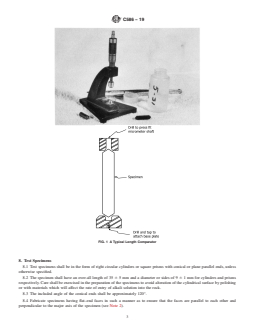
6.4 Length Comparator, for convenient and rapid measurement of lengths of specimens, the comparator shall be of such design
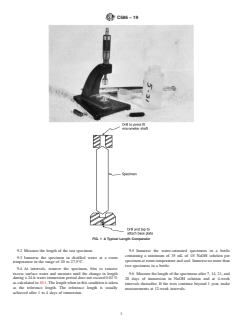
as to provide, permit, or include the following characteristics. One type of comparator which has been found satisfactory is shown
in Fig. 1.
6.4.1 A positive means of contact with the conical ends of the specimen to ensure reproducible measurement of length. A variety
of contact points have been used successfully. Care should be exercised to ensure that when using specimens with conical ends
as described in 8.3, contact is made on the end along a circle which is concentric about the long axis of the specimen. If the
measuring device is a barrel micrometer, it shall have a ratchet stop to produce a constant pressure on the specimen.
6.4.2 A high-grade barrel or dial micrometer graduated to read in 0.001 or 0.002-mm units, and accurate within 0.002 mm in
any 0.020-mm range, and within 0.004 mm in any 0.200-mm range. The measuring device should be calibrated throughout its
range to determine both periodic and cumulative errors for proper correction of observed data.
6.4.3 A sufficient range to allow for small differences among gage lengths of various specimens. If care is taken in the
fabrication of the specimens, a measuring device with a travel of not less than 7.5 mm provides ample range in the instrument,
and
6.4.4 A standard or reference shall be used for checking the measuring device at regular intervals. The bar that serves as a
reference for the length comparator shall have an over-all length of 35 6 2 mm. The length of the bar shall be known to an accuracy
−6
of 0.002 mm. The bar shall be fused silica or a steel alloy having a coefficient of thermal expansion not greater than 1.0 × 10
°C. Each end shall be machined to the same shape as that of the rock specimens. If a steel alloy is used, it shall be polished (see
Note 1). The reference bar shall be placed in the instrument in the same position each time a length measurement is made. The
micrometer setting of the measuring device shall be checked by use of the reference bar at least at the beginning and end of the
readings made within a half day when the apparatus is kept in a room maintained at constant temperature. It shall be checked more
often when kept in a room where temperature is not constant.
NOTE 1—Steel alloys with low thermal expansion coefficient should not be heat treated because they lose their low coefficient of thermal expansion
when so treated.
7. Sampling
7.1 Sample the rock in accordance with the applicable requirements of Practice D75D75/D75M, except that the sample mass
of each discernable stratum shall be at least 1 kg, and individual pieces shall be not less than 75 × 75 × 75 mm in size.
7.2 Sampling should be under the direction of an individual capable of distinguishing differences in lithology, and the sample
of rock should be taken to represent only the particular lithology under consideration bearing in mind the limitations and
significance of this method as stated in Section 5. Each sample of rock should be in one piece of sufficient size for preparing the
necessary test specimens.
7.3 One test specimen will sufficiently represent the sample of rock unless shale seams or other discontinuities are prese
...