

ASTM B415-16(2021)
(Specification)Standard Specification for Hard-Drawn Aluminum-Clad Steel Wire
General Information
- Abstract
ABSTRACT
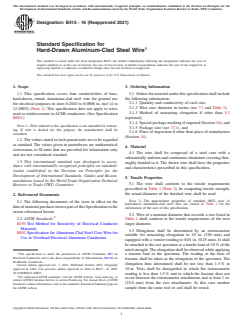
This specification covers four conductivities of bare, hard-drawn, round, aluminum-clad steel wire for general use for electrical purposes. The wire shall be composed of a steel core with a substantially uniform and continuous aluminum covering thoroughly bonded to it. The drawn wire shall have the properties and characteristics prescribed in the specification. The wire of varying nominal diameters shall conform to the prescribed tensile requirements such as tensile strength and elongation. The electrical resistance of the wire shall be determined by resistance measurements and maximum resistance shall be based on the nominal diameter of the wire and the resistivity value. The steel wire shall conform to the prescribed values of physical constants such as modulus of elasticity, coefficient of linear expansion, and temperature coefficient of resistance. Within a required range of diameters, the wire shall not vary from the specified diameter by more than the amount indicated. The aluminum thickness at any point shall not be less than the required values. The wire shall undergo a twist test, where the specimen shall be gripped at its ends in vises, one of which shall be free to move longitudinally during the test. The finished wire shall contain no joints or splices. The material shall also conform to the approximate properties of hard-drawn conductivity aluminum-clad steel wire.
SCOPE
1.1 This specification covers four conductivities of bare, hard-drawn, round, aluminum-clad steel wire for general use for electrical purposes in sizes 0.2043 to 0.0808 in. incl (4 to 12 AWG) (Note 1). This specification does not apply to wires used as reinforcement in ACSR conductors. (See Specification B502.)
Note 1: Wire ordered to this specification is not intended for redrawing. If wire is desired for this purpose, the manufacturer shall be consulted.
1.2 The values stated in inch-pound units are to be regarded as standard. The values given in parentheses are mathematical conversions to SI units that are provided for information only and are not considered standard.
1.3 This international standard was developed in accordance with internationally recognized principles on standardization established in the Decision on Principles for the Development of International Standards, Guides and Recommendations issued by the World Trade Organization Technical Barriers to Trade (TBT) Committee.
- Status
- Published
- Publication Date
- 30-Sep-2021
- Technical Committee
- B01 - Electrical Conductors
- Drafting Committee
- B01.06 - Bi-Metallic Conductors

Overview
ASTM B415-16(2021): Standard Specification for Hard-Drawn Aluminum-Clad Steel Wire defines requirements for bare, hard-drawn, round, aluminum-clad steel wire suitable for general electrical applications. Published by ASTM International, this standard specifies four different conductivities and covers wire diameters from 0.2043 to 0.0808 inches (4 to 12 AWG). The wire features a steel core with a uniform, continuously bonded aluminum covering, combining the mechanical strength of steel with the conductivity and corrosion resistance of aluminum. This standard does not apply to aluminum-clad steel wires intended as reinforcement in ACSR conductors.
Key Topics
- Material Composition: Specifies a steel core continuously bonded to a uniform aluminum layer.
- Conductivity Grades: Four conductivities addressed - 20.3%, 27%, 30%, and 40%.
- Mechanical Properties: Requirements for tensile strength, elongation, twist endurance, and smooth surface finish.
- Electrical Properties: Prescribes maximum resistance values based on size and conductivity; electrical resistance determined per ASTM B193.
- Dimensional Tolerances: Stringent limits on wire diameter and aluminum cladding thickness, ensuring product consistency.
- Testing Requirements:
- Twist test to verify mechanical integrity and bond between aluminum and steel.
- Elongation and tensile tests to ensure compliance with strength requirements.
- Thickness measurement for aluminum layer.
- Inspection and Sampling: Procedures for sampling, inspection at manufacture site, and quality control.
- Packaging and Marking: Details on coil/reel labeling with mass, manufacturer, and size for shipping and traceability.
Applications
Aluminum-clad steel wire manufactured to ASTM B415 is used primarily for general electrical purposes where a combination of high mechanical strength, conductivity, and resistance to environmental factors is required. Typical applications include:
- Grounding wire and line wire in power distribution systems: Its superior corrosion resistance makes it suitable for outdoor and utility applications.
- Antenna, guy, and messenger wires: The hybrid properties of strength and conductivity benefit both structural and signal transmission needs.
- Utility construction and infrastructure: Used where standard copper or aluminum wire might lack mechanical durability or where long service life in challenging environments is essential.
- Telecommunications: As support strand for aerial cables or as part of triplex or duplex wiring systems.
The specification covers applications not involving use as core reinforcement in ACSR (Aluminum Conductor Steel Reinforced) conductors, for which other standards, such as ASTM B502, are applicable.
Related Standards
- ASTM B193: Test Method for Resistivity of Electrical Conductor Materials - Used for electrical resistance determination in B415.
- ASTM B502: Specification for Aluminum-Clad Steel Core Wire for Use in Overhead Electrical Aluminum Conductors - Reference standard for wires intended as reinforcement in ACSR.
- Other ASTM Standards: Related to wire and conductor testing, dimensional tolerances, and quality assurance practices.
Practical Value
By adhering to ASTM B415, manufacturers and users ensure that aluminum-clad steel wires meet stringent requirements for mechanical integrity, electrical conductivity, and durability. This standardization promotes reliability, safety, and performance across power distribution, telecommunications, and general electrical installations. The defined test protocols and sampling procedures further enhance quality assurance, helping end users and regulators to specify and verify product suitability in a wide variety of electrical applications.
Keywords: ASTM B415, aluminum-clad steel wire, hard-drawn wire, electrical conductor, conductivity, tensile strength, corrosion resistance, wire specification, ASTM standards.
Relations
- Effective Date
- 01-Apr-2016
- Effective Date
- 01-Apr-2014
- Effective Date
- 01-Apr-2010
- Effective Date
- 01-Sep-2008
- Effective Date
- 01-Oct-2007
- Effective Date
- 10-Oct-2002
- Effective Date
- 10-Apr-2002
- Effective Date
- 10-Apr-2002
- Effective Date
- 10-Apr-2002
Get Certified
Connect with accredited certification bodies for this standard

Element Materials Technology
Materials testing and product certification.

Inštitut za kovinske materiale in tehnologije
Institute of Metals and Technology. Materials testing, metallurgical analysis, NDT.
Sponsored listings
Frequently Asked Questions
ASTM B415-16(2021) is a technical specification published by ASTM International. Its full title is "Standard Specification for Hard-Drawn Aluminum-Clad Steel Wire". This standard covers: ABSTRACT This specification covers four conductivities of bare, hard-drawn, round, aluminum-clad steel wire for general use for electrical purposes. The wire shall be composed of a steel core with a substantially uniform and continuous aluminum covering thoroughly bonded to it. The drawn wire shall have the properties and characteristics prescribed in the specification. The wire of varying nominal diameters shall conform to the prescribed tensile requirements such as tensile strength and elongation. The electrical resistance of the wire shall be determined by resistance measurements and maximum resistance shall be based on the nominal diameter of the wire and the resistivity value. The steel wire shall conform to the prescribed values of physical constants such as modulus of elasticity, coefficient of linear expansion, and temperature coefficient of resistance. Within a required range of diameters, the wire shall not vary from the specified diameter by more than the amount indicated. The aluminum thickness at any point shall not be less than the required values. The wire shall undergo a twist test, where the specimen shall be gripped at its ends in vises, one of which shall be free to move longitudinally during the test. The finished wire shall contain no joints or splices. The material shall also conform to the approximate properties of hard-drawn conductivity aluminum-clad steel wire. SCOPE 1.1 This specification covers four conductivities of bare, hard-drawn, round, aluminum-clad steel wire for general use for electrical purposes in sizes 0.2043 to 0.0808 in. incl (4 to 12 AWG) (Note 1). This specification does not apply to wires used as reinforcement in ACSR conductors. (See Specification B502.) Note 1: Wire ordered to this specification is not intended for redrawing. If wire is desired for this purpose, the manufacturer shall be consulted. 1.2 The values stated in inch-pound units are to be regarded as standard. The values given in parentheses are mathematical conversions to SI units that are provided for information only and are not considered standard. 1.3 This international standard was developed in accordance with internationally recognized principles on standardization established in the Decision on Principles for the Development of International Standards, Guides and Recommendations issued by the World Trade Organization Technical Barriers to Trade (TBT) Committee.
ABSTRACT This specification covers four conductivities of bare, hard-drawn, round, aluminum-clad steel wire for general use for electrical purposes. The wire shall be composed of a steel core with a substantially uniform and continuous aluminum covering thoroughly bonded to it. The drawn wire shall have the properties and characteristics prescribed in the specification. The wire of varying nominal diameters shall conform to the prescribed tensile requirements such as tensile strength and elongation. The electrical resistance of the wire shall be determined by resistance measurements and maximum resistance shall be based on the nominal diameter of the wire and the resistivity value. The steel wire shall conform to the prescribed values of physical constants such as modulus of elasticity, coefficient of linear expansion, and temperature coefficient of resistance. Within a required range of diameters, the wire shall not vary from the specified diameter by more than the amount indicated. The aluminum thickness at any point shall not be less than the required values. The wire shall undergo a twist test, where the specimen shall be gripped at its ends in vises, one of which shall be free to move longitudinally during the test. The finished wire shall contain no joints or splices. The material shall also conform to the approximate properties of hard-drawn conductivity aluminum-clad steel wire. SCOPE 1.1 This specification covers four conductivities of bare, hard-drawn, round, aluminum-clad steel wire for general use for electrical purposes in sizes 0.2043 to 0.0808 in. incl (4 to 12 AWG) (Note 1). This specification does not apply to wires used as reinforcement in ACSR conductors. (See Specification B502.) Note 1: Wire ordered to this specification is not intended for redrawing. If wire is desired for this purpose, the manufacturer shall be consulted. 1.2 The values stated in inch-pound units are to be regarded as standard. The values given in parentheses are mathematical conversions to SI units that are provided for information only and are not considered standard. 1.3 This international standard was developed in accordance with internationally recognized principles on standardization established in the Decision on Principles for the Development of International Standards, Guides and Recommendations issued by the World Trade Organization Technical Barriers to Trade (TBT) Committee.
ASTM B415-16(2021) is classified under the following ICS (International Classification for Standards) categories: 77.140.65 - Steel wire, wire ropes and link chains; 77.150.10 - Aluminium products. The ICS classification helps identify the subject area and facilitates finding related standards.
ASTM B415-16(2021) has the following relationships with other standards: It is inter standard links to ASTM B193-16, ASTM B193-02(2014), ASTM B502-10, ASTM B193-02(2008), ASTM B502-02(2007), ASTM B502-02, ASTM B193-02, ASTM B193-01, ASTM B193-00. Understanding these relationships helps ensure you are using the most current and applicable version of the standard.
ASTM B415-16(2021) is available in PDF format for immediate download after purchase. The document can be added to your cart and obtained through the secure checkout process. Digital delivery ensures instant access to the complete standard document.
Standards Content (Sample)
This international standard was developed in accordance with internationally recognized principles on standardization established in the Decision on Principles for the
Development of International Standards, Guides and Recommendations issued by the World Trade Organization Technical Barriers to Trade (TBT) Committee.
Designation:B415 −16 (Reapproved 2021)
Standard Specification for
Hard-Drawn Aluminum-Clad Steel Wire
This standard is issued under the fixed designation B415; the number immediately following the designation indicates the year of
original adoption or, in the case of revision, the year of last revision. A number in parentheses indicates the year of last reapproval. A
superscript epsilon (´) indicates an editorial change since the last revision or reapproval.
This standard has been approved for use by agencies of the U.S. Department of Defense.
1. Scope 3. Ordering Information
3.1 Orders for material under this specification shall include
1.1 This specification covers four conductivities of bare,
the following information:
hard-drawn, round, aluminum-clad steel wire for general use
3.1.1 Quantity and conductivity of each size,
for electrical purposes in sizes 0.2043 to 0.0808 in. incl (4 to
3.1.2 Wire size: diameter in inches (see 7.1 and Table 1),
12 AWG) (Note 1). This specification does not apply to wires
3.1.3 Method of measuring elongation if other than 5.3
used as reinforcement inACSR conductors. (See Specification
(optional),
B502.)
3.1.4 Special package marking if required (Section 16), and
NOTE 1—Wire ordered to this specification is not intended for redraw-
3.1.5 Package size (see 17.1), and
ing. If wire is desired for this purpose, the manufacturer shall be
3.1.6 Place of inspection if other than place of manufacture
consulted.
(Section 14).
1.2 The values stated in inch-pound units are to be regarded
as standard. The values given in parentheses are mathematical
4. Material
conversions to SI units that are provided for information only
4.1 The wire shall be composed of a steel core with a
and are not considered standard.
substantially uniform and continuous aluminum covering thor-
1.3 This international standard was developed in accor-
oughly bonded to it. The drawn wire shall have the properties
dance with internationally recognized principles on standard-
and characteristics prescribed in this specification.
ization established in the Decision on Principles for the
Development of International Standards, Guides and Recom-
5. Tensile Properties
mendations issued by the World Trade Organization Technical
5.1 The wire shall conform to the tensile requirements
Barriers to Trade (TBT) Committee.
prescribed in Table 1 (Note 2). In computing tensile strength,
the actual diameter of the finished wire shall be used.
2. Referenced Documents
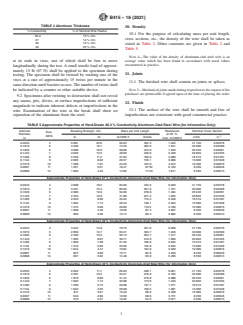
NOTE 2—The approximate properties of standard AWG sizes of
2.1 The following documents of the issue in effect on the
hard-drawn aluminum-clad steel wire are shown in Table 2 for the
dateofmaterialpurchaseformapartofthisSpecificationtothe
information of the user of this specification.
extent referenced herein.
5.2 Wire of a nominal diameter that exceeds a size listed in
2.2 ASTM Standards: Table 1 shall conform to the tensile requirements of the next
B193 Test Method for Resistivity of Electrical Conductor
larger diameter.
Materials
5.3 Elongation shall be determined by an extensometer
B502 Specification for Aluminum-Clad Steel Core Wire for
suitable for measuring elongation in 10 in. (250 mm) and
Use in Overhead Electrical Aluminum Conductors
equipped with a vernier reading to 0.01 in. (0.25 mm). It shall
be attached to the test specimen at a tensile load of 10 % of the
ratedstrength.Theelongationshallbeobservedwhileapplying
This specification is under the jurisdiction of ASTM Committee B01 on
a tension load to the specimen. The reading at the time of
Electrical Conductors and is the direct responsibility of Subcommittee B01.06 on
fracture shall be taken as the elongation of the specimen. The
Bi-Metallic Conductors.
elongation thus determined shall be not less than 1.5 % in
Current edition approved Oct. 1, 2021. Published October 2021. Originally
10 in. Tests shall be disregarded in which the extensometer
approved in 1964. Last previous edition approved in 2016 as B415 – 16. DOI:
10.1520/B0415-16R21.
reading is less than 1.5 % and in which the fracture does not
For referenced ASTM standards, visit the ASTM website, www.astm.org, or
occur between the extensometer attachments and at least 1 in.
contact ASTM Customer Service at service@astm.org. For Annual Book of ASTM
(25.0 mm) from the two attachments. In this case another
Standards volume information, refer to the standard’s Document Summary page on
the ASTM website. sample from the same reel or coil shall be tested.
Copyright © ASTM International, 100 Barr Harbor Drive, PO Box C700, West Conshohocken, PA 19428-2959. United States
B415−16 (2021)
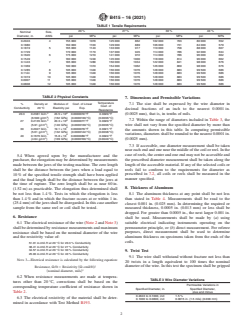
TABLE 1 Tensile Requirements
20 % 27 % 30 % 40 %
Nominal Size,
Diameter, in. AWG
psi MPa psi MPa psi MPa psi MPa
0.2043 4 155 000 1070 125 000 862 102 000 703 80 000 552
0.1880 160 000 1100 129 000 889 106 000 731 84 000 579
0.1819 5 165 000 1140 133 000 917 110 000 758 88 000 607
0.1729 170 000 1170 137 000 945 114 000 786 92 000 634
0.1620 6 175 000 1210 141 000 972 114 000 786 96 000 662
0.1549 180 000 1240 145 000 1000 118 000 814 96 000 662
0.1443 7 185 000 1280 150 000 1034 122 000 841 98 000 676
0.1369 190 000 1310 154 000 1062 126 000 869 98 000 676
0.1285 8 195 000 1340 156 000 1076 128 000 883 99 500 686
0.1144 9 195 000 1340 156 000 1076 128 000 883 99 500 686
0.1019 10 195 000 1340 156 000 1076 128 000 883 99 500 686
0.0907 11 195 000 1340 156 000 1076 128 000 883 99 500 686
0.0808 12 195 000 1340 156 000 1076 128 000 883 99 500 686
TABLE 2 Physical Constants
7. Dimensions and Permissible Variations
Temperature
% Density at Modulus of Coef. of Linear 7.1 The size shall be expressed by the wire diameter in
Coef. of
Conductivity 20 °C Elasticity psi Exp.
decimal fractions of an inch to the nearest 0.0001 in.
Resistance
3 6
(0.0025 mm), that is, in tenths of mils.
20.3 0.2381 lb/in. 23.5 × 10 0.0000072/°F 0.0020/°F
(6.590 g/cm ) (162 GPa) (0.0000130/°C) (0.0036/°C)
3 6 7.2 Within the range of diameters included in Table 3, the
27 0.2135 lb/in. 20.3 × 10 0.0000077/°F 0.0020/°F
wire shall not vary from the specified diameter by more than
(5.91 g/cm ) (140 GPa) (0.0000139/°C) (0.0036/°C)
3 6
30 0.2027 lb/in. 19.1 × 10 0.0000079/°F 0.0021/°F
the amounts shown in this table. In computing permissible
(5.61 g/cm ) (132 GPa) (0.0000142/°C) (0.0038/°C)
3 6 variations, diameters shall be rounded to the nearest 0.0001 in.
40 0.1676 lb/in. 15.8 × 10 0.0000089/°F 0.0022/°F
(4.64 g/cm ) (109 GPa) (0.0000160/°C) (0.0040/°C) (0.0025 mm).
7.3 If accessible, one diameter measurement shall be taken
near each end and one near the middle of the coil or reel. In the
case of reels, the center and one end may not be accessible and
5.4 When agreed upon by the manufacturer and the
the prescribed diameter measurement shall be taken along the
purchaser, the elongation may be determined by measurements
length of the accessible material. If any of the selected coils or
made between the jaws of the testing machine.The zero length
reels fail to conform to the requirements for diameter as
shall be the distance between the jaws when a load equal to
prescribed in 7.2, all coils or reels shall be measured in the
10 % of the specified tensile strength shall have been applied
manner specified.
and the final length shall be the distance between the jaws at
the time of rupture. The zero length shall be as near 60 in.
8. Thickness of Aluminum
(1.52 m) as practicable. The elongation thus determined shall
be not less than 1.4 %. Tests in which the elongation is less
8.1 The aluminum thickness at any point shall be not less
than 1.4 % and in which the fracture occurs at or within 1 in. than stated in Table 4. Measurements shall be read to the
(25.4 mm) of the jaws shall be disregarded. In this case another
closest 0.001 in. (0.025 mm). In determining the required or
sample from the same reel or coil shall be tested. measured thickness, 0.0005 in. (0.013 mm) or less shall be
dropped. For greater than 0.0005 in., the next larger 0.001 in.
6. Resistance
shall be used. Measurements shall be made by (a) using
6.1 The electrical resistance of the wire (Note 2 and Note 3) suitable electrical indicating instruments operating on the
permeameter principle, or (b) direct measurement. For referee
shall be determined by resistance measurements and maximum
resistance shall be based on the nominal diameter of the wire purposes, direct measurement shall be used to determine
aluminum thickness on specimens taken from the ends o
...