

ASTM D1506-23
(Test Method)Standard Test Methods for Carbon Black-Ash Content
General Information
- Abstract
SIGNIFICANCE AND USE
4.1 The ash content of a carbon black is the amount of non-carbon components present after combustion. Primary contributants to ash are the manufacturing process water and the catalyst in the feedstock.
SCOPE
1.1 These test methods cover the determination of the ash content of carbon black.
1.2 The values stated in SI units are to be regarded as standard. No other units of measurement are included in this standard.
1.3 This standard does not purport to address all of the safety concerns, if any, associated with its use. It is the responsibility of the user of this standard to establish appropriate safety, health, and environmental practices and determine the applicability of regulatory limitations prior to use. For specific precautionary statements see Sections 6 and 13.
1.4 This international standard was developed in accordance with internationally recognized principles on standardization established in the Decision on Principles for the Development of International Standards, Guides and Recommendations issued by the World Trade Organization Technical Barriers to Trade (TBT) Committee.
- Status
- Published
- Publication Date
- 30-Apr-2023
- Technical Committee
- D24 - Carbon Black
- Drafting Committee
- D24.31 - Non-Carbon Black Components of Carbon Black

Overview
ASTM D1506-23: Standard Test Methods for Carbon Black-Ash Content provides precise procedures for determining the ash content in carbon black materials. Ash content measures the amount of non-carbon substances remaining after combustion, reflecting the presence of residual inorganic components such as manufacturing process water and catalysts from feedstock. Developed by ASTM International, this standard plays a critical role in the quality assessment and control of carbon black used across various industries.
Key Topics
- Scope: The standard outlines two primary test methods-muffle furnace and microwave furnace procedures-to accurately determine carbon black ash content.
- Test Methods:
- Muffle Furnace: Involves heating a pre-dried carbon black sample at 550°C for an extended period and weighing the residue.
- Microwave Furnace: Uses microwave heating for ashing, providing a potentially faster alternative with comparable accuracy.
- Precision and Repeatability: Includes detailed data on interlaboratory studies, supporting the method’s reliability for both repeatability (same lab, short-term) and reproducibility (across labs).
- Units: All results are reported in SI units, ensuring global consistency.
- Safety Considerations: Users are responsible for establishing appropriate safety, health, and environmental practices when applying these test methods.
Applications
ASTM D1506-23 is essential for manufacturers, suppliers, and laboratories working with carbon black, notably in industries such as:
- Rubber and Plastics Manufacturing: Ash content analysis is key to qualifying reinforcing fillers and ensuring product performance.
- Quality Control: Consistent determination of non-carbon residue assures compliance with product specifications and regulatory requirements.
- Research and Development: The test methods support efforts to refine carbon black production processes, leading to improved purity and performance.
- Compliance and Certification: Meeting ASTM D1506-23 test criteria is often a requirement in supply chains and by regulatory bodies, especially for products used in automotive, electronics, and industrial applications.
These standardized methods support accurate reporting and comparability of ash content results across different laboratories and production batches, aiding in uniform product quality and reducing variability.
Related Standards
For comprehensive carbon black characterization and analysis, the following ASTM standards are frequently used alongside ASTM D1506-23:
- ASTM D1799 - Practice for Carbon Black-Sampling Packaged Shipments
- ASTM D1900 - Practice for Carbon Black-Sampling Bulk Shipments
- ASTM D4483 - Practice for Evaluating Precision for Test Method Standards in the Rubber and Carbon Black Manufacturing Industries
These related documents ensure best practices in sampling and statistical evaluation, further reinforcing the reliability of ash content measurements.
Keywords: ASTM D1506-23, carbon black, ash content, standard test methods, muffle furnace, microwave furnace, non-carbon components, quality control, industrial standards, rubber manufacturing.
Relations
- Effective Date
- 01-Nov-2015
- Effective Date
- 01-Jun-2014
- Effective Date
- 01-May-2011
- Effective Date
- 01-Sep-2008
- Effective Date
- 01-Oct-2006
- Effective Date
- 01-Nov-2003
- Effective Date
- 10-Jun-2003
- Effective Date
- 10-Nov-2002
- Effective Date
- 10-Nov-1997
- Effective Date
- 15-Aug-1994
Get Certified
Connect with accredited certification bodies for this standard

DIN CERTCO
DIN Group product certification.

Smithers Quality Assessments
US management systems and product certification.
Sponsored listings
Frequently Asked Questions
ASTM D1506-23 is a standard published by ASTM International. Its full title is "Standard Test Methods for Carbon Black-Ash Content". This standard covers: SIGNIFICANCE AND USE 4.1 The ash content of a carbon black is the amount of non-carbon components present after combustion. Primary contributants to ash are the manufacturing process water and the catalyst in the feedstock. SCOPE 1.1 These test methods cover the determination of the ash content of carbon black. 1.2 The values stated in SI units are to be regarded as standard. No other units of measurement are included in this standard. 1.3 This standard does not purport to address all of the safety concerns, if any, associated with its use. It is the responsibility of the user of this standard to establish appropriate safety, health, and environmental practices and determine the applicability of regulatory limitations prior to use. For specific precautionary statements see Sections 6 and 13. 1.4 This international standard was developed in accordance with internationally recognized principles on standardization established in the Decision on Principles for the Development of International Standards, Guides and Recommendations issued by the World Trade Organization Technical Barriers to Trade (TBT) Committee.
SIGNIFICANCE AND USE 4.1 The ash content of a carbon black is the amount of non-carbon components present after combustion. Primary contributants to ash are the manufacturing process water and the catalyst in the feedstock. SCOPE 1.1 These test methods cover the determination of the ash content of carbon black. 1.2 The values stated in SI units are to be regarded as standard. No other units of measurement are included in this standard. 1.3 This standard does not purport to address all of the safety concerns, if any, associated with its use. It is the responsibility of the user of this standard to establish appropriate safety, health, and environmental practices and determine the applicability of regulatory limitations prior to use. For specific precautionary statements see Sections 6 and 13. 1.4 This international standard was developed in accordance with internationally recognized principles on standardization established in the Decision on Principles for the Development of International Standards, Guides and Recommendations issued by the World Trade Organization Technical Barriers to Trade (TBT) Committee.
ASTM D1506-23 is classified under the following ICS (International Classification for Standards) categories: 83.040.20 - Rubber compounding ingredients. The ICS classification helps identify the subject area and facilitates finding related standards.
ASTM D1506-23 has the following relationships with other standards: It is inter standard links to ASTM D1900-06(2015), ASTM D1799-03a(2014), ASTM D1900-06(2011), ASTM D1799-03a(2008), ASTM D1900-06, ASTM D1799-03a, ASTM D1799-03, ASTM D1799-02, ASTM D1799-93(1997), ASTM D1900-94(2002). Understanding these relationships helps ensure you are using the most current and applicable version of the standard.
ASTM D1506-23 is available in PDF format for immediate download after purchase. The document can be added to your cart and obtained through the secure checkout process. Digital delivery ensures instant access to the complete standard document.
Standards Content (Sample)
This international standard was developed in accordance with internationally recognized principles on standardization established in the Decision on Principles for the
Development of International Standards, Guides and Recommendations issued by the World Trade Organization Technical Barriers to Trade (TBT) Committee.
Designation: D1506 − 23
Standard Test Methods for
Carbon Black—Ash Content
This standard is issued under the fixed designation D1506; the number immediately following the designation indicates the year of
original adoption or, in the case of revision, the year of last revision. A number in parentheses indicates the year of last reapproval. A
superscript epsilon (´) indicates an editorial change since the last revision or reapproval.
This standard has been approved for use by agencies of the U.S. Department of Defense.
1. Scope 4. Significance and Use
1.1 These test methods cover the determination of the ash 4.1 The ash content of a carbon black is the amount of
content of carbon black. non-carbon components present after combustion. Primary
contributants to ash are the manufacturing process water and
1.2 The values stated in SI units are to be regarded as
the catalyst in the feedstock.
standard. No other units of measurement are included in this
standard.
Method A—Muffle Furnace Method
1.3 This standard does not purport to address all of the
safety concerns, if any, associated with its use. It is the
5. Apparatus
responsibility of the user of this standard to establish appro-
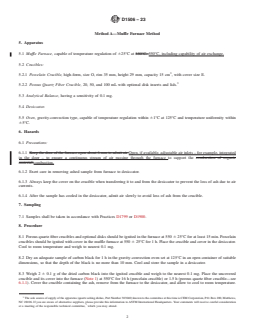
5.1 Muffle Furnace, capable of temperature regulation of
priate safety, health, and environmental practices and deter-
625°C at 550°C, including capability of air exchange.
mine the applicability of regulatory limitations prior to use.
5.2 Crucibles:
For specific precautionary statements see Sections 6 and 13.
5.2.1 Porcelain Crucible, high-form, size O, rim 35 mm,
1.4 This international standard was developed in accor-
height 29 mm, capacity 15 cm , with cover size E.
dance with internationally recognized principles on standard-
5.2.2 Porous Quartz Fiber Crucible, 20, 50, and 100 mL
ization established in the Decision on Principles for the
with optional disk inserts and lids.
Development of International Standards, Guides and Recom-
mendations issued by the World Trade Organization Technical 5.3 Analytical Balance, having a sensitivity of 0.1 mg.
Barriers to Trade (TBT) Committee.
5.4 Desiccator.
2. Referenced Documents
5.5 Oven, gravity-convection type, capable of temperature
regulation within 61°C at 125°C and temperature uniformity
2.1 ASTM Standards:
within 65°C.
D1799 Practice for Carbon Black—Sampling Packaged
Shipments
6. Hazards
D1900 Practice for Carbon Black—Sampling Bulk Ship-
ments
6.1 Precautions:
D4483 Practice for Evaluating Precision for Test Method
6.1.1 Open, if available, adjustable air inlets – for example,
Standards in the Rubber and Carbon Black Manufacturing
integrated in the door – to ensure a continuous stream of air
Industries
passing through the furnace to support the combustion.
6.1.2 Exert care in removing ashed sample from furnace to
3. Summary of Test Method
desiccator.
3.1 A pre-dried sample (1 h at 125°C) is weighed before and
6.1.3 Always keep the cover on the crucible when transfer-
after combustion for 16 h at 550°C. The remaining ash is
ring it to and from the desiccator to prevent the loss of ash due
weighed and calculated as a percent of the dried sample.
to air currents.
6.1.4 After the sample has cooled in the desiccator, admit air
These test methods are under the jurisdiction of ASTM Committee D24 on
slowly to avoid loss of ash from the crucible.
Carbon Black and are the direct responsibility of Subcommittee D24.31 on
Non-Carbon Black Components of Carbon Black.
Current edition approved May 1, 2023. Published May 2023. Originally
approved in 1957. Last previous edition approved in 2020 as D1506 – 15 (2020). The sole source of supply of the apparatus (quartz ashing dishes, Part Number
DOI: 10.1520/D1506-23. 303040) known to the committee at this time is CEM Corporation, P.O. Box 200,
For referenced ASTM standards, visit the ASTM website, www.astm.org, or Matthews, NC 28106. If you are aware of alternative suppliers, please provide this
contact ASTM Customer Service at service@astm.org. For Annual Book of ASTM information to ASTM International Headquarters. Your comments will receive
Standards volume information, refer to the standard’s Document Summary page on careful consideration at a meeting of the responsible technical committee, which
the ASTM website. you may attend.
Copyright © ASTM International, 100 Barr Harbor Drive, PO Box C700, West Conshohocken, PA 19428-2959. United States
D1506 − 23
7. Sampling ticular materials and the specific testing protocols of the test
method. Any appropriate value may be used from Table 1.
7.1 Samples shall be taken in accordance with Practices
D1799 or D1900. 11.3 A type 1 inter-laboratory precision program was con-
ducted as detailed in Table 2. Both repeatability and reproduc-
8. Procedure
ibility represent short term (daily) testing conditions. The
testing was performed using two operators in each laboratory
8.1 Porous quartz fiber crucibles and optional disks should
performing the test once on each of two days (total of four
be ignited in the furnace at 550 6 25°C for at least 15 min.
tests). A test result is the value obtained from a single
Porcelain crucibles should be ignited with cover in the muffle
determination. Acceptable difference values were not mea-
furnace at 550 6 25°C for 1 h. Place the crucible and cover in
sured. The between operator component of variation is in-
the desiccator. Cool to room temperature and weigh to nearest
cluded in the calculated values for r and R.
0.1 mg.
11.4 The results of the precision calculations for this test are
8.2 Dry an adequate sample of carbon black for 1 h in the
given in Table 1. The materials are arranged in ascending
gravity-convection oven set at 125°C in an open container of
“mean level” order.
suitable dimensions, so that the depth of the black is no more
than 10 mm. Cool and store the sample in a desiccator.
11.5 Repeatability—The pooled relative repeatability, (r), of
this test has been established as 16.0 %. Any other value in
8.3 Weigh 2 6 0.1 g of the dried carbon black into the
Table 1 may be used as an estimate of repeatability, as
ignited crucible and weigh to the nearest 0.1 mg. Place the
appropriate. The difference between two single test results (or
uncovered crucible and its cover into the furnace (Note 1) at
determinations) found on identical test material under the
550°C for 16 h (porcelain crucible) or 1.5 h (porous quartz
repeatability conditions prescribed for this test will exceed the
fiber crucible—see 6.1.1). Cover the crucible containing the
repeatability on an average of not more than once in 20 cases
ash, remove from the furnace to the desiccator, and allow to
in the normal and correct operation of the method. Two single
cool to room temperature. Weigh the covered crucible to the
test results that differ by more than the appropriate value from
nearest 0.1 mg. Put the covered crucible back into the furnace
Table 1 must be suspected of being from different populations
for additional 0.5 h. Reweigh to the nearest 0.1 mg. Repeat this
and some appropriate action taken.
weighing process until constant mass is obtained.
NOTE 3—Appropriate action may be an investigation of the test method
NOTE 1—For carbon blacks with very low ash content (such as high
procedure or apparatus for faulty operation or the declaration of a
purity blacks) larger sample mass and longer ashing time may be required.
significant difference in the two materials, samples, etc., which generated
NOTE 2—If control testing is done at temperatures exceeding 550°C,
the two test results.
some volatile salts may be lost from inorganic ash.
11.6 Reproducibility—The pooled relative reproducibility,
9. Calculation
(R), of this test has been established as 29.7 %. Any other value
in Table 1 may be used as an estimate of reproducibility, as
9.1 Calculate the percent ash to the nearest 0.01 % as
appropriate. The difference between two single and indepen-
follows:
dent test results found by two operators working under the
A 5 D 2 B / C 2 B × 100 (1)
@~ ! ~ !#
prescribed reproducibility conditions in different laboratories
where:
on identical test material will exceed the reproducibility on an
average of not more than once in 20 cases in the normal and
A = ash, %,
B = mass of crucible, g, correct operation of the method. Two single test results
C = mass of crucible plus the sample, g, and
produced in different laboratories that differ by more than the
D = mass of crucible plus the ash, g.
appropriate value from Table 1 must be suspected of being
from different populations and some appropriate investigative
10. Report
or technical/commercial action taken.
10.1 Report the following information:
11.7 Bias—In test method terminology, bias is the difference
10.1.1 Proper identification of the sample, and
between an
...
This document is not an ASTM standard and is intended only to provide the user of an ASTM standard an indication of what changes have been made to the previous version. Because
it may not be technically possible to adequately depict all changes accurately, ASTM recommends that users consult prior editions as appropriate. In all cases only the current version
of the standard as published by ASTM is to be considered the official document.
Designation: D1506 − 15 (Reapproved 2020) D1506 − 23
Standard Test Methods for
Carbon Black—Ash Content
This standard is issued under the fixed designation D1506; the number immediately following the designation indicates the year of
original adoption or, in the case of revision, the year of last revision. A number in parentheses indicates the year of last reapproval. A
superscript epsilon (´) indicates an editorial change since the last revision or reapproval.
This standard has been approved for use by agencies of the U.S. Department of Defense.
1. Scope
1.1 These test methods cover the determination of the ash content of carbon black.
1.2 The values stated in SI units are to be regarded as standard. No other units of measurement are included in this standard.
1.3 This standard does not purport to address all of the safety concerns, if any, associated with its use. It is the responsibility
of the user of this standard to establish appropriate safety, health, and environmental practices and determine the applicability of
regulatory limitations prior to use. For specific precautionary statements see Sections 6 and 13.
1.4 This international standard was developed in accordance with internationally recognized principles on standardization
established in the Decision on Principles for the Development of International Standards, Guides and Recommendations issued
by the World Trade Organization Technical Barriers to Trade (TBT) Committee.
2. Referenced Documents
2.1 ASTM Standards:
D1799 Practice for Carbon Black—Sampling Packaged Shipments
D1900 Practice for Carbon Black—Sampling Bulk Shipments
D4483 Practice for Evaluating Precision for Test Method Standards in the Rubber and Carbon Black Manufacturing Industries
3. Summary of Test Method
3.1 A pre-dried sample (1 h at 125°C) is weighed before and after combustion for 16 h at 550°C. The remaining ash is weighed
and calculated as a percent of the dried sample.
4. Significance and Use
4.1 The ash content of a carbon black is the amount of non-carbon components present after combustion. Primary contributants
to ash are the manufacturing process water and the catalyst in the feedstock.
These test methods are under the jurisdiction of ASTM Committee D24 on Carbon Black and are the direct responsibility of Subcommittee D24.31 on Non-Carbon Black
Components of Carbon Black.
Current edition approved Nov. 1, 2020May 1, 2023. Published December 2020May 2023. Originally approved in 1957. Last previous edition approved in 20152020 as
D1506 – 15.D1506 – 15 (2020). DOI: 10.1520/D1506-15R20.10.1520/D1506-23.
For referenced ASTM standards, visit the ASTM website, www.astm.org, or contact ASTM Customer Service at service@astm.org. For Annual Book of ASTM Standards
volume information, refer to the standard’s Document Summary page on the ASTM website.
Copyright © ASTM International, 100 Barr Harbor Drive, PO Box C700, West Conshohocken, PA 19428-2959. United States
D1506 − 23
Method A—Muffle Furnace Method
5. Apparatus
5.1 Muffle Furnace, capable of temperature regulation of 625°C at 550°C. 550°C, including capability of air exchange.
5.2 Crucibles:
5.2.1 Porcelain Crucible, high-form, size O, rim 35 mm, height 29 mm, capacity 15 cm , with cover size E.
5.2.2 Porous Quartz Fiber Crucible, 20, 50, and 100 mL with optional disk inserts and lids.
5.3 Analytical Balance, having a sensitivity of 0.1 mg.
5.4 Desiccator.
5.5 Oven, gravity-convection type, capable of temperature regulation within 61°C at 125°C and temperature uniformity within
65°C.
6. Hazards
6.1 Precautions:
6.1.1 Keep the door of the furnace open about 6 mm to admit air Open, if available, adjustable air inlets – for example, integrated
in the door – to ensure a continuous stream of air passing through the furnace to support the combustion of organic
material.combustion.
6.1.2 Exert care in removing ashed sample from furnace to desiccator.
6.1.3 Always keep the cover on the crucible when transferring it to and from the desiccator to prevent the loss of ash due to air
currents.
6.1.4 After the sample has cooled in the desiccator, admit air slowly to avoid loss of ash from the crucible.
7. Sampling
7.1 Samples shall be taken in accordance with Practices D1799 or D1900.
8. Procedure
8.1 Porous quartz fiber crucibles and optional disks should be ignited in the furnace at 550 6 25°C for at least 15 min. Porcelain
crucibles should be ignited with cover in the muffle furnace at 550 6 25°C for 1 h. Place the crucible and cover in the desiccator.
Cool to room temperature and weigh to nearest 0.1 mg.
8.2 Dry an adequate sample of carbon black for 1 h in the gravity-convection oven set at 125°C in an open container of suitable
dimensions, so that the depth of the black is no more than 10 mm. Cool and store the sample in a desiccator.
8.3 Weigh 2 6 0.1 g of the dried carbon black into the ignited crucible and weigh to the nearest 0.1 mg. Place the uncovered
crucible and its cover into the furnace (Note 1) at 550°C for 16 h (porcelain crucible) or 1.5 h (porous quartz fiber crucible—see
6.1.1). Cover the crucible containing the ash, remove from the furnace to the desiccator, and allow to cool to room temperature.
The sole source of supply of the apparatus (quartz ashing dishes, Part Number 303040) known to the committee at this time is CEM Corporation, P.O. Box 200, Matthews,
NC 28106. If you are aware of alternative suppliers, please provide this information to ASTM International Headquarters. Your comments will receive careful consideration
at a meeting of the responsible technical committee, which you may attend.
D1506 − 23
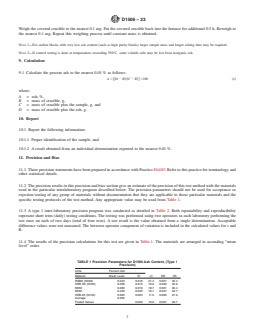
Weigh the covered crucible to the nearest 0.1 mg. Put the covered crucible back into the furnace for additional 0.5 h. Reweigh to
the nearest 0.1 mg. Repeat this weighing process until constant mass is obtained.
NOTE 1—For carbon blacks with very low ash content (such as high purity blacks) larger sample mass and longer ashing time may be required.
NOTE 2—If control testing is done at temperatures exceeding 550°C, some volatile salts may be lost from inorganic ash.
9. Calculation
9.1 Calculate the percent ash to the nearest 0.01 % as follows:
A 5 @~D 2 B!/~C 2 B!# ×100 (1)
where:
A = ash, %,
B = mass of crucible, g,
C = mass of crucible plus the sample, g, and
D = mass of crucible plus the ash, g.
10. Report
10.1 Report the following information:
10.1.1 Proper identification of the sample, and
10.1.2 A result obtained from an individual determination reported to the nearest 0.01 %.
11. Precision and Bias
11.1 These precision statements have been prepared in accordance with Practice D4483. Refer to this practice for terminology and
other statistical details.
11.2 The precision results in this precision and bias section give an estimate of the precision of this test method with the materials
used in the particular interlaboratory program described below. The precision parameters should not be used for acceptance or
rejection testing of any group of materials without documentation that they are applicable to those particular materials and the
specific testing protocols of the test method. Any appropriate value may be used from Table 1.
11.3 A type 1 inter-laboratory precision program was conducted as detailed in Table 2. Both repeatability and reproducibility
represent short term (daily) testing conditions. The testing was performed using two operators in each laboratory performing the
test once on each of two days (total of four tests). A test result is the value obtained from a single determination. Acceptable
difference values were not measured. The between operator component of variation is included in the calculated values for r and
R.
11.4 The results of the precision calculations for this test are given in Table 1. The materials are arranged in ascending “mean
level” order.
TABLE 1 Precision Parameters for D1506 Ash Content, (Type 1
Precision)
Units Percent Ash
Material Mean Level Sr (r) SR (R)
IRB#6 (N330) 0.233 0.018 21.4 0.027 32.4
SRB D5 (N762) 0.258 0.015 16.0 0.030 32.6
N650 0.289 0.019 18.7 0.031 30.4
N550 0.436 0.025 16.1 0.037 23.7
SRB A5 (N135) 0.565 0.023 11.5 0.056 27.9
Average 0.356
Pooled Values 0.020 16.0 0.037 29.7
D1506 − 23
TABLE 2 Interlaboratory Precision Program
Nominal Test Period Material Number of Laboratories
March 1996 N650 45
October 1996 IRB#6 (N330) 37
March 1997 SRB N762 48
September 1997 SRB A5 (N135) 43
March 1998 N550 46
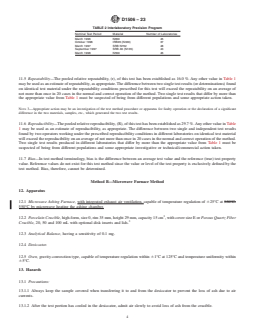
11.5 Repeatability—The pooled relative repeatability, (r), of this test has been established as 16.0 %. Any other value in Table 1
may be used as an estimate of repeatability, as appropriate. The difference between two single test results (or determinations) found
on identical test material under the repeatability conditions prescribed for this test will exceed the repeatability on an average of
not more than once in 20 cases in the norma
...