

ASTM C1425-19
(Test Method)Standard Test Method for Interlaminar Shear Strength of 1D and 2D Continuous Fiber-Reinforced Advanced Ceramics at Elevated Temperatures
General Information
- Abstract
SIGNIFICANCE AND USE
5.1 Continuous fiber-reinforced ceramic composites are candidate materials for structural applications requiring high degrees of wear, erosion, corrosion resistance, and damage tolerance at high temperatures.
5.2 The 1D and 2D CFCCs are highly anisotropic and their transthickness tensile and interlaminar shear strength are lower than their in-plane tensile and in-plane shear strength, respectively.
5.3 Shear tests provide information on the strength and deformation of materials under shear stresses.
5.4 This test method may be used for material development, material comparison, quality assurance, characterization, and design data generation.
5.5 For quality control purposes, results derived from standardized shear test specimens may be considered indicative of the response of the material from which they were taken for given primary processing conditions and post-processing heat treatments.
SCOPE
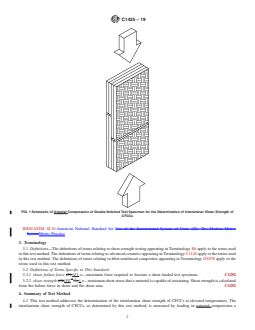
1.1 This test method addresses the uniaxial compression of a double-notched test specimen to determine interlaminar shear strength of continuous fiber-reinforced ceramic composites (CFCCs) at elevated temperatures. Failure of the test specimen occurs by interlaminar shear between two centrally located notches machined halfway through the thickness of the test specimen and spaced a fixed distance apart on opposing faces (see Fig. 1). Test specimen preparation methods and requirements, testing modes (force or displacement control), testing rates (force rate or displacement rate), data collection, and reporting procedures are addressed.
FIG. 1 Schematic of Uniaxial Compression of Double-Notched Test Specimen for the Determination of Interlaminar Shear Strength of CFCCs
1.2 This test method is used for testing advanced ceramic or glass matrix composites with continuous fiber reinforcement having a laminated structure such as in unidirectional (1D) or bidirectional (2D) fiber architecture (lay-ups of unidirectional plies or stacked fabric). This test method does not address composites with nonlaminated structures, such as (3D) fiber architecture or discontinuous fiber-reinforced, whisker-reinforced, or particulate-reinforced ceramics.
1.3 Values expressed in this test method are in accordance with the International System of Units (SI) and IEEE/ASTM SI 10.
1.4 This standard does not purport to address all of the safety concerns, if any, associated with its use. It is the responsibility of the user of this standard to establish appropriate safety, health, and environmental practices and determine the applicability of regulatory limitations prior to use. Specific precautionary statements are noted in 8.1 and 8.2.
1.5 This international standard was developed in accordance with internationally recognized principles on standardization established in the Decision on Principles for the Development of International Standards, Guides and Recommendations issued by the World Trade Organization Technical Barriers to Trade (TBT) Committee.
- Status
- Published
- Publication Date
- 31-Jan-2019
- Technical Committee
- C28 - Advanced Ceramics
- Drafting Committee
- C28.07 - Ceramic Matrix Composites
Buy Documents
ASTM C1425-19 - Standard Test Method for Interlaminar Shear Strength of 1D and 2D Continuous Fiber-Reinforced Advanced Ceramics at Elevated Temperatures
REDLINE ASTM C1425-19 - Standard Test Method for Interlaminar Shear Strength of 1D and 2D Continuous Fiber-Reinforced Advanced Ceramics at Elevated Temperatures
Overview
ASTM C1425-19 is the recognized standard test method for determining the interlaminar shear strength of one-dimensional (1D) and two-dimensional (2D) continuous fiber-reinforced advanced ceramics at elevated temperatures. Developed by ASTM Committee C28 on Advanced Ceramics, this test is essential for evaluating the mechanical properties of continuous fiber-reinforced ceramic composites (CFCCs), particularly for structural applications subjected to challenging wear, erosion, and corrosion environments at high temperatures.
This standard focuses on advanced ceramic or glass matrix composites with unidirectional or bidirectional continuous fiber architectures. By subjecting double-notched test specimens to uniaxial compression, the method assesses shear failure between notches, providing reliable data for material development, comparison, quality assurance, design, and characterization.
Key Topics
Test Methodology: Specifies the use of uniaxial compression on a double-notched specimen. The specimen is machined to specific dimensions, ensuring that failure occurs via interlaminar shear in a controlled gage section. The method covers detailed requirements for specimen preparation, testing modes (force or displacement control), heating, temperature monitoring, and data collection.
Material Scope: Applicable exclusively to CFCCs with laminated structures (unidirectional or bidirectional fiber lay-ups or stacked fabric). It does not apply to non-laminated, three-dimensional, discontinuous, whisker-reinforced, or particulate-reinforced ceramics.
Test Environment: The test accounts for variables like atmosphere (air, inert gases), temperature, humidity, and test rates that can significantly affect interlaminar shear strength. The conditions must be strictly monitored and reported to ensure data consistency.
Significance: CFCCs are highly anisotropic, displaying weaker transthickness tensile and interlaminar shear properties compared to their in-plane strength. Interlaminar shear tests deliver vital information about how these advanced ceramics deform and fail under shear stress, supporting their use in safety-critical, high-temperature environments.
Applications
This standard is vital across industries that use advanced ceramics for high-temperature structural components, such as:
- Aerospace and Defense: Manufacturing turbine components, thermal protection systems, and high-strength structural elements.
- Energy and Power Generation: Components exposed to high wear and thermal cycling, such as gas turbines and boiler parts.
- Industrial Processing: Equipment subject to aggressive wear or corrosive environments at elevated temperatures.
- Automotive and Transport: High-performance braking systems and engine components.
Common applications include:
- Material development and comparison,
- Quality assurance and control,
- Generation of design data for engineering structures,
- Characterization of new CFCCs, and
- Verification of processing and heat treatment consistency.
Related Standards
Testing and terminology can reference or be complemented by several related ASTM standards:
- ASTM C1292: Test Method for Shear Strength of Continuous Fiber-Reinforced Advanced Ceramics at Ambient Temperatures
- ASTM C1145: Terminology of Advanced Ceramics
- ASTM D695: Test Method for Compressive Properties of Rigid Plastics
- ASTM D3846: Test Method for In-Plane Shear Strength of Reinforced Plastics
- ASTM D3878: Terminology for Composite Materials
- ASTM D6856/D6856M: Guide for Testing Fabric-Reinforced "Textile" Composite Materials
- ASTM E4, E6, E122, E220/E230: Practices and methods for force verification, mechanical testing terminology, sampling, and temperature calibration
These standards help ensure consistency, comparability, and reliability in the measurement of mechanical properties for advanced ceramics and fiber-reinforced composites.
Keywords: ASTM C1425-19, interlaminar shear strength, continuous fiber-reinforced ceramic composites, CFCC, advanced ceramics, high temperature materials testing, double-notched specimen, ceramic matrix composites, quality assurance, material characterization
Relations
- Effective Date
- 01-Feb-2019
- Refers
ASTM D6856/D6856M-23 - Standard Guide for Testing Fabric-Reinforced “Textile” Composite Materials - Effective Date
- 01-Nov-2023
- Effective Date
- 01-Nov-2023
- Effective Date
- 01-May-2023
- Effective Date
- 15-Oct-2019
- Effective Date
- 01-Jul-2019
- Effective Date
- 15-Apr-2019
- Effective Date
- 01-Apr-2018
- Effective Date
- 01-Sep-2016
- Effective Date
- 01-Aug-2016
- Effective Date
- 01-Sep-2015
- Effective Date
- 01-Jul-2015
- Effective Date
- 01-Jun-2014
- Effective Date
- 01-Nov-2013
- Effective Date
- 01-May-2013
Buy Documents
ASTM C1425-19 - Standard Test Method for Interlaminar Shear Strength of 1D and 2D Continuous Fiber-Reinforced Advanced Ceramics at Elevated Temperatures
REDLINE ASTM C1425-19 - Standard Test Method for Interlaminar Shear Strength of 1D and 2D Continuous Fiber-Reinforced Advanced Ceramics at Elevated Temperatures
Frequently Asked Questions
ASTM C1425-19 is a standard published by ASTM International. Its full title is "Standard Test Method for Interlaminar Shear Strength of 1D and 2D Continuous Fiber-Reinforced Advanced Ceramics at Elevated Temperatures". This standard covers: SIGNIFICANCE AND USE 5.1 Continuous fiber-reinforced ceramic composites are candidate materials for structural applications requiring high degrees of wear, erosion, corrosion resistance, and damage tolerance at high temperatures. 5.2 The 1D and 2D CFCCs are highly anisotropic and their transthickness tensile and interlaminar shear strength are lower than their in-plane tensile and in-plane shear strength, respectively. 5.3 Shear tests provide information on the strength and deformation of materials under shear stresses. 5.4 This test method may be used for material development, material comparison, quality assurance, characterization, and design data generation. 5.5 For quality control purposes, results derived from standardized shear test specimens may be considered indicative of the response of the material from which they were taken for given primary processing conditions and post-processing heat treatments. SCOPE 1.1 This test method addresses the uniaxial compression of a double-notched test specimen to determine interlaminar shear strength of continuous fiber-reinforced ceramic composites (CFCCs) at elevated temperatures. Failure of the test specimen occurs by interlaminar shear between two centrally located notches machined halfway through the thickness of the test specimen and spaced a fixed distance apart on opposing faces (see Fig. 1). Test specimen preparation methods and requirements, testing modes (force or displacement control), testing rates (force rate or displacement rate), data collection, and reporting procedures are addressed. FIG. 1 Schematic of Uniaxial Compression of Double-Notched Test Specimen for the Determination of Interlaminar Shear Strength of CFCCs 1.2 This test method is used for testing advanced ceramic or glass matrix composites with continuous fiber reinforcement having a laminated structure such as in unidirectional (1D) or bidirectional (2D) fiber architecture (lay-ups of unidirectional plies or stacked fabric). This test method does not address composites with nonlaminated structures, such as (3D) fiber architecture or discontinuous fiber-reinforced, whisker-reinforced, or particulate-reinforced ceramics. 1.3 Values expressed in this test method are in accordance with the International System of Units (SI) and IEEE/ASTM SI 10. 1.4 This standard does not purport to address all of the safety concerns, if any, associated with its use. It is the responsibility of the user of this standard to establish appropriate safety, health, and environmental practices and determine the applicability of regulatory limitations prior to use. Specific precautionary statements are noted in 8.1 and 8.2. 1.5 This international standard was developed in accordance with internationally recognized principles on standardization established in the Decision on Principles for the Development of International Standards, Guides and Recommendations issued by the World Trade Organization Technical Barriers to Trade (TBT) Committee.
SIGNIFICANCE AND USE 5.1 Continuous fiber-reinforced ceramic composites are candidate materials for structural applications requiring high degrees of wear, erosion, corrosion resistance, and damage tolerance at high temperatures. 5.2 The 1D and 2D CFCCs are highly anisotropic and their transthickness tensile and interlaminar shear strength are lower than their in-plane tensile and in-plane shear strength, respectively. 5.3 Shear tests provide information on the strength and deformation of materials under shear stresses. 5.4 This test method may be used for material development, material comparison, quality assurance, characterization, and design data generation. 5.5 For quality control purposes, results derived from standardized shear test specimens may be considered indicative of the response of the material from which they were taken for given primary processing conditions and post-processing heat treatments. SCOPE 1.1 This test method addresses the uniaxial compression of a double-notched test specimen to determine interlaminar shear strength of continuous fiber-reinforced ceramic composites (CFCCs) at elevated temperatures. Failure of the test specimen occurs by interlaminar shear between two centrally located notches machined halfway through the thickness of the test specimen and spaced a fixed distance apart on opposing faces (see Fig. 1). Test specimen preparation methods and requirements, testing modes (force or displacement control), testing rates (force rate or displacement rate), data collection, and reporting procedures are addressed. FIG. 1 Schematic of Uniaxial Compression of Double-Notched Test Specimen for the Determination of Interlaminar Shear Strength of CFCCs 1.2 This test method is used for testing advanced ceramic or glass matrix composites with continuous fiber reinforcement having a laminated structure such as in unidirectional (1D) or bidirectional (2D) fiber architecture (lay-ups of unidirectional plies or stacked fabric). This test method does not address composites with nonlaminated structures, such as (3D) fiber architecture or discontinuous fiber-reinforced, whisker-reinforced, or particulate-reinforced ceramics. 1.3 Values expressed in this test method are in accordance with the International System of Units (SI) and IEEE/ASTM SI 10. 1.4 This standard does not purport to address all of the safety concerns, if any, associated with its use. It is the responsibility of the user of this standard to establish appropriate safety, health, and environmental practices and determine the applicability of regulatory limitations prior to use. Specific precautionary statements are noted in 8.1 and 8.2. 1.5 This international standard was developed in accordance with internationally recognized principles on standardization established in the Decision on Principles for the Development of International Standards, Guides and Recommendations issued by the World Trade Organization Technical Barriers to Trade (TBT) Committee.
ASTM C1425-19 is classified under the following ICS (International Classification for Standards) categories: 81.060.30 - Advanced ceramics. The ICS classification helps identify the subject area and facilitates finding related standards.
ASTM C1425-19 has the following relationships with other standards: It is inter standard links to ASTM C1425-13, ASTM D6856/D6856M-23, ASTM E230/E230M-23a, ASTM E230/E230M-23, ASTM D3878-19a, ASTM C1145-19, ASTM D3878-19, ASTM D3878-18, ASTM D6856/D6856M-03(2016), ASTM D3878-16, ASTM D3846-08(2015), ASTM D3878-15, ASTM E4-14, ASTM E220-13, ASTM D3878-07(2013). Understanding these relationships helps ensure you are using the most current and applicable version of the standard.
ASTM C1425-19 is available in PDF format for immediate download after purchase. The document can be added to your cart and obtained through the secure checkout process. Digital delivery ensures instant access to the complete standard document.
Standards Content (Sample)
This international standard was developed in accordance with internationally recognized principles on standardization established in the Decision on Principles for the
Development of International Standards, Guides and Recommendations issued by the World Trade Organization Technical Barriers to Trade (TBT) Committee.
Designation: C1425 − 19
Standard Test Method for
Interlaminar Shear Strength of 1D and 2D Continuous Fiber-
Reinforced Advanced Ceramics at Elevated Temperatures
This standard is issued under the fixed designation C1425; the number immediately following the designation indicates the year of
original adoption or, in the case of revision, the year of last revision. A number in parentheses indicates the year of last reapproval. A
superscript epsilon (´) indicates an editorial change since the last revision or reapproval.
1. Scope* 2. Referenced Documents
1.1 This test method addresses the uniaxial compression of 2.1 ASTM Standards:
adouble-notchedtestspecimentodetermineinterlaminarshear C1145 Terminology of Advanced Ceramics
strength of continuous fiber-reinforced ceramic composites C1292 Test Method for Shear Strength of Continuous Fiber-
(CFCCs) at elevated temperatures. Failure of the test specimen Reinforced Advanced Ceramics at Ambient Temperatures
occurs by interlaminar shear between two centrally located D695 Test Method for Compressive Properties of Rigid
notches machined halfway through the thickness of the test Plastics
specimen and spaced a fixed distance apart on opposing faces D3846 Test Method for In-Plane Shear Strength of Rein-
(see Fig. 1). Test specimen preparation methods and forced Plastics
requirements, testing modes (force or displacement control), D3878 Terminology for Composite Materials
testing rates (force rate or displacement rate), data collection, D6856/D6856M Guide for Testing Fabric-Reinforced “Tex-
and reporting procedures are addressed. tile” Composite Materials
E4 Practices for Force Verification of Testing Machines
1.2 This test method is used for testing advanced ceramic or
E6 Terminology Relating to Methods of Mechanical Testing
glass matrix composites with continuous fiber reinforcement
E122 Practice for Calculating Sample Size to Estimate,With
having a laminated structure such as in unidirectional (1D) or
Specified Precision, the Average for a Characteristic of a
bidirectional (2D) fiber architecture (lay-ups of unidirectional
Lot or Process
plies or stacked fabric). This test method does not address
E220 Test Method for Calibration of Thermocouples By
composites with nonlaminated structures, such as (3D) fiber
Comparison Techniques
architecture or discontinuous fiber-reinforced, whisker-
E230/E230M Specification for Temperature-Electromotive
reinforced, or particulate-reinforced ceramics.
Force (emf) Tables for Standardized Thermocouples
1.3 Values expressed in this test method are in accordance
E337 Test Method for Measuring Humidity with a Psy-
with the International System of Units (SI) and IEEE/ASTM
chrometer (the Measurement of Wet- and Dry-Bulb Tem-
SI 10.
peratures)
1.4 This standard does not purport to address all of the IEEE/ASTM SI 10 American National Standard for Metric
safety concerns, if any, associated with its use. It is the
Practice
responsibility of the user of this standard to establish appro-
3. Terminology
priate safety, health, and environmental practices and deter-
3.1 Definitions—The definitions of terms relating to shear
mine the applicability of regulatory limitations prior to use.
strength testing appearing in Terminology E6 apply to the
Specific precautionary statements are noted in 8.1 and 8.2.
terms used in this test method.The definitions of terms relating
1.5 This international standard was developed in accor-
to advanced ceramics appearing in Terminology C1145 apply
dance with internationally recognized principles on standard-
to the terms used in this test method. The definitions of terms
ization established in the Decision on Principles for the
relating to fiber-reinforced composites appearing in Terminol-
Development of International Standards, Guides and Recom-
ogy D3878 apply to the terms used in this test method.
mendations issued by the World Trade Organization Technical
Barriers to Trade (TBT) Committee.
3.2 Definitions of Terms Specific to This Standard:
3.2.1 shear failure force [F], n—maximumforcerequiredto
fracture a shear-loaded test specimen. C1292
This test method is under the jurisdiction of ASTM Committee C28 on
Advanced Ceramics and is the direct responsibility of Subcommittee C28.07 on
Ceramic Matrix Composites. For referenced ASTM standards, visit the ASTM website, www.astm.org, or
Current edition approved Feb. 1, 2019. Published February 2019. Originally contact ASTM Customer Service at service@astm.org. For Annual Book of ASTM
approved in 1999. Last previous edition approved in 2013 as C1425 – 13. DOI: Standards volume information, refer to the standard’s Document Summary page on
10.1520/C1425-19. the ASTM website.
*A Summary of Changes section appears at the end of this standard
Copyright ©ASTM International, 100 Barr Harbor Drive, PO Box C700, West Conshohocken, PA19428-2959. United States
C1425 − 19
determination of the interlaminar shear strength of CFCCs at
ambient temperature, except that the considerations for con-
ducting the test at elevated temperatures are addressed in this
test method.
5. Significance and Use
5.1 Continuous fiber-reinforced ceramic composites are
candidate materials for structural applications requiring high
degrees of wear, erosion, corrosion resistance, and damage
tolerance at high temperatures.
5.2 The 1D and 2D CFCCs are highly anisotropic and their
transthickness tensile and interlaminar shear strength are lower
than their in-plane tensile and in-plane shear strength, respec-
tively.
5.3 Shear tests provide information on the strength and
deformation of materials under shear stresses.
5.4 This test method may be used for material development,
material comparison, quality assurance, characterization, and
design data generation.
5.5 For quality control purposes, results derived from stan-
dardized shear test specimens may be considered indicative of
the response of the material from which they were taken for
given primary processing conditions and post-processing heat
treatments.
6. Interferences
6.1 Testenvironment(vacuum,inertgas,ambientair,andso
forth), including moisture content (for example, relative
humidity),mayhaveaninfluenceonthemeasuredinterlaminar
shear strength. In particular, the behavior of materials suscep-
tible to slow crack growth will be strongly influenced by test
environment and testing rate.Testing to evaluate the maximum
strength potential of a material shall be conducted in inert
environmentsoratsufficientlyrapidtestingrates,orboth,soas
to minimize slow crack growth effects. Conversely, testing can
be conducted in environments and testing modes and rates
FIG. 1 Schematic of Uniaxial Compression of Double-Notched
representative of service conditions to evaluate material per-
Test Specimen for the Determination of Interlaminar Shear
formance under those conditions.When testing is conducted in
Strength of CFCCs
uncontrolled ambient air with the objective of evaluating
maximumstrengthpotential,relativehumidityandtemperature
–2
must be monitored and reported. Testing at humidity levels
3.2.2 shear strength [FL ], n—maximumshearstressthata
>65 % RH is not recommended and any deviations from this
material is capable of sustaining. Shear strength is calculated
recommendation must be reported.
from the failure force in shear and the shear area. C1292
6.2 Preparation of test specimens can introduce fabrication
4. Summary of Test Method
flaws which may have pronounced effects on the mechanical
4.1 This test method addresses the determination of the properties and behavior (for example, shape and level of the
interlaminar shear strength of CFCCs at elevated temperatures. resulting force-displacement curve and shear strength). Ma-
The interlaminar shear strength of CFCCs, as determined by chining damage introduced during test specimen preparation
this test method, is measured by loading in uniaxial compres- can be either a random interfering factor in the determination
sion a double-notched test specimen of uniform width. Failure of shear strength of pristine material, or an inherent part of the
of the test specimen occurs by interlaminar shear between two strength characteristics to be measured. Universal or standard-
centrally located notches machined halfway through the thick- ized test methods of surface preparation do not exist. Final
ness of the test specimen and spaced a fixed distance apart on machining steps may, or may not, negate machining damage
opposing faces. Schematics of the loading mode and the test introduced during the initial machining. Thus, test specimen
specimen are shown in Fig. 1. The procedures in this test fabrication history may play an important role in the measured
method are similar to those in Test Method C1292 for the strength distributions and shall be reported.
C1425 − 19
6.3 Bending in uniaxially loaded shear tests can cause or within the selected force range of the testing machine as
promote nonuniform stress distributions that may alter the defined in Practices E4.
desired state of stress during the test. For example, nonuniform
7.2 Heating Apparatus—The apparatus for, and method of,
loading will occur if the loading surfaces of the test specimen
heating the test specimens shall provide the temperature
are not flat and parallel.
control necessary to satisfy the requirement of 10.2.
6.4 Fractures that initiate outside the gage section of a test
7.2.1 Heating can be radiative by indirect electrical resis-
specimen may be due to factors such as localized stress
tance (heating elements), indirect induction through a
concentrations, extraneous stresses introduced by improper
susceptor,orradiantlampwiththetestspecimeninambientair
loading configurations, or strength-limiting features in the
at atmospheric pressure unless other environments are specifi-
microstructure of the test specimen. Such non-gage section
cally applied and reported. Note that conductive or direct
fractures will normally constitute invalid tests.
resistance heating is not recommended for heating CFCCs due
to possible differences of the electrical resistance of the
6.5 For the evaluation of the interlaminar shear strength by
the uniaxial compression of a double-notched test specimen, constituent materials which may produce nonuniform heating
thedistancebetweenthenotcheshasaneffectonthemaximum of the test specimen.
3,4,5
force and therefore on the interlaminar shear strength. It
7.3 Temperature-Measuring Apparatus—The method of
hasbeenfoundthatthestressdistributioninthegagesectionof
temperature measurement shall be sufficiently sensitive and
the test specimen is independent of the distance between the
reliable to ensure that the temperature of the test specimen is
notches when the notches are far apart. However, when the
within the limits specified in 10.2.
distance between the notches is such that the stress fields
7.3.1 Primary temperature measurement shall be made with
around the notches interact, the measured interlaminar shear
thermocouples in conjunction with potentiometers,
strengthincreases.Becauseofthecomplexityofthestressfield
millivoltmeters, or electronic temperature controllers or read-
around each notch and its dependence on the properties and
out units, or combinations thereof. Such measurements are
homogeneity of the material, conduct a series of tests on test
subject to two types of error. Thermocouple calibration and
specimens with different spacing between the notches to
instrument measuring errors initially produce uncertainty as to
determine the effect of notch separation on the measured
the exact temperature. Secondly, both thermocouples and
interlaminar shear strength.
measuring instruments may be subject to variations over time.
6.6 For the evaluation of the interlaminar shear strength by
Common errors encountered in the use of thermocouples to
the uniaxial compression of a double-notched test specimen,
measure temperatures include: calibration error, drift in cali-
excessive clamping forces will reduce the stress concentration
bration due to contamination or deterioration with use, lead-
around the notches and, therefore, artificially increase the
wire error, error arising from method of attachment to the test
measured interlaminar shear strength. Excessive clamping
specimen, direct radiation of heat to the bead, heat conduction
might occur if interference between the test fixture and the test
along thermocouple wires, and so forth.
specimen results from mismatch in their thermal expansion.
7.3.2 Temperature measurements shall be made with ther-
Paragraph 7.6 provides guidance to prevent this problem.
mocouples of known calibration. Representative thermo-
6.7 The interlaminar shear strength of 1D and 2D CFCCs is
couples shall be calibrated from each lot of wires used for
controlled either by the matrix-rich interlaminar regions or by
making noble-metal (for example, platinum or rhodium) ther-
the weakest of the fiber-matrix interfaces. Whether
mocouples.Exceptforrelativelylowtemperaturesofexposure,
interlaminar-shear failure initiates at the matrix-rich interlami-
noble-metalthermocouplesareeventuallysubjecttoerrorupon
nar region or at the weakest of the fiber/matrix interfaces
reuse. Oxidized noble-metal thermocouples shall not be reused
depends on the location of the root of the notch, or where the
without clipping back to remove wire exposed to the hot zone,
interlaminar shear stress is largest, or with respect to the
re-welding, and annealing. Any reuse of noble-metal thermo-
interlaminar microstructural features, or combinations thereof.
couples after relatively low-temperature use without this pre-
caution shall be accompanied by re-calibration data demon-
7. Apparatus
strating that calibration was not unduly affected by the
7.1 Testing Machines—The testing machine shall be in
conditions of exposure.
conformancewithPracticesE4.Theforcesusedindetermining
7.3.3 Measurement of the drift in calibration of thermo-
shear strength shall be accurate within 61 % at any force
couples during use is difficult. When drift is a problem during
tests, a method shall be devised to check the readings of the
thermocouples monitoring the test specimen temperature dur-
Whitney, J. M., “Stress Analysis of the Double Notch Shear Specimen,”
ing the test. For reliable calibration of thermocouples after use,
Proceedings of the American Society for Composites, 4th Technical Conference,
Blacksburg, VA, Technomic Publishing Co., Oct. 3–5, 1989, pp. 325.
thetemperaturegradientofthetestfurnacemustbereproduced
Fang, N. J. J., and Chou, T. W., “Characterization of Interlaminar Shear
during the re-calibration.
StrengthofCeramicMatrixComposites,” Journal of theAmerican Ceramic Society,
7.3.4 Temperature measuring, controlling, and recording
Vol 76, No. 10, 1993, pp. 2539–48.
Lara-Curzio, E., and Ferber, M. K., “Shear Strength of Continuous Fiber
instruments shall be calibrated against a secondary standard,
Reinforced Ceramic Composites,” in Thermal and Mechanical Test Methods and
such as precision potentiometer, optical pyrometer, or black-
Behavior of Continuous Fiber Ceramic Composites, ASTM STP 1309M, G. Jenkins,
body thyristor. Lead-wire error shall be checked with the lead
S. T. Gonczy, E. Lara-Curzio, N. E. Ashgaugh, and L. P. Zawada, eds., American
Society for Testing and Materials, West Conshohocken, PA, 1996. wires in place as they normally are used. For thermocouple
C1425 − 19
calibration procedures, refer to Test Method E220 and Speci- semicylindrical spacers as suggested in Fig. 2a and 2b, select
fication E230/E230M. their dimensions so that a gap not larger than 1 % of the test
specimen thickness exists between the test specimen and each
7.4 Data Acquisition—Either digital data acquisition sys-
spacer (or between the test specimen and the walls of the
tems or analog chart recorders may be used for this purpose,
slotted body) at the test temperature. To facilitate this
although a digital record is recommended for ease of later data
requirement, use a compliant interphase between the test
analysis. Recording devices must be accurate to 61 % of full
specimen and the spacers (or walls of the slotted body). This
scale and shall have a minimum data acquisition rate of 10 Hz,
compliant interphase will also be useful for the purpose of
with a response of 50 Hz deemed more than sufficient.
accommodating thermally induced deformation. To prevent
7.5 Dimension-Measuring Devices—Micrometers and other
mechanical interference between the test fixture and the test
devices used for measuring linear dimensions must be accurate
specimen and avoid compressing the test specimen at the test
and precise to at least 0.01 mm.
temperature, it is recommended to manufacture the test fixture
using a material with equal or higher coefficient of thermal
7.6 Test Fixture—The main purposes of the test fixture are
toallowforuniformuniaxialcompressionofthetestspecimen, expansion than that of the test specimen in its thickness
and to provide lateral support to prevent buckling. Fig. 2a and direction. To ensure uniform axial loading, the pistons should
be concentric with, and form a tight clearance fit with, the
2b show schematics of test fixtures that have been used
successfully to evaluate the interlaminar shear strength of sleeve or hollow cylinder (that is, the pistons should be able to
slide without friction within the sleeve). This can be achieved
CFCCs at elevated temperatures. Fig. 2a shows the schematic
of a test fixture consisting of a slotted body and one loading by meeting tight cylindricity requirements for the inner diam-
eter of the sleeve and the outer diameter of the piston.
piston. Fig. 2b shows the schematic of a test fixture consisting
of one hollow cylinder (sleeve), two pistons, and two semicy-
NOTE 1—The material used to construct the test fixture shall be
lindrical spacers.Asupporting jig conforming to the geometry
thermochemically stable and rigid at the test temperature: (a) Sectioned
of that shown in Figure 1 of Test Method D3846 or in Figure
view of text fixture using one piston and one slotted base; (b) Cross-
sectional view of test fixture using two pistons and two semicylindrical
4ofTestMethodD695mayalsobeused.Thematerialusedfor
spacers.
the manufacture of the test fixture should be stable and remain
NOTE 2—0.70 mm thick aluminum-oxide paper has worked well as an
rigid at the test temperature. When using a slotted body or two 6
interphase between 3.0 mm thick 2D ceramic grade and Hi-Nicalon/SiC
CFCCs and a α-SiC test fixture for tests in air at elevated temperatures.
0.79 mm thick GRAFOIL has worked well as an interphase between 6.0
mm thick 1D C/C CFCC and an aluminum-oxide test fixture for tests in
inert environment at elevated temperatures.
8. Precautionary Statements
8.1 Duringtheconductofthistestmethod,thepossibilityof
flying fragments of broken test material may be high. The
brittle nature of advanced ceramics and the release of strain
energy contribute to the potential release of uncontrolled
fragments upon fracture. Means for containment and retention
of these fragments for later fractographic reconstruction and
analysis is highly recommended.
8.2 Exposed fibers at the edges of CFCC test specimens
present a hazard due to the sharpness and brittleness of the
ceramic fibers. All persons required to handle these materials
must be well informed of these conditions and the proper
handling techniques.
9. Test Specimen
9.1 Test Specimen Geometry—The test specimens shall
conform to the shape and tolerances shown in Fig. 3. The test
specimenconsistsofarectangularplatewithnotchesmachined
on both sides. The depth of the notches shall be at least equal
Hi-Nicalon/SiC, a registered trademark of UCAR Carbon Company, Inc. P. O.
Box 218, Columbia, TN 38402-0218, has been found satisfactory for this purpose.
GRAFOIL, a registered trademark a registered trademark of UCAR Carbon
Company, Inc. P. O. Box 218, Columbia, TN 38402-0218, has been found
satisfactory for this purpose.
Lara-Curzio, E., Bowers, David, and Ferber, M. K., “The Interlam
...
This document is not an ASTM standard and is intended only to provide the user of an ASTM standard an indication of what changes have been made to the previous version. Because
it may not be technically possible to adequately depict all changes accurately, ASTM recommends that users consult prior editions as appropriate. In all cases only the current version
of the standard as published by ASTM is to be considered the official document.
Designation: C1425 − 13 C1425 − 19
Standard Test Method for
Interlaminar Shear Strength of 1–D1D and 2–D2D
Continuous Fiber-Reinforced Advanced Ceramics at
Elevated Temperatures
This standard is issued under the fixed designation C1425; the number immediately following the designation indicates the year of
original adoption or, in the case of revision, the year of last revision. A number in parentheses indicates the year of last reapproval. A
superscript epsilon (´) indicates an editorial change since the last revision or reapproval.
1. Scope*
1.1 This test method addresses the uniaxial compression of a double-notched test specimen to determine interlaminar shear
strength of continuous fiber-reinforced ceramic composites (CFCCs) at elevated temperatures. Failure of the test specimen occurs
by interlaminar shear between two centrally located notches machined halfway through the thickness of the test specimen and
spaced a fixed distance apart on opposing faces (see Fig. 1). Test specimen preparation methods and requirements, testing modes
(force or displacement control), testing rates (force rate or displacement rate), data collection, and reporting procedures are
addressed.
1.2 This test method is used for testing advanced ceramic or glass matrix composites with continuous fiber reinforcement having
a laminated structure such as in unidirectional (1-D)(1D) or bidirectional (2-D)(2D) fiber architecture (lay-ups of unidirectional
plies or stacked fabric). This test method does not address composites with nonlaminated structures, such as (3-D)(3D) fiber
architecture or discontinuous fiber-reinforced, whisker-reinforced, or particulate-reinforced ceramics.
1.3 Values expressed in this test method are in accordance with the International System of Units (SI) and IEEE/ASTM SI 10.
1.4 This standard does not purport to address all of the safety concerns, if any, associated with its use. It is the responsibility
of the user of this standard to establish appropriate safety safety, health, and healthenvironmental practices and determine the
applicability of regulatory limitations prior to use. Specific precautionary statements are noted in 8.1 and 8.2.
1.5 This international standard was developed in accordance with internationally recognized principles on standardization
established in the Decision on Principles for the Development of International Standards, Guides and Recommendations issued
by the World Trade Organization Technical Barriers to Trade (TBT) Committee.
2. Referenced Documents
2.1 ASTM Standards:
C1145 Terminology of Advanced Ceramics
C1292 Test Method for Shear Strength of Continuous Fiber-Reinforced Advanced Ceramics at Ambient Temperatures
D695 Test Method for Compressive Properties of Rigid Plastics
D3846 Test Method for In-Plane Shear Strength of Reinforced Plastics
D3878 Terminology for Composite Materials
D6856/D6856M Guide for Testing Fabric-Reinforced “Textile” Composite Materials
E4 Practices for Force Verification of Testing Machines
E6 Terminology Relating to Methods of Mechanical Testing
E122 Practice for Calculating Sample Size to Estimate, With Specified Precision, the Average for a Characteristic of a Lot or
Process
E220 Test Method for Calibration of Thermocouples By Comparison Techniques
E230E230/E230M Specification for Temperature-Electromotive Force (emf) Tables for Standardized Thermocouples
E337 Test Method for Measuring Humidity with a Psychrometer (the Measurement of Wet- and Dry-Bulb Temperatures)
This test method is under the jurisdiction of ASTM Committee C28 on Advanced Ceramics and is the direct responsibility of Subcommittee C28.07 on Ceramic Matrix
Composites.
Current edition approved Feb. 15, 2013Feb. 1, 2019. Published April 2013February 2019. Originally approved in 1999. Last previous edition approved in 20112013 as
C1425 – 11.C1425 – 13. DOI: 10.1520/C1425-13.10.1520/C1425-19.
For referenced ASTM standards, visit the ASTM website, www.astm.org, or contact ASTM Customer Service at service@astm.org. For Annual Book of ASTM Standards
volume information, refer to the standard’s Document Summary page on the ASTM website.
*A Summary of Changes section appears at the end of this standard
Copyright © ASTM International, 100 Barr Harbor Drive, PO Box C700, West Conshohocken, PA 19428-2959. United States
C1425 − 19
FIG. 1 Schematic of Uniaxial Compression of Double-Notched Test Specimen for the Determination of Interlaminar Shear Strength of
CFCCs
IEEE/ASTM SI 10 American National Standard for Use of the International System of Units (SI): The Modern Metric
SystemMetric Practice
3. Terminology
3.1 Definitions—The definitions of terms relating to shear strength testing appearing in Terminology E6 apply to the terms used
in this test method. The definitions of terms relating to advanced ceramics appearing in Terminology C1145 apply to the terms used
in this test method. The definitions of terms relating to fiber-reinforced composites appearing in Terminology D3878 apply to the
terms used in this test method.
3.2 Definitions of Terms Specific to This Standard:
3.2.1 shear failure force (F),[F], n—maximum force required to fracture a shear-loaded test specimen. C1292
-2–2
3.2.2 shear strength (FL[FL ),], n—maximum shear stress that a material is capable of sustaining. Shear strength is calculated
from the failure force in shear and the shear area. C1292
4. Summary of Test Method
4.1 This test method addresses the determination of the interlaminar shear strength of CFCCs at elevated temperatures. The
interlaminar shear strength of CFCCs, as determined by this test method, is measured by loading in uniaxial compression a
C1425 − 19
double-notched test specimen of uniform width. Failure of the test specimen occurs by interlaminar shear between two centrally
located notches machined halfway through the thickness of the test specimen and spaced a fixed distance apart on opposing faces.
Schematics of the loading mode and the test specimen are shown in Fig. 1. The procedures in this test method are similar to those
in Test Method C1292 for the determination of the interlaminar shear strength of CFCCs at ambient temperature, except that the
considerations for conducting the test at elevated temperatures are addressed in this test method.
5. Significance and Use
5.1 Continuous fiber-reinforced ceramic composites are candidate materials for structural applications requiring high degrees
of wear andwear, erosion, corrosion resistance, and damage tolerance at high temperatures.
5.2 The 1-D1D and 2-D2D CFCCs are highly anisotropic and their transthickness tensile and interlaminar shear strength are
lower than their in-plane tensile and in-plane shear strength, respectively.
5.3 Shear tests provide information on the strength and deformation of materials under shear stresses.
5.4 This test method may be used for material development, material comparison, quality assurance, characterization, and
design data generation.
5.5 For quality control purposes, results derived from standardized shear test specimens may be considered indicative of the
response of the material from which they were taken for given primary processing conditions and post-processing heat treatments.
6. Interferences
6.1 Test environment (vacuum, inert gas, ambient air, and so forth)forth), including moisture content (for example, relative
humidity)humidity), may have an influence on the measured interlaminar shear strength. In particular, the behavior of materials
susceptible to slow crack growth will be strongly influenced by test environment and testing rate. Testing to evaluate the maximum
strength potential of a material shall be conducted in inert environments or at sufficiently rapid testing rates, or both, so as to
minimize slow crack growth effects. Conversely, testing can be conducted in environments and testing modes and rates
representative of service conditions to evaluate material performance under those conditions. When testing is conducted in
uncontrolled ambient air with the objective of evaluating maximum strength potential, relative humidity and temperature must be
monitored and reported. Testing at humidity levels >65 % RH is not recommended and any deviations from this recommendation
must be reported.
6.2 Preparation of test specimens, although normally not considered a major concern with CFCCs, specimens can introduce
fabrication flaws which may have pronounced effects on the mechanical properties and behavior (for example, shape and level of
the resulting force-displacement curve and shear strength). Machining damage introduced during test specimen preparation can be
either a random interfering factor in the determination of shear strength of pristine material, or an inherent part of the strength
characteristics to be measured. Universal or standardized test methods of surface preparation do not exist. Final machining steps
may, or may not, negate machining damage introduced during the initial machining. Thus, test specimen fabrication history may
play an important role in the measured strength distributions and shall be reported.
6.3 Bending in uniaxially loaded shear tests can cause or promote non-uniformnonuniform stress distributions that may alter the
desired state of stress during the test. For example, non-uniformnonuniform loading will occur if the loading surfaces of the test
specimen are not flat and parallel.
6.4 Fractures that initiate outside the gage section of a test specimen may be due to factors such as localized stress
concentrations, extraneous stresses introduced by improper loading configurations, or strength-limiting features in the microstruc-
ture of the test specimen. Such non-gage section fractures will normally constitute invalid tests.
6.5 For the evaluation of the interlaminar shear strength by the uniaxial compression of a double-notched test specimen, the
3,4,5
distance between the notches has an effect on the maximum force and therefore on the interlaminar shear strength. It has been
found that the stress distribution in the gage section of the test specimen is independent of the distance between the notches when
the notches are far apart. However, when the distance between the notches is such that the stress fields around the notches interact,
the measured interlaminar shear strength increases. Because of the complexity of the stress field around each notch and its
dependence on the properties and homogeneity of the material, conduct a series of tests on test specimens with different spacing
between the notches to determine the effect of notch separation on the measured interlaminar shear strength.
6.6 For the evaluation of the interlaminar shear strength by the uniaxial compression of a double-notched test specimen,
excessive clamping forces will reduce the stress concentration around the notches and, therefore, artificially increase the measured
Whitney, J. M., “Stress Analysis of the Double Notch Shear Specimen,” Proceedings of the American Society for Composites, 4th Technical Conference, Blacksburg,
VA, Technomic Publishing Co., Oct. 3-5,3–5, 1989, pp. 325.
Fang, N. J. J., and Chou, T. W., “Characterization of Interlaminar Shear Strength of Ceramic Matrix Composites,” Journal Am. Ceram. Soc.of the American Ceramic
Society, Vol 76, [No. 10], 1993, pp. 2539-48.–48.
Lara-Curzio, E., and Ferber, M. K., “Shear Strength of Continuous Fiber Reinforced Ceramic Composites,” in Thermal and Mechanical Test Methods and Behavior of
Continuous Fiber Ceramic Composites, ASTM STP 1309M, G. Jenkins, S. T. Gonczy, E. Lara-Curzio, N. E. Ashgaugh, and L. P. Zawada, eds., American Society for Testing
and Materials, Philadelphia, West Conshohocken, PA, 1996.
C1425 − 19
interlaminar shear strength. Excessive clamping might occur if interference between the test fixurefixture and the test specimen
results from mismatch in their thermal expansion. SectionParagraph 7.6 provides guidance to prevent this problem.
6.7 The interlaminar shear strength of 1-D1D and 2-D2D CFCCs is controlled either by the matrix-rich interlaminar regions or
by the weakest of the fiber-matrix interfaces. Whether interlaminar-shear failure initiates at the matrix-rich interlaminar region or
at the weakest of the fiber/matrix interfaces depends on the location of the root of the notch, or where the interlaminar shear stress
is largest, or with respect to the interlaminar microstructural features.features, or combinations thereof.
7. Apparatus
7.1 Testing Machines—The testing machine shall be in conformance with Practices E4. The forces used in determining shear
strength shall be accurate within 61 % at any force within the selected force range of the testing machine as defined in Practices
E4.
7.2 Heating Apparatus—The apparatus for, and method of, heating the test specimens shall provide the temperature control
necessary to satisfy the requirement of 10.2.
7.2.1 Heating can be radiative by indirect electrical resistance (heating elements), indirect induction through a susceptor, or
radiant lamp with the test specimen in ambient air at atmospheric pressure unless other environments are specifically applied and
reported. Note that conductive or direct resistance heating is not recommended for heating CFCCs due to possible differences of
the electrical resistance of the constituent materials which may produce nonuniform heating of the test specimen.
7.3 Temperature-Measuring Apparatus—The method of temperature measurement shall be sufficiently sensitive and reliable to
ensure that the temperature of the test specimen is within the limits specified in 10.2.
7.3.1 Primary temperature measurement shall be made with thermocouples in conjunction with potentiometers, millivoltmeters,
or electronic temperature controllers or readout units, or combinationcombinations thereof. Such measurements are subject to two
types of error. Thermocouple calibration and instrument measuring errors initially produce uncertainty as to the exact temperature.
Secondly, both thermocouples and measuring instruments may be subject to variations over time. Common errors encountered in
the use of thermocouples to measure temperatures include: calibration error, drift in calibration due to contamination or
deterioration with use, lead-wire error, error arising from method of attachment to the test specimen, direct radiation of heat to the
bead, heat conduction along thermocouple wires, and so forth.
7.3.2 Temperature measurements shall be made with thermocouples of known calibration. Representative thermocouples shall
be calibrated from each lot of wires used for making noble-metal (for example, platinum or rhodium) thermocouples. Except for
relatively low temperatures of exposure, noble-metal thermocouples are eventually subject to error upon reuse. Oxidized
noble-metal thermocouples shall not be reused without clipping back to remove wire exposed to the hot zone, re-welding, and
annealing. Any reuse of noble-metal thermocouples after relatively low-temperature use without this precaution shall be
accompanied by re-calibration data demonstrating that calibration was not unduly affected by the conditions of exposure.
7.3.3 Measurement of the drift in calibration of thermocouples during use is difficult. When drift is a problem during tests, a
method shall be devised to check the readings of the thermocouples monitoring the test specimen temperature during the test. For
reliable calibration of thermocouples after use, the temperature gradient of the test furnace must be reproduced during the
re-calibration.
7.3.4 Temperature-measuring, Temperature measuring, controlling, and recording instruments shall be calibrated against a
secondary standard, such as precision potentiometer, optical pyrometer, or black-body thyristor. Lead-wire error shall be checked
with the lead wires in place as they normally are used. For thermocouple calibration procedures, refer to Test Method E220 and
Specification E230E230/E230M.
7.4 Data Acquisition—At a minimum, autographic records of applied force and cross-head displacement versus time shall be
obtained. Either analog chart recorders or Either digital data acquisition systems or analog chart recorders may be used for this
purpose, although a digital record is recommended for ease of later data analysis. Ideally, an analog chart recorder or plotter shall
be used in conjunction with the digital data acquisition system to provide an immediate record of the test as a supplement to the
digital record. Recording devices must be accurate to 61 % of full scale and shall have a minimum data acquisition rate of 10 Hz,
with a response of 50 Hz deemed more than sufficient.
7.5 Dimension-Measuring Devices—Micrometers and other devices used for measuring linear dimensions must be accurate and
precise to at least 0.01 mm.
7.6 Test Fixture—The main purposes of the test fixurefixture are to allow for uniform axialuniaxial compression of the test
specimen, and to provide lateral support to prevent buckling. Fig. 2a and 2b show schematics of test fixtures that have been used
successfully to evaluate the interlaminar shear strength of CFCCs at elevated temperatures. Fig. 2a.a shows the schematic of a test
fixurefixture consisting of a slotted body and one loading piston. Fig. 2b shows the schematic of a test fixurefixture consisting of
one hollow cylinder (sleeve), two pistons, and two semicylindrical spacers. A supporting jig conforming to the geometry of that
shown in Figure 1 of Test Method D3846 or in Figure 4 of Test Method D695 may also be used. The material used for the
manufacture of the test fixurefixture should be stable and remain rigid at the test temperature. When using a slotted-body slotted
body or two semicylindrical spacers as suggested in Fig. 2a and 2b, select their dimensions so that a gap not larger than 1 % of
C1425 − 19
FIG. 2 Schematic of Test Fixture for the Uniaxial Compression of Double-Notched Test Specimens at Elevated Temperatures
the test specimen thickness exists between the test specimen and each spacer (or between the test specimen and the walls of the
slotted body) at the test temperature. To facilitate this requirement, use a compliant interphase between the test specimen and the
spacers (or walls of the slotted body). This compliant interphase will also be useful for the purpose of accommodating thermally
induced deformation. To prevent mechanical interference between the test fixurefixture and the test specimen and avoid
compressing the test specimen at the test temperature, it is recommended to manufacture the test fixture using a material with equal
or higher coefficient of thermal expansion than that of the test specimen in its thickness direction. To ensure uniform axial loading,
the pistons should be concentric with, and form a tight clearance fit with, the sleeve or hollow cylinder (that is, the pistons should
be able to slide without friction within the sleeve). This can be achieved by meeting tight cylindricity requirements for the inner
diameter of the sleeve and the outer diameter of the piston.
NOTE 1—The material used to construct the test fixurefixture shall be thermochemically stable and rigid at the test temperature: (a) Sectioned view of
text fixture using one piston and one slotted basebase; (b) Cross-sectional view of test fixurefixture using two pistons and two semicylindrical spacers.
NOTE 2—0.70 mm thick aluminum-oxide paper has worked well as an interphase between 3.0-mm 3.0 mm thick 2-D2D ceramic grade and
6 7
Hi-Nicalon/SiC CFCCs and a α-SiC test fixurefixture for tests in air at elevated temperatures. 0.79 mm thick GRAFOIL has worked well as an
interphase between 6.0-mm 6.0 mm thick 1-D1D C/C CFCC and an aluminum-oxide test fixurefixture for tests in inert environment at elevated
temperatures.
8. Precautionary StatementStatements
8.1 During the conduct of this test method, the possibility of flying fragments of broken test material may be high. The brittle
nature of advanced ceramics and the release of strain energy contribute to the potential release of uncontrolled fragments upon
fracture. Means for containment and retention of these fragments for later fractographic reconstruction and analysis is highly
recommended.
Hi-Nicalon/SiC, a registered trademark of UCAR Carbon Company, Inc. P. O. Box 218, Columbia, TN 38402-0218, has been found satisfactory for this purpose.
GRAFOIL, a registered trademark a registered trademark of UCAR Carbon Company, Inc. P. O. Box 218, Columbia, TN 38402-0218, has been found satisfactory for
this purpose.
Lara-Curzio, E., Bowers, David, and Ferber, M. K., “The Interlaminar Tensile and Shear Properties of a Unidirectional C/C Composite,” Jou
...