

ASTM C1326-13(2023)
(Test Method)Standard Test Method for Knoop Indentation Hardness of Advanced Ceramics
General Information
- Abstract
SIGNIFICANCE AND USE
5.1 For advanced ceramics, Knoop indenters are used to create indentations. The surface projection of the long diagonal is measured with optical microscopes.
5.2 The Knoop indentation hardness is one of many properties that is used to characterize advanced ceramics. Attempts have been made to relate Knoop indentation hardness to other hardness scales, but no generally accepted methods are available. Such conversions are limited in scope and should be used with caution, except for special cases where a reliable basis for the conversion has been obtained by comparison tests.
5.3 For advanced ceramics, the Knoop indentation is often preferred to the Vickers indentation since the Knoop long diagonal length is 2.8 times longer than the Vickers diagonal for the same force, and cracking is much less of a problem (1).5 On the other hand, the long slender tip of the Knoop indentation is more difficult to precisely discern, especially in materials with low contrast. The indentation forces chosen in this test method are designed to produce indentations as large as may be possible with conventional microhardness equipment, yet not so large as to cause cracking.
5.4 The Knoop indentation is shallower than Vickers indentations made at the same force. Knoop indents may be useful in evaluating coating hardnesses.
5.5 Knoop hardness is calculated from the ratio of the applied force divided by the projected indentation area on the specimen surface. It is assumed that the elastic springback of the narrow diagonal is negligible. (Vickers indenters are also used to measure hardness, but Vickers hardness is calculated from the ratio of applied force to the area of contact of the four faces of the undeformed indenter.)
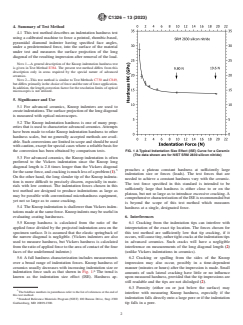
5.6 A full hardness characterization includes measurements over a broad range of indentation forces. Knoop hardness of ceramics usually decreases with increasing indentation size or indentation force such as that shown in Fig. 1.6 The trend is known as the in...
SCOPE
1.1 This test method covers the determination of the Knoop indentation hardness of advanced ceramics. In this test, a pointed, rhombic-based, pyramidal diamond indenter of prescribed shape is pressed into the surface of a ceramic with a predetermined force to produce a relatively small, permanent indentation. The surface projection of the long diagonal of the permanent indentation is measured using a light microscope. The length of the long diagonal and the applied force are used to calculate the Knoop hardness which represents the material’s resistance to penetration by the Knoop indenter.
1.2 The values stated in SI units are to be regarded as standard. No other units of measurement are included in this standard.
1.3 Units—When Knoop and Vickers hardness tests were developed, the force levels were specified in units of grams-force (gf) and kilograms-force (kgf). This standard specifies the units of force and length in the International System of Units (SI); that is, force in newtons (N) and length in mm or μm. However, because of the historical precedent and continued common usage, force values in gf and kgf units are occasionally provided for information. This test method specifies that Knoop hardness be reported either in units of GPa or as a dimensionless Knoop hardness number.
1.4 This standard does not purport to address all of the safety concerns, if any, associated with its use. It is the responsibility of the user of this standard to establish appropriate safety, health, and environmental practices and determine the applicability of regulatory limitations prior to use.
1.5 This international standard was developed in accordance with internationally recognized principles on standardization established in the Decision on Principles for the Development of International Standards, Guides and Recommendations issued by the World Trade Organization Technical Barriers to Trade (TBT) Committee.
- Status
- Published
- Publication Date
- 31-Dec-2022
- Technical Committee
- C28 - Advanced Ceramics
- Drafting Committee
- C28.01 - Mechanical Properties and Performance
Overview
ASTM C1326-13(2023) - Standard Test Method for Knoop Indentation Hardness of Advanced Ceramics provides a systematic approach for determining the microhardness of advanced ceramic materials using the Knoop indentation method. By employing a rhombic-based, pyramidal diamond indenter, this standardized test enables accurate measurement of a material's resistance to localized plastic deformation. The test is essential for quality control, material selection, and research and development within the ceramics industry. All measurements and results are reported in SI units, ensuring international consistency and comparability.
Key Topics
Knoop Indentation Hardness:
- Defines the method for using a Knoop indenter to create a shallow, elongated indentation in the ceramic surface.
- The length of the long diagonal of the indentation is measured precisely using an optical microscope.
- Hardness is calculated as the ratio of the applied force to the projected area of the indentation.
Test Method Details:
- Utilizes a diamond indenter with specific angles (172° 30′ and 130° 00′).
- Test forces are selected to produce measurable indentations without causing excessive cracking.
- Focuses on minimizing measurement uncertainties and addressing potential sources of error, such as surface preparation and indenter integrity.
- Recommends multiple indentations (typically five to ten) for representative and reliable results.
Significance and Use:
- Knoop hardness is one of several critical properties to characterize advanced ceramics.
- Especially suitable for materials and coatings prone to cracking under other hardness tests, such as the Vickers method.
- Indentation size effect (ISE) is acknowledged, with larger forces typically resulting in lower measured hardness, emphasizing the need for force consistency.
Applications
This Knoop indentation hardness test method is vital in:
- Quality Control: Manufacturers of advanced ceramics rely on Knoop hardness measurements to ensure product consistency and compliance with required mechanical properties.
- Material Development: Researchers use the method to compare the hardness of new ceramic compositions, supporting innovation in structural and functional ceramic components.
- Coating Evaluation: Due to its shallow indentation, the Knoop test is especially useful for assessing the hardness of surface coatings without penetrating into the underlying substrate.
- Comparative Analysis: The method aids in the selection of ceramics for demanding applications such as cutting tools, wear-resistant components, medical implants, and aerospace parts.
By following ASTM C1326, organizations ensure reproducible and internationally recognized results that assist in material certification and specification development.
Related Standards
For comprehensive hardness testing and related material property evaluation, consider referencing the following standards:
- ASTM C730: Test Method for Knoop Indentation Hardness of Glass
- ASTM C849: Test Method for Knoop Indentation Hardness of Ceramic Whitewares
- ASTM E384: Test Method for Microindentation Hardness of Materials
- ASTM E4: Practices for Force Calibration and Verification of Testing Machines
- ISO 9385: Glass and Glass Ceramics – Knoop Hardness Test
- CEN ENV 843-4: Vickers, Knoop, and Rockwell Superficial Hardness Tests for Monolithic Ceramics
These documents provide supplementary guidance on optical measurement accuracy, calibration, and broader hardness evaluation practices for both ceramics and other advanced materials.
Keywords: Knoop indentation hardness, advanced ceramics, ASTM C1326, microhardness testing, diamond indenter, ceramic coatings, material quality control, hardness measurement, optical microscopy, indentation size effect.
Relations
- Effective Date
- 01-Jun-2014
- Effective Date
- 01-May-2014
- Effective Date
- 01-May-2013
- Effective Date
- 01-May-2013
- Effective Date
- 01-Nov-2011
- Refers
ASTM C849-88(2011) - Standard Test Method for Knoop Indentation Hardness of Ceramic Whitewares - Effective Date
- 01-Mar-2011
- Effective Date
- 01-Oct-2010
- Effective Date
- 01-Jun-2010
- Effective Date
- 01-Feb-2010
- Effective Date
- 01-Feb-2010
- Effective Date
- 01-Nov-2009
- Effective Date
- 01-May-2009
- Effective Date
- 01-Apr-2009
- Effective Date
- 01-Dec-2008
- Effective Date
- 01-Oct-2008
Frequently Asked Questions
ASTM C1326-13(2023) is a standard published by ASTM International. Its full title is "Standard Test Method for Knoop Indentation Hardness of Advanced Ceramics". This standard covers: SIGNIFICANCE AND USE 5.1 For advanced ceramics, Knoop indenters are used to create indentations. The surface projection of the long diagonal is measured with optical microscopes. 5.2 The Knoop indentation hardness is one of many properties that is used to characterize advanced ceramics. Attempts have been made to relate Knoop indentation hardness to other hardness scales, but no generally accepted methods are available. Such conversions are limited in scope and should be used with caution, except for special cases where a reliable basis for the conversion has been obtained by comparison tests. 5.3 For advanced ceramics, the Knoop indentation is often preferred to the Vickers indentation since the Knoop long diagonal length is 2.8 times longer than the Vickers diagonal for the same force, and cracking is much less of a problem (1).5 On the other hand, the long slender tip of the Knoop indentation is more difficult to precisely discern, especially in materials with low contrast. The indentation forces chosen in this test method are designed to produce indentations as large as may be possible with conventional microhardness equipment, yet not so large as to cause cracking. 5.4 The Knoop indentation is shallower than Vickers indentations made at the same force. Knoop indents may be useful in evaluating coating hardnesses. 5.5 Knoop hardness is calculated from the ratio of the applied force divided by the projected indentation area on the specimen surface. It is assumed that the elastic springback of the narrow diagonal is negligible. (Vickers indenters are also used to measure hardness, but Vickers hardness is calculated from the ratio of applied force to the area of contact of the four faces of the undeformed indenter.) 5.6 A full hardness characterization includes measurements over a broad range of indentation forces. Knoop hardness of ceramics usually decreases with increasing indentation size or indentation force such as that shown in Fig. 1.6 The trend is known as the in... SCOPE 1.1 This test method covers the determination of the Knoop indentation hardness of advanced ceramics. In this test, a pointed, rhombic-based, pyramidal diamond indenter of prescribed shape is pressed into the surface of a ceramic with a predetermined force to produce a relatively small, permanent indentation. The surface projection of the long diagonal of the permanent indentation is measured using a light microscope. The length of the long diagonal and the applied force are used to calculate the Knoop hardness which represents the material’s resistance to penetration by the Knoop indenter. 1.2 The values stated in SI units are to be regarded as standard. No other units of measurement are included in this standard. 1.3 Units—When Knoop and Vickers hardness tests were developed, the force levels were specified in units of grams-force (gf) and kilograms-force (kgf). This standard specifies the units of force and length in the International System of Units (SI); that is, force in newtons (N) and length in mm or μm. However, because of the historical precedent and continued common usage, force values in gf and kgf units are occasionally provided for information. This test method specifies that Knoop hardness be reported either in units of GPa or as a dimensionless Knoop hardness number. 1.4 This standard does not purport to address all of the safety concerns, if any, associated with its use. It is the responsibility of the user of this standard to establish appropriate safety, health, and environmental practices and determine the applicability of regulatory limitations prior to use. 1.5 This international standard was developed in accordance with internationally recognized principles on standardization established in the Decision on Principles for the Development of International Standards, Guides and Recommendations issued by the World Trade Organization Technical Barriers to Trade (TBT) Committee.
SIGNIFICANCE AND USE 5.1 For advanced ceramics, Knoop indenters are used to create indentations. The surface projection of the long diagonal is measured with optical microscopes. 5.2 The Knoop indentation hardness is one of many properties that is used to characterize advanced ceramics. Attempts have been made to relate Knoop indentation hardness to other hardness scales, but no generally accepted methods are available. Such conversions are limited in scope and should be used with caution, except for special cases where a reliable basis for the conversion has been obtained by comparison tests. 5.3 For advanced ceramics, the Knoop indentation is often preferred to the Vickers indentation since the Knoop long diagonal length is 2.8 times longer than the Vickers diagonal for the same force, and cracking is much less of a problem (1).5 On the other hand, the long slender tip of the Knoop indentation is more difficult to precisely discern, especially in materials with low contrast. The indentation forces chosen in this test method are designed to produce indentations as large as may be possible with conventional microhardness equipment, yet not so large as to cause cracking. 5.4 The Knoop indentation is shallower than Vickers indentations made at the same force. Knoop indents may be useful in evaluating coating hardnesses. 5.5 Knoop hardness is calculated from the ratio of the applied force divided by the projected indentation area on the specimen surface. It is assumed that the elastic springback of the narrow diagonal is negligible. (Vickers indenters are also used to measure hardness, but Vickers hardness is calculated from the ratio of applied force to the area of contact of the four faces of the undeformed indenter.) 5.6 A full hardness characterization includes measurements over a broad range of indentation forces. Knoop hardness of ceramics usually decreases with increasing indentation size or indentation force such as that shown in Fig. 1.6 The trend is known as the in... SCOPE 1.1 This test method covers the determination of the Knoop indentation hardness of advanced ceramics. In this test, a pointed, rhombic-based, pyramidal diamond indenter of prescribed shape is pressed into the surface of a ceramic with a predetermined force to produce a relatively small, permanent indentation. The surface projection of the long diagonal of the permanent indentation is measured using a light microscope. The length of the long diagonal and the applied force are used to calculate the Knoop hardness which represents the material’s resistance to penetration by the Knoop indenter. 1.2 The values stated in SI units are to be regarded as standard. No other units of measurement are included in this standard. 1.3 Units—When Knoop and Vickers hardness tests were developed, the force levels were specified in units of grams-force (gf) and kilograms-force (kgf). This standard specifies the units of force and length in the International System of Units (SI); that is, force in newtons (N) and length in mm or μm. However, because of the historical precedent and continued common usage, force values in gf and kgf units are occasionally provided for information. This test method specifies that Knoop hardness be reported either in units of GPa or as a dimensionless Knoop hardness number. 1.4 This standard does not purport to address all of the safety concerns, if any, associated with its use. It is the responsibility of the user of this standard to establish appropriate safety, health, and environmental practices and determine the applicability of regulatory limitations prior to use. 1.5 This international standard was developed in accordance with internationally recognized principles on standardization established in the Decision on Principles for the Development of International Standards, Guides and Recommendations issued by the World Trade Organization Technical Barriers to Trade (TBT) Committee.
ASTM C1326-13(2023) is classified under the following ICS (International Classification for Standards) categories: 81.060.30 - Advanced ceramics. The ICS classification helps identify the subject area and facilitates finding related standards.
ASTM C1326-13(2023) has the following relationships with other standards: It is inter standard links to ASTM E4-14, ASTM E177-14, ASTM E177-13, ASTM E691-13, ASTM E691-11, ASTM C849-88(2011), ASTM E177-10, ASTM E4-10, ASTM E384-10e1, ASTM E384-10, ASTM E4-09a, ASTM E384-09, ASTM E4-09, ASTM E4-08, ASTM E691-08. Understanding these relationships helps ensure you are using the most current and applicable version of the standard.
ASTM C1326-13(2023) is available in PDF format for immediate download after purchase. The document can be added to your cart and obtained through the secure checkout process. Digital delivery ensures instant access to the complete standard document.
Standards Content (Sample)
This international standard was developed in accordance with internationally recognized principles on standardization established in the Decision on Principles for the
Development of International Standards, Guides and Recommendations issued by the World Trade Organization Technical Barriers to Trade (TBT) Committee.
Designation: C1326 − 13 (Reapproved 2023)
Standard Test Method for
Knoop Indentation Hardness of Advanced Ceramics
This standard is issued under the fixed designation C1326; the number immediately following the designation indicates the year of
original adoption or, in the case of revision, the year of last revision. A number in parentheses indicates the year of last reapproval. A
superscript epsilon (´) indicates an editorial change since the last revision or reapproval.
1. Scope 2. Referenced Documents
1.1 This test method covers the determination of the Knoop
2.1 ASTM Standards:
indentation hardness of advanced ceramics. In this test, a C730 Test Method for Knoop Indentation Hardness of Glass
pointed, rhombic-based, pyramidal diamond indenter of pre-
C849 Test Method for Knoop Indentation Hardness of Ce-
scribed shape is pressed into the surface of a ceramic with a
ramic Whitewares
predetermined force to produce a relatively small, permanent
E4 Practices for Force Calibration and Verification of Test-
indentation. The surface projection of the long diagonal of the
ing Machines
permanent indentation is measured using a light microscope.
E177 Practice for Use of the Terms Precision and Bias in
The length of the long diagonal and the applied force are used
ASTM Test Methods
to calculate the Knoop hardness which represents the material’s
E384 Test Method for Microindentation Hardness of Mate-
resistance to penetration by the Knoop indenter.
rials
E691 Practice for Conducting an Interlaboratory Study to
1.2 The values stated in SI units are to be regarded as
Determine the Precision of a Test Method
standard. No other units of measurement are included in this
IEEE/ASTM SI 10 Standard for Use of the International
standard.
System of Units (SI) (The Modern Metric System)
1.3 Units—When Knoop and Vickers hardness tests were
2.2 European Standard:
developed, the force levels were specified in units of grams-
CEN ENV 843-4 Advanced Technical Ceramics, Monolithic
force (gf) and kilograms-force (kgf). This standard specifies
Ceramics, Mechanical Properties at Room Temperature,
the units of force and length in the International System of
Part 4: Vickers, Knoop, and Rockwell Superficial Hard-
Units (SI); that is, force in newtons (N) and length in mm or
ness Tests
μm. However, because of the historical precedent and contin-
ued common usage, force values in gf and kgf units are
2.3 ISO Standard:
occasionally provided for information. This test method speci-
ISO 9385 Glass and Glass Ceramics—Knoop Hardness Test
fies that Knoop hardness be reported either in units of GPa or
as a dimensionless Knoop hardness number.
3. Terminology
1.4 This standard does not purport to address all of the
3.1 Definitions:
safety concerns, if any, associated with its use. It is the
3.1.1 Knoop hardness number (HK), n—an expression of
responsibility of the user of this standard to establish appro-
hardness obtained by dividing the force applied to the Knoop
priate safety, health, and environmental practices and deter-
indenter by the projected area of the permanent impression
mine the applicability of regulatory limitations prior to use.
made by the indenter.
1.5 This international standard was developed in accor-
3.1.2 Knoop indenter, n—a rhombic-based pyramidal-
dance with internationally recognized principles on standard-
shaped diamond indenter with edge angles of 172° 30' and
ization established in the Decision on Principles for the
130° 00'.
Development of International Standards, Guides and Recom-
mendations issued by the World Trade Organization Technical
Barriers to Trade (TBT) Committee.
For referenced ASTM standards, visit the ASTM website, www.astm.org, or
contact ASTM Customer Service at service@astm.org. For Annual Book of ASTM
Standards volume information, refer to the standard’s Document Summary page on
This test method is under the jurisdiction of ASTM Committee C28 on the ASTM website.
Advanced Ceramics and is the direct responsibility of Subcommittee C28.01 on Available from European Committee for Standardization (CEN), 36 rue de
Mechanical Properties and Performance. Stassart, B-1050, Brussels, Belgium, http://www.cenorm.be.
Current edition approved Jan. 1, 2023. Published February 2023. Originally Available from International Organization for Standardization (ISO), 1, ch. de
approved in 1996. Last previous edition approved in 2018 as C1326 – 13 (2018). la Voie-Creuse, Case postale 56, CH-1211, Geneva 20, Switzerland, http://
DOI: 10.1520/C1326-13R23. www.iso.ch.
Copyright © ASTM International, 100 Barr Harbor Drive, PO Box C700, West Conshohocken, PA 19428-2959. United States
C1326 − 13 (2023)
4. Summary of Test Method
4.1 This test method describes an indentation hardness test
using a calibrated machine to force a pointed, rhombic-based,
pyramidal diamond indenter having specified face angles,
under a predetermined force, into the surface of the material
under test and measures the surface projection of the long
diagonal of the resulting impression after removal of the load.
NOTE 1—A general description of the Knoop indentation hardness test
is given in Test Method E384. The present test method differs from this
description only in areas required by the special nature of advanced
ceramics.
NOTE 2—This test method is similar to Test Methods C730 and C849,
but differs primarily in the choice of force and the rate of force application.
In addition, the length correction factor for the resolution limits of optical
microscopes is not utilized.
5. Significance and Use
5.1 For advanced ceramics, Knoop indenters are used to
create indentations. The surface projection of the long diagonal
is measured with optical microscopes.
5.2 The Knoop indentation hardness is one of many prop-
erties that is used to characterize advanced ceramics. Attempts
have been made to relate Knoop indentation hardness to other
hardness scales, but no generally accepted methods are avail-
able. Such conversions are limited in scope and should be used
with caution, except for special cases where a reliable basis for
FIG. 1 A Typical Indentation Size Effect (ISE) Curve for a Ceramic
the conversion has been obtained by comparison tests.
(The data shown are for NIST SRM 2830 silicon nitride)
5.3 For advanced ceramics, the Knoop indentation is often
preferred to the Vickers indentation since the Knoop long
diagonal length is 2.8 times longer than the Vickers diagonal
proaches a plateau constant hardness at sufficiently large
for the same force, and cracking is much less of a problem (1).
indentation size or forces (loads). The test forces that are
On the other hand, the long slender tip of the Knoop indenta-
needed to achieve a constant hardness vary with the ceramic.
tion is more difficult to precisely discern, especially in mate-
The test force specified in this standard is intended to be
rials with low contrast. The indentation forces chosen in this
sufficiently large that hardness is either close to or on the
test method are designed to produce indentations as large as
plateau, but not so large as to introduce excessive cracking. A
may be possible with conventional microhardness equipment,
comprehensive characterization of the ISE is recommended but
yet not so large as to cause cracking.
is beyond the scope of this test method which measures
5.4 The Knoop indentation is shallower than Vickers inden-
hardness at a single, designated force.
tations made at the same force. Knoop indents may be useful in
evaluating coating hardnesses. 6. Interferences
5.5 Knoop hardness is calculated from the ratio of the 6.1 Cracking from the indentation tips can interfere with
applied force divided by the projected indentation area on the interpretation of the exact tip location. The forces chosen for
specimen surface. It is assumed that the elastic springback of this test method are sufficiently low that tip cracking, if it
the narrow diagonal is negligible. (Vickers indenters are also occurs, will cause tiny, rather tight cracks at the indentation tips
used to measure hardness, but Vickers hardness is calculated in advanced ceramics. Such cracks will have a negligible
from the ratio of applied force to the area of contact of the four interference on measurements of the long diagonal length (2)
faces of the undeformed indenter.) (unlike Vickers indentations in ceramics).
5.6 A full hardness characterization includes measurements 6.2 Cracking or spalling from the sides of the Knoop
over a broad range of indentation forces. Knoop hardness of impression may also occur, possibly in a time-dependent
ceramics usually decreases with increasing indentation size or manner (minutes or hours) after the impression is made. Small
indentation force such as that shown in Fig. 1. The trend is amounts of such lateral cracking have little or no influence
known as the indentation size effect (ISE). Hardness ap-
upon measured hardness, provided that the tip impressions are
still readable and the tips are not dislodged (2).
6.3 Porosity (either on or just below the surface) may
The boldface numbers in parentheses refer to the list of references at the end of
interfere with measuring Knoop hardness, especially if the
this test method.
indentation falls directly onto a large pore or if the indentation
Standard Reference Materials Program (NIST) 100 Bureau Drive, Stop 2300
Gaithersburg, MD 20899-2300. tip falls in a pore.
C1326 − 13 (2023)
6.4 At higher magnifications in the optical microscope, it
may be difficult to obtain a sharp contrast between the
indentation tip and the polished surface of some advanced
ceramics. This may be overcome by careful adjustment of the
lighting as discussed in Test Method E384 and Refs (2, 3).
7. Apparatus
7.1 Testing Machines:
7.1.1 There are three general types of machines available for
making this test. One type is a self-contained unit built for this
purpose that uses deadweights (masses) on a pan or lever beam
to carefully apply force to the test piece. There is no load cell
to record the force during the test sequence. The machine has
a built-in compound optical microscope for measuring the
indentation sizes. The second type is an accessory to existing
compound optical microscopes. Usually, this second type is
fitted on an inverted-stage microscope. The third, more modern
type, is a self-contained unit built for this purpose which has a
built-in load cell that controls a ram or crosshead that moves
the indenter into contact with the test piece. The peak force and
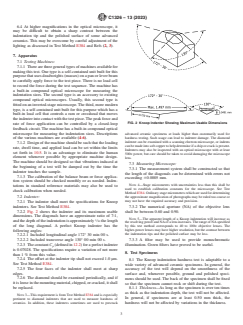
FIG. 2 Knoop Indenter Showing Maximum Usable Dimensions
rate of force application can be controlled by a closed-loop
feedback circuit. The machine has a built-in compound optical
microscope for measuring the indentation sizes. Descriptions
advanced ceramic specimens at loads higher than customarily used for
hardness testing. Such usage can lead to indenter damage. The diamond
of the various machines are available (4-6).
indenter can be examined with a scanning electron microscope, or indents
7.1.2 Design of the machine should be such that the loading
can be made into soft copper to help determine if a chip or crack is present.
rate, dwell time, and applied load can be set within the limits
Indenters may also be inspected with an optical microscope with at least
set forth in 10.5. It is an advantage to eliminate the human
500× power, but care should be taken to avoid damaging the microscope
element whenever possible by appropriate machine design.
lens.
The machine should be designed so that vibrations induced at
7.3 Measuring Microscope:
the beginning of a test will be damped out by the time the
7.3.1 The measurement system shall be constructed so that
indenter touches the sample.
the length of the diagonals can be determined with errors not
7.1.3 The calibration of the balance beam or force applica-
exceeding 60.0005 mm.
tion system should be checked monthly or as needed. Inden-
NOTE 4—Stage micrometers with uncertainties less than this shall be
tations in standard reference materials may also be used to
used to establish calibration constants for the microscope. See Test
check calibration when needed.
Method E384. Ordinary stage micrometers which are used for determining
7.2 Indenter: the approximate magnification of photographs may be ruled too coarse or
may not have the required accuracy and precision.
7.2.1 The indenter shall meet the specifications for Knoop
indenters. See Test Method E384.
7.3.2 The numerical aperture (NA) of the objective lens
7.2.2 Fig. 2 shows the indenter and its maximum usable shall be between 0.60 and 0.90.
dimensions. The diagonals have an approximate ratio of 7:1,
NOTE 5—The apparent length of a Knoop indentation will increase as
and the depth of the indentation is approximately ⁄30 the length
the resolving power and NA of a lens increases. The range of NA specified
of the long diagonal. A perfect Knoop indenter has the
by this test method corresponds to 40 to 100× objective lenses. The
higher-power lenses may have higher resolution, but the contrast between
following angles:
the indentation tips and the polished surface may be less.
7.2.2.1 Included longitudinal angle 172° 30 min 00 s.
7.2.2.2 Included transverse angle 130° 00 min 00 s. 7.3.3 A filter may be used to provide monochromatic
7.2.3 The constant C (defined in 12.2) for a perfect indenter illumination. Green filters have proved to be useful.
p
is 0.07028. The specifications require a variation of not more
8. Test Specimens
than 1 % from this value.
7.2.4 The offset at the indenter tip shall not exceed 1.0 μm.
8.1 The Knoop indentation hardness test is adaptable to a
See Test Method E384.
wide variety of advanced ceramic specimens. In general, the
7.2.5 The four faces of the indenter shall meet at sharp
accuracy of the test will depend on the smoothness of the
edges.
surface and, whenever possible, ground and polished speci-
7.2.6 The diamond should be examined periodically, and if
mens should be used. The back of the specimen shall be fixed
it is loose in the mounting material, chipped, or cracked, it shall
so that the specimen cannot rock or shift during the test.
be replaced.
8.1.1 Thickness—As long as the specimen is over ten times
as thick as the indentation depth, the test will not be affected.
NOTE 3—This requirement is from Test Method E384 and is especially
In general, if specimens are at least 0.50 mm thick, the
pertinent to diamond indenters that are used to measure hardness of
ceramics. In addition, these indenters sometimes are used to precrack hardness will not be affected by variations in the thickness.
C1326 − 13 (2023)
8.1.2 Surface Finish—Specimens should have a ground and 10.2.3 Leveling the specimen to meet these specifications is
polished surface. The roughness should be less than 0.1 μm facilitated if one has a leveling device.
rms. However, if one is investigating a surface coating or
10.3 Magnitude of Test Force—A test force of either 9.81 N
treatment, one cannot grind and polish the specimen.
(1 kgf) or 19.61 N (2 kgf) is specified. 19.61 N is preferred.
9.81 N may be used if the higher force is not available on the
NOTE 6—This requirement is necessary to ensure that the surface is flat
and that the indentation is sharp. Residual stresses from polishing are of apparatus, if cracking is a problem, or if preferred for a specific
less concern for most advanced ceramics than for glasses or metals.
requirement. If cracking is a problem at 9.81 N, lower forces
References (2) and (7) report that Knoop hardness was insensitive to
may be used and the reporting procedure of 12.6 shall be used.
surface finish for surfaces prepared with 1 μm or finer diamond abrasive.
(The precision might be less and the bias greater with the lower
Hardness was only affected when the surface finish had an optically
forces.) If additional forces are used (for example to measure
resolvable amount of abrasive damage (7). (Extra caution may be
appropriate during polishing of transformation toughening ceramics, such
the indentation size effect trend), then the reporting procedure
as some zirconias, since the effect upon hardness is not known.)
of 12.6 shall be used for each data set.
8.1.3 Radius of Curvature—Care should be used when
NOTE 8—“Load” and “force” are used interchangeably in this standard.
relating hardness values obtained on curved surfaces to those
10.4 Clean the Indenter—The indenter shall be cleaned
obtained on polished, flat surfaces. The hardness values ob-
prior to and during a test series. A cotton swab with ethanol,
tained will be affected even when the curvature is only in the
methanol, or isopropanol may be used. Indenting into soft
direction of the short diagonal.
copper also may help remove debris.
NOTE 9—Ceramic powders or fragments from the ceramic test piece
9. Preparation of Apparatus
can adhere to the diamond indenter.
9.1 Verification of Force—Most of the machines available
10.5 Application of Test Force:
for Knoop hardness testing use a loaded beam. This beam shall
10.5.1 Start the machine smoothly. The rate of indenter
be tested for zero force. An indentation should not be visible
motion prior to contact with the specimen shall be 0.015 to
with zero force, but the indenter should contact the sample.
0.070 mm/s. If the machine is loaded by an electrical system or
Methods of verifying the force application are given in
a dash-pot lever system, it should be mounted on shock
Practices E4.
absorbers which damp out all vibrations by the time the
9.2 Separate Verification of Force, Indenter, and Measuring
indenter touches the specimen.
Microscope—Procedures in Test Method E384, Annex A1,
NOTE 10—This rate of loading is consistent with Test Method E384, but
Verification of Knoop and Vickers Hardness Testing Machines
is faster than that prescribed in Test Methods C730 and C849.
and Indenters, may be followed.
10.5.2 The time of application of the full test force shall be
9.3 Verification by Standard Reference Materials—Standard
10 s to 15 s unless otherwise specified. After the indenter has
reference blocks, SRM No. 2830, of silicon nitride that are
been in contact with the specimen for this required dwell time,
available from the National Institute of Standards and Tech-
raise it carefully off the sample to avoid a vibration impact.
nology can be used to verify that an apparatus produces a
10.5.3 The operator shall not bump or inadvertently contact
Knoop hardness within 65 % of the certified value.
the test machine or the associated support (for example, the
table) during the period of indenter contact with the specimen.
10. Procedure
10.6 Spacing of Indentations—Allow a distance of at least
10.1 Specimen Placement—Place the specimen on the stage
one-and-one-half indentation times the long diagonal between
of the machine so the specimen will not rock or shift during the
the indentations as illustrated in Fig. 3. If there is evidence of
measurement. The specimen shall be clean and free of any
interaction between lateral cracking (from the sides of the
grease or film.
indentation), then the spacing shall be increased.
10.2 Specimen Leveling:
10.7 Acceptability of Indentations—If there is excessive
10.2.1 The surface of the specimen being tested shall lie in cracking from the indent sides, the indent shall be rejected for
a plane normal to the axis of the indenter. measurement. Fig. 4 provides guidance in this assessment. If
this occurs on most indentations, a lower indentation force
10.2.2 If one leg (one half) of the long diagonal i
...