

ASTM D5628-18
(Test Method)Standard Test Method for Impact Resistance of Flat, Rigid Plastic Specimens by Means of a Falling Dart (Tup or Falling Mass)
General Information
- Abstract
SIGNIFICANCE AND USE
5.1 Plastics are viscoelastic and therefore are likely to be sensitive to changes in velocity of the mass falling on their surfaces. However, the velocity of a free-falling object is a function of the square root of the drop height. A change of a factor of two in the drop height will cause a change of only 1.4 in velocity. Hagan et al (2) found that the mean-failure energy of sheeting was constant at drop heights between 0.30 and 1.4 m. This suggests that a constant mass-variable height method will give the same results as the constant height-variable mass technique. On the other hand, different materials respond differently to changes in the velocity of impact. While both constant-mass and constant-height techniques are permitted by these methods, the constant-height method is to be used for those materials that are found to be rate-sensitive in the range of velocities encountered in falling-weight types of impact tests.
5.2 The test geometry FA causes a moderate level of stress concentration and can be used for most plastics.
5.3 Geometry FB causes a greater stress concentration and results in failure of tough or thick specimens that do not fail with Geometry FA (3). This approach can produce a punch shear failure on thick sheet. If that type of failure is undesirable, Geometry FC is to be used. Geometry FB is suitable for research and development because of the smaller test area required.
5.3.1 The conical configuration of the 12.7-mm diameter tup used in Geometry FB minimizes problems with tup penetration and sticking in failed specimens of some ductile materials.
5.4 The test conditions of Geometry FC are the same as those of Test Method A of Test Method D1709. They have been used in specifications for extruded sheeting. A limitation of this geometry is that considerable material is required.
5.5 The test conditions of Geometry FD are the same as for Test Method D3763.
5.6 The test conditions of Geometry FE are the same as for ISO 6603-1.
5...
SCOPE
1.1 This test method covers the determination of the threshold value of impact-failure energy required to crack or break flat, rigid plastic specimens under various specified conditions of impact of a free-falling dart (tup), based on testing many specimens.
1.2 The values stated in SI units are to be regarded as the standard. The values in parentheses are for information only.
1.3 This standard does not purport to address all of the safety concerns, if any, associated with its use. It is the responsibility of the user of this standard to establish appropriate safety, health, and environmental practices and determine the applicability of regulatory limitations prior to use. Specific hazard statements are given in Section 8.
Note 1: This test method and ISO 6603-1 are technically equivalent only when the test conditions and specimen geometry required for Geometry FE and the Bruceton Staircase method of calculation are used.
1.4 This international standard was developed in accordance with internationally recognized principles on standardization established in the Decision on Principles for the Development of International Standards, Guides and Recommendations issued by the World Trade Organization Technical Barriers to Trade (TBT) Committee.
- Status
- Published
- Publication Date
- 30-Apr-2018
- Technical Committee
- D20 - Plastics
- Drafting Committee
- D20.10 - Mechanical Properties
Buy Documents
ASTM D5628-18 - Standard Test Method for Impact Resistance of Flat, Rigid Plastic Specimens by Means of a Falling Dart (Tup or Falling Mass)
REDLINE ASTM D5628-18 - Standard Test Method for Impact Resistance of Flat, Rigid Plastic Specimens by Means of a Falling Dart (Tup or Falling Mass)
Overview
ASTM D5628-18 specifies a standard test method for evaluating the impact resistance of flat, rigid plastic specimens using a falling dart (also referred to as a tup or falling mass). Developed by ASTM International, this standard provides a consistent approach to determining the threshold impact-failure energy required to crack or break rigid plastics under defined conditions, making it crucial for quality assurance, materials characterization, and product development in the plastics industry. The test supports both constant-mass variable-height and constant-height variable-mass methodologies, and uses various specimen geometries for flexibility depending on material properties and research needs.
Key Topics
- Falling Dart Impact Test: This method involves dropping a weighted dart onto a supported plastic specimen from a predetermined height, or with variable mass, to assess the material's impact resistance.
- Mean-Failure Energy: The test quantitatively measures the energy required to produce a 50% failure rate among tested specimens, using the Bruceton Staircase (Up-and-Down) statistical method.
- Specimen Geometry and Clamping: The test accommodates multiple tup and clamp geometries (FA, FB, FC, FD, FE) to modify stress concentration and failure modes. Clamping of specimens is recommended for improved precision, though some rigid specimens can be tested unclamped.
- Data Precision and Comparability: Results are primarily used for comparative or ranking purposes among materials, as absolute impact strength values are influenced by specific test conditions and geometry.
- Material Rate Sensitivity: The standard acknowledges the viscoelastic nature of plastics and their potential to react differently to varying impact velocities, instructing on method selection based on material sensitivity.
Applications
ASTM D5628-18 serves industries and laboratories concerned with the mechanical performance of rigid plastics, such as automotive, construction, packaging, and consumer goods. Key applications include:
- Material Selection and Product Design: Provides critical data during the development phase to select plastics that meet specific impact resistance requirements for their intended use.
- Quality Control: Used in manufacturing and R&D environments to ensure batch-to-batch consistency in impact performance.
- Specification and Compliance Testing: Frequently referenced in procurement and regulatory requirements to validate that plastic materials comply with industry or customer standards.
- Research and Development: Enables the study of novel plastic formulations, blends, or processing methods on impact resistance under controlled conditions.
Related Standards
ASTM D5628-18 is closely associated with several other ASTM and international standards relevant to plastic impact testing:
- ASTM D1709 – Test Methods for Impact Resistance of Plastic Film by the Free-Falling Dart Method
- ASTM D3763 – Test Method for High Speed Puncture Properties of Plastics Using Load and Displacement Sensors
- ASTM D2444 – Practice for Determination of the Impact Resistance of Thermoplastic Pipe and Fittings by Means of a Tup (Falling Weight)
- ASTM D618 – Practice for Conditioning Plastics for Testing
- ISO 6603-1 – Plastics-Determination of Multiaxial Impact Behaviour of Rigid Plastics-Part 1: Falling Dart Method
Practical Value
ASTM D5628-18 provides a scientifically robust and repeatable process for measuring and comparing the impact strength of rigid plastics, supporting product longevity, safety, and performance. By standardizing test conditions and reporting, it helps manufacturers, researchers, and quality assurance professionals ensure materials are fit for purpose, meet relevant regulations, and perform reliably in real-world applications. Utilizing this standard supports best practices in materials science and underpins confidence in material selection and specification.
Relations
- Effective Date
- 01-Feb-2024
- Effective Date
- 01-Nov-2023
- Effective Date
- 01-Nov-2023
- Effective Date
- 01-Jan-2020
- Effective Date
- 01-Aug-2019
- Effective Date
- 15-Apr-2019
- Effective Date
- 01-Feb-2019
- Effective Date
- 01-Dec-2018
- Effective Date
- 01-Nov-2018
- Effective Date
- 01-Nov-2018
- Refers
ASTM D1600-18 - Standard Terminology for Abbreviated Terms Relating to Plastics (Withdrawn 2024) - Effective Date
- 01-Jan-2018
- Effective Date
- 15-Nov-2017
- Effective Date
- 15-Aug-2017
- Effective Date
- 01-Mar-2017
- Effective Date
- 01-May-2016
Buy Documents
ASTM D5628-18 - Standard Test Method for Impact Resistance of Flat, Rigid Plastic Specimens by Means of a Falling Dart (Tup or Falling Mass)
REDLINE ASTM D5628-18 - Standard Test Method for Impact Resistance of Flat, Rigid Plastic Specimens by Means of a Falling Dart (Tup or Falling Mass)
Get Certified
Connect with accredited certification bodies for this standard

DIN CERTCO
DIN Group product certification.

Smithers Quality Assessments
US management systems and product certification.
Sponsored listings
Frequently Asked Questions
ASTM D5628-18 is a standard published by ASTM International. Its full title is "Standard Test Method for Impact Resistance of Flat, Rigid Plastic Specimens by Means of a Falling Dart (Tup or Falling Mass)". This standard covers: SIGNIFICANCE AND USE 5.1 Plastics are viscoelastic and therefore are likely to be sensitive to changes in velocity of the mass falling on their surfaces. However, the velocity of a free-falling object is a function of the square root of the drop height. A change of a factor of two in the drop height will cause a change of only 1.4 in velocity. Hagan et al (2) found that the mean-failure energy of sheeting was constant at drop heights between 0.30 and 1.4 m. This suggests that a constant mass-variable height method will give the same results as the constant height-variable mass technique. On the other hand, different materials respond differently to changes in the velocity of impact. While both constant-mass and constant-height techniques are permitted by these methods, the constant-height method is to be used for those materials that are found to be rate-sensitive in the range of velocities encountered in falling-weight types of impact tests. 5.2 The test geometry FA causes a moderate level of stress concentration and can be used for most plastics. 5.3 Geometry FB causes a greater stress concentration and results in failure of tough or thick specimens that do not fail with Geometry FA (3). This approach can produce a punch shear failure on thick sheet. If that type of failure is undesirable, Geometry FC is to be used. Geometry FB is suitable for research and development because of the smaller test area required. 5.3.1 The conical configuration of the 12.7-mm diameter tup used in Geometry FB minimizes problems with tup penetration and sticking in failed specimens of some ductile materials. 5.4 The test conditions of Geometry FC are the same as those of Test Method A of Test Method D1709. They have been used in specifications for extruded sheeting. A limitation of this geometry is that considerable material is required. 5.5 The test conditions of Geometry FD are the same as for Test Method D3763. 5.6 The test conditions of Geometry FE are the same as for ISO 6603-1. 5... SCOPE 1.1 This test method covers the determination of the threshold value of impact-failure energy required to crack or break flat, rigid plastic specimens under various specified conditions of impact of a free-falling dart (tup), based on testing many specimens. 1.2 The values stated in SI units are to be regarded as the standard. The values in parentheses are for information only. 1.3 This standard does not purport to address all of the safety concerns, if any, associated with its use. It is the responsibility of the user of this standard to establish appropriate safety, health, and environmental practices and determine the applicability of regulatory limitations prior to use. Specific hazard statements are given in Section 8. Note 1: This test method and ISO 6603-1 are technically equivalent only when the test conditions and specimen geometry required for Geometry FE and the Bruceton Staircase method of calculation are used. 1.4 This international standard was developed in accordance with internationally recognized principles on standardization established in the Decision on Principles for the Development of International Standards, Guides and Recommendations issued by the World Trade Organization Technical Barriers to Trade (TBT) Committee.
SIGNIFICANCE AND USE 5.1 Plastics are viscoelastic and therefore are likely to be sensitive to changes in velocity of the mass falling on their surfaces. However, the velocity of a free-falling object is a function of the square root of the drop height. A change of a factor of two in the drop height will cause a change of only 1.4 in velocity. Hagan et al (2) found that the mean-failure energy of sheeting was constant at drop heights between 0.30 and 1.4 m. This suggests that a constant mass-variable height method will give the same results as the constant height-variable mass technique. On the other hand, different materials respond differently to changes in the velocity of impact. While both constant-mass and constant-height techniques are permitted by these methods, the constant-height method is to be used for those materials that are found to be rate-sensitive in the range of velocities encountered in falling-weight types of impact tests. 5.2 The test geometry FA causes a moderate level of stress concentration and can be used for most plastics. 5.3 Geometry FB causes a greater stress concentration and results in failure of tough or thick specimens that do not fail with Geometry FA (3). This approach can produce a punch shear failure on thick sheet. If that type of failure is undesirable, Geometry FC is to be used. Geometry FB is suitable for research and development because of the smaller test area required. 5.3.1 The conical configuration of the 12.7-mm diameter tup used in Geometry FB minimizes problems with tup penetration and sticking in failed specimens of some ductile materials. 5.4 The test conditions of Geometry FC are the same as those of Test Method A of Test Method D1709. They have been used in specifications for extruded sheeting. A limitation of this geometry is that considerable material is required. 5.5 The test conditions of Geometry FD are the same as for Test Method D3763. 5.6 The test conditions of Geometry FE are the same as for ISO 6603-1. 5... SCOPE 1.1 This test method covers the determination of the threshold value of impact-failure energy required to crack or break flat, rigid plastic specimens under various specified conditions of impact of a free-falling dart (tup), based on testing many specimens. 1.2 The values stated in SI units are to be regarded as the standard. The values in parentheses are for information only. 1.3 This standard does not purport to address all of the safety concerns, if any, associated with its use. It is the responsibility of the user of this standard to establish appropriate safety, health, and environmental practices and determine the applicability of regulatory limitations prior to use. Specific hazard statements are given in Section 8. Note 1: This test method and ISO 6603-1 are technically equivalent only when the test conditions and specimen geometry required for Geometry FE and the Bruceton Staircase method of calculation are used. 1.4 This international standard was developed in accordance with internationally recognized principles on standardization established in the Decision on Principles for the Development of International Standards, Guides and Recommendations issued by the World Trade Organization Technical Barriers to Trade (TBT) Committee.
ASTM D5628-18 is classified under the following ICS (International Classification for Standards) categories: 83.140.10 - Films and sheets. The ICS classification helps identify the subject area and facilitates finding related standards.
ASTM D5628-18 has the following relationships with other standards: It is inter standard links to ASTM D883-24, ASTM D3763-23, ASTM D883-23, ASTM D883-20, ASTM D883-19c, ASTM D883-19a, ASTM D883-19, ASTM D883-18a, ASTM D883-18, ASTM D3763-18, ASTM D1600-18, ASTM D2444-17, ASTM D883-17, ASTM D6779-17, ASTM D1709-16a. Understanding these relationships helps ensure you are using the most current and applicable version of the standard.
ASTM D5628-18 is available in PDF format for immediate download after purchase. The document can be added to your cart and obtained through the secure checkout process. Digital delivery ensures instant access to the complete standard document.
Standards Content (Sample)
This international standard was developed in accordance with internationally recognized principles on standardization established in the Decision on Principles for the
Development of International Standards, Guides and Recommendations issued by the World Trade Organization Technical Barriers to Trade (TBT) Committee.
Designation: D5628 − 18
Standard Test Method for
Impact Resistance of Flat, Rigid Plastic Specimens by
Means of a Falling Dart (Tup or Falling Mass)
This standard is issued under the fixed designation D5628; the number immediately following the designation indicates the year of
original adoption or, in the case of revision, the year of last revision.Anumber in parentheses indicates the year of last reapproval.A
superscript epsilon (´) indicates an editorial change since the last revision or reapproval.
1. Scope* D2444Practice for Determination of the Impact Resistance
of Thermoplastic Pipe and Fittings by Means of a Tup
1.1 This test method covers the determination of the thresh-
(Falling Weight)
old value of impact-failure energy required to crack or break
D3763Test Method for High Speed Puncture Properties of
flat, rigid plastic specimens under various specified conditions
Plastics Using Load and Displacement Sensors
of impact of a free-falling dart (tup), based on testing many
D4000Classification System for Specifying Plastic Materi-
specimens.
als
1.2 The values stated in SI units are to be regarded as the
D5947Test Methods for Physical Dimensions of Solid
standard. The values in parentheses are for information only.
Plastics Specimens
1.3 This standard does not purport to address all of the D6779Classification System for and Basis of Specification
safety concerns, if any, associated with its use. It is the
for Polyamide Molding and Extrusion Materials (PA)
responsibility of the user of this standard to establish appro- E691Practice for Conducting an Interlaboratory Study to
priate safety, health, and environmental practices and deter-
Determine the Precision of a Test Method
mine the applicability of regulatory limitations prior to use.
2.2 ISO Standards:
Specific hazard statements are given in Section 8.
ISO 291Standard Atmospheres for Conditioning and Test-
ing
NOTE 1—This test method and ISO 6603-1 are technically equivalent
ISO 6603-1Plastics—Determination of Multiaxial Impact
only when the test conditions and specimen geometry required for
Geometry FE and the Bruceton Staircase method of calculation are used. Behavior of Rigid Plastics—Part 1: Falling Dart Method
1.4 This international standard was developed in accor-
3. Terminology
dance with internationally recognized principles on standard-
3.1 Definitions:
ization established in the Decision on Principles for the
Development of International Standards, Guides and Recom- 3.1.1 For definitions of plastic terms used in this test
method, see Terminologies D883 and D1600.
mendations issued by the World Trade Organization Technical
Barriers to Trade (TBT) Committee. 3.2 Definitions of Terms Specific to This Standard:
3.2.1 failure (of test specimen)—the presence of any crack
2. Referenced Documents or split, created by the impact of the falling tup, that can be
2 seen by the naked eye under normal laboratory lighting
2.1 ASTM Standards:
conditions.
D618Practice for Conditioning Plastics for Testing
3.2.2 mean-failure energy (mean-impact resistance)—the
D883Terminology Relating to Plastics
energy required to produce 50% failures, equal to the product
D1600TerminologyforAbbreviatedTermsRelatingtoPlas-
of the constant drop height and the mean-failure mass, or, to
tics
the product of the constant mass and the mean-failure height.
D1709Test Methods for Impact Resistance of Plastic Film
by the Free-Falling Dart Method
3.2.3 mean-failure height (impact-failure height)—the
height at which a standard mass, when dropped on test
specimens, will cause 50% failures.
ThistestmethodisunderthejurisdictionofASTMCommitteeD20onPlastics
NOTE 2—Cracks usually start at the surface opposite the one that is
and is the direct responsibility of Subcommittee D20.10 on Mechanical Properties.
struck. Occasionally incipient cracking in glass-reinforced products, for
Current edition approved May 1, 2018. Published June 2018. Originally
example, is difficult to differentiate from the reinforcing fibers. In such
approved in 1994. Last previous edition approved in 2010 as D5628-10. DOI:
cases, a penetrating dye can confirm the onset of crack formation.
10.1520/D5628-18.
For referenced ASTM standards, visit the ASTM website, www.astm.org, or
contact ASTM Customer Service at service@astm.org. For Annual Book of ASTM
Standards volume information, refer to the standard’s Document Summary page on Available fromAmerican National Standards Institute (ANSI), 25 W. 43rd St.,
the ASTM website. 4th Floor, New York, NY 10036, http://www.ansi.org.
*A Summary of Changes section appears at the end of this standard
Copyright ©ASTM International, 100 Barr Harbor Drive, PO Box C700, West Conshohocken, PA19428-2959. United States
D5628 − 18
3.2.4 mean-failure mass (impact-failure mass)—the mass of 5.3.1 The conical configuration of the 12.7-mm diameter
the dart (tup) that, when dropped on the test specimens from a tup used in Geometry FB minimizes problems with tup
standard height, will cause 50% failures. penetration and sticking in failed specimens of some ductile
materials.
3.2.5 tup—a dart with a hemispherical nose. See 7.2 and
5.4 The test conditions of Geometry FC are the same as
Fig. 1.
thoseofTestMethodAofTestMethodD1709.Theyhavebeen
usedinspecificationsforextrudedsheeting.Alimitationofthis
4. Summary of Test Method
geometry is that considerable material is required.
4.1 Afree-falling dart (tup) is allowed to strike a supported
5.5 The test conditions of Geometry FD are the same as for
specimen directly. Either a dart having a fixed mass is dropped
Test Method D3763.
from various heights, or a dart having an adjustable mass is
dropped from a fixed height. (See Fig. 2).
5.6 The test conditions of Geometry FE are the same as for
ISO 6603-1.
4.2 The procedure determines the energy (mass×height)
that will cause 50% of the specimens tested to fail (mean
5.7 Because of the nature of impact testing, the selection of
failure energy). a test method and tup must be somewhat arbitrary.Although a
choiceoftupgeometriesisavailable,knowledgeofthefinalor
4.3 The technique used to determine mean failure energy is
intended end-use application shall be considered.
commonly called the Bruceton Staircase Method or the Up-
5.8 Clamping of the test specimen will improve the preci-
and-DownMethod (1). Testingisconcentratednearthemean,
sion of the data. Therefore, clamping is recommended.
reducing the number of specimens required to obtain a reason-
ably precise estimate of the impact resistance. However, with rigid specimens, valid determinations can be
made without clamping. Unclamped specimens tend to exhibit
4.4 Eachtestmethodpermitstheuseofdifferenttupandtest
greater impact resistance.
specimen geometries to obtain different modes of failure,
5.9 Before proceeding with this test method, reference the
permit easier sampling, or test limited amounts of material.
specification of the material being tested. Table 1 of Classifi-
There is no known means for correlating the results of tests
cation System D4000 lists the ASTM materials standards that
made by different impact methods or procedures.
currently exist. Any test specimens preparation, conditioning,
dimensions, or testing parameters or combination thereof
5. Significance and Use
coveredintherelevantASTMmaterialsspecificationshalltake
5.1 Plastics are viscoelastic and therefore are likely to be
precedence over those mentioned in this test method. If there
sensitive to changes in velocity of the mass falling on their
are no relevantASTM material specifications, then the default
surfaces. However, the velocity of a free-falling object is a
conditions apply.
function of the square root of the drop height. A change of a
factoroftwointhedropheightwillcauseachangeofonly1.4
6. Interferences
in velocity. Hagan et al (2) found that the mean-failure energy
6.1 Falling-mass-impact-test results are dependent on the
of sheeting was constant at drop heights between 0.30 and 1.4
geometry of both the falling mass and the support. Thus,
m. This suggests that a constant mass-variable height method
impact tests are used only to obtain relative rankings of
will give the same results as the constant height-variable mass
materials. Impact values cannot be considered absolute unless
technique. On the other hand, different materials respond
the geometry of the test equipment and specimen conform to
differently to changes in the velocity of impact. While both
theend-userequirement.Dataobtainedbydifferentprocedures
constant-mass and constant-height techniques are permitted by
withinthistestmethod,orwithdifferentgeometries,cannot,in
these methods, the constant-height method is to be used for
general, be compared directly with each other. However, the
those materials that are found to be rate-sensitive in the range
relative ranking of materials is expected to be the same
of velocities encountered in falling-weight types of impact
betweentwotestmethodsifthemodeoffailureandtheimpact
tests.
velocities are the same.
6.1.1 Falling-mass-impact types of tests are not suitable for
5.2 The test geometry FA causes a moderate level of stress
predicting the relative ranking of materials at impact velocities
concentration and can be used for most plastics.
differing greatly from those imposed by these test methods.
5.3 Geometry FB causes a greater stress concentration and
6.2 As cracks usually start at the surface opposite the one
results in failure of tough or thick specimens that do not fail
that is struck, the results can be greatly influenced by the
with Geometry FA (3). This approach can produce a punch
quality of the surface of test specimens. Therefore, the com-
shear failure on thick sheet. If that type of failure is
position of this surface layer, its smoothness or texture, levels
undesirable, Geometry FC is to be used. Geometry FB is
ofandtypeoftexture,andthedegreeoforientationintroduced
suitable for research and development because of the smaller
during the formation of the specimen (such as during injection
test area required.
molding) are very important variables. Flaws in this surface
will also affect results.
6.3 Impact properties of plastic materials can be very
The boldface numbers in parentheses refer to a list of references at the end of
the text. sensitive to temperature. This test can be carried out at any
D5628 − 18
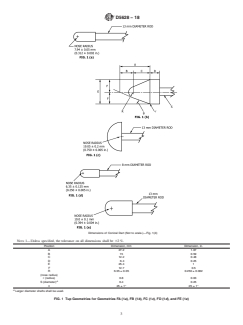
Dimensions of Conical Dart (Not to scale.)—Fig. 1(b)
NOTE 1—Unless specified, the tolerance on all dimensions shall be 62%.
Position Dimension, mm Dimension, in.
A 27.2 1.07
B 15 0.59
C 12.2 0.48
D 6.4 0.25
E 25.4 1
F 12.7 0.5
R 6.35±0.05 0.250±0.002
(nose radius)
r (radius) 0.8 0.03
A
S (diameter) 6.4 0.25
θ 25±1° 25±1°
A
Larger diameter shafts shall be used.
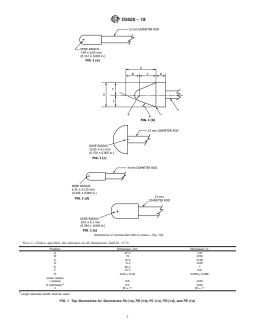
FIG. 1 Tup Geometries for Geometries FA (1a), FB (1b), FC (1c), FD (1d), and FE (1e)
D5628 − 18
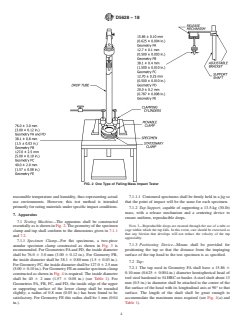
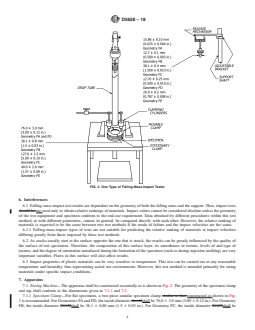
FIG. 2 One Type of Falling Mass Impact Tester
reasonable temperature and humidity, thus representing actual 7.1.1.1 Contoured specimens shall be firmly held in a jig so
use environments. However, this test method is intended that the point of impact will be the same for each specimen.
primarily for rating materials under specific impact conditions.
7.1.2 Tup Support, capable of supporting a 13.5-kg (30-lb)
mass, with a release mechanism and a centering device to
7. Apparatus
ensure uniform, reproducible drops.
7.1 Testing Machine—The apparatus shall be constructed
NOTE 3—Reproducible drops are ensured through the use of a tube or
essentiallyasisshowninFig.2.Thegeometryofthespecimen
cage within which the tup falls. In this event, care should be exercised so
clamp and tup shall conform to the dimensions given in 7.1.1
that any friction that develops will not reduce the velocity of the tup
and 7.2.
appreciably.
7.1.1 Specimen Clamp—For flat specimens, a two-piece
annular specimen clamp constructed as shown in Fig. 3 is 7.1.3 Positioning Device—Means shall be provided for
positioning the tup so that the distance from the impinging
recommended.ForGeometriesFAandFD,theinsidediameter
shall be 76.0 6 3.0 mm (3.00 6 0.12 in.). For Geometry FB, surface of the tup head to the test specimen is as specified.
the inside diameter shall be 38.1 6 0.80 mm (1.5 6 0.03 in.).
7.2 Tup:
ForGeometryFC,theinsidediametershallbe127.0 62.5mm
7.2.1 The tup used in Geometry FA shall have a 15.86 6
(5.00 60.10in.).ForGeometryFEanannularspecimenclamp
0.10-mm (0.625 6 0.004-in.) diameter hemispherical head of
constructedasshowninFig.4isrequired.Theinsidediameter
toolsteelhardenedto54HRCorharder.Asteelshaftabout13
shall be 40 6 2 mm (1.57 6 0.08 in.) (see Table 1). For
mm (0.5 in.) in diameter shall be attached to the center of the
Geometries FA, FB, FC, and FD, the inside edge of the upper
flat surface of the head with its longitudinal axis at 90° to that
or supporting surface of the lower clamp shall be rounded
surface. The length of the shaft shall be great enough to
slightly; a radius of 0.8 mm (0.03 in.) has been found to be
accommodate the maximum mass required (see Fig. 1(a) and
satisfactory. For Geometry FE this radius shall be 1 mm (0.04
in.). Table 1).
D5628 − 18
FIG. 3 Support Plate/Specimen/Clamp Configuration for Geometries FA, FB, FC, and FD
FIG. 4 Test-Specimen Support for Geometry FE
TABLE 1 Tup and Support Ring Dimensions
7.2.3 The tup used for Geometry FC shall be made of tool
Dimensions, mm (in.) steel hardened to 54 HRC or harder. The hemispherical head
Geometry
Tup Diameter Inside Diameter Support Ring shall have a diameter of 38.1 6 0.4 mm (1.5 6 0.015 in.). A
steel shaft about 13 mm (0.5 in.) in diameter shall be attached
FA 15.86 ± 0.10 76.0 ± 3.0
(0.625 ± 0.004) (3.00 ± 0.12)
tothecenteroftheflatsurfaceoftheheadwithitslongitudinal
FB 12.7 ± 0.1 38.1 ± 0.8
axisat90°tothatsurface.Thelengthoftheshaftshallbegreat
(0.500 ± 0.003) (1.5 ± 0.03)
FC 38.1 ± 0.4 127.0 ± 2.5 enough to accommodate the maximum mass (see Fig. 1(c) and
(1.5 ± 0.010) (5.00 ± 0.10)
Table 1).
FD 12.70 ± 0.25 76.0 ± 3.0
7.2.4 The tup used in Geometry FD shall have a 12.70 6
(0.500 ± 0.010) (3.00 ± 0.12)
FE 20.0 ± 0.2 40.0 ± 2.0 0.25-mm (0.500 6 0.010-in.) diameter hemispherical head of
(0.787 ± 0.008) (1.57 ± 0.08)
tool steel hardened to 54 HRC or harder.Asteel shaft about 8
mm (0.31 in.) in diameter shall be attached to the center of the
flat surface of the head with its longitudinal axis at 90° to the
7.2.2 The tup used in Geometry FB shall be made of tool surface. The length of the shaft shall be great enough to
steel hardened to 54 HRC or harder. The head shall have a accommodate the maximum mass required (see Fig. 1(d) and
diameter of 12.76 0.1 mm (0.500 6 0.003 in.) with a conical Table 1).
(50°includedangle)configurationsuchthattheconicalsurface 7.2.5 The tup used in Geometry FE shall have a 20.0 6
is tangent to the hemispherical nose. A 6.4-mm (0.25-in.) 0.2-mm (0.787 6 0.008-in.) diameter hemispherical head of
diameter shaft is satisfactory (see Fig. 1(b) and Table 1). toolsteelhardenedto54HRCorharder.Asteelshaftabout13
D5628 − 18
TABLE 2 Minimum Size of Specimen
ISO 6603-1 the test specimen shall be 60 6 2 mm (2.4 6 0.08
Geometry Specimen Diameter, mm (in.) Square Specimen, mm (in.) in.) in diameter or 60 6 2 mm (2.4 6 0.08 in.) square with a
FA 89 (3.5) 89 by 89
thickness of 2 6 0.1 mm (0.08 6 0.004 in.). Machining
(3.5 by 3.5)
specimens to reduce thickness variation is not permissible.
FB 51 (2.0) 51 by 51
(2.0 by 2.0)
10.3 When the approximate mean failure mass for a given
FC 140 (5.5) 140 by 140
sample is known, 20 specimens will usually yield sufficiently
(5.5 by 5.5)
FD 89 (3.5) 89 by 89
precise results. If the approximate mean failure mass is
(3.5 by 3.5)
unknown, six or more additional specimens shall be used to
FE 58 (2.3) 58 by 58
(2.3 by 2.3) determine the appropriate starting point of the test. For
compliancewithISO6603-1aminimumof30specimensmust
be tested.
10.4 Carefullyexaminethespecimenvisuallytoensurethat
mm (0.5 in.) in diameter shall be attached to the center of the
samples are free of cracks or other obvious imperfections or
flat surface of the head with its longitudinal axis at 90° to the
damages, unless these imperfections constitute variables under
surface. The length of the shaft shall be great enough to
study. Samples known to be defective shall not be tested for
accommodate the maximum mass required (see Fig. 1(e) and
specification purposes. Production parts, however, shall be
Table 1).
testedintheas-receivedconditiontodetermineconformanceto
7.2.6 The tup head shall be free of nicks, scratches, or other
specified standards.
surface irregularities.
10.5 Select a suitable method for making the specimen that
7.3 Masses—Cylindricalsteelmassesarerequiredthathave
will not affect the impact resistance of the material.
a center hole into which the tup shaft will fit. A variety of
massesareneededifdifferentmaterialsorthicknessesaretobe
10.6 Specimens range from having flat smooth surfaces on
tested. The optimal increments in tup mass range from 10 g or
both sides, being textured on one side and smooth on the other
lessformaterialsoflowimpactresistance,to1kgorhigherfor
side, or be textured on both surfaces. When testing, special
materials of high impact resistance.
attentionmustbepaidtohowthespecimenispositionedonthe
support.
7.4 Micrometer—Apparatus for measuring the width and
thickness of the test specimen shall comply with the require-
NOTE 4—As few as ten sp
...
This document is not an ASTM standard and is intended only to provide the user of an ASTM standard an indication of what changes have been made to the previous version. Because
it may not be technically possible to adequately depict all changes accurately, ASTM recommends that users consult prior editions as appropriate. In all cases only the current version
of the standard as published by ASTM is to be considered the official document.
Designation: D5628 − 10 D5628 − 18
Standard Test Method for
Impact Resistance of Flat, Rigid Plastic Specimens by
Means of a Falling Dart (Tup or Falling Mass)
This standard is issued under the fixed designation D5628; the number immediately following the designation indicates the year of
original adoption or, in the case of revision, the year of last revision. A number in parentheses indicates the year of last reapproval. A
superscript epsilon (´) indicates an editorial change since the last revision or reapproval.
1. Scope*
1.1 This test method covers the determination of the threshold value of impact-failure energy required to crack or break flat,
rigid plastic specimens under various specified conditions of impact of a free-falling dart (tup), based on testing many specimens.
1.2 The values stated in SI units are to be regarded as the standard. The values in parentheses are for information only.
1.3 This standard does not purport to address all of the safety concerns, if any, associated with its use. It is the responsibility
of the user of this standard to establish appropriate safety safety, health, and healthenvironmental practices and determine the
applicability of regulatory limitations prior to use. Specific hazard statements are given in Section 8.
NOTE 1—This test method and ISO 6603-1 are technically equivalent only when the test conditions and specimen geometry required for Geometry FE
and the Bruceton Staircase method of calculation are used.
1.4 This international standard was developed in accordance with internationally recognized principles on standardization
established in the Decision on Principles for the Development of International Standards, Guides and Recommendations issued
by the World Trade Organization Technical Barriers to Trade (TBT) Committee.
2. Referenced Documents
2.1 ASTM Standards:
D618 Practice for Conditioning Plastics for Testing
D883 Terminology Relating to Plastics
D1600 Terminology for Abbreviated Terms Relating to Plastics
D1709 Test Methods for Impact Resistance of Plastic Film by the Free-Falling Dart Method
D2444 Practice for Determination of the Impact Resistance of Thermoplastic Pipe and Fittings by Means of a Tup (Falling
Weight)
D3763 Test Method for High Speed Puncture Properties of Plastics Using Load and Displacement Sensors
D4000 Classification System for Specifying Plastic Materials
D5947 Test Methods for Physical Dimensions of Solid Plastics Specimens
D6779 Classification System for and Basis of Specification for Polyamide Molding and Extrusion Materials (PA)
E691 Practice for Conducting an Interlaboratory Study to Determine the Precision of a Test Method
2.2 ISO Standards:
ISO 291 Standard Atmospheres for Conditioning and Testing
ISO 6603-1 Plastics—Determination of Multiaxial Impact Behavior of Rigid Plastics—Part 1: Falling Dart Method
3. Terminology
3.1 Definitions:
3.1.1 For definitions of plastic terms used in this test method, see Terminologies D883 and D1600.
3.2 Definitions of Terms Specific to This Standard:
3.2.1 failure (of test specimen)—the presence of any crack or split, created by the impact of the falling tup, that can be seen by
the naked eye under normal laboratory lighting conditions.
This test method is under the jurisdiction of ASTM Committee D20 on Plastics and is the direct responsibility of Subcommittee D20.10 on Mechanical Properties.
Current edition approved July 1, 2010May 1, 2018. Published July 2010June 2018. Originally approved in 1994. Last previous edition approved in 20072010 as
D5628 - 07.D5628 - 10. DOI: 10.1520/D5628-10.10.1520/D5628-18.
For referenced ASTM standards, visit the ASTM website, www.astm.org, or contact ASTM Customer Service at service@astm.org. For Annual Book of ASTM Standards
volume information, refer to the standard’s Document Summary page on the ASTM website.
Available from American National Standards Institute (ANSI), 25 W. 43rd St., 4th Floor, New York, NY 10036, http://www.ansi.org.
*A Summary of Changes section appears at the end of this standard
Copyright © ASTM International, 100 Barr Harbor Drive, PO Box C700, West Conshohocken, PA 19428-2959. United States
D5628 − 18
3.2.2 mean-failure energy (mean-impact resistance)—the energy required to produce 50 % failures, equal to the product of the
constant drop height and the mean-failure mass, or, to the product of the constant mass and the mean-failure height.
3.2.3 mean-failure height (impact-failure height)—the height at which a standard mass, when dropped on test specimens, will
cause 50 % failures.
NOTE 2—Cracks usually start at the surface opposite the one that is struck. Occasionally incipient cracking in glass-reinforced products, for example,
is difficult to differentiate from the reinforcing fibers. In such cases, a penetrating dye can confirm the onset of crack formation.
3.2.4 mean-failure mass (impact-failure mass)—the mass of the dart (tup) that, when dropped on the test specimens from a
standard height, will cause 50 % failures.
3.2.5 tup—a dart with a hemispherical nose. See 7.2 and Fig. 1.
4. Summary of Test Method
4.1 A free-falling dart (tup) is allowed to strike a supported specimen directly. Either a dart having a fixed mass is dropped from
various heights, or a dart having an adjustable mass is dropped from a fixed height. (See Fig. 2).
4.2 The procedure determines the energy (mass × height) that will cause 50 % of the specimens tested to fail (mean failure
energy).
4.3 The technique used to determine mean failure energy is commonly called the Bruceton Staircase Method or the
Up-and-Down Method (1). Testing is concentrated near the mean, reducing the number of specimens required to obtain a
reasonably precise estimate of the impact resistance.
4.4 Each test method permits the use of different tup and test specimen geometries to obtain different modes of failure, permit
easier sampling, or test limited amounts of material. There is no known means for correlating the results of tests made by different
impact methods or procedures.
5. Significance and Use
5.1 Plastics are viscoelastic and therefore are likely to be sensitive to changes in velocity of the mass falling on their surfaces.
However, the velocity of a free-falling object is a function of the square root of the drop height. A change of a factor of two in
the drop height will cause a change of only 1.4 in velocity. Hagan et al (2) found that the mean-failure energy of sheeting was
constant at drop heights between 0.30 and 1.4 m. This suggests that a constant mass-variable height method will give the same
results as the constant height-variable mass technique. On the other hand, different materials respond differently to changes in the
velocity of impact. Equivalence of these methods should not be taken for granted. While both constant-mass and constant-height
techniques are permitted by these methods, the constant-height method should is to be used for those materials that are found to
be rate-sensitive in the range of velocities encountered in falling-weight types of impact tests.
5.2 The test geometry FA causes a moderate level of stress concentration and can be used for most plastics.
5.3 Geometry FB causes a greater stress concentration and results in failure of tough or thick specimens that do not fail with
Geometry FA (3). This approach can produce a punch shear failure on thick sheet. If that type of failure is undesirable, Geometry
FC should is to be used. Geometry FB is suitable for research and development because of the smaller test area required.
5.3.1 The conical configuration of the 12.7-mm diameter tup used in Geometry FB minimizes problems with tup penetration
and sticking in failed specimens of some ductile materials.
5.4 The test conditions of Geometry FC are the same as those of Test Method A of Test Method D1709. They have been used
in specifications for extruded sheeting. A limitation of this geometry is that considerable material is required.
5.5 The test conditions of Geometry FD are the same as for Test Method D3763.
5.6 The test conditions of Geometry FE are the same as for ISO 6603-1.
5.7 Because of the nature of impact testing, the selection of a test method and tup must be somewhat arbitrary. Although a choice
of tup geometries is available, knowledge of the final or intended end-use application shall be considered.
5.8 Clamping of the test specimen will improve the precision of the data. Therefore, clamping is recommended. However, with
rigid specimens, valid determinations can be made without clamping. Unclamped specimens tend to exhibit greater impact
resistance.
5.9 Before proceeding with this test method, reference should be made to the specification of the material being tested. Table
1 of Classification System D4000 lists the ASTM materials standards that currently exist. Any test specimens preparation,
conditioning, dimensions, or testing parameters or combination thereof covered in the relevant ASTM materials specification shall
take precedence over those mentioned in this test method. If there are no relevant ASTM material specifications, then the default
conditions apply.
The boldface numbers in parentheses refer to a list of references at the end of the text.
D5628 − 18
Dimensions of Conical Dart (Not to scale.)—Fig. 1(b)
NOTE 1—Unless specified, the tolerance on all dimensions shall be 62 %.
Position Dimension, mm Dimension, in.
A 27.2 1.07
B 15 0.59
C 12.2 0.48
D 6.4 0.25
E 25.4 1
F 12.7 0.5
R 6.35 ± 0.05 0.250 ± 0.002
(nose radius)
r (radius) 0.8 0.03
A
S (diameter) 6.4 0.25
θ 25 ± 1° 25 ± 1°
A
Larger diameter shafts shall be used.
FIG. 1 Tup Geometries for Geometries FA (1a), FB (1b), FC (1c), FD (1d), and FE (1e)
D5628 − 18
FIG. 2 One Type of Falling Mass Impact Tester
6. Interferences
6.1 Falling-mass-impact-test results are dependent on the geometry of both the falling mass and the support. Thus, impact tests
should be are used only to obtain relative rankings of materials. Impact values cannot be considered absolute unless the geometry
of the test equipment and specimen conform to the end-use requirement. Data obtained by different procedures within this test
method, or with different geometries, cannot, in general, be compared directly with each other. However, the relative ranking of
materials is expected to be the same between two test methods if the mode of failure and the impact velocities are the same.
6.1.1 Falling-mass-impact types of tests are not suitable for predicting the relative ranking of materials at impact velocities
differing greatly from those imposed by these test methods.
6.2 As cracks usually start at the surface opposite the one that is struck, the results can be greatly influenced by the quality of
the surface of test specimens. Therefore, the composition of this surface layer, its smoothness or texture, levels of and type of
texture, and the degree of orientation introduced during the formation of the specimen (such as during injection molding) are very
important variables. Flaws in this surface will also affect results.
6.3 Impact properties of plastic materials can be very sensitive to temperature. This test can be carried out at any reasonable
temperature and humidity, thus representing actual use environments. However, this test method is intended primarily for rating
materials under specific impact conditions.
7. Apparatus
7.1 Testing Machine—The apparatus shall be constructed essentially as is shown in Fig. 2. The geometry of the specimen clamp
and tup shall conform to the dimensions given in 7.1.1 and 7.2.
7.1.1 Specimen Clamp—For flat specimens, a two-piece annular specimen clamp similar to that constructed as shown in Fig.
3 is recommended. For Geometries FA and FD, the inside diameter shouldshall be 76.0 6 3.0 mm (3.00 6 0.12 in.). For Geometry
FB, the inside diameter shouldshall be 38.1 6 0.80 mm (1.5 6 0.03 in.). For Geometry FC, the inside diameter shouldshall be
D5628 − 18
FIG. 3 Support Plate/Specimen/Clamp Configuration for Geometries FA, FB, FC, and FD
127.0 6 2.5 mm (5.00 6 0.10 in.). For Geometry FE an annular specimen clamp similar to that constructed as shown in Fig. 4
is required. The inside diameter shouldshall be 40 6 2 mm (1.57 6 0.08 in.) (see Table 1). For Geometries FA, FB, FC, and FD,
the inside edge of the upper or supporting surface of the lower clamp shouldshall be rounded slightly; a radius of 0.8 mm (0.03
in.) has been found to be satisfactory. For Geometry FE this radius shouldshall be 1 mm (0.04 in.).
7.1.1.1 Contoured specimens shall be firmly held in a jig so that the point of impact will be the same for each specimen.
7.1.2 Tup Support, capable of supporting a 13.5-kg (30-lb) mass, with a release mechanism and a centering device to ensure
uniform, reproducible drops.
NOTE 3—Reproducible drops are ensured through the use of a tube or cage within which the tup falls. In this event, care should be exercised so that
any friction that develops will not reduce the velocity of the tup appreciably.
7.1.3 Positioning Device—Means shall be provided for positioning the tup so that the distance from the impinging surface of
the tup head to the test specimen is as specified.
7.2 Tup:
7.2.1 The tup used in Geometry FA shall have a 15.86 6 0.10-mm (0.625 6 0.004-in.) diameter hemispherical head of tool steel
hardened to 54 HRC or harder. A steel shaft about 13 mm (0.5 in.) in diameter shall be attached to the center of the flat surface
of the head with its longitudinal axis at 90° to that surface. The length of the shaft shall be great enough to accommodate the
maximum mass required (see Fig. 1(a) and Table 1).
7.2.2 The tup used in Geometry FB shall be made of tool steel hardened to 54 HRC or harder. The head shall have a diameter
of 12.76 0.1 mm (0.500 6 0.003 in.) with a conical (50° included angle) configuration such that the conical surface is tangent
to the hemispherical nose. A 6.4-mm (0.25-in.) diameter shaft is satisfactory (see Fig. 1(b) and Table 1).
7.2.3 The tup used for Geometry FC shall be made of tool steel hardened to 54 HRC or harder. The hemispherical head shall
have a diameter of 38.1 6 0.4 mm (1.5 6 0.015 in.). A steel shaft about 13 mm (0.5 in.) in diameter shall be attached to the center
of the flat surface of the head with its longitudinal axis at 90° to that surface. The length of the shaft shall be great enough to
accommodate the maximum mass (see Fig. 1(c) and Table 1).
7.2.4 The tup used in Geometry FD shall have a 12.70 6 0.25-mm (0.500 6 0.010-in.) diameter hemispherical head of tool steel
hardened to 54 HRC or harder. A steel shaft about 8 mm (0.31 in.) in diameter shall be attached to the center of the flat surface
of the head with its longitudinal axis at 90° to the surface. The length of the shaft shall be great enough to accommodate the
maximum mass required (see Fig. 1(d) and Table 1).
7.2.5 The tup used in Geometry FE shall have a 20.0 6 0.2-mm (0.787 6 0.008-in.) diameter hemispherical head of tool steel
hardened to 54 HRC or harder. A steel shaft about 13 mm (0.5 in.) in diameter shall be attached to the center of the flat surface
of the head with its longitudinal axis at 90° to the surface. The length of the shaft shall be great enough to accommodate the
maximum mass required (see Fig. 1(e) and Table 1).
7.2.6 The tup head shall be free of nicks, scratches, or other surface irregularities.
7.3 Masses—Cylindrical steel masses are required that have a center hole into which the tup shaft will fit. A variety of masses
are needed if different materials or thicknesses are to be tested. The optimal increments in tup mass range from 10 g or less for
materials of low impact resistance, to 1 kg or higher for materials of high impact resistance.
7.4 Micrometer, Micrometer—for measurement of specimen thickness. It should be accurate to within 1 % of the average
Apparatus for measuring the width and thickness of the specimens being tested. See test specimen shall comply with the
requirements of Test Methods D5947 for descriptions of suitable micrometers.
D5628 − 18
FIG. 4 Test-Specimen Support for Geometry FE
TABLE 1 Tup and Support Ring Dimensions
Dimensions, mm (in.)
Geometry
Tup Diameter Inside Diameter Support Ring
FA 15.86 ± 0.10 76.0 ± 3.0
(0.625 ± 0.004) (3.00 ± 0.12)
FB 12.7 ± 0.1 38.1 ± 0.8
(0.500 ± 0.003) (1.5 ± 0.03)
FC 38.1 ± 0.4 127.0 ± 2.5
(1.5 ± 0.010) (5.00 ± 0.10)
FD 12.70 ± 0.25 76.0 ± 3.0
(0.500 ± 0.010) (3.00 ± 0.12)
FE 20.0 ± 0.2 40.0 ± 2.0
(0.787 ± 0.008) (1.57 ± 0.08)
7.5 The mass of the tup head and shaft assembly and the additional mass required must be known to within an accuracy of
61 %.
8. Hazards
8.1 Safety Precautions:
8.1.1 Cushioning and shielding devices shall be provided to protect personnel and to avoid damage to the impinging surface
of the tup. A tube or cage can contain the tup if it rebounds after striking a specimen.
8.1.2 When heavy weights are used, it is hazardous for an operator to attempt to catch a rebounding tup. Figure 2 of Test Method
D2444 shows an effective mechanical “rebound catcher” employed in conjunction with a drop tube.
9. Sampling
9.1 Sample the material to meet the requirements of Section 14.
10. Test Specimens
10.1 Flat test specimens shall be large enough so that they can be clamped firmly if clamping is desirable. See Table 2 for the
minimum size of specimen that can be used for each test geometry.
10.2 The thickness of any specimen in a sample shall not differ by more than 5 % from the average specimen thickness of that
sample. However, if variations greater than 5 % are unavoidable in a sample that is obtained from parts, the data shall not be used
for referee purposes. For compliance with ISO 6603-1 the test specimen shall be 60 6 2 mm (2.4 6 0.08 in.) in diameter or 60
6 2 mm (2.4 6 0.08 in.) square with a thickness of 2 6 0.1 mm (0.08 6 0.004 in.). Machining specimens to reduce thickness
variation is not permissible.
10.3 When the approximate mean failure mass for a given sample is known, 20 specimens will usually yield sufficiently precise
results. If the approximate mean failure mass is unknown, six or more additional specimens shouldshall be used to determine the
appropriate starting point of the test. For compliance with ISO 6603-1 a minimum of 30 specimens must be tested.
D5628 − 18
TABLE 2 Minimum Size of Specimen
Geometry Specimen Diameter, mm (in.) Square Specimen, mm (in.)
FA 89 (3.5) 89 by 89
(3.5 by 3.5)
FB 51 (2.0) 51 by 51
(2.0 by 2.0)
FC 140 (5.5) 140 by 140
(5.5 by 5.5)
FD 89 (3.5) 89 by 89
(3.5 by 3.5)
FE 58 (2.3) 58 by 58
(2.3 by 2.3)
10.4 Carefully examine the specimen visually to ensure that samples are free of cracks or other obvious imperfections or
damages, unless these imperfections constitute variables under study. Samples known to be defective shouldshall not be tested for
specification purposes. Production parts, however, shouldshall be tested in the as-received
...