

ASTM D6799-23
(Terminology)Standard Terminology Relating to Inflatable Restraints
General Information
- Abstract
SCOPE
1.1 This standard covers terminology which is used in the evaluation of inflatable restraint fabrics, cushions, and modules.
1.2 This international standard was developed in accordance with internationally recognized principles on standardization established in the Decision on Principles for the Development of International Standards, Guides and Recommendations issued by the World Trade Organization Technical Barriers to Trade (TBT) Committee.
- Status
- Published
- Publication Date
- 31-May-2023
- Technical Committee
- D13 - Textiles
- Drafting Committee
- D13.20 - Inflatable Restraints

Overview
ASTM D6799-23, Standard Terminology Relating to Inflatable Restraints, provides comprehensive definitions for terms used in the evaluation and manufacturing of inflatable restraint fabrics, cushions, and modules. As an international standard developed by ASTM International, it helps unify language and concepts across industries involved in producing automotive safety systems such as airbags. The terminology ensures precise communication during research, design, testing, and quality assurance, reducing ambiguity in technical documentation and standardizing evaluation criteria for this critical safety component.
Key Topics
The standard covers terminology relevant to:
- Inflatable restraint systems: Definitions for airbags, cushions, inflators, modules, and related components.
- Fabric characteristics and evaluation:
- Terms describing textile features (e.g., woven patterns, coated fabrics, and imperfections).
- Defects, imperfections, and common fabric faults relevant to safety and performance.
- Testing and quality control:
- Procedures and definitions for tests such as accelerated aging, dynamic air permeability, grading, and inspection.
- Terms for environmental and laboratory testing atmospheres.
- Assembly and manufacturing:
- Seam types, failures (adhesive and cohesive), and definitions of sealed and sewn seams.
- Techniques such as rework, packability, and specific packability.
Key terminology enables clear communication among engineers, manufacturers, and quality control professionals, supporting the safe and effective production of inflatable restraint systems.
Applications
ASTM D6799-23 brings practical value in several key areas:
- Automotive Safety System Development: Provides standardized language for manufacturers, suppliers, and testing laboratories involved in airbag design, prototyping, and production.
- Quality Assurance and Inspection: Enables consistent description and assessment of fabric quality and defect types, supporting reliability and safety standards for airbag modules.
- Product Testing and Evaluation: Supports methodical evaluation of materials and assemblies for performance under various environmental conditions (heat, humidity, ozone) and at different deployment pressures.
- International Trade and Regulation: Aligns terminology across borders, aiding compliance with World Trade Organization (WTO) Technical Barriers to Trade (TBT) principles and facilitating smoother regulatory approval processes globally.
Related Standards
Users of ASTM D6799-23 should also be aware of related ASTM standards that provide foundational terminology and additional context for the evaluation of textiles and inflatable restraints:
- ASTM D123: Terminology Relating to Textiles
Essential for understanding general textile terms referenced in D6799. - ASTM D3990: Terminology Relating to Fabric Defects
Provides important definitions of fabric defects, complementing defect assessments in inflatable restraint fabrics.
For the latest updates, official versions, and additional application guidance, users are encouraged to consult the ASTM International website at www.astm.org.
Keywords: ASTM D6799-23, inflatable restraints, airbag terminology, inflatable restraint fabrics, automotive safety, textile evaluation, ASTM airbag standard
Relations
- Effective Date
- 01-Mar-2017
- Effective Date
- 15-Sep-2015
- Effective Date
- 01-Sep-2015
- Effective Date
- 01-Apr-2015
- Effective Date
- 15-Jun-2013
- Effective Date
- 15-Jun-2013
- Effective Date
- 15-May-2013
- Effective Date
- 01-Jul-2012
- Effective Date
- 01-Jul-2012
- Effective Date
- 01-Feb-2012
- Effective Date
- 01-Feb-2012
- Effective Date
- 15-Jan-2009
- Effective Date
- 15-Jan-2009
- Effective Date
- 15-Jan-2009
- Effective Date
- 01-Jul-2008
Get Certified
Connect with accredited certification bodies for this standard

TÜV Rheinland
TÜV Rheinland is a leading international provider of technical services.

TÜV SÜD
TÜV SÜD is a trusted partner of choice for safety, security and sustainability solutions.

DEKRA Certification Inc.
DEKRA US certification services.
Sponsored listings
Frequently Asked Questions
ASTM D6799-23 is a standard published by ASTM International. Its full title is "Standard Terminology Relating to Inflatable Restraints". This standard covers: SCOPE 1.1 This standard covers terminology which is used in the evaluation of inflatable restraint fabrics, cushions, and modules. 1.2 This international standard was developed in accordance with internationally recognized principles on standardization established in the Decision on Principles for the Development of International Standards, Guides and Recommendations issued by the World Trade Organization Technical Barriers to Trade (TBT) Committee.
SCOPE 1.1 This standard covers terminology which is used in the evaluation of inflatable restraint fabrics, cushions, and modules. 1.2 This international standard was developed in accordance with internationally recognized principles on standardization established in the Decision on Principles for the Development of International Standards, Guides and Recommendations issued by the World Trade Organization Technical Barriers to Trade (TBT) Committee.
ASTM D6799-23 is classified under the following ICS (International Classification for Standards) categories: 43.040.80 - Crash protection and restraint systems. The ICS classification helps identify the subject area and facilitates finding related standards.
ASTM D6799-23 has the following relationships with other standards: It is inter standard links to ASTM D123-17, ASTM D123-15b, ASTM D123-15a, ASTM D123-15, ASTM D123-13ae1, ASTM D123-13a, ASTM D123-13, ASTM D3990-12, ASTM D3990-12e1, ASTM D123-12, ASTM D123-12e1, ASTM D123-09, ASTM D123-09e1, ASTM D123-09e2, ASTM D3990-99(2008). Understanding these relationships helps ensure you are using the most current and applicable version of the standard.
ASTM D6799-23 is available in PDF format for immediate download after purchase. The document can be added to your cart and obtained through the secure checkout process. Digital delivery ensures instant access to the complete standard document.
Standards Content (Sample)
This international standard was developed in accordance with internationally recognized principles on standardization established in the Decision on Principles for the
Development of International Standards, Guides and Recommendations issued by the World Trade Organization Technical Barriers to Trade (TBT) Committee.
Designation: D6799 − 23
Standard Terminology Relating to
Inflatable Restraints
This standard is issued under the fixed designation D6799; the number immediately following the designation indicates the year of
original adoption or, in the case of revision, the year of last revision. A number in parentheses indicates the year of last reapproval. A
superscript epsilon (´) indicates an editorial change since the last revision or reapproval.
1. Scope sealant layer must remain attached to one of the two
substrate surfaces, while a portion of the sealant less than
1.1 This standard covers terminology which is used in the
10 % of the original thickness of the sealant layer must
evaluation of inflatable restraint fabrics, cushions, and mod-
remain attached to the other of the two substrate surfaces.
ules.
1.2 This international standard was developed in accor-
air splice, n—for inflatable restraint fabrics, the thicker
dance with internationally recognized principles on standard-
portion of a yarn resulting from the entanglement of the
ization established in the Decision on Principles for the filaments at the ends of two multifilament yarns to create a
Development of International Standards, Guides and Recom-
continuous yarn.
mendations issued by the World Trade Organization Technical
average dynamic air permeability (ADAP), n—for inflatable
Barriers to Trade (TBT) Committee.
restraints, the average of all of DAP measurements within a
specified range of pressure differentials.
2. Referenced Documents
2.1 ASTM Standards:
bleedthrough, n— for coated inflatable restraint fabrics, the
D123 Terminology Relating to Textiles
presence of coating material on the uncoated side, between
D3990 Terminology Relating to Fabric Defects
two yarns, without covering either yarn.
blip, n—for inflatable restraint fabrics, any short, irregularly
3. Terminology
shaped or textured portion of an individual multifilament
3.1 Definitions:
yarn that has been woven into the fabric, including slough
abrasion, n—for inflatable restraint fabrics, a fuzzy cluster of
offs, stripbacks, fuzz balls, snarls, and slubs.
broken filaments damaged by scraping.
breakout pressure, n— for inflatable restraints, the pressure
accelerated aging, n— in textile processing and testing, the
level during deployment which ruptures the module cover.
use of controlled environmental conditions to promote rapid
physical or chemical change in a textile material.
broken filament, n— for inflatable restraint fabrics, an indi-
DISCUSSION—For inflatable restraints, practices for conducting accel-
vidual filament, separated from a multifilament yarn bundle,
erated aging are designed to determine the aggravated effects on a
that lies on the surface of the fabric.
fabric from exposures to heat, humidity, or ozone, or a combination
thereof. These environmental conditions may also be cycled in combi-
bruise, n—for inflatable restraint fabrics, a shift in the
nation. The four accelerated aging procedures of concern to the design
squareness of the weave pattern in an area that has been
and manufacture of inflatable restraints are referred to as cycle aging,
subjected to impact or pressure.
heat aging, humidity aging, and ozone aging.
adhesive failure, n—for inflatable restraint sealed and sewn
coated fabric, n—a flexible material composed of a textile
seams, a failure of seam sealant at the interface of two
fabric and an adherent polymeric material applied to one or
substrates where the sealant is sheared such that a portion of
both sides.
the sealant greater than 90 % of the original thickness of the
coating slub, n— for coated inflatable restraint fabrics, an
irregularly shaped lump of coating material on the surface of
the coated layer resembling a yarn slub.
This terminology is under the jurisdiction of ASTM Committee D13 on Textiles
and is the direct responsibility of Subcommittee D13.20 on Inflatable Restraints.
Current edition approved June 1, 2023. Published September 2023. Originally
coating streak, n— for coated inflatable restraint fabrics,
approved in 2005. Last previous edition approved in 2019 as D6799 – 13(2019).
minor variation in the color or opacity of the coated layer.
DOI: 10.1520/D6799-23.
For referenced ASTM standards, visit the ASTM website, www.astm.org, or
coating transfer, n— for coated inflatable restraint fabrics, the
contact ASTM Customer Service at service@astm.org. For Annual Book of ASTM
presence of coating material on the uncoated side, covering
Standards volume information, refer to the standard’s Document Summary page on
the ASTM website. one or more yarns.
Copyright © ASTM International, 100 Barr Harbor Drive, PO Box C700, West Conshohocken, PA 19428-2959. United States
D6799 − 23
cohesive failure, n—for inflatable restraint sealed and sewn foreign matter, n— for inflatable restraint fabrics, an extra-
seams, a failure of seam sealant at the interface of two neous interwoven fragment whose size, color, or texture
substrates where the sealant is sheared such that a portion of indicates that it is not of the same material as the fibers in the
the sealant greater than 10 % of the original thickness of the base fabric.
sealant layer must remain attached to both of the two
grading, n—the procedure used to identify and quantify the
substrate surfaces.
number of imperfections in a roll of fabric detected during
visual inspection.
contamination, n— for coated inflatable restraint fabrics, the
presence of non-coating material in the coated layer.
hard contamination, n— for coated inflatable restraint
fabrics, the presence of non-coating material within or on the
cushion, n—for inflatable restraints, the inflatable fabric en-
coating layer, such material visibly appearing to be of large
velope portion of a module.
size, coarse or sharp in texture, and of a thickness that
cushion overpressurization, n—for inflatable restraints, the
protrudes significantly above the surface of the coating layer.
process of inflating a cushion at internal pressures greater
DISCUSSION—Examples are metal filings, glass, plastic, or wood
than design deployment pressures; bag burst. splinters.
DISCUSSION—Side lighting of fabric during fabric inspection may be
defect, n—specific for inflatable restraints, an imperfection in
used to determine how significantly contamination protrudes from the
a cut piece of fabric that judgment and experience indicate is
surface of the fabric.
likely to result in either hazardous or improper deployment
heavy coating streak, n— for coated inflatable restraint
of the inflatable restraint module in which the imperfection
fabrics, a narrow area of fabric, generally in the shape of a
is incorporated.
DISCUSSION—An example of a defect is a hole in the piece of fabric line oriented in the warp direction of the fabric, in which the
through which inflation gases can vent improperly.
coating layer is visibly at a higher rate of coverage than the
surrounding material.
deployment, n—for inflatable restraints, the sequence of
events related to the activation of a module. hole, n—for inflatable restraint fabrics, an opening not char-
acteristic of the normal weave pattern where one or more
dynamic air permeability (DAP), n—for inflatable restraints,
yarns is cut, torn, or shifted.
the dynamic air permeability measured at a single specified
imperfection, n—a departure of a quality characteristic from
pressure differential.
its intended level or state.
edgecombing, n— for inflatable restraints, the separation of
inflatable restraint, n—a vehicular safety device designed to
yarns from their normal orthagonal configuration in a woven
cushion an occupant or equipment during collision; an
fabric due to seam stress or similar action near the edge of a
airbag.
cut part
inflator, n—for inflatable restraints, a device for generating
environmental conditions, n—in textile testing, the atmo-
and directing expansion gases into a cushion.
sphere in which specified moisture levels, temperature
ranges, and concentrations of gases are controlled.
ink stain, n—for inflatable restraint fabrics, presence of
marking ink in an area of fabric not provided for identifica-
exponent of dynamic air permeability (EXP), n—for inflat-
tion by an applicable specification.
able restraints, a descriptive factor used in a mathematical
model integral to the apparatus software which relates the inspection, n—in fabric grading, the process of viewing,
measuring, examining, or otherwise comparing the visual
change in dynamic air permeability as the pressure differen-
tial changes. characteristics of a fabric with applicable requirements.
kinky filling, n— for inflatable restraint fabrics, an area of the
extractable matter, n— for inflatable restraint fabrics,, non
fabric in which a short section of the weft yarn is folded back
fibrous material in or on a textile, not including water, which
upon itself, causing the appearance of a thick or heavy
is removable by a specified solvent or solvents, as directed in
section of yarn. This is contrasted to a loop in that the excess
a specified procedure.
yarn does not protrude from the surface of the fabric.
filling bar, n— for inflatable re
...
This document is not an ASTM standard and is intended only to provide the user of an ASTM standard an indication of what changes have been made to the previous version. Because
it may not be technically possible to adequately depict all changes accurately, ASTM recommends that users consult prior editions as appropriate. In all cases only the current version
of the standard as published by ASTM is to be considered the official document.
Designation: D6799 − 13 (Reapproved 2019) D6799 − 23
Standard Terminology Relating to
Inflatable Restraints
This standard is issued under the fixed designation D6799; the number immediately following the designation indicates the year of
original adoption or, in the case of revision, the year of last revision. A number in parentheses indicates the year of last reapproval. A
superscript epsilon (´) indicates an editorial change since the last revision or reapproval.
1. Scope
1.1 This standard covers terminology which is used in the evaluation of inflatable restraint fabrics, cushions, and modules.
1.2 This international standard was developed in accordance with internationally recognized principles on standardization
established in the Decision on Principles for the Development of International Standards, Guides and Recommendations issued
by the World Trade Organization Technical Barriers to Trade (TBT) Committee.
2. Referenced Documents
2.1 ASTM Standards:
D123 Terminology Relating to Textiles
D3990 Terminology Relating to Fabric Defects
3. Terminology
3.1 Definitions:
abrasion, n—for inflatable restraint fabrics, a fuzzy cluster of broken filaments damaged by scraping.
accelerated aging, n— in textile processing and testing, the use of controlled environmental conditions to promote rapid
physical or chemical change in a textile material.
DISCUSSION—
For inflatable restraints, practices for conducting accelerated aging are designed to determine the aggravated effects on a fabric from exposures to heat,
humidity, or ozone, or a combination thereof. These environmental conditions may also be cycled in combination. The four accelerated aging
procedures of concern to the design and manufacture of inflatable restraints are referred to as cycle aging, heat aging, humidity aging, and ozone aging.
adhesive failure, n—for inflatable restraint sealed and sewn seams, a failure of seam sealant at the interface of two substrates
where the sealant is sheared such that a portion of the sealant greater than 90 % of the original thickness of the sealant layer
must remain attached to one of the two substrate surfaces, while a portion of the sealant less than 10 % of the original thickness
of the sealant layer must remain attached to the other of the two substrate surfaces.
air splice, n—for inflatable restraint fabrics, the thicker portion of a yarn resulting from the entanglement of the filaments at
the ends of two multifilament yarns to create a continuous yarn.
This terminology is under the jurisdiction of ASTM Committee D13 on Textiles and is the direct responsibility of Subcommittee D13.20 on Inflatable Restraints.
Current edition approved Jan. 1, 2019June 1, 2023. Published March 2019September 2023. Originally approved in 2005. Last previous edition approved in 20132019 as
ɛ1
D6799 – 13 . DOI: 10.1520/D6799-13R19.(2019). DOI: 10.1520/D6799-23.
For referenced ASTM standards, visit the ASTM website, www.astm.org, or contact ASTM Customer Service at service@astm.org. For Annual Book of ASTM Standards
volume information, refer to the standard’s Document Summary page on the ASTM website.
Copyright © ASTM International, 100 Barr Harbor Drive, PO Box C700, West Conshohocken, PA 19428-2959. United States
D6799 − 23
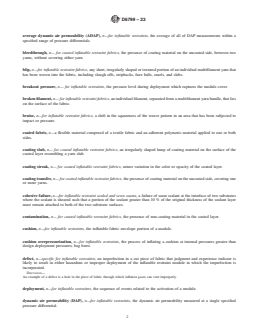
average dynamic air permeability (ADAP), n—for inflatable restraints, the average of all of DAP measurements within a
specified range of pressure differentials.
bleedthrough, n— for coated inflatable restraint fabrics, the presence of coating material on the uncoated side, between two
yarns, without covering either yarn.
blip, n—for inflatable restraint fabrics, any short, irregularly shaped or textured portion of an individual multifilament yarn that
has been woven into the fabric, including slough offs, stripbacks, fuzz balls, snarls, and slubs.
breakout pressure, n— for inflatable restraints, the pressure level during deployment which ruptures the module cover.
broken filament, n— for inflatable restraint fabrics, an individual filament, separated from a multifilament yarn bundle, that lies
on the surface of the fabric.
bruise, n—for inflatable restraint fabrics, a shift in the squareness of the weave pattern in an area that has been subjected to
impact or pressure.
coated fabric, n—a flexible material composed of a textile fabric and an adherent polymeric material applied to one or both
sides.
coating slub, n— for coated inflatable restraint fabrics, an irregularly shaped lump of coating material on the surface of the
coated layer resembling a yarn slub.
coating streak, n— for coated inflatable restraint fabrics, minor variation in the color or opacity of the coated layer.
coating transfer, n— for coated inflatable restraint fabrics, the presence of coating material on the uncoated side, covering one
or more yarns.
cohesive failure, n—for inflatable restraint sealed and sewn seams, a failure of seam sealant at the interface of two substrates
where the sealant is sheared such that a portion of the sealant greater than 10 % of the original thickness of the sealant layer
must remain attached to both of the two substrate surfaces.
contamination, n— for coated inflatable restraint fabrics, the presence of non-coating material in the coated layer.
cushion, n—for inflatable restraints, the inflatable fabric envelope portion of a module.
cushion overpressurization, n—for inflatable restraints, the process of inflating a cushion at internal pressures greater than
design deployment pressures; bag burst.
defect, n—specific for inflatable restraints, an imperfection in a cut piece of fabric that judgment and experience indicate is
likely to result in either hazardous or improper deployment of the inflatable restraint module in which the imperfection is
incorporated.
DISCUSSION—
An example of a defect is a hole in the piece of fabric through which inflation gases can vent improperly.
deployment, n—for inflatable restraints, the sequence of events related to the activation of a module.
dynamic air permeability (DAP), n—for inflatable restraints, the dynamic air permeability measured at a single specified
pressure differential.
D6799 − 23
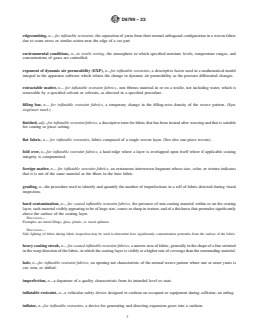
edgecombing, n— for inflatable restraints, the separation of yarns from their normal orthagonal configuration in a woven fabric
due to seam stress or similar action near the edge of a cut part
environmental conditions, n—in textile testing, the atmosphere in which specified moisture levels, temperature ranges, and
concentrations of gases are controlled.
exponent of dynamic air permeability (EXP), n—for inflatable restraints, a descriptive factor used in a mathematical model
integral to the apparatus software which relates the change in dynamic air permeability as the pressure differential changes.
extractable matter, n— for inflatable restraint fabrics,, non fibrous material in or on a textile, not including water, which is
removable by a specified solvent or solvents, as directed in a specified procedure.
filling bar, n— for inflatable restraint fabrics, a temporary change in the filling-wise density of the weave pattern. (Syn:
stop/start mark.)
finished, adj—for inflatable restraint fabrics, a descriptive term for fabric that has been treated after weaving and that is suitable
for coating or piece cutting.
flat fabric, n— for inflatable restraints, fabric composed of a single woven layer. (See also one-piece woven).
fold over, n—for inflatable restraint fabrics, a hard ridge where a layer is overlapped upon itself where if applicable coating
integrity is compromised.
foreign matter, n— for inflatable restraint fabrics, an extraneous interwoven fragment whose size, color, or texture indicates
that it is not of the same material as the fibers in the base fabric.
grading, n—the procedure used to identify and quantify the number of imperfections in a roll of fabric detected during visual
inspection.
hard contamination, n— for coated inflatable restraint fabrics, the presence of non-coating material within or on the coating
layer, such material visibly appearing to be of large size, coarse or sharp in texture, and of a thickness that protrudes significantly
above the surface of the coating layer.
DISCUSSION—
Examples are metal filings, glass, plastic, or wood splinters.
DISCUSSION—
Side lighting of fabric during fabric inspection may be used to determine how significantly contamination protrudes from the surface of the fabric.
heavy coating streak, n— for coated inflatable restraint fabrics, a narrow area of fabric, generally in the shape of a line oriented
in the warp direction of the fabric, in which the coating layer is visibly at a higher rate of coverage than the surrounding material.
hole, n—for inflatable restraint fabrics, an opening not characteristic of the normal weave pattern where one or more yarns is
cut, torn, or shifted.
imperfection, n—a departure of a quality characteristic from its intended level or state.
inflatable restraint, n—a vehicular safety device designed to cushion an occupant or equipment during collision; an airbag.
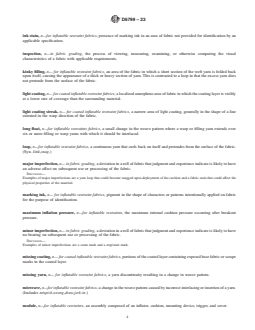
inflator, n—for inflatable restraints, a device for generating and directing expansion gases into a cushion.
D6799
...