

ASTM D6747-21
(Guide)Standard Guide for Selection of Techniques for Electrical Leak Location of Leaks in Geomembranes
General Information
- Abstract
SIGNIFICANCE AND USE
4.1 Geomembranes are used as barriers to prevent liquids from leaking from landfills, ponds, and other containments. For this purpose, it is desirable that the geomembrane have as little leakage as practical.
4.2 The liquids may contain contaminants that, if released, can cause damage to the environment. Leaking liquids can erode the subgrade, causing further damage. Leakage can result in product loss or otherwise prevent the installation from performing its intended containment purpose.
4.3 Geomembranes are often assembled in the field, either by unrolling and welding panels of the geomembrane material together in the field, unfolding flexible geomembranes in the field, or a combination of both.
4.4 Geomembrane leaks can be caused by poor quality of the subgrade, poor quality of the material placed on the geomembrane, accidents, poor workmanship, manufacturing defects, and carelessness.
4.5 Experience demonstrates that geomembranes can have leaks caused during their installation and placement of material(s) on the geomembrane.
4.6 Electrical leak location methods are an effective and proven quality assurance measure to locate leaks. Such methods have been used successfully to locate leaks in electrically insulating geomembranes such as polyethylene, polypropylene, polyvinyl chloride, chlorosulfonated polyethylene, and bituminous geomembranes installed in basins, ponds, tanks, ore and waste pads, and landfill cells.
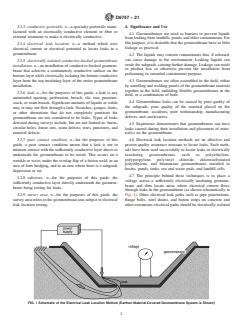
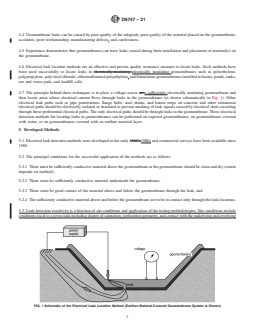
4.7 The principle behind these techniques is to place a voltage across a sufficiently electrically insulating geomembrane and then locate areas where electrical current flows through leaks in the geomembrane (as shown schematically in Fig. 1). Other electrical leak paths such as pipe penetrations, flange bolts, steel drains, and batten strips on concrete and other extraneous electrical paths should be electrically isolated or insulated to prevent masking of leak signals caused by electrical short-circuiting through those preferential el...
SCOPE
1.1 This guide is intended to assist individuals or groups in assessing different options available for locating leaks in installed geomembranes using electrical methods. For clarity, this guide uses the term “leak” to mean holes, punctures, tears, knife cuts, seam defects, cracks, and similar breaches in an installed geomembrane (as defined in 3.2.6).
1.2 This guide does not cover systems that are restricted to seam testing only, nor does it cover systems that may detect leaks non-electrically. It does not cover systems that only detect the presence, but not the location, of leaks.
1.3 (Warning—The electrical methods used for geomembrane leak location could use high voltages, resulting in the potential for electrical shock or electrocution. This hazard might be increased because operations might be conducted in or near water. In particular, a high voltage could exist between the water or earth material and earth ground, or any grounded conductor. These procedures are potentially very dangerous, and can result in personal injury or death. The electrical methods used for geomembrane leak location should be attempted only by qualified and experienced personnel. Appropriate safety measures must be taken to protect the leak location operators as well as other people at the site.)
1.4 The values stated in SI units are to be regarded as standard. No other units of measurement are included in this standard.
1.5 This standard does not purport to address all of the safety concerns, if any, associated with its use. It is the responsibility of the user of this standard to establish appropriate safety, health, and environmental practices and determine the applicability of regulatory limitations prior to use.
1.6 This international standard was developed in accordance with internationally recognized principles on standardization established in the Decision on Principles for the Development of International Standards, G...
- Status
- Published
- Publication Date
- 31-Jul-2021
- Technical Committee
- D35 - Geosynthetics
- Drafting Committee
- D35.10 - Geomembranes
Buy Documents
ASTM D6747-21 - Standard Guide for Selection of Techniques for Electrical Leak Location of Leaks in Geomembranes
REDLINE ASTM D6747-21 - Standard Guide for Selection of Techniques for Electrical Leak Location of Leaks in Geomembranes
Overview
ASTM D6747-21 is the Standard Guide for Selection of Techniques for Electrical Leak Location of Leaks in Geomembranes, published by ASTM International. This standard provides guidance on the selection and application of electrical methods for detecting leaks in geomembranes-critical barriers used in containments such as landfills, ponds, tanks, and waste pads. The objective is to help practitioners choose the most effective electrical leak location techniques to ensure geomembrane integrity, minimize environmental risks, and enhance containment reliability.
Geomembranes serve as essential liners to prevent the escape of liquids that could otherwise contaminate surrounding soil and groundwater. Leak detection is a key quality assurance practice in installations, and electrical methods have a proven track record for effective and accurate identification of breaches, including holes, punctures, tears, seam defects, and other flaws.
Key Topics
Electrical Leak Location Methods: The guide explains several field-proven electrical methods for locating leaks in geomembranes. These include:
- Water puddle method
- Water lance method
- Arc testing method
- Spark testing method
- Dipole methods for covered geomembranes
Importance of Leak Detection: Even small leaks in geomembranes can lead to significant risks, such as environmental contamination, subgrade erosion, and product loss. Leak location supports installation quality and long-term containment performance.
Selection Criteria: The guide emphasizes that the choice of leak detection technique depends on installation type (bare, water-covered, or earth-covered geomembrane), site conditions, geomembrane material, and cover materials present.
Safety Considerations: Electrical leak detection often involves high voltages and work in potentially hazardous, wet environments. The guide highlights that only qualified and experienced personnel should conduct testing, using strict safety protocols.
Definition of Leaks: For this standard, a "leak" refers to any breach such as holes, tears, punctures, seam defects, or cracks-anything that compromises the geomembrane’s barrier function.
Applications
ASTM D6747-21 is widely applicable in the following areas:
- Landfill Liners and Caps: Ensuring the integrity of geomembranes used to contain municipal, hazardous, or industrial wastes.
- Ponds and Lagoons: Leak detection in water retention or treatment basins to prevent contamination of groundwater.
- Mining Facilities: Protection of ore and waste pads from leakage of chemicals or other liquids.
- Tank Farms and Secondary Containment: Periodic leak monitoring in liquid storage facilities.
- Construction Quality Assurance: Testing geomembrane installations during or after construction to identify and repair leaks before cover materials or liquids are added.
By applying the appropriate electrical leak detection method, facility managers and contractors can proactively manage risks, adhere to regulatory requirements, and minimize costly remediation.
Related Standards
ASTM D6747-21 references several related ASTM standards that address terminology, equipment, and specific monitoring techniques, such as:
- ASTM D4439: Terminology for Geosynthetics
- ASTM D7002: Practice for Water Puddle Method on Exposed Geomembranes
- ASTM D7703: Practice for Water Lance Method on Exposed Geomembranes
- ASTM D7240: Practice for Spark Testing on Conductive-Backed Geomembranes
- ASTM D7852: Practice for Leak Location Surveys Using Conductive Geotextile
- ASTM D7953: Practice for Arc Testing on Exposed Geomembranes
- ASTM D8265: Practices for Mapping Leaks in Installed Geomembranes
These additional standards offer more detailed procedures and requirements for specific leak detection applications.
For effective geomembrane leak detection and to support responsible environmental management, ASTM D6747-21 provides essential guidance on selecting and applying the right electrical methods for your containment project.
Relations
- Effective Date
- 01-Mar-2024
- Effective Date
- 01-Feb-2024
- Effective Date
- 01-Nov-2023
- Effective Date
- 01-Jan-2020
- Effective Date
- 01-Aug-2019
- Effective Date
- 15-Apr-2018
- Effective Date
- 01-Feb-2018
- Effective Date
- 01-Aug-2017
- Effective Date
- 01-Jan-2016
- Effective Date
- 01-Sep-2015
- Effective Date
- 01-Jul-2015
- Effective Date
- 01-Jan-2015
- Effective Date
- 01-Jan-2015
- Effective Date
- 01-Jan-2015
- Effective Date
- 01-Jul-2014
Buy Documents
ASTM D6747-21 - Standard Guide for Selection of Techniques for Electrical Leak Location of Leaks in Geomembranes
REDLINE ASTM D6747-21 - Standard Guide for Selection of Techniques for Electrical Leak Location of Leaks in Geomembranes
Get Certified
Connect with accredited certification bodies for this standard

Control Union Certifications
Global certification for agriculture and sustainability.

Hohenstein Institut
Textile testing and certification.

Bureau Veritas Bangladesh
Bureau Veritas certification services in Bangladesh.
Sponsored listings
Frequently Asked Questions
ASTM D6747-21 is a guide published by ASTM International. Its full title is "Standard Guide for Selection of Techniques for Electrical Leak Location of Leaks in Geomembranes". This standard covers: SIGNIFICANCE AND USE 4.1 Geomembranes are used as barriers to prevent liquids from leaking from landfills, ponds, and other containments. For this purpose, it is desirable that the geomembrane have as little leakage as practical. 4.2 The liquids may contain contaminants that, if released, can cause damage to the environment. Leaking liquids can erode the subgrade, causing further damage. Leakage can result in product loss or otherwise prevent the installation from performing its intended containment purpose. 4.3 Geomembranes are often assembled in the field, either by unrolling and welding panels of the geomembrane material together in the field, unfolding flexible geomembranes in the field, or a combination of both. 4.4 Geomembrane leaks can be caused by poor quality of the subgrade, poor quality of the material placed on the geomembrane, accidents, poor workmanship, manufacturing defects, and carelessness. 4.5 Experience demonstrates that geomembranes can have leaks caused during their installation and placement of material(s) on the geomembrane. 4.6 Electrical leak location methods are an effective and proven quality assurance measure to locate leaks. Such methods have been used successfully to locate leaks in electrically insulating geomembranes such as polyethylene, polypropylene, polyvinyl chloride, chlorosulfonated polyethylene, and bituminous geomembranes installed in basins, ponds, tanks, ore and waste pads, and landfill cells. 4.7 The principle behind these techniques is to place a voltage across a sufficiently electrically insulating geomembrane and then locate areas where electrical current flows through leaks in the geomembrane (as shown schematically in Fig. 1). Other electrical leak paths such as pipe penetrations, flange bolts, steel drains, and batten strips on concrete and other extraneous electrical paths should be electrically isolated or insulated to prevent masking of leak signals caused by electrical short-circuiting through those preferential el... SCOPE 1.1 This guide is intended to assist individuals or groups in assessing different options available for locating leaks in installed geomembranes using electrical methods. For clarity, this guide uses the term “leak” to mean holes, punctures, tears, knife cuts, seam defects, cracks, and similar breaches in an installed geomembrane (as defined in 3.2.6). 1.2 This guide does not cover systems that are restricted to seam testing only, nor does it cover systems that may detect leaks non-electrically. It does not cover systems that only detect the presence, but not the location, of leaks. 1.3 (Warning—The electrical methods used for geomembrane leak location could use high voltages, resulting in the potential for electrical shock or electrocution. This hazard might be increased because operations might be conducted in or near water. In particular, a high voltage could exist between the water or earth material and earth ground, or any grounded conductor. These procedures are potentially very dangerous, and can result in personal injury or death. The electrical methods used for geomembrane leak location should be attempted only by qualified and experienced personnel. Appropriate safety measures must be taken to protect the leak location operators as well as other people at the site.) 1.4 The values stated in SI units are to be regarded as standard. No other units of measurement are included in this standard. 1.5 This standard does not purport to address all of the safety concerns, if any, associated with its use. It is the responsibility of the user of this standard to establish appropriate safety, health, and environmental practices and determine the applicability of regulatory limitations prior to use. 1.6 This international standard was developed in accordance with internationally recognized principles on standardization established in the Decision on Principles for the Development of International Standards, G...
SIGNIFICANCE AND USE 4.1 Geomembranes are used as barriers to prevent liquids from leaking from landfills, ponds, and other containments. For this purpose, it is desirable that the geomembrane have as little leakage as practical. 4.2 The liquids may contain contaminants that, if released, can cause damage to the environment. Leaking liquids can erode the subgrade, causing further damage. Leakage can result in product loss or otherwise prevent the installation from performing its intended containment purpose. 4.3 Geomembranes are often assembled in the field, either by unrolling and welding panels of the geomembrane material together in the field, unfolding flexible geomembranes in the field, or a combination of both. 4.4 Geomembrane leaks can be caused by poor quality of the subgrade, poor quality of the material placed on the geomembrane, accidents, poor workmanship, manufacturing defects, and carelessness. 4.5 Experience demonstrates that geomembranes can have leaks caused during their installation and placement of material(s) on the geomembrane. 4.6 Electrical leak location methods are an effective and proven quality assurance measure to locate leaks. Such methods have been used successfully to locate leaks in electrically insulating geomembranes such as polyethylene, polypropylene, polyvinyl chloride, chlorosulfonated polyethylene, and bituminous geomembranes installed in basins, ponds, tanks, ore and waste pads, and landfill cells. 4.7 The principle behind these techniques is to place a voltage across a sufficiently electrically insulating geomembrane and then locate areas where electrical current flows through leaks in the geomembrane (as shown schematically in Fig. 1). Other electrical leak paths such as pipe penetrations, flange bolts, steel drains, and batten strips on concrete and other extraneous electrical paths should be electrically isolated or insulated to prevent masking of leak signals caused by electrical short-circuiting through those preferential el... SCOPE 1.1 This guide is intended to assist individuals or groups in assessing different options available for locating leaks in installed geomembranes using electrical methods. For clarity, this guide uses the term “leak” to mean holes, punctures, tears, knife cuts, seam defects, cracks, and similar breaches in an installed geomembrane (as defined in 3.2.6). 1.2 This guide does not cover systems that are restricted to seam testing only, nor does it cover systems that may detect leaks non-electrically. It does not cover systems that only detect the presence, but not the location, of leaks. 1.3 (Warning—The electrical methods used for geomembrane leak location could use high voltages, resulting in the potential for electrical shock or electrocution. This hazard might be increased because operations might be conducted in or near water. In particular, a high voltage could exist between the water or earth material and earth ground, or any grounded conductor. These procedures are potentially very dangerous, and can result in personal injury or death. The electrical methods used for geomembrane leak location should be attempted only by qualified and experienced personnel. Appropriate safety measures must be taken to protect the leak location operators as well as other people at the site.) 1.4 The values stated in SI units are to be regarded as standard. No other units of measurement are included in this standard. 1.5 This standard does not purport to address all of the safety concerns, if any, associated with its use. It is the responsibility of the user of this standard to establish appropriate safety, health, and environmental practices and determine the applicability of regulatory limitations prior to use. 1.6 This international standard was developed in accordance with internationally recognized principles on standardization established in the Decision on Principles for the Development of International Standards, G...
ASTM D6747-21 is classified under the following ICS (International Classification for Standards) categories: 59.080.70 - Geotextiles. The ICS classification helps identify the subject area and facilitates finding related standards.
ASTM D6747-21 has the following relationships with other standards: It is inter standard links to ASTM D7007-24, ASTM D4439-24, ASTM D8265-23, ASTM D7953-20, ASTM D8265-19, ASTM D4439-18, ASTM D7240-18, ASTM D4439-17, ASTM D7007-16, ASTM D4439-15a, ASTM D4439-15, ASTM D7703-15, ASTM D7002-15, ASTM D7007-15, ASTM D7953-14. Understanding these relationships helps ensure you are using the most current and applicable version of the standard.
ASTM D6747-21 is available in PDF format for immediate download after purchase. The document can be added to your cart and obtained through the secure checkout process. Digital delivery ensures instant access to the complete standard document.
Standards Content (Sample)
This international standard was developed in accordance with internationally recognized principles on standardization established in the Decision on Principles for the
Development of International Standards, Guides and Recommendations issued by the World Trade Organization Technical Barriers to Trade (TBT) Committee.
Designation: D6747 − 21
Standard Guide for
Selection of Techniques for Electrical Leak Location of
Leaks in Geomembranes
This standard is issued under the fixed designation D6747; the number immediately following the designation indicates the year of
original adoption or, in the case of revision, the year of last revision. A number in parentheses indicates the year of last reapproval. A
superscript epsilon (´) indicates an editorial change since the last revision or reapproval.
1. Scope mendations issued by the World Trade Organization Technical
Barriers to Trade (TBT) Committee.
1.1 This guide is intended to assist individuals or groups in
assessing different options available for locating leaks in
2. Referenced Documents
installed geomembranes using electrical methods. For clarity,
this guide uses the term “leak” to mean holes, punctures, tears, 2.1 ASTM Standards:
knife cuts, seam defects, cracks, and similar breaches in an D4439 Terminology for Geosynthetics
installed geomembrane (as defined in 3.2.6). D7002 Practice for Electrical Leak Location on Exposed
Geomembranes Using the Water Puddle Method
1.2 This guide does not cover systems that are restricted to
D7007 Practices for Electrical Methods for Locating Leaks
seam testing only, nor does it cover systems that may detect
in Geomembranes Covered with Water or Earthen Mate-
leaks non-electrically. It does not cover systems that only
rials
detect the presence, but not the location, of leaks.
D7240 Practice for Electrical Leak Location Using
1.3 (Warning—The electrical methods used for geomem-
Geomembranes with an Insulating Layer in Intimate
brane leak location could use high voltages, resulting in the
Contact with a Conductive Layer via Electrical Capaci-
potential for electrical shock or electrocution. This hazard
tance Technique (Conductive-Backed Geomembrane
might be increased because operations might be conducted in
Spark Test)
or near water. In particular, a high voltage could exist between
D7703 Practice for Electrical Leak Location on Exposed
the water or earth material and earth ground, or any grounded
Geomembranes Using the Water Lance Method
conductor. These procedures are potentially very dangerous,
D7852 Practice for Use of an Electrically Conductive Geo-
and can result in personal injury or death. The electrical
textile for Leak Location Surveys
methods used for geomembrane leak location should be
D7953 Practice for Electrical Leak Location on Exposed
attempted only by qualified and experienced personnel.Appro-
Geomembranes Using the Arc Testing Method
priate safety measures must be taken to protect the leak
D8265 Practices for Electrical Methods for Mapping Leaks
location operators as well as other people at the site.)
in Installed Geomembranes
1.4 The values stated in SI units are to be regarded as
standard. No other units of measurement are included in this 3. Terminology
standard.
3.1 For general definitions used in this guide, refer to
1.5 This standard does not purport to address all of the
Terminology D4439.
safety concerns, if any, associated with its use. It is the
3.2 Definitions of Terms Specific to This Standard:
responsibility of the user of this standard to establish appro-
3.2.1 conductive-backed geomembrane, n—a specialty
priate safety, health, and environmental practices and deter-
geomembrane manufactured using the co-extrusion process
mine the applicability of regulatory limitations prior to use.
with an insulating layer in intimate contact with a conductive
1.6 This international standard was developed in accor-
layer.
dance with internationally recognized principles on standard-
3.2.2 conductive drainage geocomposite, n—a specialty
ization established in the Decision on Principles for the
drainage geocomposite manufactured with one or several
Development of International Standards, Guides and Recom-
conductive geotextiles.
This guide is under the jurisdiction ofASTM Committee D35 on Geosynthetics
and is the direct responsibility of Subcommittee D35.10 on Geomembranes. For referenced ASTM standards, visit the ASTM website, www.astm.org, or
Current edition approved Aug. 1, 2021. Published August 2021. Originally contact ASTM Customer Service at service@astm.org. For Annual Book of ASTM
approved in 2002. Last previous edition approved in 2015 as D6747 – 15. DOI: Standards volume information, refer to the standard’s Document Summary page on
10.1520/D6747-21. the ASTM website.
Copyright © ASTM International, 100 Barr Harbor Drive, PO Box C700, West Conshohocken, PA 19428-2959. United States
D6747 − 21
3.2.3 conductive geotextile, n—a specialty geotextile manu- 4. Significance and Use
factured with an electrically conductive element or fiber or
4.1 Geomembranes are used as barriers to prevent liquids
external treatment to make it electrically conductive.
fromleakingfromlandfills,ponds,andothercontainments.For
this purpose, it is desirable that the geomembrane have as little
3.2.4 electrical leak location, n—a method which uses
leakage as practical.
electrical current or electrical potential to locate leaks in a
geomembrane.
4.2 The liquids may contain contaminants that, if released,
can cause damage to the environment. Leaking liquids can
3.2.5 electrically isolated conductive-backed geomembrane
erodethesubgrade,causingfurtherdamage.Leakagecanresult
installation, n—an installation of conductive-backed geomem-
in product loss or otherwise prevent the installation from
brane that achieves a continuously conductive surface on the
performing its intended containment purpose.
bottom layer while electrically isolating the bottom conductive
layer from the top insulating layer of the entire geomembrane 4.3 Geomembranes are often assembled in the field, either
installation. by unrolling and welding panels of the geomembrane material
together in the field, unfolding flexible geomembranes in the
3.2.6 leak, n—for the purposes of this guide, a leak is any
field, or a combination of both.
unintended opening, perforation, breach, slit, tear, puncture,
4.4 Geomembrane leaks can be caused by poor quality of
crack, or seam breach. Significant amounts of liquids or solids
the subgrade, poor quality of the material placed on the
may or may not flow through a leak. Scratches, gouges, dents,
geomembrane, accidents, poor workmanship, manufacturing
or other aberrations that do not completely penetrate the
defects, and carelessness.
geomembrane are not considered to be leaks. Types of leaks
detected during surveys include, but are not limited to: burns,
4.5 Experience demonstrates that geomembranes can have
circular holes, linear cuts, seam defects, tears, punctures, and leaks caused during their installation and placement of mate-
material defects. rial(s) on the geomembrane.
3.2.7 poor contact condition, n—for the purposes of this 4.6 Electrical leak location methods are an effective and
proven quality assurance measure to locate leaks. Such meth-
guide, a poor contact condition means that a leak is not in
ods have been used successfully to locate leaks in electrically
intimate contact with the sufficiently conductive layer above or
insulating geomembranes such as polyethylene,
underneath the geomembrane to be tested. This occurs on a
polypropylene, polyvinyl chloride, chlorosulfonated
wrinkle or wave, under the overlap flap of a fusion weld, in an
polyethylene, and bituminous geomembranes installed in
area of liner bridging, and in an area where there is a subgrade
basins, ponds, tanks, ore and waste pads, and landfill cells.
depression or rut.
4.7 The principle behind these techniques is to place a
3.2.8 substrate, n—for the purposes of this guide, the
voltage across a sufficiently electrically insulating geomem-
sufficiently conductive layer directly underneath the geomem-
brane and then locate areas where electrical current flows
brane being testing for leaks.
through leaks in the geomembrane (as shown schematically in
3.2.9 survey area, n—for the purposes of this guide, the
Fig. 1). Other electrical leak paths such as pipe penetrations,
surveyareareferstothegeomembraneareasubjecttoelectrical
flange bolts, steel drains, and batten strips on concrete and
leak location testing. other extraneous electrical paths should be electrically isolated
FIG. 1 Schematic of the Electrical Leak Location Method (Earthen Material-Covered Geomembrane System is Shown)
D6747 − 21
or insulated to prevent masking of leak signals caused by 5.7 A conductive-backed geomembrane is manufactured
electrical short-circuiting through those preferential electrical using a co-extrusion process with an insulating layer in
paths. The only electrical paths should be through leaks in the intimate contact with a sufficiently conductive layer and can be
geomembrane. These electrical detection methods for locating used to overcome the substrate conductivity and hole contact
leaks in geomembranes can be performed on exposed limitations of the various leak location methods. However, if
geomembranes, on geomembranes covered with water, or on any method other than the spark testing method is to be
geomembranes covered with an earthen material layer. performed, the conductive-backed geomembrane must be in-
stalled as an electrically isolated conductive-backed geomem-
5. Developed Methods
brane.
5.1 Electrical leak detection methods were developed in the
5.8 Conductive geotextiles or conductive drainage geocom-
early 1980s and commercial surveys have been available since
posites are geosynthetics that offer on one of their faces a
1985.
conductive layer that can carry the current below the geomem-
5.2 The principal conditions for the successful application brane being tested, overcoming the substrate conductivity
limitations of the various leak location methods. The use of
of the methods are as follows:
5.2.1 There must be sufficiently conductive material above conductive geotextiles/geocomposites is detailed in Practice
D7852.
thegeomembraneorthegeomembraneshouldbecleananddry
(extent depends on method),
6. Exposed Geomembrane Methods
5.2.2 There must be sufficiently conductive material under-
neath the geomembrane,
6.1 Comparison of Methodologies:
5.2.3 There must be good contact of the material above and
6.1.1 Currently available methods include the water puddle
below the geomembrane through the leak, and
method (Practice D7002), the water lance method (Practice
5.2.4 The sufficiently conductive material above and below
D7703),thesparktestingmethod(PracticeD7240),andthearc
the geomembrane are to be in contact only through the leak
testing method (Practice D7953).
locations.
6.1.2 All of the methods listed in 6.1.1 are effective at
5.3 Leak detection sensitivity is a function of site conditions
locating leaks in exposed geomembranes. Each method has
and application of the testing methodologies. Site conditions
specific site and labor requirements, survey speeds,
include conditions local to a given leak including degree of
advantages, limitations, and cost factors. A professional spe-
saturation, perforation geometry, and contact with the under-
cializing in the electrical leak location methods can provide
lying and overlying material(s). Functionality testing for each
adviceontheadvantagesanddisadvantagesofeachmethodfor
method is performed with an actual or artificial leak of a given
a specific project and specific site conditions.Alternatives to a
circular diameter to verify that testing parameters are opti-
project’s specified method should be accepted when warranted
mized for site conditions. Functionality testing should not be
by site conditions, logistics, schedule, or economic reasons.
mistaken for leak detection sensitivity, which can only be
6.2 Asummary of the comparisons of the exposed geomem-
determined by the field application of the testing method.
brane electrical leak location methods is presented in Table 1.
5.4 The methods can be organized into two categories
6.3 The Water Puddle Method—This technique is appropri-
depending on whether the geomembrane is bare or covered
ate to survey a dry, uncovered geomembrane placed directly on
with a sufficiently conductive material. A short description of
a sufficiently conductive substrate. Practice D7002 is a stan-
each of the methods that can be applied to these geomembrane
dard practice describing the water puddle method. The sub-
conditions is presented in Sections 6 and 7.
strate is usually the subgrade soil and the upper sufficiently
5.5 Choosing which method is appropriate for a particular
conductive layer is the water in an applied puddle. One
application will depend foremost on whether the geomembrane
electrode of a low voltage power supply is placed in contact
is bare or covered with water or earth. If the geomembrane is
with the substrate and another electrode is placed in a water
bare, multiple methods are effective. Each method has different
puddle maintained by a squeegee or roller bar (as shown
features and limitations, as described in Section 6.Ifthe
schematically in Fig. 2).Water is usually supplied from a water
geomembrane is covered, the method selection will depend on
truck or other pressurized water source. For this technique to
whether the material is covered with water or earth, and
be effective in locating leaks, the water in the puddle or stream
whether the method is to be performed as part of construction
must come into contact through the leak with the electrical
or as part of a permanent leak monitoring system, as described
conducting material below the geomembrane. This completes
in Section 7.
an electrical circuit and electrical current will flow. Detector
electronics are used to monitor the electrical current. The
5.6 For geomembranes that are to be covered with earthen
materials, for a higher probability of locating all leaks, a bare detector electronics convert a change in the current into a
change in an audio tone. Functionality testing is performed
geomembrane leak survey method can be performed before
cover material is placed to locate the leaks caused during the with a 1-mm diameter actual or artificial leak.
geomembrane installation. Then after the earthen material is 6.3.1 Features—The main advantage of this method is the
placed, the dipole method (Practice D7007 or D8265) can be detection of leaks in geomembrane seams and sheets while the
used to locate any damage incurred during cover material geomembrane installation work progresses during construc-
placement. tion. The method does not require covering the geomembrane
D6747 − 21
TABLE 1 Summary of Comparisons of Exposed Geomembrane Leak Location Methods (typical)
A
Geomembrane Type Water Puddle Any nonconducting or conductive-backed geomembrane
A
Water Lance Any nonconducting or conductive-backed geomembrane
Spark Tester Conductive-backed geomembrane
A
Arc Tester Any nonconducting or conductive-backed geomembrane
Substrate Conductivity Water Puddle Must be sufficiently conductive
Water Lance Must be sufficiently conductive
Spark Tester Not relevant: spark testing used exclusively on conductive-
backed geomembrane
Arc Tester Must be sufficiently conductive
Water Source Requirement Water Puddle Required – low volume
Water Lance Required – high volume
Spark Tester Not required
Arc Tester Not required
Additional Labor Requirement for Movement of Water Puddle May be required
Water Supply Hoses
Water Lance May be required
Spark Tester Not required
Arc Tester Not required
Power Supply Water Puddle Up to 36 volts DC or AC
Water Lance Up to 36 volts DC or AC
Spark Tester 6000 to 35 000 volts DC, AC, or pulsed
Arc Tester 6000 to 35 000 volts DC, AC, or pulsed
Effectiveness on Side Slopes and Vertical Walls Water Puddle Can be effective: slightly less effective on vertical walls
Water Lance Can be effective: less effective on vertical walls
Spark Tester Effective: not dependent on contact between geomembrane
and substrate
Arc Tester Effective: less effective with separation from substrate
Setup and Calibration Time Water Puddle 1 hour
Water Lance 1 hour
Spark Tester 30 min
Arc Tester 30 min
Measurement Time Water Puddle A second or two
Water Lance A second or two
Spark Tester Instantaneous
Arc Tester Instantaneous
Operator Training Time Requirement Water Puddle 1 day
Water Lance 1 day
Spark Tester 1 hour
Arc Tester 1 hour
Typical Survey Speed (varies depending on Water Puddle 1000 m per hour per operator
equipment used)
Water Lance 900 m per hour per operator
Spark Tester 500 m per hour per operator
Arc Tester 900 m per hour per operator
Tolerance to Wet and Dirty Geomembrane Water Puddle Tolerant to slightly wet and dirty sites
Water Lance Tolerant to slightly wet and dirty sites
Spark Tester Tolerant to slightly dirty but dry sites
Arc Tester Tolerant to slightly dirty but dry sites
Effectiveness in Locating Leaks in Poor Contact Water Puddle Effective: however, depends on if water can get through leak
B B
Conditions and make contact with substrate
Water Lance Effective: however, depends on if water can get through leak
B
and make contact with substrate
Spark Tester Effective
B
Arc Tester Somewhat effective: depends on arc length
A
If used, conductive-backed geomembrane must be installed as an electrically isolated conductive-backed geomembrane installation in order to allow it to be tested using
all of the available electrical leak location methods.
B
If conductive-backed geomembrane is being tested and it has been installed as an electrically isolated conductive-backed geomembrane installation, then all methods
become effective at locating leaks in poor contact conditions.
withwaterotherthanthesmallpuddleofwater.Procedurescan any area where the substrate is not in intimate contact with the
be used to differentiate smaller leaks from larger leaks in their geomembrane, unless measures are taken to make the contact.
vicinity. The electrical survey rate of approximately 3000 m /h This technique cannot be used during rainy weather or when
per operator does not affect the installation work schedule and the membrane is installed on an electrically nonconductive
permits a rapid construction quality control of the geomem- material, typically a desiccated substrate, and in the near
brane installers’ finished work. The approximate setup time vicinity of conductive structures that cannot be fully insulated
varies from 1 to 3 h.The method requires a minimal amount of or isolated. The detection of leaks in seams of repair patches is
training to be proficient. difficult and time consuming since it requires a potential
6.3.2 Limitations—Unless a geomembrane manufactured lengthy water infiltration time. A constant water source is
with a conductive layer in intimate contact with the insulating required for the application of the water puddle. The water
geomembrane is being tested, leaks may not be detected in applied to the geomembrane must not be allowed to flow off to
poor contact situations such as at the peak of a wrinkle and in the surrounding soil. The geomembrane must be reasonably
D6747 − 21
FIG. 2 Schematic of Water Puddle Method
clean and mostly dry at the commencement of the survey. geomembrane. This completes an electrical circuit and electri-
Conductive objects such as concrete sumps, batten strips, or
cal current will flow. Detector electronics are used to monitor
metal pipes connected to the conductive layer under the
either the electrical current or the voltage between two points
geomembrane must be electrically isolated from the water
along the column of the water lance. The detector electronics
applied to the survey area and cannot be leak tested.
converts a change in the current or voltage into a change in an
audio tone. Functionality testing is performed with a 1-mm
6.4 The Water Lance Method—Thistechniqueisappropriate
diameter actual or artificial leak.
to survey a dry, uncovered geomembrane placed directly on a
sufficiently conductive substrate. Practice D7703 is a standard
6.4.1 Features—The main advantage of this method is the
practice describing the water lance method. The substrate is
detection of leaks in geomembrane seams and sheets while the
usually the subgrade soil and the upper sufficiently conductive
geomembrane installation work progresses during construc-
layer is the water in a stream of water. There are two ways to
tion. The method does not require covering the geomembrane
implementthewaterlancemethodsetup,asdetailedinPractice
with water other than the water stream. Procedures can be used
D7703. Fig. 3 shows one way to connect the power supply and
to differentiate smaller leaks from larger leaks in their vicinity.
sensor. The meter measures the voltage drop in a continuous 2
The electrical survey rate of approximately 900 m /h per
stream of water.Another implementation is the same electrical
operator does not affect the installation work schedule and
setup as that used for the water puddle method previously
permits a rapid construction quality control of the geomem-
shown in Fig. 2, except a continuous stream of water is used
brane installers’ finished work. The approximate setup time
instead of a squeegee. Water is usually supplied from a tank,
varies from 1 to 3 h. When the water lance is set up to measure
the sump or low spot of a survey area, or other pressurized
voltage potential along the water column in the water lance, it
water source. For this technique to be effective in locating
can be less susceptible to current short-circuiting, but the
leaks, the water in the stream must come into contact through
overall survey sensitivity would be less than when the lance is
the leak with the electrical conducting material below the
FIG. 3 Schematic of Water Lance Method
D6747 − 21
set up to measure current. The method requires a minimal slopes and vertical walls can be tested. The method can detect
amount of training to be proficient. pinhole leaks. The electrical survey rate of approximately
6.4.2 Limitations—Unless a conductive-backed geomem- 900 m /h per operator does not affect the installation work
brane is being tested, leaks may not be detected in poor contact schedule and permits a rapid construction quality control of the
situations such as at the peak of a wrinkle and in any area geomembrane installers’ finished work. Repairs can be per-
where the substrate is not in intimate contact with the formed immediately upon location of a leak. The setup time
geomembrane, unless measures are taken to make the contact. required is approximately 30 min. The method requires very
This technique cannot be used during rainy weather or when little training to be proficient.
the membrane is installed on an electrically nonconductive 6.5.2 Limitations—The maximum arc length for leak detec-
material, typically a desiccated substrate, and in the near tion depends on the site conditions and equipment voltage.
vicinity of conductive structures that cannot be fully insulated Unless a conductive-backed geomembrane is being tested,
or isolated. The detection of leaks in seams of repair patches is leaks will not be detected in poor contact situations such as at
difficult and time consuming since it requires a potential the peak of a wrinkle, under a seam overlap flap, and in any
lengthy water infiltration time. A constant water source is area where the substrate is not within the maximum arc length
required for the application of the water stream. The water of the geomembrane, unless effort is made to improve the
stream must be continuous to detect a leak. The water applied contact. This technique cannot be used during rain events. The
to the geomembrane must not be allowed to flow off to the geomembrane must be dry and clean (or slightly dirty).
surrounding soil. The geomembrane must be reasonably clean Conductive objects such as concrete sumps, batten strips, or
and mostly dry at the commencement of the survey. Conduc- metal pipes connected to the conductive layer under the
tive objects such as concrete sumps, batten strips, or metal geomembrane cannot be leak tested.
pipes connected to the conductive layer under the geomem-
6.6 The Spark Testing Method—Co-extrusion technology
branemustbeelectricallyisolatedfromthewaterappliedtothe
made it possible to manufacture a polyethylene geomembrane
survey area and cannot be leak tested.
that can be spark tested. Practice D7240 is a standard practice
6.5 The Arc Testing Method—This technique is appropriate for this method. The material has a thin layer of electrically
...
This document is not an ASTM standard and is intended only to provide the user of an ASTM standard an indication of what changes have been made to the previous version. Because
it may not be technically possible to adequately depict all changes accurately, ASTM recommends that users consult prior editions as appropriate. In all cases only the current version
of the standard as published by ASTM is to be considered the official document.
Designation: D6747 − 15 D6747 − 21
Standard Guide for
Selection of Techniques for Electrical Leak Location of
Leaks in Geomembranes
This standard is issued under the fixed designation D6747; the number immediately following the designation indicates the year of
original adoption or, in the case of revision, the year of last revision. A number in parentheses indicates the year of last reapproval. A
superscript epsilon (´) indicates an editorial change since the last revision or reapproval.
1. Scope
1.1 This guide is intended to assist individuals or groups in assessing different options available for locating leaks in installed
geomembranes using electrical methods. For clarity, this guide uses the term “leak” to mean holes, punctures, tears, knife cuts,
seam defects, cracks, and similar breaches in an installed geomembrane (as defined in 3.2.33.2.6).
1.2 This guide does not cover systems that are restricted to seam testing only, nor does it cover systems that may detect leaks
non-electrically. It does not cover systems that only detect the presence, but not the location, of leaks.
1.3 (Warning—The electrical methods used for geomembrane leak location could use high voltages, resulting in the potential for
electrical shock or electrocution. This hazard might be increased because operations might be conducted in or near water. In
particular, a high voltage could exist between the water or earth material and earth ground, or any grounded conductor. These
procedures are potentially very dangerous, and can result in personal injury or death. The electrical methods used for geomembrane
leak location should be attempted only by qualified and experienced personnel. Appropriate safety measures must be taken to
protect the leak location operators as well as other people at the site.)
1.4 The values stated in SI units are to be regarded as standard. No other units of measurement are included in this standard.
1.5 This standard does not purport to address all of the safety concerns, if any, associated with its use. It is the responsibility
of the user of this standard to establish appropriate safety safety, health, and healthenvironmental practices and determine the
applicability of regulatory requirementslimitations prior to use.
1.6 This international standard was developed in accordance with internationally recognized principles on standardization
established in the Decision on Principles for the Development of International Standards, Guides and Recommendations issued
by the World Trade Organization Technical Barriers to Trade (TBT) Committee.
2. Referenced Documents
2.1 ASTM Standards:
D4439 Terminology for Geosynthetics
D7002 Practice for Electrical Leak Location on Exposed Geomembranes Using the Water Puddle Method
D7007 Practices for Electrical Methods for Locating Leaks in Geomembranes Covered with Water or Earthen Materials
D7240 Practice for Electrical Leak Location Using Geomembranes with an Insulating Layer in Intimate Contact with a
Conductive Layer via Electrical Capacitance Technique (Conductive-Backed Geomembrane Spark Test)
This guide is under the jurisdiction of ASTM Committee D35 on Geosynthetics and is the direct responsibility of Subcommittee D35.10 on Geomembranes.
Current edition approved Jan. 1, 2015Aug. 1, 2021. Published January 2015August 2021. Originally approved in 2002. Last previous edition approved in 20122015 as
D6747D6747 – 15.–12. DOI: 10.1520/D6747-15.10.1520/D6747-21.
For referenced ASTM standards, visit the ASTM website, www.astm.org, or contact ASTM Customer Service at service@astm.org. For Annual Book of ASTM Standards
volume information, refer to the standard’s Document Summary page on the ASTM website.
Copyright © ASTM International, 100 Barr Harbor Drive, PO Box C700, West Conshohocken, PA 19428-2959. United States
D6747 − 21
D7703 Practice for Electrical Leak Location on Exposed Geomembranes Using the Water Lance Method
D7852 Practice for Use of an Electrically Conductive Geotextile for Leak Location Surveys
D7953 Practice for Electrical Leak Location on Exposed Geomembranes Using the Arc Testing Method
D8265 Practices for Electrical Methods for Mapping Leaks in Installed Geomembranes
3. Terminology
3.1 For general definitions used in this guide, refer to Terminology D4439.
3.2 Definitions of Terms Specific to This Standard:
3.2.1 conductive-backed geomembrane, n—a specialty geomembrane manufactured using the coextrusionco-extrusion process
with an insulating layer in intimate contact with a conductive layer.
3.2.2 conductive drainage geocomposite, n—a specialty drainage geocomposite manufactured with one or several conductive
geotextiles.
3.2.3 conductive geotextile, n—a specialty geotextile manufactured with an electrically conductive element or fiber or external
treatment to make it electrically conductive.
3.2.4 electrical leak location, n—a method which uses electrical current or electrical potential to locate leaks in a geomembrane.
3.2.5 electrically isolated conductive-backed geomembrane installation, n—an installation of conductive-backed geomembrane
that achieves a continuously conductive surface on the bottom layer while electrically isolating the bottom conductive layer from
the top insulating layer of the entire geomembrane installation.
3.2.6 leak, n—for the purposes of this guide, a leak is any unintended opening, perforation, breach, slit, tear, puncture, crack, or
seam breach. Significant amounts of liquids or solids may or may not flow through a leak. Scratches, gouges, dents, or other
aberrations that do not completely penetrate the geomembrane are not considered to be leaks. Types of leaks detected during
surveys include, but are not limited to: burns, circular holes, linear cuts, seam defects, tears, punctures, and material defects.
3.2.4 leak detection sensitivity, n—the smallest leak that the leak location equipment and survey methodology are capable of
detecting under a given set of conditions. The leak detection sensitivity specification is usually stated as a diameter of the smallest
leak that can be likely detected.
3.2.7 poor contact condition, n—for the purposes of this guide, a poor contact condition means that a leak is not in intimate contact
with the sufficiently conductive layer above or underneath the geomembrane to be tested. This occurs on a wrinkle or wave, under
the overlap flap of a fusion weld, in an area of liner bridging, and in an area where there is a subgrade depression or rut.
3.2.8 substrate, n—for the purposes of this guide, the sufficiently conductive layer directly underneath the geomembrane being
testing for leaks.
3.2.9 survey area, n—for the purposes of this guide, the survey area refers to the geomembrane area subject to electrical leak
location testing.
4. Significance and Use
4.1 Geomembranes are used as barriers to prevent liquids from leaking from landfills, ponds, and other containments. For this
purpose, it is desirable that the geomembrane have as little leakage as practical.
4.2 The liquids may contain contaminants that, if released, can cause damage to the environment. Leaking liquids can erode the
subgrade, causing further damage. Leakage can result in product loss or otherwise prevent the installation from performing its
intended containment purpose.
4.3 Geomembranes are often assembled in the field, either by unrolling and welding panels of the geomembrane material together
in the field, unfolding flexible geomembranes in the field, or a combination of both.
D6747 − 21
4.4 Geomembrane leaks can be caused by poor quality of the subgrade, poor quality of the material placed on the geomembrane,
accidents, poor workmanship, manufacturing defects, and carelessness.
4.5 Experience demonstrates that geomembranes can have leaks caused during their installation and placement of material(s) on
the geomembrane.
4.6 Electrical leak location methods are an effective and proven quality assurance measure to locate leaks. Such methods have
been used successfully to locate leaks in electrically-insulating electrically insulating geomembranes such as polyethylene,
polypropylene, polyvinyl chloride, chlorosulfonated polyethylene, and bituminous geomembranes installed in basins, ponds, tanks,
ore and waste pads, and landfill cells.
4.7 The principle behind these techniques is to place a voltage across an a sufficiently electrically insulating geomembrane and
then locate areas where electrical current flows through leaks in the geomembrane (as shown schematically in Fig. 1). Other
electrical leak paths such as pipe penetrations, flange bolts, steel drains, and batten strips on concrete and other extraneous
electrical paths should be electrically isolated or insulated to prevent masking of leak signals caused by electrical short-circuiting
through those preferential electrical paths. The only electrical paths should be through leaks in the geomembrane. These electrical
detection methods for locating leaks in geomembranes can be performed on exposed geomembranes, on geomembranes covered
with water, or on geomembranes covered with an earthen material layer.
5. Developed Methods
5.1 Electrical leak detection methods were developed in the early 1980’s1980s and commercial surveys have been available since
1985.
5.2 The principal conditions for the successful application of the methods are as follows:
5.2.1 There must be sufficiently conductive material above the geomembrane or the geomembrane should be clean and dry (extent
depends on method),
5.2.2 There must be sufficiently conductive material underneath the geomembrane,
5.2.3 There must be good contact of the material above and below the geomembrane through the leak, and
5.2.4 The sufficiently conductive material above and below the geomembrane are to be in contact only through the leak locations.
5.3 Leak detection sensitivity is a function of site conditions and application of the testing methodologies. Site conditions include
conditions local to a given leak including degree of saturation, perforation geometry, and contact with the underlying and overlying
FIG. 1 Schematic of the Electrical Leak Location Method (Earthen Material-Covered Geomembrane System is Shown)
D6747 − 21
material(s). Functionality testing for each method is performed with an actual or artificial leak of a given circular diameter to verify
that testing parameters are optimized for site conditions. Functionality testing should not be mistaken for leak detection sensitivity,
which can only be determined by the field application of the testing method.
5.4 The methods can be organized into two categories depending on whether the geomembrane is bare or covered with a
sufficiently conductive material. A short description of each of the methods that can be applied to these geomembrane conditions
is presented in Sections 6 and 76 and 7.
5.5 Choosing which method is appropriate for a particular application will depend foremost on whether the geomembrane is bare
or covered with water or earth. If the geomembrane is bare, multiple methods are effective. Each method has different features and
limitations and typical leak detection sensitivities, limitations, as described in Section 6. If the geomembrane is covered, the
method selection will depend on whether the material is covered with water or earth, and whether the method is to be performed
as part of construction or as part of a permanent leak monitoring system, as described in Section 7.
5.6 For geomembranes that are to be covered with earthen materials, for enhanced leak detection, a a higher probability of locating
all leaks, a bare geomembrane leak survey method shouldcan be performed before cover material is placed. The survey on the bare
geomembrane will detect the smaller placed to locate the leaks caused during the geomembrane installation. Then after the
earthearthen material is placed, the dipole method (Practices(Practice D7007 or D8265) can be used to locate any damage incurred
during material placement. If only the dipole method is used, the smallest leaks caused during liner installation will likely not be
detected due to the variable and generally lower sensitivity of the dipole method.cover material placement.
5.7 Conductive-backed A conductive-backed geomembrane is manufactured using a coextrusionco-extrusion process with an
insulating layer in intimate contact with a sufficiently conductive layer and can be used to overcome the subgradesubstrate
conductivity and hole contact limitations of the water puddle, water lance, arc testing, and soil-covered dipole various leak location
methods. If it is used, the geomembrane should be installed with the manufacturer’s recommended specific installation procedures
and equipment to enable electrical leak location methods. If the manufacturer’s specific recommendations are not followed, in most
cases false positive signals will be measured along the seams. In some cases, some of the methods may not work at all. For
example, the false positive signals along the seams can draw too much current away from the survey area for the dipole method
to be effective, and if the water puddle method is used, false signals from the seams can mask the signal of a hole near the
seam.However, if any method other than the spark testing method is to be performed, the conductive-backed geomembrane must
be installed as an electrically isolated conductive-backed geomembrane.
5.8 Conductive geotextiles or conductive drainage geocomposites are geosynthetics that offer on one of their faces a conductive
layer that can carry the current below the geomembrane being tested, overcoming the substrate conductivity limitations of the
various leak location methods. The use of conductive geotextiles/geocomposites is detailed in Practice D7852.
6. Exposed Geomembrane Methods
6.1 Comparison of Methodologies:
6.1.1 Currently available methods include the water puddle method (Practice D7002), the water lance method (Practice D7703),
the spark testing method (Practice D7240), and the arc testing method (Practice D7953).
6.1.2 All of the methods listed in 6.1.1 are effective at locating leaks in exposed geomembranes. Each method has specific site
and labor requirements, survey speeds, advantages, limitations, and cost factors. A professional specializing in the electrical leak
location methods can provide advice on the advantages and disadvantages of each method for a specific project. project and specific
site conditions. Alternatives to a project’s specified method should be accepted when warranted by site conditions, logistics,
schedule, or economic reasons.
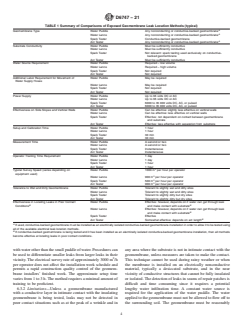
6.2 A summary of the comparisons of the exposed geomembrane electrical leak location methods is presented in Table 1.
6.3 The Water Puddle Method—This technique is appropriate to survey a dry, uncovered geomembrane placed directly on a
sufficiently conductive layer below the electrically insulating geomembrane. substrate. Practice D7002 is a standard practice
describing the water puddle method. The lower sufficiently conductive material substrate is usually the subgrade soil and the upper
sufficiently conductive layer is the water in an applied puddle. One electrode of a low voltage power supply is placed in contact
with the lower sufficiently conductive material substrate and another electrode is placed in a water puddle maintained by a squeegee
D6747 − 21
TABLE 1 Summary of Comparisons of Exposed Geomembrane Leak Location Methods (typical)
A
Geomembrane Type Water Puddle Any non-conducting or conductive-backed geomembrane
A
Geomembrane Type Water Puddle Any nonconducting or conductive-backed geomembrane
A
Water Lance Any non-conducting or conductive-backed geomembrane
A
Water Lance Any nonconducting or conductive-backed geomembrane
Spark Tester Conductive-backed geomembrane
A
Arc Tester Any non-conducting or conductive-backed geomembrane
A
Arc Tester Any nonconducting or conductive-backed geomembrane
Subgrade Conductivity Water Puddle Must be sufficiently conductive
Substrate Conductivity Water Puddle Must be sufficiently conductive
Water Lance Must be sufficiently conductive
Spark Tester Not relevant; Spark testing used exclusively on conductive-
backed geomembrane
Spark Tester Not relevant: spark testing used exclusively on conductive-
backed geomembrane
Arc Tester Must be sufficiently conductive
Water Source Requirement Water Puddle Required – low volume
Water Lance Required – high volume
Spark Tester Not required
Arc Tester Not required
Additional Labor Requirement for Movement of Water Puddle May be required
Water Supply Hoses
Water Lance May be required
Spark Tester Not required
Arc Tester Not required
Power Supply Water Puddle 12 to 36 volts DC or AC
Power Supply Water Puddle Up to 36 volts DC or AC
Water Lance 12 to 36 volts DC or AC
Water Lance Up to 36 volts DC or AC
Spark Tester 6000 to 35 000 volts DC, AC, or pulsed
Arc Tester 6000 to 35 000 volts DC, AC, or pulsed
Effectiveness on Side Slopes and Vertical Walls Water Puddle Effective: slightly less effective on vertical walls
Effectiveness on Side Slopes and Vertical Walls Water Puddle Can be effective: slightly less effective on vertical walls
Water Lance Can be effective: less effective on vertical walls
Spark Tester Effective: not dependent on contact between geomembrane
and subgrade
Spark Tester Effective: not dependent on contact between geomembrane
and substrate
Arc Tester Can be effective: project specific
Arc Tester Effective: less effective with separation from substrate
Setup and Calibration Time Water Puddle 1 hour
Water Lance 1 hour
Spark Tester 30 min
Arc Tester 30 min
Measurement Time Water Puddle A second or two
Water Lance A second or two
Spark Tester Instantaneous
Arc Tester Instantaneous
Operator Training Time Requirement Water Puddle 1 day
Water Lance 1 day
Spark Tester 1 hour
Arc Tester 1 hour
Typical Survey Speed (varies depending on Water Puddle 1000 m per hour per operator
equipment used)
Water Lance 900 m per hour per operator
Spark Tester 500 m per hour per operator
Arc Tester 900 m per hour per operator
Tolerance to Wet and Dirty Geomembrane Water Puddle Tolerant to slightly wet and dirty sites
Water Lance Tolerant to slightly wet and dirty sites
Spark Tester Tolerant to slightly dirty but dry sites
Arc Tester Tolerant to slightly dirty but dry sites
Effectiveness in Locating Leaks in Poor Contact Water Puddle Somewhat effective: depends on if water can get through leak
B B
Conditions and make contact with subgrade
Effectiveness in Locating Leaks in Poor Contact Water Puddle Effective: however, depends on if water can get through leak
B B
Conditions and make contact with substrate
Water Lance Somewhat effective: depends on if water can get through leak
B
and make contact with subgrade
Water Lance Effective: however, depends on if water can get through leak
B
and make contact with substrate
Spark Tester Effective
B
Arc Tester Somewhat effective: depends on arc length
Leak Detection Sensitivity Water Puddle Smaller than 1 mm diameter
Water Lance Smaller than 1 mm diameter
Spark Tester Smaller than 1 mm diameter
Arc Tester Smaller than 1 mm diameter
D6747 − 21
A
If used, conductive-backed geomembrane must be installed per the manufacturer’s recommendations as an electrically isolated conductive-backed geomembrane
installation in order to allow it to be tested using all of the available electrical leak location methods. In particular, there must be some means to break the conductive path
through the fusion welds along the entire lengths of the welds, the undersides of adjacent panels (and patches) should be electrically connected together, and a means
of preventing unwanted grounding at the anchor trenches or other unwanted earth grounds should be provided.
B
If conductive-backed geomembrane is being tested and it has been installed using specific installation guidelines with the intent of enabling electrical leak location
surveys, as an electrically isolated conductive-backed geomembrane installation, then all methods become effective at locating leaks in poor contact conditions.
or roller bar (as shown schematically in Fig. 2). Water is usually supplied from a tank water truck or other pressurized water source.
For this technique to be effective in locating leaks, the water in the puddle or stream must come into contact through the leak with
the electrical conducting material below the geomembrane. This completes an electrical circuit and electrical current will flow.
Detector electronics are used to monitor the electrical current. The detector electronics convert a change in the current into a change
in an audio tone. This method can typically locate leaks as small as 1 mm in diameter and smaller.Functionality testing is performed
with a 1-mm diameter actual or artificial leak.
6.3.1 Features—The main advantage of this method is the detection of leaks in geomembrane seams and sheets while the
geomembrane installation work progresses during construction. The method does not require covering the geomembrane with
water other than the small puddle of water. Procedures can be used to differentiate smaller leaks from larger leaks in their vicinity.
The electrical survey rate of approximately 10003000 m /h per operator does not affect the installation work schedule and permits
a rapid construction quality control of the geomembrane installers’ finished work. The approximate setup time varies from 1 to 3
h. The method requires a minimal amount of training to be proficient.
6.3.2 Limitations—Unless a geomembrane manufactured with a conductive layer in intimate contact with the insulating
geomembrane is being tested, leaks may not be detected in poor contact situations such as at the peak of a wrinkle and in any area
where the subgradesubstrate is not in intimate contact with the geomembrane, unless measures are taken to make the contact. This
technique cannot be used during rainy weather or when the membrane is installed on an electrically non-conductivenonconductive
material, typically a desiccated subgrade,substrate, and in the near vicinity of conductive structures that cannot be fully insulated
or isolated. The detection of leaks in seams of repair patches is difficult and time consuming since it requires a potential lengthy
water infiltration time. A constant water source is required for the application of the water puddle. The water applied to the
geomembrane must not be allowed to flow off to the surrounding soil. The geomembrane must be reasonably clean and mostly
dry at the commencement of the survey. Conductive objects such as concrete sumps, batten strips, or metal pipes connected to the
conductive layer under the geomembrane must be electrically isolated from the water applied to the survey area and cannot be leak
tested.
6.4 The Water Lance Method—This technique is appropriate to survey a dry, uncovered geomembrane placed directly on a
sufficiently conductive layer below the electrically insulating geomembrane. substrate. Practice D7703 is a standard practice
describing the water lance method. The lower sufficiently conductive material substrate is usually the subgrade soil and the upper
sufficiently conductive layer is the water in a stream of water. There are two ways to implement the water lance method set up,
setup, as detailed in Practice D7703. Fig. 3 shows one way to connect the power supply and sensor. The meter measures the voltage
drop in a continuous stream of water. Another implementation is the same electrical set up setup as that used for the water puddle
FIG. 2 Schematic of Water Puddle Method
D6747 − 21
FIG. 3 Schematic of Water Lance Method
method previously shown in Fig. 2, except a continuous stream of water is used instead of a squeegee. Water is usually supplied
from a tank, the sump or low spot of a survey area, or other pressurized water source. For this technique to be effective in locating
leaks, the water in the stream must come into contact through the leak with the electrical conducting material below the
geomembrane. This completes an electrical circuit and electrical current will flow. Detector electronics are used to monitor either
the electrical current or the voltage between two points along the column of the water lance. The detector electronics converts a
change in the current or voltage into a change in an audio tone. This method can typically locate leaks as small as 1 mm in diameter
and smaller.Functionality testing is performed with a 1-mm diameter actual or artificial leak.
6.4.1 Features—The main advantage of this method is the detection of leaks in geomembrane seams and sheets while the
geomembrane installation work progresses during construction. The method does not require covering the geomembrane with
water other than the water stream. Procedures can be used to differentiate smaller leaks from larger leaks in their vicinity. The
electrical survey rate of approximately 900 m /h per operator does not affect the installation work schedule and permits a rapid
construction quality control of the geomembrane installers’ finished work. The approximate setup time varies from 1 to 3 h. When
the water lance is set up to measure voltage potential along the water column in the water lance, it can be less susceptible to current
short-circuiting, but the overall survey sensitivity would be less than when the lance is set up to measure current. The method
requires a minimal amount of training to be proficient.
6.4.2 Limitations—Unless a geomembrane manufactured with a conductive layer in intimate contact with the insulating
geomembrane conductive-backed geomembrane is being tested, leaks may not be detected in poor contact situations such as at the
peak of a wrinkle and in any area where the subgradesubstrate is not in intimate contact with the geomembrane, unless measures
are taken to make the contact. This technique cannot be used during rainy weather or when the membrane is installed on an
electrically non-conductivenonconductive material, typically a desiccated subgrade,substrate, and in the near vicinity of conductive
structures that cannot be fully insulated or isolated. The detection of leaks in seams of repair patches is difficult and time consuming
since it requires a potential lengthy water infiltration time. A constant water source is required for the application of the water
stream. The water stream must be continuous to detect a leak. The water applied to the geomembrane must not be allowed to flow
off to the surrounding soil. The geomembrane must be reasonably clean and mostly dry at the commencement of the survey.
Conductive objects such as concrete sumps, batten strips, or metal pipes connected to the conductive layer under the geomembrane
must be electrically isolated from the water applied to the survey area and cannot be leak tested.
6.5 The Arc Testing Method—This technique is appropriate to survey a clean (or slightly dirty), dry, uncovered geomembrane
placed directly on a sufficiently conductive layer below the electrically insulating geomembrane. substrate. Practice D7953 is a
standard practice describing the arc testing method. The lower sufficiently conductive material substrate is usually the subgrade
soil. One electrode is placed in contact with the lower sufficiently conductive material or subgrade. substrate. Another electrode
is introduced above the geomembrane as an electrically conductive probe with a very high voltage power supply (as shown
schematically in Fig. 4). The test probe is swept over the upper surface to inspect for the presence of leaks. Where a leak occurs,
a closed circuit is created and an electrical arc is produced. In addition to a visual arc, the equipment has an audible and visual
alarm. Different types of test probes can be utilized with the equipment depending on the area to be tested. For example, small
probes are used in confined areas and large probes can be used on large, open areas. This method can typically locate leaks as small
as 1 mm in diameter and smaller.Functionality testing is performed with a 1-mm diameter actual or artificial leak.
6.5.1 Features—The main advantage of this technique is that the technique is not dependantdependent on the use of water. All
slopes and vertical walls can be tested. The method can detect pinhole leaks. The electrical survey rate of approximately 900
D6747 − 21
FIG. 4 Schematic of Arc Testing Method
m900 m /h per operator does not affect the installation work schedule and permits a rapid construction quality control of the
geomembrane installers’ finished work. Repairs can be performed immediately upon location of a leak. The setup time required
is approximately 30 min. The method requires very little training to be proficient.
6.5.2 Limitations—The maximum arc length for leak detection depends on the site conditions and equipment voltage. Unless a
geomembrane manufactured with a conductive layer in intimate contact with the insulating geomembrane conductive-backed
geomembrane is being tested, leaks will not be detected in poor contact situations such as at the peak of a wrinkle, under a seam
overlap flap, and in any area where the subgradesubstrate is not within the maximum arc length of the geomembrane, unless effort
is made to improve the contact. This technique cannot be used during rain events. The geomembrane must be dry and clean (or
slightly dirty). Conductive objects such as concrete sumps, batten strips, or metal pipes connected to the conductive layer under
the geomembrane cannot be leak tested.
6.6 The Spark Testing Method—CoextrusionCo-extrusion technology made it possible to manufacture a polyethylene geomem-
brane that can be spark tested. Practice D7240 is a standard practice for this method. The material has a thin layer of electrically
conductive material on one surface as an integral part of the geomembrane. This provides a way to spark test the installed
geomembrane. The conductive-backed geomembrane is installed such that the non-conductivenonconductive surface is on top. The
testing utilizes a very high voltage power supply to charge an element such as an electrically conductive neoprene pad. The
geomembrane acts as a dielectric of a capacitor that provides a low impedance through the geomembrane. Another conductive
element is then swept over the upper surface to inspect for the presence of leaks. When the probe is scanned over a leak, the high
voltage causes a spark through the leak to the co-extruded lower layer as shown in Fig. 5. To facilitate leak location, equipment
must include an audible alarm. Different types of equipment are utilized depending on the area to be tested. For example, small,
hand-heldhandheld detectors are used in confined areas and large detectors can be used on large, open areas. This method can
typically locate leaks as small as 1 mm in diameter and smaller.Functionality testing is performed with a 1-mm diameter actual
or artificial leak.
6.6.1 Features—One advantage of this technique is that the technique is not dependantdependent on the use of water. All slopes
and vertical walls can be tested. The method can detect pinhole leaks. Since the geomembrane tested is manufactured with a
conductive layer in intimate contact with the insulating geomembrane, the problems of insufficiently conductive subgradesubstrate
FIG. 5 Schematic of Spark Testing Method
D6747 − 21
and poor hole contact are eliminated. This means that the technique can locate holes on wrinkles and waves and when the
subgradesubstrate is not sufficiently conductive. It can be performed while construction is ongoing. All slopes and vertical walls
can be tested. The rate of testing depends on the type of equipment used. Using a 2-m wide brush, travelling at 3 to 5 km/h, the
rate can be up to 500 to 1500 m /h. Repairs can be performed immediately upon location of a leak. The setup time required is
approximately 30 min. The method requires very littl
...