

ASTM D476-15(2021)
(Classification)Standard Classification for Dry Pigmentary Titanium Dioxide Products
General Information
- Abstract
SIGNIFICANCE AND USE
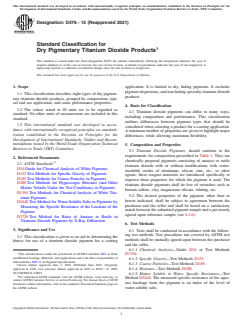
3.1 This classification is given as an aid in determining the fitness for use of a titanium dioxide pigment for a coating application. It is limited to dry, hiding pigments. It excludes pigment dispersions, and non-hiding specialty titanium dioxide products.
SCOPE
1.1 This classification describes eight types of dry pigmentary titanium dioxide products, grouped by composition, typical end use application, and some performance properties.
1.2 The values stated in SI units are to be regarded as standard. No other units of measurement are included in this standard.
1.3 This international standard was developed in accordance with internationally recognized principles on standardization established in the Decision on Principles for the Development of International Standards, Guides and Recommendations issued by the World Trade Organization Technical Barriers to Trade (TBT) Committee.
- Status
- Published
- Publication Date
- 31-May-2021
- Technical Committee
- D01 - Paint and Related Coatings, Materials, and Applications
- Drafting Committee
- D01.31 - Pigment Specifications


Overview
ASTM D476-15(2021): Standard Classification for Dry Pigmentary Titanium Dioxide Products provides essential guidance on classifying eight different types of dry pigmentary titanium dioxide (TiO₂) pigments. Developed and published by ASTM International, this standard focuses exclusively on dry, hiding pigments for coating applications and does not cover dispersions or non-hiding specialty titanium dioxide products.
The standard assists manufacturers, buyers, and formulators in determining the most suitable titanium dioxide pigment for their specific paint, coating, or related materials. Its adoption helps ensure consistent quality and performance in coatings, aligning with recognized international practices.
Key Topics
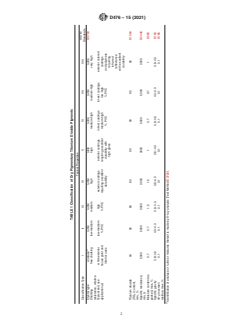
- Classification of Pigment Types: The standard defines eight distinct types of pigmentary titanium dioxide, primarily categorized by crystal structure (anatase or rutile), composition, and typical end use.
- Properties and Performance Criteria:
- Minimum TiO₂ content
- Specific gravity range
- Moisture content limitations
- Chalking resistance (important for exterior durability)
- Content of water-soluble salts
- Maximum residue on 45-micron screen
- Test Methods: References several ASTM methods used to assess chemical properties, specific gravity, moisture content, coarse particles, and composition.
- Basis for Classification: Outlines major differentiating properties to help users select the most appropriate titanium dioxide pigment based on performance and application needs.
- Agreement on Additional Properties: Stipulates that other product characteristics may be specified and agreed upon by the purchaser and seller as required.
Applications
- Paint and Coatings Industry: The principal application of this standard is in selecting pigmentary titanium dioxide for formulating paints and coatings. Depending on the required characteristics-such as exterior durability, chalking resistance, and gloss-manufacturers can choose a suitable pigment type (e.g., high gloss for interior or high-durability for exterior paints).
- Polymer Compounds: Some pigment types addressed by the standard are used in coloring or opacifying plastics and polymers, especially where exterior durability and infrared reflectance are required.
- Quality Assurance and Procurement: The classification system aids procurement professionals, formulators, and quality assurance teams in tender specifications, supplier comparison, and verification of pigment fitness for intended use.
- Industry Compliance: Aligning with ASTM D476-15(2021) supports compliance with international best practices and regulatory requirements, facilitating global trade, and enhancing product credibility.
Related Standards
- ASTM D34 - Guide for Chemical Analysis of White Pigments
- ASTM D153 - Test Methods for Specific Gravity of Pigments
- ASTM D185 - Test Methods for Coarse Particles in Pigments
- ASTM D280 - Test Methods for Hygroscopic Moisture in Pigments
- ASTM D1394 - Test Methods for Chemical Analysis of White Titanium Pigments
- ASTM D2448 - Test Method for Water-Soluble Salts in Pigments
- ASTM D3720 - Test Method for Ratio of Anatase to Rutile in Titanium Dioxide Pigments by X-Ray Diffraction
Practical Value
Adhering to ASTM D476-15(2021) ensures that paint and coating manufacturers select the proper type of titanium dioxide pigment, resulting in products with consistent color, opacity, and weather resistance. This standard also streamlines quality control, supports effective procurement, and underpins regulatory compliance in all markets where titanium dioxide pigments are used for coatings and related applications.
Keywords: ASTM D476, titanium dioxide pigment classification, rutile, anatase, paint pigment standard, pigment properties, pigment testing, coating applications, ASTM pigment standards, quality assurance in coatings
Relations
- Effective Date
- 01-Jun-2020
- Effective Date
- 01-Jun-2020
- Effective Date
- 01-Oct-2019
- Effective Date
- 01-May-2019
- Effective Date
- 01-Dec-2014
- Effective Date
- 01-Dec-2014
- Effective Date
- 01-Nov-2012
- Effective Date
- 01-Nov-2012
- Effective Date
- 01-Jun-2011
- Effective Date
- 01-Jun-2009
- Effective Date
- 01-Feb-2008
- Effective Date
- 01-Feb-2008
- Effective Date
- 01-Jul-2007
- Effective Date
- 01-Jun-2007
- Effective Date
- 01-Feb-2007
Frequently Asked Questions
ASTM D476-15(2021) is a standard published by ASTM International. Its full title is "Standard Classification for Dry Pigmentary Titanium Dioxide Products". This standard covers: SIGNIFICANCE AND USE 3.1 This classification is given as an aid in determining the fitness for use of a titanium dioxide pigment for a coating application. It is limited to dry, hiding pigments. It excludes pigment dispersions, and non-hiding specialty titanium dioxide products. SCOPE 1.1 This classification describes eight types of dry pigmentary titanium dioxide products, grouped by composition, typical end use application, and some performance properties. 1.2 The values stated in SI units are to be regarded as standard. No other units of measurement are included in this standard. 1.3 This international standard was developed in accordance with internationally recognized principles on standardization established in the Decision on Principles for the Development of International Standards, Guides and Recommendations issued by the World Trade Organization Technical Barriers to Trade (TBT) Committee.
SIGNIFICANCE AND USE 3.1 This classification is given as an aid in determining the fitness for use of a titanium dioxide pigment for a coating application. It is limited to dry, hiding pigments. It excludes pigment dispersions, and non-hiding specialty titanium dioxide products. SCOPE 1.1 This classification describes eight types of dry pigmentary titanium dioxide products, grouped by composition, typical end use application, and some performance properties. 1.2 The values stated in SI units are to be regarded as standard. No other units of measurement are included in this standard. 1.3 This international standard was developed in accordance with internationally recognized principles on standardization established in the Decision on Principles for the Development of International Standards, Guides and Recommendations issued by the World Trade Organization Technical Barriers to Trade (TBT) Committee.
ASTM D476-15(2021) is classified under the following ICS (International Classification for Standards) categories: 87.060.10 - Pigments and extenders. The ICS classification helps identify the subject area and facilitates finding related standards.
ASTM D476-15(2021) has the following relationships with other standards: It is inter standard links to ASTM D153-84(2020), ASTM D1394-76(2020), ASTM D2448-85(2019), ASTM D3720-90(2019), ASTM D153-84(2014), ASTM D34-08(2014), ASTM D280-01(2012), ASTM D2448-85(2012), ASTM D3720-90(2011), ASTM D1394-76(2009), ASTM D34-08, ASTM D153-84(2008), ASTM D185-07, ASTM D2448-85(2007), ASTM D280-01(2007). Understanding these relationships helps ensure you are using the most current and applicable version of the standard.
ASTM D476-15(2021) is available in PDF format for immediate download after purchase. The document can be added to your cart and obtained through the secure checkout process. Digital delivery ensures instant access to the complete standard document.
Standards Content (Sample)
This international standard was developed in accordance with internationally recognized principles on standardization established in the Decision on Principles for the
Development of International Standards, Guides and Recommendations issued by the World Trade Organization Technical Barriers to Trade (TBT) Committee.
Designation: D476 −15 (Reapproved 2021)
Standard Classification for
Dry Pigmentary Titanium Dioxide Products
This standard is issued under the fixed designation D476; the number immediately following the designation indicates the year of
original adoption or, in the case of revision, the year of last revision. A number in parentheses indicates the year of last reapproval. A
superscript epsilon (´) indicates an editorial change since the last revision or reapproval.
This standard has been approved for use by agencies of the U.S. Department of Defense.
1. Scope application. It is limited to dry, hiding pigments. It excludes
pigment dispersions, and non-hiding specialty titanium dioxide
1.1 This classification describes eight types of dry pigmen-
products.
tary titanium dioxide products, grouped by composition, typi-
cal end use application, and some performance properties.
4. Basis for Classification
1.2 The values stated in SI units are to be regarded as
4.1 Titanium dioxide pigments can differ in many ways,
standard. No other units of measurement are included in this
including composition and performance. This classification
standard.
outlines differences between pigment types that should be
1.3 This international standard was developed in accor-
considered when selecting a product for a coating application.
dance with internationally recognized principles on standard-
A minimum number of properties are given to highlight major
ization established in the Decision on Principles for the
differences, while allowing maximum flexibility.
Development of International Standards, Guides and Recom-
mendations issued by the World Trade Organization Technical
5. Composition and Properties
Barriers to Trade (TBT) Committee.
5.1 Titanium Dioxide Pigments, should conform to the
requirements for composition prescribed in Table 1. They are
2. Referenced Documents
chemically prepared pigments consisting of anatase or rutile
2.1 ASTM Standards:
titanium dioxide with or without modifications with water-
D34 Guide for Chemical Analysis of White Pigments
insoluble oxides of aluminum, silicon, zinc, etc., or other
D153 Test Methods for Specific Gravity of Pigments
agents; these reagent materials are introduced specifically to
D185 Test Methods for Coarse Particles in Pigments
improve those properties for which the pigment is used. The
D280 Test Methods for Hygroscopic Moisture (and Other
titanium dioxide pigments shall be free of extenders such as
Matter Volatile Under the Test Conditions) in Pigments
barium sulfate, clay, magnesium silicate, whiting, etc.
D1394 Test Methods for Chemical Analysis of White Tita-
5.2 The desired properties of the pigment, other than as
nium Pigments
herein indicated, shall be subject to agreement between the
D2448 Test Method for Water-Soluble Salts in Pigments by
purchaser and the seller and shall be based on a satisfactory
Measuring the Specific Resistance of the Leachate of the
match between the submitted pigment sample and a previously
Pigment
agreed upon reference sample (see 6.1.6).
D3720 Test Method for Ratio of Anatase to Rutile in
Titanium Dioxide Pigments by X-Ray Diffraction
6. Test Methods
3. Significance and Use
6.1 Tests shall be conducted in accordance with the follow-
ing test methods. Test procedures not covered by ASTM test
3.1 This classification is given as an aid in determining the
methods shall be mutually agreed upon between the purchaser
fitness for use of a titanium dioxide pigment for a coating
and the seller.
6.1.1 Chemical Analysis—Guide D34 or Test Methods
This classification is under the jurisdiction of ASTM Committee D01 on Paint
D1394.
and Related Coatings, Materials, andApplications and is the direct responsibility of
6.1.2 Specific Gravity—Test Methods D153.
Subcommittee D01.31 on Pigment Specifications.
6.1.3 Coarse Particles—Test Methods D185.
Current edition approved June 1, 2021. Published June 2021. Originally
6.1.4 Moisture—Test Meth
...