

ASTM D3987-12(2020)
(Practice)Standard Practice for Shake Extraction of Solid Waste with Water
General Information
- Abstract
SIGNIFICANCE AND USE
4.1 This practice is intended as a rapid means for obtaining an extract of solid waste. The extract may be used to estimate the release of constituents of the solid waste under the laboratory conditions described in this procedure.
4.2 This practice is not intended to provide an extract that is representative of the actual leachate produced from a solid waste in the field or to produce extracts to be used as the sole basis of engineering design.
4.3 This practice is not intended to simulate site-specific leaching conditions. It has not been demonstrated to simulate actual disposal site leaching conditions.
4.4 The intent of this practice is that the final pH of the extract reflects the interaction of the extractant with the buffering capacity of the solid waste.
4.5 The intent of this practice is that the water extraction simulates conditions where the solid waste is the dominant factor in determining the pH of the extract.
4.6 The practice produces an extract that is amenable to the determination of both major and minor constituents. When minor constituents are being determined, it is especially important that precautions are taken in sample storage and handling to avoid possible contamination of the samples.
4.7 The practice has not been tested for applicability to organic substances and volatile matter.
SCOPE
1.1 This practice covers a procedure for leaching of solid waste to obtain an aqueous solution to be used to determine the constituents leached under the specified testing conditions.
1.2 This practice provides for the shaking of a known mass of waste with water of specified composition and the separation of the aqueous phase for analysis.
1.3 The values stated in SI units are to be regarded as standard. Values given in parentheses are mathematical conversions to inch-pound units that are provided for information only and are not considered standard.
1.4 This standard does not purport to address all of the safety concerns, if any, associated with its use. It is the responsibility of the user of this standard to establish appropriate safety, health, and environmental practices and determine the applicability of regulatory limitations prior to use.
1.5 This international standard was developed in accordance with internationally recognized principles on standardization established in the Decision on Principles for the Development of International Standards, Guides and Recommendations issued by the World Trade Organization Technical Barriers to Trade (TBT) Committee.
- Status
- Published
- Publication Date
- 30-Apr-2020
- Technical Committee
- D34 - Waste Management
- Drafting Committee
- D34.01.04 - Waste Leaching Techniques

Overview
ASTM D3987-12(2020): Standard Practice for Shake Extraction of Solid Waste with Water is an internationally recognized method developed by ASTM International. This standard practice provides a procedure for laboratory shake extraction of solid waste samples with water, under controlled conditions, to obtain an aqueous extract. The resulting solution can be analyzed to estimate the release of constituents from solid waste materials, supporting environmental assessment, waste characterization, and regulatory compliance efforts for waste management.
Shake extraction is not intended to replicate field leaching or site-specific conditions and should not be used as the sole basis for engineering or design decisions. It is a rapid, standardized laboratory method valued for its reproducibility and utility in comparative analyses.
Key Topics
- Scope and Purpose
- Designed to obtain an extract from solid waste by shaking a known mass of waste with water of specified composition.
- Intended for rapid laboratory assessment of potential constituent release, not for simulating field or disposal site conditions.
- Final extract pH reflects the buffering capacity of the solid waste, providing informative chemical interaction data.
- Sample Preparation and Handling
- Emphasizes the importance of representative waste sampling and proper sample storage to avoid contamination or alteration.
- Prevents changes in solid waste prior to extraction by recommending immediate processing or refrigeration.
- Shake Extraction Procedure
- Specifies the use of standardized agitation equipment and water-to-solid ratios for consistency.
- Details sample mass, agitation times, separation, and filtration methods.
- Extract is analyzed for major and minor constituents, with attention to quality control for low-level contaminants.
- Limitations
- The method is not validated for organic substances or volatile matter.
- Not intended to simulate site-specific or field leaching.
Applications
- Environmental Testing and Monitoring: Laboratories use ASTM D3987-12(2020) to evaluate the potential for contaminants to leach from industrial, municipal, or construction waste under standard laboratory conditions.
- Waste Characterization: Provides data to help classify solid wastes regarding their potential environmental hazard.
- Regulatory Compliance: Supports data needs for environmental agencies, reporting, and documentation by generating reproducible extraction results.
- Product Development and Research: Useful in research for comparing leachability of different materials or treatment methods, particularly when assessing changes in waste composition.
Practical Uses:
- Estimating the leachability of hazardous or controlled constituents in solid waste for reporting and compliance.
- Comparing different waste materials, processes, or treatments based on their observed release in water extraction.
- Generating consistent, standardized data for waste assessment studies, permitting, or internal quality control.
Related Standards
- ASTM D75/D75M - Practice for Sampling Aggregates
- ASTM D420 - Guide for Site Characterization for Engineering Design and Construction Purposes
- ASTM D1193 - Specification for Reagent Water
- ASTM D2216 - Test Methods for Laboratory Determination of Water (Moisture) Content of Soil and Rock by Mass
- ASTM D3370 - Practices for Sampling Water from Flowing Process Streams
- ASTM E122 - Practice for Calculating Sample Size to Estimate, With Specified Precision, the Average for a Characteristic of a Lot or Process
- ASTM D5681 - Terminology for Waste and Waste Management
- C471M - Test Methods for Chemical Analysis of Gypsum and Gypsum Products
These related standards provide guidance for sampling, terminology, water quality, and analytical procedures referenced in ASTM D3987-12(2020).
Keywords: ASTM D3987-12, shake extraction, solid waste, water leaching, waste characterization, environmental testing, aqueous extract, laboratory extraction, regulatory compliance.
Relations
- Effective Date
- 01-May-2020
- Refers
ASTM C471M-24 - Standard Test Methods for Chemical Analysis of Gypsum and Gypsum Products (Metric) - Effective Date
- 01-Apr-2024
- Effective Date
- 01-Nov-2023
- Effective Date
- 01-Dec-2019
- Effective Date
- 01-Nov-2019
- Effective Date
- 01-Mar-2019
- Effective Date
- 01-Nov-2018
- Effective Date
- 01-Feb-2018
- Effective Date
- 15-Oct-2017
- Refers
ASTM C471M-17a - Standard Test Methods for Chemical Analysis of Gypsum and Gypsum Products (Metric) - Effective Date
- 01-Oct-2017
- Effective Date
- 01-Sep-2017
- Refers
ASTM C471M-17 - Standard Test Methods for Chemical Analysis of Gypsum and Gypsum Products (Metric) - Effective Date
- 01-Jun-2017
- Refers
ASTM C471M-17e1 - Standard Test Methods for Chemical Analysis of Gypsum and Gypsum Products (Metric) - Effective Date
- 01-Jun-2017
- Effective Date
- 01-Nov-2016
- Refers
ASTM C471M-16a - Standard Test Methods for Chemical Analysis of Gypsum and Gypsum Products (Metric) - Effective Date
- 15-Jun-2016
Get Certified
Connect with accredited certification bodies for this standard

CIS Institut d.o.o.
Personal Protective Equipment (PPE) certification body. Notified Body NB-2890 for EU Regulation 2016/425 PPE.

Kiwa BDA Testing
Building and construction product certification.
Kmetijski inštitut Slovenije
Agricultural Institute of Slovenia. Soil testing, plant health, agricultural product analysis.
Sponsored listings
Frequently Asked Questions
ASTM D3987-12(2020) is a standard published by ASTM International. Its full title is "Standard Practice for Shake Extraction of Solid Waste with Water". This standard covers: SIGNIFICANCE AND USE 4.1 This practice is intended as a rapid means for obtaining an extract of solid waste. The extract may be used to estimate the release of constituents of the solid waste under the laboratory conditions described in this procedure. 4.2 This practice is not intended to provide an extract that is representative of the actual leachate produced from a solid waste in the field or to produce extracts to be used as the sole basis of engineering design. 4.3 This practice is not intended to simulate site-specific leaching conditions. It has not been demonstrated to simulate actual disposal site leaching conditions. 4.4 The intent of this practice is that the final pH of the extract reflects the interaction of the extractant with the buffering capacity of the solid waste. 4.5 The intent of this practice is that the water extraction simulates conditions where the solid waste is the dominant factor in determining the pH of the extract. 4.6 The practice produces an extract that is amenable to the determination of both major and minor constituents. When minor constituents are being determined, it is especially important that precautions are taken in sample storage and handling to avoid possible contamination of the samples. 4.7 The practice has not been tested for applicability to organic substances and volatile matter. SCOPE 1.1 This practice covers a procedure for leaching of solid waste to obtain an aqueous solution to be used to determine the constituents leached under the specified testing conditions. 1.2 This practice provides for the shaking of a known mass of waste with water of specified composition and the separation of the aqueous phase for analysis. 1.3 The values stated in SI units are to be regarded as standard. Values given in parentheses are mathematical conversions to inch-pound units that are provided for information only and are not considered standard. 1.4 This standard does not purport to address all of the safety concerns, if any, associated with its use. It is the responsibility of the user of this standard to establish appropriate safety, health, and environmental practices and determine the applicability of regulatory limitations prior to use. 1.5 This international standard was developed in accordance with internationally recognized principles on standardization established in the Decision on Principles for the Development of International Standards, Guides and Recommendations issued by the World Trade Organization Technical Barriers to Trade (TBT) Committee.
SIGNIFICANCE AND USE 4.1 This practice is intended as a rapid means for obtaining an extract of solid waste. The extract may be used to estimate the release of constituents of the solid waste under the laboratory conditions described in this procedure. 4.2 This practice is not intended to provide an extract that is representative of the actual leachate produced from a solid waste in the field or to produce extracts to be used as the sole basis of engineering design. 4.3 This practice is not intended to simulate site-specific leaching conditions. It has not been demonstrated to simulate actual disposal site leaching conditions. 4.4 The intent of this practice is that the final pH of the extract reflects the interaction of the extractant with the buffering capacity of the solid waste. 4.5 The intent of this practice is that the water extraction simulates conditions where the solid waste is the dominant factor in determining the pH of the extract. 4.6 The practice produces an extract that is amenable to the determination of both major and minor constituents. When minor constituents are being determined, it is especially important that precautions are taken in sample storage and handling to avoid possible contamination of the samples. 4.7 The practice has not been tested for applicability to organic substances and volatile matter. SCOPE 1.1 This practice covers a procedure for leaching of solid waste to obtain an aqueous solution to be used to determine the constituents leached under the specified testing conditions. 1.2 This practice provides for the shaking of a known mass of waste with water of specified composition and the separation of the aqueous phase for analysis. 1.3 The values stated in SI units are to be regarded as standard. Values given in parentheses are mathematical conversions to inch-pound units that are provided for information only and are not considered standard. 1.4 This standard does not purport to address all of the safety concerns, if any, associated with its use. It is the responsibility of the user of this standard to establish appropriate safety, health, and environmental practices and determine the applicability of regulatory limitations prior to use. 1.5 This international standard was developed in accordance with internationally recognized principles on standardization established in the Decision on Principles for the Development of International Standards, Guides and Recommendations issued by the World Trade Organization Technical Barriers to Trade (TBT) Committee.
ASTM D3987-12(2020) is classified under the following ICS (International Classification for Standards) categories: 13.060.50 - Examination of water for chemical substances. The ICS classification helps identify the subject area and facilitates finding related standards.
ASTM D3987-12(2020) has the following relationships with other standards: It is inter standard links to ASTM D3987-12, ASTM C471M-24, ASTM D5681-23, ASTM D2234/D2234M-19, ASTM D75/D75M-19, ASTM D2216-19, ASTM D5681-18, ASTM D420-18, ASTM D2234/D2234M-17, ASTM C471M-17a, ASTM D5681-17, ASTM C471M-17, ASTM C471M-17e1, ASTM D5681-16a, ASTM C471M-16a. Understanding these relationships helps ensure you are using the most current and applicable version of the standard.
ASTM D3987-12(2020) is available in PDF format for immediate download after purchase. The document can be added to your cart and obtained through the secure checkout process. Digital delivery ensures instant access to the complete standard document.
Standards Content (Sample)
This international standard was developed in accordance with internationally recognized principles on standardization established in the Decision on Principles for the
Development of International Standards, Guides and Recommendations issued by the World Trade Organization Technical Barriers to Trade (TBT) Committee.
Designation: D3987 − 12 (Reapproved 2020)
Standard Practice for
Shake Extraction of Solid Waste with Water
This standard is issued under the fixed designation D3987; the number immediately following the designation indicates the year of
original adoption or, in the case of revision, the year of last revision. A number in parentheses indicates the year of last reapproval. A
superscript epsilon (´) indicates an editorial change since the last revision or reapproval.
1. Scope D2234/D2234M Practice for Collection of a Gross Sample
of Coal
1.1 This practice covers a procedure for leaching of solid
D3370 Practices for Sampling Water from Flowing Process
waste to obtain an aqueous solution to be used to determine the
Streams
constituents leached under the specified testing conditions.
D5681 Terminology for Waste and Waste Management
1.2 This practice provides for the shaking of a known mass
E122 Practice for Calculating Sample Size to Estimate,With
ofwastewithwaterofspecifiedcompositionandtheseparation
Specified Precision, the Average for a Characteristic of a
of the aqueous phase for analysis.
Lot or Process
1.3 The values stated in SI units are to be regarded as
3. Definitions
standard. Values given in parentheses are mathematical con-
3.1 For definitions of terms used in this practice, see
versions to inch-pound units that are provided for information
Terminology D5681.
only and are not considered standard.
1.4 This standard does not purport to address all of the
4. Significance and Use
safety concerns, if any, associated with its use. It is the
4.1 This practice is intended as a rapid means for obtaining
responsibility of the user of this standard to establish appro-
an extract of solid waste. The extract may be used to estimate
priate safety, health, and environmental practices and deter-
the release of constituents of the solid waste under the
mine the applicability of regulatory limitations prior to use.
laboratory conditions described in this procedure.
1.5 This international standard was developed in accor-
4.2 This practice is not intended to provide an extract that is
dance with internationally recognized principles on standard-
representative of the actual leachate produced from a solid
ization established in the Decision on Principles for the
waste in the field or to produce extracts to be used as the sole
Development of International Standards, Guides and Recom-
basis of engineering design.
mendations issued by the World Trade Organization Technical
Barriers to Trade (TBT) Committee. 4.3 This practice is not intended to simulate site-specific
leaching conditions. It has not been demonstrated to simulate
2. Referenced Documents
actual disposal site leaching conditions.
2.1 ASTM Standards:
4.4 The intent of this practice is that the final pH of the
C471M Test Methods for ChemicalAnalysis of Gypsum and
extract reflects the interaction of the extractant with the
Gypsum Products (Metric)
buffering capacity of the solid waste.
D75/D75M Practice for Sampling Aggregates
4.5 The intent of this practice is that the water extraction
D420 Guide for Site Characterization for Engineering De-
simulates conditions where the solid waste is the dominant
sign and Construction Purposes
factor in determining the pH of the extract.
D1193 Specification for Reagent Water
4.6 The practice produces an extract that is amenable to the
D2216 Test Methods for Laboratory Determination of Water
determination of both major and minor constituents. When
(Moisture) Content of Soil and Rock by Mass
minor constituents are being determined, it is especially
important that precautions are taken in sample storage and
handling to avoid possible contamination of the samples.
This practice is under the jurisdiction of ASTM Committee D34 on Waste
Management and is the direct responsibility of Subcommittee D34.01.04 on Waste
4.7 The practice has not been tested for applicability to
Leaching Techniques.
organic substances and volatile matter.
Current edition approved May 1, 2020. Published May 2020. Originally
approved in 1981. Last previous edition approved in 2012 as D3987 – 12. DOI:
5. Apparatus
10.1520/D3987-12R20.
For referenced ASTM standards, visit the ASTM website, www.astm.org, or
5.1 Agitation Equipment, of any type that rotates about a
contact ASTM Customer Service at service@astm.org. For Annual Book of ASTM
central axis at a rate of 29 6 2 r/min and mixes samples in an
Standards volume information, refer to the standard’s Document Summary page on
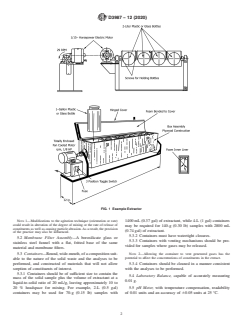
the ASTM website. end-over-end fashion (see example equipment in Fig. 1).
Copyright © ASTM International, 100 Barr Harbor Drive, PO Box C700, West Conshohocken, PA 19428-2959. United States
D3987 − 12 (2020)
FIG. 1 Example Extractor
NOTE 1—Modifications to the agitation technique (orientation or rate)
1400 mL (0.37 gal) of extractant, while 4-L (1 gal) containers
could result in alteration of the degree of mixing or the rate of release of
may be required for 140-g (0.30 lb) samples with 2800 mL
constituents as well as causing particle abrasion.As a result, the precision
(0.74 gal) of extractant.
of the practice may also be influenced.
5.3.2 Containers must have watertight closures.
5.2 Membrane Filter Assembly—A borosilicate glass or
5.3.3 Containers with venting mechanisms should be pro-
stainless steel funnel with a flat, fritted base of the same
vided for samples where gases may be released.
material and membrane filters.
NOTE 2—Allowing the container to vent generated gases has the
5.3 Containers—Round,wide-mouth,ofacompositionsuit-
potential to affect the concentrations of constituents in the extract.
able to the nature of the solid waste and the analyses to be
performed, and constructed of materials that will not allow 5.3.4 Containers should be cleaned in a manner consistent
sorption of constituents of interest.
with the analyses to be performed.
5.3.1 Containers should be of sufficient size to contain the
5.4 Laboratory Balance, capable of accurately measuring
mass of the solid sample plus the volume of extractant at a
0.01 g.
liquid-to-solid ratio of 20 mL/g, leaving approximately 10 to
20 % headspace for mixing. For example, 2-L (0.5 gal) 5.5 pH Meter, with temperature compensation, readability
containers may be used for 70-g (0.15 lb) samples with of 0.01 units and an accuracy of 60.05 units at 25 °C.
D3987 − 12 (2020)
6. Reagents 8.1.4 Lift all four corners of the sheet towards the center
and,holdingallfourcornerstogether,raisetheentiresheetinto
6.1 Purity of Reagents—Reagent-grade chemicals shall be
the air to form a pocket for the sample.
used.Unlessotherwiseindicated,itisintendedthatallreagents
8.1.5 Repeat 8.1.2.
shall conform to the specifications of the American Chemical
8.1.6 With a straightedge at least as long as the flattened
Society, where such specifications are available. Other grades
mound of sample (such as a thin-edged yard stick), gently
may be used, provided it is first ascertained that the reagent is
divide the sample into quarters. An effort should be made to
of sufficiently high purity to permit its use without lessening
avoid using pressure on the straightedge sufficient to cause
the accuracy of the determination.
damage to the particles.
6.2 Purity of Water—Unless otherwise indicated, references
8.1.7 Discard alternate quarters.
to water shall be understood to mean Type IV reagent water at
8.1.8 If further reduction of sample size is necessary, repeat
18 to 27 °C (Specification D1193). The method by which the
8.1.3 – 8.1.7.Aminimum sample size of 70 g is recommended
Type IV water is prepared, that is, distillation, ion exchange,
for each extraction.Additional samples should be provided for
reverse osmosis, electrodialysis, should remain constant
determination of solids content. If smaller samples are used in
throughout testing.
the practice, report this fact.
7. Sampling
8.2 For field-cored solid wastes or castings produced in the
laboratory, cut a representative section weighing approxi-
7.1 Obtain a representative sample of the solid waste to be
mately 70 or 140 g for testi
...