

ASTM D6604-00(2022)
(Practice)Standard Practice for Glass Transition Temperatures of Hydrocarbon Resins by Differential Scanning Calorimetry
General Information
- Abstract
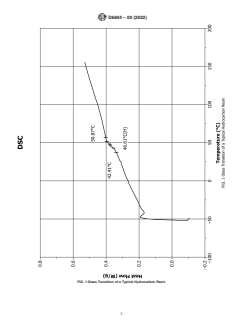
SIGNIFICANCE AND USE
5.1 Thermal analysis provides a rapid method for determining transition temperatures in HC resins that possess them.
5.2 This practice is useful for both quality assurance and research.
SCOPE
1.1 This practice covers determination of glass transition temperatures of hydrocarbon (HC) resins by differential scanning calorimetry (DSC).
1.2 This practice is applicable to HC resins as defined in Terminology D6640. The normal operating temperature range is from the cryogenic region to approximately 180 °C. The temperature range can be extended.
1.3 The values stated in SI units are to be regarded as standard. No other units of measurement are included in this standard.
1.4 Further discussion of glass transition can be found in Test Method D3418, and Test Method E1356.
1.5 This standard does not purport to address all of the safety concerns, if any, associated with its use. It is the responsibility of the user of this standard to establish appropriate safety, health, and environmental practices and determine the applicability of regulatory limitations prior to use.
1.6 This international standard was developed in accordance with internationally recognized principles on standardization established in the Decision on Principles for the Development of International Standards, Guides and Recommendations issued by the World Trade Organization Technical Barriers to Trade (TBT) Committee.
- Status
- Published
- Publication Date
- 30-Nov-2022
- Technical Committee
- D01 - Paint and Related Coatings, Materials, and Applications
- Drafting Committee
- D01.34 - Pine Chemicals and Hydrocarbon Resins

Overview
ASTM D6604-00(2022), titled Standard Practice for Glass Transition Temperatures of Hydrocarbon Resins by Differential Scanning Calorimetry, provides standardized procedures for determining the glass transition temperatures (Tg) of hydrocarbon resins using differential scanning calorimetry (DSC). Developed by ASTM International, this practice ensures a reliable and repeatable approach for both quality assurance and research applications. It guides laboratories and manufacturers in applying consistent methods to measure critical thermal properties of hydrocarbon (HC) resins, enhancing material performance analysis and quality controls.
Key Topics
- Glass Transition Temperature Measurement: Describes the determination of the glass transition temperature (Tg) of HC resins, a vital property indicating the temperature range over which a resin transitions from a brittle, glassy state to a more pliable, rubbery state.
- Differential Scanning Calorimetry (DSC): Outlines DSC as the preferred method, which measures the difference in energy input between a sample and a reference as they undergo controlled temperature changes, highlighting transitions in the resin.
- Material Compatibility: Applicable to hydrocarbon resins as referenced in ASTM D6640, within a typical temperature range from cryogenic conditions up to approximately 180 °C, although this can be extended as needed.
- Standardized Testing Conditions: Specifies the use of SI units only and includes guidance on sample preparation, selection of containers (glass tubes, metal pans), inert atmospheres (nitrogen), calibration materials (indium, benzoic acid, mercury), and temperature recording.
- Quality Assurance and Research: The practice aids in confirming batch consistency and suitability for specific applications, while also supporting research and development in resin technology.
Applications
ASTM D6604-00(2022) is widely relevant for stakeholders in:
- Polymer and Resin Manufacturing: Ensures hydrocarbon resins meet required performance criteria for coatings, adhesives, and sealants.
- Quality Control (QC) Laboratories: Provides standardized procedures to verify batch-to-batch consistency, support regulatory compliance, and resolve customer disputes regarding thermal properties.
- Research and Development: Assists scientists in characterizing new hydrocarbon resin formulations and understanding how composition impacts glass transition behavior, which in turn affects processing and end-use performance.
- Product Development and Specification: Clear determination of Tg allows for tailored resin selection for applications demanding specific thermal performance, such as in high-temperature or flexible plastic products.
- Thermal Analysis Service Providers: Testing labs use the standard to generate reliable data for clients seeking third-party validation of material properties.
Related Standards
Several other ASTM standards provide complementary or supporting procedures for the measurement and understanding of glass transition and related thermal properties:
- ASTM D3418: Test Method for Transition Temperatures and Enthalpies of Fusion and Crystallization of Polymers by Differential Scanning Calorimetry – a primary reference for determining transition temperatures in polymers.
- ASTM E1356: Test Method for Assignment of the Glass Transition Temperatures by Differential Scanning Calorimetry – offers additional discussion and evaluation strategies for identifying Tg.
- ASTM D6640: Practice for Collection and Handling of Soils Obtained in Core Barrel Samplers for Environmental Investigations – cited for resin definitions.
- ASTM E473: Terminology Relating to Thermal Analysis and Rheology – establishes consistent terminology for thermal analysis practices.
By adhering to ASTM D6604-00(2022) and its related standards, organizations benefit from internationally recognized methodology, improving quality assurance, product development, and research outcomes in the hydrocarbon resin sector.
Relations
- Effective Date
- 01-Oct-2023
- Effective Date
- 15-Aug-2014
- Effective Date
- 01-Aug-2012
- Effective Date
- 01-Aug-2012
- Effective Date
- 15-Jun-2011
- Effective Date
- 01-Apr-2011
- Effective Date
- 01-May-2010
- Effective Date
- 01-Mar-2010
- Effective Date
- 01-Aug-2009
- Effective Date
- 01-Sep-2008
- Effective Date
- 01-Sep-2008
- Effective Date
- 01-Nov-2007
- Effective Date
- 01-Jul-2007
- Effective Date
- 01-May-2007
- Effective Date
- 01-Sep-2006
Get Certified
Connect with accredited certification bodies for this standard

DIN CERTCO
DIN Group product certification.

Smithers Quality Assessments
US management systems and product certification.
Sponsored listings
Frequently Asked Questions
ASTM D6604-00(2022) is a standard published by ASTM International. Its full title is "Standard Practice for Glass Transition Temperatures of Hydrocarbon Resins by Differential Scanning Calorimetry". This standard covers: SIGNIFICANCE AND USE 5.1 Thermal analysis provides a rapid method for determining transition temperatures in HC resins that possess them. 5.2 This practice is useful for both quality assurance and research. SCOPE 1.1 This practice covers determination of glass transition temperatures of hydrocarbon (HC) resins by differential scanning calorimetry (DSC). 1.2 This practice is applicable to HC resins as defined in Terminology D6640. The normal operating temperature range is from the cryogenic region to approximately 180 °C. The temperature range can be extended. 1.3 The values stated in SI units are to be regarded as standard. No other units of measurement are included in this standard. 1.4 Further discussion of glass transition can be found in Test Method D3418, and Test Method E1356. 1.5 This standard does not purport to address all of the safety concerns, if any, associated with its use. It is the responsibility of the user of this standard to establish appropriate safety, health, and environmental practices and determine the applicability of regulatory limitations prior to use. 1.6 This international standard was developed in accordance with internationally recognized principles on standardization established in the Decision on Principles for the Development of International Standards, Guides and Recommendations issued by the World Trade Organization Technical Barriers to Trade (TBT) Committee.
SIGNIFICANCE AND USE 5.1 Thermal analysis provides a rapid method for determining transition temperatures in HC resins that possess them. 5.2 This practice is useful for both quality assurance and research. SCOPE 1.1 This practice covers determination of glass transition temperatures of hydrocarbon (HC) resins by differential scanning calorimetry (DSC). 1.2 This practice is applicable to HC resins as defined in Terminology D6640. The normal operating temperature range is from the cryogenic region to approximately 180 °C. The temperature range can be extended. 1.3 The values stated in SI units are to be regarded as standard. No other units of measurement are included in this standard. 1.4 Further discussion of glass transition can be found in Test Method D3418, and Test Method E1356. 1.5 This standard does not purport to address all of the safety concerns, if any, associated with its use. It is the responsibility of the user of this standard to establish appropriate safety, health, and environmental practices and determine the applicability of regulatory limitations prior to use. 1.6 This international standard was developed in accordance with internationally recognized principles on standardization established in the Decision on Principles for the Development of International Standards, Guides and Recommendations issued by the World Trade Organization Technical Barriers to Trade (TBT) Committee.
ASTM D6604-00(2022) is classified under the following ICS (International Classification for Standards) categories: 83.080.20 - Thermoplastic materials. The ICS classification helps identify the subject area and facilitates finding related standards.
ASTM D6604-00(2022) has the following relationships with other standards: It is inter standard links to ASTM E473-23b, ASTM E473-14, ASTM D3418-12e1, ASTM D3418-12, ASTM E473-11a, ASTM E473-11, ASTM D6640-01(2010), ASTM E473-10, ASTM E473-09, ASTM E1356-08, ASTM E473-08, ASTM E473-07b, ASTM E473-07a, ASTM E473-07, ASTM E473-06a. Understanding these relationships helps ensure you are using the most current and applicable version of the standard.
ASTM D6604-00(2022) is available in PDF format for immediate download after purchase. The document can be added to your cart and obtained through the secure checkout process. Digital delivery ensures instant access to the complete standard document.
Standards Content (Sample)
This international standard was developed in accordance with internationally recognized principles on standardization established in the Decision on Principles for the
Development of International Standards, Guides and Recommendations issued by the World Trade Organization Technical Barriers to Trade (TBT) Committee.
Designation: D6604 − 00 (Reapproved 2022)
Standard Practice for
Glass Transition Temperatures of Hydrocarbon Resins by
Differential Scanning Calorimetry
This standard is issued under the fixed designation D6604; the number immediately following the designation indicates the year of
original adoption or, in the case of revision, the year of last revision. A number in parentheses indicates the year of last reapproval. A
superscript epsilon (´) indicates an editorial change since the last revision or reapproval.
1. Scope tained in Core Barrel Samplers for Environmental Inves-
tigations
1.1 This practice covers determination of glass transition
E473 Terminology Relating to Thermal Analysis and Rhe-
temperatures of hydrocarbon (HC) resins by differential scan-
ology
ning calorimetry (DSC).
E1356 Test Method for Assignment of the Glass Transition
1.2 This practice is applicable to HC resins as defined in
Temperatures by Differential Scanning Calorimetry
Terminology D6640. The normal operating temperature range
is from the cryogenic region to approximately 180 °C. The 3. Terminology
temperature range can be extended.
3.1 Definitions:
1.3 The values stated in SI units are to be regarded as 3.1.1 differential scanning calorimetry (DSC), n—a tech-
standard. No other units of measurement are included in this nique in which the difference in energy inputs into a substance
standard. and a reference material is measured as a function of
temperature, while the substance and reference material are
1.4 Further discussion of glass transition can be found in
subjected to a controlled temperature program.
Test Method D3418, and Test Method E1356.
3.1.1.1 Discussion—The record is the DSC curve. Two
1.5 This standard does not purport to address all of the
modes, power-compensation DSC and heat-flux DSC, can be
safety concerns, if any, associated with its use. It is the
distinguished, depending on the method of measurement used.
responsibility of the user of this standard to establish appro-
3.2 For other definitions of terms relating to thermal
priate safety, health, and environmental practices and deter-
analysis, see Terminology E473.
mine the applicability of regulatory limitations prior to use.
1.6 This international standard was developed in accor-
4. Summary of Practice
dance with internationally recognized principles on standard-
4.1 This practice consists of heating or cooling the test
ization established in the Decision on Principles for the
material at a controlled rate, in a controlled atmosphere, and
Development of International Standards, Guides and Recom-
continuously monitoring with a suitable sensing device, the
mendations issued by the World Trade Organization Technical
difference in heat input between a reference material and a test
Barriers to Trade (TBT) Committee.
material due to energy changes in the material. Absorption or
release of energy marks a transition in the specimen resulting
2. Referenced Documents
in a corresponding baseline shift in the heating or cooling
2.1 ASTM Standards:
curve.
D3418 Test Method for Transition Temperatures and En-
thalpies of Fusion and Crystallization of Polymers by
5. Significance and Use
Differential Scanning Calorimetry
5.1 Thermal analysis provides a rapid method for determin-
D6640 Practice for Collection and Handling of Soils Ob-
ing transition temperatures in HC resins that possess them.
5.2 This practice is useful for both quality assurance and
This practice is under the jurisdiction of ASTM Committee D01 on Paint and research.
Related Coatings, Materials, and Applications and is the direct responsibility of
Subcommittee D01.34 on Pine Chemicals and Hydrocarbon Resins.
6. Apparatus
Current edition approved Dec. 1, 2022. Published December 2022. Originally
6.1 Differential Scanning Calorimeter—An instrument ca-
approved in 2000. Last previous edition approved in 2017 as D6604 – 00 (2017).
DOI: 10.1520/D6604-00R22.
pable of heating or cooling at rates up to 20 °C⁄min 6
For referenced ASTM standards, visit the ASTM website, www.astm.org, or
1 °C⁄min and automatically recording the difference in input
contact ASTM Customer Service at service@astm.org. For Annual Book of ASTM
between the sample and a reference material to the required
Standards volume information, refer to the standard’s Document Summary page on
the ASTM website. sensitivity and precision.
Copyright © ASTM International, 100 Barr Harbor Drive, PO Box C700, West Conshohocken, PA 19428-2959. United States
D6604 − 00 (2022)
particle size should be fairly consistent from sample to sample.
6.2 Sample Tubes or Pans—Borosilicate glass tubes are
used for certain applications and aluminum or other metal pans
10.2 Perform and record a preliminary t
...