

ASTM D5897-13(2021)
(Test Method)Standard Test Method for Determination of Percent Hydroxyl on Cellulose Esters by Potentiometric Titration-Alternative Method
General Information
- Abstract
SIGNIFICANCE AND USE
4.1 This test method provides a simpler means for the determination of the hydroxyl content of cellulose esters than the preparation and measurement of the carbanilate derivative described in Test Methods D817 and D871.
4.2 The hydroxyl content is an important indicator of solubility and reactivity.
SCOPE
1.1 This test method covers a procedure for determining the percent hydroxyl on cellulose esters by potentiometric titration. The typical range of percent hydroxyl measured is 0.7 to 10.0 %.
1.2 The values stated in SI units are to be regarded as standard. No other units of measurement are included in this standard.
1.3 This standard does not purport to address all of the safety concerns, if any, associated with its use. It is the responsibility of the user of this standard to establish appropriate safety, health, and environmental practices and determine the applicability of regulatory limitations prior to use.
1.4 This international standard was developed in accordance with internationally recognized principles on standardization established in the Decision on Principles for the Development of International Standards, Guides and Recommendations issued by the World Trade Organization Technical Barriers to Trade (TBT) Committee.
- Status
- Published
- Publication Date
- 31-May-2021
- Technical Committee
- D01 - Paint and Related Coatings, Materials, and Applications
- Drafting Committee
- D01.36 - Cellulose and Cellulose Derivatives

Overview
ASTM D5897-13(2021): Standard Test Method for Determination of Percent Hydroxyl on Cellulose Esters by Potentiometric Titration (Alternative Method) establishes a reliable procedure for determining the hydroxyl content in cellulose esters. This test method offers a simpler approach compared to traditional methods, such as those involving the preparation and measurement of carbanilate derivatives as described in ASTM D817 and ASTM D871. By utilizing potentiometric titration, this standard streamlines the process, allowing for accurate measurement of hydroxyl values typically ranging from 0.7% to 10.0%.
The percent hydroxyl is a crucial property for cellulose esters, serving as a key indicator of solubility and reactivity. The method supports process control and product quality in industries using cellulose esters, such as coatings, plastics, and textiles.
Key Topics
- Simplified Hydroxyl Determination: This standard provides an alternative to more complex derivatization procedures, reducing time and resource requirements.
- Potentiometric Titration: The use of automated titration ensures precise endpoint detection and calculation of hydroxyl content.
- Significance in Quality Control: Accurate measurement of hydroxyl content is vital for monitoring product consistency, solubility, and chemical reactivity of cellulose esters.
- Applicability Range: The method is validated for hydroxyl content from 0.7% to 10.0%, accommodating a variety of cellulose ester materials.
Applications
Adopting ASTM D5897-13(2021) is beneficial for organizations that manufacture or process cellulose esters, including:
- Coatings Industry: Ensuring optimal solubility characteristics and consistent film-forming properties.
- Plastics and Polymer Manufacturing: Monitoring hydroxyl content for improved thermal and mechanical performance.
- Textile Production: Controlling reactivity of cellulose esters for fiber and fabric modification.
- Quality Assurance Laboratories: Routine analysis of cellulose esters for production, research, and development.
- Product Development: Supporting formulation adjustments and innovation in cellulose ester-based products.
By implementing this standard, laboratories and manufacturers can maintain compliance with internationally recognized test methods, enhance product quality, and streamline analytical workflows.
Related Standards
For comprehensive quality management and extended testing capabilities, the following related ASTM standards should be considered:
- ASTM D817: Test Methods of Testing Cellulose Acetate Propionate and Cellulose Acetate Butyrate
- ASTM D871: Test Methods of Testing Cellulose Acetate
These referenced methods provide additional testing procedures and context for evaluating cellulose derivatives, complementing the simplified hydroxyl determination of ASTM D5897-13(2021).
Keywords: ASTM D5897-13(2021), percent hydroxyl, cellulose esters, potentiometric titration, quality control, solubility, reactivity, alternative method, cellulose derivative testing, laboratory standards.
Relations
- Effective Date
- 01-Dec-2019
- Effective Date
- 01-Jan-2019
- Effective Date
- 01-Nov-2012
- Effective Date
- 01-Jun-2010
- Effective Date
- 01-Jun-2010
- Effective Date
- 01-Jun-2004
- Effective Date
- 01-Jun-2004
- Effective Date
- 01-Jun-2004
- Effective Date
- 10-Nov-1996
- Effective Date
- 01-Jan-1996
Get Certified
Connect with accredited certification bodies for this standard

DIN CERTCO
DIN Group product certification.

Smithers Quality Assessments
US management systems and product certification.
Sponsored listings
Frequently Asked Questions
ASTM D5897-13(2021) is a standard published by ASTM International. Its full title is "Standard Test Method for Determination of Percent Hydroxyl on Cellulose Esters by Potentiometric Titration-Alternative Method". This standard covers: SIGNIFICANCE AND USE 4.1 This test method provides a simpler means for the determination of the hydroxyl content of cellulose esters than the preparation and measurement of the carbanilate derivative described in Test Methods D817 and D871. 4.2 The hydroxyl content is an important indicator of solubility and reactivity. SCOPE 1.1 This test method covers a procedure for determining the percent hydroxyl on cellulose esters by potentiometric titration. The typical range of percent hydroxyl measured is 0.7 to 10.0 %. 1.2 The values stated in SI units are to be regarded as standard. No other units of measurement are included in this standard. 1.3 This standard does not purport to address all of the safety concerns, if any, associated with its use. It is the responsibility of the user of this standard to establish appropriate safety, health, and environmental practices and determine the applicability of regulatory limitations prior to use. 1.4 This international standard was developed in accordance with internationally recognized principles on standardization established in the Decision on Principles for the Development of International Standards, Guides and Recommendations issued by the World Trade Organization Technical Barriers to Trade (TBT) Committee.
SIGNIFICANCE AND USE 4.1 This test method provides a simpler means for the determination of the hydroxyl content of cellulose esters than the preparation and measurement of the carbanilate derivative described in Test Methods D817 and D871. 4.2 The hydroxyl content is an important indicator of solubility and reactivity. SCOPE 1.1 This test method covers a procedure for determining the percent hydroxyl on cellulose esters by potentiometric titration. The typical range of percent hydroxyl measured is 0.7 to 10.0 %. 1.2 The values stated in SI units are to be regarded as standard. No other units of measurement are included in this standard. 1.3 This standard does not purport to address all of the safety concerns, if any, associated with its use. It is the responsibility of the user of this standard to establish appropriate safety, health, and environmental practices and determine the applicability of regulatory limitations prior to use. 1.4 This international standard was developed in accordance with internationally recognized principles on standardization established in the Decision on Principles for the Development of International Standards, Guides and Recommendations issued by the World Trade Organization Technical Barriers to Trade (TBT) Committee.
ASTM D5897-13(2021) is classified under the following ICS (International Classification for Standards) categories: 83.080.20 - Thermoplastic materials. The ICS classification helps identify the subject area and facilitates finding related standards.
ASTM D5897-13(2021) has the following relationships with other standards: It is inter standard links to ASTM D817-12(2019), ASTM D871-96(2019), ASTM D817-12, ASTM D817-96(2010), ASTM D871-96(2010), ASTM D871-96(2004), ASTM D817-96(2004), ASTM D817-96(2004)e1, ASTM D871-96, ASTM D817-96. Understanding these relationships helps ensure you are using the most current and applicable version of the standard.
ASTM D5897-13(2021) is available in PDF format for immediate download after purchase. The document can be added to your cart and obtained through the secure checkout process. Digital delivery ensures instant access to the complete standard document.
Standards Content (Sample)
This international standard was developed in accordance with internationally recognized principles on standardization established in the Decision on Principles for the
Development of International Standards, Guides and Recommendations issued by the World Trade Organization Technical Barriers to Trade (TBT) Committee.
Designation: D5897 − 13 (Reapproved 2021)
Standard Test Method for
Determination of Percent Hydroxyl on Cellulose Esters by
Potentiometric Titration—Alternative Method
This standard is issued under the fixed designation D5897; the number immediately following the designation indicates the year of
original adoption or, in the case of revision, the year of last revision. A number in parentheses indicates the year of last reapproval. A
superscript epsilon (´) indicates an editorial change since the last revision or reapproval.
1. Scope titrator dispenses the titrant, potentiometrically determines the
endpoint, and calculates the percent hydroxyl on the cellulose
1.1 This test method covers a procedure for determining the
ester based on a blank determination.
percenthydroxyloncelluloseestersbypotentiometrictitration.
The typical range of percent hydroxyl measured is 0.7 to
4. Significance and Use
10.0 %.
4.1 This test method provides a simpler means for the
1.2 The values stated in SI units are to be regarded as
determination of the hydroxyl content of cellulose esters than
standard. No other units of measurement are included in this
the preparation and measurement of the carbanilate derivative
standard.
described in Test Methods D817 and D871.
1.3 This standard does not purport to address all of the
4.2 The hydroxyl content is an important indicator of
safety concerns, if any, associated with its use. It is the
solubility and reactivity.
responsibility of the user of this standard to establish appro-
priate safety, health, and environmental practices and deter-
5. Interferences
mine the applicability of regulatory limitations prior to use.
1.4 This international standard was developed in accor-
5.1 Undissolved ester may accumulate on the sides of the
dance with internationally recognized principles on standard-
flask and on top of the stirring-star during dissolution, leading
ization established in the Decision on Principles for the
to low results. Gently swirling the solution during titration can
Development of International Standards, Guides and Recom-
reduce this problem.
mendations issued by the World Trade Organization Technical
5.2 The ground glass joints of the flask and the air con-
Barriers to Trade (TBT) Committee.
denser must always be rinsed into the flask with hydrolyzing
solutionatthepointofhydrolysisandbeforetitration.Thiswill
2. Referenced Documents
prevent erroneous results from material that may have refluxed
2.1 ASTM Standards:
into the joint.
D817 Test Methods of Testing CelluloseAcetate Propionate
and Cellulose Acetate Butyrate
6. Apparatus
D871 Test Methods of Testing Cellulose Acetate
6.1 Titrator, equipped with Glass Electrode.
3. Summary of Test Method
6.2 Heating/Stirring Module, six-place.
3.1 The cellulose ester is dissolved in pyridine and the
6.3 Heating/Stirring Block, cut from polished-finish alumi-
hydroxyl sites on the cellulose ester are acetylated with acetic
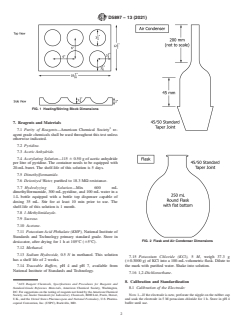
num block to fit stirrer in 6.2 (see Fig. 1 for dimensions).
anhydride in the presence of basic catalyst, 1-methylimidazole.
6.4 Stirrer, six place.
The excess acetic anhydride is hydrolyzed and the resulting
6.5 Magnetic Stirrers, size 25 mm and 50 mm.
acetic acid is titrated with sodium hydroxide. An automatic
6.6 Stirring Bar.
This test method is under the jurisdiction of ASTM Committee D01 on Paint 6.7 Flask and Air Condenser, (see Fig. 2 for dimensions).
and Related Coatings, Materials, andApplications and is the direct responsibility of
6.8 Bottle-Top Dispensers, capable of dispensing 20 mL, 35
Subcommittee D01.36 on Cellulose and Cellulose Derivatives.
Current edition approved June 1, 2021. Published June 2021. Originally mL, and 50 mL, or equivalent.
approved in 1996. Last previous edition approved in 2013 as D5897 – 13. DOI:
6.9 Analytical Balance, capable of weighing 250 g to the
10.1520/D5897-13R21.
For referenced ASTM standards, visit the ASTM website, www.astm.org, or fourth decimal place.
contact ASTM Customer Service at service@astm.org. For Annual Book of ASTM
6.10 Analytical Balance, capable of weighing 1000 g to the
Standards volume information, refer to the standard’s Document Summary page on
the ASTM website. second decimal place.
Copyright © ASTM International, 100 Barr Harbor Drive, PO Box C700, West Conshohocken, PA 19428-2959. United States
D5897 − 13 (2021)
FIG. 1 Heating/Stirring Block Dimensions
7. Reagents and Materials
7.1 Purity of Reagents—American Chemical Society re-
agent grade chemicals shall be used throughout this test unless
otherwise indicated.
7.2 Pyridine.
7.3 Acetic Anhydride.
7.4 Acetylating Solution—115 6 0.50 g of acetic anhydride
per litre of pyridine. The container needs to be equipped with
20-mL buret. The shelf-life of this solution is 5 days.
7.5 Dimethylformamide.
7.6 Deionized Water, purified to 18.3 MΩ resistance.
7.7 Hydrolyzing Solution—Mix 600 mL
dimethylformamide, 300 mL pyridine, and 100 mL water in a
1-L bottle equipped with a bottle top dispenser capable of
dosing 35 mL. Stir for at least 10 min prior to use. The
shelf-life of this solution is 1 month.
7.8 1-Methylimidazole.
7.9 Sucrose.
7.10 Acetone.
7.11 Potassium Acid Phthalate (KHP), National Institute of
Standards and Technology primary standard grade. Store in
FIG. 2 Flask and Air Condenser Dimensions
desiccator, after drying for1hat 105°C (65°C).
7.12 Methanol.
7.13 Sodium Hydroxide, 0.5 N in methanol. This solution
7.15 Potassium Chloride (KCl), 5 M, weigh 37.3 g
has a shelf life of 2 weeks.
(60.3000 g) of KCl into a 100-mL volumetric flask. Dilute to
7.14 Traceable Buffers, pH 4 and pH 7, available from
the mark with purified water. Shake into solution.
National Institute of Standards and Technology.
7.16 1,2-Dichloroethane.
8. Calibration and Standardization
ACS Reagent Chemicals, Specifications and Procedures for Reagents and
Standard-Grade Reference Materials, American Chemical Society, Washington,
8.1 Calibration of the Electrode:
DC. For suggestions on the testing of reagents not listed by theAmerican Chemical
NOTE 1—If the electrode is new, perforate the nipple on the rubber cap
Society, see Analar Standards for Laboratory Chemicals, BDH Ltd., Poole, Dorset,
U.K., and the United States Pharmacopeia and National Formulary, U.S. Pharma- and soak the electrode in 5 M potassium chloride for 1 h. Store in pH 4
copeial Convention, Inc. (USPC), Rockville, MD. buffer until use.
D5897 − 13 (2021)
8.1.1 Select from the titrator menu the procedure for cali- 9.2.1 Dispense1.0mL1-methylimidazoleand20mLacety-
bration of the electrode. lating solution into the flask containing a spin-type stirring bar.
Set the flask into a heating block at 115 6 5°C.
8.1.2 Add about 50 mL of pH 4 buffer into a titration cup
and lower the electrode into it.
9.2.2 Weigh 0.25 g 6 0.0100
...