

ASTM F3566-22
(Specification)Standard Performance Specifications and Test Methods for Walk-Through Metal Detectors Used in Safety and Security
General Information
- Abstract
SCOPE
1.1 This standard applies to all walk-through metal detectors that are used to find metal contraband concealed or hidden on people.
1.2 This standard describes baseline acceptable technical performance requirements, which includes metal object detection performance, safety (electrical, mechanical, fire), electromagnetic compatibility, environmental conditions and ranges, and mechanical durability. The requirements for metal detection performance are unique and, therefore, test methods for these parameters are provided, including the design of test objects. An agency or organization using this standard is encouraged to add their unique operationally-based requirements to those requirements listed in this baseline technical performance standard.
Note 1: For ease of use, steps of test procedures in this standard are indicated by numbered lists.
1.3 This standard describes the use of threat object exemplars, instead of actual threat objects, to test the detection performance of walk-through metal detectors.
1.4 The values stated in SI units are to be regarded as standard. No other units of measurement are included in this standard.
1.5 This standard does not purport to address all of the safety concerns, if any, associated with its use. It is the responsibility of the user of this standard to establish appropriate safety, health, and environmental practices and determine the applicability of regulatory limitations prior to use.
1.6 This international standard was developed in accordance with internationally recognized principles on standardization established in the Decision on Principles for the Development of International Standards, Guides and Recommendations issued by the World Trade Organization Technical Barriers to Trade (TBT) Committee.
- Status
- Published
- Publication Date
- 31-Oct-2022
- Technical Committee
- F12 - Security Systems and Equipment
- Drafting Committee
- F12.60 - Controlled Access Security, Search, and Screening Equipment
Overview
ASTM F3566-22: Standard Performance Specifications and Test Methods for Walk-Through Metal Detectors Used in Safety and Security establishes the technical baseline for evaluating walk-through metal detectors (WTMDs) utilized to detect concealed or hidden metal contraband on individuals in safety and security settings. Developed by ASTM, this international standard defines performance criteria, safety and electromagnetic compatibility requirements, environmental tolerances, and mechanical durability for WTMDs. Designed for global applicability, the standard allows agencies and organizations to supplement these requirements with operationally specific needs for a robust and versatile security solution.
Key Topics
- Metal Detection Performance: Establishes minimum acceptable detection rates and false alarm probabilities across defined threat object size classes, ensuring high-confidence detection of both ferromagnetic and nonferromagnetic items.
- Safety Specifications: Includes requirements for electrical, mechanical, fire, and human exposure safety, referencing international standards like IEC 61010-1 and ICNIRP guidelines.
- Test Methods & Object Exemplars: Specifies repeatable test procedures (numerically listed for clarity), using exemplars representing threat items rather than actual hazardous objects.
- Environmental Conditions: Sets out environmental operating and storage parameters, including temperature, humidity, ingress protection (IP codes), and mechanical shock-addressing both indoor and outdoor use cases.
- Electromagnetic Compatibility: Ensures WTMDs meet EMC standards for emissions and immunity, reducing interference with other electronic equipment and resilience in diverse electromagnetic environments.
- Functional & Operational Requirements: Addresses requirements for alarms (audible and visual), power backup, communication interface, and operational readiness.
- Measurement & Calibration: Requires use of certified laboratories and measurement systems in accordance with ISO/IEC standards for calibration and traceability.
- Accessibility & Design: Includes minimum portal dimensions for accessibility and compliance with regulations such as the American Disabilities Act.
Applications
Walk-through metal detectors standardized under ASTM F3566-22 are widely deployed for screening people for weapons and metal contraband in various sectors, including:
- Airports, transit hubs, and transport facilities: Enhancing security by screening large crowds quickly and reliably.
- Government buildings and courthouses: Preventing unauthorized entry of weapons and protecting staff and visitors.
- Schools and educational campuses: Addressing safety concerns while accommodating high throughput.
- Sports arenas and event venues: Ensuring public safety during mass gatherings.
- Correctional institutions: Detecting small, concealable metallic contraband items entering secured areas.
- Commercial buildings and critical infrastructure: Strengthening asset and personnel protection.
Organizations using walk-through metal detectors can reference this standard to specify procurement criteria, verify performance during acceptance testing, and support ongoing maintenance and compliance checks. The adaptability of ASTM F3566-22 empowers users to align security screening technology with specific risk profiles and operational contexts.
Related Standards
ASTM F3566-22 references and aligns with multiple international and national standards to ensure comprehensive performance and interoperability, including:
- IEC 61010-1: Safety for electrical equipment
- IEC 60529: Degrees of protection (IP Code)
- ISO/IEC 17025: Competence of testing and calibration laboratories
- IEC 61000 Series: Electromagnetic compatibility (EMC) requirements
- MIL-STD-810H: Environmental engineering for high/low temperature, shock, and humidity
- ICNIRP Guidelines: Human exposure to electromagnetic fields
- ISO 10012: Measurement management systems
- ANSI/NEMA WD 6: Wiring devices dimensional specifications
Adherence to this standard and referencing related documents facilitates regulatory compliance, ensures interoperability, and upholds the effectiveness of walk-through metal detectors in global safety and security operations.
Get Certified
Connect with accredited certification bodies for this standard

CIS Institut d.o.o.
Personal Protective Equipment (PPE) certification body. Notified Body NB-2890 for EU Regulation 2016/425 PPE.

Kiwa BDA Testing
Building and construction product certification.
Kmetijski inštitut Slovenije
Agricultural Institute of Slovenia. Soil testing, plant health, agricultural product analysis.
Sponsored listings
Frequently Asked Questions
ASTM F3566-22 is a technical specification published by ASTM International. Its full title is "Standard Performance Specifications and Test Methods for Walk-Through Metal Detectors Used in Safety and Security". This standard covers: SCOPE 1.1 This standard applies to all walk-through metal detectors that are used to find metal contraband concealed or hidden on people. 1.2 This standard describes baseline acceptable technical performance requirements, which includes metal object detection performance, safety (electrical, mechanical, fire), electromagnetic compatibility, environmental conditions and ranges, and mechanical durability. The requirements for metal detection performance are unique and, therefore, test methods for these parameters are provided, including the design of test objects. An agency or organization using this standard is encouraged to add their unique operationally-based requirements to those requirements listed in this baseline technical performance standard. Note 1: For ease of use, steps of test procedures in this standard are indicated by numbered lists. 1.3 This standard describes the use of threat object exemplars, instead of actual threat objects, to test the detection performance of walk-through metal detectors. 1.4 The values stated in SI units are to be regarded as standard. No other units of measurement are included in this standard. 1.5 This standard does not purport to address all of the safety concerns, if any, associated with its use. It is the responsibility of the user of this standard to establish appropriate safety, health, and environmental practices and determine the applicability of regulatory limitations prior to use. 1.6 This international standard was developed in accordance with internationally recognized principles on standardization established in the Decision on Principles for the Development of International Standards, Guides and Recommendations issued by the World Trade Organization Technical Barriers to Trade (TBT) Committee.
SCOPE 1.1 This standard applies to all walk-through metal detectors that are used to find metal contraband concealed or hidden on people. 1.2 This standard describes baseline acceptable technical performance requirements, which includes metal object detection performance, safety (electrical, mechanical, fire), electromagnetic compatibility, environmental conditions and ranges, and mechanical durability. The requirements for metal detection performance are unique and, therefore, test methods for these parameters are provided, including the design of test objects. An agency or organization using this standard is encouraged to add their unique operationally-based requirements to those requirements listed in this baseline technical performance standard. Note 1: For ease of use, steps of test procedures in this standard are indicated by numbered lists. 1.3 This standard describes the use of threat object exemplars, instead of actual threat objects, to test the detection performance of walk-through metal detectors. 1.4 The values stated in SI units are to be regarded as standard. No other units of measurement are included in this standard. 1.5 This standard does not purport to address all of the safety concerns, if any, associated with its use. It is the responsibility of the user of this standard to establish appropriate safety, health, and environmental practices and determine the applicability of regulatory limitations prior to use. 1.6 This international standard was developed in accordance with internationally recognized principles on standardization established in the Decision on Principles for the Development of International Standards, Guides and Recommendations issued by the World Trade Organization Technical Barriers to Trade (TBT) Committee.
ASTM F3566-22 is classified under the following ICS (International Classification for Standards) categories: 13.310 - Protection against crime. The ICS classification helps identify the subject area and facilitates finding related standards.
ASTM F3566-22 is available in PDF format for immediate download after purchase. The document can be added to your cart and obtained through the secure checkout process. Digital delivery ensures instant access to the complete standard document.
Standards Content (Sample)
This international standard was developed in accordance with internationally recognized principles on standardization established in the Decision on Principles for the
Development of International Standards, Guides and Recommendations issued by the World Trade Organization Technical Barriers to Trade (TBT) Committee.
Designation:F3566 −22
Standard Performance Specifications and Test Methods for
Walk-Through Metal Detectors Used in Safety and Security
This standard is issued under the fixed designation F3566; the number immediately following the designation indicates the year of
original adoption or, in the case of revision, the year of last revision.Anumber in parentheses indicates the year of last reapproval.A
superscript epsilon (´) indicates an editorial change since the last revision or reapproval.
1. Scope 2. Referenced Documents
1.1 This standard applies to all walk-through metal detec-
2.1 ANSI Standards:
tors that are used to find metal contraband concealed or hidden ANSIS1.4Part1:R19EditionSoundLevelMeters-Part1:
on people.
Specifications
ANSI/NEMAWD 6American National Standards Institute/
1.2 This standard describes baseline acceptable technical
National Electrical Manufacturing Association, Wiring
performance requirements, which includes metal object detec-
Devices - Dimensional Specifications
tion performance, safety (electrical, mechanical, fire), electro-
2.2 CIE Standards:
magnetic compatibility, environmental conditions and ranges,
ISO/CIE 23539Photometry — The CIE System of Physical
and mechanical durability. The requirements for metal detec-
Photometry
tion performance are unique and, therefore, test methods for
2.3 IEC Standards:
these parameters are provided, including the design of test
CISPR 16-2-1 + AMD1Specification for radio disturbance
objects. An agency or organization using this standard is
and immunity measuring apparatus and methods - Part
encouraged to add their unique operationally-based require-
2-1: Methods of measurement of disturbances and immu-
ments to those requirements listed in this baseline technical
nity - Conducted disturbance measurements
performance standard.
CISPR16-2-3Specificationforradiodisturbanceandimmu-
NOTE 1—For ease of use, steps of test procedures in this standard are
nitymeasuringapparatusandmethods-Part2-3:Methods
indicated by numbered lists.
of measurement of disturbances and immunity - Radiated
1.3 This standard describes the use of threat object disturbance measurements
exemplars, instead of actual threat objects, to test the detection
IEC 60068-2-27Basic Environmental Testing Procedures,
performance of walk-through metal detectors. Part 2-27: Tests – Test Ea and guidance: Shock
IEC 60068-2-30Environmental Testing, Part 2-30: Tests –
1.4 The values stated in SI units are to be regarded as
Test Db: Damp heat, cyclic (12h+12h cycle)
standard. No other units of measurement are included in this
IEC 60529 Ed 2Degrees of Protection Provided by Enclo-
standard.
sures (IP Code)
1.5 This standard does not purport to address all of the IEC 61000-4-2Electromagnetic compatibility (EMC) - Part
safety concerns, if any, associated with its use. It is the
4-2: Testing and measurement techniques - Electrostatic
responsibility of the user of this standard to establish appro- discharge immunity test
priate safety, health, and environmental practices and deter-
IEC 61000-4-3Electromagnetic compatibility (EMC) - Part
mine the applicability of regulatory limitations prior to use. 4-3: Testing and measurement techniques - Radiated,
radio-frequency, electromagnetic field immunity test
1.6 This international standard was developed in accor-
IEC 61000-4-4Electromagnetic compatibility (EMC) - Part
dance with internationally recognized principles on standard-
4-4: Testing and measurement techniques - Electrical fast
ization established in the Decision on Principles for the
transient/burst immunity test
Development of International Standards, Guides and Recom-
IEC61000-4-5Ed3.1Electromagneticcompatibility(EMC)
mendations issued by the World Trade Organization Technical
Barriers to Trade (TBT) Committee.
Available fromAmerican National Standards Institute (ANSI), 25 W. 43rd St.,
4th Floor, New York, NY 10036, http://www.ansi.org.
1 3
These performance specifications are under the jurisdiction ofASTM Commit- AvailablefromU.S.NationalCommitteeoftheCIE(InternationalCommission
tee F12 on Security Systems and Equipment and are the direct responsibility of on Illumination), C/o Alan Laird Lewis, 282 E. Riding, Carlisle, MA 01741,
Subcommittee F12.60 on Controlled Access Security, Search, and Screening http://www.cie-usnc.org.
Equipment. Available from International Electrotechnical Commission (IEC), 3, rue de
Current edition approved Nov. 1, 2022. Published December 2022. DOI: Varemb, 1st floor, P.O. Box 131, CH-1211, Geneva 20, Switzerland, https://
10.1520/F3566-22 www.iec.ch.
Copyright © ASTM International, 100 Barr Harbor Drive, PO Box C700, West Conshohocken, PA 19428-2959. United States
F3566−22
- Part 4-5: Testing and measurement techniques - Surge ISO 14708-6Implants for surgery — Active implantable
immunity test medical devices — Part 6: Particular requirements for
IEC 61000-4-6Electromagnetic compatibility (EMC) - Part active implantable medical devices intended to treat tach-
4-6: Testing and measurement techniques - Immunity to yarrhythmia (including implantable defibrillators)
conducteddisturbances,inducedbyradio-frequencyfields ISO 14708-7Implants for surgery — Active implantable
IEC 61000-4-8Electromagnetic compatibility (EMC) - Part medical devices — Part 7: Particular requirements for
4-8: Testing and measurement techniques - Power fre- cochlear implant system
quency magnetic field immunity test ISO 17025General Requirements for the Competence of
IEC61000-4-11Electromagneticcompatibility(EMC)-Part Testing and Calibration Laboratories
4-11: Testing and measurement techniques - Voltage dips, 2.6 Military Standards:
short interruptions and voltage variations immunity tests
MIL–STD–810H: Method 501.7Military Standard, Test
IEC 61000-6-1Electromagnetic compatibility - Generic Im- Method Standard for Environmental Engineering Consid-
munity Standard, Part 1: Residential, Commercial, and
erations and Laboratory Tests, Method 501.7, High Tem-
Light Industry perature
IEC 61000-6-3Electromagnetic compatibility - Generic
MIL–STD–810H: Method 502.7Military Standard, Test
Emission - Emission Standard for Residential,
Method Standard for Environmental Engineering Consid-
Commercial, and Light-Industrial Environments
erations and Laboratory Tests, Method 502.7, Low Tem-
IEC 61010-1+AMD1Safety Requirements for Electrical
perature
Equipment for Measurement, Control, and Laboratory
3. Terminology
Use
IEC 623691Evaluation of human exposure to electromag-
3.1 Definitions of Terms Specific to This Standard:
netic fields from short range devices (SRDs) in various
3.1.1 alarm, n—anindicationthatinformstheoperatorofan
applications over the frequency range 0 GHz to 300 GHz
event,suchasmetaldetectionorawalk-throughmetaldetector
- Part 1: Fields produced by devices used for electronic
(WTMD) status change.
article surveillance, radio frequency identification and
3.1.2 body simulant, n—a material engineered to simulate
similar systems
the average electrical conductivity and magnetic permeability
2.4 IEEE Standards:
of the human body; the average electrical conductivity is
IEEE C95.1Standard for Safety Levels with Respect to
0.8S⁄m 6 0.2S⁄m and the average magnetic permeability is
-6 -7
Human Exposure to Radio Frequency Electromagnetic
1.26 × 10 H⁄m 65×10 H⁄m.
Fields, 3 kHz to 300 GHz
3.1.3 clean test subject, n—a person who carries no electri-
IEEE C95.6Standard for Safety Levels with Respect to
cally conductive or magnetizable objects such as metallic belt
Human Exposure to Electromagnetic Fields, 0–3 kHz
buckles, metal buttons, cardiac pacemaker, coins, metal-frame
2.5 ISO Standards:
eyeglasses, hearing aid, jewelry, keys, pens and pencils, shoes
ISO 10012Measurement Management Systems — Require-
with metal arches or supports, metallic surgical implants,
ments for measurement processes and measuring equip-
undergarment support metal, metal zippers, or similar items,
ment
which would significantly alter the signal produced when the
ISO 14117Active implantable medical devices — Electro-
person carries a test object; the height and mass of the clean
magnetic compatibility — EMC test protocols for im-
test subject should be 180cm 6 5cm and 80kg 6 10kg.
plantable cardiac pacemakers, implantable cardioverter
3.1.3.1 Discussion—Alternative:Acleantestsubjectmaybe
defibrillators, and cardiac resynchronization devices
replaced by a human body simulator that approximates the
ISO 14708-1Implants for surgery — Active implantable
mass and mass distribution of an average adult male. See
medical devices — Part 1: General requirements for
5.4.1.11.
safety, marking and for information to be provided by the
3.1.4 detection, n—the discovery or finding of a metallic
manufacturer
object;thedetectionofametallicobjectistypicallytransmitted
ISO 14708-2Implants for surgery — Active implantable
to the operator by some type of alarm, typically a visual or
medical devices — Part 2: Cardiac pacemakers
audible alarm (see 4.11.2).
ISO 14708-3Implants for surgery — Active implantable
3.1.5 detection signal, n—the electrical signal generated by
medical devices — Part 3: Implantable neurostimulators
ISO 14708-4Implants for surgery — Active implantable the sensor or sensor circuit of the WTMD and caused by a
metallicobjectinteractingwiththemagneticfieldgeneratedby
medical devices — Part 4: Implantable infusion pumps
theWTMD;thedetectionsignalisthebasisonwhichanalarm
ISO 14708-5Implants for surgery — Active implantable
is activated.
medical devices — Part 5: Circulatory support devices
3.1.6 detector platform, n—a nonconductive, nonmagnetic
platformonwhichtheWTMDrests;thedetectormountlocates
Available from Institute of Electrical and Electronics Engineers, Inc. (IEEE),
445 Hoes Ln., Piscataway, NJ 08854-4141, http://www.ieee.org.
6 7
Available from International Organization for Standardization (ISO), ISO Available from U.S. Government Printing Office, Superintendent of
Central Secretariat, Chemin de Blandonnet 8, CP 401, 1214 Vernier, Geneva, Documents, 732 N. Capitol St., NW, Washington, DC 20401-0001, http://
Switzerland, https://www.iso.org. www.access.gpo.gov.
F3566−22
the detector floor at a height of 32.5cm and contains grooves 3.1.8.2 Size-2, adj—represents threat items such as large
orashelflocatedat10cmbelowitstopsurfacetofacilitatethe handguns, and similarly sized objects, that may be constructed
metal floor test of 5.7.1.2.
of ferromagnetic and/or nonferromagnetic metal; detection of
this size of threat is typically encountered at building entry
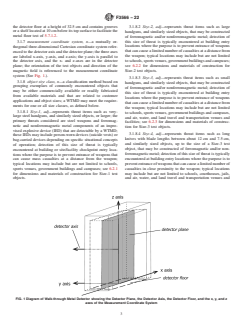
3.1.7 measurement coordinate system, n—a mutually or-
locations where the purpose is to prevent entrance of weapons
thogonal three-dimensional Cartesian coordinate system refer-
thatcancausealimitednumberofcasualtiesatadistancefrom
encedtothedetectoraxisandthedetectorplane;thethreeaxes
are labeled x-axis, y-axis, and z-axis; the y-axis is parallel to the weapon; typical locations may include but are not limited
toschools,sportsvenues,governmentbuildingsandcampuses;
the detector axis, and the x- and z-axes are in the detector
plane; the orientation of the test objects and direction of the see 6.2.2 for dimensions and materials of construction for
magnetic field is referenced to the measurement coordinate Size-2 test objects.
system (See Fig. 1.).
3.1.8.3 Size-3, adj—represents threat items such as small
3.1.8 object size class, n—a classification method based on
handguns, and similarly sized objects, that may be constructed
grouping exemplars of commonly encountered objects that
of ferromagnetic and/or nonferromagnetic metal; detection of
may be either commercially available or readily fabricated
this size of threat is typically encountered at building entry
from available materials and that are related to customer
locations where the purpose is to prevent entrance of weapons
applications and object sizes; a WTMD may meet the require-
thatcancausealimitednumberofcasualtiesatadistancefrom
ments for one or all size classes, as defined below.
the weapon; typical locations may include but are not limited
3.1.8.1 Size-1, adj—represents threat items such as very-
toschools,sportsvenues,governmentbuildingsandcampuses,
large steel handguns, and similarly sized objects, or larger; the
and air, water, and land travel and transportation venues and
primary threats considered are steel weapons and ferromag-
facilities; see 6.2.3 for dimensions and materials of construc-
netic and nonferromagnetic metal components of an impro-
tion for Size-3 test objects.
vised explosive device (IED) that are detectable by a WTMD;
3.1.8.4 Size-4, adj—represents threat items such as long
theseIEDsmayincludeperson-worndevices(suicidevests)or
knives with blade lengths between about 12cm and 7.5cm,
bag-carried devices depending on specific situational concepts
and similarly sized objects, up to the size of a Size-3 test
of operation; detection of this size of threat is typically
object, that may be constructed of ferromagnetic and/or non-
encountered at building or site/facility checkpoint entry loca-
ferromagneticmetal;detectionofthissizeofthreatistypically
tions where the purpose is to prevent entrance of weapons that
encounteredatbuildingentrylocationswherethepurposeisto
can cause mass casualties at a distance from the weapon;
prevententranceofweaponsthatcancausealimitednumberof
typical locations may include but are not limited to schools,
sports venues, government buildings and campuses; see 6.2.1 casualties in close proximity to the weapon; typical locations
may include but are not limited to schools, courthouses, jails,
for dimensions and materials of construction for Size-1 test
objects. and air, water, and land travel and transportation venues and
FIG. 1Diagram of Walk-through Metal Detector showing the Detector Plane, the Detector Axis, the Detector Floor, and the x, y, and z
axes of the Measurement Coordinate System
F3566−22
facilities; see 6.2.4 for dimensions and materials of construc- locationsatankleheightseparatedapproximatelybyhipwidth,
tion for Size-4 test objects. two at hip height separated approximately by hip width, two at
shoulderheightseparatedapproximatelybytorsowidth,oneat
3.1.8.5 Size-5, adj—represents threat items such as knives
top of head height centered along the z-axis, one at slightly
withbladelengthsofabout7.5cmanddisassembledhandguns
below armpit height centered along the z-axis, and one at
ofabout5.7cmlong,andsimilarlysizedobjects,uptothesize
crotchheightcenteredalongthez-axis(seeFig.2);thespecific
of a Size-4 test object, that may be constructed of ferromag-
test measurement locations are a subset of the test measure-
netic and/or nonferromagnetic metal; detection of this size of
ment grid locations.
threat is typically encountered at building or room entry
locations where the purpose is to prevent entrance of weapons 3.1.10 test measurement grid location, n—thepositionsona
5cm 6 0.1cm grid, measured from the detector floor (z =
thatcancausealimitednumberofcasualtiesincloseproximity
totheweapon;typicallocationsmayincludebutarenotlimited 0cm) midway (x = 0cm) between the inside surfaces of the
WTMD columns, in the x-z plane (the x-z plane is parallel to
to courthouses, jails, high-security courtrooms, and air, water,
and land travel and transportation venues and facilities; see the detector plane) through which the test object(s) shall be
passed; the test measurement grid locations are located within
6.2.5 for dimensions and materials of construction for Size-5
test objects. the rectangular region bounded by 0cm + 1.0cm/-0cmand
180cm 6 1.0cm, or the maximum height as specified by the
3.1.8.6 Size-6, adj—represents threat items such as knives
WTMD manufacturer, on the z-axis and, on the x-axis, by
with blade lengths between about 7.5cm and 6.5cm, and
10cm 61.0cmfromtheinsidesurfacesofeachoftheWTMD
similarly sized objects, up to the size of a Size-5 test object,
columns (sides); if the outer limits for x-axis are not on a 5cm
that may be constructed of ferromagnetic and/or nonferromag-
grid, the outer limits will be defined as those closest to the
netic metal; detection of this size of threat is typically
10cm offset but on the 5cm grid.
encountered at building or room entry locations where the
3.1.11 test object, n—anitemthatisusedtotesttheWTMD
purpose is to prevent entrance of weapons that can cause a
detection performance; test objects accurately simulate the
limited number of casualties in close proximity to the weapon;
electromagnetic properties of an actual threat or contraband
typical locations may include but are not limited to
item, such as a weapon or an item that can be used to defeat
courthouses, jails, and high-security courtrooms; see 6.2.6 for
security devices; the test objects are described in Section 6.
dimensions and materials of construction for Size-6 test
objects.
3.1.11.1 innocuous-item test objects, n—test objects that are
used to test the discrimination performance of the object size
3.1.8.7 Size-7, adj—representssmall-sizedthreatitemssuch
class Size-1, Size-2, and Size-3.
as, but not limited to, short knives having blade lengths less
than or equal to 6.5cm, screw-driver bits, and similarly sized
3.1.12 test object axes, n—the three mutually orthogonal
objects, up to the size of a Size-6 test object, that may be
axes of the test object that are referenced to and have a
constructed of ferromagnetic and/or nonferromagnetic metal;
one-to-one correspondence to the axes of the measurement
detection of this size of threat is typically encountered at
coordinate system.
building or room entry locations where the purpose is to
3.1.13 three-axis positioning system, n—a system providing
prevententranceofweaponsthatcancausealimitednumberof
three mutually orthogonal directions of linear translation and
casualties in close proximity to the weapon; typical locations
that is used to place test objects in the magnetic field of the
may include but are not limited to correctional institutions; see
WTMD; a Cartesian robot may be used as the three-axis
6.2.7 for dimensions and materials of construction for Size-7
positioning system but is not required.
test objects.
3.1.14 walk-through metal detector (WTMD), n—a device
3.1.8.8 Size-8, adj—representssmall-sizedthreatitemssuch
using magnetic induction to detect metallic objects; the device
as, but not limited to, short knives having blade lengths less
is an active detector that generates energy within the portal
than or equal to about 5.7cm, 0.22 caliber rounds, and
regionofthedetector;theinteractionofthegeneratedmagnetic
similarly sized objects, up to the size of a Size-7 test object,
field with certain types of objects in the portal region of the
that may be constructed of ferromagnetic and/or nonferromag-
detector and the ability to detect this interaction is the basis of
netic metal; detection of this size of threat is typically
operation for the WTMD.
encountered at correctional facilities where the purpose is to
3.1.14.1 detector axis, n—animaginarylinepassingthrough
prevent use of weapons that can cause a limited number of
and perpendicular to the detector plane that is centered
casualties in close proximity to the weapon; typical locations
vertically and horizontally within the portal of theWTMD and
may include but are not limited to correctional institutions; see
points in the direction of the test subjects motion through the
6.2.8 for dimensions and materials of construction for Size-8
portal (see Fig. 1).
test objects.
3.1.14.2 detector floor, n—the bottom plane of the WTMD
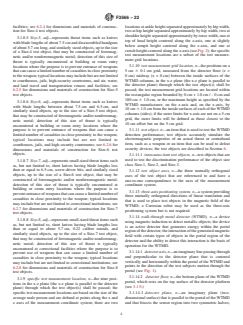
3.1.9 specific test measurement location, n—the nine posi-
portal, which rests on the top surface of the detector platform
tions in the x-z plane (the x-z plane is parallel to the detector
(see 3.1.9.)
plane) through which the test object(s) shall be passed; the
specifictestmeasurementlocationsarebasedonthesizeofthe 3.1.14.3 detector plane, n—an imaginary plane (two-
average male person and are defined at points along the x and dimensionalsurface)thatisparalleltotheportaloftheWTMD
z axes of the measurement coordinate system; there are two and that bisects the sensor region into two symmetric halves;
F3566−22
FIG. 2Specific Test Measurement Locations (indicated by dots) for Detection Performance Tests where the Outer Box Represents the
Inside Dimensions of the Walk-through Metal Detector
the detector plane contains two orthogonal axes labeled the 4.2 Safety Specifications and Requirements:
x-axis and the z-axis (see Fig. 1).
4.2.1 Electrical—The WTMD shall comply with IEC
61010-1, Section 6, Protection against electrical shock.
4. Requirements
4.2.2 Mechanical—TheWTMDshallmeettherequirements
NOTE 2—The WTMD shall meet or exceed the requirements and
of IEC 61010-1, Section 7, Protection against mechanical
specifications stated in this section.
hazards.
4.1 General Test Conditions and Requirements:
4.2.3 Thermal—The WTMD shall meet the requirements of
4.1.1 Testing and Calibration Laboratories—Laboratories
IEC 61010-1, Section 10, Equipment temperature limits and
performing testing and calibration of the WTMD or its
resistance to heat.
components, or both, shall meet the requirements of ISO
4.2.4 Fire—The WTMD shall be tested to demonstrate fire
17025.
4.1.2 Measurement Equipment and Processes—All mea- retardance as specified in IEC 610101:2001, Section 9, Protec-
surement equipment and processes shall be certified to ISO tion against the spread of fire. The result of this test is a pass
10012. if the detector complies when tested as specified.
F3566−22
4.2.5 Human Exposure: 4.4.4 Zonal Detection and Object Location (if provided)—If
the WTMD indicates the location of a metallic object within
4.2.5.1 Magnetic Field Exposure—The magnitude of the
the portal region of the detector, the following requirements
electromagnetic field generated by the WTMD shall be mea-
sured using the methods in 4.2.2 or 4.2.3 of the IEC 62369-1 shall be met:
Edition 1.0 for the exposure limits specified for general public 4.4.4.1 The WTMD shall comply with all other detection
exposure in the ICNIRP guidelines (see Appendix X3). If performance requirements of 4.4.1.
adherence to this requirement has not been demonstrated, the 4.4.4.2 The horizontal span (S ) of each zone region in the
x
manufacturershallprovideawarningwiththeWTMDinstruc- portal shall be equal, the sum of the horizontal spans of the
tions that states, “This device has not been demonstrated as zoneregionsalongthex-axisoftheportalshallequalthewidth
being safe for use on people with active implanted or body- of the portal, and the width of the portal shall be spanned by at
worn, or both, medical devices.” least one zone.
4.4.4.3 Ifapplicable,thesumoftheverticalspans(S)ofthe
z
4.3 Power Requirements:
zone regions along the z-axis of the portal shall equal the
4.3.1 AC Power Operation—IftheWTMDhastheoptionto
height of the portal, and the height of the portal shall be
operate on ac power, then the WTMD shall be tested for ac
spanned by at least three zones.
power operation as described in 5.3.1. The detector shall
4.4.4.4 The positioning accuracy of any metallic objects of
operate at power line voltages that are equal to 610% of the
the appropriate object size class shall be 6 0.5 S in the x-axis
x
nominal value, V , and with variations in frequency of
nom
direction and 6 0.5 S in the z-axis direction.
z
approximately 65% of the nominal value, f .
nom
4.4.4.5 The WTMD shall indicate the location of a test
4.3.2 Battery Backup—If the WTMD has a battery-back up
object of the appropriate size class by highlighting the corre-
unit,itshallautomaticallyswitchtoprovidepowertothemetal
sponding zone and as tested per 4.4.1.
detector in the event that the AC voltage falls below the
minimum voltage specified by the manufacturer. The battery 4.5 Environmental Conditions and Ranges—The WTMD
and all of its components and interconnections shall meet the
back-up shall be capable of providing at least 20 min of
uninterrupted power to a fully functional and operational requirements of this section. The requirements given in this
5.3.2. section shall be applied appropriately for either indoor, shel-
WTMD as tested according to
tered outdoor, or outdoor detector models. The tests identified
4.4 Detection Performance Requirements—The WTMD
in this section shall be performed on the same unit. The
shall meet the detection performance requirements for each
detector, after being tested for each and any of the tests listed
size class for which it is intended to operate.
in this section, shall meet or exceed the p requirement
d,sens
NOTE 3—The WTMD sensitivity settings shall be the same for all given in 4.4.1.
testing per 4.4 requirements.
NOTE 4—The intended operating environment for the WTMD shall be
4.4.1 Detection Sensitivity—The WTMD shall exhibit an
specifiedbythemanufacturerasindoor,outdoorsheltered,oroutdoor,and
averageprobabilityofdetection, p ,≥0.95withanaverage the device shall meet the requirements of 4.4.1 after the environmental
d,sens
testing.
confidence level of 0.95 for the test objects in each size class
specified by the manufacturer, when the test object is moving
4.5.1 Indoor Operating Temperature Stability and Range—
at a speed of 1m⁄s 6 0.05m⁄s and when tested in accordance
The WTMD shall be tested in accordance with MIL-STD-
with 5.4.2.
810H:Method501.7,ProcedureII,at46°C 63°Cafterbeing
4.4.2 Discrimination—The WTMD shall exhibit an average
exposed to that temperature continuously for 24h 6 1h. The
probability of false alarm, p , of less than 0.15 (or 15%) with
WTMDshallbetestedat46°C 63°Cafterthisnominal24-h
fa
an average confidence level of 0.95 for the innocuous item test
exposure and shall exhibit no observable changes in the
objects for each size class specified by the manufacturer
detection performance specification given in 4.4.1. The detec-
movingataspeedof0.5m⁄s 60.1m⁄swhentestedaccording
tor then shall be cooled to 0°C 6 3°C within 4h 6 0.5h and
to 5.4.3.
tested in accordance with MIL-STD-810H: Method 502.7,
4.4.3 Throughput Rate—The WTMD shall exhibit an aver-
Procedure II, at 0°C 6 3°C after being exposed to that
age probability of detection, p , ≥ 0.95 for each size class temperature continuously for 24h 6 1h. The WTMD shall be
d
specified by the manufacturer for the following throughput
tested at 0°C 6 3°C after this nominal 24-h exposure and
rates, r : shall exhibit no observable changes in the detection perfor-
tp
4.4.3.1 r ≥50persons/minforaSize-1orSize-2testobject mance specification given in 4.4.1.
tp
movingat1.0m⁄s 60.1m⁄sateachspecifictestmeasurement 4.5.2 Outdoor Operating Temperature Stability and
location when tested according to 5.4.4; and Range—The WTMD shall be tested in accordance with MIL-
4.4.3.2 r ≥25persons/minforaSize-3orSize-4testobject STD-810H: Method 501.7, Procedure II, at 55°C 6 3°C after
tp
beingexposedtothattemperaturecontinuouslyfor24h 61h.
movingat0.5m⁄s 60.1m⁄sateachspecifictestmeasurement
location when tested according to 5.4.4. The WTMD shall be tested at 55°C 6 3°C after this nominal
24-h exposure and shall exhibit no observable changes in the
detection performance specification given in 4.4.1. The detec-
tor then shall be cooled to -20°C 6 3°C within 4 h 6 0.5 h
ICNIRPGuidelinesforLimitingExposuretoTime-VaryingElectric,Magnetic,
and tested in accordance with MIL-STD-810H: Method 502.7,
and Electromagnetic Fields (up to 300 GHz), Health Physics, 74(4): 494 – 522,
1998. Procedure II, at -20°C 6 3°C after being exposed to that
F3566−22
temperature continuously for 24 h 6 1 h.TheWTMD shall be 4.7.2.1 ac Mains—The WTMD shall be tested as specified
tested at -20°C 6 3°C after this nominal 24-h exposure and in CISPR 16-2-1 +AMD1 for the frequency ranges and limits
shall exhibit no observable changes in the detection perfor- given in Table 1 for the ac Mains Port of IEC 61000-6-3.
mance specification given in 4.4.1. 4.7.2.2 Signal and Control Ports—The WTMD shall be
testedasspecifiedinCISPR16-2-1+AMD1forthefrequency
4.5.3 Storage Temperature Stability and Range—The
ranges and limits given in Table 1 for the Signal, Control, DC
WTMD shall be tested in accordance with MIL-STD-810H:
Power Input or Output Ports of IEC 61000-6-3.
Method 501.7, Procedure II, at 65°C 6 3°C after being
4.7.3 Radiated RF Electromagnetic Field Immunity—The
exposed to that temperature continuously for 24 h 6 1 h. The
WTMDshallbetestedasspecifiedinIEC61000-4-3forLevel
detector then shall be cooled to -37°C 6 3°C within 4 h 6
2 (3A/m), for the requirements given in Table 1, entry 1.2, of
0.5h and tested in accordance with MIL-STD-810H: Method
IEC 61000-6-1.
502.7, Procedure II, at -37°C 6 3°C after being exposed to
4.7.4 60 Hz Radiated Magnetic Field Immunity—The
that temperature continuously for 24 h 61h.
WTMD shall be tested as specified in IEC 61000-4-8 for
4.5.4 Relative Humidity Stability and Range—The WTMD
testing at 60 Hz, Level 2 (3A/m), and continuous exposure for
shall be tested in accordance with the requirements of IEC
30 min 6 5 min for the requirements given in Table 1, entry
60068-2-30,EnvironmentalTesting,Part2-30:Tests–TestDb:
1.1, of IEC 61000-6-1.
Damp heat, cyclic (12h+12h cycle). The most severe test
4.7.5 Electrostatic Discharge Immunity—The WTMD shall
described in IEC 60068-2-30, Section 5.2 b shall be used; six
be tested as specified in IEC 610004-2 for the requirements
cycles at 55°C. The temperature transition set forth in IEC
given in Table 1, entry 1.5, of IEC 61000-6-1.
60068-2-30, Section 7.3.3, Variant 2 shall be followed.
4.7.6 Fast Transient Immunity—The WTMD shall be tested
4.5.5 Ingress Protection (Indoor)—The WTMD shall meet
as specified in IEC 61000-4-4 for the requirements given in
or exceed the requirements specified in IEC 60529, Degrees of
Table 2, entry 2.2;Table 3, entry 3.3; andTable 4, entry 4.5, of
Protection Provided by Enclosures (IP Code), classification
IEC 61000-6-1.
IP41.
4.7.7 Surge Immunity—TheWTMDshallbetestedasspeci-
4.5.6 Ingress Protection (Sheltered Outdoor)—The WTMD
fied in IEC 61000-4-5 for the requirements given in Table 3,
shall meet or exceed the requirements specified in IEC 60529,
entry 3.2 and Table 4, entry 4.4, of IEC 61000-6-1.
Degrees of Protection Provided by Enclosures (IP Code),
4.7.8 RF Common Mode—The WTMD shall be tested as
classification IP53.
specifiedinIEC61000-4-6fortherequirementsgiveninTable
4.5.7 Ingress Protection (Outdoor)—TheWTMDshallmeet
2, entry 2.1; Table 3, entry 3.1; and Table 4, entry 4.1, of IEC
or exceed the requirements specified in IEC 60529, Degrees of
61000-6-1.
Protection Provided by Enclosures (IP Code), classification
4.7.9 Voltage Interruptions and Dips—The WTMD shall be
IP55.
tested as specified in IEC 61000-4-11 for the requirements
4.6 Mechanical Specifications and Requirements—The given in Table 4, entries 4.2 and 4.3, of IEC 61000-6-1.
WTMD or all of its components and their interconnections
4.8 Metallic Interference Requirements:
shall meet the requirements of this section. The detector, after
4.8.1 Metallic Stationary-Object Interference—TheWTMD
being tested for each and any of the tests listed in this section,
shall exhibit an average probability of detection, p , ≥0.95
d,sens
shall exhibit no observable changes in the detection perfor-
with an average confidence level of 0.95 for the steel-handgun
mance specification given in 4.4.1.
exemplarinitsgivenorientation,unlessotherwisespecifiedby
4.6.1 Portal Dimensions—TheWTMD shall be designed so
the user of the standard, with the test object moving at a speed
the interior of the portal through which people will walk has
of 1.0 m/s 6 0.05 m/s and when tested in accordance with
the following dimensions:
5.7.1.1, 5.7.1.2, and 5.7.1.3, and shall not produce an alarm
4.6.1.1 Height, minimum: 195 cm,
when no test object is presented to the detector.
4.6.1.2 Width, minimum: 71 cm, unless required to comply
4.8.2 Metallic Moving-Objects/Metal-Door Interference—
with the American Disabilities Act minimum width of 81 cm,
The WTMD, when adjusted to meet the requirements of 4.4.1,
and
shallexhibitanaverageprobabilityoffalsealarm, p ,≤0.20
fa,md
4.6.1.3 Depth, maximum: 91 cm. with an average confidence level of 0.95 when tested in
accordance with 5.7.2.
4.6.2 Shock—TheWTMDshallbetestedinaccordancewith
the requirements of IEC 60068-2-27 using the half-sine pulse
4.9 Multiple Threat Object Interference—The WTMD,
shape with a nominal peak acceleration of 5g (50 m/s ) and
when adjusted to meet the requirements of 4.4.1, shall exhibit
nominal pulse duration of 30 ms. The detector shall exhibit no
an average probability of detection, p , ≥0.95 with an
d,moi
observable changes in the requirements of 4.2.2 and 4.4.1.
average confidence level of 0.95 when tested in accordance
with 5.8.
4.7 Electromagnetic Interference Requirements:
4.10 Body Interference—The WTMD, when adjusted to
4.7.1 Radiated Emissions:
meet the requirements of 4.4.1, shall exhibit an average
4.7.1.1 The WTMD shall be tested as specified in CISPR
probability of false alarm, p , ≤0.01 with an average confi-
16-2-3 for the frequency ranges and limits given in Table 1 of fa,bi
dence level of 0.95 when tested in accordance 5.9.
IEC 61000-6-3.
4.7.2 Conducted Emissions: 4.11 Functional and Operational Requirements:
F3566−22
4.11.1 Program Storage—The WTMD shall have a means 4.11.3 Communication—The WTMD shall have an electri-
of storing the program and detection sensitivity settings in the cal connector from which either an analog or digital output
signal is obtained. This signal represents the magnitude of the
event of loss or disruption of ac power as tested according to
5.4. detector response to a test object and is the signal upon which
an alarm is based. If the output signal is analog, the connector
4.11.2 Alarm Requirements—The WTMD shall provide vi-
shall be coaxial where the inner conductor provides the signal
sual and audible alarms in the event that a metallic object
path and the outer conductor of the connector provides signal
withintheappropriatesizerangeisdetected.Themagnitudeof
ground or return.
this alarm shall be in proportion to the size, proximity,
orientation, and material of the metallic object.
5. Test Methods
4.11.2.1 Audible Alarms—All audible alarms (other than an
5.1 Noinformationispresentedabouteithertheprecisionor
earphone),unlessitisexternaltotheWTMD,shallproducean
bias of the test methods described in this standard for measur-
alarm-state sound pressure level of at least 75 dB 65dBat
ing the detection performance of a WTMD because the test
0.8m 6 0.08m from the WTMD as measured in accordance
results are binary, reflecting either a detection event or a
with 5.6.1. For status indicators, the audible alarm shall be a
no-detection event and, thus, are nonquantitative.
two-state audible alarm: active (alarm state) and inactive
5.2 General Requirements:
(nonalarm state). For metal object warning, the audible alarm
5.2.1 All tests shall be performed on the sameWTMD unit.
shall be a two-state audible alarm. The two-state alarm
All test dates shall be recorded and reported.
indicator shall produce no sound in the nonalarm state.
5.2.2 Position of WTMD—The distance between any metal
4.11.2.2 Visible Alarms—Any visible alarm, unless it is
objectotherthanatestobjectshallbeatleast32.5cmfromthe
external to the WTMD, shall produce an illumination of
detector floor, at least 50 cm from the topmost part of the
≥10lm⁄m when tested in accordance with 5.6.2. The visual
WTMD, and at least 0.8 m from any side or outward
alarms shall be a two-state visual alarm: active (illuminating)
projections of any side of the WTMD.
and inactive (nonilluminating).
5.2.3 Environmental Conditions—At the time of the tests,
4.11.2.3 Metal-Object-Detection Alarms—The WTMD
the ambient temperature shall be in the range specified in 4.5
shall have a two-state audible alarm and a visual alarm that
for the appropriate application (indoor, sheltered outdoor, or
shallalarmtoindicatethepresenceofatestobjectintheportal
outdoor); the relative humidity shall be noncondensing.
region, as tested in accordance with 5.6.3. The alarm state for
5.2.4 Installation—The WTMD shall be installed according
the metal-object-detection visual alarm shall be active
to the manufacturers instructions. Any setup or calibration
(illuminating), and the nonalarm state shall be inactive (nonil-
adjustments specified in the operator’s manual shall be per-
luminating). The metal object-detection-visual alarm shall be
formed if required.
distinct from any other visual alarms.
5.3 Power Tests:
4.11.2.4 System-Status Alarms—The WTMD shall have a
5.3.1 AC Power Test:
two-state audible alarm or a visible alarm to indicate the
(1)Connect the WTMD to an ac power source that
operational state of the WTMD and shall be activated if the
provides an adjustable voltage and frequency output.
operational state of the WTMD can cause a degradation of the
(2)Set the power source to the nominal operating ac
detection performance required by this standard, as tested in
voltage, V , and frequency, f , specified by the WTMD
nom nom
accordance to 5.6.4. The system-status visual alarm shall be
manufacturer.
inactive(nonilluminating)ifthesystemstatusisacceptableand
(3)Using a test object corresponding to the size classifica-
shall be active (illuminating) if a system status problem exists.
tion being tested, identify the location (vertically and horizon-
The system-status visual alarm shall be distinct from any other
tally) in the portal that when this test object is passed through
visual alarms.
theWTMDitcausesanalarm.Recordandusethislocationfor
4.11.2.5 Detection-Ready-State-Violation Alarm—The
the following steps.
WTMD shall have a two-state audible alarm or a visual alarm
(4)Pass the selected test object through the WTMD at the
to indicate passage of a person through the portal of the
location identified in 5.3.1 step (3).
WTMD when it was not in the ready state as tested in
(5)Record and report an alarm.
accordance to 5.6.5, and shall be activated if a person attempts
(6)Set the ac power source to output approximately 0.9
to pass through the portal of the WTMD when it is not in the
V at f .
nom nom
ready state. The visual alarm shall be active (illuminating) if a
(7)Repeat 5.3.1 steps (4) and (5).
person attempts to pass through the portal of theWTMD when
(8)Set the ac power source to output approximately 1.1
it is not in the ready state, and inactive (nonilluminating)
V at f .
nom nom
otherwise.
(9)Repeat 5.3.1 steps (4) and (5).
4.11.2.6 Speed-Range-Violation Alarm—If provided, the
(10)Set the ac power source to output approximately 1.0
WTMD shall contain a visual alarm that is activated if the V at 0.95 f .
nom nom
speed of a person walking through the portal of the WTMD is
(11)Repeat 5.3.1 steps (4) and (5).
outside the speed range of 0.2 m/s 6 0.1m⁄s to 2.0m⁄s 6 (12)Set the ac power source to output approximately 1.0
0.1m⁄s. The testing shall be performed per 5.10 at speeds of
V at 1.05 f .
nom nom
0.05m⁄s 6 0.02m⁄s and 3.0m⁄s 6 0.1m⁄s. (13)Repeat 5.3.1 steps (4) and (5).
F3566−22
(14)If an alarm is not observed from 5.3.1 step (4) and its tional Commission on Illumination) photopic curve found in
repeats, the ac power test fails. ISO/CIE 23539:2005, Photometry – The CIE System of
Physical Photometry.
5.3.2 Battery Backup Test:
(1)Ensure the WTMD is operating properly by noting an 5.4.1.8 Detector Platform—Requirements defined in 3.1.4.
alarm when a test object is passed through WTMD.
5.4.1.9 Test Object Support Platform—The test object sup-
(2)Disconnect the WTMD from the ac power and leave port platform shall be constructed of nonconductive, nonmag-
disconnected for approximately 20 min.
neticmaterials.Thepurposeofthisplatformistoprovidearest
(3)Pass the same test object used in 5.3.2 step (1) through forthetestobjectsatthetestmeasurementlocation(seeFig.2)
the WTMD.
heights of: 80 cm 6 1 cm, 130 cm 6 1 cm, and 180cm 6
(4)Record and report whether an alarm was generated or 1cm.
not.
5.4.1.10 Computer Controller—The computer controller
(5)If an alarm was not observed in 5.3.2 step (4), the
shallhaveinstalledandoperationalallnecessaryhardwareand
battery backup test fails.
software for providing instrument control and data acquisition.
5.4.1.11 Human Body Simulator—The human body simula-
5.4 Detection Performance Tests—The detection perfor-
tor shall be constructed of material with a conductivity of
mance shall be evaluated by the test methods described in this
approximately0.8S/movertherangeof100Hzto3MHz.The
section.
human body simulator shall be equipped with nonmetallic
NOTE 5—For WTMDs that contain more than one generator or sensor,
casters and a means to push it through the detector at speeds
orboth,thedetectorresponsethatisrecordedshallbetheonefromwhich
between 0.2 m/s 6 0.1 m/s and 2.0 m/s 6 0.1m⁄s.
an alarm is derived.
5.4.2 Detection Sensitivity Test:
5.4.1 Test Objects and Equipment:
5.4.2.1 Initial Procedures:
5.4.1.1 Test Objects—See Section 6.
(1)Ensurethatthevoltmeter,alarmdetector,andthree-axis
5.4.1.2 Three-Axis Positioning System—The three-axis po-
positioning system are connected to the computer controller
sitioning system shall meet the following requirements:
and that the detection signal output connector (see 4.11.3)is
(1)Displacement, x-axis: ≥1m,
connected to the voltmeter (for analog signals) or to the
(2)Displacement, y-axis: ≥1.5 m,
computer (for digital signals).
(3)Displacement, z-axis: ≥2m,
(2) Turn on the voltmeter, alarm detector, computer
(4)Position accuracy, each axis: 1 mm,
controller, and positioning system and verify proper operation
(5)Position repeatability, each axis: 1 mm, and
of the measurement system.
(6)Maximum slew speed, y-axis: ≥2 m/s.
(3)Ensure that the WTMD is securely located and posi-
5.4.1.3 Magnetic Field Sensor—The magnetic field sensor
tioned in the measurement coordinate system.
shall have a frequency response bandwidth at least five times (4)Attach the test object with the proper orientation to the
greater than the bandwidth of the generated magnetic field,
positioning system.
providearmsvoltageoutput,andhavedimensionslessthanor (5)TurnontheWTMDandensurethatitsoutputfunctions
equal to 4 cm by 4 cm by 4 cm.
properly by noting a change in the magnitude of the detection
signal and activation of the alarm as a metal object is brought
5.4.1.4 Voltmeter—The ac voltmeter shall have a bandwidth
at least five times greater than the bandwidth of the generated near the detector.
(6)Ensurethatthetestobjectdoesnothitanyobjectswhile
magnetic field, allow computer control and data retrieval, and
have a variable gain input with at least 10-bit resolution full in motion.
(7)Compute the number of tests, N , according to Annex
scale.
T
A1 for p = p .
5.4.1.5 Microphone (audible alarms)—The microphone is 0 d,sens
(8)Compute the number, n , of entry-point locations
the audible alarm indication detector. It shall be used to detect xz
using:
an audible positive alarm indication, be capable of detecting
the audible alarm indication as described in 4.11.2.1, and
W 22x H
prtl off prtl
n 5 rnd 11 rnd 11 , (1)
S H J DS H J D
provideananalogoutputthatcanbeinterfacedtothecomputer xz
x z
inc inc
controller (see 5.4.1.9). where W is the width of the portal in millimeters, H is
prtl prtl
the height of the portal in millimeters, x = 50 mm unless
5.4.1.6 Light Detector (visible alarms)—The light detector inc
otherwise specified by the user of the standard, z =50mm
inc
isthevisiblealarmindicationdetector.Itshallbeusedtodetect
unless otherwise specified by the user of the standard, x is
off
avisiblepositivealarmindication,becapableofbeingattached
the offset between the inside surface of the portal and where
directly to the visual alarm indicator, and provide an analog
measurements will be taken, and x = 50 mm unless other-
off
electrical output that can be interfaced to the computer con-
wise specified by the user of the standard, and the function
troller (see 5.4.1.9). rnd{a} returns a rounded-down integer value of a.
(9)Compute the number of scans, n , according to Annex
5.4.1.7 Illumination Meter—The illumination meter is used
s,k
A2usingthe N computedinstep (7), n computedinstep (8),
to measure the brightness of the visible alarm indicators and
T xz
n =1,and n =1
...