

ASTM B688-22
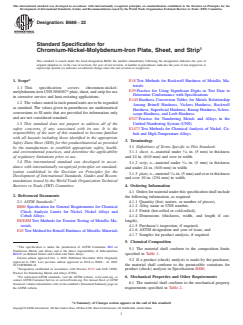
(Specification)Standard Specification for Chromium-Nickel-Molybdenum-Iron Plate, Sheet, and Strip
General Information
- Abstract
ABSTRACT
This specification covers UNS N08366 and N08367 chromium-nickel-molybdenum-iron alloy plates, sheets, and strips for use in corrosive service and heat-resisting applications. The material chemical composition and mechanical properties such as the yield strength, tensile strength, elongation, and hardness should conform to the specified requirements.
SCOPE
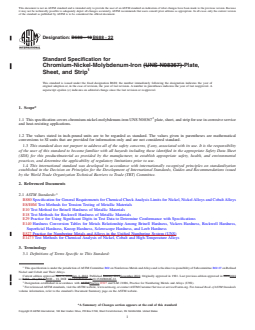
1.1 This specification covers chromium-nickel-molybdenum-iron UNS N083672 plate, sheet, and strip for use in corrosive service and heat-resisting applications.
1.2 The values stated in inch-pound units are to be regarded as standard. The values given in parentheses are mathematical conversions to SI units that are provided for information only and are not considered standard.
1.3 This standard does not purport to address all of the safety concerns, if any, associated with its use. It is the responsibility of the user of this standard to become familiar with all hazards including those identified in the appropriate Safety Data Sheet (SDS) for this product/material as provided by the manufacturer, to establish appropriate safety, health, and environmental practices, and determine the applicability of regulatory limitations prior to use.
1.4 This international standard was developed in accordance with internationally recognized principles on standardization established in the Decision on Principles for the Development of International Standards, Guides and Recommendations issued by the World Trade Organization Technical Barriers to Trade (TBT) Committee.
- Status
- Published
- Publication Date
- 30-Sep-2022
- Technical Committee
- B02 - Nonferrous Metals and Alloys
- Drafting Committee
- B02.07 - Refined Nickel and Cobalt and Their Alloys
Buy Documents
ASTM B688-22 - Standard Specification for Chromium-Nickel-Molybdenum-Iron Plate, Sheet, and Strip
REDLINE ASTM B688-22 - Standard Specification for Chromium-Nickel-Molybdenum-Iron Plate, Sheet, and Strip
Overview
ASTM B688-22 is the internationally recognized standard specification for chromium-nickel-molybdenum-iron alloy (UNS N08367) plate, sheet, and strip. Developed by ASTM International, this standard provides requirements for the chemical composition, mechanical properties, dimensions, tolerances, and marking of these corrosion-resistant and heat-resisting alloys. ASTM B688-22 supports applications in highly corrosive environments and elevated temperatures, making it vital for industries seeking reliable, high-performance materials for demanding service conditions.
Key Topics
- Material Scope: Covers plate, sheet, and strip made from UNS N08367, a high-alloyed material designed for outstanding resistance to pitting, crevice corrosion, and stress-corrosion cracking in harsh environments.
- Chemical Composition: Specifies stringent limits for elements such as chromium, nickel, molybdenum, nitrogen, manganese, and others, with iron as the balance. This ensures the alloy’s corrosion resistance and mechanical performance.
- Mechanical Properties: Defines minimum mechanical requirements, including yield strength, tensile strength, elongation, and hardness, to ensure structural integrity and prolonged service life.
- Dimensional Tolerances: Details permissible variations in thickness, width, length, flatness, and camber for hot-rolled and cold-rolled products, providing guidance for quality fabrication and installation.
- Ordering Information: Outlines criteria for orders, such as product dimensions, finish (hot-rolled or cold-rolled), inspection requirements, and certification needs.
- Product Identification and Certification: Requires clear marking and traceability of each batch and introduces mandatory manufacturer certification and test reports for assurance of compliance.
Applications
ASTM B688-22 alloys are engineered for corrosive service and heat-resisting applications, and are widely utilized in industries that demand materials with high durability and safety in extreme conditions:
- Chemical processing plants: For equipment such as heat exchangers, tanks, pipes, and valves exposed to aggressive chemicals.
- Oil and gas industry: In refining, offshore platforms, and pipelines where saline or sour service is prevalent.
- Power generation: For components in flue gas desulfurization systems or high-temperature steam environments.
- Pharmaceutical and food processing: In settings requiring high cleanliness and resistance to corrosion from process fluids.
- Marine applications: For components subjected to seawater exposure, minimizing the risk of corrosion-related failures.
Related Standards
ASTM B688-22 references other ASTM standards to verify material properties and testing methods, ensuring consistent quality and international acceptance:
- ASTM B880: Specification for general requirements for chemical check analysis limits for nickel, nickel alloys, and cobalt alloys.
- ASTM E8/E8M: Test methods for tension testing of metallic materials.
- ASTM E10: Test method for Brinell hardness of metallic materials.
- ASTM E18: Test methods for Rockwell hardness of metallic materials.
- ASTM E29: Practice for using significant digits in test data.
- ASTM E140: Hardness conversion tables for metals.
- ASTM E1473: Chemical analysis methods for nickel, cobalt, and high-temperature alloys.
- ASTM E527: Practice for numbering metals and alloys in the Unified Numbering System (UNS).
Practical Value
Complying with ASTM B688-22 ensures that manufacturers, fabricators, and end-users have access to plate, sheet, and strip materials that consistently meet rigorous standards for chemistry and mechanical performance. This standard supports reliability, safety, and cost-effectiveness in the selection and procurement of corrosion-resistant, high-strength alloys for critical infrastructure and industrial systems. By following ASTM B688-22, stakeholders benefit from a recognized benchmark that facilitates compatibility, traceability, and efficient global trade in specialty alloy materials.
Relations
- Effective Date
- 01-Jan-2024
- Effective Date
- 01-Jul-2018
- Effective Date
- 01-Jul-2017
- Effective Date
- 15-Jul-2016
- Effective Date
- 01-Feb-2015
- Effective Date
- 01-May-2014
- Effective Date
- 01-Jun-2013
- Effective Date
- 01-Dec-2012
- Effective Date
- 01-Jan-2012
- Effective Date
- 01-Dec-2011
- Effective Date
- 01-Nov-2011
- Effective Date
- 01-Jun-2010
- Effective Date
- 01-Dec-2008
- Effective Date
- 01-Oct-2008
- Effective Date
- 15-May-2008
Buy Documents
ASTM B688-22 - Standard Specification for Chromium-Nickel-Molybdenum-Iron Plate, Sheet, and Strip
REDLINE ASTM B688-22 - Standard Specification for Chromium-Nickel-Molybdenum-Iron Plate, Sheet, and Strip
Get Certified
Connect with accredited certification bodies for this standard

Element Materials Technology
Materials testing and product certification.

Inštitut za kovinske materiale in tehnologije
Institute of Metals and Technology. Materials testing, metallurgical analysis, NDT.
Sponsored listings
Frequently Asked Questions
ASTM B688-22 is a technical specification published by ASTM International. Its full title is "Standard Specification for Chromium-Nickel-Molybdenum-Iron Plate, Sheet, and Strip". This standard covers: ABSTRACT This specification covers UNS N08366 and N08367 chromium-nickel-molybdenum-iron alloy plates, sheets, and strips for use in corrosive service and heat-resisting applications. The material chemical composition and mechanical properties such as the yield strength, tensile strength, elongation, and hardness should conform to the specified requirements. SCOPE 1.1 This specification covers chromium-nickel-molybdenum-iron UNS N083672 plate, sheet, and strip for use in corrosive service and heat-resisting applications. 1.2 The values stated in inch-pound units are to be regarded as standard. The values given in parentheses are mathematical conversions to SI units that are provided for information only and are not considered standard. 1.3 This standard does not purport to address all of the safety concerns, if any, associated with its use. It is the responsibility of the user of this standard to become familiar with all hazards including those identified in the appropriate Safety Data Sheet (SDS) for this product/material as provided by the manufacturer, to establish appropriate safety, health, and environmental practices, and determine the applicability of regulatory limitations prior to use. 1.4 This international standard was developed in accordance with internationally recognized principles on standardization established in the Decision on Principles for the Development of International Standards, Guides and Recommendations issued by the World Trade Organization Technical Barriers to Trade (TBT) Committee.
ABSTRACT This specification covers UNS N08366 and N08367 chromium-nickel-molybdenum-iron alloy plates, sheets, and strips for use in corrosive service and heat-resisting applications. The material chemical composition and mechanical properties such as the yield strength, tensile strength, elongation, and hardness should conform to the specified requirements. SCOPE 1.1 This specification covers chromium-nickel-molybdenum-iron UNS N083672 plate, sheet, and strip for use in corrosive service and heat-resisting applications. 1.2 The values stated in inch-pound units are to be regarded as standard. The values given in parentheses are mathematical conversions to SI units that are provided for information only and are not considered standard. 1.3 This standard does not purport to address all of the safety concerns, if any, associated with its use. It is the responsibility of the user of this standard to become familiar with all hazards including those identified in the appropriate Safety Data Sheet (SDS) for this product/material as provided by the manufacturer, to establish appropriate safety, health, and environmental practices, and determine the applicability of regulatory limitations prior to use. 1.4 This international standard was developed in accordance with internationally recognized principles on standardization established in the Decision on Principles for the Development of International Standards, Guides and Recommendations issued by the World Trade Organization Technical Barriers to Trade (TBT) Committee.
ASTM B688-22 is classified under the following ICS (International Classification for Standards) categories: 77.140.50 - Flat steel products and semi-products. The ICS classification helps identify the subject area and facilitates finding related standards.
ASTM B688-22 has the following relationships with other standards: It is inter standard links to ASTM E8/E8M-24, ASTM E18-18, ASTM E18-17, ASTM E8/E8M-16, ASTM E8/E8M-15, ASTM E10-14, ASTM E8/E8M-13, ASTM E18-12, ASTM E10-12, ASTM E8/E8M-11, ASTM E18-11, ASTM E10-10, ASTM E10-08, ASTM E29-08, ASTM E18-08a. Understanding these relationships helps ensure you are using the most current and applicable version of the standard.
ASTM B688-22 is available in PDF format for immediate download after purchase. The document can be added to your cart and obtained through the secure checkout process. Digital delivery ensures instant access to the complete standard document.
Standards Content (Sample)
This international standard was developed in accordance with internationally recognized principles on standardization established in the Decision on Principles for the
Development of International Standards, Guides and Recommendations issued by the World Trade Organization Technical Barriers to Trade (TBT) Committee.
Designation:B688 −22
Standard Specification for
Chromium-Nickel-Molybdenum-Iron Plate, Sheet, and Strip
This standard is issued under the fixed designation B688; the number immediately following the designation indicates the year of
original adoption or, in the case of revision, the year of last revision. A number in parentheses indicates the year of last reapproval. A
superscript epsilon (´) indicates an editorial change since the last revision or reapproval.
1. Scope* E18 Test Methods for Rockwell Hardness of Metallic Ma-
terials
1.1 This specification covers chromium-nickel-
2 E29 Practice for Using Significant Digits in Test Data to
molybdenum-iron UNS N08367 plate, sheet, and strip for use
Determine Conformance with Specifications
in corrosive service and heat-resisting applications.
E140 Hardness Conversion Tables for Metals Relationship
1.2 The values stated in inch-pound units are to be regarded
Among Brinell Hardness, Vickers Hardness, Rockwell
as standard. The values given in parentheses are mathematical
Hardness, Superficial Hardness, Knoop Hardness, Sclero-
conversions to SI units that are provided for information only
scope Hardness, and Leeb Hardness
and are not considered standard.
E527 Practice for Numbering Metals and Alloys in the
1.3 This standard does not purport to address all of the Unified Numbering System (UNS)
safety concerns, if any, associated with its use. It is the
E1473 Test Methods for Chemical Analysis of Nickel, Co-
responsibility of the user of this standard to become familiar balt and High-Temperature Alloys
with all hazards including those identified in the appropriate
3. Terminology
Safety Data Sheet (SDS) for this product/material as provided
3.1 Definitions of Terms Specific to This Standard:
by the manufacturer, to establish appropriate safety, health,
3.1.1 sheet, n—material under ⁄16 in. (5 mm) in thickness
and environmental practices, and determine the applicability
and 24 in. (610 mm) and over in width.
of regulatory limitations prior to use.
1.4 This international standard was developed in accor-
3.1.2 strip, n—material under ⁄16 in. (5 mm) in thickness
dance with internationally recognized principles on standard-
and under 24 in. (610 mm) in width.
ization established in the Decision on Principles for the
3.1.3 plate, n—material ⁄16 in. (5 mm) and over in thickness
Development of International Standards, Guides and Recom-
and over 10 in. (254 mm) in width.
mendations issued by the World Trade Organization Technical
Barriers to Trade (TBT) Committee. 4. Ordering Information
4.1 Orders for material under this specification shall include
2. Referenced Documents
the following information, as required:
4.1.1 Quantity (feet, meters, or number of pieces),
2.1 ASTM Standards:
4.1.2 Alloy name or UNS number,
B880 Specification for General Requirements for Chemical
4.1.3 Finish (hot-rolled or cold-rolled),
Check Analysis Limits for Nickel, Nickel Alloys and
4.1.4 Dimensions (thickness, width, and length if cut-
Cobalt Alloys
length),
E8/E8M Test Methods for Tension Testing of Metallic Ma-
4.1.5 Purchaser’s inspection, if required,
terials
4.1.6 ASTM designation and year of issue, and
E10 Test Method for Brinell Hardness of Metallic Materials
4.1.7 Samples for product analysis, if required.
5. Chemical Composition
This specification is under the jurisdiction of ASTM Committee B02 on
5.1 The material shall conform to the composition limits
Nonferrous Metals and Alloys and is the direct responsibility of Subcommittee
specified in Table 1.
B02.07 on Refined Nickel and Cobalt and Their Alloys.
Current edition approved Oct. 1, 2022. Published November 2022. Originally
5.2 If a product (check) analysis is made by the purchaser,
approved in 1981. Last previous edition approved in 2018 as B688 – 18. DOI:
the material shall conform to the permissible variations for
10.1520/B0688-22.
Designation established in accordance with Practice E527 and SAE J1086,
product (check) analysis in Specification B880.
Practice for Numbering Metals and Alloys (UNS).
For referenced ASTM standards, visit the ASTM website, www.astm.org, or 6. Mechanical Properties and Other Requirements
contact ASTM Customer Service at service@astm.org. For Annual Book of ASTM
6.1 The material shall conform to the mechanical property
Standards volume information, refer to the standard’s Document Summary page on
the ASTM website. requirements specified in Table 2.
*A Summary of Changes section appears at the end of this standard
Copyright © ASTM International, 100 Barr Harbor Drive, PO Box C700, West Conshohocken, PA 19428-2959. United States
B688−22
TABLE 1 Chemical Requirements TABLE 4 Permissible Variations in Width and Length
for Hot-Rolled and Cold-Rolled Resquared Sheets
Composition Limits, %
Element (Stretcher Leveled Standard of Flatness)
N08367
Tolerances
Carbon 0.030 max
Specified Dimensions, in. (mm) Plus
Manganese 2.00 max
Minus
Silicon 1.00 max
in. mm
Phosphorus 0.040 max
For thickness under 0.131 (3.33):
Sulfur 0.030 max
Widths up to 48 (1219) excl ⁄16 20
Chromium 20.00 to 22.00
Widths 48 (1219) and over ⁄8 30
Nickel 23.50 to 25.50
Lengths up to 120 (3048) excl ⁄16 20
Molybdenum 6.00 to 7.00
Lengths 120 (3048) and over ⁄8 30
Nitrogen 0.18 to 0.25
For thicknesses 0.131 (3.33) and over:
A
Iron remainder
All widths and lengths ⁄4 60
Copper 0.75 max
A
Iron shall be determined arithmetically by difference.
TABLE 5 Permissible Variations in Width for Hot-Rolled and
Cold-Rolled Sheets not Resquared and Cold-Rolled Coils
TABLE 2 Mechanical Properties for Plate, Sheet, and Strip
Tolerances for Specified
N08367
Width, in. (mm)
Specified Thickness, in. (mm)
24 (610) to 48 48 (1219) and
Yield strength, 0.2 % offset, min, ksi 45 (310)
(1219), excl Over
(MPa)
3 1 1
Less than ⁄16 (4.76) ⁄16 (2) plus ⁄8 (3) plus
Tensile strength, min, ksi (MPa)
0 minus 0 minus
# ⁄16 in. (4.8 mm) thick 100 (690)
> ⁄16 95 (655)
A
Elongation in 2 in. or 50 mm or 4D, 30
min, %
B TABLE 6 Permissible Variations in Camber for Hot-Rolled
Hardness, max
A
and Cold-Rolled Sheets Not Required and Cold-Rolled Coils
# ⁄16 in. (4.8 mm) thick 100 HRB
> ⁄16 240 HBN
Tolerance per
Unit Length of
A
Not applicable for thickness under 0.015 in. (0.40 mm). Specified Width, in. (mm)
Any 8 ft (2438 mm),
B
Hardness values (Brinell, Rockwell, or equivalent) are informative only and are
in. (mm)
not to be construed as the basis for acceptance or rejection.
24 (610) to 36 (914), incl ⁄8 (3)
Over 36 (914) ⁄16 (2)
A
Camber is the greatest deviation of a side edge from a straight line and
TABLE 3 Permissible Variations in Thickness for Hot-
measurement is taken by placing an 8-ft (2438 mm) straightedge on the concave
Rolled Sheets in Cut Lengths, Cold-Rolled Sheets in Cut
side and measuring the greatest distance between the sheet edge and the
Lengths and Coils straightedge.
Permissible
Variations, Plus
A
Specified Thickness, in. (mm)
and Minus
TABLE 7 Permissible Variations in Length for Hot-
in. mm
Rolled and Cold-Rolled Sheets Not Resquared
Over 0.145 (3.68) to less than ⁄16 (4.76) 0.014 0.36
Length, ft (mm) Tolerances, in. (mm)
Over 0.130 (3.30) to 0.145 (3.68), incl 0.012 0.30 1
Up to 10 (3048), incl ⁄4 (6) plus 0 minus
Over 0.114 (2.90) to 0.130 (3.30), incl 0.010 0.25 1
Over 10 (3048) to 20 (6096), incl ⁄2 (13) plus 0 minus
Over 0.098 (2.49) to 0.114 (2.90), incl 0.009 0.23
Over 0.083 (2.11) to 0.098 (2.49), incl 0.008 0.20
Over 0.072 (1.83) to 0.083 (2.11), incl 0.007 0.18
Over 0.058 (1.47) to 0.072 (1.83), incl 0.006 0.15
Over 0.040 (1.02) to 0.058 (1.47), incl 0.005 0.13
Over 0.026 (0.66) to 0.040 (1.02), incl 0.004 0.10
7.2 Strip—Material shall conform to the variations specified
Over 0.016 (0.41) to 0.026 (0.66), incl 0.003 0.08
Over 0.007 (0.18) to 0.016 (0.41), incl 0.002 0.05
in Tables 10-13, inclusive. Note that strip of all sizes may be
Over 0.005 (0.13) to 0.007 (0.18), incl 0.0015 0.04
ordered to cut lengths in which case a variation of ⁄2 in. (13
0.005 (0.13) 0.001 0.03
A mm)overthespecifiedlengthshallbepermitted.Thereshallbe
Thicknessmeasurementsaretakenatleast ⁄8in.(9.52mm)fromtheedgeofthe
sheet. no flatness requirements for non-stretcher leveled strip.
7.3 Plate—Materialshallconformtothevariationsspecified
in Tables 14-20, inclusive. Specially flattened plate, when so
7. Dimensions and Permissible Variations
specified,shallhavepermissiblevariationsinflatnessasagreed
7.1 Sheet—Material shall conform to the variations speci-
upon between the manufacturer and purchaser.
fied in Tables 3-9, inclusive. There will be no flatness require-
ments for non-stretcher leveled sheet.
B688−22
TABLE 8 Permissible Variations in Flatness for Hot-Rolled and Cold-Rolled Sheets Specified to Stretcher-Leveled
Standard of Flatness
Specified Thickness, in. (mm) Width, in. (mm) Length, in. (mm) Flatness Tolerance, in. (mm)
3 1
Under ⁄16 (4.76) to 48 (1219), incl to 96 (2438), incl ⁄8 (3)
3 1
Under ⁄16 (4.76) to 48 (1219), incl over 96 (2438) ⁄4 (6)
3 1
Under ⁄16 (4.76) over 48 (1219) to 96 (2438), incl ⁄4 (6)
3 1
Under ⁄16 (4.76) over 48 (1219) over 96 (2438) ⁄4 (6)
TABLE 9 Permissible Variations in Diameter for Hot-Rolled and Cold-Rolled Sheets, Sheared Circles
Tolerance Over Specified Diameter (No Tolerance Under), in.
(mm)
Specified Thickness, in. (mm)
Diameters Under 30 Diameters 30 (762) Diameters Over 48
in. (762) to 48 in. (1219) in. (1219)
1 3 1
0.0972 (2.46) and thicker ⁄8 (3) ⁄16 (5) ⁄4 (6)
3 5 7
0.0971 (2.46) to 0.0568 (1.45), incl ⁄32 (2) ⁄32 (4) ⁄32 (6)
1 1 3
0.0567 (1.45) and thinner ⁄16 (2) ⁄8 (3) ⁄16 (5)
TABLE 10 Permissible Variations in Thickness for Cold-Rolled Strip in Coils and Cut Lengths
NOTE 1—Thickness measurements are taken at least ⁄8 in. (9.52 mm) in from the edge of the strip, except that on widths less than 1 in. (25.4 mm),
the tolerances are applicable for measurements at all locations. The tolerances in this table include crown tolerances.
Thickness Tolerances, for the Thickness and Widths Given, Plus and Minus, in. (mm)
Width, in. (mm)
Specified Thickness, in. (mm) 3
⁄16 (4.76) to 6 (152), Over 6 (152) to 12 Over 12 (305) to 24
incl (305), incl (610), excl
A
Thickness Tolerances
0.005 (0.13) to 0.010 (0.25), incl 10 % 10 % 10 %
Over 0.010 (0.25) to 0.011 (0.28), incl 0.0015 (0.04) 0.0015 (0.04) 0.0015 (0.04)
Over 0.011 (0.28) to 0.013 (0.33), incl 0.0015 (0.04) 0.0015 (0.04) 0.002 (0.05)
Over 0.013 (0.33) to 0.017 (0.43), incl 0.0015 (0.04) 0.002 (0.05) 0.002 (0.05)
Over 0.017 (0.43) to 0.020 (0.51), incl 0.0015 (0.04) 0.002 (0.05) 0.0025 (0.06)
Over 0.020 (0.51) to 0.029 (0.74), incl 0.002 (0.05) 0.0025 (0.06) 0.0025 (0.06)
Over 0.029 (0.74) to 0.035 (0.89), incl 0.002 (0.05) 0.003 (0.08) 0.003 (0.08)
Over 0.035 (0.89) to 0.050 (1.27), incl 0.0025 (0.06) 0.0035 (0.09) 0.0035 (0.09)
Over 0.050 (1.27) to 0.069 (1.75), incl 0.003 (0.08) 0.0035 (0.09) 0.0035 (0.09)
Over 0.069 (1.75) to 0.100 (2.54), incl 0.003 (0.08) 0.004 (0.10) 0.005 (0.13)
Over 0.100 (2.54) to 0.125 (2.98), incl 0.004 (0.10) 0.0045 (0.11) 0.005 (0.13)
Over 0.125 (2.98) to 0.161 (4.09), incl 0.0045 (0.11) 0.0045 (0.11) 0.005 (0.13)
Over 0.161 (4.09) to under ⁄16 (4.76) 0.005 (0.13) 0.005 (0.13) 0.006 (0.15)
A
Thickness tolerances given in in. (mm) unless otherwise indicated.
TABLE 11 Permissible Variations in Width for Cold-Rolled Strip in Coils and Cut Lengths for Edge Nos. 1 and 5
Width Tolerance for Thickness
and Width Given, in. (mm)
Specified Edge No. Width, in. (mm) Thickness, in. (mm)
Plus Minus
3 1
1 and 5 ⁄32 (7.14) and under ⁄16 (1.59) and under 0.005 (0.13) 0.005 (0.13)
3 3 3
1 and 5 over ⁄32 (7.14) to ⁄4 (19.05), incl ⁄32 (2.38) and under 0.005 (0.13) 0.005 (0.13)
3 1
1 and 5 over ⁄4 (19.05) to 5 (127), incl ⁄8 (3.18) and under 0.005 (0.13) 0.005 (0.13)
5 over 5 (127.00) to 9 (228.60), incl ⁄8 (3.18) to 0.008 (0.20), incl 0.010 (0.25) 0.010 (0.25)
5 over 9 (228.60) to 20 (508.00), incl 0.105 (2.67) to 0.015 (0.38) 0.010 (0.25) 0.010 (0.25)
5 over 20 (508.00) 0.080 (2.03) to 0.023 (0.58) 0.015 (0.38) 0.015 (0.38)
8. Workmanship, Finish, and Appearance 9.1.2 Lots for mechanical testing shall consist of the mate-
rial from one heat, in the same condition, and of the same
8.1 The material shall be uniform in quality and condition,
nominal thickness.
smooth, commercially straight or flat, and free of injurious
imperfections. 9.2 Test Material Selection:
9.2.1 Chemical Analysis:
9. Sampling
9.2.1.1 An analysis of each lot shall be made by the
9.1 Lot for Chemical Analysis and Mechanical Testing: manufacturer from a representative sample obtained during the
9.1.1 A lot for chemical analysis shall consist of one heat. pouring of the heat or subsequent processing.
B688−22
TABLE 12 Permissible Variations in Width for Cold-Rolled Strip in Coils and Cut Lengths for Edge No. 3
Width Tolerance, Plus and Minus for Thickness and Width Given, in. (mm)
Over 9 Over 12 Over 20
1 1
Under ⁄2 ⁄2 (12.70) Over 6
(228.60) to (304.80) to (508.00) to
Specified Thickness, in. (mm)
(12.70) to to 6 (152.40) to
12 20 24
⁄16 (4.76), (152.40), 9 (228.60),
(304.80), (508.00), (609.60),
incl incl incl
incl incl incl
Under ⁄16 (4.76) to 0.161 (4.09), incl . 0.016 0.020 0.020 0.031 0.031
(0.41) (0.51) (0.5
...
This document is not an ASTM standard and is intended only to provide the user of an ASTM standard an indication of what changes have been made to the previous version. Because
it may not be technically possible to adequately depict all changes accurately, ASTM recommends that users consult prior editions as appropriate. In all cases only the current version
of the standard as published by ASTM is to be considered the official document.
Designation: B688 − 18 B688 − 22
Standard Specification for
Chromium-Nickel-Molybdenum-Iron (UNS N08367) Plate,
Sheet, and Strip
This standard is issued under the fixed designation B688; the number immediately following the designation indicates the year of
original adoption or, in the case of revision, the year of last revision. A number in parentheses indicates the year of last reapproval. A
superscript epsilon (´) indicates an editorial change since the last revision or reapproval.
1. Scope*
1.1 This specification covers chromium-nickel-molybdenum-iron UNS N08367 plate, sheet, and strip for use in corrosive service
and heat-resisting applications.
1.2 The values stated in inch-pound units are to be regarded as standard. The values given in parentheses are mathematical
conversions to SI units that are provided for information only and are not considered standard.
1.3 This standard does not purport to address all of the safety concerns, if any, associated with its use. It is the responsibility
of the user of this standard to become familiar with all hazards including those identified in the appropriate Safety Data Sheet
(SDS) for this product/material as provided by the manufacturer, to establish appropriate safety, health, and environmental
practices, and determine the applicability of regulatory limitations prior to use.
1.4 This international standard was developed in accordance with internationally recognized principles on standardization
established in the Decision on Principles for the Development of International Standards, Guides and Recommendations issued
by the World Trade Organization Technical Barriers to Trade (TBT) Committee.
2. Referenced Documents
2.1 ASTM Standards:
B880 Specification for General Requirements for Chemical Check Analysis Limits for Nickel, Nickel Alloys and Cobalt Alloys
E8/E8M Test Methods for Tension Testing of Metallic Materials
E10 Test Method for Brinell Hardness of Metallic Materials
E18 Test Methods for Rockwell Hardness of Metallic Materials
E29 Practice for Using Significant Digits in Test Data to Determine Conformance with Specifications
E140 Hardness Conversion Tables for Metals Relationship Among Brinell Hardness, Vickers Hardness, Rockwell Hardness,
Superficial Hardness, Knoop Hardness, Scleroscope Hardness, and Leeb Hardness
E527 Practice for Numbering Metals and Alloys in the Unified Numbering System (UNS)
E1473 Test Methods for Chemical Analysis of Nickel, Cobalt and High-Temperature Alloys
3. Terminology
3.1 Definitions of Terms Specific to This Standard:
This specification is under the jurisdiction of ASTM Committee B02 on Nonferrous Metals and Alloys and is the direct responsibility of Subcommittee B02.07 on Refined
Nickel and Cobalt and Their Alloys.
Current edition approved Nov. 1, 2018Oct. 1, 2022. Published January 2019November 2022. Originally approved in 1981. Last previous edition approved in 20142018
as B688 – 96 (2014).B688 – 18. DOI: 10.1520/B0688-18.10.1520/B0688-22.
Designation established in accordance with ASTMPractice E527 and SAE J1086, Practice for Numbering Metals and Alloys (UNS).
For referenced ASTM standards, visit the ASTM website, www.astm.org, or contact ASTM Customer Service at service@astm.org. For Annual Book of ASTM Standards
volume information, refer to the standard’s Document Summary page on the ASTM website.
*A Summary of Changes section appears at the end of this standard
Copyright © ASTM International, 100 Barr Harbor Drive, PO Box C700, West Conshohocken, PA 19428-2959. United States
B688 − 22
3.1.1 sheet, n—material under ⁄16 in. (5 mm) in thickness and 24 in. (610 mm) and over in width.
3.1.2 strip, n—material under ⁄16 in. (5 mm) in thickness and under 24 in. (610 mm) in width.
3.1.3 plate, n—material ⁄16 in. (5 mm) and over in thickness and over 10 in. (254 mm) in width.
4. Ordering Information
4.1 Orders for material under this specification shall include the following information, as required:
4.1.1 Quantity (feet, meters, or number of pieces),
4.1.2 Alloy name or UNS number,
4.1.3 Finish (hot-rolled or cold-rolled),
4.1.4 Dimensions (thickness, width, and length if cut-length),
4.1.5 Purchaser’s inspection, if required,
4.1.6 ASTM designation and year of issue, and
4.1.7 Samples for product analysis, if required.
5. Chemical Composition
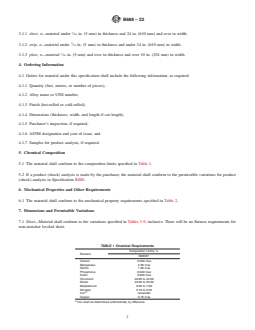
5.1 The material shall conform to the composition limits specified in Table 1.
5.2 If a product (check) analysis is made by the purchaser, the material shall conform to the permissible variations for product
(check) analysis in Specification B880.
6. Mechanical Properties and Other Requirements
6.1 The material shall conform to the mechanical property requirements specified in Table 2.
7. Dimensions and Permissible Variations
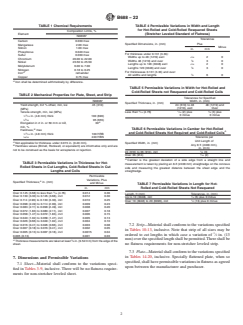
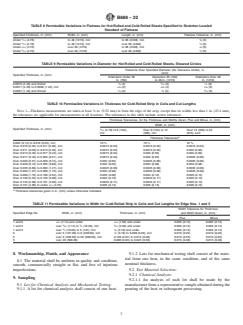
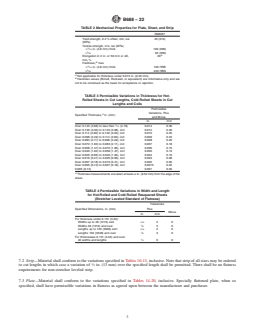
7.1 Sheet—Material shall conform to the variations specified in Tables 3-9, inclusive. There will be no flatness requirements for
non-stretcher leveled sheet.
TABLE 1 Chemical Requirements
Composition Limits, %
Element
N08367
Carbon 0.030 max
Manganese 2.00 max
Silicon 1.00 max
Phosphorus 0.040 max
Sulfur 0.030 max
Chromium 20.00 to 22.00
Nickel 23.50 to 25.50
Molybdenum 6.00 to 7.00
Nitrogen 0.18 to 0.25
A
Iron remainder
Copper 0.75 max
A
Iron shall be determined arithmetically by difference.
B688 − 22
TABLE 2 Mechanical Properties for Plate, Sheet, and Strip
N08367
Yield strength, 0.2 % offset, min, ksi 45 (310)
(MPa)
Tensile strength, min, ksi (MPa)
# ⁄16 in. (4.8 mm) thick 100 (690)
> ⁄16 95 (655)
A
Elongation in 2 in. or 50 mm or 4D, 30
min, %
B
Hardness, max
# ⁄16 in. (4.8 mm) thick 100 HRB
> ⁄16 240 HBN
A
Not applicable for thickness under 0.015 in. (0.40 mm).
B
Hardness values (Brinell, Rockwell, or equivalent) are informative only and are
not to be construed as the basis for acceptance or rejection.
TABLE 3 Permissible Variations in Thickness for Hot-
Rolled Sheets in Cut Lengths, Cold-Rolled Sheets in Cut
Lengths and Coils
Permissible
Variations, Plus
A
Specified Thickness, in. (mm)
and Minus
in. mm
Over 0.145 (3.68) to less than ⁄16 (4.76) 0.014 0.36
Over 0.130 (3.30) to 0.145 (3.68), incl 0.012 0.30
Over 0.114 (2.90) to 0.130 (3.30), incl 0.010 0.25
Over 0.098 (2.49) to 0.114 (2.90), incl 0.009 0.23
Over 0.083 (2.11) to 0.098 (2.49), incl 0.008 0.20
Over 0.072 (1.83) to 0.083 (2.11), incl 0.007 0.18
Over 0.058 (1.47) to 0.072 (1.83), incl 0.006 0.15
Over 0.040 (1.02) to 0.058 (1.47), incl 0.005 0.13
Over 0.026 (0.66) to 0.040 (1.02), incl 0.004 0.10
Over 0.016 (0.41) to 0.026 (0.66), incl 0.003 0.08
Over 0.007 (0.18) to 0.016 (0.41), incl 0.002 0.05
Over 0.005 (0.13) to 0.007 (0.18), incl 0.0015 0.04
0.005 (0.13) 0.001 0.03
A
Thickness measurements are taken at least ⁄8 in. (9.52 mm) from the edge of the
sheet.
TABLE 4 Permissible Variations in Width and Length
for Hot-Rolled and Cold-Rolled Resquared Sheets
(Stretcher Leveled Standard of Flatness)
Tolerances
Specified Dimensions, in. (mm) Plus
Minus
in. mm
For thickness under 0.131 (3.33):
Widths up to 48 (1219) excl ⁄16 2 0
Widths 48 (1219) and over ⁄8 3 0
Lengths up to 120 (3048) excl ⁄16 2 0
Lengths 120 (3048) and over ⁄8 3 0
For thicknesses 0.131 (3.33) and over:
All widths and lengths ⁄4 6 0
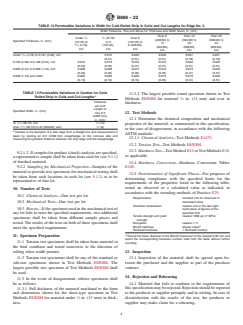
7.2 Strip—Material shall conform to the variations specified in Tables 10-13, inclusive. Note that strip of all sizes may be ordered
to cut lengths in which case a variation of ⁄2 in. (13 mm) over the specified length shall be permitted. There shall be no flatness
requirements for non-stretcher leveled strip.
7.3 Plate—Material shall conform to the variations specified in Tables 14-20, inclusive. Specially flattened plate, when so
specified, shall have permissible variations in flatness as agreed upon between the manufacturer and purchaser.
B688 − 22
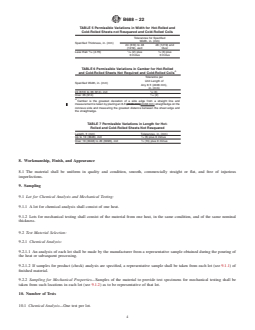
TABLE 5 Permissible Variations in Width for Hot-Rolled and
Cold-Rolled Sheets not Resquared and Cold-Rolled Coils
Tolerances for Specified
Width, in. (mm)
Specified Thickness, in. (mm)
24 (610) to 48 48 (1219) and
(1219), excl Over
3 1 1
Less than ⁄16 (4.76) ⁄16 (2) plus ⁄8 (3) plus
0 minus 0 minus
TABLE 6 Permissible Variations in Camber for Hot-Rolled
A
and Cold-Rolled Sheets Not Required and Cold-Rolled Coils
Tolerance per
Unit Length of
Specified Width, in. (mm)
Any 8 ft (2438 mm),
in. (mm)
24 (610) to 36 (914), incl ⁄8 (3)
Over 36 (914) ⁄16 (2)
A
Camber is the greatest deviation of a side edge from a straight line and
measurement is taken by placing an 8-ft (2438-mm)(2438 mm) straightedge on the
concave side and measuring the greatest distance between the sheet edge and
the straightedge.
TABLE 7 Permissible Variations in Length for Hot-
Rolled and Cold-Rolled Sheets Not Resquared
Length, ft (mm) Tolerances, in. (mm)
Up to 10 (3048), incl ⁄4 (6) plus 0 minus
Over 10 (3048) to 20 (6096), incl ⁄2 (13) plus 0 minus
8. Workmanship, Finish, and Appearance
8.1 The material shall be uniform in quality and condition, smooth, commercially straight or flat, and free of injurious
imperfections.
9. Sampling
9.1 Lot for Chemical Analysis and Mechanical Testing:
9.1.1 A lot for chemical analysis shall consist of one heat.
9.1.2 Lots for mechanical testing shall consist of the material from one heat, in the same condition, and of the same nominal
thickness.
9.2 Test Material Selection:
9.2.1 Chemical Analysis:
9.2.1.1 An analysis of each lot shall be made by the manufacturer from a representative sample obtained during the pouring of
the heat or subsequent processing.
9.2.1.2 If samples for product (check) analysis are specified, a representative sample shall be taken from each lot (see 9.1.1) of
finished material.
9.2.2 Sampling for Mechanical Properties—Samples of the material to provide test specimens for mechanical testing shall be
taken from such locations in each lot (see 9.1.2) as to be representative of that lot.
10. Number of Tests
10.1 Chemical Analysis—One test per lot.
B688 − 22
TABLE 8 Permissible Variations in Flatness for Hot-Rolled and Cold-Rolled Sheets Specified to Stretcher-Leveled
Standard of Flatness
A
Specified Thickness, in. (mm) Width, in. (mm) Length, in. (mm) Flatness Tolerance, in. (mm)
3 1
Under ⁄16 (4.76) to 48 (1219), incl to 96 (2438), incl ⁄8 (3)
3 1
Under ⁄16 (4.76) to 48 (1219), incl over 96 (2438) ⁄4 (6)
3 1
Under ⁄16 (4.76) over 48 (1219) to 96 (2438), incl ⁄4 (6)
3 1
Under ⁄16 (4.76) over 48 (1219) over 96 (2438) ⁄4 (6)
TABLE 9 Permissible Variations in Diameter for Hot-Rolled and Cold-Rolled Sheets, Sheared Circles
Tolerance Over Specified Diameter (No Tolerance Under), in.
(mm)
Specified Thickness, in. (mm)
Diameters Under 30 Diameters 30 (762) Diameters Over 48
in. (762) to 48 in. (1219) in. (1219)
1 3 1
0.0972 (2.46) and thicker ⁄8 (3) ⁄16 (5) ⁄4 (6)
3 5 7
0.0971 (2.46) to 0.0568 (1.45), incl ⁄32 (2) ⁄32 (4) ⁄32 (6)
1 1 3
0.0567 (1.45) and thinner ⁄16 (2) ⁄8 (3) ⁄16 (5)
TABLE 10 Permissible Variations in Thickness for Cold-Rolled Strip in Coils and Cut Lengths
NOTE 1—Thickness measurements are taken at least ⁄8 in. (9.52 mm) in from the edge of the strip, except that on widths less than 1 in. (25.4 mm),
the tolerances are applicable for measurements at all locations. The tolerances in this table include crown tolerances.
Thickness Tolerances, for the Thickness and Widths Given, Plus and Minus, in. (mm)
Width, in. (mm)
Specified Thickness, in. (mm) 3
⁄16 (4.76) to 6 (152), Over 6 (152) to 12 Over 12 (305) to 24
incl (305), incl (610), excl
A
Thickness Tolerances
0.005 (0.13) to 0.010 (0.25), incl 10 % 10 % 10 %
Over 0.010 (0.25) to 0.011 (0.28), incl 0.0015 (0.04) 0.0015 (0.04) 0.0015 (0.04)
Over 0.011 (0.28) to 0.013 (0.33), incl 0.0015 (0.04) 0.0015 (0.04) 0.002 (0.05)
Over 0.013 (0.33) to 0.017 (0.43), incl 0.0015 (0.04) 0.002 (0.05) 0.002 (0.05)
Over 0.017 (0.43) to 0.020 (0.51), incl 0.0015 (0.04) 0.002 (0.05) 0.0025 (0.06)
Over 0.020 (0.51) to 0.029 (0.74), incl 0.002 (0.05) 0.0025 (0.06) 0.0025 (0.06)
Over 0.029 (0.74) to 0.035 (0.89), incl 0.002 (0.05) 0.003 (0.08) 0.003 (0.08)
Over 0.035 (0.89) to 0.050 (1.27), incl 0.0025 (0.06) 0.0035 (0.09) 0.0035 (0.09)
Over 0.050 (1.27) to 0.069 (1.75), incl 0.003 (0.08) 0.0035 (0.09) 0.0035 (0.09)
Over 0.069 (1.75) to 0.100 (2.54), incl 0.003 (0.08) 0.004 (0.10) 0.005 (0.13)
Over 0.100 (2.54) to 0.125 (2.98), incl 0.004 (0.10) 0.0045 (0.11) 0.005 (0.13)
Over 0.125 (2.98) to 0.161 (4.09), incl 0.0045 (0.11) 0.0045 (0.11) 0.005 (0.13)
Over 0.161 (4.09) to under ⁄16 (4.76) 0.005 (0.13) 0.005 (0.13) 0.006 (0.15)
A
Thickness tolerances given in in. (mm) unless otherwise indicated.
TABLE 11 Permissible Variations in Width for Cold-Rolled Strip in Coils and Cut Lengths for Edge Nos. 1 and 5
Width Tolerance for Thickness
and Width Given, in. (mm)
Specified Edge No. Width, in. (mm) Thickness, in. (mm)
Plus Minus
3 1
1 and 5 ⁄32 (7.14) and under ⁄16 (1.59) and under 0.005 (0.13) 0.005 (0.13)
3 3 3
1 and 5 over ⁄32 (7.14) to ⁄4 (19.05), incl ⁄32 (2.38) and under 0.005 (0.13) 0.005 (0.13)
3 1
1 and 5 over ⁄4 (19.05) to 5 (127), incl ⁄8 (3.18) and under 0.005 (0.13) 0.005 (0.13)
5 over 5 (127.00) to 9 (228.60), incl ⁄8 (3.18) to 0.008 (0.20), incl 0.010 (0.25) 0.010 (0.25)
5 over 9 (228.60) to 20 (508.00), incl 0.105 (2.67) to 0.015 (0.38) 0.010 (0.25) 0.010 (0.25)
5 over 20 (508.00) 0.080 (2.03) to 0.023 (0.58) 0.015 (0.38) 0.015 (0.38)
10.2 Mechanical Tests—One test per lot.
10.3 Retests—If the specimen used in the mechanical test of any lot fails to meet the specified requirements, two additional
specimens shall be taken from d
...