

ASTM D7280-20
(Test Method)Standard Test Method for Quinoline-Insoluble (QI) Content of Tar and Pitch by Stainless Steel Crucible Filtration
General Information
- Abstract
SIGNIFICANCE AND USE
4.1 This test method is useful in evaluating and characterizing tar and pitch. It is also useful as one element in establishing the uniformity of shipments and sources of supply.
SCOPE
1.1 This test method covers the determination of the quinoline-insoluble matter (QI) in tar and pitch using a stainless steel filtering crucible and a filtration membrane.
1.2 This test method was evaluated in round robin testing using materials in the range of zero to twenty quinoline insoluble weight percent (wt%).
1.3 Since this test method is empirical, strict adherence to all details of the procedure is necessary.
1.4 The values stated in SI units are to be regarded as standard. No other units of measurement are included in this standard.
1.5 This standard does not purport to address all of the safety concerns, if any, associated with its use. It is the responsibility of the user of this standard to establish appropriate safety, health, and environmental practices and determine the applicability of regulatory limitations prior to use.
1.6 This international standard was developed in accordance with internationally recognized principles on standardization established in the Decision on Principles for the Development of International Standards, Guides and Recommendations issued by the World Trade Organization Technical Barriers to Trade (TBT) Committee.
- Status
- Published
- Publication Date
- 31-May-2020
- Technical Committee
- D02 - Petroleum Products, Liquid Fuels, and Lubricants
- Drafting Committee
- D02.05 - Properties of Fuels, Petroleum Coke and Carbon Material
Buy Documents
ASTM D7280-20 - Standard Test Method for Quinoline-Insoluble (QI) Content of Tar and Pitch by Stainless Steel Crucible Filtration
REDLINE ASTM D7280-20 - Standard Test Method for Quinoline-Insoluble (QI) Content of Tar and Pitch by Stainless Steel Crucible Filtration
Overview
ASTM D7280-20 is the internationally recognized standard test method for determining quinoline-insoluble (QI) content in tar and pitch using stainless steel crucible filtration. This method, established by ASTM International, serves as a critical tool for evaluating and characterizing these key industrial carbon materials. The procedure is especially significant for industries involved in the production, shipment, and quality assurance of tar and pitch, as it supports assessment of material uniformity and consistency across supply sources.
Key Topics
- Quinoline-Insoluble (QI) Matter: QI refers to insoluble materials present in tar and pitch that do not dissolve in hot quinoline. Measuring QI content helps identify impurities and assess product quality.
- Filtration Principle: The method uses a stainless steel filtering crucible and PTFE filtration membrane to separate and quantify the QI fraction.
- Empirical Protocol: The test is empirical in nature, requiring meticulous adherence to procedural steps to ensure precise and repeatable results.
- Applicable Range: Validated for materials with QI content between 0 and 20 weight percent (wt%).
- Industry Compliance: Adopts globally recognized standardization principles in line with World Trade Organization (WTO) guidelines.
Applications
The ASTM D7280-20 test method offers practical value in various industrial and research settings, particularly for:
- Quality Assurance and Control: Used to determine the homogeneity of tar and pitch shipments, promoting consistency and reliability among suppliers and batches.
- Raw Material Characterization: Assists industrial users in identifying the composition and suitability of tar and pitch for specific production processes, such as aluminum smelting, electrode fabrication, and chemical manufacturing.
- Process Optimization: Facilitates improved process control by monitoring QI levels, leading to enhanced performance of end products like carbon electrodes and specialty chemicals.
- Research and Development: Supports laboratories and R&D teams in developing improved carbon materials by providing a standard benchmark for QI content analysis.
Related Standards
Professionals using ASTM D7280-20 may also reference associated ASTM standards to complement and broaden their analytical techniques:
- ASTM D71 – Test Method for Relative Density of Solid Pitch and Asphalt (Displacement Method)
- ASTM D95 – Test Method for Water in Petroleum Products and Bituminous Materials by Distillation
- ASTM D329 – Specification for Acetone
- ASTM D2318 – Test Method for Quinoline-Insoluble (QI) Content of Tar and Pitch (alternative QI measurement)
- ASTM D4296 – Practice for Sampling Pitch
- ASTM E11 – Specification for Woven Wire Test Sieve Cloth and Test Sieves
- ASTM E691 – Practice for Conducting an Interlaboratory Study to Determine the Precision of a Test Method
Practical Value
Implementing ASTM D7280-20 enhances the reliability of quality controls and batch acceptance criteria for industries reliant on tar and pitch. The standard ensures material uniformity, boosts supply chain confidence, and assists in regulatory compliance for both domestic and international operations. Adherence to this method supports robust technical decision-making, minimizes process variability, and helps deliver consistent product performance.
Keywords: quinoline-insoluble content, tar testing, pitch analysis, ASTM D7280-20, stainless steel crucible filtration, carbon material quality, industrial standards, QI determination.
Relations
- Effective Date
- 01-Mar-2024
- Effective Date
- 01-Oct-2023
- Effective Date
- 01-Jun-2020
- Effective Date
- 01-Dec-2019
- Effective Date
- 01-Dec-2018
- Effective Date
- 01-Dec-2015
- Effective Date
- 01-Apr-2015
- Effective Date
- 01-Apr-2015
- Refers
ASTM D2318-14 - Standard Test Method for Quinoline-Insoluble (QI) Content of Tar and Pitch - Effective Date
- 01-May-2014
- Refers
ASTM D2318-14e1 - Standard Test Method for Quinoline-Insoluble (QI) Content of Tar and Pitch - Effective Date
- 01-May-2014
- Effective Date
- 01-Oct-2013
- Refers
ASTM D2318-98(2013) - Standard Test Method for Quinoline-Insoluble (QI) Content of Tar and Pitch - Effective Date
- 15-Jul-2013
- Effective Date
- 01-May-2013
- Effective Date
- 01-May-2013
- Effective Date
- 01-Nov-2011
Buy Documents
ASTM D7280-20 - Standard Test Method for Quinoline-Insoluble (QI) Content of Tar and Pitch by Stainless Steel Crucible Filtration
REDLINE ASTM D7280-20 - Standard Test Method for Quinoline-Insoluble (QI) Content of Tar and Pitch by Stainless Steel Crucible Filtration
Get Certified
Connect with accredited certification bodies for this standard

Element Materials Technology
Materials testing and product certification.

ABS Group Brazil
ABS Group certification services in Brazil.

ABS Quality Evaluations Inc.
American Bureau of Shipping quality certification.
Sponsored listings
Frequently Asked Questions
ASTM D7280-20 is a standard published by ASTM International. Its full title is "Standard Test Method for Quinoline-Insoluble (QI) Content of Tar and Pitch by Stainless Steel Crucible Filtration". This standard covers: SIGNIFICANCE AND USE 4.1 This test method is useful in evaluating and characterizing tar and pitch. It is also useful as one element in establishing the uniformity of shipments and sources of supply. SCOPE 1.1 This test method covers the determination of the quinoline-insoluble matter (QI) in tar and pitch using a stainless steel filtering crucible and a filtration membrane. 1.2 This test method was evaluated in round robin testing using materials in the range of zero to twenty quinoline insoluble weight percent (wt%). 1.3 Since this test method is empirical, strict adherence to all details of the procedure is necessary. 1.4 The values stated in SI units are to be regarded as standard. No other units of measurement are included in this standard. 1.5 This standard does not purport to address all of the safety concerns, if any, associated with its use. It is the responsibility of the user of this standard to establish appropriate safety, health, and environmental practices and determine the applicability of regulatory limitations prior to use. 1.6 This international standard was developed in accordance with internationally recognized principles on standardization established in the Decision on Principles for the Development of International Standards, Guides and Recommendations issued by the World Trade Organization Technical Barriers to Trade (TBT) Committee.
SIGNIFICANCE AND USE 4.1 This test method is useful in evaluating and characterizing tar and pitch. It is also useful as one element in establishing the uniformity of shipments and sources of supply. SCOPE 1.1 This test method covers the determination of the quinoline-insoluble matter (QI) in tar and pitch using a stainless steel filtering crucible and a filtration membrane. 1.2 This test method was evaluated in round robin testing using materials in the range of zero to twenty quinoline insoluble weight percent (wt%). 1.3 Since this test method is empirical, strict adherence to all details of the procedure is necessary. 1.4 The values stated in SI units are to be regarded as standard. No other units of measurement are included in this standard. 1.5 This standard does not purport to address all of the safety concerns, if any, associated with its use. It is the responsibility of the user of this standard to establish appropriate safety, health, and environmental practices and determine the applicability of regulatory limitations prior to use. 1.6 This international standard was developed in accordance with internationally recognized principles on standardization established in the Decision on Principles for the Development of International Standards, Guides and Recommendations issued by the World Trade Organization Technical Barriers to Trade (TBT) Committee.
ASTM D7280-20 is classified under the following ICS (International Classification for Standards) categories: 75.140 - Waxes, bituminous materials and other petroleum products. The ICS classification helps identify the subject area and facilitates finding related standards.
ASTM D7280-20 has the following relationships with other standards: It is inter standard links to ASTM D4296-24, ASTM D95-23, ASTM D2318-20, ASTM D71-94(2019), ASTM D4296-18, ASTM D2318-15, ASTM D71-94(2015)e1, ASTM D4296-83(2015)e1, ASTM D2318-14, ASTM D2318-14e1, ASTM E11-13, ASTM D2318-98(2013), ASTM E691-13, ASTM E1-13, ASTM E691-11. Understanding these relationships helps ensure you are using the most current and applicable version of the standard.
ASTM D7280-20 is available in PDF format for immediate download after purchase. The document can be added to your cart and obtained through the secure checkout process. Digital delivery ensures instant access to the complete standard document.
Standards Content (Sample)
This international standard was developed in accordance with internationally recognized principles on standardization established in the Decision on Principles for the
Development of International Standards, Guides and Recommendations issued by the World Trade Organization Technical Barriers to Trade (TBT) Committee.
Designation: D7280 − 20
Standard Test Method for
Quinoline-Insoluble (QI) Content of Tar and Pitch by
Stainless Steel Crucible Filtration
This standard is issued under the fixed designation D7280; the number immediately following the designation indicates the year of
original adoption or, in the case of revision, the year of last revision. A number in parentheses indicates the year of last reapproval. A
superscript epsilon (´) indicates an editorial change since the last revision or reapproval.
1. Scope* D362 SpecificationforIndustrialGradeToluene(Withdrawn
1989)
1.1 This test method covers the determination of the
D850 Test Method for Distillation of Industrial Aromatic
quinoline-insoluble matter (QI) in tar and pitch using a
Hydrocarbons and Related Materials
stainless steel filtering crucible and a filtration membrane.
D2318 Test Method for Quinoline-Insoluble (QI) Content of
1.2 This test method was evaluated in round robin testing
Tar and Pitch
using materials in the range of zero to twenty quinoline
D4296 Practice for Sampling Pitch
insoluble weight percent (wt%).
E1 Specification for ASTM Liquid-in-Glass Thermometers
1.3 Since this test method is empirical, strict adherence to E11 Specification for Woven Wire Test Sieve Cloth and Test
Sieves
all details of the procedure is necessary.
E691 Practice for Conducting an Interlaboratory Study to
1.4 The values stated in SI units are to be regarded as
Determine the Precision of a Test Method
standard. No other units of measurement are included in this
standard.
3. Summary of Test Method
1.5 This standard does not purport to address all of the
3.1 Thesampleisdigestedinhotquinolineandfiltered.The
safety concerns, if any, associated with its use. It is the
insoluble material is washed, dried, and weighed.
responsibility of the user of this standard to establish appro-
priate safety, health, and environmental practices and deter-
4. Significance and Use
mine the applicability of regulatory limitations prior to use.
4.1 This test method is useful in evaluating and character-
1.6 This international standard was developed in accor-
izing tar and pitch. It is also useful as one element in
dance with internationally recognized principles on standard-
establishingtheuniformityofshipmentsandsourcesofsupply.
ization established in the Decision on Principles for the
Development of International Standards, Guides and Recom-
5. Apparatus
mendations issued by the World Trade Organization Technical
Barriers to Trade (TBT) Committee.
5.1 Filtering Crucibles, stainless steel, with fine-screen
bottom, 25 mL to 40 mL capacity, high-form. See Fig. 1.
2. Referenced Documents
5.2 Filter Membrane, PFTE membrane without backing,
2.1 ASTM Standards:
10 µm porosity, 25 mm disk.
D71 Test Method for Relative Density of Solid Pitch and
5.3 Filter Apparatus, 500 mL filter flask and tube with
Asphalt (Displacement Method)
crucible adapter.
D95 Test Method for Water in Petroleum Products and
Bituminous Materials by Distillation
D329 Specification for Acetone
The last approved version of this historical standard is referenced on
www.astm.org.
The sole source of supply of the crucibles known to the committee at this time
This test method is under the jurisdiction of ASTM Committee D02 on is Drabik Tool & Die, 15601 Commerce Park Dr., Cleveland, OH 44142. If you are
Petroleum Products, Liquid Fuels, and Lubricants and is the direct responsibility of aware of alternative suppliers, please provide this information to ASTM Interna-
SubcommitteeD02.05onPropertiesofFuels,PetroleumCokeandCarbonMaterial. tional Headquarters.Your comments will receive careful consideration at a meeting
CurrenteditionapprovedJune1,2020.PublishedJuly2020.Originallyapproved of the responsible technical committee, which you may attend.
in 2006. Last previous edition approved in 2015 as D7280 – 15. DOI: 10.1520/ The sole source of supply of the filter membranes known to the committee at
D7280-20. this time is Mitex brand, Part No. LCWP 02500, available from Millipore
For referenced ASTM standards, visit the ASTM website, www.astm.org, or Corporation,290ConcordRoadBillerica,MA01821.Ifyouareawareofalternative
contact ASTM Customer Service at service@astm.org. For Annual Book of ASTM suppliers, please provide this information to ASTM International Headquarters.
Standards volume information, refer to the standard’s Document Summary page on Your comments will receive careful consideration at a meeting of the responsible
the ASTM website. technical committee, which you may attend.
*A Summary of Changes section appears at the end of this standard
Copyright © ASTM International, 100 Barr Harbor Drive, PO Box C700, West Conshohocken, PA 19428-2959. United States
D7280 − 20
FIG. 1 Stainless Steel Filtering Crucible with Support Disk
5.4 Sieves, U.S. Standard 600 µm (No. 30) and 250 µm (No. thermometer with a range from 195 °C to 305 °C, graduated in
60), conforming to Specification E11.
0.5 °C, and conforming to the requirements for Thermometer
69C as described in Specification E1. Temperature measuring
5.5 ElectricHotPlateorWaterBath,maintainedat75 °C 6
devices such as precision thermocouples, resistance tempera-
5 °C.
ture detectors (RTDs), and liquid-in-glass thermometers with
equalorbetteraccuraciesintheappropriatetemperatureranges
6. Reagents and Materials
can be used.
6.1 Quinoline, Refined—meeting the following require-
6.1.2 The quinoline shall have a specific gravity at 15.5/
ments:
15.5 °C of 1.092 to 1.098, as determined by Test Method D71,
6.1.1 The quinoline shall distill from 5 % to 95 % within a
or another method of equivalent accuracy.
range of 2 °C that shall include the temperature of 237.4 °C
after corrections for barometric pressure and emergent stem 6.1.3 Thequinolineshallbeclearandlightincolorandshall
contain less than 0.5 % by volume of water, as determined by
have been applied. The distillation shall be carried out in
accordance with Test Method D850 using a total immersion Test Method D95. If not, redistill the quinoline in all-glass
D7280 − 20
apparatus, discarding the first 5 % and collecting the next solution),andthoroughlymixtheoilwiththeresidualtarinthe
90 %. If the quinoline contains suspended matter but is clear, still after the latter has cooled to a moderate temperature.
light in color, and contains less than 0.5 % water, filter the 9.3.3 As an alternative to dehydration, the water content of
quinoline through a crucible containing 5 g of diatomaceous the tar is determined by Test Method D95, and if the water
6,5
earth filter aid. content is less than 10 % by mass, the QI content is corrected
6.1.4 Store the quinoline in a tightly closed, dark bottle. to a dry-tar basis (see 13.2). This alternative test method
appliesonlytostableemulsionsofwaterintar,thatis,nowater
6.2 Toluene, Industrial Pure, meeting Specification D362.
separates when the tar sample is left undisturbed for 24 h at
6.3 Acetone, meeting Specification D329.
room temperature.
6.4 Filter Aid—Dry to constant weight at 105 °C, and store
in tightly stoppered container. 10. Preparation of Working Sample
10.1 Hard Pitch—If the pitch can be crushed at room
NOTE 1—Manville Certified Analytical Filter Aid (CAFA) or Supelco/
Sigma Aldrich (CAFA II) Part #11485U were used in determining
temperature, prepare a 20 g working sample by suitable
precision and bias and were found to give acceptable filtration perfor-
crushing, mixing, and quartering of a representative portion of
mance.Any other grade of filter aid may differ in filtration characteristics.
the dry sample. The crushing can be done with a small jaw
crusher and a Mullite mortar and pestle. No particle in the
7. Hazards
representative sample shall be larger than 5 mm in any dimen-
7.1 Fumes of the solvents should be removed by means of
sion.
proper hoods from all working areas.
10.1.1 Crush this sample so that all of it will pass the
250 µm (No. 60) sieve but will have a minimum of fine
7.2 The working area should be kept free of sparks and
particles.
flames.
10.1.2 Store the sieved working sample in a tightly closed
7.3 Quinoline fumes should not be inhaled, and prolonged
container, and use within 24 h (see 10.4).
contact with the skin should be avoided.
10.2 Soft Pitch—If the pitch is too soft to grind and too
7.4 Toluene is toxic and flammable.
stickytomix,heatarepresentativeportionofthedrysampleto
the lowest temperature that will permit passage through the
8. Bulk Sampling
600 µm (No. 30) sieve, taking care to avoid excessive loss of
8.1 Samples from shipments shall be taken in accordance
volatile matter. Do not exceed 10 min for this melting period.
with Practice D4296 and shall be free of foreign substances.
10.2.1 Pass the heated sample through the 600 µm (No. 30)
Thoroughly mix the sample immediately before removing a
sieve to remove foreign matter.
representative portion for the determination or for dehydration.
10.3 Tar—Heat a representative portion of the dry tar to the
lowest temperature that will permit passage through the
9. Dehydration of Sample
600 µm (No. 30) sieve, then filter through this sieve to remove
9.1 Hard Pitch—If the solid bulk sample contains free
foreign matter.
water, air-dry a representative portion in a forced draft oven at
10.4 Preservation of Samples—Store samples as large
50 °C.
lumps or as solidified melts in closed containers. Discard
9.2 Soft Pitch—If the presence of water is indicated by
working samples 24 h after crushing and sieving as changes in
surface foam on heating, maintain a representative portion of
composition sometimes occur in pulverized pitch.
thebulksampleatatemperaturebetween125 °Cand150 °Cin
an open container until the surface is free of foam. Take care
11. Filter Crucible Preparation
not to overheat, and remove heat source immediately when
11.1 Unscrew the bottom ring of the filtering crucible and
foam subsides.
inspect the support disk and the ring surfaces to be certain that
9.3 Tar—Awet tar sample may either be dehydrated or used
they are free of any foreign particles.
as received as long as conditions stated in 9.3.1 and 9.3.3 are
11.2 Placethesupportingdiskbackintotheringandseatthe
met.
disk on the inside supporting shoulder of the ring.
...
This document is not an ASTM standard and is intended only to provide the user of an ASTM standard an indication of what changes have been made to the previous version. Because
it may not be technically possible to adequately depict all changes accurately, ASTM recommends that users consult prior editions as appropriate. In all cases only the current version
of the standard as published by ASTM is to be considered the official document.
Designation: D7280 − 15 D7280 − 20
Standard Test Method for
Quinoline-Insoluble (QI) Content of Tar and Pitch by
Stainless Steel Crucible Filtration
This standard is issued under the fixed designation D7280; the number immediately following the designation indicates the year of
original adoption or, in the case of revision, the year of last revision. A number in parentheses indicates the year of last reapproval. A
superscript epsilon (´) indicates an editorial change since the last revision or reapproval.
1. Scope*
1.1 This test method covers the determination of the quinoline-insoluble matter (QI) in tar and pitch using a stainless steel
filtering crucible and a filtration membrane.
1.2 This test method was evaluated in round robin testing using materials in the range of zero to twenty quinoline insoluble
weight percent (wt%).
1.3 Since this test method is empirical, strict adherence to all details of the procedure is necessary.
1.4 The values stated in SI units are to be regarded as standard. No other units of measurement are included in this standard.
1.5 This standard does not purport to address all of the safety concerns, if any, associated with its use. It is the responsibility
of the user of this standard to establish appropriate safety safety, health, and healthenvironmental practices and determine the
applicability of regulatory limitations prior to use.
1.6 This international standard was developed in accordance with internationally recognized principles on standardization
established in the Decision on Principles for the Development of International Standards, Guides and Recommendations issued
by the World Trade Organization Technical Barriers to Trade (TBT) Committee.
2. Referenced Documents
2.1 ASTM Standards:
D71 Test Method for Relative Density of Solid Pitch and Asphalt (Displacement Method)
D95 Test Method for Water in Petroleum Products and Bituminous Materials by Distillation
D329 Specification for Acetone
D362 Specification for Industrial Grade Toluene (Withdrawn 1989)
D850 Test Method for Distillation of Industrial Aromatic Hydrocarbons and Related Materials
D2318 Test Method for Quinoline-Insoluble (QI) Content of Tar and Pitch
D4296 Practice for Sampling Pitch
E1 Specification for ASTM Liquid-in-Glass Thermometers
E11 Specification for Woven Wire Test Sieve Cloth and Test Sieves
E691 Practice for Conducting an Interlaboratory Study to Determine the Precision of a Test Method
3. Summary of Test Method
3.1 The sample is digested in hot quinoline and filtered. The insoluble material is washed, dried, and weighed.
4. Significance and Use
4.1 This test method is useful in evaluating and characterizing tar and pitch. It is also useful as one element in establishing the
uniformity of shipments and sources of supply.
This test method is under the jurisdiction of ASTM Committee D02 on Petroleum Products, Liquid Fuels, and Lubricants and is the direct responsibility of Subcommittee
D02.05 on Properties of Fuels, Petroleum Coke and Carbon Material.
Current edition approved Dec. 1, 2015June 1, 2020. Published December 2015July 2020. Originally approved in 2006. Last previous edition approved in 20112015 as
D7280 – 06 (2011).D7280 – 15. DOI: 10.1520/D7280-15.10.1520/D7280-20.
For referenced ASTM standards, visit the ASTM website, www.astm.org, or contact ASTM Customer Service at service@astm.org. For Annual Book of ASTM Standards
volume information, refer to the standard’s Document Summary page on the ASTM website.
The last approved version of this historical standard is referenced on www.astm.org.
*A Summary of Changes section appears at the end of this standard
Copyright © ASTM International, 100 Barr Harbor Drive, PO Box C700, West Conshohocken, PA 19428-2959. United States
D7280 − 20
5. Apparatus
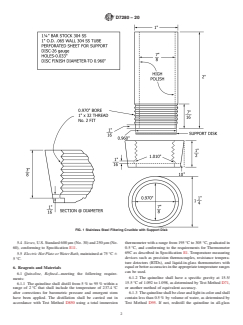
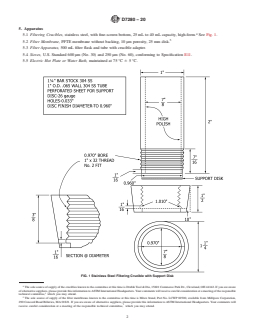
5.1 Filtering Crucibles, stainless steel, with fine-screen bottom, 25 mL to 40 mL capacity, high-form. See Fig. 1.
5.2 Filter Membrane, PFTE membrane without backing, 10 μm porosity, 25 mm disk.
5.3 Filter Apparatus, 500 mL filter flask and tube with crucible adapter.
5.4 Sieves, U.S. Standard 600 μm (No. 30) and 250 μm (No. 60), conforming to Specification E11.
5.5 Electric Hot Plate or Water Bath, maintained at 75 °C 6 5 °C.
FIG. 1 Stainless Steel Filtering Crucible with Support Disk
The sole source of supply of the crucibles known to the committee at this time is Drabik Tool & Die, 15601 Commerce Park Dr., Cleveland, OH 44142. If you are aware
of alternative suppliers, please provide this information to ASTM International Headquarters. Your comments will receive careful consideration at a meeting of the responsible
technical committee, which you may attend.
The sole source of supply of the filter membranes known to the committee at this time is Mitex brand, Part No. LCWP 02500, available from Millipore Corporation,
290 Concord Road Billerica, MA 01821. If you are aware of alternative suppliers, please provide this information to ASTM International Headquarters. Your comments will
receive careful consideration at a meeting of the responsible technical committee, which you may attend.
D7280 − 20
6. Reagents and Materials
6.1 Quinoline, Refined—meeting the following requirements:
6.1.1 The quinoline shall distill from 5 % to 95 % within a range of 2 °C that shall include the temperature of 237.4 °C after
corrections for barometric pressure and emergent stem have been applied. The distillation shall be carried out in accordance with
Test Method D850 using a total immersion thermometer with a range from 195 °C to 305 °C, graduated in 0.5 °C, and conforming
to the requirements for Thermometer 69C as described in Specification E1. Temperature measuring devices such as precision
thermocouples, resistance temperature detectors (RTDs), and liquid-in-glass thermometers with equal or better accuracies in the
appropriate temperature ranges can be used.
6.1.2 The quinoline shall have a specific gravity at 15.5/15.5 °C of 1.092 to 1.098, as determined by Test Method D71, or
another method of equivalent accuracy.
6.1.3 The quinoline shall be clear and light in color and shall contain less than 0.5 0.5 % by volume % of water, as determined
by Test Method D95. If not, redistill the quinoline in all-glass apparatus, discarding the first 5 % and collecting the next 90 %. If
the quinoline contains suspended matter but is clear, light in color, and contains less than 0.5 % water, filter the quinoline through
6,5
a crucible containing 5 g of diatomaceous earth filter aid.
6.1.4 Store the quinoline in a tightly closed, dark bottle.
6.2 Toluene, Industrial Pure, meeting Specification D362.
6.3 Acetone, meeting Specification D329.
6.4 Filter Aid—Dry to constant weight at 105 °C, and store in tightly stoppered container.
NOTE 1—Manville Certified Analytical Filter Aid (CAFA) or Supelco/Sigma Aldrich (CAFA II) Part #11485U were used in determining precision and
bias and were found to give acceptable filtration performance. Any other grade of filter aid may differ in filtration characteristics.
7. Hazards
7.1 Fumes of the solvents should be removed by means of proper hoods from all working areas.
7.2 The working area should be kept free of sparks and flames.
7.3 Quinoline fumes should not be inhaled, and prolonged contact with the skin should be avoided.
7.4 Toluene is toxic and flammable.
8. Bulk Sampling
8.1 Samples from shipments shall be taken in accordance with Practice D4296 and shall be free of foreign substances.
Thoroughly mix the sample immediately before removing a representative portion for the determination or for dehydration.
9. Dehydration of Sample
9.1 Hard Pitch—If the solid bulk sample contains free water, air-dry a representative portion in a forced draft oven at 50 °C.
9.2 Soft Pitch—If the presence of water is indicated by surface foam on heating, maintain a representative portion of the bulk
sample at a temperature between 125 °C and 150 °C in an open container until the surface is free of foam. Take care not to
overheat, and remove heat source immediately when foam subsides.
9.3 Tar—A wet tar sample may either be dehydrated or used as received as long as conditions stated in 9.3.1 and 9.3.3 are met.
9.3.1 Dehydrate a representative portion of the bulk sample at atmospheric pressure using a simple side-arm distillation
apparatus similar to the one in Test Method D850, and stop the distillation when the temperature reaches 170 °C.
9.3.2 Separate any oil from the water that has distilled over (if crystals are present, warm sufficiently to ensure their solution),
and thoroughly mix the oil with the residual tar in the still after the latter has cooled to a moderate temperature.
9.3.3 As an alternative to dehydration, the water content of the tar is determined by Test Method D95, and if the water content
is less than 10 mass %,10 % by mass, the QI content is corrected to a dry-tar basis (see 13.2). This alternative test method applies
only to stable emulsions of water in tar, that is, no water separates when the tar sample is left undisturbed for 24 h at room
temperature.
10. Preparation of Working Sample
10.1 Hard Pitch—If the pitch can be crushed at room temperature, prepare a 20 g working sample by suitable crushing, mixing,
and quartering of a representative portion of the dry sample. The crushing can be done with a small jaw crusher and a Mullite
mortar and pestle. No particle in the representative sample shall be larger than 5 mm in any dimension.
10.1.1 Crush this sample so that all of it will pass the 250 m250 μm (No. 60) sieve but will have a minimum of fine particles.
The sole source of supply of the diatomaceous earth filter aid known to the committee at this time is Celite, available from World Minerals, Santa Barbara, CA. If you
are aware of alternative suppliers, please provide this information to ASTM International Headquarters. Your comments will receive careful consideration at a meeting of
the responsible technical committee, which you may attend.
D7280 − 20
10.1.2 Store the sieved working sample in a tightly closed container, and use within 24 h (see 10.4).
10.2 Soft Pitch—If the pitch is too soft to grind and too sticky to mix, heat a representative portion of the dry sample to the
lowest temperature that will permit passage through the 600 μm (No. 30) sieve, taking care to avoid excessive loss of volatile
matter. Do not exceed 10 min for this melting period.
10.2.1 Pass the heated sample through the 600 μm (No. 30) sieve to remove foreign matter.
10.3 Tar—Heat a representative portion of the dry tar to the lowest tem
...