

ASTM C1902-22a
(Specification)Standard Specification for Cellular Glass Insulation Used in Building and Roof Applications
General Information
- Abstract
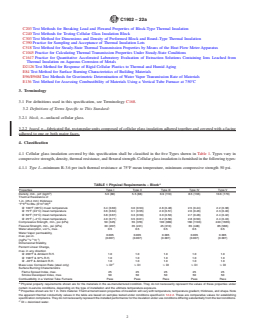
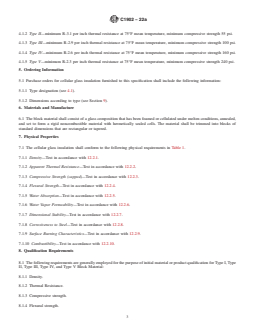
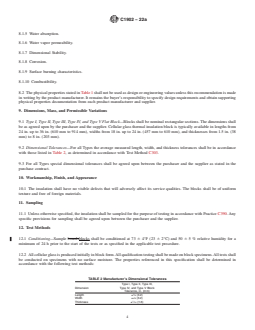
SCOPE
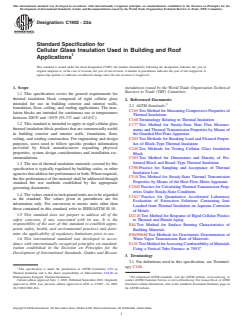
1.1 This specification covers the general requirements for thermal insulation block composed of rigid cellular glass intended for use in building exterior and interior walls, foundation, floor, ceiling, and roofing applications. The insulation blocks are intended for continuous use at temperatures between 200°F and −50°F (93.3°C and −45.6°C).
1.2 This standard is intended to apply to rigid cellular glass thermal insulation block products that are commercially useful in building exterior and interior walls, foundation, floor, ceiling, and roofing construction. For engineering and design purposes, users need to follow specific product information provided by block manufacturers regarding physical properties, system design considerations and installation recommendations.
1.3 The use of thermal insulation materials covered by this specification is typically regulated by building codes, or other agencies that address fire performance or both. Where required, the fire performance of the material shall be addressed through standard fire test methods established by the appropriate governing documents.
1.4 The values stated in inch-pound units are to be regarded as the standard. The values given in parentheses are for information only. For conversion to metric units other than those contained in this standard, refer to IEEE/ASTM SI 10.
1.5 This standard does not purport to address all of the safety concerns, if any, associated with its use. It is the responsibility of the user of this standard to establish appropriate safety, health, and environmental practices and determine the applicability of regulatory limitations prior to use.
1.6 This international standard was developed in accordance with internationally recognized principles on standardization established in the Decision on Principles for the Development of International Standards, Guides and Recommendations issued by the World Trade Organization Technical Barriers to Trade (TBT) Committee.
- Status
- Published
- Publication Date
- 31-Aug-2022
- Technical Committee
- C16 - Thermal Insulation
- Drafting Committee
- C16.20 - Homogeneous Inorganic Thermal Insulations
Buy Documents

ASTM C1902-22a - Standard Specification for Cellular Glass Insulation Used in Building and Roof Applications
REDLINE ASTM C1902-22a - Standard Specification for Cellular Glass Insulation Used in Building and Roof Applications
Overview
ASTM C1902-22a: Standard Specification for Cellular Glass Insulation Used in Building and Roof Applications establishes requirements for rigid cellular glass thermal insulation blocks intended for use in building exteriors and interiors. This standard specifies the physical and performance properties of cellular glass insulation blocks such as thermal resistance, compressive strength, water absorption, and fire performance, making it a key reference for manufacturers, suppliers, engineers, and construction professionals working with insulation solutions.
Cellular glass insulation covered by ASTM C1902-22a is suitable for applications in walls, foundations, floors, ceilings, and roofing, and is designed for continuous use at temperatures ranging from 200°F to −50°F (93.3°C to −45.6°C). Products are subject to building codes and may require fire performance verification according to established test methods.
Key Topics
- Material Composition: Rigid, noncombustible cellular glass formed by foaming and setting under molten conditions, resulting in hermetically sealed cells.
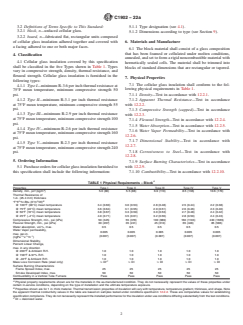
- Physical Properties: Includes density, thermal resistance, compressive strength, flexural strength, water absorption, vapor permeability, dimensional stability, and corrosion resistance. Each property is tested according to referenced ASTM test methods.
- Product Classification: Five types (I-V), each with specified minimum values for thermal resistance and compressive strength, catering to differing insulation needs and load requirements.
- Dimensional Standards: Standard blocks are typically 24–36 inches in length, 18–24 inches in width, and 1.5–8 inches in thickness, with precise tolerances to ensure reliable performance.
- Fire and Safety Considerations: Surface burning and combustibility characteristics are addressed, supporting compliance with fire safety regulations and building codes.
Applications
Cellular glass insulation specified by ASTM C1902-22a is widely used across various building and roofing applications due to its durability, low water absorption, noncombustibility, and stable thermal properties:
- Building Envelopes: Used in exterior and interior walls to provide energy-efficient thermal insulation and moisture resistance.
- Foundation and Under-Slab: Protects foundations and floors from temperature fluctuations, moisture intrusion, and helps prevent heat loss.
- Roofs: Commonly applied as roof insulation due to its compressive strength, fire resistance, and dimensional stability in varying conditions.
- Specialized Structures: Suitable for use in environments with temperature extremes or strict fire safety requirements, such as industrial facilities, cold storage, or green buildings.
- Continuous Insulation Systems: Often integrated into systems where uninterrupted insulation layers are required to meet high-performance energy codes.
Related Standards
ASTM C1902-22a references several other essential standards to ensure accurate measurement and quality consistency:
- ASTM C165: Test Method for Measuring Compressive Properties of Thermal Insulations
- ASTM C168: Terminology Relating to Thermal Insulation
- ASTM C177 / C518: Test Methods for Thermal Transmission Properties
- ASTM C203 / C240: Test Methods for Breaking Load, Flexural Properties, and Cellular Glass Block Testing
- ASTM C303: Test Method for Dimensions and Density of Preformed Insulation
- ASTM C390: Practice for Sampling and Acceptance of Thermal Insulation Lots
- ASTM E84: Test Method for Surface Burning Characteristics of Building Materials
- ASTM E96/E96M: Water Vapor Transmission Rate Test Methods
- ASTM E136: Combustibility Assessment in a Vertical Tube Furnace
Practical Value
Compliance with ASTM C1902-22a ensures that cellular glass insulation blocks used in building and roofing applications meet stringent quality, safety, and performance criteria. By adhering to this standard, stakeholders can:
- Specify products with predictable thermal performance and structural reliability
- Meet requirements for noncombustible, moisture-resistant insulation
- Streamline procurement and project approvals by referencing standardized test methods and classifications
- Address regulatory and building code mandates for fire and safety performance
Implementing products certified to ASTM C1902-22a supports sustainability, building integrity, and occupant safety in construction projects worldwide.
Relations
- Effective Date
- 15-Apr-2024
- Effective Date
- 01-Mar-2024
- Effective Date
- 01-Mar-2024
- Effective Date
- 01-Mar-2024
- Effective Date
- 01-Feb-2024
- Effective Date
- 01-Dec-2023
- Effective Date
- 15-Nov-2023
- Effective Date
- 01-Sep-2023
- Effective Date
- 01-Sep-2019
- Effective Date
- 01-Jul-2019
- Effective Date
- 01-May-2019
- Effective Date
- 15-Apr-2019
- Effective Date
- 01-Apr-2019
- Effective Date
- 01-Apr-2019
- Effective Date
- 01-Mar-2019
Buy Documents
ASTM C1902-22a - Standard Specification for Cellular Glass Insulation Used in Building and Roof Applications
REDLINE ASTM C1902-22a - Standard Specification for Cellular Glass Insulation Used in Building and Roof Applications
Get Certified
Connect with accredited certification bodies for this standard

DIBt (Deutsches Institut für Bautechnik)
German Institute for Building Technology.
DIN CERTCO
DIN Group product certification.

Aboma Certification B.V.
Specialized in construction, metal, and transport sectors.
Sponsored listings
Frequently Asked Questions
ASTM C1902-22a is a technical specification published by ASTM International. Its full title is "Standard Specification for Cellular Glass Insulation Used in Building and Roof Applications". This standard covers: SCOPE 1.1 This specification covers the general requirements for thermal insulation block composed of rigid cellular glass intended for use in building exterior and interior walls, foundation, floor, ceiling, and roofing applications. The insulation blocks are intended for continuous use at temperatures between 200°F and −50°F (93.3°C and −45.6°C). 1.2 This standard is intended to apply to rigid cellular glass thermal insulation block products that are commercially useful in building exterior and interior walls, foundation, floor, ceiling, and roofing construction. For engineering and design purposes, users need to follow specific product information provided by block manufacturers regarding physical properties, system design considerations and installation recommendations. 1.3 The use of thermal insulation materials covered by this specification is typically regulated by building codes, or other agencies that address fire performance or both. Where required, the fire performance of the material shall be addressed through standard fire test methods established by the appropriate governing documents. 1.4 The values stated in inch-pound units are to be regarded as the standard. The values given in parentheses are for information only. For conversion to metric units other than those contained in this standard, refer to IEEE/ASTM SI 10. 1.5 This standard does not purport to address all of the safety concerns, if any, associated with its use. It is the responsibility of the user of this standard to establish appropriate safety, health, and environmental practices and determine the applicability of regulatory limitations prior to use. 1.6 This international standard was developed in accordance with internationally recognized principles on standardization established in the Decision on Principles for the Development of International Standards, Guides and Recommendations issued by the World Trade Organization Technical Barriers to Trade (TBT) Committee.
SCOPE 1.1 This specification covers the general requirements for thermal insulation block composed of rigid cellular glass intended for use in building exterior and interior walls, foundation, floor, ceiling, and roofing applications. The insulation blocks are intended for continuous use at temperatures between 200°F and −50°F (93.3°C and −45.6°C). 1.2 This standard is intended to apply to rigid cellular glass thermal insulation block products that are commercially useful in building exterior and interior walls, foundation, floor, ceiling, and roofing construction. For engineering and design purposes, users need to follow specific product information provided by block manufacturers regarding physical properties, system design considerations and installation recommendations. 1.3 The use of thermal insulation materials covered by this specification is typically regulated by building codes, or other agencies that address fire performance or both. Where required, the fire performance of the material shall be addressed through standard fire test methods established by the appropriate governing documents. 1.4 The values stated in inch-pound units are to be regarded as the standard. The values given in parentheses are for information only. For conversion to metric units other than those contained in this standard, refer to IEEE/ASTM SI 10. 1.5 This standard does not purport to address all of the safety concerns, if any, associated with its use. It is the responsibility of the user of this standard to establish appropriate safety, health, and environmental practices and determine the applicability of regulatory limitations prior to use. 1.6 This international standard was developed in accordance with internationally recognized principles on standardization established in the Decision on Principles for the Development of International Standards, Guides and Recommendations issued by the World Trade Organization Technical Barriers to Trade (TBT) Committee.
ASTM C1902-22a is classified under the following ICS (International Classification for Standards) categories: 91.100.60 - Thermal and sound insulating materials. The ICS classification helps identify the subject area and facilitates finding related standards.
ASTM C1902-22a has the following relationships with other standards: It is inter standard links to ASTM C168-24, ASTM E136-24a, ASTM C390-08(2024), ASTM E96/E96M-24, ASTM E136-24, ASTM E84-23d, ASTM E96/E96M-23, ASTM E84-23c, ASTM C390-08(2019), ASTM E84-19b, ASTM C1617-19, ASTM E84-19a, ASTM C240-19, ASTM C1045-19, ASTM E84-19. Understanding these relationships helps ensure you are using the most current and applicable version of the standard.
ASTM C1902-22a is available in PDF format for immediate download after purchase. The document can be added to your cart and obtained through the secure checkout process. Digital delivery ensures instant access to the complete standard document.
Standards Content (Sample)
This international standard was developed in accordance with internationally recognized principles on standardization established in the Decision on Principles for the
Development of International Standards, Guides and Recommendations issued by the World Trade Organization Technical Barriers to Trade (TBT) Committee.
Designation:C1902 −22a
Standard Specification for
Cellular Glass Insulation Used in Building and Roof
Applications
This standard is issued under the fixed designation C1902; the number immediately following the designation indicates the year of
original adoption or, in the case of revision, the year of last revision.Anumber in parentheses indicates the year of last reapproval.A
superscript epsilon (´) indicates an editorial change since the last revision or reapproval.
1. Scope mendations issued by the World Trade Organization Technical
Barriers to Trade (TBT) Committee.
1.1 This specification covers the general requirements for
thermal insulation block composed of rigid cellular glass
2. Referenced Documents
intended for use in building exterior and interior walls,
2.1 ASTM Standards:
foundation, floor, ceiling, and roofing applications. The insu-
C165TestMethodforMeasuringCompressivePropertiesof
lation blocks are intended for continuous use at temperatures
Thermal Insulations
between 200°F and −50°F (93.3°C and −45.6°C).
C168Terminology Relating to Thermal Insulation
1.2 This standard is intended to apply to rigid cellular glass
C177Test Method for Steady-State Heat Flux Measure-
thermal insulation block products that are commercially useful
ments and Thermal Transmission Properties by Means of
in building exterior and interior walls, foundation, floor,
the Guarded-Hot-Plate Apparatus
ceiling, and roofing construction. For engineering and design
C203Test Methods for Breaking Load and Flexural Proper-
purposes, users need to follow specific product information
ties of Block-Type Thermal Insulation
provided by block manufacturers regarding physical
C240Test Methods for Testing Cellular Glass Insulation
properties, system design considerations and installation rec-
Block
ommendations.
C303Test Method for Dimensions and Density of Pre-
formed Block and Board–Type Thermal Insulation
1.3 The use of thermal insulation materials covered by this
C390Practice for Sampling and Acceptance of Thermal
specification is typically regulated by building codes, or other
Insulation Lots
agenciesthataddressfireperformanceorboth.Whererequired,
C518Test Method for Steady-State Thermal Transmission
the fire performance of the material shall be addressed through
Properties by Means of the Heat Flow Meter Apparatus
standard fire test methods established by the appropriate
C1045Practice for Calculating Thermal Transmission Prop-
governing documents.
erties Under Steady-State Conditions
1.4 The values stated in inch-pound units are to be regarded
C1617Practice for Quantitative Accelerated Laboratory
as the standard. The values given in parentheses are for
Evaluation of Extraction Solutions Containing Ions
information only. For conversion to metric units other than
Leached from Thermal Insulation on Aqueous Corrosion
those contained in this standard, refer to IEEE/ASTM SI 10.
of Metals
1.5 This standard does not purport to address all of the
D2126Test Method for Response of Rigid Cellular Plastics
safety concerns, if any, associated with its use. It is the
to Thermal and Humid Aging
responsibility of the user of this standard to establish appro-
E84Test Method for Surface Burning Characteristics of
priate safety, health, and environmental practices and deter-
Building Materials
mine the applicability of regulatory limitations prior to use.
E96/E96MTest Methods for Gravimetric Determination of
1.6 This international standard was developed in accor-
Water Vapor Transmission Rate of Materials
dance with internationally recognized principles on standard-
E136TestMethodforAssessingCombustibilityofMaterials
ization established in the Decision on Principles for the
Using a Vertical Tube Furnace at 750°C
Development of International Standards, Guides and Recom-
3. Terminology
3.1 For definitions used in this specification, see Terminol-
ogy C168.
This specification is under the jurisdiction of ASTM Committee C16 on
Thermal Insulation and is the direct responsibility of Subcommittee C16.20 on
Homogeneous Inorganic Thermal Insulations. For referenced ASTM standards, visit the ASTM website, www.astm.org, or
Current edition approved Sept. 1, 2022. Published September 2022. Originally contact ASTM Customer Service at service@astm.org. For Annual Book of ASTM
approved in 2020. Last previous edition approved in 2022 as C1902–22. DOI: Standards volume information, refer to the standard’s Document Summary page on
10.1520/C1902-22A. the ASTM website.
Copyright © ASTM International, 100 Barr Harbor Drive, PO Box C700, West Conshohocken, PA 19428-2959. United States
C1902−22a
3.2 Definitions of Terms Specific to This Standard: 5.1.1 Type designation (see 4.1).
3.2.1 block, n—unfaced cellular glass.
5.1.2 Dimensions according to type (see Section 9).
3.2.2 board, n—fabricated flat, rectangular units composed
6. Materials and Manufacture
of cellular glass insulation adhered together and covered with
a facing adhered to one or both major faces.
6.1 The block material shall consist of a glass composition
that has been foamed or cellulated under molten conditions,
4. Classification
annealed, and set to form a rigid noncombustible material with
4.1 Cellular glass insulation covered by this specification
hermetically sealed cells. The material shall be trimmed into
shall be classified in the five Types shown in Table 1. Types
blocks of standard dimensions that are rectangular or tapered.
vary in compressive strength, density, thermal resistance, and
flexural strength. Cellular glass insulation is furnished in the
7. Physical Properties
following types:
7.1 The cellular glass insulation shall conform to the fol-
4.1.1 Type I—minimumR-3.6perinchthermalresistanceat
lowing physical requirements in Table 1.
75°F mean temperature, minimum compressive strength 50
7.1.1 Density—Test in accordance with 12.2.1.
psi.
4.1.2 Type II—minimum R-3.1 per inch thermal resistance
7.1.2 Apparent Thermal Resistance—Test in accordance
at 75°F mean temperature, minimum compressive strength 55 with 12.2.2.
psi.
7.1.3 Compressive Strength (capped)—Test in accordance
4.1.3 Type III—minimum R-2.9 per inch thermal resistance
with 12.2.3.
at75°Fmeantemperature,minimumcompressivestrength100
7.1.4 Flexural Strength—Test in accordance with 12.2.4.
psi.
7.1.5 Water Absorption—Test in accordance with 12.2.5.
4.1.4 Type IV—minimum R-2.6 per inch thermal resistance
7.1.6 Water Vapor Permeability—Test in accordance with
at75°Fmeantemperature,minimumcompressivestrength160
12.2.6.
psi.
7.1.7 Dimensional Stability—Test in accordance with
4.1.5 Type V—minimum R-2.3 per inch thermal resistance
12.2.7.
at75°Fmeantemperature,minimumcompressivestrength240
7.1.8 Corrosiveness to Steel—Test in accordance with
psi.
12.2.8.
5. Ordering Information
7.1.9 Surface Burning Characteristics—Test in accordance
with 12.2.9.
5.1 Purchaseordersforcellularglassinsulationfurnishedto
this specification shall include the following information: 7.1.10 Combustibility—Test in accordance with 12.2.10.
A
TABLE 1 Physical Requirements – Block
Properties Type I Type II Type III Type IV Type V
Density, min., pcf (kg/m ) 5.0 (80) 5.5 (88) 6.9 (110) 8.5 (136) 10.6 (170)
Thermal Resistance of
1-in. (25.4 mm) thickness
2 2 B
°F*ft *hr./Btu (K*m /W)
@ 100°F (38°C) mean temperature 3.4 (0.60) 3.0 (0.53) 2.8 (0.48) 2.5 (0.44) 2.2 (0.38)
@ 75°F (24°C) mean temperature 3.6 (0.64) 3.1 (0.55) 2.9 (0.51) 2.6 (0.46) 2.3 (0.40)
@ 50°F (10°C) mean temperature 3.8 (0.67) 3.3 (0.59) 3.0 (0.53) 2.7 (0.48) 2.4 (0.42)
@ 25°F (–4°C) mean temperature 4.0 (0.71) 3.5 (0.61) 3.2 (0.56) 2.8 (0.50) 2.4 (0.43)
Compressive Strength, min., psi (kPa) 50 (345) 55 (379) 100 (689) 160 (1103) 240 (1665)
Flexural Strength, min., psi (kPa) 30 (207) 35 (241) 45 (310) 65 (448) 85 (586)
Water absorption, vol.%, max. 0.5 0.5 0.5 0.5 0.5
Water Vapor permeability,
0.005 0.005 0.005 0.005 0.005
max. per-in.
(0.007) (0.007) (0.007) (0.007) (0.007)
-1 -1 -1
(ngPa *s *m )
Dimensional Stability,
Percent Linear Change,
max. in any direction
@ 200°F & Ambient R.H. 1.0 1.0 1.0 1.0 1.0
@ 158°F & 97% R.H. 1.0 1.0 1.0 1.0 1.0
@ -40°F & Ambient R.H. 1.0 1.0 1.0 1.0 1.0
C
Mass Loss Corrosion Rate (steel only) # DI # DI # DI # DI # DI
Surface Burning Characteristics
Flame Spread Index, max. 25 25 25 25 25
Smoke Developed Index, max. 50 50 50 50 50
Combustibility in a Vertical Tube Furnace Pass Pass Pass Pass Pass
A
Physical property requirements shown are for the materials in the as-manufactured condition. They do not necessarily represent the values of these properties under
certain in-service conditions, depending on the type of installation and the ultimate temperature exposure.
B
Properties shown are for 1
...
This document is not an ASTM standard and is intended only to provide the user of an ASTM standard an indication of what changes have been made to the previous version. Because
it may not be technically possible to adequately depict all changes accurately, ASTM recommends that users consult prior editions as appropriate. In all cases only the current version
of the standard as published by ASTM is to be considered the official document.
Designation: C1902 − 22 C1902 − 22a
Standard Specification for
Cellular Glass Insulation Used in Building and Roof
Applications
This standard is issued under the fixed designation C1902; the number immediately following the designation indicates the year of
original adoption or, in the case of revision, the year of last revision. A number in parentheses indicates the year of last reapproval. A
superscript epsilon (´) indicates an editorial change since the last revision or reapproval.
1. Scope
1.1 This specification covers the general requirements for thermal insulation block composed of rigid cellular glass intended for
use in building exterior and interior walls, foundation, floor, ceiling, and roofing applications. The insulation blocks are intended
for continuous use at temperatures between 200°F and −50°F (93.3°C and −45.6°C).
1.2 This standard is intended to apply to rigid cellular glass thermal insulation block products that are commercially useful in
building exterior and interior walls, foundation, floor, ceiling, and roofing construction. For engineering and design purposes, users
need to follow specific product information provided by block manufacturers regarding physical properties, system design
considerations and installation recommendations.
1.3 The use of thermal insulation materials covered by this specification is typically regulated by building codes, or other agencies
that address fire performance or both. Where required, the fire performance of the material shall be addressed through standard fire
test methods established by the appropriate governing documents.
1.4 The values stated in inch-pound units are to be regarded as the standard. The values given in parentheses are for information
only. For conversion to metric units other than those contained in this standard, refer to IEEE/ASTM SI 10.
1.5 This standard does not purport to address all of the safety concerns, if any, associated with its use. It is the responsibility
of the user of this standard to establish appropriate safety, health, and environmental practices and determine the applicability of
regulatory limitations prior to use.
1.6 This international standard was developed in accordance with internationally recognized principles on standardization
established in the Decision on Principles for the Development of International Standards, Guides and Recommendations issued
by the World Trade Organization Technical Barriers to Trade (TBT) Committee.
2. Referenced Documents
2.1 ASTM Standards:
C165 Test Method for Measuring Compressive Properties of Thermal Insulations
C168 Terminology Relating to Thermal Insulation
C177 Test Method for Steady-State Heat Flux Measurements and Thermal Transmission Properties by Means of the
Guarded-Hot-Plate Apparatus
This specification is under the jurisdiction of ASTM Committee C16 on Thermal Insulation and is the direct responsibility of Subcommittee C16.20 on Homogeneous
Inorganic Thermal Insulations.
Current edition approved March 1, 2022Sept. 1, 2022. Published April 2022September 2022. Originally approved in 2020. Last previous edition approved in 20202022
as C1902 – 20.C1902 – 22. DOI: 10.1520/C1902-22.10.1520/C1902-22A.
For referenced ASTM standards, visit the ASTM website, www.astm.org, or contact ASTM Customer Service at service@astm.org. For Annual Book of ASTM Standards
volume information, refer to the standard’s Document Summary page on the ASTM website.
Copyright © ASTM International, 100 Barr Harbor Drive, PO Box C700, West Conshohocken, PA 19428-2959. United States
C1902 − 22a
C203 Test Methods for Breaking Load and Flexural Properties of Block-Type Thermal Insulation
C240 Test Methods for Testing Cellular Glass Insulation Block
C303 Test Method for Dimensions and Density of Preformed Block and Board–Type Thermal Insulation
C390 Practice for Sampling and Acceptance of Thermal Insulation Lots
C518 Test Method for Steady-State Thermal Transmission Properties by Means of the Heat Flow Meter Apparatus
C1045 Practice for Calculating Thermal Transmission Properties Under Steady-State Conditions
C1617 Practice for Quantitative Accelerated Laboratory Evaluation of Extraction Solutions Containing Ions Leached from
Thermal Insulation on Aqueous Corrosion of Metals
D2126 Test Method for Response of Rigid Cellular Plastics to Thermal and Humid Aging
E84 Test Method for Surface Burning Characteristics of Building Materials
E96/E96M Test Methods for Gravimetric Determination of Water Vapor Transmission Rate of Materials
E136 Test Method for Assessing Combustibility of Materials Using a Vertical Tube Furnace at 750°C
3. Terminology
3.1 For definitions used in this specification, see Terminology C168.
3.2 Definitions of Terms Specific to This Standard:
3.2.1 block, n—unfaced cellular glass.
3.2.2 board, n—fabricated flat, rectangular units composed of cellular glass insulation adhered together and covered with a facing
adhered to one or both major faces.
4. Classification
4.1 Cellular glass insulation covered by this specification shall be classified in the five Types shown in Table 1. Types vary in
compressive strength, density, thermal resistance, and flexural strength. Cellular glass insulation is furnished in the following types:
4.1.1 Type I—minimum R-3.6 per inch thermal resistance at 75°F mean temperature, minimum compressive strength 50 psi.
A
TABLE 1 Physical Requirements – Block
Properties Type I Type II Type III Type IV Type V
Density, min., pcf (kg/m ) 5.0 (80) 5.5 (88) 6.9 (110) 8.5 (136) 10.6 (170)
Thermal Resistance of
1-in. (25.4 mm) thickness
2 2 B
°F*ft *hr./Btu (K*m /W)
@ 100°F (38°C) mean temperature 3.4 (0.60) 3.0 (0.53) 2.8 (0.48) 2.5 (0.44) 2.2 (0.38)
@ 75°F (24°C) mean temperature 3.6 (0.64) 3.1 (0.55) 2.9 (0.51) 2.6 (0.46) 2.3 (0.40)
@ 50°F (10°C) mean temperature 3.8 (0.67) 3.3 (0.59) 3.0 (0.53) 2.7 (0.48) 2.4 (0.42)
@ 25°F (–4°C) mean temperature 4.0 (0.71) 3.5 (0.61) 3.2 (0.56) 2.8 (0.50) 2.4 (0.43)
Compressive Strength, min., psi (kPa) 50 (345) 55 (379) 100 (689) 160 (1103) 240 (1665)
Flexural Strength, min., psi (kPa) 30 (207) 35 (241) 45 (310) 65 (448) 85 (586)
Water absorption, vol.%, max. 0.5 0.5 0.5 0.5 0.5
Water Vapor permeability,
0.005 0.005 0.005 0.005 0.005
max. per-in.
(0.007) (0.007) (0.007) (0.007) (0.007)
-1 -1 -1
(ngPa *s *m )
Dimensional Stability,
Percent Linear Change,
max. in any direction
@ 200°F & Ambient R.H. 1.0 1.0 1.0 1.0 1.0
@ 158°F & 97% R.H. 1.0 1.0 1.0 1.0 1.0
@ -40°F & Ambient R.H. 1.0 1.0 1.0 1.0 1.0
C
Mass Loss Corrosion Rate (steel only) # DI # DI # DI # DI # DI
Surface Burning Characteristics
Flame Spread Index, max. 25 25 25 25 25
Smoke Developed Index, max. 50 50 50 50 50
Combustibility in a Vertical Tube Furnace Pass Pass Pass Pass Pass
A
Physical property requirements shown are for the materials in the as-manufactured condition. They do not necessarily represent the values of these properties under
certain in-service conditions, depending on the type of installation and the ultimate temperature exposure.
B
Properties shown are for 1 in. thick material. Thermal transmission properties of insulation will vary with temperature, temperature gradient, thickness, and shape. Note
the apparent thermal conductivity values in the table are based on samples tested under conditions specified in 12.2.2. These are comparative values for establishing
specification compliance. They do not necessarily represent the installed performance for the insulation under use conditions differing substantially from the test conditions.
C
DI = deionized water.
C1902 − 22a
4.1.2 Type II—minimum R-3.1 per inch thermal resistance at 75°F mean temperature, minimum compressive strength 55 psi.
4.1.3 Type III—minimum R-2.9 per inch thermal resistance at 75°F mean temperature, minimum compressive strength 100 psi.
4.1.4 Type IV—minimum R-2.6 per inch thermal resistance at 75°F mean temperature, minimum compressive strength 160 psi.
4.1.5 Type V—minimum R-2.3 per inch thermal resistance at 75°F mean temperature, minimum compressive strength 240 psi.
5. Ordering Information
5.1 Purchase orders for cellular glass insulation furnished to this specification shall include the following information:
5.1.1 Type designation (see 4.1).
5.1.2 Dimensions according to type (see Section 9).
6. Materials and Manufacture
6.1 The block material shall consist of a glass composition that has been foamed or cellulated under molten conditions, annealed,
and set to form a rigid noncombustible material with hermetically sealed cells. The material shall be trimmed into blocks of
standard dimensions that are rectangular or tapered.
7. Physical Properties
7.1 The cellular glass insulation shall conform to the following physical requirements in Table 1.
7.1.1 Density—Test in accordance with 12.2.1.
7.1.2 Apparent Thermal Re
...