

ASTM D3212-21
(Specification)Standard Specification for Joints for Drain and Sewer Plastic Pipes Using Flexible Elastomeric Seals
General Information
- Abstract
ABSTRACT
This specification covers joints for plastic pipe systems intended for drain, and gravity sewerage pipe at internal or external pressures less than a certain ft. head using flexible watertight elastomeric seals. The joints are classified into two types based on effecting watertightness through compression of an elastomeric seal or ring: push-on-joint is a joint in which an elastomeric ring gasket is compressed in the annular space between a bell end or socket and a spigot end of pipe and mechanical joint is a joint made using mechanical means or devices to develop a pressure seal. Joints shall not leak when subjected to the internal and external hydrostatic tests. All surfaces of the joint upon or against which the gasket bears shall be smooth and free of cracks, fractures, or imperfections. The gasket shall be the sole element depended upon to make the joint flexible and watertight. The gasket shall be a continuous elastomeric ring. In mechanical joints, the pipe spigot shall have a wall thickness sufficient to withstand, without deformation or collapse, the compressive force exerted when the fitting is tightened. Some joint designs provide for the angular deflection of a pipe joint, without reducing watertightness. Where greater deflections are required than permitted by the joint design, suitable fittings must be provided. The joint components shall be of such design that they will withstand the forces caused by the compression of the gasket when joined without cracking or fracturing when tested. Dimensions of joint components and gaskets shall meet the requirements specified. Test methods such as internal pressure test and vacuum test shall be performed.
SCOPE
1.1 This specification covers joints for plastic pipe systems intended for drain, and gravity sewerage pipe at internal or external pressures less than 25-ft head using flexible watertight elastomeric seals. This specification is intended to cover the test requirements, test methods, and acceptable materials. The test methods described for the joints are not intended to be routine quality control tests but to be reliability or performance requirements.
1.2 The text of this specification references notes, footnotes, and appendixes which provide explanatory material. These notes and footnotes (excluding those in tables and figures) shall not be considered as requirements of the specification.
1.3 The following safety hazards caveat pertains only to the test method portion, paragraph 7.5, of this specification: This standard does not purport to address all of the safety concerns, if any, associated with its use. It is the responsibility of the user of this standard to establish appropriate safety, health, and environmental practices and determine the applicability of regulatory limitations prior to use.
1.4 This international standard was developed in accordance with internationally recognized principles on standardization established in the Decision on Principles for the Development of International Standards, Guides and Recommendations issued by the World Trade Organization Technical Barriers to Trade (TBT) Committee.
- Status
- Published
- Publication Date
- 30-Nov-2021
- Technical Committee
- F17 - Plastic Piping Systems
- Drafting Committee
- F17.20 - Joining
Buy Documents


ASTM D3212-21 - Standard Specification for Joints for Drain and Sewer Plastic Pipes Using Flexible Elastomeric Seals

REDLINE ASTM D3212-21 - Standard Specification for Joints for Drain and Sewer Plastic Pipes Using Flexible Elastomeric Seals
Overview
ASTM D3212-21: Standard Specification for Joints for Drain and Sewer Plastic Pipes Using Flexible Elastomeric Seals establishes requirements for the performance, materials, and testing of joints in plastic pipe systems intended for drainage and gravity sewer applications. This standard, published by ASTM International, focuses on achieving watertight reliability by using flexible elastomeric seals in joints subject to internal or external pressures of less than 25 feet of head. The specification is relevant for push-on and mechanical joints for plastic pipes commonly used in underground infrastructure, ensuring long-term durability, flexibility, and watertightness.
Key Topics
- Scope and Purpose: ASTM D3212-21 applies to joints for plastic drain and gravity sewer pipes using flexible elastomeric sealing rings. It outlines material, testing, and dimensional requirements to ensure watertight joints under low-pressure scenarios.
- Joint Types: The standard addresses two main joint types:
- Push-on Joint: Features an elastomeric gasket compressed between the pipe’s bell and spigot ends.
- Mechanical Joint: Relies on mechanical means or devices to compress the gasket, creating a pressure-resistant seal.
- Material Requirements: Elastomeric gaskets must comply with ASTM F477 or F913. Lubricants used in installation must not adversely affect gasket or pipe material integrity.
- Performance Testing: The specification includes hydrostatic and vacuum tests for joint watertightness:
- Internal Pressure Test: Assembled joints must sustain a specific internal water pressure for a set duration without leaking.
- Vacuum Test: Assembled joints must also maintain vacuum pressure, with minimal change over the test period, to ensure air-tight sealing.
- Dimensional and Surface Quality: All bearing surfaces and components in the joint must be smooth and defect-free. Gaskets are required to be continuous rings and the only sealing component.
- Deflection Tolerance: Some joint designs tolerate angular or linear deflection without loss of watertightness; if greater deflection is needed, additional fittings may be required.
Applications
ASTM D3212-21 is widely used in the design, manufacture, and installation of underground drainage and sewerage systems utilizing thermoplastic pipes such as PVC or HDPE. The specification is applicable in:
- Municipal Drainage Systems: Ensures reliable watertight sealing for sanitary and stormwater sewers.
- Civil Infrastructure Projects: Used in residential, commercial, and industrial developments where robust, flexible pipe joints are required.
- Pipeline Installation and Maintenance: Provides guidance for qualifying pipe joints in both new construction and rehabilitation of existing sewer installations.
- Quality Assurance and Inspection: Offers a framework for verifying joint integrity and seal performance through standardized test methods.
This standard supports long-lasting and leak-resistant connections, essential for protecting the environment, reducing infiltration/exfiltration, and minimizing maintenance costs.
Related Standards
ASTM D3212-21 references and is complemented by several related ASTM standards to address different aspects of plastic pipe joint performance and elastomeric seals:
- ASTM F477: Specification for Elastomeric Seals (Gaskets) for Joining Plastic Pipe
- ASTM F913: Specification for Thermoplastic Elastomeric Seals (Gaskets) for Joining Plastic Pipe
- ASTM D1598: Test Method for Time-to-Failure of Plastic Pipe Under Constant Internal Pressure
- ASTM D2122: Test Method for Determining Dimensions of Thermoplastic Pipe and Fittings
- ASTM F1674: Test Method for Joint Restraint Products for Use with PVC Pipe
Organizations adopting ASTM D3212-21 often reference these standards to ensure comprehensive compliance with material properties, mechanical integrity, and dimensional requirements, contributing to the reliability and sustainability of plastic piping systems.
Keywords: ASTM D3212-21, plastic pipe joints, elastomeric seals, drainage pipe, sewer pipe, watertight joints, push-on joints, mechanical joints, ASTM standards, plastic piping systems.
Relations
- Refers
ASTM D2122-15 - Standard Test Method for Determining Dimensions of Thermoplastic Pipe and Fittings - Effective Date
- 15-Mar-2015
- Refers
ASTM F477-10 - Standard Specification for Elastomeric Seals (Gaskets) for Joining Plastic Pipe - Effective Date
- 15-Mar-2010
- Effective Date
- 01-Feb-2010
- Effective Date
- 01-Nov-2008
- Refers
ASTM F477-08 - Standard Specification for Elastomeric Seals (Gaskets) for Joining Plastic Pipe - Effective Date
- 01-Jul-2008
- Refers
ASTM F477-07 - Standard Specification for Elastomeric Seals (Gaskets) for Joining Plastic Pipe - Effective Date
- 15-Apr-2007
- Effective Date
- 01-Sep-2004
- Effective Date
- 10-Sep-2002
- Effective Date
- 10-Sep-2002
- Refers
ASTM F477-02e1 - Standard Specification for Elastomeric Seals (Gaskets) for Joining Plastic Pipe - Effective Date
- 10-May-2002
- Refers
ASTM F477-99 - Standard Specification for Elastomeric Seals (Gaskets) for Joining Plastic Pipe - Effective Date
- 10-Apr-1999
- Refers
ASTM D2122-98 - Standard Test Method for Determining Dimensions of Thermoplastic Pipe and Fittings - Effective Date
- 10-Apr-1998
- Refers
ASTM D2122-98e1 - Standard Test Method for Determining Dimensions of Thermoplastic Pipe and Fittings - Effective Date
- 10-Apr-1997
Buy Documents
ASTM D3212-21 - Standard Specification for Joints for Drain and Sewer Plastic Pipes Using Flexible Elastomeric Seals
REDLINE ASTM D3212-21 - Standard Specification for Joints for Drain and Sewer Plastic Pipes Using Flexible Elastomeric Seals
Get Certified
Connect with accredited certification bodies for this standard

Institut za varilstvo d.o.o. (Welding Institute)
Slovenia's leading welding institute since 1952. ISO 3834, EN 1090, pressure equipment certification, NDT personnel, welder qualification. Only IIW Au
Sponsored listings
Frequently Asked Questions
ASTM D3212-21 is a technical specification published by ASTM International. Its full title is "Standard Specification for Joints for Drain and Sewer Plastic Pipes Using Flexible Elastomeric Seals". This standard covers: ABSTRACT This specification covers joints for plastic pipe systems intended for drain, and gravity sewerage pipe at internal or external pressures less than a certain ft. head using flexible watertight elastomeric seals. The joints are classified into two types based on effecting watertightness through compression of an elastomeric seal or ring: push-on-joint is a joint in which an elastomeric ring gasket is compressed in the annular space between a bell end or socket and a spigot end of pipe and mechanical joint is a joint made using mechanical means or devices to develop a pressure seal. Joints shall not leak when subjected to the internal and external hydrostatic tests. All surfaces of the joint upon or against which the gasket bears shall be smooth and free of cracks, fractures, or imperfections. The gasket shall be the sole element depended upon to make the joint flexible and watertight. The gasket shall be a continuous elastomeric ring. In mechanical joints, the pipe spigot shall have a wall thickness sufficient to withstand, without deformation or collapse, the compressive force exerted when the fitting is tightened. Some joint designs provide for the angular deflection of a pipe joint, without reducing watertightness. Where greater deflections are required than permitted by the joint design, suitable fittings must be provided. The joint components shall be of such design that they will withstand the forces caused by the compression of the gasket when joined without cracking or fracturing when tested. Dimensions of joint components and gaskets shall meet the requirements specified. Test methods such as internal pressure test and vacuum test shall be performed. SCOPE 1.1 This specification covers joints for plastic pipe systems intended for drain, and gravity sewerage pipe at internal or external pressures less than 25-ft head using flexible watertight elastomeric seals. This specification is intended to cover the test requirements, test methods, and acceptable materials. The test methods described for the joints are not intended to be routine quality control tests but to be reliability or performance requirements. 1.2 The text of this specification references notes, footnotes, and appendixes which provide explanatory material. These notes and footnotes (excluding those in tables and figures) shall not be considered as requirements of the specification. 1.3 The following safety hazards caveat pertains only to the test method portion, paragraph 7.5, of this specification: This standard does not purport to address all of the safety concerns, if any, associated with its use. It is the responsibility of the user of this standard to establish appropriate safety, health, and environmental practices and determine the applicability of regulatory limitations prior to use. 1.4 This international standard was developed in accordance with internationally recognized principles on standardization established in the Decision on Principles for the Development of International Standards, Guides and Recommendations issued by the World Trade Organization Technical Barriers to Trade (TBT) Committee.
ABSTRACT This specification covers joints for plastic pipe systems intended for drain, and gravity sewerage pipe at internal or external pressures less than a certain ft. head using flexible watertight elastomeric seals. The joints are classified into two types based on effecting watertightness through compression of an elastomeric seal or ring: push-on-joint is a joint in which an elastomeric ring gasket is compressed in the annular space between a bell end or socket and a spigot end of pipe and mechanical joint is a joint made using mechanical means or devices to develop a pressure seal. Joints shall not leak when subjected to the internal and external hydrostatic tests. All surfaces of the joint upon or against which the gasket bears shall be smooth and free of cracks, fractures, or imperfections. The gasket shall be the sole element depended upon to make the joint flexible and watertight. The gasket shall be a continuous elastomeric ring. In mechanical joints, the pipe spigot shall have a wall thickness sufficient to withstand, without deformation or collapse, the compressive force exerted when the fitting is tightened. Some joint designs provide for the angular deflection of a pipe joint, without reducing watertightness. Where greater deflections are required than permitted by the joint design, suitable fittings must be provided. The joint components shall be of such design that they will withstand the forces caused by the compression of the gasket when joined without cracking or fracturing when tested. Dimensions of joint components and gaskets shall meet the requirements specified. Test methods such as internal pressure test and vacuum test shall be performed. SCOPE 1.1 This specification covers joints for plastic pipe systems intended for drain, and gravity sewerage pipe at internal or external pressures less than 25-ft head using flexible watertight elastomeric seals. This specification is intended to cover the test requirements, test methods, and acceptable materials. The test methods described for the joints are not intended to be routine quality control tests but to be reliability or performance requirements. 1.2 The text of this specification references notes, footnotes, and appendixes which provide explanatory material. These notes and footnotes (excluding those in tables and figures) shall not be considered as requirements of the specification. 1.3 The following safety hazards caveat pertains only to the test method portion, paragraph 7.5, of this specification: This standard does not purport to address all of the safety concerns, if any, associated with its use. It is the responsibility of the user of this standard to establish appropriate safety, health, and environmental practices and determine the applicability of regulatory limitations prior to use. 1.4 This international standard was developed in accordance with internationally recognized principles on standardization established in the Decision on Principles for the Development of International Standards, Guides and Recommendations issued by the World Trade Organization Technical Barriers to Trade (TBT) Committee.
ASTM D3212-21 is classified under the following ICS (International Classification for Standards) categories: 23.040.20 - Plastics pipes. The ICS classification helps identify the subject area and facilitates finding related standards.
ASTM D3212-21 has the following relationships with other standards: It is inter standard links to ASTM D2122-15, ASTM F477-10, ASTM D2122-98(2010), ASTM F913-02(2008), ASTM F477-08, ASTM F477-07, ASTM D2122-98(2004), ASTM F913-02, ASTM F913-02e1, ASTM F477-02e1, ASTM F477-99, ASTM D2122-98, ASTM D2122-98e1. Understanding these relationships helps ensure you are using the most current and applicable version of the standard.
ASTM D3212-21 is available in PDF format for immediate download after purchase. The document can be added to your cart and obtained through the secure checkout process. Digital delivery ensures instant access to the complete standard document.
Standards Content (Sample)
This international standard was developed in accordance with internationally recognized principles on standardization established in the Decision on Principles for the
Development of International Standards, Guides and Recommendations issued by the World Trade Organization Technical Barriers to Trade (TBT) Committee.
Designation: D3212 −21 An American National Standard
Standard Specification for
Joints for Drain and Sewer Plastic Pipes Using Flexible
Elastomeric Seals
This standard is issued under the fixed designation D3212; the number immediately following the designation indicates the year of
original adoption or, in the case of revision, the year of last revision. A number in parentheses indicates the year of last reapproval. A
superscript epsilon (´) indicates an editorial change since the last revision or reapproval.
This standard has been approved for use by agencies of the U.S. Department of Defense.
1. Scope* F477 Specification for Elastomeric Seals (Gaskets) for Join-
ing Plastic Pipe
1.1 This specification covers joints for plastic pipe systems
F913 Specification for Thermoplastic Elastomeric Seals
intended for drain, and gravity sewerage pipe at internal or
(Gaskets) for Joining Plastic Pipe
external pressures less than 25-ft head using flexible watertight
elastomeric seals. This specification is intended to cover the
3. Types
test requirements, test methods, and acceptable materials. The
3.1 This specification covers two types of joints based on
test methods described for the joints are not intended to be
effectingwatertightnessthroughcompressionofanelastomeric
routine quality control tests but to be reliability or performance
seal or ring:
requirements.
3.1.1 Push-on Joint—A joint in which an elastomeric ring
1.2 The text of this specification references notes, footnotes,
gasket is compressed in the annular space between a bell end
and appendixes which provide explanatory material. These
or socket and a spigot end of pipe.
notesandfootnotes(excludingthoseintablesandfigures)shall
3.1.2 Mechanical Joint—A joint made using mechanical
not be considered as requirements of the specification.
means or devices to develop a pressure seal.
1.3 The following safety hazards caveat pertains only to the
4. Materials
test method portion, paragraph 7.5, of this specification: This
4.1 Material used for elastomeric seal in push-on joints
standarddoesnotpurporttoaddressallofthesafetyconcerns,
shall meet the requirements of either Specification F477 or
ifany,associatedwithitsuse.Itistheresponsibilityoftheuser
F913.
of this standard to establish appropriate safety, health, and
environmental practices and determine the applicability of
4.2 Lubricant, if required, shall be suitable for lubricating
regulatory limitations prior to use.
the parts of the joints in the assembly. The lubricant shall have
1.4 This international standard was developed in accor-
no deteriorating effects on the gasket and pipe materials.
dance with internationally recognized principles on standard-
5. General Requirements
ization established in the Decision on Principles for the
Development of International Standards, Guides and Recom- 5.1 Joints shall not leak when subjected to the internal and
mendations issued by the World Trade Organization Technical
external hydrostatic tests of Section 7 for a period of 10 min.
Barriers to Trade (TBT) Committee.
5.2 All surfaces of the joint upon or against which the
gasket bears shall be smooth and free of cracks, fractures, or
2. Referenced Documents
imperfections.
2.1 ASTM Standards:
5.3 Drawings—The manufacturer shall furnish drawings of
D2122 Test Method for Determining Dimensions of Ther-
the joint and gasket if requested by the purchaser.
moplastic Pipe and Fittings
5.4 The gasket shall be the sole element depended upon to
make the joint flexible and watertight. The gasket shall be a
continuous elastomeric ring.
This specification is under the jurisdiction ofASTM Committee F17 on Plastic
Piping Systems and is the direct responsibility of Subcommittee F17.20 on Joining.
5.5 In mechanical joints, the pipe spigot shall have a wall
Current edition approved Dec. 1, 2021. Published March 2022. Originally
thickness sufficient to withstand, without deformation or
approved in 1973. Last previous edition approved in 2020 as D3212 – 20 DOI:
collapse, the compressive force exerted when the fitting is
10.1520/D3212-21.
For referenced ASTM standards, visit the ASTM website, www.astm.org, or tightened.
contact ASTM Customer Service at service@astm.org. For Annual Book of ASTM
5.6 Some joint designs provide for the angular deflection of
Standards volume information, refer to the standard’s Document Summary page on
the ASTM website. a pipe joint, without reducing watertightness. Where greater
*A Summary of Changes section appears at the end of this standard
Copyright © ASTM International, 100 Barr Harbor Drive, PO Box C700, West Conshohocken, PA 19428-2959. United States
D3212 − 21
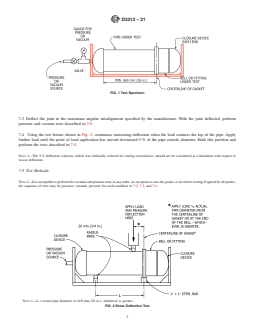
deflections are required than permitted by the joint design, 7.4 Using the test fixture shown in Fig. 2, commence
suitable fittings must be provided. measuring deflection when the load contacts the top of the
pipe.Apply further load until the point of load application has
5.7 The joint components shall be of such design that they
moved downward 5 % of the pipe outside diameter. Hold this
will withstand the forces caused by the compression of the
position and perform the tests described in 7.5.
gasket when joined without cracking or fracturing when tested
NOTE 1—The 5 % deflection criterion, which was arbitrarily selected
in accordance with the requirements of the pipe manufactur
...
This document is not an ASTM standard and is intended only to provide the user of an ASTM standard an indication of what changes have been made to the previous version. Because
it may not be technically possible to adequately depict all changes accurately, ASTM recommends that users consult prior editions as appropriate. In all cases only the current version
of the standard as published by ASTM is to be considered the official document.
Designation: D3212 − 20 D3212 − 21 An American National Standard
Standard Specification for
Joints for Drain and Sewer Plastic Pipes Using Flexible
Elastomeric Seals
This standard is issued under the fixed designation D3212; the number immediately following the designation indicates the year of
original adoption or, in the case of revision, the year of last revision. A number in parentheses indicates the year of last reapproval. A
superscript epsilon (´) indicates an editorial change since the last revision or reapproval.
This standard has been approved for use by agencies of the U.S. Department of Defense.
1. Scope*
1.1 This specification covers joints for plastic pipe systems intended for drain, and gravity sewerage pipe at internal or external
pressures less than 25-ft head using flexible watertight elastomeric seals. This specification is intended to cover the test
requirements, test methods, and acceptable materials. The test methods described for the joints are not intended to be routine
quality control tests but to be reliability or performance requirements.
1.2 The text of this specification references notes, footnotes, and appendixes which provide explanatory material. These notes and
footnotes (excluding those in tables and figures) shall not be considered as requirements of the specification.
1.3 The following safety hazards caveat pertains only to the test method portion, paragraph 7.5, of this specification: This
standard does not purport to address all of the safety concerns, if any, associated with its use. It is the responsibility of the user
of this standard to establish appropriate safety, health, and environmental practices and determine the applicability of regulatory
limitations prior to use.
1.4 This international standard was developed in accordance with internationally recognized principles on standardization
established in the Decision on Principles for the Development of International Standards, Guides and Recommendations issued
by the World Trade Organization Technical Barriers to Trade (TBT) Committee.
2. Referenced Documents
2.1 ASTM Standards:
D1598 Test Method for Time-to-Failure of Plastic Pipe Under Constant Internal Pressure
D2122 Test Method for Determining Dimensions of Thermoplastic Pipe and Fittings
F477 Specification for Elastomeric Seals (Gaskets) for Joining Plastic Pipe
F913 Specification for Thermoplastic Elastomeric Seals (Gaskets) for Joining Plastic Pipe
F1674 Test Method for Joint Restraint Products for Use with PVC Pipe
3. Types
3.1 This specification covers two types of joints based on effecting watertightness through compression of an elastomeric seal or
ring:
This specification is under the jurisdiction of ASTM Committee F17 on Plastic Piping Systems and is the direct responsibility of Subcommittee F17.20 on Joining.
Current edition approved Nov. 15, 2020Dec. 1, 2021. Published December 2020March 2022. Originally approved in 1973. Last previous edition approved in 2020 as
D3212 – 07D3212 – 20(2020). DOI: 10.1520/D3212-20.10.1520/D3212-21.
For referenced ASTM standards, visit the ASTM website, www.astm.org, or contact ASTM Customer Service at service@astm.org. For Annual Book of ASTM Standards
volume information, refer to the standard’s Document Summary page on the ASTM website.
*A Summary of Changes section appears at the end of this standard
Copyright © ASTM International, 100 Barr Harbor Drive, PO Box C700, West Conshohocken, PA 19428-2959. United States
D3212 − 21
3.1.1 Push-on Joint—A joint in which an elastomeric ring gasket is compressed in the annular space between a bell end or socket
and a spigot end of pipe.
3.1.2 Mechanical Joint—A joint made using mechanical means or devices to develop a pressure seal.
4. Materials
4.1 Material used for elastomeric seal in push-on joints shall meet the requirements of either Specification F477 or F913.
4.2 Lubricant, if required, shall be suitable for lubricating the parts of the joints in the assembly. The lubricant shall have no
deteriorating effects on the gasket and pipe materials.
5. General Requirements
5.1 Joints shall not leak when subjected to the internal and external hydrostatic tests of Section 7 for a period of 10 min.
5.2 All surfaces of the joint upon or against which the gasket bears shall be smooth and free of cracks, fractures, or imperfections.
5.3 Drawings—The manufacturer shall furnish drawings of the joint and gasket if requested by the purchaser.
5.4 The gasket shall be the sole element depended upon to make the joint flexible and watertight. The gasket shall be a continuous
elastomeric ring.
5.5 In mechanical joints, the pipe spigot shall have a wall thickness sufficient to withstand, without deformation or collapse, the
compressive force exerted when the fitting is tightened.
5.6 Some joint designs provide for the angular deflection of a pipe joint, without reducing watertightness. Where greater
deflections are required than permitted by the joint design, suitable fittings must be provided.
5.7 The joint components shall be of such design that they will withstand the forces caused by the compression of the gasket when
joined without cracking or fracturing when tested in accordance with the requirements of the pipe manufacturer.
6. Dimensions and Tolerances
6.1 Dimensions of the joint components shall be in accordance with the manufacturer’s standard design dimensions and
tolerances. Such dimensions shall be gaged at sufficiently frequent intervals to assure dimensional control and satisfactory joint
assembly. The method for measuring
...