

ASTM D1193-06(2018)
(Specification)Standard Specification for Reagent Water
General Information
- Abstract
ABSTRACT
This specification describes the required characteristics of reagent waters. Four types of waters have been specified, with three additional grades that can be applied to the four types. The grade specifications specifically address contaminants of microbiological origin. Historically, reagent water types I, II, III, and IV have been linked to specific processes for their production. Starting with this revision, these types of waters may be produced with alternate technologies as long as the appropriate constituent specifications are met. The electrical conductivity and resistance, pH, silica, sodium, chlorides, TOC, endotoxins, and microbiological contamination shall be tested to meet the requirements prescribed.
SCOPE
1.1 This specification describes the required characteristics of waters deemed suitable for use with the standards under the jurisdiction of ASTM.
1.2 The alphanumeric characters ascribed to water types and grades are specified in the manual, Form and Style for ASTM Standards. These have been assigned in order of historical precedence and should not be taken as an indication of a progression in water purity.
1.3 Four types of waters have been specified, with three additional grades that can be applied to the four types. The grade specifications specifically address contaminants of microbiological origin.
1.4 All applicable ASTM Standards are expected to reference one or more of these reagent water types where reagent water is needed as a component of an analytical measurement process. Where a different water type or grade is needed for an ASTM Standard, it may be added to this Specification through the ASTM Standard revision process.
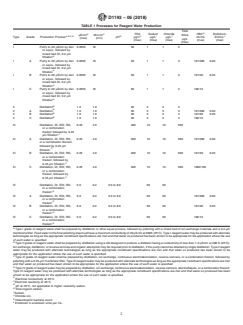
1.5 Although these water types and associated grades have been defined specifically for use with ASTM Standards, they may be appropriate for other applications. It is the responsibility of the users of this specification to ensure that the selected water types or grades are suitable for their intended use. Historically, reagent water Types I, II, III, and IV have been linked to specific processes for their production. Starting with this revision, these types of waters may be produced with alternate technologies as long as the appropriate constituent specifications are met and that water so produced has been shown to be appropriate for the application where the use of such water is specified. Therefore, the selection of an alternate technology in place of the technology specified in Table 1 should be made taking into account the potential impact of other contaminants such as microorganism and pyrogens. Such contaminants were not necessarily considered by the performance characteristics of the technology previously specified. (A) Type I grade of reagent water shall be prepared by distillation or other equal process, followed by polishing with a mixed bed of ion-exchange materials and a 0.2-µm membrane filter. Feed water to the final polishing step must have a maximum conductivity of 20 µS/cm at 298K (25°C). Type I reagent water may be produced with alternate technologies as long as the appropriate constituent specifications are met and that water so produced has been shown to be appropriate for the application where the use of such water is specified.(B) Type II grade of reagent water shall be prepared by distillation using a still designed to produce a distillate having a conductivity of less than 1.0 µS/cm at 298 K (25°C). Ion exchange, distillation, or reverse osmosis and organic adsorption may be required prior to distillation, if the purity cannot be attained by single distillation. Type II reagent water may be produced with alternate technologies as long as the appropriate constituent specifications are met and that water so produced has been shown to be appropriate for the application where the use of such water is specified.(C) Type III grade of reagent water shall be prepared by distillation, ion exchange, continuous electrodeionization, r...
- Status
- Published
- Publication Date
- 14-Mar-2018
- Technical Committee
- D19 - Water
- Drafting Committee
- D19.02 - Quality Systems, Specification, and Statistics
Overview
ASTM D1193-06(2018): Standard Specification for Reagent Water defines the minimum quality requirements and practical guidelines for the preparation, monitoring, and use of reagent water in laboratory and analytical applications. Developed by ASTM International, this standard classifies reagent water into four types-Type I, II, III, and IV-with three additional microbiological grades that may be applied to each type. The standard sets specification limits on a range of contaminants, including electrical conductivity and resistivity, pH, total organic carbon (TOC), silica, sodium, chlorides, endotoxins, and microbial content.
By referencing and applying ASTM D1193, laboratories and industries ensure analytical consistency, minimize the risk of contamination, and comply with regulatory and quality system requirements for high-purity water.
Key Topics
Types and Grades of Reagent Water:
- Four main types (I-IV) classified based on purity levels
- Additional grades addressing microbiological contamination
Production Technologies:
- Traditional and alternative water purification technologies are permitted, provided the required specifications are met
Analytical Requirements:
- Testing for electrical conductivity/resistivity, pH, TOC, silica, sodium, chlorides, bacterial counts, and endotoxins
Monitoring, Storage, and Handling:
- Emphasizes the importance of regular water quality monitoring and system maintenance
- Provides guidance on storage materials, sanitization, and distribution systems to maintain water quality
Flexibility in Application:
- The standard allows adaptation of different technologies and practices as long as water quality criteria are fulfilled
Applications
ASTM D1193-compliant reagent water is critical in various settings, including:
Analytical Laboratories:
- Used as a solvent and in the preparation of standards, reagents, and controls in chemical and biological analyses
- Provides a consistent baseline to avoid interference from contaminants in sensitive assays
Pharmaceutical and Biotechnological Manufacturing:
- Essential for processes requiring sterile or pyrogen-free water
- Supports compliance with Good Manufacturing Practices (GMP) and United States Pharmacopeia (USP) requirements
Quality Assurance in Industrial Processes:
- Assures integrity in microelectronics fabrication, environmental testing, and other processes sensitive to water impurities
Research and Development:
- Enables reproducibility in experimental procedures by controlling water quality variables
Selecting the appropriate ASTM D1193 water type and grade is crucial to meet the specific purity requirements of the intended application-whether for general laboratory use, trace element analysis, clinical tests, or specialized industrial processes.
Related Standards
- ASTM D1125: Test Methods for Electrical Conductivity and Resistivity of Water
- ASTM D1129: Terminology Relating to Water
- ASTM D1293: Test Methods for pH of Water
- ASTM D5173: Guide for On-Line Monitoring of Total Organic Carbon in Water
- ASTM D5245: Practice for Cleaning Laboratory Glassware, Plasticware, and Equipment Used in Microbiological Analyses
- ASTM D5391: Test Method for Electrical Conductivity and Resistivity of Flowing High Purity Water
- ASTM D5997: Test Method for On-Line Monitoring of Total Carbon
- ASTM F1094: Test Methods for Microbiological Monitoring of Water Used for Processing Electronic Devices
By aligning laboratory water purification and validation practices with ASTM D1193 and related standards, organizations can maintain compliance and uphold the precision and reliability of their analytical measurements.
Keywords: ASTM D1193, reagent water, laboratory water, water purity standards, laboratory analysis, water quality, analytical water, microbiological contamination, total organic carbon, water conductivity, water resistivity, water for laboratory use, water grades, water handling, water monitoring.
Relations
- Effective Date
- 01-Apr-2024
- Effective Date
- 01-May-2020
- Effective Date
- 15-Apr-2020
- Effective Date
- 01-Jul-2019
- Effective Date
- 01-Apr-2019
- Effective Date
- 01-Feb-2017
- Effective Date
- 15-Feb-2016
- Effective Date
- 01-Jan-2013
- Effective Date
- 01-Jul-2012
- Effective Date
- 01-Jun-2012
- Effective Date
- 01-Jan-2012
- Effective Date
- 01-Feb-2011
- Effective Date
- 01-Mar-2010
- Effective Date
- 01-Feb-2010
- Effective Date
- 01-Oct-2009
Get Certified
Connect with accredited certification bodies for this standard

ECOCERT
Organic and sustainability certification.

Eurofins Food Testing Global
Global leader in food, environment, and pharmaceutical product testing.

Intertek Bangladesh
Intertek certification and testing services in Bangladesh.
Sponsored listings
Frequently Asked Questions
ASTM D1193-06(2018) is a technical specification published by ASTM International. Its full title is "Standard Specification for Reagent Water". This standard covers: ABSTRACT This specification describes the required characteristics of reagent waters. Four types of waters have been specified, with three additional grades that can be applied to the four types. The grade specifications specifically address contaminants of microbiological origin. Historically, reagent water types I, II, III, and IV have been linked to specific processes for their production. Starting with this revision, these types of waters may be produced with alternate technologies as long as the appropriate constituent specifications are met. The electrical conductivity and resistance, pH, silica, sodium, chlorides, TOC, endotoxins, and microbiological contamination shall be tested to meet the requirements prescribed. SCOPE 1.1 This specification describes the required characteristics of waters deemed suitable for use with the standards under the jurisdiction of ASTM. 1.2 The alphanumeric characters ascribed to water types and grades are specified in the manual, Form and Style for ASTM Standards. These have been assigned in order of historical precedence and should not be taken as an indication of a progression in water purity. 1.3 Four types of waters have been specified, with three additional grades that can be applied to the four types. The grade specifications specifically address contaminants of microbiological origin. 1.4 All applicable ASTM Standards are expected to reference one or more of these reagent water types where reagent water is needed as a component of an analytical measurement process. Where a different water type or grade is needed for an ASTM Standard, it may be added to this Specification through the ASTM Standard revision process. 1.5 Although these water types and associated grades have been defined specifically for use with ASTM Standards, they may be appropriate for other applications. It is the responsibility of the users of this specification to ensure that the selected water types or grades are suitable for their intended use. Historically, reagent water Types I, II, III, and IV have been linked to specific processes for their production. Starting with this revision, these types of waters may be produced with alternate technologies as long as the appropriate constituent specifications are met and that water so produced has been shown to be appropriate for the application where the use of such water is specified. Therefore, the selection of an alternate technology in place of the technology specified in Table 1 should be made taking into account the potential impact of other contaminants such as microorganism and pyrogens. Such contaminants were not necessarily considered by the performance characteristics of the technology previously specified. (A) Type I grade of reagent water shall be prepared by distillation or other equal process, followed by polishing with a mixed bed of ion-exchange materials and a 0.2-µm membrane filter. Feed water to the final polishing step must have a maximum conductivity of 20 µS/cm at 298K (25°C). Type I reagent water may be produced with alternate technologies as long as the appropriate constituent specifications are met and that water so produced has been shown to be appropriate for the application where the use of such water is specified.(B) Type II grade of reagent water shall be prepared by distillation using a still designed to produce a distillate having a conductivity of less than 1.0 µS/cm at 298 K (25°C). Ion exchange, distillation, or reverse osmosis and organic adsorption may be required prior to distillation, if the purity cannot be attained by single distillation. Type II reagent water may be produced with alternate technologies as long as the appropriate constituent specifications are met and that water so produced has been shown to be appropriate for the application where the use of such water is specified.(C) Type III grade of reagent water shall be prepared by distillation, ion exchange, continuous electrodeionization, r...
ABSTRACT This specification describes the required characteristics of reagent waters. Four types of waters have been specified, with three additional grades that can be applied to the four types. The grade specifications specifically address contaminants of microbiological origin. Historically, reagent water types I, II, III, and IV have been linked to specific processes for their production. Starting with this revision, these types of waters may be produced with alternate technologies as long as the appropriate constituent specifications are met. The electrical conductivity and resistance, pH, silica, sodium, chlorides, TOC, endotoxins, and microbiological contamination shall be tested to meet the requirements prescribed. SCOPE 1.1 This specification describes the required characteristics of waters deemed suitable for use with the standards under the jurisdiction of ASTM. 1.2 The alphanumeric characters ascribed to water types and grades are specified in the manual, Form and Style for ASTM Standards. These have been assigned in order of historical precedence and should not be taken as an indication of a progression in water purity. 1.3 Four types of waters have been specified, with three additional grades that can be applied to the four types. The grade specifications specifically address contaminants of microbiological origin. 1.4 All applicable ASTM Standards are expected to reference one or more of these reagent water types where reagent water is needed as a component of an analytical measurement process. Where a different water type or grade is needed for an ASTM Standard, it may be added to this Specification through the ASTM Standard revision process. 1.5 Although these water types and associated grades have been defined specifically for use with ASTM Standards, they may be appropriate for other applications. It is the responsibility of the users of this specification to ensure that the selected water types or grades are suitable for their intended use. Historically, reagent water Types I, II, III, and IV have been linked to specific processes for their production. Starting with this revision, these types of waters may be produced with alternate technologies as long as the appropriate constituent specifications are met and that water so produced has been shown to be appropriate for the application where the use of such water is specified. Therefore, the selection of an alternate technology in place of the technology specified in Table 1 should be made taking into account the potential impact of other contaminants such as microorganism and pyrogens. Such contaminants were not necessarily considered by the performance characteristics of the technology previously specified. (A) Type I grade of reagent water shall be prepared by distillation or other equal process, followed by polishing with a mixed bed of ion-exchange materials and a 0.2-µm membrane filter. Feed water to the final polishing step must have a maximum conductivity of 20 µS/cm at 298K (25°C). Type I reagent water may be produced with alternate technologies as long as the appropriate constituent specifications are met and that water so produced has been shown to be appropriate for the application where the use of such water is specified.(B) Type II grade of reagent water shall be prepared by distillation using a still designed to produce a distillate having a conductivity of less than 1.0 µS/cm at 298 K (25°C). Ion exchange, distillation, or reverse osmosis and organic adsorption may be required prior to distillation, if the purity cannot be attained by single distillation. Type II reagent water may be produced with alternate technologies as long as the appropriate constituent specifications are met and that water so produced has been shown to be appropriate for the application where the use of such water is specified.(C) Type III grade of reagent water shall be prepared by distillation, ion exchange, continuous electrodeionization, r...
ASTM D1193-06(2018) is classified under the following ICS (International Classification for Standards) categories: 71.040.30 - Chemical reagents. The ICS classification helps identify the subject area and facilitates finding related standards.
ASTM D1193-06(2018) has the following relationships with other standards: It is inter standard links to ASTM D5245-19(2024), ASTM D1129-13(2020)e2, ASTM F1094-87(2020), ASTM D6161-19, ASTM D5245-19, ASTM D4453-17, ASTM D4453-16, ASTM D6071-13, ASTM F1094-87(2012), ASTM D5245-92(2012), ASTM D1293-12, ASTM D4453-11, ASTM D1129-10, ASTM D6161-10, ASTM D4517-04(2009). Understanding these relationships helps ensure you are using the most current and applicable version of the standard.
ASTM D1193-06(2018) is available in PDF format for immediate download after purchase. The document can be added to your cart and obtained through the secure checkout process. Digital delivery ensures instant access to the complete standard document.
Standards Content (Sample)
This international standard was developed in accordance with internationally recognized principles on standardization established in the Decision on Principles for the
Development of International Standards, Guides and Recommendations issued by the World Trade Organization Technical Barriers to Trade (TBT) Committee.
Designation:D1193 −06 (Reapproved 2018) Federal Test Method
Standard No. 7916
Standard Specification for
Reagent Water
This standard is issued under the fixed designation D1193; the number immediately following the designation indicates the year of
original adoption or, in the case of revision, the year of last revision. A number in parentheses indicates the year of last reapproval. A
superscript epsilon (´) indicates an editorial change since the last revision or reapproval.
This standard has been approved for use by agencies of the U.S. Department of Defense.
1. Scope contaminants were not necessarily considered by the perfor-
mance characteristics of the technology previously specified.
1.1 This specification describes the required characteristics
of waters deemed suitable for use with the standards under the 1.6 Guidance for applications, the preparation, use and
jurisdiction of ASTM. monitoring, storage, handling, distribution, testing of these
specified waters and validation of the water purification system
1.2 Thealphanumericcharactersascribedtowatertypesand
is provided in Appendix X1 of this specification.
grades are specified in the manual, Form and Style for ASTM
Standards. These have been assigned in order of historical 1.7 The values stated in SI units are to be regarded as
precedence and should not be taken as an indication of a standard. No other units of measurement are included in this
progression in water purity. standard.
1.8 This standard does not purport to address all of the
1.3 Four types of waters have been specified, with three
safety concerns, if any, associated with its use. It is the
additional grades that can be applied to the four types. The
responsibility of the user of this standard to establish appro-
grade specifications specifically address contaminants of mi-
priate safety, health, and environmental practices and deter-
crobiological origin.
mine the applicability of regulatory limitations prior to use.
1.4 All applicable ASTM Standards are expected to refer-
1.9 This international standard was developed in accor-
ence one or more of these reagent water types where reagent
dance with internationally recognized principles on standard-
water is needed as a component of an analytical measurement
ization established in the Decision on Principles for the
process. Where a different water type or grade is needed for an
Development of International Standards, Guides and Recom-
ASTM Standard, it may be added to this Specification through
mendations issued by the World Trade Organization Technical
the ASTM Standard revision process.
Barriers to Trade (TBT) Committee.
1.5 Although these water types and associated grades have
been defined specifically for use with ASTM Standards, they
2. Referenced Documents
may be appropriate for other applications. It is the responsi-
2.1 ASTM Standards:
bility of the users of this specification to ensure that the
D1125 Test Methods for Electrical Conductivity and Resis-
selected water types or grades are suitable for their intended
tivity of Water
use. Historically, reagent water Types I, II, III, and IV have
D1129 Terminology Relating to Water
been linked to specific processes for their production. Starting
D1293 Test Methods for pH of Water
with this revision, these types of waters may be produced with
D4453 Practice for Handling of High Purity Water Samples
alternate technologies as long as the appropriate constituent
D4517 Test Method for Low-Level Total Silica in High-
specifications are met and that water so produced has been
Purity Water by Flameless Atomic Absorption Spectros-
shown to be appropriate for the application where the use of
copy
such water is specified. Therefore, the selection of an alternate
D5128 Test Method for On-Line pH Measurement of Water
technology in place of the technology specified in Table 1
of Low Conductivity
should be made taking into account the potential impact of
D5173 Guide for On-Line Monitoring of Total Organic
other contaminants such as microorganism and pyrogens. Such
Carbon in Water by Oxidation and Detection of Resulting
Carbon Dioxide
This specification is under the jurisdiction ofASTM Committee D19 on Water
and is the responsibility of Subcommittee D19.02 on Quality Systems,
Specification, and Statistics. For referenced ASTM standards, visit the ASTM website, www.astm.org, or
Current edition approved March 15, 2018. Published March 2018. Originally contact ASTM Customer Service at service@astm.org. For Annual Book of ASTM
approved in 1951. Last previous edition approved in 2011 as D1193 – 06 (2011). Standards volume information, refer to the standard’s Document Summary page on
DOI: 10.1520/D1193-06R18. the ASTM website.
Copyright © ASTM International, 100 Barr Harbor Drive, PO Box C700, West Conshohocken, PA 19428-2959. United States
D1193−06 (2018)
TABLE 1 Processes for Reagent Water Production
Total
K
TOC Sodium Chloride Endotoxin,
E F HBC
Silica
µS/cm MΩ·cm
A,B,C,D G
H I J L
Type Grade Production Process pH µg/L µg/L µg/L cfu/mL EU/mL
(max) (min)
µg/L
(max) (max) (max) (max) (max)
(max)
I Purify to 20 µS/cm by dist. 0.0555 18 50 1 1 3
or equiv., followed by
mixed bed DI, 0.2 µm
A
filtration
I A Purify to 20 µS/cm by dist. 0.0555 18 50 1 1 3 10/1000 0.03
or equiv., followed by
mixed bed DI, 0.2 µm
A
filtration
I B Purify to 20 µS/cm by dist. 0.0555 18 50 1 1 3 10/100 0.25
or equiv., followed by
mixed bed DI, 0.2 µm
A
filtration
I C Purify to 20 µS/cm by dist. 0.0555 18 50 1 1 3 100/10
or equiv., followed by
mixed bed DI, 0.2 µm
A
filtration
B
II Distillation 1.0 1.0 50 5 5 3
B
II A Distillation 1.0 1.0 50 5 5 3 10/1000 0.03
B
II B Distillation 1.0 1.0 50 5 5 3 10/100 0.25
B
II C Distillation 1.0 1.0 50 5 5 3 100/10
III Distillation, DI, EDI, RO, 0.25 4.0 200 10 10 500
or a combination
thereof followed by 0.45
C
µm filtration.
III A Distillation, DI, EDI, RO, 0.25 4.0 200 10 10 500 10/1000 0.03
or a combination thereof,
followed by 0.45 µm
C
filtration.
III B Distillation, DI, EDI, RO, 0.25 4.0 200 10 10 500 10/100 0.25
or a combination
thereof, followed by
C
0.45 µm filtration.
III C Distillation, DI, EDI, RO, 0.25 4.0 200 10 10 500 1000/100
or a combination
thereof, followed by
C
0.45 µm filtration.
IV Distillation, DI, EDI, RO, 5.0 0.2 5.0 to 8.0 50 50
or a combination
D
thereof.
IV A Distillation, DI, EDI, RO, 5.0 0.2 5.0 to 8.0 50 50 10/1000 0.03
or a combination
D
thereof.
IV B Distillation, DI, EDI, RO, 5.0 0.2 5.0 to 8.0 50 50 10/100 0.25
or a combination
D
thereof.
IV C Distillation, DI, EDI, RO, 5.0 0.2 5.0 to 8.0 50 50 100/10
or a combination
D
thereof.
A
Type I grade of reagent water shall be prepared by distillation or other equal process, followed by polishing with a mixed bed of ion-exchange materials and a 0.2-µm
membrane filter. Feed water to the final polishing step must have a maximum conductivity of 20 µS/cm at 298K (25°C). Type I reagent water may be produced with alternate
technologies as long as the appropriate constituent specifications are met and that water so produced has been shown to be appropriate for the application where the use
of such water is specified.
B
Type II grade of reagent water shall be prepared by distillation using a still designed to produce a distillate having a conductivity of less than 1.0 µS/cm at 298 K (25°C).
Ion exchange, distillation, or reverse osmosis and organic adsorption may be required prior to distillation, if the purity cannot be attained by single distillation. Type II reagent
water may be produced with alternate technologies as long as the appropriate constituent specifications are met and that water so produced has been shown to be
appropriate for the application where the use of such water is specified.
C
Type III grade of reagent water shall be prepared by distillation, ion exchange, continuous electrodeionization, reverse osmosis, or a combination thereof, followed by
polishing with a 0.45-µm membrane filter. Type III reagent water may be produced with alternate technologies as long as the appropriate constituent specifications are met
and that water so produced has been shown to be appropriate for the application where the use of such water is specified.
D
Type IV grade of reagent water may be prepared by distillation, ion exchange, continuous electrodeionization, reverse osmosis, electrodialysis, or a combination thereof.
Type IV reagent water may be produced with alternate technologies as long as the appropriate constituent specifications are met and that water so produced has been
shown to be appropriate for the application where the use of such water is specified.
E
Electrical conductivity at 25°C.
F
Electrical resistivity at 25°C.
G
pH at 25°C, not applicable to higher resistivity waters.
H
Total organic carbon.
I
Sodium.
J
Chloride ion.
K
Heterotrophic bacteria count.
L
Endotoxin in endotoxin units per mL.
D1193−06 (2018)
D5245 Practice for Cleaning Laboratory Glassware, media are a primary sizing parameter. Electrodeionization
Plasticware, and Equipment Used in Microbiological devices typically comprise semi-permeable ion-exchange
Analyses membranes and permanently charged ion-exchange media (see
D5391 Test Method for Electrical Conductivity and Resis- Test Method D6529).
tivity of a Flowing High Purity Water Sample
3.2.3 reverse osmosis (RO)—the separation process where
D5542 Test Methods for Trace Anions in High Purity Water
one component of a solution is removed from another compo-
by Ion Chromatography
nent by flowing the feed stream under pressure across a
D5997 Test Method for On-Line Monitoring of Total
semipermeable membrane. RO removes ions based on electro-
Carbon, Inorganic Carbon in Water by Ultraviolet, Persul-
chemical forces, colloids, and organics down to 150 molecular
fate Oxidation, and Membrane Conductivity Detection
weight. May also be called hyperfiltration (see Terminology
D6071 Test Method for Low Level Sodium in High Purity
D6161).
Water by Graphite Furnace Atomic Absorption Spectros-
4. Composition and Characteristics
copy
D6161 Terminology Used for Microfiltration, Ultrafiltration,
4.1 The types and grades of water specified in this specifi-
Nanofiltration and Reverse Osmosis Membrane Processes
cation shall conform to the requirements in Table 1.
D6529 Test Method for Operating Performance of Continu-
5. Test Methods
ous Electrodeionization Systems on Feeds from 50–1000
µS/cm
5.1 Electrical Conductivity and Resistivity—Refer to Test
F1094 Test Methods for Microbiological Monitoring of
Methods D1125 and D5391.
Water Used for Processing Electron and Microelectronic
5.2 pH—Refer to Test Methods D1293 and D5128.
Devices by Direct Pressure Tap Sampling Valve and by
5.3 Silica—Refer to Test Method D4517.
the Presterilized Plastic Bag Method
5.4 Sodium—Refer to Test Method D6071.
3. Terminology
5.5 Chlorides—Refer to Test Methods D5542.
3.1 Definitions:
3.1.1 For definitions of terms used in this standard, refer to 5.6 TOC—Refer to Guide D5173 and Test Method D5997.
Terminology D1129. 3
5.7 Endotoxins—Refer to LAL Test Method.
3.2 Definitions of Terms Specific to This Standard:
5.8 Microbiological Contamination—Refer to Test Methods
3.2.1 reagent water—water that is used specifically as a
F1094.
component of an analytical measurement process and meets or
6. Keywords
exceeds the specifications for these waters.
3.2.2 electrodeionization—a process that removes ionized
6.1 laboratory analysis; reagent; water
and ionizable species from liquids using electrically active
media and using an electrical potential to influence ion 3
Published in the U.S. Pharmacopeia by The U.S. Pharmacopeial Convention,
transport, where the ionic transport properties of the active Inc.
APPENDIX
(Nonmandatory Information)
X1. POTENTIAL REAGENT WATER ISSUES
INTRODUCTION
This appendix is provided as a guide to various issues in the production, application, storage, and
monitoring of reagent water. These issues are very complex and extensive. This guidance is not
intended to be comprehensive or complete. Producers and users of reagent water are encouraged to
seek out additional sources of guidance in this area.
X1.1 Preparation has been shown to be appropriate for the application where the
use of such water is specified.
X1.1.1 Historically, reagent water Types I, II, III, and IV
have been linked to specific process for their production. X1.1.2 The preparation methods of the various grades of
Starting with this revision, these types of waters may be reagent water influences the limits of impurities.Therefore, the
produced with alternate technologies as long as the appropriate selection of an alternate technology in place of the technology
constituent specifications are met and that water so produced specified in the Table 1 should be made taking into account the
D1193−06 (2018)
potential impact of other contaminants such as micro-organism X1.2.2.3 Type II water is typically pyrogen-free as
and pyrogens, even if a grade is not specified. Such contami- produced, but should be tested in conformance with the
nants were not necessarily considered by the performance requirements of the referenced edition of United States
characteristics of the technology previously specified. Pharmacopeia, if proof is needed.
X1.2.3 All Types of Water:
X1.2 Use and Application
X1.2.3.1 Biological contaminants may be important in the
X1.2.1 Type I and Type III Water:
test
...