

ASTM D6915-23
(Practice)Standard Practice for Carbon Black-Evaluation of Standard Reference Blacks
General Information
- Abstract
SIGNIFICANCE AND USE
3.1 This practice is intended to ensure that SRBs are produced and evaluated by a standard procedure.
3.2 This practice is to be used to establish the average physicochemical properties of a set of carbon blacks to be used as SRBs.
3.3 The carbon black grades to be used as SRBs should be selected to give as much coverage of the typical usage range for each test and as nearly evenly spaced across the range as possible. Typically, the carbon black grades selected consist of three tread (hard) type furnace grades (designated A, B, and C), three carcass (soft) type furnace grades (designated D, E, and F), and one thermal type grade (designated G). Subcommittee D24.61 may elect to carry one or more of the existing SRBs into the next set provided there is enough remaining material at the rate of usage to last through the expected life of the next set. Limiting the choice of grades to be used means that not all tests will have an SRB set that is evenly spaced across the range of interest. All the SRB candidates are produced at approximately the same time by the various producers. They are used as a set once they are approved. The sets are consecutively numbered. Values and identification for the current set are given in Guide D4821. Any SRBs carried forward will be renumbered for the new set.
SCOPE
1.1 This practice covers guidelines for the production and testing for uniformity of a set of carbon blacks to be used as Standard Reference Blacks (SRBs).
1.2 The values stated in SI units are to be regarded as the standard. The values given in parentheses are for information only.
1.3 This standard does not purport to address all of the safety concerns, if any, associated with its use. It is the responsibility of the user of this standard to establish appropriate safety, health, and environmental practices and determine the applicability of regulatory limitations prior to use.
1.4 This international standard was developed in accordance with internationally recognized principles on standardization established in the Decision on Principles for the Development of International Standards, Guides and Recommendations issued by the World Trade Organization Technical Barriers to Trade (TBT) Committee.
- Status
- Published
- Publication Date
- 31-May-2023
- Technical Committee
- D24 - Carbon Black
- Drafting Committee
- D24.61 - Carbon Black Sampling and Statistical Analysis
Overview
ASTM D6915-23: Standard Practice for Carbon Black-Evaluation of Standard Reference Blacks (SRBs) provides guidelines for the production and assessment of carbon blacks used as standard references in testing. Developed by ASTM International’s Committee D24, this standard ensures uniformity and reliability of SRBs, supporting consistency in physicochemical testing of carbon black materials. The procedures defined in ASTM D6915-23 help laboratories and manufacturers establish the average properties and control limits of SRBs, allowing for precise and reproducible results across various applications in the rubber, plastics, and related industries.
Key Topics
Production and Uniformity
The standard outlines step-by-step procedures for producing and testing SRBs in large, homogeneous lots. It emphasizes the use of state-of-the-art manufacturing techniques to maximize uniformity and minimize variation across the reference material set.Selection of Carbon Black Grades
SRBs are chosen to broadly represent the typical usage range in key tests. Generally, three tread (hard) furnace grades, three carcass (soft) furnace grades, and a thermal grade are included, providing robust coverage for different industrial needs.Physicochemical Testing
Each SRB is evaluated through core tests focusing on properties such as:- Iodine adsorption number
- Oil absorption number (OAN)
- Oil absorption number of compressed sample (COAN)
- Tint strength
- Statistical thickness surface area (STSA) These tests use referenced ASTM methods, ensuring internationally recognized accuracy.
Statistical Evaluation and Control
Uniformity and mean/control limit values are determined through interlaboratory studies. At least 20 laboratories participate, and data analysis follows established statistical practices to ensure validity.Shelf Life and Packaging
SRBs have an indefinite shelf life when stored to protect against moisture. Packaging in polyethylene bags and plastic-wrapped pallets helps maintain material integrity and prolong usability.
Applications
Rubber and Tires Manufacturing
Reliable SRBs guide the calibration and validation of methods in rubber compounding and tire production, where carbon black properties affect product performance.Quality Control in Carbon Black Production
Manufacturers use SRBs as controls to ensure consistency and traceability in routine testing.Standardization across Laboratories
Laboratories involved in interlaboratory comparisons or proficiency programs use SRBs to harmonize test results, improving reproducibility across the industry.Product Development and Research
SRBs serve as baseline materials in research and development, providing a standard comparison for new carbon black grades or formulations.
Related Standards
ASTM D6915-23 references several other key ASTM standards relevant in the carbon black and rubber industries, including:
- ASTM D1510: Test Method for Carbon Black-Iodine Adsorption Number
- ASTM D2414: Test Method for Carbon Black-Oil Absorption Number (OAN)
- ASTM D3265: Test Method for Carbon Black-Tint Strength
- ASTM D3493: Test Method for Oil Absorption Number of Compressed Sample (COAN)
- ASTM D4483: Practice for Evaluating Precision for Test Method Standards
- ASTM D4821: Guide for Carbon Black-Validation of Test Method Precision and Bias
- ASTM D6556: Test Method for Carbon Black-Total and External Surface Area by Nitrogen Adsorption
- ASTM D8043: Guide for Carbon Black-Shelf Life
By following ASTM D6915-23 and the referenced methods, laboratories and manufacturers support international best practices, ensure data comparability, and drive material quality in carbon black applications. This enhances the value and consistency of products within global supply chains.
Relations
- Effective Date
- 01-Jan-2024
- Effective Date
- 01-Jan-2024
- Effective Date
- 15-Dec-2023
- Effective Date
- 01-Nov-2023
- Effective Date
- 01-Nov-2023
- Effective Date
- 01-Nov-2023
- Effective Date
- 01-May-2019
- Effective Date
- 01-Jan-2019
- Effective Date
- 01-Dec-2018
- Effective Date
- 01-Dec-2018
- Effective Date
- 01-Jul-2018
- Effective Date
- 01-Oct-2017
- Effective Date
- 01-May-2017
- Effective Date
- 01-Nov-2016
- Effective Date
- 01-Jun-2016
Get Certified
Connect with accredited certification bodies for this standard

DIN CERTCO
DIN Group product certification.

Smithers Quality Assessments
US management systems and product certification.
Sponsored listings
Frequently Asked Questions
ASTM D6915-23 is a standard published by ASTM International. Its full title is "Standard Practice for Carbon Black-Evaluation of Standard Reference Blacks". This standard covers: SIGNIFICANCE AND USE 3.1 This practice is intended to ensure that SRBs are produced and evaluated by a standard procedure. 3.2 This practice is to be used to establish the average physicochemical properties of a set of carbon blacks to be used as SRBs. 3.3 The carbon black grades to be used as SRBs should be selected to give as much coverage of the typical usage range for each test and as nearly evenly spaced across the range as possible. Typically, the carbon black grades selected consist of three tread (hard) type furnace grades (designated A, B, and C), three carcass (soft) type furnace grades (designated D, E, and F), and one thermal type grade (designated G). Subcommittee D24.61 may elect to carry one or more of the existing SRBs into the next set provided there is enough remaining material at the rate of usage to last through the expected life of the next set. Limiting the choice of grades to be used means that not all tests will have an SRB set that is evenly spaced across the range of interest. All the SRB candidates are produced at approximately the same time by the various producers. They are used as a set once they are approved. The sets are consecutively numbered. Values and identification for the current set are given in Guide D4821. Any SRBs carried forward will be renumbered for the new set. SCOPE 1.1 This practice covers guidelines for the production and testing for uniformity of a set of carbon blacks to be used as Standard Reference Blacks (SRBs). 1.2 The values stated in SI units are to be regarded as the standard. The values given in parentheses are for information only. 1.3 This standard does not purport to address all of the safety concerns, if any, associated with its use. It is the responsibility of the user of this standard to establish appropriate safety, health, and environmental practices and determine the applicability of regulatory limitations prior to use. 1.4 This international standard was developed in accordance with internationally recognized principles on standardization established in the Decision on Principles for the Development of International Standards, Guides and Recommendations issued by the World Trade Organization Technical Barriers to Trade (TBT) Committee.
SIGNIFICANCE AND USE 3.1 This practice is intended to ensure that SRBs are produced and evaluated by a standard procedure. 3.2 This practice is to be used to establish the average physicochemical properties of a set of carbon blacks to be used as SRBs. 3.3 The carbon black grades to be used as SRBs should be selected to give as much coverage of the typical usage range for each test and as nearly evenly spaced across the range as possible. Typically, the carbon black grades selected consist of three tread (hard) type furnace grades (designated A, B, and C), three carcass (soft) type furnace grades (designated D, E, and F), and one thermal type grade (designated G). Subcommittee D24.61 may elect to carry one or more of the existing SRBs into the next set provided there is enough remaining material at the rate of usage to last through the expected life of the next set. Limiting the choice of grades to be used means that not all tests will have an SRB set that is evenly spaced across the range of interest. All the SRB candidates are produced at approximately the same time by the various producers. They are used as a set once they are approved. The sets are consecutively numbered. Values and identification for the current set are given in Guide D4821. Any SRBs carried forward will be renumbered for the new set. SCOPE 1.1 This practice covers guidelines for the production and testing for uniformity of a set of carbon blacks to be used as Standard Reference Blacks (SRBs). 1.2 The values stated in SI units are to be regarded as the standard. The values given in parentheses are for information only. 1.3 This standard does not purport to address all of the safety concerns, if any, associated with its use. It is the responsibility of the user of this standard to establish appropriate safety, health, and environmental practices and determine the applicability of regulatory limitations prior to use. 1.4 This international standard was developed in accordance with internationally recognized principles on standardization established in the Decision on Principles for the Development of International Standards, Guides and Recommendations issued by the World Trade Organization Technical Barriers to Trade (TBT) Committee.
ASTM D6915-23 is classified under the following ICS (International Classification for Standards) categories: 83.040.20 - Rubber compounding ingredients. The ICS classification helps identify the subject area and facilitates finding related standards.
ASTM D6915-23 has the following relationships with other standards: It is inter standard links to ASTM D1510-24, ASTM D3265-24, ASTM D8043-23, ASTM D3265-23a, ASTM D1510-23a, ASTM D2414-23a, ASTM D3265-19, ASTM D6556-19, ASTM D2414-18a, ASTM D3493-18a, ASTM D3493-18, ASTM D6556-17, ASTM D3265-17e1, ASTM D1510-16a, ASTM D8043-16. Understanding these relationships helps ensure you are using the most current and applicable version of the standard.
ASTM D6915-23 is available in PDF format for immediate download after purchase. The document can be added to your cart and obtained through the secure checkout process. Digital delivery ensures instant access to the complete standard document.
Standards Content (Sample)
This international standard was developed in accordance with internationally recognized principles on standardization established in the Decision on Principles for the
Development of International Standards, Guides and Recommendations issued by the World Trade Organization Technical Barriers to Trade (TBT) Committee.
Designation: D6915 − 23
Standard Practice for
Carbon Black—Evaluation of Standard Reference Blacks
This standard is issued under the fixed designation D6915; the number immediately following the designation indicates the year of
original adoption or, in the case of revision, the year of last revision. A number in parentheses indicates the year of last reapproval. A
superscript epsilon (´) indicates an editorial change since the last revision or reapproval.
1. Scope D6556 Test Method for Carbon Black—Total and External
Surface Area by Nitrogen Adsorption
1.1 This practice covers guidelines for the production and
D8043 Guide for Carbon Black—Shelf Life
testing for uniformity of a set of carbon blacks to be used as
Standard Reference Blacks (SRBs).
3. Significance and Use
1.2 The values stated in SI units are to be regarded as the
3.1 This practice is intended to ensure that SRBs are
standard. The values given in parentheses are for information
produced and evaluated by a standard procedure.
only.
3.2 This practice is to be used to establish the average
1.3 This standard does not purport to address all of the
physicochemical properties of a set of carbon blacks to be used
safety concerns, if any, associated with its use. It is the
as SRBs.
responsibility of the user of this standard to establish appro-
3.3 The carbon black grades to be used as SRBs should be
priate safety, health, and environmental practices and deter-
selected to give as much coverage of the typical usage range
mine the applicability of regulatory limitations prior to use.
for each test and as nearly evenly spaced across the range as
1.4 This international standard was developed in accor-
possible. Typically, the carbon black grades selected consist of
dance with internationally recognized principles on standard-
three tread (hard) type furnace grades (designated A, B, and C),
ization established in the Decision on Principles for the
three carcass (soft) type furnace grades (designated D, E, and
Development of International Standards, Guides and Recom-
F), and one thermal type grade (designated G). Subcommittee
mendations issued by the World Trade Organization Technical
D24.61 may elect to carry one or more of the existing SRBs
Barriers to Trade (TBT) Committee.
into the next set provided there is enough remaining material at
2. Referenced Documents the rate of usage to last through the expected life of the next
2 set. Limiting the choice of grades to be used means that not all
2.1 ASTM Standards:
tests will have an SRB set that is evenly spaced across the
D1510 Test Method for Carbon Black—Iodine Adsorption
range of interest. All the SRB candidates are produced at
Number
approximately the same time by the various producers. They
D2414 Test Method for Carbon Black—Oil Absorption
are used as a set once they are approved. The sets are
Number (OAN)
consecutively numbered. Values and identification for the
D3265 Test Method for Carbon Black—Tint Strength
current set are given in Guide D4821. Any SRBs carried
D3493 Test Method for Carbon Black—Oil Absorption
forward will be renumbered for the new set.
Number of Compressed Sample (COAN)
D4483 Practice for Evaluating Precision for Test Method
4. Production, Packaging, Quality Control, and Quality
Standards in the Rubber and Carbon Black Manufacturing
Assurance
Industries
4.1 It is assumed that manufacturers of the SRBs will use
D4821 Guide for Carbon Black—Validation of Test Method
state-of-the-art techniques to ensure maximum uniformity
Precision and Bias
throughout the entire production run. The production should be
made in one continuous production and packaging lot run. The
testing called for in this practice is not intended to be a
This practice is under the jurisdiction of ASTM Committee D24 on Carbon
substitute for in-process quality control. This interlaboratory
Black and is the direct responsibility of Subcommittee D24.61 on Carbon Black
Sampling and Statistical Analysis.
study is only adequate to verify the quality of a homogeneous
Current edition approved June 1, 2023. Published June 2023. Originally
lot.
ε1
approved in 2003. Last previous edition approved in 2017 as D6915 – 17 . DOI:
10.1520/D6915-23.
4.2 The size of the lot for each SRB is determined by
For referenced ASTM standards, visit the ASTM website, www.astm.org, or
historical records on the rate of use. The lot should have an
contact ASTM Customer Service at service@astm.org. For Annual Book of ASTM
expected life of about five years at the most recent rate of use.
Standards volume information, refer to the standard’s Document Summary page on
the ASTM website. Historically, the lot size has usually been 10 000 lb.
Copyright © ASTM International, 100 Barr Harbor Drive, PO Box C700, West Conshohocken, PA 19428-2959. United States
D6915 − 23
4.2.1 The actual usage rate of any reference material may 5.3 The producer of the SRB shall be responsible for
result in one or more SRB material being depleted before the performing all testing to demonstrate lot uniformity, and the
remaining materials in a given SRB set. When this happens, producer must submit the uniformity data to subcommittee
Subcommittee D24.61 may elect to have a supplemental lot D24.61. The tests to be performed as a minimum are those
produced for the needed SRB(s). listed in Section 6. All test results must be 62 repeatability
standard deviations as determined for each test using any one
4.2.2 It is preferred that any supplemental SRB lots be
of the following means of determining S :
produced at the same location, on the same production
r
(1) Any appropriate SRB material’s S listed in the preci-
equipment, under the same production conditions as reason-
r
sion table for a given test.
ably possible, and using the same production targets and
(2) The average pooled value S listed in the precision table
specifications as was used to produce the initial SRB lot in
r
for a given test.
order to minimize variation between the two lots.
(3) Determine a test’s S using a linear regression from
4.2.3 The supplemental lot size must be large enough to
r
existing precision data for a given test as defined in Annex A1.
meet the expected life of the remaining materials in the SRB
set and without a prohibitively large quantity remaining for
5.4 The packaging equipment used to package the SRB lot
disposal after the remainder of the set is depleted. Multiples of
must be flushed to remove any possible contamination from
typical pallet quantities of 1134 kg (2500 lb) are preferred. The
other materials that may remain in the packaging system. This
total quantity produced must be enough to meet the needed
flushing shall be accomplished by packaging at least 10 000 kg
supplemental lot size and have sufficient material to flush the
(22 000 lb) of the SRB material before isolating the packages
packaging equipment as described in 5.4.
to be used for the SRB lot. This flushing is especially critical
4.2.4 The supplemental SRB lot shall carry the same refer-
if the same packaging equipment is used to package other
ence designation as the SRB material it is replacing with the
grades of carbon black.
addition of another digit numbering the lot, beginning with the
5.5 The samples for determining lot uniformity shall be
digit “2”. For example, a supplemental lot for the reference
taken at the same time as when the SRB is packaged. The
material SRB8A would be designated SRB8A2. If the condi-
number of samples and sampling location needed to demon-
tions of 4.2.3 are met, there will not be a need for another
strate uniformity shall be:
supplemental lot of any given SRB material.
5.5.1 Typically a bag is removed from the packaging stream
4.3 The SRB material should be bagged in 22.7 kg (50-lb)
at the designated sample location without reducing the total
polyethylene bags to reduce moisture incursion. Each pallet
bag count on the pallet (nominally 50) so that the total number
should have a nominal 50 bags. Each pallet of bagged material
of bags pulled is the sum of bags on the pallet and bags needed
should be wrapped in plastic to reduce environmental expo-
for samples. It may be necessary to remove more than one bag
sure.
at each sampling event to provide a sufficient quantity for
subsequent uniformity testing per 5.6.
5. Uniformity Sampling and Testing
5.5.2 If just one pallet of material is being packaged, take a
sample at the beginning (bottom layer), middle, and end (top
5.1 It is the producer’s responsibility to ensure the SRB is
layer) of the pallet.
produced under stable conditions using good statistical process
5.5.3 If more than one pallet of material is being packaged,
control techniques. Such control techniques include but are not
take a sample at the beginning (bottom layer) and middle of
limited to:
each pallet and the end (top layer) of the last pallet.
5.1.1 Stable statistical process control for at least 24 h prior
to isolating the candidate SRB material.
5.6 The number of samples taken and t
...
This document is not an ASTM standard and is intended only to provide the user of an ASTM standard an indication of what changes have been made to the previous version. Because
it may not be technically possible to adequately depict all changes accurately, ASTM recommends that users consult prior editions as appropriate. In all cases only the current version
of the standard as published by ASTM is to be considered the official document.
´1
Designation: D6915 − 17 D6915 − 23
Standard Practice for
Carbon Black—Evaluation of Standard Reference Blacks
This standard is issued under the fixed designation D6915; the number immediately following the designation indicates the year of
original adoption or, in the case of revision, the year of last revision. A number in parentheses indicates the year of last reapproval. A
superscript epsilon (´) indicates an editorial change since the last revision or reapproval.
ε NOTE—Corrected Fig. A1.2 editorially in August 2017.
1. Scope
1.1 This practice covers guidelines for the production and testing for uniformity of a set of carbon blacks to be used as Standard
Reference Blacks (SRBs).
1.2 The values stated in SI units are to be regarded as the standard. The values given in parentheses are for information only.
1.3 This standard does not purport to address all of the safety concerns, if any, associated with its use. It is the responsibility
of the user of this standard to establish appropriate safety, health, and environmental practices and determine the applicability of
regulatory limitations prior to use.
1.4 This international standard was developed in accordance with internationally recognized principles on standardization
established in the Decision on Principles for the Development of International Standards, Guides and Recommendations issued
by the World Trade Organization Technical Barriers to Trade (TBT) Committee.
2. Referenced Documents
2.1 ASTM Standards:
D1510 Test Method for Carbon Black—Iodine Adsorption Number
D2414 Test Method for Carbon Black—Oil Absorption Number (OAN)
D3265 Test Method for Carbon Black—Tint Strength
D3493 Test Method for Carbon Black—Oil Absorption Number of Compressed Sample (COAN)
D4483 Practice for Evaluating Precision for Test Method Standards in the Rubber and Carbon Black Manufacturing Industries
D4821 Guide for Carbon Black—Validation of Test Method Precision and Bias
D6556 Test Method for Carbon Black—Total and External Surface Area by Nitrogen Adsorption
D8043 Guide for Carbon Black—Shelf Life
3. Significance and Use
3.1 This practice is intended to ensure that SRBs are produced and evaluated by a standard procedure.
3.2 This practice is to be used to establish the average physicochemical properties of a set of carbon blacks to be used as SRBs.
This practice is under the jurisdiction of ASTM Committee D24 on Carbon Black and is the direct responsibility of Subcommittee D24.61 on Carbon Black Sampling
and Statistical Analysis.
Current edition approved May 1, 2017June 1, 2023. Published May 2017June 2023. Originally approved in 2003. Last previous edition approved in 20122017 as
ε1
D6915 – 12.D6915 – 17 . DOI: 10.1520/D6915-17E01.10.1520/D6915-23.
For referenced ASTM standards, visit the ASTM website, www.astm.org, or contact ASTM Customer Service at service@astm.org. For Annual Book of ASTM Standards
volume information, refer to the standard’s Document Summary page on the ASTM website.
Copyright © ASTM International, 100 Barr Harbor Drive, PO Box C700, West Conshohocken, PA 19428-2959. United States
D6915 − 23
3.3 The carbon black grades to be used as SRBs should be selected to give as much coverage of the typical usage range for each
test and as nearly evenly spaced across the range as possible. Typically, the carbon black grades selected consist of three tread
(hard) type furnace grades (designated A, B, and C), three carcass (soft) type furnace grades (designated D, E, and F), and one
thermal type grade (designated G). Subcommittee D24.61 may elect to carry one or more of the existing SRBs into the next set
provided there is enough remaining material at the rate of usage to last through the expected life of the next set. Limiting the choice
of grades to be used means that not all tests will have an SRB set that is evenly spaced across the range of interest. All the SRB
candidates are produced at approximately the same time by the various producers. They are used as a set once they are approved.
The sets are consecutively numbered. Values and identification for the current set are given in Guide D4821. Any SRBs carried
forward will be renumbered for the new set.
4. Production, Packaging, Quality Control, and Quality Assurance
4.1 It is assumed that manufacturers of the SRBs will use state-of-the-art techniques to ensure maximum uniformity throughout
the entire production run. The production should be made in one continuous production and packaging lot run. The testing called
for in this practice is not intended to be a substitute for in-process quality control. This interlaboratory study is only adequate to
verify the quality of a homogeneous lot.
4.2 The size of the lot for each SRB is determined by historical records on the rate of use. The lot should have an expected life
of about five years at the most recent rate of use. Historically, the lot size has usually been 10 000 lb.
4.2.1 The actual usage rate of any reference material may result in one or more SRB material being depleted before the remaining
materials in a given SRB set. When this happens, Subcommittee D24.61 may elect to have a supplemental lot produced for the
needed SRB(s).
4.2.2 It is preferred that any supplemental SRB lots be produced at the same location, on the same production equipment, under
the same production conditions as reasonably possible, and using the same production targets and specifications as was used to
produce the initial SRB lot in order to minimize variation between the two lots.
4.2.3 The supplemental lot size must be large enough to meet the expected life of the remaining materials in the SRB set and
without a prohibitively large quantity remaining for disposal after the remainder of the set is depleted. Multiples of typical pallet
quantities of 1134 kg (2500 lb) are preferred. The total quantity produced must be enough to meet the needed supplemental lot
size and have sufficient material to flush the packaging equipment as described in 5.4.
4.2.4 The supplemental SRB lot shall carry the same reference designation as the SRB material it is replacing with the addition
of another digit numbering the lot, beginning with the digit “2”. For example, a supplemental lot for the reference material SRB8A
would be designated SRB8A2. If the conditions of 4.2.3 are met, there will not be a need for another supplemental lot of any given
SRB material.
4.3 The SRB material should be bagged in 22.7 kg (50-lb) polyethylene bags to reduce moisture incursion. Each pallet should have
a nominal 50 bags. Each pallet of bagged material should be wrapped in plastic to reduce environmental exposure.
5. Uniformity Sampling and Testing
5.1 It is the producer’s responsibility to ensure the SRB is produced under stable conditions using good statistical process control
techniques. Such control techniques include but are not limited to:
5.1.1 Stable statistical process control for at least 24 h prior to isolating the candidate SRB material.
5.1.2 Stable statistical process control during the entire period the candidate SRB material is being produced. If there is an
occurrence of instability (process not in statistical control) while the candidate SRB material is being produced, the isolated
material must be discarded and a new period of stability demonstrated per 5.1.1.
5.1.3 The storage vessel used to hold the candidate SRB material must be emptied and reasonably cleaned prior to being used to
isolate the candidate SRB material. The emptying and cleaning is particularly important if the storage previously held a material
of a different grade than the candidate SRB material.
D6915 − 23
5.2 The producer shall maintain all test equipment in proper calibration and be able to supply proof of calibration records, if
requested. It is preferred that the testing laboratory for the production facility be an active participant in D24’s Laboratory
Proficiency Rating System (LPRS) program. Active participation shall be demonstrated by submitting test results for at least the
previous three LPRS samples.
5.3 The producer of the SRB shall be responsible for performing all testing to demonstrate lot uniformity, and the producer must
submit the uniformity data to subcommittee D24.61. The tests to be performed as a minimum are those listed in Section 6. All test
results must be 62 repeatability standard deviations as determined for each test using any one of the following means of
determining S :
r
(1) Any appropriate SRB material’s S listed in the precision table for a given test.
r
(2) The average pooled value S listed in the precision table for a given test.
r
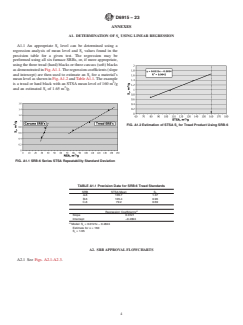
(3) Determine a test’s S using a linear regression from existing precision data for a given test as defined in Annex A1.
r
5.4 The packaging equipment used to package the SRB lot must be flushed to remove any possible contamination from other
materials that may remain in the packaging system. This flushing shall be accomplished by packaging at least 10
...