

ASTM C938-19
(Practice)Standard Practice for Proportioning Grout Mixtures for Preplaced-Aggregate Concrete
General Information
- Abstract
SIGNIFICANCE AND USE
5.1 This practice provides a standard procedure for selecting proportions for mixtures of grout to be used at fluid consistency in the production of PA concrete meeting applicable criteria for strength, density, and other properties.
5.2 This practice is also useful for determining the composition of grout mixed at fluid consistency and meeting specified requirements for filling voids, cavities, and spaces in rock, foundations, and concrete structures.
SCOPE
1.1 This practice describes the laboratory procedure for selecting proportions for grout mixtures required in the production of preplaced-aggregate (PA) concrete.
1.2 The values stated in SI units are to be regarded as standard. The values given in parentheses after SI units are provided for information only and are not considered standard.
1.3 This standard does not purport to address all of the safety concerns, if any, associated with its use. It is the responsibility of the user of this standard to establish appropriate safety, health, and environmental practices and determine the applicability of regulatory limitations prior to use.
1.4 This international standard was developed in accordance with internationally recognized principles on standardization established in the Decision on Principles for the Development of International Standards, Guides and Recommendations issued by the World Trade Organization Technical Barriers to Trade (TBT) Committee.
- Status
- Published
- Publication Date
- 30-Apr-2019
- Technical Committee
- C09 - Concrete and Concrete Aggregates
- Drafting Committee
- C09.41 - Hydraulic Cement Grouts
Buy Documents

ASTM C938-19 - Standard Practice for Proportioning Grout Mixtures for Preplaced-Aggregate Concrete

REDLINE ASTM C938-19 - Standard Practice for Proportioning Grout Mixtures for Preplaced-Aggregate Concrete
Overview
ASTM C938-19 - Standard Practice for Proportioning Grout Mixtures for Preplaced-Aggregate Concrete sets out a comprehensive procedure for determining the appropriate mix proportions of grout used in preplaced-aggregate (PA) concrete. Published by ASTM International, this standard guides laboratory methods for selecting mix ratios that optimize strength, density, and performance criteria, ensuring the manufactured grout meets project-specific requirements. It applies to grouts at fluid consistency, essential for efficiently filling voids, cavities, and spaces in heavy concrete and foundation work.
It is widely used to establish consistent, high-quality procedures for the preparation and testing of grout mixtures, supporting quality control for infrastructure and repair projects involving PA concrete.
Key Topics
- Proportioning of Grout Mixtures: Provides step-by-step guidance for determining the properties and composition of grout for PA concrete, including trials to meet desired criteria for strength and workability.
- Laboratory Testing Procedures: Details the required mixing procedure, apparatus (such as mixers and scales), and order of material addition to ensure repeatability and accuracy in samples.
- Materials Selection: Specifies quality standards for cement, pozzolans, fluidifiers, fine aggregates, and water, ensuring ingredients represent the actual materials to be used in the construction project.
- Sampling and Conditioning: Establishes best practices for representative sampling, continuous agitation, and laboratory conditioning to control temperature and material handling.
- Testing and Reporting: Defines key tests for fluid and hardened grout properties, including flow (efflux time), expansion and bleeding, water retentivity, density, and compressive strength at various ages.
Applications
- Preplaced-Aggregate Concrete Construction: Used extensively in building large concrete structures where conventional placement methods are impractical or where high aggregate content and reduced shrinkage are desired.
- Repair and Rehabilitation: Serves as a guideline for the grouting of voids and cavities in deteriorated infrastructure, including bridges, dams, and rock foundations.
- Specialized Engineering Projects: Supports projects that require consistent, high-density concrete, such as radiation shielding or underwater concrete work, by ensuring that grout mixtures can reliably fill complex spaces.
- Quality Assurance in Construction: By standardizing grout proportioning and test procedures, ASTM C938-19 helps owners, engineers, and contractors achieve uniformity and regulatory compliance in critical structural elements.
Related Standards
- ASTM C125: Terminology Relating to Concrete and Concrete Aggregates
- ASTM C150/C150M: Specification for Portland Cement
- ASTM C185: Test Method for Air Content of Hydraulic Cement Mortar
- ASTM C219: Terminology Relating to Hydraulic Cement
- ASTM C618: Specification for Coal Fly Ash and Pozzolan in Concrete
- ASTM C637: Specification for Aggregates for Radiation-Shielding Concrete
- ASTM C937: Specification for Grout Fluidifier for PA Concrete
- ASTM C939/C939M: Test Method for Grout Flow (Flow Cone)
- ASTM C940: Test Method for Expansion/Bleeding of Freshly Mixed Grouts
- ASTM C941: Test Method for Water Retentivity of Grout Mixtures
- ASTM C942: Test Method for Compressive Strength of Grouts
- ASTM C943: Practice for Making Test Cylinders and Prisms for PA Concrete
Aligning with international best practices, ASTM C938-19 facilitates standardized, high-quality results in the selection and testing of grout mixtures, making it a valuable reference for the construction and maintenance of long-lasting, high-strength PA concrete structures.
Relations
- Replaces
ASTM C938-16 - Standard Practice for Proportioning Grout Mixtures for Preplaced-Aggregate Concrete - Effective Date
- 01-May-2019
- Effective Date
- 01-Apr-2024
- Effective Date
- 01-Aug-2020
- Effective Date
- 01-Apr-2020
- Effective Date
- 01-Apr-2020
- Effective Date
- 01-Jan-2020
- Effective Date
- 15-Dec-2019
- Effective Date
- 01-Dec-2019
- Effective Date
- 15-Nov-2019
- Effective Date
- 01-Jun-2019
- Effective Date
- 01-Apr-2019
- Effective Date
- 01-Jan-2019
- Effective Date
- 01-Oct-2018
- Effective Date
- 01-Jul-2018
- Effective Date
- 01-Jan-2018
Buy Documents
ASTM C938-19 - Standard Practice for Proportioning Grout Mixtures for Preplaced-Aggregate Concrete
REDLINE ASTM C938-19 - Standard Practice for Proportioning Grout Mixtures for Preplaced-Aggregate Concrete
Get Certified
Connect with accredited certification bodies for this standard

DIBt (Deutsches Institut für Bautechnik)
German Institute for Building Technology.
DIN CERTCO
DIN Group product certification.

Aboma Certification B.V.
Specialized in construction, metal, and transport sectors.
Sponsored listings
Frequently Asked Questions
ASTM C938-19 is a standard published by ASTM International. Its full title is "Standard Practice for Proportioning Grout Mixtures for Preplaced-Aggregate Concrete". This standard covers: SIGNIFICANCE AND USE 5.1 This practice provides a standard procedure for selecting proportions for mixtures of grout to be used at fluid consistency in the production of PA concrete meeting applicable criteria for strength, density, and other properties. 5.2 This practice is also useful for determining the composition of grout mixed at fluid consistency and meeting specified requirements for filling voids, cavities, and spaces in rock, foundations, and concrete structures. SCOPE 1.1 This practice describes the laboratory procedure for selecting proportions for grout mixtures required in the production of preplaced-aggregate (PA) concrete. 1.2 The values stated in SI units are to be regarded as standard. The values given in parentheses after SI units are provided for information only and are not considered standard. 1.3 This standard does not purport to address all of the safety concerns, if any, associated with its use. It is the responsibility of the user of this standard to establish appropriate safety, health, and environmental practices and determine the applicability of regulatory limitations prior to use. 1.4 This international standard was developed in accordance with internationally recognized principles on standardization established in the Decision on Principles for the Development of International Standards, Guides and Recommendations issued by the World Trade Organization Technical Barriers to Trade (TBT) Committee.
SIGNIFICANCE AND USE 5.1 This practice provides a standard procedure for selecting proportions for mixtures of grout to be used at fluid consistency in the production of PA concrete meeting applicable criteria for strength, density, and other properties. 5.2 This practice is also useful for determining the composition of grout mixed at fluid consistency and meeting specified requirements for filling voids, cavities, and spaces in rock, foundations, and concrete structures. SCOPE 1.1 This practice describes the laboratory procedure for selecting proportions for grout mixtures required in the production of preplaced-aggregate (PA) concrete. 1.2 The values stated in SI units are to be regarded as standard. The values given in parentheses after SI units are provided for information only and are not considered standard. 1.3 This standard does not purport to address all of the safety concerns, if any, associated with its use. It is the responsibility of the user of this standard to establish appropriate safety, health, and environmental practices and determine the applicability of regulatory limitations prior to use. 1.4 This international standard was developed in accordance with internationally recognized principles on standardization established in the Decision on Principles for the Development of International Standards, Guides and Recommendations issued by the World Trade Organization Technical Barriers to Trade (TBT) Committee.
ASTM C938-19 is classified under the following ICS (International Classification for Standards) categories: 91.100.30 - Concrete and concrete products. The ICS classification helps identify the subject area and facilitates finding related standards.
ASTM C938-19 has the following relationships with other standards: It is inter standard links to ASTM C938-16, ASTM C219-24, ASTM C219-20a, ASTM C219-20, ASTM C185-20, ASTM C637-20, ASTM C125-19a, ASTM C185-19, ASTM C219-19a, ASTM C219-19, ASTM C150/C150M-19, ASTM C125-19, ASTM C125-18b, ASTM C125-18a, ASTM C125-18. Understanding these relationships helps ensure you are using the most current and applicable version of the standard.
ASTM C938-19 is available in PDF format for immediate download after purchase. The document can be added to your cart and obtained through the secure checkout process. Digital delivery ensures instant access to the complete standard document.
Standards Content (Sample)
This international standard was developed in accordance with internationally recognized principles on standardization established in the Decision on Principles for the
Development of International Standards, Guides and Recommendations issued by the World Trade Organization Technical Barriers to Trade (TBT) Committee.
Designation: C938 − 19
Standard Practice for
Proportioning Grout Mixtures for Preplaced-Aggregate
Concrete
This standard is issued under the fixed designation C938; the number immediately following the designation indicates the year of
original adoption or, in the case of revision, the year of last revision. A number in parentheses indicates the year of last reapproval. A
superscript epsilon (´) indicates an editorial change since the last revision or reapproval.
1. Scope* C939/C939M Test Method for Flow of Grout for Preplaced-
Aggregate Concrete (Flow Cone Method)
1.1 This practice describes the laboratory procedure for
C940 Test Method for Expansion and Bleeding of Freshly
selecting proportions for grout mixtures required in the pro-
Mixed Grouts for Preplaced-Aggregate Concrete in the
duction of preplaced-aggregate (PA) concrete.
Laboratory
1.2 The values stated in SI units are to be regarded as
C941 Test Method for Water Retentivity of Grout Mixtures
standard. The values given in parentheses after SI units are
for Preplaced-Aggregate Concrete in the Laboratory
provided for information only and are not considered standard.
C942 Test Method for Compressive Strength of Grouts for
1.3 This standard does not purport to address all of the
Preplaced-Aggregate Concrete in the Laboratory
safety concerns, if any, associated with its use. It is the C943 Practice for Making Test Cylinders and Prisms for
responsibility of the user of this standard to establish appro-
Determining Strength and Density of Preplaced-
priate safety, health, and environmental practices and deter- Aggregate Concrete in the Laboratory
mine the applicability of regulatory limitations prior to use.
3. Terminology
1.4 This international standard was developed in accor-
dance with internationally recognized principles on standard-
3.1 Definitions:
ization established in the Decision on Principles for the
3.1.1 For definitions of terms used in this test method, refer
Development of International Standards, Guides and Recom-
to Terminologies C125 and C219.
mendations issued by the World Trade Organization Technical
4. Summary of Practice
Barriers to Trade (TBT) Committee.
4.1 Grouts at fluid consistency are prepared from one or
2. Referenced Documents
more mixtures of cement, pozzolan, fine aggregate, grout
2.1 ASTM Standards:
fluidifier, with or without other chemical admixtures, and
C125 Terminology Relating to Concrete and Concrete Ag-
water, and tested to determine:
gregates
4.1.1 The properties of the grout, and
C150/C150M Specification for Portland Cement
4.1.2 The properties of PA concrete made with the grout
C185 Test Method for Air Content of Hydraulic Cement
when the grout is intended for such use.
Mortar
4.2 The procedure and equipment required for mixing this
C219 Terminology Relating to Hydraulic Cement
grout are prescribed in this practice.
C618 Specification for Coal Fly Ash and Raw or Calcined
Natural Pozzolan for Use in Concrete
5. Significance and Use
C637 Specification for Aggregates for Radiation-Shielding
5.1 Thispracticeprovidesastandardprocedureforselecting
Concrete
proportionsformixturesofgrouttobeusedatfluidconsistency
C937 Specification for Grout Fluidifier for Preplaced-
in the production of PAconcrete meeting applicable criteria for
Aggregate Concrete
strength, density, and other properties.
This practice is under the jurisdiction of ASTM Committee C09 on Concrete 5.2 This practice is also useful for determining the compo-
and Concrete Aggregates and is the direct responsibility of Subcommittee C09.41
sitionofgroutmixedatfluidconsistencyandmeetingspecified
on Hydraulic Cement Grouts.
requirements for filling voids, cavities, and spaces in rock,
Current edition approved May 1, 2019. Published May 2019. Originally
foundations, and concrete structures.
approved in 1982. Last previous edition approved in 2016 as C938–16. DOI:
10.1520/C0938-19.
For referenced ASTM standards, visit the ASTM website, www.astm.org, or 6. Apparatus
contact ASTM Customer Service at service@astm.org. For Annual Book of ASTM
6.1 Mixer—Use a mixer specified by the manufacturer of
Standards volume information, refer to the standard’s Document Summary page on
the ASTM website. the grout. In absence of manufacturer’s mixer
*A Summary of Changes section appears at the end of this standard
Copyright © ASTM International, 100 Barr Harbor Drive, PO Box C700, West Conshohocken, PA 19428-2959. United States
C938 − 19
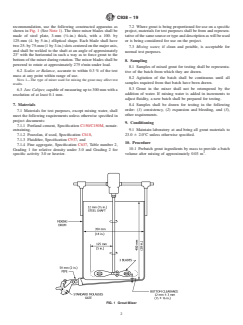
recommendation, use the following constructed apparatus as 7.2 Where grout is being proportioned for use on a specific
shown in Fig. 1 (See Note 1). The three mixer blades shall be project, materials for test purposes shall be from and represen-
made of steel plate, 3-mm ( ⁄8-in.) thick, with a 100- by tativeofthesamesourceortypeanddescriptionaswillbeused
125-mm (4- by 5-in.) elliptical shape. Each blade shall have or is being considered for use on the project.
two 25- by 75-mm (1 by 3-in.) slots centered on the major axis,
7.3 Mixing water, if clean and potable, is acceptable for
and shall be welded to the shaft at an angle of approximately
normal test purposes.
23° with the horizontal in such a way as to force grout to the
bottom of the mixer during rotation. The mixer blades shall be
8. Sampling
powered to rotate at approximately 275 r/min under load.
8.1 Samples of mixed grout for testing shall be representa-
6.2 Scales or Balance, accurate to within 0.3 % of the test
tive of the batch from which they are drawn.
mass at any point within range of use.
8.2 Agitation of the batch shall be continuous until all
NOTE 1—The type of mixer used for mixing the grout may affect test
samples required from that batch have been drawn.
results.
8.3 Grout in the mixer shall not be retempered by the
6.3 Jaw Caliper, c
...
This document is not an ASTM standard and is intended only to provide the user of an ASTM standard an indication of what changes have been made to the previous version. Because
it may not be technically possible to adequately depict all changes accurately, ASTM recommends that users consult prior editions as appropriate. In all cases only the current version
of the standard as published by ASTM is to be considered the official document.
Designation: C938 − 16 C938 − 19
Standard Practice for
Proportioning Grout Mixtures for Preplaced-Aggregate
Concrete
This standard is issued under the fixed designation C938; the number immediately following the designation indicates the year of
original adoption or, in the case of revision, the year of last revision. A number in parentheses indicates the year of last reapproval. A
superscript epsilon (´) indicates an editorial change since the last revision or reapproval.
1. Scope*
1.1 This practice describes the laboratory procedure for selecting proportions for grout mixtures required in the production of
preplaced-aggregate (PA) concrete.
1.2 The values stated in SI units are to be regarded as standard. No other units of measurement are included in this The values
given in parentheses after SI units are provided for information only and are not considered standard.
1.3 This standard does not purport to address all of the safety concerns, if any, associated with its use. It is the responsibility
of the user of this standard to establish appropriate safety safety, health, and healthenvironmental practices and determine the
applicability of regulatory limitations prior to use.
1.4 This international standard was developed in accordance with internationally recognized principles on standardization
established in the Decision on Principles for the Development of International Standards, Guides and Recommendations issued
by the World Trade Organization Technical Barriers to Trade (TBT) Committee.
2. Referenced Documents
2.1 ASTM Standards:
C125 Terminology Relating to Concrete and Concrete Aggregates
C150/C150M Specification for Portland Cement
C185 Test Method for Air Content of Hydraulic Cement Mortar
C219 Terminology Relating to Hydraulic Cement
C618 Specification for Coal Fly Ash and Raw or Calcined Natural Pozzolan for Use in Concrete
C637 Specification for Aggregates for Radiation-Shielding Concrete
C937 Specification for Grout Fluidifier for Preplaced-Aggregate Concrete
C939/C939M Test Method for Flow of Grout for Preplaced-Aggregate Concrete (Flow Cone Method)
C940 Test Method for Expansion and Bleeding of Freshly Mixed Grouts for Preplaced-Aggregate Concrete in the Laboratory
C941 Test Method for Water Retentivity of Grout Mixtures for Preplaced-Aggregate Concrete in the Laboratory
C942 Test Method for Compressive Strength of Grouts for Preplaced-Aggregate Concrete in the Laboratory
C943 Practice for Making Test Cylinders and Prisms for Determining Strength and Density of Preplaced-Aggregate Concrete
in the Laboratory
3. Terminology
3.1 Definitions:
3.1.1 For definitions of terms used in this test method, refer to Terminologies C125 and C219.
4. Summary of Practice
4.1 Grouts at fluid consistency are prepared from one or more mixtures of cement, pozzolan, fine aggregate, grout fluidifier, with
or without other chemical admixtures, and water, and tested to determine:
4.1.1 The properties of the grout, and
This practice is under the jurisdiction of ASTM Committee C09 on Concrete and Concrete Aggregates and is the direct responsibility of Subcommittee C09.41 on
Hydraulic Cement Grouts.
Current edition approved Feb. 1, 2016May 1, 2019. Published March 2016May 2019. Originally approved in 1982. Last previous edition approved in 20102016 as
C938–10.–16. DOI: 10.1520/C0938-16.10.1520/C0938-19.
For referenced ASTM standards, visit the ASTM website, www.astm.org, or contact ASTM Customer Service at service@astm.org. For Annual Book of ASTM Standards
volume information, refer to the standard’s Document Summary page on the ASTM website.
*A Summary of Changes section appears at the end of this standard
Copyright © ASTM International, 100 Barr Harbor Drive, PO Box C700, West Conshohocken, PA 19428-2959. United States
C938 − 19
4.1.2 The properties of PA concrete made with the grout when the grout is intended for such use.
4.2 The procedure and equipment required for mixing this grout are prescribed in this practice.
5. Significance and Use
5.1 This practice provides a standard procedure for selecting proportions for mixtures of grout to be used at fluid consistency
in the production of PA concrete meeting applicable criteria for strength, density, and other properties.
5.2 This practice is also useful for determining the composition of grout mixed at fluid consistency and meeting specified
requirements for filling voids, cavities, and spaces in rock, foundations, and concrete structures.
6. Apparatus
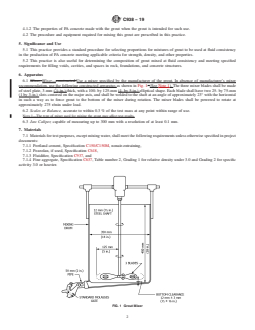
6.1 Mixer, Mixer—constructed Use a mixer specified by the manufacturer of the grout. In absence of manufacturer’s mixer
recommendation, use the following constructed apparatus as shown in Fig. 1. (See Note 1). The three mixer blades shall be made
of steel plate, 3-mm ( ⁄8-in.) thick, with a 100- by 125-mm (4- by 5-in.) elliptical shape. Each blade shall have two 25- by 75-mm
(1 by 3-in.) slots centered on the major axis, and shall be welded to the shaft at an angle of approximately 23° with the horizontal
in such a way as to force grout to the bottom of the mixer during rotation. The mixer blades shall be powered to rotate at
approximately 275 r/min under load.
6.2 Scales or Balance, accurate to within 0.3 % of the test mass at any point within range of use.
NOTE 1—The type of mixer used for mixing the grout may affect test results.
6.3 Jaw Caliper, capable of measuring up to 300 mm with a resolution of at least 0.1 mm.
7. Materials
7.1 Materials for test purposes, except mixing water, shall meet the following requirements unless otherwise specified in project
documents:
7.1.1 Portland cement, Specification C150/C150M, nonair-entraining,
7.1.2 Pozzolan, if used, Specification C618,
7.1.3 Fluidifier, Specification C937, and
7.1.4 Fine aggregate, Specification C637, Table number 2, Grading 1 for relative density under 3.0 and Grading 2 for specific
activity 3.0 or heavier.
FIG. 1 Grout Mixer
-------------
...