

ASTM D5741-96(2023)
(Practice)Standard Practice for Characterizing Surface Wind Using a Wind Vane and Rotating Anemometer
General Information
- Abstract
SIGNIFICANCE AND USE
5.1 This practice will characterize the distribution of wind with a maximum of utility and a minimum of archive space. Applications of wind data to the fields of air quality, wind engineering, wind energy, agriculture, oceanography, forecasting, aviation, climatology, severe storms, turbulence and diffusion, military, and electrical utilities are satisfied with this practice. When this practice is employed, archive data will be of value to any of these fields of application. The consensus reached for this practice includes representatives of instrument manufacturers which provides a practical acceptance of these theoretical principles used to characterize the wind.
SCOPE
1.1 This practice covers a method for characterizing surface wind speed, wind direction, peak one-minute speeds, peak three-second and peak one-minute speeds, and standard deviations of fluctuation about the means of speed and direction.
1.2 This practice may be used with other kinds of sensors if the response characteristics of the sensors, including their signal conditioners, are equivalent or faster and the measurement uncertainty of the system is equivalent or better than those specified below.
1.3 The characterization prescribed in this practice will provide information on wind acceptable for a wide variety of applications.
Note 1: This practice builds on a consensus reached by the attendees at a workshop sponsored by the Office of the Federal Coordinator for Meteorological Services and Supporting Research in Rockville, MD on Oct. 29–30, 1992.
1.4 The values stated in SI units are to be regarded as standard. No other units of measurement are included in this standard.
1.5 This standard does not purport to address all of the safety concerns, if any, associated with its use. It is the responsibility of the user of this standard to establish appropriate safety, health, and environmental practices and determine the applicability of regulatory limitations prior to use.
1.6 This international standard was developed in accordance with internationally recognized principles on standardization established in the Decision on Principles for the Development of International Standards, Guides and Recommendations issued by the World Trade Organization Technical Barriers to Trade (TBT) Committee.
- Status
- Published
- Publication Date
- 31-Aug-2023
- Technical Committee
- D22 - Air Quality
- Drafting Committee
- D22.11 - Meteorology
Overview
ASTM D5741-96(2023): Standard Practice for Characterizing Surface Wind Using a Wind Vane and Rotating Anemometer establishes standardized methods for quantifying surface wind characteristics using established instruments such as wind vanes and rotating anemometers. Developed by ASTM International, this practice ensures that wind data is both accurate and practical across a variety of applications, while minimizing storage requirements for archived data.
This standard is essential for fields that rely on reliable wind data, such as air quality assessment, wind engineering, wind energy, agriculture, meteorology, oceanography, aviation, climatology, severe weather analysis, and utility management. The consensus-based approach guarantees broad industry acceptance and practical applicability.
Key Topics
- Measurement Parameters: The standard defines procedures for measuring surface wind speed, wind direction, peak one-minute speeds, peak three-second and one-minute speeds, and the standard deviation of wind speed and direction.
- Sensor Requirements: Wind vanes and rotating anemometers are specified, but the practice is adaptable to other sensors meeting equivalent or better response characteristics and measurement uncertainty.
- Data Output and Archiving:
- Standard 10-minute interval reporting for detailed data.
- Optional condensed 60-minute reporting for reduced archival storage.
- Siting and Installation: Guidelines are provided for optimal sensor placement, such as 10 meters above level or gently sloping terrain with an open fetch, to ensure the highest data quality and consistency.
- Sampling Techniques: Recommends a minimum sampling interval of 3 seconds for both wind speed and direction, with a preference for faster sampling (1 second where possible) to improve peak gust characterization.
- System Performance and Quality Assurance:
- Regular calibration and audits according to recognized methods (e.g., traceable to NIST).
- Documentation and station logs are required for data traceability.
- Continuous monitoring and automatic range/rate tests to ensure ongoing measurement reliability.
- Data Documentation: Mandates comprehensive record-keeping, including station identification, location, sensor types, calibration history, siting photos, and system configuration.
Applications
The methodology provided by ASTM D5741-96(2023) is invaluable for any industry or research area that depends on qualitative and quantitative assessments of surface wind. Key applications include:
- Environmental monitoring: Supporting air quality and pollution studies by providing high-precision wind characterization.
- Wind energy development: Assisting in site evaluation, turbine siting, and performance prediction.
- Infrastructure engineering: Providing data critical to wind engineering and designing structures to withstand wind loads.
- Agricultural planning: Understanding wind patterns for crop protection and management.
- Weather forecasting and climatology: Supplying foundational data for short- and long-term wind trend analysis and severe storm research.
- Aviation and oceanography: Enhancing safety and operational planning through accurate surface wind data.
- Military and utility operations: Informing strategic planning, emergency response, and network reliability.
Related Standards
Alignment with related ASTM standards ensures consistent terminology and measurement integrity:
- ASTM D1356: Terminology Relating to Sampling and Analysis of Atmospheres.
- ASTM D5096: Test Method for Determining the Performance of a Cup Anemometer or Propeller Anemometer.
- ASTM D5366: Test Method for Determining the Dynamic Performance of a Wind Vane.
Additional guidance on quality assurance and site-specific documentation enhances the reliability and global acceptance of the practice.
By adhering to ASTM D5741-96(2023), organizations and researchers can ensure their wind data collection is robust, accurate, and universally applicable, facilitating informed decisions across a wide array of technical disciplines.
Relations
- Effective Date
- 01-Sep-2023
- Effective Date
- 01-Mar-2024
- Effective Date
- 01-Sep-2023
- Effective Date
- 01-Sep-2023
Frequently Asked Questions
ASTM D5741-96(2023) is a standard published by ASTM International. Its full title is "Standard Practice for Characterizing Surface Wind Using a Wind Vane and Rotating Anemometer". This standard covers: SIGNIFICANCE AND USE 5.1 This practice will characterize the distribution of wind with a maximum of utility and a minimum of archive space. Applications of wind data to the fields of air quality, wind engineering, wind energy, agriculture, oceanography, forecasting, aviation, climatology, severe storms, turbulence and diffusion, military, and electrical utilities are satisfied with this practice. When this practice is employed, archive data will be of value to any of these fields of application. The consensus reached for this practice includes representatives of instrument manufacturers which provides a practical acceptance of these theoretical principles used to characterize the wind. SCOPE 1.1 This practice covers a method for characterizing surface wind speed, wind direction, peak one-minute speeds, peak three-second and peak one-minute speeds, and standard deviations of fluctuation about the means of speed and direction. 1.2 This practice may be used with other kinds of sensors if the response characteristics of the sensors, including their signal conditioners, are equivalent or faster and the measurement uncertainty of the system is equivalent or better than those specified below. 1.3 The characterization prescribed in this practice will provide information on wind acceptable for a wide variety of applications. Note 1: This practice builds on a consensus reached by the attendees at a workshop sponsored by the Office of the Federal Coordinator for Meteorological Services and Supporting Research in Rockville, MD on Oct. 29–30, 1992. 1.4 The values stated in SI units are to be regarded as standard. No other units of measurement are included in this standard. 1.5 This standard does not purport to address all of the safety concerns, if any, associated with its use. It is the responsibility of the user of this standard to establish appropriate safety, health, and environmental practices and determine the applicability of regulatory limitations prior to use. 1.6 This international standard was developed in accordance with internationally recognized principles on standardization established in the Decision on Principles for the Development of International Standards, Guides and Recommendations issued by the World Trade Organization Technical Barriers to Trade (TBT) Committee.
SIGNIFICANCE AND USE 5.1 This practice will characterize the distribution of wind with a maximum of utility and a minimum of archive space. Applications of wind data to the fields of air quality, wind engineering, wind energy, agriculture, oceanography, forecasting, aviation, climatology, severe storms, turbulence and diffusion, military, and electrical utilities are satisfied with this practice. When this practice is employed, archive data will be of value to any of these fields of application. The consensus reached for this practice includes representatives of instrument manufacturers which provides a practical acceptance of these theoretical principles used to characterize the wind. SCOPE 1.1 This practice covers a method for characterizing surface wind speed, wind direction, peak one-minute speeds, peak three-second and peak one-minute speeds, and standard deviations of fluctuation about the means of speed and direction. 1.2 This practice may be used with other kinds of sensors if the response characteristics of the sensors, including their signal conditioners, are equivalent or faster and the measurement uncertainty of the system is equivalent or better than those specified below. 1.3 The characterization prescribed in this practice will provide information on wind acceptable for a wide variety of applications. Note 1: This practice builds on a consensus reached by the attendees at a workshop sponsored by the Office of the Federal Coordinator for Meteorological Services and Supporting Research in Rockville, MD on Oct. 29–30, 1992. 1.4 The values stated in SI units are to be regarded as standard. No other units of measurement are included in this standard. 1.5 This standard does not purport to address all of the safety concerns, if any, associated with its use. It is the responsibility of the user of this standard to establish appropriate safety, health, and environmental practices and determine the applicability of regulatory limitations prior to use. 1.6 This international standard was developed in accordance with internationally recognized principles on standardization established in the Decision on Principles for the Development of International Standards, Guides and Recommendations issued by the World Trade Organization Technical Barriers to Trade (TBT) Committee.
ASTM D5741-96(2023) is classified under the following ICS (International Classification for Standards) categories: 07.060 - Geology. Meteorology. Hydrology. The ICS classification helps identify the subject area and facilitates finding related standards.
ASTM D5741-96(2023) has the following relationships with other standards: It is inter standard links to ASTM D5741-96(2017), ASTM D5096-24, ASTM D5096-23, ASTM D711-23. Understanding these relationships helps ensure you are using the most current and applicable version of the standard.
ASTM D5741-96(2023) is available in PDF format for immediate download after purchase. The document can be added to your cart and obtained through the secure checkout process. Digital delivery ensures instant access to the complete standard document.
Standards Content (Sample)
This international standard was developed in accordance with internationally recognized principles on standardization established in the Decision on Principles for the
Development of International Standards, Guides and Recommendations issued by the World Trade Organization Technical Barriers to Trade (TBT) Committee.
Designation: D5741 − 96 (Reapproved 2023)
Standard Practice for
Characterizing Surface Wind Using a Wind Vane and
Rotating Anemometer
This standard is issued under the fixed designation D5741; the number immediately following the designation indicates the year of
original adoption or, in the case of revision, the year of last revision. A number in parentheses indicates the year of last reapproval. A
superscript epsilon (´) indicates an editorial change since the last revision or reapproval.
1. Scope 2. Referenced Documents
2.1 ASTM Standards:
1.1 This practice covers a method for characterizing surface
D1356 Terminology Relating to Sampling and Analysis of
wind speed, wind direction, peak one-minute speeds, peak
Atmospheres
three-second and peak one-minute speeds, and standard devia-
D5096 Test Method for Determining the Performance of a
tions of fluctuation about the means of speed and direction.
Cup Anemometer or Propeller Anemometer
1.2 This practice may be used with other kinds of sensors if
D5366 Test Method for Determining the Dynamic Perfor-
the response characteristics of the sensors, including their
mance of a Wind Vane
signal conditioners, are equivalent or faster and the measure-
ment uncertainty of the system is equivalent or better than
3. Terminology
those specified below.
3.1 Discussion—For terms that are not defined herein, refer
1.3 The characterization prescribed in this practice will to Terminology D1356.
provide information on wind acceptable for a wide variety of
3.2 Definitions of Terms Specific to This Standard:
applications.
3.2.1 aerodynamic roughness length (z , m)—a characteris-
tic length representing the height above the surface where
NOTE 1—This practice builds on a consensus reached by the attendees
at a workshop sponsored by the Office of the Federal Coordinator for extrapolation of wind speed measurements, below the limit of
Meteorological Services and Supporting Research in Rockville, MD on
profile validity, would predict the wind speed would become
Oct. 29–30, 1992.
zero (1). It can be estimated for direction sectors from a
1.4 The values stated in SI units are to be regarded as landscape description.
standard. No other units of measurement are included in this
3.2.2 damped natural wavelength (λ , m)—a characteristic
d
standard.
of a wind vane empirically related to the delay distance and the
damping ratio. See Test Method D5366 for test methods to
1.5 This standard does not purport to address all of the
determine the delay distance and equations to estimate the
safety concerns, if any, associated with its use. It is the
damped natural wavelength.
responsibility of the user of this standard to establish appro-
priate safety, health, and environmental practices and deter-
3.2.3 damping ratio (η, dimensionless)—the ratio of the
mine the applicability of regulatory limitations prior to use.
actual damping, related to the inertial-driven overshoot of wind
1.6 This international standard was developed in accor- vanes to direction changes, to the critical damping, the fastest
dance with internationally recognized principles on standard- response where no overshoot occurs. See Test Method D5366
ization established in the Decision on Principles for the for test methods and equations to determine the damping ratio
Development of International Standards, Guides and Recom- of a wind vane.
mendations issued by the World Trade Organization Technical
3.2.4 distance constant (L, m)—the distance the air flows
Barriers to Trade (TBT) Committee.
past a rotating anemometer during the time it takes the cup
For referenced ASTM standards, visit the ASTM website, www.astm.org, or
This practice is under the jurisdiction of ASTM Committee D22 on Air Quality contact ASTM Customer Service at service@astm.org. For Annual Book of ASTM
and is the direct responsibility of Subcommittee D22.11 on Meteorology. Standards volume information, refer to the standard’s Document Summary page on
Current edition approved Sept. 1, 2023. Published October 2023. Originally the ASTM website.
approved in 1996. Last previous edition approved in 2017 as D5741 – 96 (2017). The boldface numbers in parentheses refers to the list of references at the end
DOI: 10.1520/D5741-96R23. of this standard.
Copyright © ASTM International, 100 Barr Harbor Drive, PO Box C700, West Conshohocken, PA 19428-2959. United States
D5741 − 96 (2023)
wheel or propeller to reach (1 − 1 ⁄e) or 63 % of the equilibrium 4. Summary of Practice
speed after a step change in wind speed. See Test Method
4.1 Siting of the Wind Sensors:
D5096.
4.1.1 The wind sensor location will be identified by an
3.2.5 maximum operating speed (u , m/s)—as related to unambiguous label which will include either the longitude and
m
anemometer, the highest speed as which the sensor will survive
latitude with a resolution of 1 s of arc (about 30 m or less) or
the force of the wind and perform within the accuracy a station number which will lead to that information in the
specification. station description file. When redundant sensors or microscale
network stations (for example, airport runway sensors) are
3.2.6 maximum operating speed (u , m/s)—as related to
m
available, they will have individual labels which unambigu-
wind vane, the highest speed at which the sensor will survive
ously identify the data they produce.
the force of the wind and perform within the accuracy
4.1.2 The anemometer and wind vane shall be located at a
specification.
10 m height above level or gently sloping terrain with an open
3.2.7 standard deviation of wind direction (σ , degrees)—
θ
fetch of at least 150 m in all directions, with the largest fetch
the unbiased estimate of the standard deviation of wind
possible in the prevailing wind direction. Compromise is
direction samples about the mean horizontal wind direction.
frequently recognized and acceptable for some sites. Obstacles
The circular scale of wind direction with a discontinuity at
in the vicinity should be at least ten times their own height
north may bias the calculation when the direction oscillates
distant from the wind sensors.
about north. Estimates of the standard deviation such as
4.1.3 The wind sensors shall preferably be located on top of
suggested by (2, 3) are acceptable.
a solitary mast. If side mounting is necessary, the boom length
3.2.8 standard deviation of wind speed (σ , m/s)—the esti-
u
should be at least three times the mast width. In the undesirable
mate of the standard deviation of wind speed samples about the
case that locally no open terrain is available and the measure-
mean wind speed.
ment is to be made above some building, then the wind sensor
3.2.9 starting threshold (u , m/s)—as related to height above the roof top should be at least 1.5 times the lesser
anemometer, the lowest speed at which the sensor begins to of the maximum building height and the maximum horizontal
turn and continues to turn and produces a measurable signal dimension of the major roof surface. In this case, the station
when mounted in its normal position (see Test Method D5096). description file shall indicate the height above ground level
(AGL) of the highest part of the building, the height of the
3.2.10 starting threshold (u , m/s)—as related to system, the
wind sensors above ground, AGL, and the height of the wind
indicated wind speed when the anemometer is at rest.
sensors above roof level. Site characteristics shall be docu-
3.2.11 starting threshold (u , m/s)—as related to wind vane,
mented in sectors no greater than 45 degrees nor smaller than
the lowest speed at which the vane can be observed or
30 degrees in width around the wind sensors. The near terrain
measured moving from a 10° offset position in a wind tunnel
may be characterized with photographs, taken at wind sensor
(see Test Method D5366).
height if possible, aimed radially outward at labeled central
3.2.12 wind direction (θ, degrees)—the direction, referenced
angles, with respect to true north. Average roughness of the
to true north, from which air flows past the sensor location if
nearest 3 km of each sector shall be characterized according to
the sensor or other obstructions were absent. The wind direc-
the roughness class as tabulated above (4). The z numbers in
tion distribution is characterized over each 10 min period with
Table 1 are typical and not precise statements.
a scalar (non-speed weighted) mean, standard deviation, and
4.1.4 Important terrain features at distances larger than 3 km
the direction of the peak 1 min average speed. The circular
(hills, cities, lakes, and so forth, within 20 km) shall be
direction range, with its discontinuity at north, requires special
identified by sector and distance. Additional information, such
attention in the averaging process. A unit vector method is an
as aerial photographs, maps, and so forth, pertinent to the site,
acceptable solution to this problem.
is recommended to be added to the basic site documentation.
3.2.12.1 Discussion—Wind vane direction systems provide
NOTE 2—Cameras using 35 mm film in the landscape orientation will
outputs when the wind speed is below the starting threshold for
have the following theoretical focal length to field angle relationships:
the vane. For this practice, report the calculated values (see 4.3
50 mm yields 40°
or 4.4) when more than 25 % of the possible samples are above
40 mm yields 48°
the wind vane threshold and the standard deviation of the 28 mm yields 66°
acceptable samples, σ , is 30° or less, otherwise report light
Prints or transparencies may not utilize the total theoretical width of the
θ
image. It is desirable to label known angles in the photograph. For
and variable code, 000.
example, a 45° sector photograph could have a central label of 360 with
3.2.13 wind speed (u, m/s)—the speed with which air flows
marker flags located at 337.5° and 022.5° true.
past the sensor location if the sensor or other obstructions were
4.2 Characteristics of the Wind Systems—There are two
absent. The wind speed distribution is characterized over each
categories of sensor design within this practice. Sensitive
10 min period with a scalar mean, standard deviation, peak 3 s
describes sensors commonly applied for all but extreme wind
average, and peak 1 min average.
conditions. Ruggedized describes sensors intended to function
during extreme wind conditions. The application of this prac-
tice requires the starting threshold (u ) of both the wind vane
and the anemometer to meet the same operating range cat-
egory.
D5741 − 96 (2023)
TABLE 1 Characterizations Extracted from Wieringa, J. (4)
No. z , m Landscape Description
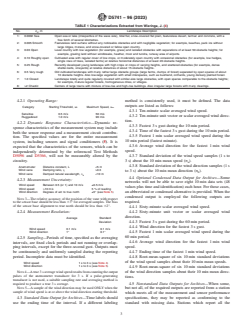
1: 0.0002 Sea Open sea or lake (irrespective of the wave size), tidal flat, snow-covered flat plain, featureless desert, tarmac and concrete, with a
free fetch of several kilometres.
2: 0.005 Smooth Featureless land surface without any noticeable obstacles and with negligible vegetation; for example, beaches, pack ice without
large ridges, morass, and snow-covered or fallow open country.
3: 0.03 Open Level country with low vegetation (for example, grass) and isolated obstacles with separations of at least 50 obstacle heights; for
example, grazing land without windbreaks, heather, moor and tundra, runway area of airports.
4: 0.10 Roughly open Cultivated area with regular cover of low crops, or moderately open country with occasional obstacles (for example, low hedges,
single rows of trees, isolated farms) at relative horizontal distances of at least 20 obstacle heights.
5: 0.25 Rough Recently developed young landscape with high crops or crops of varying heights, and scattered obstacles (for example, dense
shelter-belts, vineyards) at relative distances of about 15 obstacle heights.
6: 0.5 Very rough Old cultivated landscape with many rather large obstacle groups (large farms, clumps of forest) separated by open spaces of about
10 obstacle heights. Also low-large vegetation with small interspaces, such as bushland, orchards, young densely planted forest.
7: 1.0 Closed Landscape totally and quite regularly co
...