

ASTM E1521-19
(Test Method)Standard Test Method for Liquid Holding Capacity of Granular Carriers
General Information
- Abstract
SIGNIFICANCE AND USE
3.1 This test method has been designed principally for granular carriers with LHC greater than 5.0 %. The incremental amount of suitable fluid added can be adjusted down as needed for carriers with LHC less than 5.0 %.
3.2 This test method has been designed principally for granular carriers with a relatively rapid absorption of liquid. Some materials may absorb liquids more slowly than the described times in the method. If such is the case, the time limit of two (2) min. may be extended.
3.3 This test method is applicable to granules in the range from 4 to 100 mesh (4.75 to 0.150 mm).
SCOPE
1.1 This test method is used to determine the liquid holding capacity (LHC) of granular carriers.
1.2 The values stated in SI units are to be regarded as standard. No other units of measurement are included in this standard.
1.3 This standard does not purport to address all of the safety concerns, if any, associated with its use. It is the responsibility of the user of this standard to establish appropriate safety, health, and environmental practices and determine the applicability of regulatory limitations prior to use. For specific precautionary statements, see Section 5.
1.4 This international standard was developed in accordance with internationally recognized principles on standardization established in the Decision on Principles for the Development of International Standards, Guides and Recommendations issued by the World Trade Organization Technical Barriers to Trade (TBT) Committee.
- Status
- Published
- Publication Date
- 31-Oct-2019
- Technical Committee
- E35 - Pesticides, Antimicrobials, and Alternative Control Agents
- Drafting Committee
- E35.22 - Pesticide Formulations and Delivery Systems




Overview
ASTM E1521-19: Standard Test Method for Liquid Holding Capacity of Granular Carriers establishes a procedure for determining the liquid holding capacity (LHC) of granular carrier materials. Granular carriers play a crucial role in industries such as agriculture, pharmaceuticals, and chemical manufacturing, where the ability to accurately measure and compare the absorption characteristics of granules is essential for formulation performance, process control, and quality assurance. This ASTM standard ensures consistency, repeatability, and reliability when assessing how much liquid a specified sample of granular carrier can absorb and retain.
Key Topics
Scope of Application
- Primarily intended for granular carriers with an LHC greater than 5.0%, but adaptable for carriers with LHC below this threshold.
- Suitable for granules sized from 4 to 100 mesh (approximately 4.75 to 0.150 mm).
- Developed in accordance with internationally recognized standardization principles.
Test Method and Procedure
- Incremental addition of suitable liquid to a weighed sample until specific endpoint conditions are met, such as the granules appearing wet or sticking to the container.
- Standard procedures can be adjusted for slower-absorbing materials or carriers with lower liquid holding capacities.
- Calculation of % LHC based on the volume and specific gravity of the fluid absorbed by the granular carrier.
Practical Considerations
- Safety is prioritized with recommendations to review material safety data sheets and apply proper protective equipment.
- Disposal of tested materials must adhere to local and regulatory requirements.
Applications
- Pesticide Formulation: Reliable determination of LHC helps in formulating granular pesticide products to ensure even and effective distribution of active ingredients.
- Pharmaceuticals: Measurement of liquid absorption capacity is crucial in the development of granular drug delivery systems and excipients.
- Chemical Manufacturing: Enables optimization of carrier properties for catalysts, absorbents, or other specialty chemicals where controlled liquid uptake is critical.
- Quality Control: Useful for standardizing batches of granular materials, supporting performance consistency across products and applications.
- Research & Development: Provides a validated method to compare experimental or new granular carrier materials for suitability in specific processes.
Related Standards
- ASTM E1519: Terminology related to pesticides and alternative control agents.
- ASTM E1856: Test methods for determining properties of granular materials.
- ISO Standards: International Organization for Standardization guidance on testing granular media, which may offer complementary or alternative procedures.
- Regulatory Guidelines: Industry-specific regulatory requirements regarding pesticide formulations, chemical carriers, or pharmaceutical excipients often reference such ASTM methods for compliance.
Summary
Adoption of ASTM E1521-19 offers a consistent, repeatable way to measure and report the liquid holding capacity of granular carriers across multiple sectors. Leveraging this standard enhances product quality, supports regulatory compliance, and facilitates the global trade of materials that depend on accurate absorption measurements. Keywords such as liquid holding capacity, granular carriers, formulation testing, and ASTM standards remain central to ensuring discoverability and practical utility for professionals seeking to enhance their material assessment protocols.
Relations
- Effective Date
- 01-Nov-2019
Get Certified
Connect with accredited certification bodies for this standard

CIS Institut d.o.o.
Personal Protective Equipment (PPE) certification body. Notified Body NB-2890 for EU Regulation 2016/425 PPE.

Kiwa BDA Testing
Building and construction product certification.
Kmetijski inštitut Slovenije
Agricultural Institute of Slovenia. Soil testing, plant health, agricultural product analysis.
Sponsored listings
Frequently Asked Questions
ASTM E1521-19 is a standard published by ASTM International. Its full title is "Standard Test Method for Liquid Holding Capacity of Granular Carriers". This standard covers: SIGNIFICANCE AND USE 3.1 This test method has been designed principally for granular carriers with LHC greater than 5.0 %. The incremental amount of suitable fluid added can be adjusted down as needed for carriers with LHC less than 5.0 %. 3.2 This test method has been designed principally for granular carriers with a relatively rapid absorption of liquid. Some materials may absorb liquids more slowly than the described times in the method. If such is the case, the time limit of two (2) min. may be extended. 3.3 This test method is applicable to granules in the range from 4 to 100 mesh (4.75 to 0.150 mm). SCOPE 1.1 This test method is used to determine the liquid holding capacity (LHC) of granular carriers. 1.2 The values stated in SI units are to be regarded as standard. No other units of measurement are included in this standard. 1.3 This standard does not purport to address all of the safety concerns, if any, associated with its use. It is the responsibility of the user of this standard to establish appropriate safety, health, and environmental practices and determine the applicability of regulatory limitations prior to use. For specific precautionary statements, see Section 5. 1.4 This international standard was developed in accordance with internationally recognized principles on standardization established in the Decision on Principles for the Development of International Standards, Guides and Recommendations issued by the World Trade Organization Technical Barriers to Trade (TBT) Committee.
SIGNIFICANCE AND USE 3.1 This test method has been designed principally for granular carriers with LHC greater than 5.0 %. The incremental amount of suitable fluid added can be adjusted down as needed for carriers with LHC less than 5.0 %. 3.2 This test method has been designed principally for granular carriers with a relatively rapid absorption of liquid. Some materials may absorb liquids more slowly than the described times in the method. If such is the case, the time limit of two (2) min. may be extended. 3.3 This test method is applicable to granules in the range from 4 to 100 mesh (4.75 to 0.150 mm). SCOPE 1.1 This test method is used to determine the liquid holding capacity (LHC) of granular carriers. 1.2 The values stated in SI units are to be regarded as standard. No other units of measurement are included in this standard. 1.3 This standard does not purport to address all of the safety concerns, if any, associated with its use. It is the responsibility of the user of this standard to establish appropriate safety, health, and environmental practices and determine the applicability of regulatory limitations prior to use. For specific precautionary statements, see Section 5. 1.4 This international standard was developed in accordance with internationally recognized principles on standardization established in the Decision on Principles for the Development of International Standards, Guides and Recommendations issued by the World Trade Organization Technical Barriers to Trade (TBT) Committee.
ASTM E1521-19 is classified under the following ICS (International Classification for Standards) categories: 13.080.40 - Hydrological properties of soils. The ICS classification helps identify the subject area and facilitates finding related standards.
ASTM E1521-19 has the following relationships with other standards: It is inter standard links to ASTM E1521-14. Understanding these relationships helps ensure you are using the most current and applicable version of the standard.
ASTM E1521-19 is available in PDF format for immediate download after purchase. The document can be added to your cart and obtained through the secure checkout process. Digital delivery ensures instant access to the complete standard document.
Standards Content (Sample)
This international standard was developed in accordance with internationally recognized principles on standardization established in the Decision on Principles for the
Development of International Standards, Guides and Recommendations issued by the World Trade Organization Technical Barriers to Trade (TBT) Committee.
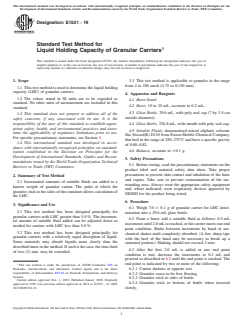
Designation: E1521 − 19
Standard Test Method for
Liquid Holding Capacity of Granular Carriers
This standard is issued under the fixed designation E1521; the number immediately following the designation indicates the year of
original adoption or, in the case of revision, the year of last revision. A number in parentheses indicates the year of last reapproval. A
superscript epsilon (´) indicates an editorial change since the last revision or reapproval.
1. Scope 3.3 This test method is applicable to granules in the range
from 4 to 100 mesh (4.75 to 0.150 mm).
1.1 This test method is used to determine the liquid holding
capacity (LHC) of granular carriers.
4. Apparatus and Reagents
1.2 The values stated in SI units are to be regarded as
4.1 Buret Stand.
standard. No other units of measurement are included in this
4.2 Buret, 10 to 25 mL, accurate to 0.2 mL.
standard.
4.3 Glass Bottle, 29.6 mL, with poly seal cap (7 by 3.5-cm
1.3 This standard does not purport to address all of the
outside diameter).
safety concerns, if any, associated with its use. It is the
responsibility of the user of this standard to establish appro- 4.4 Glass Bottle, 236.8 mL, wide mouth with poly seal cap.
priate safety, health, and environmental practices and deter-
4.5 Suitable Fluids, dearomatized mixed aliphatic solvents
mine the applicability of regulatory limitations prior to use.
like Exxsol(R) D110 from Exxon Mobile Chemical Company,
For specific precautionary statements, see Section 5.
that boil in the range of 250–275°C and have a specific gravity
1.4 This international standard was developed in accor-
of 0.80–0.82.
dance with internationally recognized principles on standard-
4.6 Balance, accurate to 60.1 g.
ization established in the Decision on Principles for the
Development of International Standards, Guides and Recom-
5. Safety Precautions
mendations issued by the World Trade Organization Technical
5.1 Before testing, read the precautionary statements on the
Barriers to Trade (TBT) Committee.
product label and material safety data sheet. Take proper
precautions to prevent skin contact and inhalation of the fines
2. Summary of Test Method
and vapors. Take care to prevent contamination of the sur-
2.1 Incremental amounts of suitable fluids are added to a
rounding area. Always wear the appropriate safety equipment
known weight of granular carrier. The point at which the
and, where indicated, wear respiratory devices approved by
granules stick to the sides of the container allows calculation of
NIOSH for the product being tested.
the LHC.
6. Procedure
3. Significance and Use
6.1 Weigh 7.0 6 0.1 g of granular carrier for LHC deter-
3.1 This test method has been designed principally for
mination into a 29.6-mL glass bottle.
granular carriers with LHC greater than 5.0 %. The incremen-
6.2 From a buret, add a suitable fluid as follows: 0.5-mL
tal amount of suitable fluid added can be adjusted down as
incrementsuntil2.0mLisreached,orthecarriermeetsoneend
needed for carriers with LHC less than 5.0 %.
point condition. Shake between increments by hand or me-
3.2 This test method has been designed principally for
chanical shaker until completely absorbed. (A few sharp taps
granular carriers with a relatively rapid absorption of liquid.
with the heel of the hand may be necessary to break up a
Some materials may absorb liquids m
...
This document is not an ASTM standard and is intended only to provide the user of an ASTM standard an indication of what changes have been made to the previous version. Because
it may not be technically possible to adequately depict all changes accurately, ASTM recommends that users consult prior editions as appropriate. In all cases only the current version
of the standard as published by ASTM is to be considered the official document.
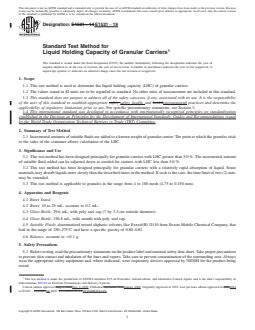
Designation: E1521 − 14 E1521 − 19
Standard Test Method for
Liquid Holding Capacity of Granular Carriers
This standard is issued under the fixed designation E1521; the number immediately following the designation indicates the year of
original adoption or, in the case of revision, the year of last revision. A number in parentheses indicates the year of last reapproval. A
superscript epsilon (´) indicates an editorial change since the last revision or reapproval.
1. Scope
1.1 This test method is used to determine the liquid holding capacity (LHC) of granular carriers.
1.2 The values stated in SI units are to be regarded as standard. No other units of measurement are included in this standard.
1.3 This standard does not purport to address all of the safety concerns, if any, associated with its use. It is the responsibility
of the user of this standard to establish appropriate safety safety, health, and healthenvironmental practices and determine the
applicability of regulatory limitations prior to use. For specific precautionary statements, see Section 5.
1.4 This international standard was developed in accordance with internationally recognized principles on standardization
established in the Decision on Principles for the Development of International Standards, Guides and Recommendations issued
by the World Trade Organization Technical Barriers to Trade (TBT) Committee.
2. Summary of Test Method
2.1 Incremental amounts of suitable fluids are added to a known weight of granular carrier. The point at which the granules stick
to the sides of the container allows calculation of the LHC.
3. Significance and Use
3.1 This test method has been designed principally for granular carriers with LHC greater than 5.0 %. The incremental amount
of suitable fluid added can be adjusted down as needed for carriers with LHC less than 5.0 %.
3.2 This test method has been designed principally for granular carriers with a relatively rapid absorption of liquid. Some
materials may absorb liquids more slowly than the described times in the method. If such is the case, the time limit of two (2) min.
may be extended.
3.3 This test method is applicable to granules in the range from 4 to 100 mesh (4.75 to 0.150 mm).
4. Apparatus and Reagents
4.1 Buret Stand.
4.2 Buret, 10 to 25 mL, accurate to 0.2 mL.
4.3 Glass Bottle, 29.6 mL, with poly seal cap (7 by 3.5-cm outside diameter).
4.4 Glass Bottle, 236.8 mL, wide mouth with poly seal cap.
4.5 Suitable Fluids, dearomatized mixed aliphatic solvents like Exxsol(R) D110 from Exxon Mobile Chemical Company, that
boil in the range of 250–275°C and have a specific gravity of 0.80–0.82.
4.6 Balance, accurate to 60.1 g.
5. Safety Precautions
5.1 Before testing, read the precautionary statements on the product label and material safety data sheet. Take proper precautions
to prevent skin contact and inhalation of the fines and vapors. Take care to prevent contamination of the surrounding area. Always
wear the appropriate safety equipment and, where indicated, wear respiratory devices approved by NIOSH for the product being
tested.
This test method is under the jurisdiction of ASTM Committee E35 on Pesticides, Antimicrobials, and Alternative Control Agents and is the direct responsibility of
Subcommittee E35.22 on Pesticide Formulations and Delivery Systems.
Current edition appro
...