

ASTM D3807-98(2019)
(Test Method)Standard Test Method for Strength Properties of Adhesives in Cleavage Peel by Tension Loading (Engineering Plastics-to-Engineering Plastics)
General Information
- Abstract
SIGNIFICANCE AND USE
4.1 This test method determines strength properties of adhesives in cleavage peel by tension loading. It allows the comparative testing of cleavage/peel strengths of bonded engineering thermoplastic adherends.
4.2 Cleavage/peel forces are common in bonded assemblies. This test method gives information as to the performance of substrate/adhesive combinations under cleavage/peel forces.
SCOPE
1.1 This test method covers the determination of the comparative cleavage/peel strengths of adhesives for bonding engineering plastics when tested on a standard specimen and under specific conditions of preparation and testing.
1.2 The values stated in SI units are to be regarded as the standard. The values given in parentheses are for information only.
1.3 This standard does not purport to address all of the safety concerns, if any, associated with its use. It is the responsibility of the user of this standard to establish appropriate safety, health, and environmental practices and determine the applicability of regulatory limitations prior to use.
1.4 This international standard was developed in accordance with internationally recognized principles on standardization established in the Decision on Principles for the Development of International Standards, Guides and Recommendations issued by the World Trade Organization Technical Barriers to Trade (TBT) Committee.
- Status
- Published
- Publication Date
- 31-May-2019
- Technical Committee
- D14 - Adhesives
- Drafting Committee
- D14.40 - Adhesives for Plastics


Overview
ASTM D3807-98(2019) is a widely recognized standard issued by ASTM International, detailing the method for determining the comparative cleavage/peel strength of adhesives used for bonding engineering plastics to engineering plastics. This standard specifies the test procedures, specimen preparation, and methods for tensile loading, ensuring consistent and reliable evaluation of adhesive performance under cleavage and peel forces.
Cleavage and peel stresses are commonly encountered in bonded assemblies involving plastics. The results from this test method provide valuable insight into the suitability and durability of substrate and adhesive combinations when exposed to tension loading, helping manufacturers and researchers select appropriate adhesive systems for demanding applications.
Key Topics
- Cleavage/Peel Strength Testing: The standard outlines procedures for measuring the force required to separate bonded engineering plastic adherends under controlled tension and peel conditions.
- Standardized Test Specimen: Samples consist of two semirigid adherends bonded with adhesive, designed to allow comparative evaluation between different adhesives.
- Specimen Preparation: Specific dimensions, surface preparation, and conditioning protocols ensure repeatable and meaningful test results.
- Testing Apparatus: The use of a tension testing machine with precise load application and measurement capabilities is required for reliable data acquisition.
- Performance Data: The method generates load-displacement curves, providing data on average, maximum, and minimum peel strengths, as well as failure modes.
- Reporting Practices: Detailed reporting is emphasized, including adhesive identification, specimen construction, testing conditions, and observed results.
Applications
The ASTM D3807-98(2019) standard is highly valuable for industries and professionals involved in:
- Adhesive Formulation and Quality Control: By comparing cleavage/peel strengths under standardized conditions, manufacturers can optimize adhesive formulations for engineering plastics.
- Material Selection and Validation: Engineers and designers assess and qualify adhesive/substrate combinations for use in structural plastic assemblies, especially where peel and cleavage loads are common.
- Research and Development: Laboratories utilize this standard to study new adhesive technologies and bonding methods for advanced plastic materials.
- Product Certification: Compliance with ASTM D3807-98(2019) facilitates product validation and supports claims related to adhesive performance in plastic bonding.
- Failure Analysis: When bonded plastic assemblies fail in service, this test method helps pinpoint the origin and mode of failure by replicating cleavage/peel conditions.
Practical examples of use include automotive parts, electronics housings, medical devices, and structural plastic components, where strong, reliable bonds between engineering thermoplastics are critical.
Related Standards
ASTM D3807-98(2019) references and complements several other standards relevant to the adhesives and plastics industries, including:
- ASTM D907: Terminology of Adhesives - defines critical terms used in adhesive testing and evaluation.
- Adhesive Bond Strength Standards: Supports other ASTM standards focused on lap shear, tensile, and peel strength of bonded joints.
- International Guidelines: Developed in accordance with World Trade Organization (WTO) principles for removing technical barriers to trade, this standard is recognized globally.
By adhering to ASTM D3807-98(2019), organizations can ensure a consistent approach to evaluating the strength of adhesive bonds in engineering plastics, support product innovation, and meet regulatory and quality expectations in both domestic and international markets.
Keywords: ASTM D3807, cleavage peel strength, adhesive testing, engineering plastics, tension loading, adhesive bond evaluation, peel testing, plastics-to-plastics bonding.
Relations
- Effective Date
- 01-Jun-2019
- Effective Date
- 01-Jul-2012
- Effective Date
- 01-May-2012
- Effective Date
- 01-Dec-2011
- Effective Date
- 01-Jan-2011
- Effective Date
- 01-Oct-2008
- Effective Date
- 15-Aug-2008
- Effective Date
- 01-Mar-2008
- Effective Date
- 01-Dec-2006
- Effective Date
- 01-Apr-2005
- Effective Date
- 01-Apr-2005
- Effective Date
- 01-Dec-2004
- Effective Date
- 01-Apr-2004
- Effective Date
- 10-May-2003
- Effective Date
- 10-Oct-2000
Get Certified
Connect with accredited certification bodies for this standard

DIN CERTCO
DIN Group product certification.

Smithers Quality Assessments
US management systems and product certification.
Sponsored listings
Frequently Asked Questions
ASTM D3807-98(2019) is a standard published by ASTM International. Its full title is "Standard Test Method for Strength Properties of Adhesives in Cleavage Peel by Tension Loading (Engineering Plastics-to-Engineering Plastics)". This standard covers: SIGNIFICANCE AND USE 4.1 This test method determines strength properties of adhesives in cleavage peel by tension loading. It allows the comparative testing of cleavage/peel strengths of bonded engineering thermoplastic adherends. 4.2 Cleavage/peel forces are common in bonded assemblies. This test method gives information as to the performance of substrate/adhesive combinations under cleavage/peel forces. SCOPE 1.1 This test method covers the determination of the comparative cleavage/peel strengths of adhesives for bonding engineering plastics when tested on a standard specimen and under specific conditions of preparation and testing. 1.2 The values stated in SI units are to be regarded as the standard. The values given in parentheses are for information only. 1.3 This standard does not purport to address all of the safety concerns, if any, associated with its use. It is the responsibility of the user of this standard to establish appropriate safety, health, and environmental practices and determine the applicability of regulatory limitations prior to use. 1.4 This international standard was developed in accordance with internationally recognized principles on standardization established in the Decision on Principles for the Development of International Standards, Guides and Recommendations issued by the World Trade Organization Technical Barriers to Trade (TBT) Committee.
SIGNIFICANCE AND USE 4.1 This test method determines strength properties of adhesives in cleavage peel by tension loading. It allows the comparative testing of cleavage/peel strengths of bonded engineering thermoplastic adherends. 4.2 Cleavage/peel forces are common in bonded assemblies. This test method gives information as to the performance of substrate/adhesive combinations under cleavage/peel forces. SCOPE 1.1 This test method covers the determination of the comparative cleavage/peel strengths of adhesives for bonding engineering plastics when tested on a standard specimen and under specific conditions of preparation and testing. 1.2 The values stated in SI units are to be regarded as the standard. The values given in parentheses are for information only. 1.3 This standard does not purport to address all of the safety concerns, if any, associated with its use. It is the responsibility of the user of this standard to establish appropriate safety, health, and environmental practices and determine the applicability of regulatory limitations prior to use. 1.4 This international standard was developed in accordance with internationally recognized principles on standardization established in the Decision on Principles for the Development of International Standards, Guides and Recommendations issued by the World Trade Organization Technical Barriers to Trade (TBT) Committee.
ASTM D3807-98(2019) is classified under the following ICS (International Classification for Standards) categories: 83.180 - Adhesives. The ICS classification helps identify the subject area and facilitates finding related standards.
ASTM D3807-98(2019) has the following relationships with other standards: It is inter standard links to ASTM D3807-98(2012), ASTM D907-12a, ASTM D907-12, ASTM D907-11a, ASTM D907-11, ASTM D907-08b, ASTM D907-08a, ASTM D907-08, ASTM D907-06, ASTM D907-05e1, ASTM D907-05, ASTM D907-04a, ASTM D907-04, ASTM D907-03, ASTM D907-00. Understanding these relationships helps ensure you are using the most current and applicable version of the standard.
ASTM D3807-98(2019) is available in PDF format for immediate download after purchase. The document can be added to your cart and obtained through the secure checkout process. Digital delivery ensures instant access to the complete standard document.
Standards Content (Sample)
This international standard was developed in accordance with internationally recognized principles on standardization established in the Decision on Principles for the
Development of International Standards, Guides and Recommendations issued by the World Trade Organization Technical Barriers to Trade (TBT) Committee.
Designation: D3807 − 98 (Reapproved 2019)
Standard Test Method for
Strength Properties of Adhesives in Cleavage Peel by
Tension Loading (Engineering Plastics-to-Engineering
Plastics)
This standard is issued under the fixed designation D3807; the number immediately following the designation indicates the year of
original adoption or, in the case of revision, the year of last revision. A number in parentheses indicates the year of last reapproval. A
superscript epsilon (´) indicates an editorial change since the last revision or reapproval.
1. Scope 3.2.1 semirigid adherend, n—an adherend that has dimen-
sions and physical properties that permit bending at designated
1.1 This test method covers the determination of the com-
test temperature through any angle up to 30° without breaking
parative cleavage/peel strengths of adhesives for bonding
or cracking.
engineering plastics when tested on a standard specimen and
under specific conditions of preparation and testing.
4. Significance and Use
1.2 The values stated in SI units are to be regarded as the
4.1 This test method determines strength properties of
standard. The values given in parentheses are for information
adhesives in cleavage peel by tension loading. It allows the
only.
comparative testing of cleavage/peel strengths of bonded
engineering thermoplastic adherends.
1.3 This standard does not purport to address all of the
safety concerns, if any, associated with its use. It is the
4.2 Cleavage/peelforcesarecommoninbondedassemblies.
responsibility of the user of this standard to establish appro- This test method gives information as to the performance of
priate safety, health, and environmental practices and deter-
substrate/adhesive combinations under cleavage/peel forces.
mine the applicability of regulatory limitations prior to use.
5. Apparatus
1.4 This international standard was developed in accor-
dance with internationally recognized principles on standard-
5.1 Tension Testing Machine, capable of applying a tensile
ization established in the Decision on Principles for the load having the following prescribed conditions:
Development of International Standards, Guides and Recom-
5.1.1 Select the machine and loading range so that the
mendations issued by the World Trade Organization Technical maximum load on the specimen falls between 15 and 85 % of
Barriers to Trade (TBT) Committee.
the upper limit of the loading range.
5.1.2 Maintain the rate of movement between heads to be
2. Referenced Documents essentially constant under fluctuating loads.
NOTE 1—It is difficult to meet this requirement when loads are
2.1 ASTM Standards:
measured with a spring-type or pendulum-type weighing device. Gear-
D907 Terminology of Adhesives
driven head separation is recommended.
5.1.3 Equip the machine with suitable grips capable of
3. Terminology
clamping the specimens firmly throughout the tests.
3.1 Definitions—Many of the terms used in this test method
5.1.4 The machine is autographic, giving a chart that can be
are defined in Terminology D907.
read in terms of centimetres (inches) of separation as one
coordinate and applied load as the other coordinate.
3.2 Definitions of Terms Specific to This Standard:
5.1.5 The applied tension as measured and recorded is to be
accurate within 61%.
5.2 Conditioning Room or Desiccators, capable of main-
This test method is under the jurisdiction of ASTM Committee D14 on
AdhesivesandisthedirectresponsibilityofSubcommitteeD14.40onAdhesivesfor
taining a relative humidity of 50 6 5 % at 23 6 2°C.
Plastics.
Current edition approved June 1, 2019. Published June 2019. Originally
6. Test Specimen
approved in 1979. Last previous edition approved in 2012 as D3807 – 98 (2012).
DOI: 10.1520/D3807-98R19.
6.1 Laminated test panels (see Fig. 1) consist of two
For referenced ASTM standards, visit the ASTM website, www.astm.org, or
semirigid adherends properly prepared and bonded together in
contact ASTM Customer Service at service@astm.org. For Annual Book of ASTM
accordance with the manufacturer’s recommendations. Spe-
Standards volume information, refer to the standard’s Document Summary page on
the ASTM website. cially prepared test specimens shall be 25.4 mm (1 in.) wide by
Copyright © ASTM International, 100 Barr Harbor Drive, PO Box C700, West Conshohocken, PA 19428-2959. United States
D3807 − 98 (2019)
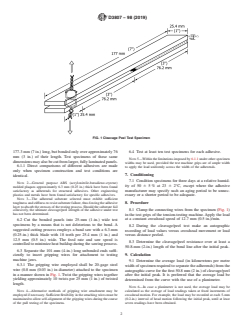
FIG. 1 Cleavage Peel Test Specimen
177.3 mm (7 in.) long, but bonded only over approximately 76 6.4 Test at least ten test specimens for each adhesive.
mm (3 in.) of their length. Test specimens of these same
NOTE 5—Within the limitations imposed by 6.1.1 under other specimen
dimensionsmayalsobecutfromlarger,fullylaminatedpanels.
widths may be used, provided the test machine grips are of ample width
6.1.1 Direct comparisons of different adhesives are made
to apply the load uniformly across the width of the adherends.
only when specimen construction and test conditions are
7. Conditioning
identical.
7.1 Condition specimens for three days at a relative humid-
NOTE 2—General purpose ABS (acrylonitrile-butadiene-styrene)
ity of 50 6 5 % at 23 6 2°C, except where the adhesive
molded plaques approximately 6.3 mm (0.25 in.) thick have been found
manufacturer may specify such an aging period to be unnec-
satisfactory as adherends for structural adhesives. Other engineering
plastics and metals have been found satisfactory for specific adhesives.
essary or a shorter period to be adequate.
NOTE 3—The adherend substrate selected must exh
...