

ASTM F2361-18
(Guide)Standard Guide for Ordering Low Voltage (1000 VAC or Less) Alternating Current Electric Motors for Shipboard Service—Up to and Including Motors of 500 Horsepower
General Information
- Abstract
ABSTRACT
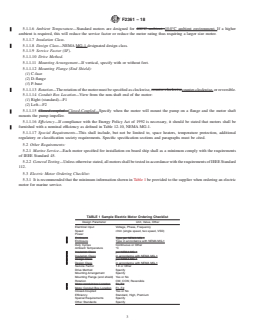
This guide provides the required basic ordering information for low voltage (1000 VAC or less, and up to and including motors of 500 hp) general-purpose (GP), commercial, universal, small and medium sized alternating current electric motors intended to drive common shipboard mechanical machinery such as fans, blowers, centrifugal and screw pumps. This guide does not address the ordering information for special-purpose (SP) motors, definite-purpose motors (for example, cryogenic service), or motors for use in hazardous (classified) locations as defined by the National Electrical Code (NFPA 70). The ordering checklist shall provide the following minimum information: electrical input; speed; power; enclosure; duty cycles; ambient temperature; insulation class; design class; service factor; drive method; mounting arrangement; mounting flange (end shield); rotation; motor conduit box location; closed-coupled; efficiency; and other special requirements.
SIGNIFICANCE AND USE
4.1 The selection criteria is to be applied for uses of (1) new motors and (2) replacement motors.
4.2 For the selection of new or replacement motors, this practice defines the choice criteria in terms of the ordering data below.
SCOPE
1.1 This guide covers the required basic ordering information for low voltage (1000 VAC or less) general-purpose, commercial, universal, small-, and medium-sized alternating current electric motors for shipboard use, up to and including motors of 500 hp.
1.2 The electric motors covered by this guide are general-purpose (GP) motors intended to drive common shipboard mechanical machinery such as fans, blowers, centrifugal and screw pumps.
1.3 This guide is not intended to be used to order special-purpose (SP) motors or definite-purpose motors (for example, cryogenic service) or motors for use in hazardous (classified) locations as defined by the National Electrical Code (NFPA 70).
1.4 This standard does not purport to address all of the safety concerns, if any, associated with its use. It is the responsibility of the user of this standard to establish appropriate safety, health, and environmental practices and determine the applicability of regulatory limitations prior to use.
1.5 This international standard was developed in accordance with internationally recognized principles on standardization established in the Decision on Principles for the Development of International Standards, Guides and Recommendations issued by the World Trade Organization Technical Barriers to Trade (TBT) Committee.
- Status
- Published
- Publication Date
- 31-Oct-2018
- Technical Committee
- F25 - Ships and Marine Technology
- Drafting Committee
- F25.10 - Electrical
Buy Documents


ASTM F2361-18 - Standard Guide for Ordering Low Voltage (1000 VAC or Less) Alternating Current Electric Motors for Shipboard Service—Up to and Including Motors of 500 Horsepower

REDLINE ASTM F2361-18 - Standard Guide for Ordering Low Voltage (1000 VAC or Less) Alternating Current Electric Motors for Shipboard Service—Up to and Including Motors of 500 Horsepower
Overview
ASTM F2361-18, titled Standard Guide for Ordering Low Voltage (1000 VAC or Less) Alternating Current Electric Motors for Shipboard Service-Up to and Including Motors of 500 Horsepower, provides comprehensive guidance on the minimum information required when ordering general-purpose, small-, and medium-sized AC electric motors for use aboard ships. This standard is primarily intended for electric motors rated at 1000 VAC or less and up to 500 horsepower that are commonly used to drive shipboard mechanical equipment such as fans, blowers, and pumps. By specifying the required parameters for ordering, ASTM F2361-18 ensures compatibility, safety, and efficiency in marine electrical systems.
Key Topics
Ordering Information: The guide lists the essential data that must be included when specifying a new or replacement marine AC motor:
- Electrical input (voltage, phase, frequency)
- Speed and power rating
- Enclosure type (such as drip-proof, TEFC, weather-protected)
- Duty cycle and ambient temperature
- Insulation and design class (per NEMA standards)
- Service factor, drive method, and mounting arrangement
- Mounting flange, rotation direction, and conduit box location
- Closed-coupled configuration (if required)
- Motor efficiency levels
- Special requirements (e.g., space heaters, protection devices)
Scope Limitations: The standard does not address:
- Special-purpose or definite-purpose motors (e.g., for cryogenic service)
- Motors used in hazardous (classified) locations as defined by the National Electrical Code (NFPA 70)
Selection Criteria: Applicable to both new installations and replacement of existing shipboard motors, promoting lifecycle consistency and regulatory compliance.
Applications
ASTM F2361-18 is critical in the marine and shipbuilding industry for standardizing the procurement and specification of electric motors, particularly:
- Shipboard Mechanical Systems: Fans, blowers, centrifugal and screw pumps, and other auxiliary systems.
- Replacement and Retrofit Projects: Ensures that new or replacement motors are compatible with vessel requirements and existing electrical infrastructure.
- Marine Electrical Engineering: Guides engineers and naval architects in preparing documentation for ship construction, maintenance, or modernization.
By using the ordering checklist and guidelines of ASTM F2361-18, ship owners, designers, and suppliers benefit from:
- Reduced risk of incorrect motor specification
- Improved reliability and operational efficiency
- Enhanced compliance with industry and safety standards
Related Standards
ASTM F2361-18 references and aligns with several key industry and regional standards for electric motors:
- IEEE 45: Recommended Practice for Electrical Installations on Shipboard
- IEEE 112: Standard Test Procedure for Polyphase Induction Motors and Generators
- NEMA MG-1: Motors and Generators Standard by the National Electrical Manufacturers Association
- CSA C390-93: Energy Efficiency Test Methods for Three-Phase Induction Motors (Canadian Standards Association)
- NFPA 70: National Electrical Code (for hazardous area definitions)
Adherence to these standards ensures the reliability, safety, and performance of shipboard electric motors in demanding marine environments.
Practical Value
Implementing ASTM F2361-18 in shipbuilding and marine engineering projects delivers clear advantages:
- Standardized documentation for motor procurement
- Facilitates communication between marine engineers, shipowners, and suppliers
- Minimizes errors and delays in equipment delivery and installation
- Supports regulatory and classification society compliance
This standard is a valuable resource for anyone involved in specifying or ordering low voltage AC electric motors for shipboard applications.
Relations
- Effective Date
- 01-Nov-2018
Buy Documents
ASTM F2361-18 - Standard Guide for Ordering Low Voltage (1000 VAC or Less) Alternating Current Electric Motors for Shipboard Service—Up to and Including Motors of 500 Horsepower
REDLINE ASTM F2361-18 - Standard Guide for Ordering Low Voltage (1000 VAC or Less) Alternating Current Electric Motors for Shipboard Service—Up to and Including Motors of 500 Horsepower
Get Certified
Connect with accredited certification bodies for this standard

DNV
DNV is an independent assurance and risk management provider.

Lloyd's Register
Lloyd's Register is a global professional services organisation specialising in engineering and technology.

FSC International
Forest Stewardship Council certification.
Sponsored listings
Frequently Asked Questions
ASTM F2361-18 is a guide published by ASTM International. Its full title is "Standard Guide for Ordering Low Voltage (1000 VAC or Less) Alternating Current Electric Motors for Shipboard Service—Up to and Including Motors of 500 Horsepower". This standard covers: ABSTRACT This guide provides the required basic ordering information for low voltage (1000 VAC or less, and up to and including motors of 500 hp) general-purpose (GP), commercial, universal, small and medium sized alternating current electric motors intended to drive common shipboard mechanical machinery such as fans, blowers, centrifugal and screw pumps. This guide does not address the ordering information for special-purpose (SP) motors, definite-purpose motors (for example, cryogenic service), or motors for use in hazardous (classified) locations as defined by the National Electrical Code (NFPA 70). The ordering checklist shall provide the following minimum information: electrical input; speed; power; enclosure; duty cycles; ambient temperature; insulation class; design class; service factor; drive method; mounting arrangement; mounting flange (end shield); rotation; motor conduit box location; closed-coupled; efficiency; and other special requirements. SIGNIFICANCE AND USE 4.1 The selection criteria is to be applied for uses of (1) new motors and (2) replacement motors. 4.2 For the selection of new or replacement motors, this practice defines the choice criteria in terms of the ordering data below. SCOPE 1.1 This guide covers the required basic ordering information for low voltage (1000 VAC or less) general-purpose, commercial, universal, small-, and medium-sized alternating current electric motors for shipboard use, up to and including motors of 500 hp. 1.2 The electric motors covered by this guide are general-purpose (GP) motors intended to drive common shipboard mechanical machinery such as fans, blowers, centrifugal and screw pumps. 1.3 This guide is not intended to be used to order special-purpose (SP) motors or definite-purpose motors (for example, cryogenic service) or motors for use in hazardous (classified) locations as defined by the National Electrical Code (NFPA 70). 1.4 This standard does not purport to address all of the safety concerns, if any, associated with its use. It is the responsibility of the user of this standard to establish appropriate safety, health, and environmental practices and determine the applicability of regulatory limitations prior to use. 1.5 This international standard was developed in accordance with internationally recognized principles on standardization established in the Decision on Principles for the Development of International Standards, Guides and Recommendations issued by the World Trade Organization Technical Barriers to Trade (TBT) Committee.
ABSTRACT This guide provides the required basic ordering information for low voltage (1000 VAC or less, and up to and including motors of 500 hp) general-purpose (GP), commercial, universal, small and medium sized alternating current electric motors intended to drive common shipboard mechanical machinery such as fans, blowers, centrifugal and screw pumps. This guide does not address the ordering information for special-purpose (SP) motors, definite-purpose motors (for example, cryogenic service), or motors for use in hazardous (classified) locations as defined by the National Electrical Code (NFPA 70). The ordering checklist shall provide the following minimum information: electrical input; speed; power; enclosure; duty cycles; ambient temperature; insulation class; design class; service factor; drive method; mounting arrangement; mounting flange (end shield); rotation; motor conduit box location; closed-coupled; efficiency; and other special requirements. SIGNIFICANCE AND USE 4.1 The selection criteria is to be applied for uses of (1) new motors and (2) replacement motors. 4.2 For the selection of new or replacement motors, this practice defines the choice criteria in terms of the ordering data below. SCOPE 1.1 This guide covers the required basic ordering information for low voltage (1000 VAC or less) general-purpose, commercial, universal, small-, and medium-sized alternating current electric motors for shipboard use, up to and including motors of 500 hp. 1.2 The electric motors covered by this guide are general-purpose (GP) motors intended to drive common shipboard mechanical machinery such as fans, blowers, centrifugal and screw pumps. 1.3 This guide is not intended to be used to order special-purpose (SP) motors or definite-purpose motors (for example, cryogenic service) or motors for use in hazardous (classified) locations as defined by the National Electrical Code (NFPA 70). 1.4 This standard does not purport to address all of the safety concerns, if any, associated with its use. It is the responsibility of the user of this standard to establish appropriate safety, health, and environmental practices and determine the applicability of regulatory limitations prior to use. 1.5 This international standard was developed in accordance with internationally recognized principles on standardization established in the Decision on Principles for the Development of International Standards, Guides and Recommendations issued by the World Trade Organization Technical Barriers to Trade (TBT) Committee.
ASTM F2361-18 is classified under the following ICS (International Classification for Standards) categories: 47.020.20 - Marine engines and propulsion systems. The ICS classification helps identify the subject area and facilitates finding related standards.
ASTM F2361-18 has the following relationships with other standards: It is inter standard links to ASTM F2361-03(2013). Understanding these relationships helps ensure you are using the most current and applicable version of the standard.
ASTM F2361-18 is available in PDF format for immediate download after purchase. The document can be added to your cart and obtained through the secure checkout process. Digital delivery ensures instant access to the complete standard document.
Standards Content (Sample)
This international standard was developed in accordance with internationally recognized principles on standardization established in the Decision on Principles for the
Development of International Standards, Guides and Recommendations issued by the World Trade Organization Technical Barriers to Trade (TBT) Committee.
Designation: F2361 − 18 An American National Standard
Standard Guide for
Ordering Low Voltage (1000 VAC or Less) Alternating
Current Electric Motors for Shipboard Service—Up to and
Including Motors of 500 Horsepower
This standard is issued under the fixed designation F2361; the number immediately following the designation indicates the year of
original adoption or, in the case of revision, the year of last revision. A number in parentheses indicates the year of last reapproval. A
superscript epsilon (´) indicates an editorial change since the last revision or reapproval.
1. Scope 2.2 Institute of Electrical and Electronic Engineers
(IEEE):
1.1 This guide covers the required basic ordering informa-
IEEE Standard 45 Recommended Practice for Electrical
tion for low voltage (1000 VAC or less) general-purpose,
Installations on Shipboard
commercial, universal, small-, and medium-sized alternating
IEEE Standard 112 Standard Test—Procedure for Polyphase
current electric motors for shipboard use, up to and including
Induction Motors and Generators
motors of 500 hp.
2.3 National Electrical Manufacturers Association (NEMA)
1.2 The electric motors covered by this guide are general-
Standard:
purpose (GP) motors intended to drive common shipboard
NEMA Standard MG-l Motors and Generators
mechanical machinery such as fans, blowers, centrifugal and
2.4 National Fire Protection Association (NFPA):
screw pumps.
NFPA 70 National Electrical Code
1.3 This guide is not intended to be used to order special-
3. Terminology
purpose (SP) motors or definite-purpose motors (for example,
3.1 Definitions of Terms Specific to This Standard:
cryogenic service) or motors for use in hazardous (classified)
3.1.1 closed-coupled, n—a special design where the motor
locations as defined by the National Electrical Code (NFPA
features a face mounting flange that the pump casing mounts
70).
to, and a motor shaft extension on which the pump impeller is
1.4 This standard does not purport to address all of the
mounted.
safety concerns, if any, associated with its use. It is the
3.1.2 dripproof, n—a machine enclosure that allows the
responsibility of the user of this standard to establish appro-
priate safety, health, and environmental practices and deter- motor to be cooled by ambient air having ventilation openings
that allow operation when drops of liquid or solid particles
mine the applicability of regulatory limitations prior to use.
1.5 This international standard was developed in accor- strike the enclosure at any angle from zero to 15°.
dance with internationally recognized principles on standard-
3.1.3 drive method, n—the method of driving the
ization established in the Decision on Principles for the
equipment, such as direct, belt, gearbox, or chain.
Development of International Standards, Guides and Recom-
3.1.4 effıciency classes, n—standardefficiencyclassesestab-
mendations issued by the World Trade Organization Technical
lished by NEMA based on motor performance.
Barriers to Trade (TBT) Committee.
3.1.5 end shield, n—a machined flange or base which have
rabbets and bolt holes for mounting equipment to the motor or
2. Referenced Documents
for overhanging the motor on a driven machine.
2.1 Canadian Standards Association (CSA):
3.1.6 frame size, n—standard sizes established by NEMA
CSA Standard C390-93C Energy Efficiency Test Methods
based on motor power and speed.
for Three-Phase Induction Motors General Instruction
No.1 3.1.7 mounting arrangement, n—the installed operating po-
sition of the motor, such as horizontal, vertical shaft up, or
vertical shaft down.
This guide is under the jurisdiction of ASTM Committee F25 on Ships and
Marine Technology and is the direct responsibility of Subcommittee F25.10 on
Electrical. Available from Institute of Electrical and Electronics Engineers, Inc. (IEEE),
Current edition approved Nov. 1, 2018. Published November 2018. Originally 445 Hoes Ln., Piscataway, NJ 08854-4141, http://www.ieee.org.
approved in 2003. Last previous edition approved in 2013 as F2361 – 03 (2013). Available from National Electrical Manufacturers Association (NEMA), 1300
DOI: 10.1520/F2361-18. N. 17th St., Suite 900, Arlington, VA 22209, http://www.nema.org.
Available from Canadian Standards Association (CSA), 178 Rexdale Blvd., Available from National Fire Protection Association (NFPA), 1 Batterymarch
Toronto, ON M9W 1R3, Canada, http://www.csagroup.org. Park, Quincy, MA 02169-7471, http://www.nfpa.org.
Copyright © ASTM International, 100 Barr Harbor Drive, PO Box C700, West Conshohocken, PA 19428-2959. United States
F2361 − 18
3.1.8 multi-speed, n—a motor that can operate at more than 3.1.25 weather protected, n—a machine with ventilating
one speed, typically at two or three speeds. passages so constructed as to minimize the entrance of rain,
snow and airborne particles to the electrical components.
3.1.9 NEMA design classes, n—design classifications desig-
nated by NEMA (see NEMA Standard MG-1) for motors that
4. Significance and Use
provides information to the end user on characteristics such as
4.1 The selection criteria is to be applied for uses of (1) new
motor starting, torque, voltage, and so forth.
motors and (2) replacement motors.
3.1.10 NEMA insulation classes, n—NEMA system that
4.2 For the selection of new or replacement motors, this
classifies motor insulation systems by their ability to withstand
practice defines the choice criteria in terms of the ordering data
a specified temperature for a specified length of time with
below.
minimum deterioration.
3.1.11 polyphase medium motors, n—motors which have
5. General Requirements for Electric Motor Ordering
windings so arranged to accept to polyphase voltage sources.
5.1 Electric Motor Ordering Requirements:
3.1.12 service factor, n—service factor for an ac motor is a
5.1.1 With each electric motor ordered for marine service,
multiplier, which when applied to the rated horsepower,
provide the following, to the greatest extent practicable, for
indicates a permissible horsepower loading which may be
each speed at which the motor is to operate:
carried under the conditions specified for the service factor.
5.1.1.1 Electrical Input—Voltage, phases and f
...
This document is not an ASTM standard and is intended only to provide the user of an ASTM standard an indication of what changes have been made to the previous version. Because
it may not be technically possible to adequately depict all changes accurately, ASTM recommends that users consult prior editions as appropriate. In all cases only the current version
of the standard as published by ASTM is to be considered the official document.
Designation: F2361 − 03 (Reapproved 2013) F2361 − 18 An American National Standard
Standard Guide for
Ordering Low Voltage (1000 VAC or Less) Alternating
Current Electric Motors for Shipboard Service—Up to and
Including Motors of 500 Horsepower
This standard is issued under the fixed designation F2361; the number immediately following the designation indicates the year of
original adoption or, in the case of revision, the year of last revision. A number in parentheses indicates the year of last reapproval. A
superscript epsilon (´) indicates an editorial change since the last revision or reapproval.
1. Scope
1.1 This guide covers the required basic ordering information for low voltage (1000 VAC or less) general-purpose, commercial,
universal, smallsmall-, and medium sized medium-sized alternating current electric motors for shipboard use, up to and including
motors of 500 hp.
1.2 The electric motors covered by this guide are general-purpose (GP) motors intended to drive common shipboard mechanical
machinery such as fans, blowers, centrifugal and screw pumps.
1.3 This guide is not intended to be used to order special-purpose (SP) motors or definite-purpose motors (for example,
cryogenic service) or motors for use in hazardous (classified) locations as defined by the National Electrical Code (NFPA 70).
1.4 This standard does not purport to address all of the safety concerns, if any, associated with its use. It is the responsibility
of the user of this standard to establish appropriate safety, health, and environmental practices and determine the applicability of
regulatory limitations prior to use.
1.5 This international standard was developed in accordance with internationally recognized principles on standardization
established in the Decision on Principles for the Development of International Standards, Guides and Recommendations issued
by the World Trade Organization Technical Barriers to Trade (TBT) Committee.
2. Referenced Documents
2.1 Canadian Standards Association (CSA):
CSA Standard C390-93C Energy Efficiency Test Methods for Three-Phase Induction Motors General Instruction No.1
2.2 Institute of Electrical and Electronic Engineers (IEEE):
IEEE Standard 45 Recommended Practice for Electrical Installations on Shipboard
IEEE Standard 112 Standard Test—Procedure for Polyphase Induction Motors and Generators
2.3 National Electrical Manufacturers Association (NEMA) Standard:
NEMA Standard MG-l Motors and Generators
2.4 National Fire Protection Association (NFPA):
NFPA 70 National Electrical Code
3. Terminology
3.1 Definitions of Terms Specific to This Standard:
3.1.1 closed-coupled—closed-coupled, n—a special design where the motor features a face mounting flange that the pump
casing mounts to, and a motor shaft extension on which the pump impeller is mounted.
3.1.2 dripproof—dripproof, n—a machine enclosure that allows the motor to be cooled by ambient air having ventilation
openings that allow operation when drops of liquid or solid particles strike the enclosure at any angle from zero to 15°.
This guide is under the jurisdiction of ASTM Committee F25 on Ships and Marine Technology and is the direct responsibility of Subcommittee F25.10 on Electrical.
Current edition approved Oct. 1, 2013Nov. 1, 2018. Published October 2013November 2018. Originally approved in 2003. Last previous edition approved in 20092013
as F2361 – 03 (2009).(2013). DOI: 10.1520/F2361-03R13.10.1520/F2361-18.
Available from Canadian Standards Association (CSA), 5060 Spectrum Way, Mississauga, ON L4W 5N6, Canada, http://www.csa.ca.178 Rexdale Blvd., Toronto, ON
M9W 1R3, Canada, http://www.csagroup.org.
Available from Institute of Electrical and Electronics Engineers, Inc. (IEEE), 445 Hoes Ln., P.O. Box 1331, Piscataway, NJ 08854-1331,08854-4141, http://www.ieee.org.
Available from National Electrical Manufacturers Association (NEMA), 1300 N. 17th St., Suite 1752, Rosslyn,900, Arlington, VA 22209, http://www.nema.org.
Available from National Fire Protection Association (NFPA), 1 Batterymarch Park, Quincy, MA 02169-7471, http://www.nfpa.org.
Copyright © ASTM International, 100 Barr Harbor Drive, PO Box C700, West Conshohocken, PA 19428-2959. United States
F2361 − 18
3.1.3 drive method—method, n—the method of driving the equipment, such as direct, belt, gearbox, or chain.
3.1.4 effıciency classes—classes, n—standard efficiency classes established by NEMA based on motor performance.
3.1.5 end shield—shield, n—a machined flange or base which have rabbets and bolt holes for mounting equipment to the motor
or for overhanging the motor on a driven machine.
3.1.6 frame size—size, n—standard sizes established by NEMA based on motor power and speed.
3.1.7 mounting arrangement—arrangement, n—the installed operating position of the motor, such as horizontal, vertical shaft
up, or vertical shaft down.
3.1.8 multi-speed—multi-speed, n—a motor that can operate at more than one speed, typically at two or three speeds.
3.1.9 NEMA design classes—classes, n—design classifications designated by NEMA (see NEMA Standard MG-1) for motors
that provides information to the end user on characteristics such as motor starting, torque, voltage, and so forth.
3.1.10 NEMA insulation classes—classes, n—NEMA system that classifies motor insulation systems by their ability to
withstand a specified temperature for a specified length of time with minimum deterioration.
3.1.11 polyphase medium motors—motors, n—motors which have windings so arranged to accept to polyphase voltage sources.
3.1.12 service factor—factor, n—service factor for an ac motor is a multiplier, which when applied to the rated horsepower,
indicates a permissible horsepower loading which may be carried under the conditions specified for the service factor.
3.1.13 single-phase fractional horsepower motors—motors, n—motors with ratings up to 1 hp which use single-phase power.
3.1.14 single-phase integral horsepower motors—motors, n—motors with ratings of 1 hp up to and including 10 hp, which
normally use single-phase power but at the upper end of their specified range may also utilize polyphase power.
3.1.15 slip—slip, n—the difference between synchronous speed and full load speed. Normal slip is less than 5 %.
3.1.16 speed—speed, n—the number of revolutions per minute (r/min) at which an induction motor operates, which is dependent
upon the input power, frequency, and the number of magnetic poles in the machine.
3.1.17 temperature, ambient—ambient, n—th
...