

ASTM B248M-22
(Specification)Standard Specification for General Requirements for Wrought Copper and Copper-Alloy Plate, Sheet, Strip, and Rolled Bar (Metric)
General Information
- Abstract
ABSTRACT
This specification establishes the general requirements common to several wrought products including copper and copper-alloy plates, sheets, strips, and rolled bars. The numerical values in this specification are not presented in inch-pound units, but rather, in metric or SI units only. The material for manufacture shall be a cast bar, cake, or slab of such purity and soundness as to be suitable for processing by hot- or cold-working, and annealing to produce a uniform wrought structure in the finished product. The edges shall be slit, sheared, sawed, or rolled, as specified. When rolled edges are required, they may be produced by either rolling or drawing to one of the following specified edge contours: square edges (square corners), rounded corners, rounded edges, and full-rounded edges. Products shall be sampled and prepared, then tested accordingly to examine their conformance to dimensional (thickness, length, width, weight, and straightness), mechanical (tensile and yield strength, Rockwell hardness, and elongation), electrical (resistivity and conductivity), chemical composition, and grain size requirements.
SIGNIFICANCE AND USE
11.1 For the purposes of determining compliance with the specified limits for requirements of the properties listed in the following table and for dimensional tolerances, an observed value or a calculated value shall be rounded as indicated in accordance with the rounding method of Practice E29:
Property
Rounded Unit for Observed or
Calculated Value
Chemical composition
nearest unit in the last
Hardness
right-hand significant digit
Electrical resistivity
used in expressing
Electrical conductivity
the limiting value
Tensile strength
nearest 5 MPa
Yield strength
nearest 5 MPa
Elongation:
nearest 1 %
Grain size:
Under 0.060 mm
nearest multiple of 0.005 mm
0.060 mm and over
nearest 0.01 mm
SCOPE
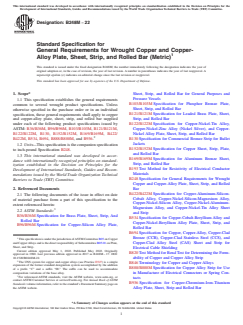
1.1 This specification establishes the general requirements common to several wrought product specifications. Unless otherwise specified in the purchase order or in an individual specification, these general requirements shall apply to copper and copper-alloy plate, sheet, strip, and rolled bar supplied under each of the following product specifications issued by ASTM: B36/B36M, B96/B96M, B103/B103M, B121/B121M, B122/B122M, B130, B152/B152M, B169/B169M, B422/B422M, B534, B694, B888/B888M, and B936.2
1.2 Units—This specification is the companion specification to inch-pound Specification B248.
1.3 This international standard was developed in accordance with internationally recognized principles on standardization established in the Decision on Principles for the Development of International Standards, Guides and Recommendations issued by the World Trade Organization Technical Barriers to Trade (TBT) Committee.
- Status
- Published
- Publication Date
- 30-Apr-2022
- Technical Committee
- B05 - Copper and Copper Alloys
- Drafting Committee
- B05.01 - Plate, Sheet, and Strip
Buy Documents
ASTM B248M-22 - Standard Specification for General Requirements for Wrought Copper and Copper-Alloy Plate, Sheet, Strip, and Rolled Bar (Metric)
REDLINE ASTM B248M-22 - Standard Specification for General Requirements for Wrought Copper and Copper-Alloy Plate, Sheet, Strip, and Rolled Bar (Metric)
Overview
ASTM B248M-22 is the internationally recognized standard from ASTM International that specifies the general requirements for wrought copper and copper-alloy plate, sheet, strip, and rolled bar supplied in metric (SI) units. This standard is critical for manufacturers, suppliers, and buyers in the copper processing industry, providing clear guidelines for the physical, mechanical, and chemical properties that these copper products must meet. ASTM B248M-22 is applicable across various industries where material quality, dimensional tolerances, and product traceability are essential.
Key Topics
- Scope and Applicability: Covers copper and copper-alloy plate, sheet, strip, and rolled bar, referencing several specific ASTM materials standards (e.g., B36/B36M, B152/B152M).
- Metric/SI Units: All requirements and tolerances are established exclusively in metric units, facilitating global harmonization.
- Materials and Manufacture: Requires starting materials (cast bar, cake, or slab) of high purity and soundness, suitable for hot- or cold-working and annealing to achieve uniform wrought structure.
- Dimensional and Geometric Requirements:
- Thickness Tolerances: Prescribed for different product types and widths.
- Width, Length, and Straightness Tolerances: Detailed for various cutting/finishing methods, including slit, sheared, sawed, and rolled edges.
- Edge Configurations: Specifies square, rounded, and full-rounded edge contours as required.
- Weight Tolerances: Defined for lot and individual product weights based on type and dimensions.
- Physical and Mechanical Properties:
- Mechanical: Includes tensile strength, yield strength, elongation, and Rockwell hardness.
- Electrical: Resistivity and conductivity as required by product specification.
- Grain Size: Minimum and maximum grain size requirements are defined for final product quality.
- Conformance and Testing:
- Sampling and Sample Preparation: Procedures for lot sizes and representative samples.
- Test Methods: Referenced ASTM test standards for chemical, mechanical, electrical, and grain size testing.
- Rounding Methods: Use of ASTM E29 for significant digits and rounding of test results.
- Quality and Inspection:
- Workmanship and Appearance: Products must be free of defects that impact functionality; minor blemishes are permissible if they do not affect use.
- Rejection and Retest Provisions: Procedures for notification and retests if requirements are not met.
- Identification and Packaging: Details on marking, traceability, and protective packaging to ensure product integrity during transport and storage.
Applications
ASTM B248M-22 is an essential standard for producers and purchasers of copper and copper-alloy products used in:
- Electrical and Electronics Industries: High conductivity copper products for wiring, connectors, and bus bars.
- Building and Construction: Structural copper and alloys for roofing, cladding, and architectural applications.
- Industrial Fabrication: Precision strip and sheet for stamped parts, tubes, and further processing.
- Mechanical Engineering: Copper plates and bars used in heat exchangers, bearings, and pressure vessels.
- Transportation: Automotive, aerospace, and railway components where copper and copper-alloys are integral.
The standardized requirements ensure reliable material performance, manufacturing consistency, and quality assurance across diverse applications.
Related Standards
For robust compliance and compatibility, ASTM B248M-22 references/coordinates with numerous related standards, including:
- ASTM B36/B36M: Brass plate, sheet, strip, and rolled bar.
- ASTM B103/B103M: Phosphor bronze products.
- ASTM B152/B152M: General copper sheet, strip, plate, and bar.
- ASTM B121/B121M, B122/B122M, B169/B169M: Various copper-alloy specifications.
- ASTM E8/E8M: Tension testing of metallic materials.
- ASTM E18: Hardness testing of metallic materials.
- ASTM E29: Guide for significant digits and rounding.
- ASTM B193, E1004: Electrical conductivity and resistivity test methods.
- ASTM B248: Companion inch-pound (Imperial) unit specification.
Compliance with ASTM B248M-22 ensures products meet established global copper industry benchmarks for quality, performance, and safety in metric-based projects.
Relations
- Effective Date
- 01-Jan-2024
- Effective Date
- 01-Dec-2023
- Effective Date
- 01-Nov-2023
- Effective Date
- 01-Oct-2023
- Refers
ASTM B103/B103M-23 - Standard Specification for Phosphor Bronze Plate, Sheet, Strip, and Rolled Bar - Effective Date
- 01-Oct-2023
- Effective Date
- 01-Oct-2023
- Effective Date
- 01-Apr-2020
- Effective Date
- 01-Apr-2020
- Refers
ASTM B103/B103M-19 - Standard Specification for Phosphor Bronze Plate, Sheet, Strip, and Rolled Bar - Effective Date
- 01-Oct-2019
- Effective Date
- 01-Oct-2019
- Effective Date
- 01-Oct-2019
- Effective Date
- 01-Aug-2019
- Effective Date
- 01-Apr-2019
- Effective Date
- 01-Apr-2019
- Effective Date
- 01-Apr-2019
Buy Documents
ASTM B248M-22 - Standard Specification for General Requirements for Wrought Copper and Copper-Alloy Plate, Sheet, Strip, and Rolled Bar (Metric)
REDLINE ASTM B248M-22 - Standard Specification for General Requirements for Wrought Copper and Copper-Alloy Plate, Sheet, Strip, and Rolled Bar (Metric)
Get Certified
Connect with accredited certification bodies for this standard

Element Materials Technology
Materials testing and product certification.

Inštitut za kovinske materiale in tehnologije
Institute of Metals and Technology. Materials testing, metallurgical analysis, NDT.
Sponsored listings
Frequently Asked Questions
ASTM B248M-22 is a technical specification published by ASTM International. Its full title is "Standard Specification for General Requirements for Wrought Copper and Copper-Alloy Plate, Sheet, Strip, and Rolled Bar (Metric)". This standard covers: ABSTRACT This specification establishes the general requirements common to several wrought products including copper and copper-alloy plates, sheets, strips, and rolled bars. The numerical values in this specification are not presented in inch-pound units, but rather, in metric or SI units only. The material for manufacture shall be a cast bar, cake, or slab of such purity and soundness as to be suitable for processing by hot- or cold-working, and annealing to produce a uniform wrought structure in the finished product. The edges shall be slit, sheared, sawed, or rolled, as specified. When rolled edges are required, they may be produced by either rolling or drawing to one of the following specified edge contours: square edges (square corners), rounded corners, rounded edges, and full-rounded edges. Products shall be sampled and prepared, then tested accordingly to examine their conformance to dimensional (thickness, length, width, weight, and straightness), mechanical (tensile and yield strength, Rockwell hardness, and elongation), electrical (resistivity and conductivity), chemical composition, and grain size requirements. SIGNIFICANCE AND USE 11.1 For the purposes of determining compliance with the specified limits for requirements of the properties listed in the following table and for dimensional tolerances, an observed value or a calculated value shall be rounded as indicated in accordance with the rounding method of Practice E29: Property Rounded Unit for Observed or Calculated Value Chemical composition nearest unit in the last Hardness right-hand significant digit Electrical resistivity used in expressing Electrical conductivity the limiting value Tensile strength nearest 5 MPa Yield strength nearest 5 MPa Elongation: nearest 1 % Grain size: Under 0.060 mm nearest multiple of 0.005 mm 0.060 mm and over nearest 0.01 mm SCOPE 1.1 This specification establishes the general requirements common to several wrought product specifications. Unless otherwise specified in the purchase order or in an individual specification, these general requirements shall apply to copper and copper-alloy plate, sheet, strip, and rolled bar supplied under each of the following product specifications issued by ASTM: B36/B36M, B96/B96M, B103/B103M, B121/B121M, B122/B122M, B130, B152/B152M, B169/B169M, B422/B422M, B534, B694, B888/B888M, and B936.2 1.2 Units—This specification is the companion specification to inch-pound Specification B248. 1.3 This international standard was developed in accordance with internationally recognized principles on standardization established in the Decision on Principles for the Development of International Standards, Guides and Recommendations issued by the World Trade Organization Technical Barriers to Trade (TBT) Committee.
ABSTRACT This specification establishes the general requirements common to several wrought products including copper and copper-alloy plates, sheets, strips, and rolled bars. The numerical values in this specification are not presented in inch-pound units, but rather, in metric or SI units only. The material for manufacture shall be a cast bar, cake, or slab of such purity and soundness as to be suitable for processing by hot- or cold-working, and annealing to produce a uniform wrought structure in the finished product. The edges shall be slit, sheared, sawed, or rolled, as specified. When rolled edges are required, they may be produced by either rolling or drawing to one of the following specified edge contours: square edges (square corners), rounded corners, rounded edges, and full-rounded edges. Products shall be sampled and prepared, then tested accordingly to examine their conformance to dimensional (thickness, length, width, weight, and straightness), mechanical (tensile and yield strength, Rockwell hardness, and elongation), electrical (resistivity and conductivity), chemical composition, and grain size requirements. SIGNIFICANCE AND USE 11.1 For the purposes of determining compliance with the specified limits for requirements of the properties listed in the following table and for dimensional tolerances, an observed value or a calculated value shall be rounded as indicated in accordance with the rounding method of Practice E29: Property Rounded Unit for Observed or Calculated Value Chemical composition nearest unit in the last Hardness right-hand significant digit Electrical resistivity used in expressing Electrical conductivity the limiting value Tensile strength nearest 5 MPa Yield strength nearest 5 MPa Elongation: nearest 1 % Grain size: Under 0.060 mm nearest multiple of 0.005 mm 0.060 mm and over nearest 0.01 mm SCOPE 1.1 This specification establishes the general requirements common to several wrought product specifications. Unless otherwise specified in the purchase order or in an individual specification, these general requirements shall apply to copper and copper-alloy plate, sheet, strip, and rolled bar supplied under each of the following product specifications issued by ASTM: B36/B36M, B96/B96M, B103/B103M, B121/B121M, B122/B122M, B130, B152/B152M, B169/B169M, B422/B422M, B534, B694, B888/B888M, and B936.2 1.2 Units—This specification is the companion specification to inch-pound Specification B248. 1.3 This international standard was developed in accordance with internationally recognized principles on standardization established in the Decision on Principles for the Development of International Standards, Guides and Recommendations issued by the World Trade Organization Technical Barriers to Trade (TBT) Committee.
ASTM B248M-22 is classified under the following ICS (International Classification for Standards) categories: 77.150.30 - Copper products. The ICS classification helps identify the subject area and facilitates finding related standards.
ASTM B248M-22 has the following relationships with other standards: It is inter standard links to ASTM E8/E8M-24, ASTM E1004-23, ASTM B820-23, ASTM B36/B36M-23, ASTM B103/B103M-23, ASTM B936-23, ASTM B169/B169M-20, ASTM B534-20, ASTM B103/B103M-19, ASTM B152/B152M-19, ASTM B888/B888M-19, ASTM B846-19a, ASTM B130-19, ASTM B694-19, ASTM B936-19. Understanding these relationships helps ensure you are using the most current and applicable version of the standard.
ASTM B248M-22 is available in PDF format for immediate download after purchase. The document can be added to your cart and obtained through the secure checkout process. Digital delivery ensures instant access to the complete standard document.
Standards Content (Sample)
This international standard was developed in accordance with internationally recognized principles on standardization established in the Decision on Principles for the
Development of International Standards, Guides and Recommendations issued by the World Trade Organization Technical Barriers to Trade (TBT) Committee.
Designation:B248M −22
Standard Specification for
General Requirements for Wrought Copper and Copper-
Alloy Plate, Sheet, Strip, and Rolled Bar (Metric)
This standard is issued under the fixed designation B248M; the number immediately following the designation indicates the year of
original adoption or, in the case of revision, the year of last revision. A number in parentheses indicates the year of last reapproval. A
superscript epsilon (´) indicates an editorial change since the last revision or reapproval.
This standard has been approved for use by agencies of the U.S. Department of Defense.
1. Scope* Sheet, Strip, and Rolled Bar for General Purposes and
Pressure Vessels
1.1 This specification establishes the general requirements
B103/B103M Specification for Phosphor Bronze Plate,
common to several wrought product specifications. Unless
Sheet, Strip, and Rolled Bar
otherwise specified in the purchase order or in an individual
B121/B121M Specification for Leaded Brass Plate, Sheet,
specification, these general requirements shall apply to copper
Strip, and Rolled Bar
and copper-alloy plate, sheet, strip, and rolled bar supplied
B122/B122M Specification for Copper-Nickel-Tin Alloy,
under each of the following product specifications issued by
ASTM: B36/B36M, B96/B96M, B103/B103M, B121/B121M, Copper-Nickel-Zinc Alloy (Nickel Silver), and Copper-
B122/B122M, B130, B152/B152M, B169/B169M, B422/ Nickel Alloy Plate, Sheet, Strip, and Rolled Bar
B422M, B534, B694, B888/B888M, and B936.
B130 Specification for Commercial Bronze Strip for Bullet
Jackets
1.2 Units—This specification is the companion specification
B152/B152M Specification for Copper Sheet, Strip, Plate,
to inch-pound Specification B248.
and Rolled Bar
1.3 This international standard was developed in accor-
B169/B169M Specification for Aluminum Bronze Sheet,
dance with internationally recognized principles on standard-
Strip, and Rolled Bar
ization established in the Decision on Principles for the
B193 Test Method for Resistivity of Electrical Conductor
Development of International Standards, Guides and Recom-
Materials
mendations issued by the World Trade Organization Technical
B248 Specification for General Requirements for Wrought
Barriers to Trade (TBT) Committee.
Copper and Copper-Alloy Plate, Sheet, Strip, and Rolled
Bar
2. Referenced Documents
B422/B422M Specification for Copper-Aluminum-Silicon-
2.1 The following documents of the issue in effect on date
Cobalt Alloy, Copper-Nickel-Silicon-Magnesium Alloy,
of material purchase form a part of this specification to the
Copper-Nickel-Silicon Alloy, Copper-Nickel-Aluminum-
extent referenced herein:
Magnesium Alloy, and Copper-Nickel-Tin Alloy Sheet
2.2 ASTM Standards:
and Strip
B36/B36M Specification for Brass Plate, Sheet, Strip, And
B534 Specification for Copper-Cobalt-Beryllium Alloy and
Rolled Bar
Copper-Nickel-Beryllium Alloy Plate, Sheet, Strip, and
B96/B96M Specification for Copper-Silicon Alloy Plate,
Rolled Bar
B694 Specification for Copper, Copper-Alloy, Copper-Clad
1 Bronze (CCB), Copper-Clad Stainless Steel (CCS), and
ThisspecificationisunderthejurisdictionofASTMCommitteeB05onCopper
andCopperAlloysandisthedirectresponsibilityofSubcommitteeB05.01onPlate,
Copper-Clad Alloy Steel (CAS) Sheet and Strip for
Sheet, and Strip.
Electrical Cable Shielding
Current edition approved May 1, 2022. Published May 2022. Originally
B820 Test Method for Bend Test for Determining the Form-
approved in 1980. Last previous edition approved in 2017 as B248M – 17. DOI:
10.1520/B0248M-22.
ability of Copper and Copper Alloy Strip
The UNS system for copper and copper alloys (see Practice E527) is a simple
B846 Terminology for Copper and Copper Alloys
expansion of the former standard designation system accomplished by the addition
B888/B888M Specification for Copper Alloy Strip for Use
of a prefix “C” and a suffix “00.” The suffix can be used to accommodate
composition variations of the base alloy.
in Manufacture of Electrical Connectors or Spring Con-
For referenced ASTM standards, visit the ASTM website, www.astm.org, or
tacts
contact ASTM Customer Service at service@astm.org. For Annual Book of ASTM
B936 Specification for Copper-Chromium-Iron-Titanium
Standards volume information, refer to the standard’s Document Summary page on
the ASTM website. Alloy Plate, Sheet, Strip and Rolled Bar
*A Summary of Changes section appears at the end of this standard
Copyright © ASTM International, 100 Barr Harbor Drive, PO Box C700, West Conshohocken, PA 19428-2959. United States
B248M−22
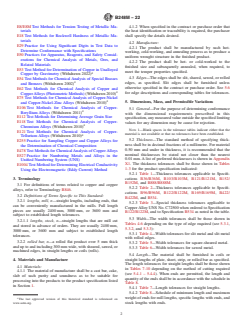
E8/E8M Test Methods for Tension Testing of Metallic Ma- 4.1.2 When specified in the contract or purchase order that
terials the heat identification or traceability is required, the purchaser
E18 Test Methods for Rockwell Hardness of Metallic Ma- shall specify the details desired.
terials
4.2 Manufacture:
E29 Practice for Using Significant Digits in Test Data to
4.2.1 The product shall be manufactured by such hot-
Determine Conformance with Specifications
working, cold-working, and annealing process as to produce a
E50 Practices for Apparatus, Reagents, and Safety Consid-
uniform wrought structure in the finished product.
erations for Chemical Analysis of Metals, Ores, and
4.2.2 The product shall be hot- or cold-worked to the
Related Materials
finished size and subsequently annealed, when required, to
E53 Test Method for Determination of Copper in Unalloyed
meet the temper properties specified.
Copper by Gravimetry (Withdrawn 2022)
4.3 Edges—The edges shall be slit, shared, sawed, or rolled
E54 Test Methods for ChemicalAnalysis of Special Brasses
edges, as specified. Slit edges shall be furnished unless
and Bronzes (Withdrawn 2002)
otherwise specified in the contract or purchase order. See 5.6
E62 Test Methods for Chemical Analysis of Copper and
for edge descriptions and corresponding tables for tolerances.
CopperAlloys(PhotometricMethods)(Withdrawn2010)
E75 Test Methods for Chemical Analysis of Copper-Nickel
5. Dimensions, Mass, and Permissible Variations
and Copper-Nickel-Zinc Alloys (Withdrawn 2010)
E106 Test Methods for Chemical Analysis of Copper-
5.1 General—For the purpose of determining conformance
Beryllium Alloys (Withdrawn 2011)
with the dimensional requirements prescribed in this
E112 Test Methods for Determining Average Grain Size
specification,anymeasuredvalueoutsidethespecifiedlimiting
E118 Test Methods for Chemical Analysis of Copper-
values for any dimension may be cause for rejection.
Chromium Alloys (Withdrawn 2010)
NOTE 1—Blank spaces in the tolerance tables indicate either that the
E121 Test Methods for Chemical Analysis of Copper-
material is not available or that no tolerances have been established.
Tellurium Alloys (Withdrawn 2010)
5.2 Thickness—The standard method of specifying thick-
E255 Practice for Sampling Copper and Copper Alloys for
ness shall be in decimal fractions of a millimetre. For material
the Determination of Chemical Composition
0.50 mm and under in thickness, it is recommended that the
E478 Test Methods for ChemicalAnalysis of CopperAlloys
nominal thicknesses be stated not closer than the nearest
E527 Practice for Numbering Metals and Alloys in the
0.01 mm.Alist of preferred thicknesses is shown in Appendix
Unified Numbering System (UNS)
X1. The thickness tolerances shall be those shown in Tables
E1004 Test Method for Determining Electrical Conductivity
1-3 for the product specification indicated:
Using the Electromagnetic (Eddy Current) Method
5.2.1 Table 1—Thickness tolerances applicable to Specifi-
3. Terminology cations B36/B36M, B103/B103M, B121/B121M, B152/
B152M, and B888/B888M.
3.1 For definitions of terms related to copper and copper
5.2.2 Table 2—Thickness tolerances applicable to Specifi-
alloys, refer to Terminology B846.
cations B96/B96M, B122/B122M, B169/B169M, B422/
3.2 Definitions of Terms Specific to This Standard:
B422M, and B534.
3.2.1 lengths, mill, n—straight lengths, including ends, that
5.2.3 Table 3—Special thickness tolerances applicable to
can be conveniently manufactured in the mills. Full length
CopperAlloy UNS No. C72500 when ordered to Specification
pieces are usually 2400 mm, 3000 mm, or 3600 mm and
B122/B122M, and to Specification B534 as noted in the table.
subject to established length tolerances.
5.3 Width—The width tolerances shall be those shown in
3.2.1.1 lengths, stock, n—straight lengths that are mill cut
Tables 4-6 depending on the type of edge required (see 5.3.1,
and stored in advance of orders. They are usually 2400 mm,
5.3.2, and 5.3.3):
3000 mm, or 3600 mm and subject to established length
5.3.1 Table 4—Width tolerances for slit metal and slit metal
tolerances.
with rolled edges.
3.2.2 rolled bar, n—a rolled flat product over 5 mm thick
5.3.2 Table 5—Width tolerances for square-sheared metal.
and up to and including 300 mm wide, with sheared, sawed, or
5.3.3 Table 6—Width tolerances for sawed metal.
machined edges, in straight lengths or coils (rolls).
5.4 Length—The material shall be furnished in coils or
straight lengths of plate, sheet, strip, or rolled bar as specified.
4. Materials and Manufacture
The length tolerances for straight lengths shall be those shown
4.1 Materials:
in Tables 7-10 depending on the method of cutting required
4.1.1 The material of manufacture shall be a cast bar, cake,
(see 5.4.1 – 5.4.4). When ends are permitted, the length and
slab of such purity and soundness as to be suitable for
quantity of the ends shall be in accordance with the schedule in
processing into the products to the product specification listed
Table 8.
in Section 1.
5.4.1 Table 7—Length tolerances for straight lengths.
5.4.2 Table 8—Schedule of minimum length and maximum
weight of ends for mill lengths, specific lengths with ends, and
The last approved version of this historical standard is referenced on
www.astm.org. stock lengths with ends.
B248M−22
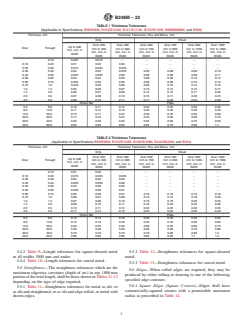
TABLE 1 Thickness Tolerances
(Applicable to Specifications B36/B36M, B103/B103M, B121/B121M, B152/B152M, B888/B888M, and B936)
Thickness, mm Thickness Tolerances, Plus and Minus, mm
Strip Sheet
Over 200 Over 300 Over 600 Over 700 Over 900 Over 1200
Up to 200
Over Through
mm to 300 mm to 600 mm to 700 mm to 900 mm to 1200 mm to 1600
mm, incl, in
mm, incl, in mm, incl, in mm, incl, in mm, incl, in mm, incl, in mm, incl, in
Width
Width Width Width Width Width Width
0.10 0.007 0.015 . . . . .
0.10 0.20 0.01 0.02 0.03 . . . .
0.20 0.30 0.015 0.025 0.035 . . . .
0.30 0.40 0.02 0.03 0.045 0.06 0.08 0.09 0.10
0.40 0.50 0.025 0.035 0.05 0.06 0.08 0.09 0.11
0.50 0.60 0.03 0.04 0.05 0.08 0.09 0.10 0.12
0.60 0.70 0.035 0.05 0.06 0.08 0.09 0.10 0.12
0.70 1.0 0.045 0.05 0.06 0.09 0.10 0.12 0.15
1.0 1.3 0.05 0.06 0.07 0.10 0.12 0.15 0.17
1.3 2.0 0.06 0.07 0.08 0.12 0.15 0.17 0.20
2.0 3.5 0.07 0.08 0.10 0.15 0.17 0.20 0.25
3.5 5.0 0.08 0.10 0.11 0.17 0.20 0.25 0.30
Rolled Bar Plate
5.0 8.0 0.10 0.11 0.12 0.22 0.25 0.30 0.35
8.0 13.0 0.11 0.12 0.15 0.30 0.35 0.40 0.45
13.0 20.0 0.13 0.17 0.22 0.40 0.45 0.50 0.60
20.0 30.0 0.17 0.22 0.27 0.45 0.55 0.60 0.75
30.0 40.0 0.55 0.55 0.55 0.55 0.65 0.75 0.90
40.0 60.0 0.65 0.65 0.65 0.65 0.75 0.90 1.1
TABLE 2 Thickness Tolerances
(Applicable to Specifications B96/B96M, B122/B122M, B169/B169M, B422/B422M, and B534)
Thickness, mm Thickness Tolerances, Plus and Minus, mm
Strip Sheet
Over 200 Over 300 Over 600 Over 700 Over 900 Over 1200
Up to 200
Over Through
mm to 300 mm to 600 mm to 700 mm to 900 mm to 1200 mm to 1600
mm, incl, in
mm, incl, in mm, incl, in mm, incl, in mm, incl, in mm, incl, in mm, incl, in
Width
Width Width Width Width Width Width
0.10 0.01 0.02 . . . . .
0.10 0.20 0.015 0.025 0.035 . . . .
0.20 0.30 0.02 0.03 0.05 . . . .
0.30 0.40 0.025 0.035 0.06 . . . .
0.40 0.50 0.03 0.05 0.06 . . . .
0.50 0.60 0.035 0.06 0.07 . . . .
0.60 0.70 0.05 0.06 0.07 0.10 0.13 0.15 0.18
0.70 1.0 0.06 0.07 0.08 0.13 0.15 0.18 0.20
1.0 1.3 0.07 0.08 0.10 0.15 0.18 0.20 0.25
1.3 2.0 0.08 0.10 0.11 0.18 0.20 0.25 0.30
2.0 3.5 0.10 0.11 0.12 0.20 0.25 0.30 0.35
3.5 5.0 0.11 0.13 0.15 0.25 0.30 0.35 0.40
Rolled Bar Plate
5.0 8.0 0.13 0.15 0.18 0.30 0.35 0.40 0.45
8.0 13.0 0.15 0.18 0.20 0.40 0.45 0.50 0.60
13.0 20.0 0.20 0.25 0.30 0.50 0.55 0.60 0.75
20.0 30.0 0.30 0.40 0.50 0.60 0.65 0.75 0.95
30.0 40.0 0.70 0.70 0.70 0.70 0.80 0.95 1.2
40.0 60.0 0.85 0.85 0.85 0.85 0.95 1.1 1.4
5.4.3 Table 9—Length tolerances for square-sheared metal 5.5.2 Table 12—Straightness tolerances for square-sheared
in all widths 3000 mm and under. metal.
5.4.4 Table 10—Length tolerances for sawed metal.
5.5.3 Table 13—Straightness tolerances for sawed metal.
5.5 Straightness—The straightness tolerances which are the
5.6 Edges—When rolled edges are required, they may be
maximum edgewise curvature (depth of arc) in any 1800 mm
produced by either rolling or drawing to one of the following
portionofthetotallength,shallbethoseshowninTables11-13
specified edge contours:
depending on the type of edge required.
5.6.1 Square Edges (Square Corners)—Edges shall have
5.5.1 Table 11—Straightness tolerances for metal as slit, or
commercially-squared corners with a permissible maximum
asslitandstraightened,orasslitandedge-rolled,ormetalwith
radius as prescribed in Table 14.
drawn edges.
B248M−22
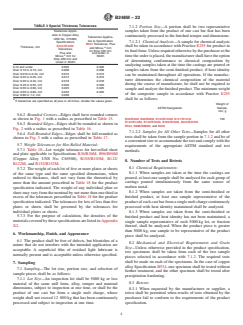
TABLE 3 Special Thickness Tolerances
7.1.2 Portion Size—A portion shall be two representative
Tolerances Applic- samples taken from the product of one cast bar that has been
able to Copper Alloy
continuously processed to the finished temper and dimensions.
Tolerances Applica-
UNS No. C72500,
ble to Specification
7.1.2.1 Chemical Analysis—Asample for chemical analysis
Specifications
B534 Tolerances, Plus
B122/B122M
shall be taken in accordance with Practice E255 for product in
Thickness, mm A
and Minus, mm
Tolerances,
for Strip 100 mm
itsfinalform.Unlessrequiredotherwisebythepurchaseratthe
Plus and
and Under in
A
time the order is placed, the manufacturer shall have the option
Minus, mm for
Width
Strip 200 mm and
of determining conformance to chemical composition by
Under in Width
analyzing samples taken at the time the castings are poured or
0.10 and under 0.005 0.005
Over 0.10 to 0.16, incl 0.008 0.008 samples taken from the semi-finished product, if heat identity
Over 0.016 to 0.22, incl 0.010 0.013
can be maintained throughout all operations. If the manufac-
Over 0.22 to 0.35, incl 0.013 0.015
turer determines the chemical composition of the material
Over 0.35 to 0.45, incl 0.018 0.018
during the course of manufacture, he shall not be required to
Over 0.45 to 0.55, incl 0.020 0.020
Over 0.55 to 0.60, incl 0.025 0.025
sample and analyze the finished product.The minimum weight
Over 0.65 to 0.80, incl 0.033 0.025
of the composite sample in accordance with Practice E255
Over 0.80 to 1.2, incl 0.038 .
shall be as follows:
A
If tolerances are specified as all plus or all minus, double the values given.
Weight of
ASTM Designation Sample,
min, g
5.6.2 Rounded Corners—Edges shall have rounded corners
B36/B36M, B96/B96M, B103/B103M, B121/B121M, 150
as shown in Fig. 1 with a radius as prescribed in Table 15.
B122/B122M, B152/B152M, B169/B169M, B422/B422M,
5.6.3 Rounded Edges—Edges shall be rounded as shown in
B534, B888/B888M, and B936
Fig. 2 with a radius as prescribed in Table 16.
7.1.2.2 Samples for All Other Tests—Samples for all other
5.6.4 Full-Rounded Edges—Edges shall be full-rounded as
tests shall be taken from the sample portion in 7.1.2 and be of
shown in Fig. 3 with a radius as prescribed in Table 17.
a convenient size to accommodate the test and comply with the
5.7 Weight Tolerances for Hot-Rolled Material:
requirements of the appropriate ASTM standard and test
5.7.1 Table 18—Lot weight tolerances for hot-rolled sheet
methods.
and plate applicable to Specifications B36/B36M, B96/B96M
(Copper Alloy UNS No. C65500), B103/B103M, B122/
8. Number of Tests and Retests
B122M, and B152/B152M.
8.1 Chemical Requirements:
5.7.2 The weight of each lot of five or more plates or sheets
8.1.1 When samples are taken at the time the castings are
of the same type and the same specified dimensions, when
poured, at least one sample shall be analyzed for each group of
ordered to thickness, shall not vary from the theoretical by
castings poured simultaneously from the same source of
more than the amount prescribed in Table 18 for the product
molten metal.
specification indicated. The weight of any individual plate or
sheet may vary from the nominal by not more than one third in 8.1.2 When samples are taken from the semi-finished or
finished product, at least one sample representative of the
excess of the tolerances prescribed in Table 18 for the product
specification indicated. The tolerances for lots of less than five productofeachcastbarfromasinglemeltchargecontinuously
processed with heat identity maintained shall be analyzed.
plates or sheets shall be governed by the tolerances for
individual plates or sheets.
8.1.3 When samples are taken from the semi-finished or
5.7.3 For the purpose of calculation, the densities of the finished product and heat identity has not been maintained, a
materialscoveredbythesespecificationsarelistedinAppendix
single sample representative of each 5000 kg lot, or fraction
X2.
thereof, shall be analyzed. When the product piece is greater
than 5000 kg, one sample to be representative of the product
6. Workmanship, Finish, and Appearance
piece shall be analyzed.
6.1 The product shall be free of defects, but blemishes of a
8.2 Mechanical and Electrical Requirements and Grain
nature that do not interfere with the intended application are
Size—Unless otherwise provided in the product specification,
acceptable. A superficial film of residual light lubricant is
test specimens shall be taken from each of the two sample
normally present and is acceptable unless otherwise specified.
pieces selected in accordance with 7.1.2. The required tests
shall be made on each of the specimens. In the case of copper
7. Sampling
alloy Specification B534, one specimen shall be tested without
7.1 Sampling—The lot size, portion size, and selection of
further treatment, and the other specimen shall be tested after
sample pieces shall be as follows:
precipitation hardening.
7.1.1 Lot Size—An inspection lot shall be 5000 kg or less
8.3 Retests:
material of the same mill form, alloy, temper and nominal
dimensions, subject to inspection at one time, or shall be the 8.3.1 When requested by the manufacturer or supplier, a
product of one cast bar from a single melt charge, whose retest shall be permitted when results of tests obtained by the
weight shall not exceed 12 000 kg that has been continuously purchaser fail to conform to the requirements of the product
processed and subject to inspection at one time. specification.
B248M−22
TABLE 4 Width Tolerances for Slit Metal and Slit Metal with Rolled Edges
(Applicable to all specifications listed in 1.1)
A
Width Tolerances, Plus and Minus, mm
Width, mm
For Thicknesses For Thicknesses For Thicknesses For Thicknesses
0.102 to 0.80 mm, incl Over 0.80 to 3.2 mm, incl Over 3.2 to 5.0 mm, incl Over 5.0 to 12.0 mm, incl
50.8 and under 0.13 0.25 0.30 0.38
Over 50.8 to 200, incl 0.20 0.33 0.38 0.38
Over 200 to 600, incl 0.40 0.40 0.40 0.79
Over 600 to 1270, incl 0.79 0.79 0.79 1.19
A
If tolerances are specified as all plus or all minus, double the values given.
TABLE 5 Width Tolerances for Square-Sheared Metal
the middle two thirds of the gage length or in a punched or
(Applicable to all specifications listed in 1.1)
scribed mark within the reduced section, a retest shall be
allowed.
NOTE 1—All lengths up to 3.05 m, inclusive.
A
8.3.5 If a bend test specimen fails, due to conditions of
Width Tolerances, Plus and Minus, mm
1.59 mm Over 1.5 mm
bending more severe than required by the specification, a retest
Over 3.5
Width, mm and Under to 3.5 mm,
mm in shall be permitted, either on a duplicate specimen or on a
in Thick- incl, in
Thickness
remaining portion of the failed specimen.
ness Thickness
500 and under 0.79 1.2 1.6
8.3.6 After removal of defective specimens and correction
Over 500 to 900, incl 1.2 1.2 1.6
of test methods, only one retest cycle is permitted. If after the
Over 900 to 3000, incl 1.6 1.6 1.6
retest the material fails to meet the requirements of this
A
If tolerances are specified as all plus or all minus, double the values given.
specification, it shall be rejected.
8.3.7 All test specimens shall conform to the product
specification requirement(s) in retest. Failure to conform shall
TABLE 6 Width Tolerances for Sawed Metal
(Applicable to all specifications listed in 1.1)
be cause for rejection.
A
Width Tolerances, Plus and Minus, mm
For Lengths Up to For Length Over
9. Specimen Preparation
3000 mm, incl 3000 mm
Width, mm For Thick-
9.1 Chemical Analysis—A composite sample of the semi-
For Thick-
nesses Up All Thick-
nesses Over finished or finished product shall be prepared in accordance
to 38 mm, nesses
38.1 mm
with Practice E255 or as described in 7.1.2.1.
incl
Up to 300, incl 0.79 1.6 1.6
9.2 Specimens shall be prepared in accordance with the
Over 300 to 3000, incl 1.6 1.6 1.6
method prescribed in 10.3 for all other tests. Full cross section
A
If tolerances are specified as all plus or all minus, double the values given.
specimens shall be used whenever possible. Samples shall be
representative of the condition of the material, and particular
specimen preparation techniques shall be stated in the specific
TABLE 7 Length Tolerances for Straight Lengths
(Applicable to all specifications listed in 1.1 except B694)
product specification.
NOTE 1—The following length tolerances are all plus: if all minus
10. Test Methods
tolerances are desired, use the same values; if tolerances are desired plus
and minus, halve the values given.
10.1 The test method(s) quality control or production
Length
Length, mm
control, or both, for determination of conformance with prod-
Tolerances, mm
uct property requirements are discretionary.
Specific lengths, mill lengths, multiple lengths, and
specific lengths with ends 10.1.1 The test method(s) used to obtain data for prepara-
3000 and under 6.4
tion of certification or test report, or both, shall be made
Over 3000 to 6000, incl 13
A available to the purchaser upon request.
Stock lengths and stock lengths with ends 25
A
Asstocklengthsarecutandplacedinstockinadvanceoforders,departurefrom 10.2 Chemical Composition:
this tolerance is not practicable.
10.2.1 In case of disagreement, test method(s) for chemical
analysis shall be subject to agreement between the manufac-
turer or supplier and the purchaser.
10.2.2 The following Test Methods E53, E54, E62, E75,
E106, E118, E121,or E478 include published test methods,
8.3.2 The retest shall be as directed in the product specifi-
which may no longer be viable, for reference.
cation for the initial test, except the number of test specimens
10.2.3 The specific method to be used for each specified
shall be twice that normally required for the specified test.
8.3.3 If any test specimen shows defective machining or element may be prescribed in the product specification.
develops flaws, it may be discarded and another specimen 10.2.4 Test method(s) to be followed for the determination
substituted. of element(s) resulting from contractual or purchase order
8.3.4 If the percent elongation of any tension test specimen agreementshallbeasagreeduponbetweenthemanufactureror
is less than that specified and any part of the fracture is outside supplier and purchaser.
B248M−22
TABLE 8 Schedule of Minimum Length and Maximum Weight of Ends for Mill Lengths, Specific Lengths with Ends,
and Stock Lengths with Ends
(Applicab
...
This document is not an ASTM standard and is intended only to provide the user of an ASTM standard an indication of what changes have been made to the previous version. Because
it may not be technically possible to adequately depict all changes accurately, ASTM recommends that users consult prior editions as appropriate. In all cases only the current version
of the standard as published by ASTM is to be considered the official document.
Designation: B248M − 17 B248M − 22
Standard Specification for
General Requirements for Wrought Copper and Copper-
Alloy Plate, Sheet, Strip, and Rolled Bar (Metric)
This standard is issued under the fixed designation B248M; the number immediately following the designation indicates the year of
original adoption or, in the case of revision, the year of last revision. A number in parentheses indicates the year of last reapproval. A
superscript epsilon (´) indicates an editorial change since the last revision or reapproval.
This standard has been approved for use by agencies of the U.S. Department of Defense.
1. Scope*
1.1 This specification establishes the general requirements common to several wrought product specifications. Unless otherwise
specified in the purchase order or in an individual specification, these general requirements shall apply to copper and copper-alloy
plate, sheet, strip, and rolled bar supplied under each of the following product specifications issued by ASTM: B19, B36/B36M,
B96/B96M, B103/B103M, B121/B121M, B122/B122M, B130, B152/B152M, B169/B169M, B194, B422/B422M, B465, B534,
B591, B592, B694, B740, B747, B768, B888/B888M, and B936.
1.2 Units—This specification is the companion specification to inch-pound Specification B248.
1.3 This international standard was developed in accordance with internationally recognized principles on standardization
established in the Decision on Principles for the Development of International Standards, Guides and Recommendations issued
by the World Trade Organization Technical Barriers to Trade (TBT) Committee.
2. Referenced Documents
2.1 The following documents of the issue in effect on date of material purchase form a part of this specification to the extent
referenced herein:
2.2 ASTM Standards:
B19 Specification for Cartridge Brass Sheet, Strip, Plate, Bar, and Disks
B36/B36M Specification for Brass Plate, Sheet, Strip, And Rolled Bar
B96/B96M Specification for Copper-Silicon Alloy Plate, Sheet, Strip, and Rolled Bar for General Purposes and Pressure Vessels
B103/B103M Specification for Phosphor Bronze Plate, Sheet, Strip, and Rolled Bar
B121/B121M Specification for Leaded Brass Plate, Sheet, Strip, and Rolled Bar
B122/B122M Specification for Copper-Nickel-Tin Alloy, Copper-Nickel-Zinc Alloy (Nickel Silver), and Copper-Nickel Alloy
Plate, Sheet, Strip, and Rolled Bar
B130 Specification for Commercial Bronze Strip for Bullet Jackets
B152/B152M Specification for Copper Sheet, Strip, Plate, and Rolled Bar
This specification is under the jurisdiction of ASTM Committee B05 on Copper and Copper Alloys and is the direct responsibility of Subcommittee B05.01 on Plate,
Sheet, and Strip.
Current edition approved Oct. 1, 2017May 1, 2022. Published November 2017May 2022. Originally approved in 1980. Last previous edition approved in 20122017 as
B248M – 12.B248M – 17. DOI: 10.1520/B0248M-17.10.1520/B0248M-22.
The UNS system for copper and copper alloys (see Practice E527) is a simple expansion of the former standard designation system accomplished by the addition of a
prefix “C” and a suffix “00.” The suffix can be used to accommodate composition variations of the base alloy.
For referenced ASTM standards, visit the ASTM website, www.astm.org, or contact ASTM Customer Service at service@astm.org. For Annual Book of ASTM Standards
volume information, refer to the standard’s Document Summary page on the ASTM website.
*A Summary of Changes section appears at the end of this standard
Copyright © ASTM International, 100 Barr Harbor Drive, PO Box C700, West Conshohocken, PA 19428-2959. United States
B248M − 22
B169/B169M Specification for Aluminum Bronze Sheet, Strip, and Rolled Bar
B193 Test Method for Resistivity of Electrical Conductor Materials
B194 Specification for Copper-Beryllium Alloy Plate, Sheet, Strip, and Rolled Bar
B248 Specification for General Requirements for Wrought Copper and Copper-Alloy Plate, Sheet, Strip, and Rolled Bar
B422/B422M Specification for Copper-Aluminum-Silicon-Cobalt Alloy, Copper-Nickel-Silicon-Magnesium Alloy, Copper-
Nickel-Silicon Alloy, Copper-Nickel-Aluminum-Magnesium Alloy, and Copper-Nickel-Tin Alloy Sheet and Strip
B465 Specification for Copper-Iron Alloy Plate, Sheet, Strip, and Rolled Bar
B534 Specification for Copper-Cobalt-Beryllium Alloy and Copper-Nickel-Beryllium Alloy Plate, Sheet, Strip, and Rolled Bar
B591 Specification for Copper-Zinc-Tin and Copper-Zinc-Tin-Iron-Nickel Alloys Plate, Sheet, Strip, and Rolled Bar
B592 Specification for Copper-Zinc-Aluminum-Cobalt Alloy, Copper-Zinc-Tin-Iron Alloy Plate, Sheet, Strip, and Rolled Bar
B694 Specification for Copper, Copper-Alloy, Copper-Clad Bronze (CCB), Copper-Clad Stainless Steel (CCS), and Copper-
Clad Alloy Steel (CAS) Sheet and Strip for Electrical Cable Shielding
B740 Specification for Copper-Nickel-Tin Spinodal Alloy Strip
B747 Specification for Copper-Zirconium Alloy Sheet and Strip
B768B820 Specification for Copper-Cobalt-Beryllium Alloy and Copper-Nickel-Beryllium Alloy Strip and SheetTest Method
for Bend Test for Determining the Formability of Copper and Copper Alloy Strip
B846 Terminology for Copper and Copper Alloys
B888/B888M Specification for Copper Alloy Strip for Use in Manufacture of Electrical Connectors or Spring Contacts
B936 Specification for Copper-Chromium-Iron-Titanium Alloy Plate, Sheet, Strip and Rolled Bar
E8/E8M Test Methods for Tension Testing of Metallic Materials
E18 Test Methods for Rockwell Hardness of Metallic Materials
E29 Practice for Using Significant Digits in Test Data to Determine Conformance with Specifications
E50 Practices for Apparatus, Reagents, and Safety Considerations for Chemical Analysis of Metals, Ores, and Related Materials
E53 Test Method for Determination of Copper in Unalloyed Copper by Gravimetry (Withdrawn 2022)
E54 Test Methods for Chemical Analysis of Special Brasses and Bronzes (Withdrawn 2002)
E62 Test Methods for Chemical Analysis of Copper and Copper Alloys (Photometric Methods) (Withdrawn 2010)
E75 Test Methods for Chemical Analysis of Copper-Nickel and Copper-Nickel-Zinc Alloys (Withdrawn 2010)
E106 Test Methods for Chemical Analysis of Copper-Beryllium Alloys (Withdrawn 2011)
E112 Test Methods for Determining Average Grain Size
E118 Test Methods for Chemical Analysis of Copper-Chromium Alloys (Withdrawn 2010)
E121 Test Methods for Chemical Analysis of Copper-Tellurium Alloys (Withdrawn 2010)
E255 Practice for Sampling Copper and Copper Alloys for the Determination of Chemical Composition
E478 Test Methods for Chemical Analysis of Copper Alloys
E527 Practice for Numbering Metals and Alloys in the Unified Numbering System (UNS)
E1004 Test Method for Determining Electrical Conductivity Using the Electromagnetic (Eddy Current) Method
3. Terminology
3.1 For definitions of terms related to copper and copper alloys, refer to Terminology B846.
3.2 Definitions of Terms Specific to This Standard:
3.2.1 lengths, mill, n—straight lengths, including ends, that can be conveniently manufactured in the mills. Full length pieces are
usually 2400, 3000,2400 mm, 3000 mm, or 3600 mm and subject to established length tolerances.
3.2.1.1 lengths, stock, n—straight lengths that are mill cut and stored in advance of orders. They are usually 2400,
3000,2400 mm, 3000 mm, or 3600 mm and subject to established length tolerances.
3.2.2 rolled bar, n—a rolled flat product over 5 mm thick and up to and including 300 mm wide, with sheared, sawed, or machined
edges, in straight lengths or coils (rolls).
4. Materials and Manufacture
4.1 Materials:
4.1.1 The material of manufacture shall be a cast bar, cake, slab of such purity and soundness as to be suitable for processing into
the products to the product specification listed in Section 1.
The last approved version of this historical standard is referenced on www.astm.org.
B248M − 22
4.1.2 When specified in the contract or purchase order that the heat identification or traceability is required, the purchaser shall
specify the details desired.
4.2 Manufacture:
4.2.1 The product shall be manufactured by such hot-working, cold-working, and annealing process as to produce a uniform
wrought structure in the finished product.
4.2.2 The product shall be hot- or cold-worked to the finished size and subsequently annealed, when required, to meet the temper
properties specified.
4.3 Edges—The edges shall be slit, shared, sawed, or rolled edges, as specified. Slit edges shall be furnished unless otherwise
specified in the contract or purchase order. See 5.6 for edge descriptions and corresponding tables for tolerances.
5. Dimensions, Mass, and Permissible Variations
5.1 General—For the purpose of determining conformance with the dimensional requirements prescribed in this specification, any
measured value outside the specified limiting values for any dimension may be cause for rejection.
NOTE 1—Blank spaces in the tolerance tables indicate either that the material is not available or that no tolerances have been established.
5.2 Thickness—The standard method of specifying thickness shall be in decimal fractions of a millimetre. For material 0.50 mm
and under in thickness, it is recommended that the nominal thicknesses be stated not closer than the nearest 0.01 mm. A list of
preferred thicknesses is shown in Appendix X1. The thickness tolerances shall be those shown in Tables 1-3 for the product
specification indicated:
5.2.1 Table 1—Thickness tolerances applicable to Specifications B36/B36M, B103/B103M, B121/B121M, B152/B152M, B465,
B591, B592, B747, and B888/B888M.
5.2.2 Table 2—Thickness tolerances applicable to Specifications B96/B96M, B122/B122M, B169/B169M, B194, B422/B422M,
B534,and B740B534, and B768.
TABLE 1 Thickness Tolerances
(Applicable to Specifications B36/B36M, B103/B103M, B121/B121M, B152/B152M, B465, B591, B592, B747, B888/B888M, and B936)
Thickness, mm Thickness Tolerances, Plus and Minus, mm
Strip Sheet
Over 200 Over 300 Over 600 Over 700 Over 900 Over 1200
Up to 200
Over Through
mm to 300 mm to 600 mm to 700 mm to 900 mm to 1200 mm to 1600
mm, incl, in
mm, incl, in mm, incl, in mm, incl, in mm, incl, in mm, incl, in mm, incl, in
Width
Width Width Width Width Width Width
0.10 0.007 0.015 . . . . .
0.10 0.20 0.01 0.02 0.03 . . . .
0.20 0.30 0.015 0.025 0.035 . . . .
0.30 0.40 0.02 0.03 0.045 0.06 0.08 0.09 0.10
0.40 0.50 0.025 0.035 0.05 0.06 0.08 0.09 0.11
0.50 0.60 0.03 0.04 0.05 0.08 0.09 0.10 0.12
0.60 0.70 0.035 0.05 0.06 0.08 0.09 0.10 0.12
0.70 1.0 0.045 0.05 0.06 0.09 0.10 0.12 0.15
1.0 1.3 0.05 0.06 0.07 0.10 0.12 0.15 0.17
1.3 2.0 0.06 0.07 0.08 0.12 0.15 0.17 0.20
2.0 3.5 0.07 0.08 0.10 0.15 0.17 0.20 0.25
3.5 5.0 0.08 0.10 0.11 0.17 0.20 0.25 0.30
Rolled Bar Plate
5.0 8.0 0.10 0.11 0.12 0.22 0.25 0.30 0.35
8.0 13.0 0.11 0.12 0.15 0.30 0.35 0.40 0.45
13.0 20.0 0.13 0.17 0.22 0.40 0.45 0.50 0.60
20.0 30.0 0.17 0.22 0.27 0.45 0.55 0.60 0.75
30.0 40.0 0.55 0.55 0.55 0.55 0.65 0.75 0.90
40.0 60.0 0.65 0.65 0.65 0.65 0.75 0.90 1.1
B248M − 22
TABLE 2 Thickness Tolerances
(Applicable to Specifications B96/B96M, B122/B122M, B169/B169M, B194, B422/B422M, B534,and B740B534, and B768)
Thickness, mm Thickness Tolerances, Plus and Minus, mm
Strip Sheet
Over 200 Over 300 Over 600 Over 700 Over 900 Over 1200
Up to 200
Over Through
mm to 300 mm to 600 mm to 700 mm to 900 mm to 1200 mm to 1600
mm, incl, in
mm, incl, in mm, incl, in mm, incl, in mm, incl, in mm, incl, in mm, incl, in
Width
Width Width Width Width Width Width
0.10 0.01 0.02 . . . . .
0.10 0.20 0.015 0.025 0.035 . . . .
0.20 0.30 0.02 0.03 0.05 . . . .
0.30 0.40 0.025 0.035 0.06 . . . .
0.40 0.50 0.03 0.05 0.06 . . . .
0.50 0.60 0.035 0.06 0.07 . . . .
0.60 0.70 0.05 0.06 0.07 0.10 0.13 0.15 0.18
0.70 1.0 0.06 0.07 0.08 0.13 0.15 0.18 0.20
1.0 1.3 0.07 0.08 0.10 0.15 0.18 0.20 0.25
1.3 2.0 0.08 0.10 0.11 0.18 0.20 0.25 0.30
2.0 3.5 0.10 0.11 0.12 0.20 0.25 0.30 0.35
3.5 5.0 0.11 0.13 0.15 0.25 0.30 0.35 0.40
Rolled Bar Plate
5.0 8.0 0.13 0.15 0.18 0.30 0.35 0.40 0.45
8.0 13.0 0.15 0.18 0.20 0.40 0.45 0.50 0.60
13.0 20.0 0.20 0.25 0.30 0.50 0.55 0.60 0.75
20.0 30.0 0.30 0.40 0.50 0.60 0.65 0.75 0.95
30.0 40.0 0.70 0.70 0.70 0.70 0.80 0.95 1.2
40.0 60.0 0.85 0.85 0.85 0.85 0.95 1.1 1.4
TABLE 3 Special Thickness Tolerances
Tolerances Applic-
Tolerances Applica-
able to Copper Alloy
ble to SpecificationsSpeci-
UNS No. C72500,
fication
Specifications
B194, B534, B740, and
B122/B122M
Thickness, mm
B768Tolerances, Plus
Tolerances,
A
and Minus, mm
Plus and
for Strip 100 mm
A
Minus, mm for
and Under in
Strip 200 mm and
Width
Under in Width
0.10 and under 0.005 0.005
Over 0.10 to 0.16, incl 0.008 0.008
Over 0.016 to 0.22, incl 0.010 0.013
Over 0.22 to 0.35, incl 0.013 0.015
Over 0.35 to 0.45, incl 0.018 0.018
Over 0.45 to 0.55, incl 0.020 0.020
Over 0.55 to 0.60, incl 0.025 0.025
Over 0.65 to 0.80, incl 0.033 0.025
Over 0.80 to 1.2, incl 0.038 .
A
If tolerances are specified as all plus or all minus, double the values given.
5.2.3 Table 3—Special thickness tolerances applicable to Copper Alloy UNS No. C72500 when ordered to Specification
B122/B122M, and to SpecificationsSpecification B194, B534, B740, and B768as noted in the table.
5.3 Width—The width tolerances shall be those shown in Tables 4-6 depending on the type of edge required (see 5.3.1, 5.3.2, and
TABLE 4 Width Tolerances for Slit Metal and Slit Metal with Rolled Edges
(Applicable to all specifications listed in 1.1)
A
Width Tolerances, Plus and Minus, mm
Width, mm
For Thicknesses For Thicknesses For Thicknesses For Thicknesses
0.102 to 0.80 mm, incl Over 0.80 to 3.2 mm, incl Over 3.2 to 5.0 mm, incl Over 5.0 to 12.0 mm, incl
50.8 and under 0.13 0.25 0.30 0.38
Over 50.8 to 200, incl 0.20 0.33 0.38 0.38
Over 200 to 600, incl 0.40 0.40 0.40 0.79
Over 600 to 1270, incl 0.79 0.79 0.79 1.19
A
If tolerances are specified as all plus or all minus, double the values given.
B248M − 22
TABLE 5 Width Tolerances for Square-Sheared Metal
(Applicable to all specifications listed in 1.1)
NOTE 1—All lengths up to 3.05 m, inclusive.
A
Width Tolerances, Plus and Minus, mm
1.59 mm Over 1.5 mm
Over 3.5
Width, mm and Under to 3.5 mm,
mm in
in Thick- incl, in
Thickness
ness Thickness
500 and under 0.79 1.2 1.6
Over 500 to 900, incl 1.2 1.2 1.6
Over 900 to 3000, incl 1.6 1.6 1.6
A
If tolerances are specified as all plus or all minus, double the values given.
TABLE 6 Width Tolerances for Sawed Metal
(Applicable to all specifications listed in 1.1)
A
Width Tolerances, Plus and Minus, mm
For Lengths Up to For Length Over
3000 mm, incl 3000 mm
Width, mm For Thick-
For Thick-
nesses Up All Thick-
nesses Over
to 38 mm, nesses
38.1 mm
incl
Up to 300, incl 0.79 1.6 1.6
Over 300 to 3000, incl 1.6 1.6 1.6
A
If tolerances are specified as all plus or all minus, double the values given.
5.3.3):
5.3.1 Table 4—Width tolerances for slit metal and slit metal with rolled edges.
5.3.2 Table 5—Width tolerances for square-sheared metal.
5.3.3 Table 6—Width tolerances for sawed metal.
5.4 Length—The material shall be furnished in coils or straight lengths of plate, sheet, strip, or rolled bar as specified. The length
tolerances for straight lengths shall be those shown in Tables 7-10 depending on the method of cutting required (see 5.4.1 – 5.4.4).
When ends are permitted, the length and quantity of the ends shall be in accordance with the schedule in Table 8.
5.4.1 Table 7—Length tolerances for straight lengths.
5.4.2 Table 8—Schedule of minimum length and maximum weight of ends for mill lengths, specific lengths with ends, and stock
lengths with ends.
5.4.3 Table 9—Length tolerances for square-sheared metal in all widths 3000 mm and under.
5.4.4 Table 10—Length tolerances for sawed metal.
TABLE 7 Length Tolerances for Straight Lengths
(Applicable to all specifications listed in 1.1 except B694)
NOTE 1—The following length tolerances are all plus: if all minus
tolerances are desired, use the same values; if tolerances are desired plus
and minus, halve the values given.
Length
Length, mm
Tolerances, mm
Specific lengths, mill lengths, multiple lengths, and
specific lengths with ends
3000 and under 6.4
Over 3000 to 6000, incl 13
A
Stock lengths and stock lengths with ends 25
A
As stock lengths are cut and placed in stock in advance of orders, departure from
this tolerance is not practicable.
B248M − 22
TABLE 8 Schedule of Minimum Length and Maximum Weight of Ends for Mill Lengths, Specific Lengths with Ends,
and Stock Lengths with Ends
(Applicable to all specifications listed in 1.1 except B694)
1.3 mm and Under in Over 1.3 to 3.2 mm, incl, in Over 3.2 to 6.5 mm, incl, in
Thickness Thickness Thickness
Nominal Minimum Maximum Minimum Maximum Minimum Maximum
Length, mm Length of Permissible Length of Permissible Length of Permissible
Shortest Weight of Shortest Weight of Shortest Weight of
Piece, mm Ends, % of Piece, mm Ends, % of Piece, mm Ends, % of
Lot Weight Lot Weight Lot Weight
1800 to 2400, incl 1200 20 1200 25 900 30
2400 to 3000, incl 1800 25 1500 30 1200 35
3000 to 4300, incl 2000 30 1800 35 1500 40
TABLE 9 Length Tolerances for Square-Sheared Metal in All
Widths 3000 mm and Under
(Applicable to all specifications listed in 1.1 except B694)
A
Length Tolerance, Plus and Minus, mm
For Thick- For Thick-
For Thick-
Length, mm nesses Up nesses Over
nesses Over
to 1.6 mm, 1.6 to 3.2
3.2mm 3.2 mm
incl mm, incl
508 and under 0.8 1.2 1.6
Over 508 to 914, incl 1.2 1.2 1.6
Over 914 to 3048, incl 1.6 1.6 1.6
A
If tolerances are specified as all plus or all minus, double the values given.
TABLE 10 Length Tolerances for Sawed Metal
(Applicable to all specifications listed in 1.1 except B694)
NOTE 1—The following tolerances are all plus; if all minus tolerances
are desired, use the same values; if tolerances are desired plus and minus,
halve the values given.
Width, mm Length Tolerance, mm
Up to 3000, incl 64
5.5 Straightness—The straightness tolerances which are the maximum edgewise curvature (depth of arc) in any 1800-
mm1800 mm portion of the total length, shall be those shown in Tables 11-13 depending on the type of edge required.
5.5.1 Table 11—Straightness tolerances for metal as slit, or as slit and straightened, or as slit and edge-rolled, or metal with drawn
edges.
5.5.2 Table 12—Straightness tolerances for square-sheared metal.
TABLE 11 Straightness Tolerances for Slit Metal or Slit Metal
Either Straightened or Edge-Rolled
(Applicable to all specifications listed in 1.1)
Maximum Edgewise Curvature (Depth of Arc) in any 1800-mm1800 mm Portion
of the Total Length
Straightness Tolerance, mm
As Slit and Either
As Slit Only Straightened
Width, mm or Edge Rolled
Shipped Flat,
Shipped in Shipped
in Rolls, or on
Rolls Flat
Bucks
Over 6 to 10, incl 51 38 13
Over 10 to 12, incl 38 25 13
Over 12 to 25, incl 25 19 13
Over 25 to 50, incl 16 16 9.5
Over 50 to 100, incl 13 13 9.5
Over 100 9.5 9.5 9.5
B248M − 22
TABLE 12 Straightness Tolerances for Square-Sheared Metal
(Applicable to all specifications listed in 1.1)
(Not applicable to metal over 3000 mm in length)
Maximum Edgewise Curvature (Depth of Arc) in any
1800-mm1800 mm Portion of the Total Length
Straightness Tolerances, mm
Up to 250 Over 250
Thickness, mm
mm, incl, in mm in
Width Width
3.2 and under 1.6 0.79
Over 3.2 to 5.0, incl 3.2 1.2
Over 5.0 3.2 1.6
TABLE 13 Straightness Tolerances for Sawed Metal
(Applicable to all specifications listed in 1.1)
(Not applicable to metal over 3600 mm in length)
Maximum Edgewise Curvature (Depth of Arc) in Any
2000-mm Portion of the Total Length
Maximum Edgewise Curvature (Depth of Arc) in Any
2000 mm Portion of the Total Length
Width, mm Straightness Tolerances, mm
80 and under 1.6
Over 80 1.2
5.5.3 Table 13—Straightness tolerances for sawed metal.
5.6 Edges—When rolled edges are required, they may be produced by either rolling or drawing to one of the following specified
edge contours:
5.6.1 Square Edges (Square Corners)—Edges shall have commercially-squared corners with a permissible maximum radius as
prescribed in Table 14.
5.6.2 Rounded Corners—Edges shall have rounded corners as shown in Fig. 1 with a radius as prescribed in Table 15.
5.6.3 Rounded Edges—Edges shall be rounded as shown in Fig. 2 with a radius as prescribed in Table 16.
5.6.4 Full-Rounded Edges—Edges shall be full-rounded as shown in Fig. 3 with a radius as prescribed in Table 17.
5.7 Weight Tolerances for Hot-Rolled Material:
5.7.1 Table 18—Lot weight tolerances for hot-rolled sheet and plate applicable to Specifications B36/B36M, B96/B96M (Copper
Alloy UNS No. C65500), B103/B103M, B122/B122M, B152/B152M, and and B591B152/B152M.
5.7.2 The weight of each lot of five or more plates or sheets of the same type and the same specified dimensions, when ordered
to thickness, shall not vary from the theoretical by more than the amount prescribed in Table 18 for the product specification
indicated. The weight of any individual plate or sheet may vary from the nominal by not more than one third in excess of the
tolerances prescribed in Table 18 for the product specification indicated. The tolerances for lots of less than five plates or sheets
shall be governed by the tolerances for individual plates or sheets.
5.7.3 For the purpose of calculation, the densities of the materials covered by these specifications are listed in Appendix X2.
TABLE 14 Tolerances for Radius of Commercially Square
Corners of Rolled or Drawn Edges with Square Corners
(Applicable to all specifications listed in 1.1 except B694)
Permissible Radius of
Thickness, mm
Corners, max, mm
0.8 to 1.6, incl 0.25
Over 1.6 to 4.8, incl 0.40
Over 4.8 to 25, incl 0.8
B248M − 22
NOTE 1—The arc of the rounded corner shall not necessarily be tangent at points “A,” but the product shall be commercially free from sharp, rough,
or projecting edges.
FIG. 1 Rounded Corners
TABLE 15 Tolerances for Radius on Corners of Rolled or Drawn
Edges with Rounded Corners
(Applicable to all specifications listed in 1.1 except B694)
Radius of Corners, mm
Thickness, mm
Min Max
A
Up to 3.2, incl . .
Over 3.2 to 4.8, incl 0.40 1.2
Over 4.8 to 25, incl 0.80 2.4
Over 25 to 50, incl 1.6 4.8
A
Not available.
NOTE 1—The arc of the rounded edge shall be substantially symmetrical with the axis of the product. The corners “A” will usually be sharp but shall
not have rough or projecting edges.
FIG. 2 Rounded Edge
TABLE 16 Tolerances for Radius of Rolled or Drawn
Rounded Edges
(Applicable to all specifications listed in 1.1 except B694)
A
Radius of Edges
Thickness, mm
Min Max
1 3
Up to 4.78, incl ⁄4 t 1 ⁄4 t
Over 4.78 1 t 1 ⁄2t
A
The t refers to the measured thickness of the test specimen.
NOTE 1—The arc of the rounded edge shall not necessarily be tangent at points “A” but shall be substantially symmetrical with the axis of the product,
and the product shall be commercially free from sharp, rough, or projecting edges.
FIG. 3 Full Rounded Edge
6. Workmanship, Finish, and Appearance
6.1 The product shall be free of defects, but blemishes of a nature that do not interfere with the intended application are acceptable.
A superficial film of residual light lubricant is normally present and is acceptable unless otherwise specified.
B248M − 22
TABLE 17 Tolerances for Radius of Rolled or Drawn Full-
Rounded Edges
(Applicable in all specifications listed in 1.1)
A
Radius of Edges
Thickness, mm
Min Max
1 3
All thicknesses ⁄2 t ⁄4 t
A
The t refers to the thickness of the test specimen.
7. Sampling
7.1 Sampling—The lot size, portion size, and selection of sample pieces shall be as follows:
7.1.1 Lot Size—An inspection lot shall be 5000 kg or less material of the same mill form, alloy, temper and nominal dimensions,
subject to inspection at one time, or shall be the product of one cast bar from a single melt charge, whose weight shall not exceed
12 000 kg that has been continuously processed and subject to inspection at one time.
7.1.2 Portion Size—A portion shall be two representative samples taken from the product of one cast bar that has been
continuously processed to the finished temper and dimensions.
7.1.2.1 Chemical Analysis—A sample for chemical analysis shall be taken in accordance with Practice E255 for product in its final
form. Unless required otherwise by the purchaser at the time the order is placed, the manufacturer shall have the option of
determining conformance to chemical composition by analyzing samples taken at the time the castings are poured or samples taken
from the semi-finished product, if heat identity can be maintained throughout all operations. If the manufacturer determines the
chemical composition of the material during the course of manufacture, he shall not be required to sample and analyze the finished
product. The minimum weight of the composite sample in accordance with Practice E255 shall be as follows:
Weight of
ASTM Designation Sample,
min, g
B36/B36M, B96/B96M, B103/B103M, B121/B121M, 150
B122/B122M, B152/B152M, B169/B169M, B194, B422/B422M,
B465, B534, B591, B592,B740, B747,B768, B888/B888M,
and B936
B36/B36M, B96/B96M, B103/B103M, B121/B121M, 150
B122/B122M, B152/B152M, B169/B169M, B422/B422M,
B534, B888/B888M,
and B936
7.1.2.2 Samples for All Other Tests—Samples for all other tests shall be taken from the sample portion in 7.1.2 and be of a
convenient size to accommodate the test and comply with the requirements of the appropriate ASTM standard and test methods.
8. Number of Tests and Retests
8.1 Chemical Requirements:
8.1.1 When samples are taken at the time the castings are poured, at least one sample shall be analyzed for each group of castings
poured simultaneously from the same source of molten metal.
8.1.2 When samples are taken from the semi-finished or finished product, at least one sample representative of the product of each
cast bar from a single melt charge continuously processed with heat identity maintained shall be analyzed.
8.1.3 When samples are taken from the semi-finished or finished product and heat identity has not been maintained, a single
sample representative of each 5000-kg5000 kg lot, or fraction thereof, shall be analyzed. When the product piece is greater than
5000 kg, one sample to be representative of the product piece shall be analyzed.
8.2 Mechanical and Electrical Requirements and Grain Size—Unless otherwise provided in
...