

ASTM E1800-21
(Specification)Standard Specification for Adhesive for Bonding Foam Cored Sandwich Panels (160 °F Elevated Humidity Service), Type I Panels
General Information
- Abstract
ABSTRACT
This specification covers two-part paste adhesives for bonding foam core sandwich panels. The adhesive may be used for new production or depot maintenance. The adhesive should be suitable for forming bonds that can withstand long-term exposure to temperatures, and also withstand combinations of stress, temperature, and humidity. The adhesives shall be used for bonding aluminum alloy facing to foam core, inserts, edge attachments, and other components of a foam cored sandwich panel. Materials shall be tested and shall conform to the material requirements, working characteristics; and to the specified values of curing time, temperature, and pressure; mix ratio, storage life, adhesive life, humidity exposure, and salt spray exposure.
SIGNIFICANCE AND USE
5.1 This specification is intended to provide information on the properties of adhesives, and the test methods required to evaluate adhesives to be used in the production bonding of aluminum alloys to foam core materials for the manufacture of tactical shelters.
SCOPE
1.1 This specification covers two-part paste adhesives for bonding foam core sandwich panels. The adhesive may be used for new production or depot maintenance. The adhesive should be suitable for forming bonds that can withstand long term exposure to temperatures from −55 °C to 71 °C (−67 °F to 160 °F) and also withstand combinations of stress, temperature, and humidity expected to be encountered in service. The adhesives shall be used for bonding aluminum alloy facing to foam core, inserts, internal aluminum framing members, and other components of a foam cored sandwich panel.
1.2 The values stated in SI units are to be regarded as the standard where only SI units are given or where SI units are given first followed by inch-pound units; where inch-pound units are given first followed by SI units, the inch-pound units are to be regarded as the standard.
1.3 This standard does not purport to address all of the safety concerns, if any, associated with its use. It is the responsibility of the user of this standard to establish appropriate safety, health, and environmental practices and determine the applicability of regulatory limitations prior to use.
1.4 This international standard was developed in accordance with internationally recognized principles on standardization established in the Decision on Principles for the Development of International Standards, Guides and Recommendations issued by the World Trade Organization Technical Barriers to Trade (TBT) Committee.
- Status
- Published
- Publication Date
- 14-Jun-2021
- Technical Committee
- E06 - Performance of Buildings
Buy Documents


ASTM E1800-21 - Standard Specification for Adhesive for Bonding Foam Cored Sandwich Panels (160 °F Elevated Humidity Service), Type I Panels
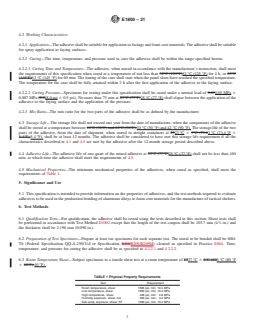
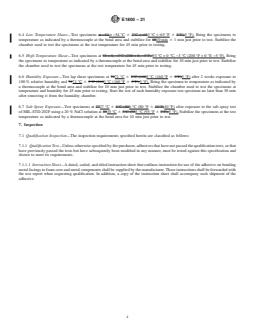
REDLINE ASTM E1800-21 - Standard Specification for Adhesive for Bonding Foam Cored Sandwich Panels (160 °F Elevated Humidity Service), Type I Panels
Overview
ASTM E1800-21 is an international standard specification developed by ASTM for two-part paste adhesives designed to bond foam core sandwich panels. This adhesive is specifically intended for applications requiring durable bonds that can withstand long-term exposure to elevated humidity and temperatures up to 160 °F (71 °C), as well as various combinations of stress, temperature, and humidity. The specification is widely used in the production and maintenance (including depot-level repairs) of aluminum alloy faced foam core panels, often in the manufacturing of tactical shelters and relocatable structures.
Key Topics
- Adhesive Composition: Covers two-part thermosetting epoxy paste adhesives, without asbestos, providing strong and durable bonds suitable for harsh environments.
- Temperature and Humidity Resistance: Adhesives must perform across a wide temperature range (-55 °C to 71 °C; -67 °F to 160 °F) and elevated humidity, ensuring longevity in demanding conditions.
- Bonding Applications: Suitable for adhering aluminum alloy facings to foam core materials, as well as inserts, internal framing, edge attachments, and other sandwich panel components.
- Curing Requirements: Details specific curing times, temperatures, and pressures to ensure optimal bond strength and integrity.
- Mechanical Properties: Defines minimum performance criteria under room, low, and high temperature, humidity exposure, and salt spray conditions.
- Testing and Qualification: Specifies test methods (including tensile shear strength) and quality assurance protocols to certify adhesive performance before use in production.
- Storage and Shelf Life: Adhesive components must meet defined storage life requirements to maintain quality for up to one year under controlled conditions.
Applications
- Tactical Shelters: Essential for constructing and maintaining rigid wall shelters, especially for military and emergency deployments where environmental durability is crucial.
- Relocatable Structures: Used in modular buildings that require quick assembly, strong bonding, and resistance to environmental stresses.
- Aerospace and Defense: Applied in bonding lightweight composite panels for aircraft, vehicles, and shelters subject to temperature extremes and high humidity.
- Industrial Sandwich Panels: Ideal for manufacturing panels where aluminum facings must be securely bonded to foam cores to achieve structural strength and insulation performance.
Related Standards
ASTM E1800-21 references several related standards for adhesive bonding and materials:
- ASTM B209/B209M - Specification for Aluminum and Aluminum-Alloy Sheet and Plate
- ASTM D1002 - Test Method for Apparent Shear Strength of Single-Lap-Joint Adhesively Bonded Metal Specimens by Tension Loading
- ASTM E631 - Terminology of Building Constructions
- ASTM E864 - Practice for Surface Preparation of Aluminum Alloys to Be Adhesively Bonded in Honeycomb Shelter Panels
- ASTM E1749 - Terminology Relating to Rigid Wall Relocatable Shelters
- Federal Specification QQ-A-250/11d - Aluminum Alloy 6061 T6 Plate and Sheet
- MIL-STD-202F - Test Methods for Electronic and Electrical Component Parts
Practical Value
Adhering to ASTM E1800-21 ensures that adhesive applications in foam cored sandwich panels meet stringent performance criteria, resulting in enhanced durability, reduced maintenance, and increased reliability of bonded structures under challenging service conditions. By specifying recognized test methods and mechanical property requirements, this standard supports consistent quality and safety for adhesives used in mission-critical and industrial panel assemblies.
Relations
- Effective Date
- 01-Apr-2019
- Effective Date
- 01-Oct-2018
- Effective Date
- 01-Mar-2015
- Effective Date
- 01-Nov-2014
- Effective Date
- 01-Nov-2010
- Effective Date
- 01-Nov-2008
- Effective Date
- 01-Jun-2006
- Effective Date
- 01-Oct-2005
- Effective Date
- 01-Oct-2005
- Effective Date
- 01-Oct-2003
- Effective Date
- 10-Oct-2001
- Effective Date
- 10-Oct-2001
- Effective Date
- 28-Jul-2000
- Effective Date
- 10-Apr-2000
- Effective Date
- 10-Apr-1998
Buy Documents
ASTM E1800-21 - Standard Specification for Adhesive for Bonding Foam Cored Sandwich Panels (160 °F Elevated Humidity Service), Type I Panels
REDLINE ASTM E1800-21 - Standard Specification for Adhesive for Bonding Foam Cored Sandwich Panels (160 °F Elevated Humidity Service), Type I Panels
Get Certified
Connect with accredited certification bodies for this standard

DIN CERTCO
DIN Group product certification.

Smithers Quality Assessments
US management systems and product certification.
Sponsored listings
Frequently Asked Questions
ASTM E1800-21 is a technical specification published by ASTM International. Its full title is "Standard Specification for Adhesive for Bonding Foam Cored Sandwich Panels (160 °F Elevated Humidity Service), Type I Panels". This standard covers: ABSTRACT This specification covers two-part paste adhesives for bonding foam core sandwich panels. The adhesive may be used for new production or depot maintenance. The adhesive should be suitable for forming bonds that can withstand long-term exposure to temperatures, and also withstand combinations of stress, temperature, and humidity. The adhesives shall be used for bonding aluminum alloy facing to foam core, inserts, edge attachments, and other components of a foam cored sandwich panel. Materials shall be tested and shall conform to the material requirements, working characteristics; and to the specified values of curing time, temperature, and pressure; mix ratio, storage life, adhesive life, humidity exposure, and salt spray exposure. SIGNIFICANCE AND USE 5.1 This specification is intended to provide information on the properties of adhesives, and the test methods required to evaluate adhesives to be used in the production bonding of aluminum alloys to foam core materials for the manufacture of tactical shelters. SCOPE 1.1 This specification covers two-part paste adhesives for bonding foam core sandwich panels. The adhesive may be used for new production or depot maintenance. The adhesive should be suitable for forming bonds that can withstand long term exposure to temperatures from −55 °C to 71 °C (−67 °F to 160 °F) and also withstand combinations of stress, temperature, and humidity expected to be encountered in service. The adhesives shall be used for bonding aluminum alloy facing to foam core, inserts, internal aluminum framing members, and other components of a foam cored sandwich panel. 1.2 The values stated in SI units are to be regarded as the standard where only SI units are given or where SI units are given first followed by inch-pound units; where inch-pound units are given first followed by SI units, the inch-pound units are to be regarded as the standard. 1.3 This standard does not purport to address all of the safety concerns, if any, associated with its use. It is the responsibility of the user of this standard to establish appropriate safety, health, and environmental practices and determine the applicability of regulatory limitations prior to use. 1.4 This international standard was developed in accordance with internationally recognized principles on standardization established in the Decision on Principles for the Development of International Standards, Guides and Recommendations issued by the World Trade Organization Technical Barriers to Trade (TBT) Committee.
ABSTRACT This specification covers two-part paste adhesives for bonding foam core sandwich panels. The adhesive may be used for new production or depot maintenance. The adhesive should be suitable for forming bonds that can withstand long-term exposure to temperatures, and also withstand combinations of stress, temperature, and humidity. The adhesives shall be used for bonding aluminum alloy facing to foam core, inserts, edge attachments, and other components of a foam cored sandwich panel. Materials shall be tested and shall conform to the material requirements, working characteristics; and to the specified values of curing time, temperature, and pressure; mix ratio, storage life, adhesive life, humidity exposure, and salt spray exposure. SIGNIFICANCE AND USE 5.1 This specification is intended to provide information on the properties of adhesives, and the test methods required to evaluate adhesives to be used in the production bonding of aluminum alloys to foam core materials for the manufacture of tactical shelters. SCOPE 1.1 This specification covers two-part paste adhesives for bonding foam core sandwich panels. The adhesive may be used for new production or depot maintenance. The adhesive should be suitable for forming bonds that can withstand long term exposure to temperatures from −55 °C to 71 °C (−67 °F to 160 °F) and also withstand combinations of stress, temperature, and humidity expected to be encountered in service. The adhesives shall be used for bonding aluminum alloy facing to foam core, inserts, internal aluminum framing members, and other components of a foam cored sandwich panel. 1.2 The values stated in SI units are to be regarded as the standard where only SI units are given or where SI units are given first followed by inch-pound units; where inch-pound units are given first followed by SI units, the inch-pound units are to be regarded as the standard. 1.3 This standard does not purport to address all of the safety concerns, if any, associated with its use. It is the responsibility of the user of this standard to establish appropriate safety, health, and environmental practices and determine the applicability of regulatory limitations prior to use. 1.4 This international standard was developed in accordance with internationally recognized principles on standardization established in the Decision on Principles for the Development of International Standards, Guides and Recommendations issued by the World Trade Organization Technical Barriers to Trade (TBT) Committee.
ASTM E1800-21 is classified under the following ICS (International Classification for Standards) categories: 83.180 - Adhesives. The ICS classification helps identify the subject area and facilitates finding related standards.
ASTM E1800-21 has the following relationships with other standards: It is inter standard links to ASTM D1002-10(2019), ASTM E1749-18, ASTM E631-15, ASTM E631-14, ASTM E1749-10, ASTM E864-08, ASTM E631-06, ASTM E1749-05, ASTM D1002-05, ASTM E864-03, ASTM D1002-99, ASTM D1002-01, ASTM E631-93a(1998)e1, ASTM E1749-00, ASTM E864-98. Understanding these relationships helps ensure you are using the most current and applicable version of the standard.
ASTM E1800-21 is available in PDF format for immediate download after purchase. The document can be added to your cart and obtained through the secure checkout process. Digital delivery ensures instant access to the complete standard document.
Standards Content (Sample)
This international standard was developed in accordance with internationally recognized principles on standardization established in the Decision on Principles for the
Development of International Standards, Guides and Recommendations issued by the World Trade Organization Technical Barriers to Trade (TBT) Committee.
Designation: E1800 −21
Standard Specification for
Adhesive for Bonding Foam Cored Sandwich Panels (160 °F
Elevated Humidity Service), Type I Panels
This standard is issued under the fixed designation E1800; the number immediately following the designation indicates the year of
original adoption or, in the case of revision, the year of last revision.Anumber in parentheses indicates the year of last reapproval.A
superscript epsilon (´) indicates an editorial change since the last revision or reapproval.
This standard has been approved for use by agencies of the U.S. Department of Defense.
1. Scope B209/B209MSpecification for Aluminum and Aluminum-
Alloy Sheet and Plate
1.1 This specification covers two-part paste adhesives for
D1002Test Method for Apparent Shear Strength of Single-
bondingfoamcoresandwichpanels.Theadhesivemaybeused
Lap-Joint Adhesively Bonded Metal Specimens by Ten-
fornewproductionordepotmaintenance.Theadhesiveshould
sion Loading (Metal-to-Metal)
be suitable for forming bonds that can withstand long term
E631Terminology of Building Constructions
exposure to temperatures from−55°C to 71°C (−67°F to
E864Practice for Surface Preparation of Aluminum Alloys
160 °F) and also withstand combinations of stress,
to Be Adhesively Bonded in Honeycomb Shelter Panels
temperature, and humidity expected to be encountered in
E1749Terminology Relating to Rigid Wall Relocatable
service. The adhesives shall be used for bonding aluminum
Shelters
alloy facing to foam core, inserts, internal aluminum framing
members, and other components of a foam cored sandwich
2.2 Military Standard:
panel.
MIL-STD-202FTest Methods for Electronic and Electrical
Component Parts
1.2 The values stated in SI units are to be regarded as the
standard where only SI units are given or where SI units are
2.3 Federal Specification:
given first followed by inch-pound units; where inch-pound
QQ-A-250/11dAluminum Alloy 6061 T6 Plate and Sheet
units are given first followed by SI units, the inch-pound units
are to be regarded as the standard.
3. Terminology
1.3 This standard does not purport to address all of the
3.1 Definitions:
safety concerns, if any, associated with its use. It is the
3.1.1 For definitions of general terms related to building
responsibility of the user of this standard to establish appro-
construction used in this specification, refer to Terminology
priate safety, health, and environmental practices and deter-
E631, and for general terms related to rigid wall relocatable
mine the applicability of regulatory limitations prior to use.
shelters, refer to Terminology E1749.
1.4 This international standard was developed in accor-
3.2 Definitions of Terms Specific to This Standard:
dance with internationally recognized principles on standard-
3.2.1 adhesive life—the maximum time that an adhesive,
ization established in the Decision on Principles for the
when mixed in a prescribed quantity, can set at a designated
Development of International Standards, Guides and Recom-
temperature, after which the adhesive, when used to prepare
mendations issued by the World Trade Organization Technical
specimens, will deliver the required properties.
Barriers to Trade (TBT) Committee.
2. Referenced Documents 4. Requirements
2.1 ASTM Standards:
4.1 Material—The adhesive shall be a two-part thermoset-
tingepoxypastecontainingnoasbestosand,whentestedusing
the test methods described in Section 6, shall meet the
This specification is under the jurisdiction of ASTM Committee E06 on
Performance of Buildings and is the direct responsibility of Subcommittee E06.53
requirements of Section 4. The adhesive shall not have a
on Materials and Processes for Durable Rigidwall Relocatable Structures.
detrimental effect on the components being bonded over the
Current edition approved June 15, 2021. Published July 2021. Originally
range of temperatures at which the adhesive will be used.
approved in 1996. Last previous edition approved in 2013 as E1800–13. DOI:
10.1520/E1800-21.
For referenced ASTM standards, visit the ASTM website, www.astm.org, or
contact ASTM Customer Service at service@astm.org. For Annual Book of ASTM
Standards volume information, refer to the standard’s Document Summary page on Available from DLA Document Services, Building 4-D, 700 Robbins Avenue,
the ASTM website. Philadelphia, PA 19111, http://quicksearch.dla.mil/.
Copyright © ASTM International, 100 Barr Harbor Drive, PO Box C700, West Conshohocken, PA 19428-2959. United States
E1800 − 21
4.2 Working Characteristics: shall be performed in accordance with Test Method D1002
4.2.1 Application—The adhesive shall be suitable for appli- exceptthatthelengthofthetestcouponshallbe103.7mm(4 ⁄4
cation to facings and foam core materials. The adhesive shall in.) and the thickness shall be 2.196 mm (0.090 in.).
be suitable for spray application to faying surfaces.
6.2 Preparation of Test Specimens—Prepare at least ten
4.2.2 Curing—The time, temperature, and pressure used to
specimens for each separate test. The metal to be bonded shall
cure the adhesive shall be within the range specified herein.
be 6061 T6 (Federal Specification QQ-A-250/11d or Specifi-
4.2.2.1 Curing Time and Temperature—The adhesive, when
cation B209/B209M) cleaned as specified in Practice E864.
mixed in accordance with the manufacturer’s instruction, shall
Time, temperature, and pressure for curing the adhesive shall
meet the requirements of this specification when cured at a
be as specified in 4.2.2.1 and 4.2.2.2.
temperature of not less than 52°C (125°F) for 4 h, or 63°C
6.3 Room Temperature Shear—Subject specimens to a ten-
(145°F)for60min.Thetimingofthecureshallstartwhenthe
sile shear test at a room temperature of 27°C 6 6°C (80°F 6
panel skins have reached the specified temperature. The
10°F).
temperature for the cure shall be fully attained within 2 h after
the first application of the adhesive to the faying surface. 6.4 Low Temperature Shear—Test specimens at−54°C 6
4.2.2.2 Curing Pressure—Spe
...
This document is not an ASTM standard and is intended only to provide the user of an ASTM standard an indication of what changes have been made to the previous version. Because
it may not be technically possible to adequately depict all changes accurately, ASTM recommends that users consult prior editions as appropriate. In all cases only the current version
of the standard as published by ASTM is to be considered the official document.
Designation: E1800 − 13 E1800 − 21
Standard Specification for
Adhesive for Bonding Foam Cored Sandwich Panels
(160°F(160 °F Elevated Humidity Service), Type I Panels
This standard is issued under the fixed designation E1800; the number immediately following the designation indicates the year of
original adoption or, in the case of revision, the year of last revision. A number in parentheses indicates the year of last reapproval. A
superscript epsilon (´) indicates an editorial change since the last revision or reapproval.
This standard has been approved for use by agencies of the U.S. Department of Defense.
1. Scope
1.1 This specification covers two-part paste adhesives for bonding foam core sandwich panels. The adhesive may be used for new
production or depot maintenance. The adhesive should be suitable for forming bonds that can withstand long term exposure to
temperatures from −55from −55 °C to 71°C (−6771 °C (−67 °F to 160°F)160 °F) and also withstand combinations of stress,
temperature, and humidity expected to be encountered in service. The adhesives shall be used for bonding aluminum alloy facing
to foam core, inserts, internal aluminum framing members, and other components of a foam cored sandwich panel.
1.2 The values stated in SI units are to be regarded as the standard where only SI units are given or where SI units are given first
followed by inch-pound units; where inch-pound units are given first followed by SI units, the inch-pound units are to be regarded
as the standard.
1.3 This standard does not purport to address all of the safety concerns, if any, associated with its use. It is the responsibility
of the user of this standard to establish appropriate safety safety, health, and healthenvironmental practices and determine the
applicability of regulatory limitations prior to use.
1.4 This international standard was developed in accordance with internationally recognized principles on standardization
established in the Decision on Principles for the Development of International Standards, Guides and Recommendations issued
by the World Trade Organization Technical Barriers to Trade (TBT) Committee.
2. Referenced Documents
2.1 ASTM Standards:
B209B209/B209M Specification for Aluminum and Aluminum-Alloy Sheet and Plate (Metric) B0209_B0209M
D1002 Test Method for Apparent Shear Strength of Single-Lap-Joint Adhesively Bonded Metal Specimens by Tension Loading
(Metal-to-Metal)
E631 Terminology of Building Constructions
E864 Practice for Surface Preparation of Aluminum Alloys to Be Adhesively Bonded in Honeycomb Shelter Panels
E1749 Terminology Relating to Rigid Wall Relocatable Shelters
2.2 Military Standard:
MIL-STD-202F Test Methods for Electronic and Electrical Component Parts
This specification is under the jurisdiction of ASTM Committee E06 on Performance of Buildings and is the direct responsibility of Subcommittee E06.53 on Materials
and Processes for Durable Rigidwall Relocatable Structures.
Current edition approved Oct. 1, 2013June 15, 2021. Published February 2014July 2021. Originally approved in 1996. Last previous edition approved in 20082013 as
E1800 – 08.E1800 – 13. DOI: 10.1520/E1800-13.10.1520/E1800-21.
For referenced ASTM standards, visit the ASTM website, www.astm.org, or contact ASTM Customer Service at service@astm.org. For Annual Book of ASTM Standards
volume information, refer to the standard’sstandard’s Document Summary page on the ASTM website.
Available from DLA Document Services, Building 4/D,4-D, 700 Robbins Avenue, Philadelphia, PA 19111-5094,19111, http://quicksearch.dla.mil/.
Copyright © ASTM International, 100 Barr Harbor Drive, PO Box C700, West Conshohocken, PA 19428-2959. United States
E1800 − 21
2.3 Federal Specification:
QQ-A-250/11d Aluminum Alloy 6061 T6 Plate and Sheet
3. Terminology
3.1 DefinitionsDefinitions:—See
3.1.1 For definitions of general terms related to building construction used in this specification, refer to Terminology E631, and
for general terms related to rigid wall relocatable shelters, refer to Terminology E1749. Terminologies E631 and E1749 for
definitions of terms used in this specification.
3.2 Definitions of Terms Specific to This Standard:
3.2.1 adhesive life—the maximum time that an adhesive, when mixed in a prescribed quantity, can set at a designated temperature,
after which the adhesive, when used to prepare specimens, will deliver the required properties.
4. Requirements
4.1 Material—The adhesive shall be a two-part thermosetting epoxy paste containing no asbestos and, when tested using the test
methods described in Section 6, shall meet the requirements of Section 4. The adhesive shall not have a detrimental effect on the
components being bonded over the range of temperatures at which the adhesive will be used.
E1800 − 21
4.2 Working Characteristics:
4.2.1 Application—The adhesive shall be suitable for application to facings and foam core materials. The adhesive shall be suitable
for spray application to faying surfaces.
4.2.2 Curing—The time, temperature, and pressure used to cure the adhesive shall be within the range specified herein.
4.2.2.1 Curing Time and Temperature—The adhesive, when mixed in accordance with the manufacturer’s instruction, shall meet
the requirements of this specification when cured at a temperature of not less than 52°C (125°F)52 °C (125 °F) for 4 h, or 63°C
(145°F)63 °C (145 °F) for 60 min. The timing of the cure shall start when the panel skins have reached the specified temperature.
The temperature for the cure shall be fully attained within 2 h after the first application of the adhesive to the faying surface.
4.2.2.2 Curing Pressure—Specimens for testing under this specification shall be cured under a normal load of 0.050.05 MPa 6
0.007 MPa (8.0(8.0 psi 6 0.5 psi). No more than 75 min at 25°C (77°F)25 °C (77 °F) shall elapse between the application of the
adhesive to the faying surface and the application of the pressure.
4.2.3 Mix Ratio—The mix ratio for the two parts of the adhesive shall be as defined by the manufacturer.
4.3 Storage Life—The storage life shall not exceed one year from the date of manufacture, when the components of the adhesive
shall be stored at a temperature between 10°C (50°F) and 42°C (90°F).10 °C (50 °F) and 42 °C (90 °F). The storage life of
...