

ASTM E990-21
(Specification)Standard Specification for Core-Splice Adhesive for Honeycomb Sandwich Structural Panels
General Information
- Abstract
ABSTRACT
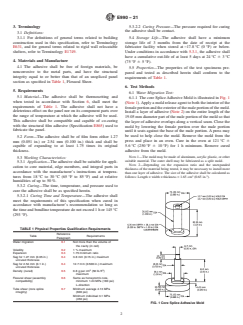
This specification covers the requirements for core-splice adhesive for use with nonmetallic honeycomb cores in the fabrication of honeycomb sandwich panels used in relocatable structures. The adhesive shall be thermosetting, of film form, and capable of expanding to several times its original thickness and shall be cured at specific curing time, temperature, and pressure. Materials shall be tested for physical properties qualification which shall conform to water migration, volatility, expansion, sag, density, flexural shear strength or assembly compatibility, and tube shear or core splice integrity requirements. The adhesive shall be suitable for application to core material, edge members, and integral parts.
SCOPE
1.1 This specification covers core-splice adhesive for use with nonmetallic honeycomb cores in the fabrication of honeycomb sandwich panels used in relocatable structures. The adhesive shall be used for new production or depot repair. The adhesive shall be suitable for forming bonds that can withstand long combinations of stress, temperature, and relative humidity expected to be encountered in service. The adhesive shall be used for bonding core segments and for bonding core segments to edge members and to integral members in a honeycomb sandwich panel. The adhesive shall not allow the transfer of water from one part of the panel to another either through or along the line of the adhesive.
1.2 The values stated in SI units are to be regarded as standard. The values given in parentheses after SI units are provided for information only and are not considered standard.
1.3 The following precautionary caveat pertains only to the test method portion, Section 6, of this specification: This standard does not purport to address all of the safety concerns, if any, associated with its use. It is the responsibility of the user of this standard to establish appropriate safety, health, and environmental practices and determine the applicability of regulatory limitations prior to use.
1.4 This international standard was developed in accordance with internationally recognized principles on standardization established in the Decision on Principles for the Development of International Standards, Guides and Recommendations issued by the World Trade Organization Technical Barriers to Trade (TBT) Committee.
- Status
- Published
- Publication Date
- 31-Jan-2021
- Technical Committee
- E06 - Performance of Buildings
Buy Documents
ASTM E990-21 - Standard Specification for Core-Splice Adhesive for Honeycomb Sandwich Structural Panels

REDLINE ASTM E990-21 - Standard Specification for Core-Splice Adhesive for Honeycomb Sandwich Structural Panels
Overview
ASTM E990-21 is the authoritative standard for core-splice adhesive used in the manufacturing and repair of honeycomb sandwich structural panels with nonmetallic honeycomb cores. These sandwich panels are widely utilized in relocatable structures where lightweight construction and high structural integrity are critical. The standard specifies thermosetting film adhesives that can expand during curing and must adhere to strict requirements relating to bond strength, water migration, and compatibility, ensuring long-term durability under typical service stresses, temperatures, and humidity.
Key Topics
Major requirements covered in ASTM E990-21:
- Adhesive Type and Form
- Adhesive must be thermosetting film, provided typically in specific thicknesses.
- Capable of expanding significantly during curing to fill gaps and ensure robust bonding.
- Performance under Environmental Stress
- Bonds must withstand expected combinations of mechanical stress, elevated or fluctuating temperatures, and high relative humidity.
- Water migration prevention is fundamental; the adhesive line may not permit water transfer across panel segments.
- Physical Properties Qualification
- Adhesive is tested and must conform to standards for water migration, volatility, expansion (minimum ratio), sag, and density.
- Strength benchmarks for flexural shear strength (assembly compatibility) and tube shear (core splice integrity).
- Application Scope
- Suitable for new production and depot repair situations.
- Must bond core segments to each other and attach edge or integral structural members within the panel system.
- Quality Assurance
- Inspection and test protocols ensure compliance with specifications.
- Storage life and handling guidelines maintain adhesive quality before use.
- Safety
- Users are responsible for establishing safe handling practices and ensuring all regulatory requirements are met during use.
Applications
ASTM E990-21 core-splice adhesives are critical in:
- Building Relocatable Structures
- Panels fabricated per this standard are used in modular buildings, shelters, and temporary facilities requiring high strength with reduced weight.
- Panel Manufacturing and Repair
- Enables both the production of new honeycomb sandwich panels and the structural repair of existing installations.
- Aerospace and Defense
- The standard is approved for use by U.S. Department of Defense agencies, highlighting its role in defense shelters, mobile operational facilities, and similar demanding environments.
- Industrial and Commercial Applications
- Suited for environments where panels must perform under challenging conditions, including exposure to moisture and temperature extremes.
- Transportation and Logistics
- Used in portable housing and enclosures transported via various means, requiring durable, lightweight panel systems.
Related Standards
ASTM E990-21 references several related standards for compatibility and comprehensive application:
- ASTM B209: Aluminum and aluminum-alloy sheet and plate specifications.
- ASTM C393/C393M: Test method for core shear properties of sandwich constructions.
- ASTM D792: Density and specific gravity of plastics by displacement.
- ASTM E631: Terminology for building constructions.
- ASTM E864: Surface preparation of aluminum alloys for adhesive bonding.
- ASTM E865: Specification for structural film adhesives for sandwich panels.
- ASTM E874: Practice for bonding of aluminum facings to nonmetallic honeycomb core.
- ASTM E1091: Specification for nonmetallic honeycomb core use in shelter panels.
- Federal and Military Standards: Including specifications for aluminum alloys and sealing compounds (e.g., QQ-A-250/4, QQ-A-250/8d, QQ-A-250/11d, MIL-S-8802).
By adhering to ASTM E990-21, manufacturers and users can ensure that honeycomb sandwich structural panels are bonded with adhesives delivering optimal mechanical performance and environmental resistance, supporting sustainable, durable infrastructure solutions in relocatable and specialty environments.
Relations
- Effective Date
- 01-Jul-2019
- Effective Date
- 01-Oct-2018
- Effective Date
- 01-Mar-2015
- Effective Date
- 01-Nov-2014
- Effective Date
- 01-Oct-2011
- Effective Date
- 01-Oct-2011
- Effective Date
- 01-Sep-2011
- Effective Date
- 01-Nov-2010
- Effective Date
- 01-Nov-2010
- Effective Date
- 01-Nov-2010
- Effective Date
- 01-Oct-2010
- Effective Date
- 01-Nov-2008
- Refers
ASTM E865-08 - Standard Specification for Structural Film Adhesives for Honeycomb Sandwich Panels - Effective Date
- 01-Nov-2008
- Refers
ASTM E1091-08 - Standard Specification for Nonmetallic Honeycomb Core for Use in Shelter Panels - Effective Date
- 01-Nov-2008
- Effective Date
- 15-Jun-2008
Buy Documents
ASTM E990-21 - Standard Specification for Core-Splice Adhesive for Honeycomb Sandwich Structural Panels
REDLINE ASTM E990-21 - Standard Specification for Core-Splice Adhesive for Honeycomb Sandwich Structural Panels
Get Certified
Connect with accredited certification bodies for this standard

DIN CERTCO
DIN Group product certification.

Smithers Quality Assessments
US management systems and product certification.
Sponsored listings
Frequently Asked Questions
ASTM E990-21 is a technical specification published by ASTM International. Its full title is "Standard Specification for Core-Splice Adhesive for Honeycomb Sandwich Structural Panels". This standard covers: ABSTRACT This specification covers the requirements for core-splice adhesive for use with nonmetallic honeycomb cores in the fabrication of honeycomb sandwich panels used in relocatable structures. The adhesive shall be thermosetting, of film form, and capable of expanding to several times its original thickness and shall be cured at specific curing time, temperature, and pressure. Materials shall be tested for physical properties qualification which shall conform to water migration, volatility, expansion, sag, density, flexural shear strength or assembly compatibility, and tube shear or core splice integrity requirements. The adhesive shall be suitable for application to core material, edge members, and integral parts. SCOPE 1.1 This specification covers core-splice adhesive for use with nonmetallic honeycomb cores in the fabrication of honeycomb sandwich panels used in relocatable structures. The adhesive shall be used for new production or depot repair. The adhesive shall be suitable for forming bonds that can withstand long combinations of stress, temperature, and relative humidity expected to be encountered in service. The adhesive shall be used for bonding core segments and for bonding core segments to edge members and to integral members in a honeycomb sandwich panel. The adhesive shall not allow the transfer of water from one part of the panel to another either through or along the line of the adhesive. 1.2 The values stated in SI units are to be regarded as standard. The values given in parentheses after SI units are provided for information only and are not considered standard. 1.3 The following precautionary caveat pertains only to the test method portion, Section 6, of this specification: This standard does not purport to address all of the safety concerns, if any, associated with its use. It is the responsibility of the user of this standard to establish appropriate safety, health, and environmental practices and determine the applicability of regulatory limitations prior to use. 1.4 This international standard was developed in accordance with internationally recognized principles on standardization established in the Decision on Principles for the Development of International Standards, Guides and Recommendations issued by the World Trade Organization Technical Barriers to Trade (TBT) Committee.
ABSTRACT This specification covers the requirements for core-splice adhesive for use with nonmetallic honeycomb cores in the fabrication of honeycomb sandwich panels used in relocatable structures. The adhesive shall be thermosetting, of film form, and capable of expanding to several times its original thickness and shall be cured at specific curing time, temperature, and pressure. Materials shall be tested for physical properties qualification which shall conform to water migration, volatility, expansion, sag, density, flexural shear strength or assembly compatibility, and tube shear or core splice integrity requirements. The adhesive shall be suitable for application to core material, edge members, and integral parts. SCOPE 1.1 This specification covers core-splice adhesive for use with nonmetallic honeycomb cores in the fabrication of honeycomb sandwich panels used in relocatable structures. The adhesive shall be used for new production or depot repair. The adhesive shall be suitable for forming bonds that can withstand long combinations of stress, temperature, and relative humidity expected to be encountered in service. The adhesive shall be used for bonding core segments and for bonding core segments to edge members and to integral members in a honeycomb sandwich panel. The adhesive shall not allow the transfer of water from one part of the panel to another either through or along the line of the adhesive. 1.2 The values stated in SI units are to be regarded as standard. The values given in parentheses after SI units are provided for information only and are not considered standard. 1.3 The following precautionary caveat pertains only to the test method portion, Section 6, of this specification: This standard does not purport to address all of the safety concerns, if any, associated with its use. It is the responsibility of the user of this standard to establish appropriate safety, health, and environmental practices and determine the applicability of regulatory limitations prior to use. 1.4 This international standard was developed in accordance with internationally recognized principles on standardization established in the Decision on Principles for the Development of International Standards, Guides and Recommendations issued by the World Trade Organization Technical Barriers to Trade (TBT) Committee.
ASTM E990-21 is classified under the following ICS (International Classification for Standards) categories: 83.180 - Adhesives. The ICS classification helps identify the subject area and facilitates finding related standards.
ASTM E990-21 has the following relationships with other standards: It is inter standard links to ASTM E874-19, ASTM E1749-18, ASTM E631-15, ASTM E631-14, ASTM C393/C393M-11, ASTM C393/C393M-11e1, ASTM E874-11, ASTM B209-10, ASTM E874-10a, ASTM E1749-10, ASTM E874-10, ASTM E864-08, ASTM E865-08, ASTM E1091-08, ASTM D792-08. Understanding these relationships helps ensure you are using the most current and applicable version of the standard.
ASTM E990-21 is available in PDF format for immediate download after purchase. The document can be added to your cart and obtained through the secure checkout process. Digital delivery ensures instant access to the complete standard document.
Standards Content (Sample)
This international standard was developed in accordance with internationally recognized principles on standardization established in the Decision on Principles for the
Development of International Standards, Guides and Recommendations issued by the World Trade Organization Technical Barriers to Trade (TBT) Committee.
Designation:E990 −21
Standard Specification for
Core-Splice Adhesive for Honeycomb Sandwich Structural
Panels
This standard is issued under the fixed designation E990; the number immediately following the designation indicates the year of
original adoption or, in the case of revision, the year of last revision.Anumber in parentheses indicates the year of last reapproval.A
superscript epsilon (´) indicates an editorial change since the last revision or reapproval.
This standard has been approved for use by agencies of the U.S. Department of Defense.
1. Scope mendations issued by the World Trade Organization Technical
Barriers to Trade (TBT) Committee.
1.1 This specification covers core-splice adhesive for use
with nonmetallic honeycomb cores in the fabrication of hon-
2. Referenced Documents
eycomb sandwich panels used in relocatable structures. The
2.1 ASTM Standards:
adhesive shall be used for new production or depot repair.The
B209Specification for Aluminum and Aluminum-Alloy
adhesiveshallbesuitableforformingbondsthatcanwithstand
Sheet and Plate
longcombinationsofstress,temperature,andrelativehumidity
C393/C393MTest Method for Core Shear Properties of
expected to be encountered in service. The adhesive shall be
Sandwich Constructions by Beam Flexure
usedforbondingcoresegmentsandforbondingcoresegments
D792Test Methods for Density and Specific Gravity (Rela-
to edge members and to integral members in a honeycomb
tive Density) of Plastics by Displacement
sandwich panel. The adhesive shall not allow the transfer of
E631Terminology of Building Constructions
water from one part of the panel to another either through or
E864Practice for Surface Preparation of Aluminum Alloys
along the line of the adhesive.
to Be Adhesively Bonded in Honeycomb Shelter Panels
E865Specification for Structural Film Adhesives for Hon-
1.2 The values stated in SI units are to be regarded as
eycomb Sandwich Panels
standard. The values given in parentheses after SI units are
E874Practice for Adhesive Bonding of Aluminum Facings
providedforinformationonlyandarenotconsideredstandard.
to Nonmetallic Honeycomb Core for Shelter Panels
1.3 The following precautionary caveat pertains only to the
E1091Specification for Nonmetallic Honeycomb Core for
test method portion, Section 6, of this specification: This
Use in Shelter Panels
standard does not purport to address all of the safety concerns,
E1749Terminology Relating to Rigid Wall Relocatable
if any, associated with its use. It is the responsibility of the user
Shelters
of this standard to establish appropriate safety, health, and
2.2 Federal Standards:
environmental practices and determine the applicability of
QQ-A-250/4Aluminum Alloy 2024, Plate and Sheet
regulatory limitations prior to use.
QQ-A-250/8dAluminum Alloy 5052H34, Plate and Sheet
1.4 This international standard was developed in accor-
QQ-A-250/11dAluminum Alloy 6061T6, Plate and Sheet
dance with internationally recognized principles on standard-
2.3 Military Standards:
ization established in the Decision on Principles for the
MIL-S-8802 Sealing Compound, Temperature-Resistant,
Development of International Standards, Guides and Recom-
Integral Fuel Tanks, and Fuel Cell Cavities, High-
Adhesion
1 2
This specification is under the jurisdiction of ASTM Committee E06 on For referenced ASTM standards, visit the ASTM website, www.astm.org, or
Performance of Buildings and is the direct responsibility of Subcommittee E06.53 contact ASTM Customer Service at service@astm.org. For Annual Book of ASTM
on Materials and Processes for Durable Rigidwall Relocatable Structures. Standards volume information, refer to the standard’s Document Summary page on
Current edition approved Feb. 1, 2021. Published February 2021. Originally the ASTM website.
approved in 1984. Last previous edition approved in 2013 as E990–13. DOI: Available from DLA Document Services, Building 4/D, 700 Robbins Avenue,
10.1520/E0990-21. Philadelphia, PA 19111-5094, http://quicksearch.dla.mil/.
Copyright © ASTM International, 100 Barr Harbor Drive, PO Box C700, West Conshohocken, PA 19428-2959. United States
E990−21
3. Terminology 5.3.2.2 Curing Pressure—The pressure required for curing
the adhesive shall be contact.
3.1 Definitions:
3.1.1 For definitions of general terms related to building 5.4 Storage Life—The adhesive shall have a minimum
construction used in this specification, refer to Terminology storage life of 3 months from the date of receipt at the
E631, and for general terms related to rigid wall relocatable fabricator facility when stored at−17.8°C (0°F) or below.
shelters, refer to Terminology E1749. Under conditions in accordance with 5.3.1, the adhesive shall
have a cumulative out-life of at least 5 days at 24°C 63°C
4. Materials and Manufacture
(75°F 6 5°F).
4.1 The adhesive shall be free of foreign materials, be
5.5 Properties—The properties of the test specimens pre-
noncorrosive to the metal parts, and have the structural
pared and tested as described herein shall conform to the
integrity equal to or better than that of an unspliced panel
requirements of Table 1.
section as specified in Table 1, Flexural Sheer.
6. Test Methods
5. Requirements
6.1 Water Migration Test:
5.1 Material—The adhesive shall be thermosetting and
6.1.1 The core SpliceAdhesive Mold is illustrated in Fig. 1
when tested in accordance with Section 6, shall meet the
(Note 1).Apply a mold release agent to both the interior of the
requirements of Table 1. The adhesive shall not have a
femaleportionandtheexteriorofthemaleportionofthemold.
deleterious effect on the panel nor on its component parts over
Install a layer of adhesive (Note 2) on the entire length of the
the range of temperature at which the adhesive will be used.
19.05mmdiameterpartofthemaleportionofthemoldsothat
This adhesive shall be compatible and capable of co-curing
the layer of adhesive overlaps along a vertical seam. Close the
with the structural film adhesive (Specification E865) used to
mold by lowering the female portion over the male portion
fabricate the panel.
until it seats against the base of the male portion.Apress may
be used to help close the mold. Remove the mold from the
5.2 Form—The adhesive shall be of film form either 1.27
press and place in an oven. Cure in the oven at 121°C 6
mm (0.051 in.) or 2.54 mm (0.100 in.) thick and shall be
5.6°C (250°F 6 10°F) for 1 h minimum. Remove cured
capable of expanding to at least 1.75 times its original
adhesive from the mold.
thickness.
5.3 Working Characteristics: NOTE 1—The mold may be made of aluminum, acrylic plastic, or other
suitable material. The outer shell may be fabricated as a split mold.
5.3.1 Application—The adhesive shall be suitable for appli-
NOTE 2—Depending on the expansion ratio and the unexpanded
cation to core material, edge members, and integral parts in
thickness of the material being tested, it may be necessary to install more
accordance with the manufacturer’s instructions at tempera-
than one layer of adhesive.The size of the adhesive shall be calculated as
3 3
tures from 18°C to 30°C (65°F to 85°F) and at relative
follows: Length×width×thickness=1.65 cm (0.65 in. ).
humidities of up to 50%.
5.3.2 Curing—The time, temperature, and pressure used to
cure the adhesive shall be as specified herein.
5.3.2.1 Curing Time and Temperature—The adhesive shall
meet the requirements of this specification when cured in
accordance with manufacturer’s recommendation so long as
thetimeandbondlinetemperaturedonotexceed1hor145°C
(293°F).
TABLE 1 Physical Properties Qualification Requirements
Reference
Table Requirements
Paragraph
Water migration 6.1 Not more than the volume of
the cavity (in cell)
Volatility 6.2 1 % maximum
Expansion 6.3 1.75 minimum ratio
Sag for 1.27 mm (0.05 in.) 6.4 3.8 mm (0.15 in.) maximum
uncured thickness
Sag for 2.54 mm (0.1 in.) 6.4 12.7 mm (0.500 in.) maximum
uncured thickness
3 3
Density (cured) 6.5 0.8 g per cm (50 lb ⁄ft )
maximum
Flexural shear (assembly 6.6 Same as honeycomb core,
compatibility) minimum 1.24 MPa (180 psi)
L-direction
Tube shear (core splice 6.7 Minimum average 4.13 MPa
integrity) (600 psi)
Minimum individual 3.1 MPa
(450 psi)
FIG. 1Core Splice Adhesive Mold
E990−21
FIG. 2Water Migration Test Specimen Assembly
6.1.2 Prepare the sample (approximately 38 mm (1 ⁄2 in.)
long) by cutting the cylinder of cured adhesive and visually
checktoensurethattherearenocracks,pinholes,andsoforth.
6.1.3 Cover a piece of aluminum (approx.
FIG. 3Water Migration Test
50mm×50mm×6 mm) (2in.×2in.× ⁄4 in.) with MIL-S-
8802, Class B-2 Sealant, or equivalent, to a depth of 3mm to
1 1
6mm( ⁄8in. to ⁄4 in.). Use a “dam,” such as vacuum-bagging
6.2.1 Cut the adhesive into three one-ply test specimens.
putty or an aluminum foil tray, around the edge of the
Eachspecimenistobea51mm(2in.)diameterdiskor51mm
aluminum to prevent the sealant from running off (see Fig. 2).
by 51mm (2in. by 2in.) square.
6.1.4 Place the prepared sample of adhesive (6.1.2)onthe
6.2.2 Weigh the containers that will be used in the cure of
sealant and seat it gently into the sealer. Allow the sealant to
the test specimens cut in 6.2.1. Each container shall be an
cure at room temperature overnight.
aluminum moisture dish, of sufficient size to allow the speci-
6.1.5 Install a glass tube approximately 38 mm (1 ⁄2 in.)
men to lie in the bottom without the edges of the specimen
long approximately 19 mm ( ⁄4 in.) down into the hole in the
touching the side of the container. (W =weight of container.)
top of the specimen, and seal between the glass tube and the
6.2.3 Place each specimen in a container, then place the
test specimen with MIL-S-8802, Class B-2 sealant, or equiva-
containers in a desiccator that contains a desiccant such as
lent.Allow the sealant to cure at room temperature overnight.
dryerite for 2 h 6 10 min at room temperature, 24°C 63°C
6.1.6 Fill the cell in the sample through the glass tube with
(75°F 6 5°F).
distilled water using a hypodermic needle. Inject the water at
6.2.4 Remove the container and specimen from the desic-
the bottom to ensure that the cell is full and that no air is
cator and weigh. This weight shall be designated as W .
entrapped. Measure the volume required to fill the cell.
(W =weight of container plus weight of uncured adhesive.)
6.1.7 Connect a buret filled with distilled water to the glass
6.2.5 Cure the specimens in a forced-air circulating oven.
tube using a clear polyethylene tubing (see Fig. 3).Adjust the
The time and temperature shall be in accordance with 5.3.2.1.
buret to a height of 914.4 mm (36 in.) above the top of the test
When a cure temperature range is specified, the volatility test
specimen and ensure that there is no entrapped air.
shall be conducted at the maximum curing temperature.
6.1.8 The water migration through the adhesive tube speci-
6.2.6 Remove the containers and cured specimens from the
men shall not exceed the number of millilitres required to fill
oven while at cure temperature, and place in a desiccator and
the cavity (approximately 12 mL(0.4 oz)) when subjected to a
cool to room temperature, 24°C 6 2.8°C (75°F 6 5°F).
915 mm (36in.) head for 24 h.
6.2.7 Removethecooledcontainersandspecimensfromthe
6.2 Volatile Test—Volatility of the film adhesive shall be desiccator and reweigh.This weight shall be designated as W .
tested in accordance with the procedure in 6.2.1 – 6.2.9. (W =weight of cured adhesive and container.)
E990−21
6.2.8 Thepercentweightlossshallbecalculatedasfollows: 6.6.1.4 1.3mm (0.050in.) thick core splice adhesive as
specified in this specification.
W 2 W
2 3
V 5 3100 (1)
6.6.2 Three individual sandwich specimens shall be fabri-
W 2 W
2 1
cated with core splice adhesive being used to form a splice in
where:
the L (longitudinal) direction of the core across the 76mm
V = weight loss (volatility), %,
(3in.) specimen width at the location specified in 6.6.3 (see
W = weight of container, g (oz),
1 SpecificationE1091fororientationofcorematerial).Notethat
W = w
...
This document is not an ASTM standard and is intended only to provide the user of an ASTM standard an indication of what changes have been made to the previous version. Because
it may not be technically possible to adequately depict all changes accurately, ASTM recommends that users consult prior editions as appropriate. In all cases only the current version
of the standard as published by ASTM is to be considered the official document.
Designation: E990 − 13 E990 − 21
Standard Specification for
Core-Splice Adhesive for Honeycomb Sandwich Structural
Panels
This standard is issued under the fixed designation E990; the number immediately following the designation indicates the year of
original adoption or, in the case of revision, the year of last revision. A number in parentheses indicates the year of last reapproval. A
superscript epsilon (´) indicates an editorial change since the last revision or reapproval.
This standard has been approved for use by agencies of the U.S. Department of Defense.
1. Scope
1.1 This specification covers core-splice adhesive for use with nonmetallic honeycomb cores in the fabrication of honeycomb
sandwich panels used in relocatable structures. The adhesive shall be used for new production or depot repair. The adhesive shall
be suitable for forming bonds that can withstand long combinations of stress, temperature, and relative humidity expected to be
encountered in service. The adhesive shall be used for bonding core segments and for bonding core segments to edge members
and to integral members in a honeycomb sandwich panel. The adhesive shall not allow the transfer of water from one part of the
panel to another either through or along the line of the adhesive.
1.2 The values stated in SI units are to be regarded as the standard. The values given in parentheses are for information only.after
SI units are provided for information only and are not considered standard.
1.3 The following precautionary caveat pertains only to the test method portion, Section 6, of this specification: This standard
does not purport to address all of the safety concerns, if any, associated with its use. It is the responsibility of the user of this
standard to establish appropriate safety safety, health, and healthenvironmental practices and determine the applicability of
regulatory limitations prior to use.
1.4 This international standard was developed in accordance with internationally recognized principles on standardization
established in the Decision on Principles for the Development of International Standards, Guides and Recommendations issued
by the World Trade Organization Technical Barriers to Trade (TBT) Committee.
2. Referenced Documents
2.1 ASTM Standards:
B209 Specification for Aluminum and Aluminum-Alloy Sheet and Plate
C393/C393M Test Method for Core Shear Properties of Sandwich Constructions by Beam Flexure
D792 Test Methods for Density and Specific Gravity (Relative Density) of Plastics by Displacement
E631 Terminology of Building Constructions
E864 Practice for Surface Preparation of Aluminum Alloys to Be Adhesively Bonded in Honeycomb Shelter Panels
E865 Specification for Structural Film Adhesives for Honeycomb Sandwich Panels
E874 Practice for Adhesive Bonding of Aluminum Facings to Nonmetallic Honeycomb Core for Shelter Panels
E1091 Specification for Nonmetallic Honeycomb Core for Use in Shelter Panels
This specification is under the jurisdiction of ASTM Committee E06 on Performance of Buildings and is the direct responsibility of Subcommittee E06.53 on Materials
and Processes for Durable Rigidwall Relocatable Structures.
Current edition approved Oct. 1, 2013Feb. 1, 2021. Published February 2014February 2021. Originally approved in 1984. Last previous edition approved in 20092013
as E990 – 09.E990 – 13. DOI: 10.1520/E0990-13.10.1520/E0990-21.
For referenced ASTM standards, visit the ASTM website, www.astm.org, or contact ASTM Customer Service at service@astm.org. For Annual Book of ASTM Standards
volume information, refer to the standard’sstandard’s Document Summary page on the ASTM website.
Copyright © ASTM International, 100 Barr Harbor Drive, PO Box C700, West Conshohocken, PA 19428-2959. United States
E990 − 21
E1749 Terminology Relating to Rigid Wall Relocatable Shelters
2.2 Federal Standards:
QQ-A-250/4 Aluminum Alloy 2024, Plate and Sheet
QQ-A-250/8d Aluminum Alloy 5052H34, Plate and Sheet
QQ-A-250/11d Aluminum Alloy 6061T6, Plate and Sheet
2.3 Military Standards:
MIL-S-8802 Sealing Compound, Temperature-Resistant, Integral Fuel Tanks, and Fuel Cell Cavities, High-Adhesion
Available from DLA Document Services, Building 4/D, 700 Robbins Avenue, Philadelphia, PA 19111-5094, http://quicksearch.dla.mil/.
E990 − 21
3. Terminology
3.1 DefinitionsDefinitions:—See
3.1.1 For definitions of general terms related to building construction used in this specification, refer to Terminology E631, and
for general terms related to rigid wall relocatable shelters, refer to Terminology E1749. Terminologies E631 and E1749 for
definitions of general terms used in this specification.
4. Materials and Manufacture
4.1 The adhesive shall be free of foreign materials, be noncorrosive to the metal parts, and have the structural integrity equal to
or better than that of an unspliced panel section as specified in Table 1, Flexural Sheer.
5. Requirements
5.1 Material—The adhesive shall be thermosetting and when tested in accordance with Section 6, shall meet the requirements of
Table 1. The adhesive shall not have a deleterious effect on the panel nor on its component parts over the range of temperature
at which the adhesive will be used. This adhesive shall be compatible and capable of co-curing with the structural film adhesive
(Specification E865) used to fabricate the panel.
5.2 Form—The adhesive shall be of film form either 1.27 mm (0.051 in.) or 2.54 mm (0.100 in.) thick and shall be capable of
expanding to at least 1.75 times its original thickness.
5.3 Working Characteristics:
5.3.1 Application—The adhesive shall be suitable for application to core material, edge members, and integral parts in accordance
with the manufacturer’s instructions at temperatures from 1818 °C to 30°C (6530 °C (65 °F to 85°F)85 °F) and at relative
humidities of up to 50 %.
5.3.2 Curing—The time, temperature, and pressure used to cure the adhesive shall be as specified herein.
5.3.2.1 Curing Time and Temperature—The adhesive shall meet the requirements of this specification when cured in accordance
with manufacturer’s recommendation so long as the time and bondline temperature do not exceed 1 h or 145°C (293°F).145 °C
(293 °F).
5.3.2.2 Curing Pressure—The pressure required for curing the adhesive shall be contact.
5.4 Storage Life—The adhesive shall have a minimum storage life of 3 months from the date of receipt at the fabricator facility
TABLE 1 Physical Properties Qualification Requirements
Reference
Table Requirements
Paragraph
Water migration 6.1 Not more than the volume of
the cavity (in cell)
Volatility 6.2 1 % maximum
Expansion 6.3 1.75 minimum ratio
Sag for 1.27 mm (0.05 in.) 6.4 3.8 mm (0.15 in.) maximum
uncured thickness
Sag for 2.54 mm (0.1 in.) 6.4 12.7 mm (0.500 in.) maximum
uncured thickness
3 3
Density (cured) 6.5 0.8 g per cm (50 lb/ft )
maximum
3 3
Density (cured) 6.5 0.8 g per cm (50 lb ⁄ft )
maximum
Flexural shear (assembly 6.6 Same as honeycomb core,
compatibility) minimum 1.24 MPa (180 psi)
L-direction
Tube shear (core splice 6.7 Minimum average 4.13 MPa
integrity) (600 psi)
Minimum individual 3.1 MPa
(450 psi)
E990 − 21
when stored at −17.8°C (0°F)at −17.8 °C (0 °F) or below. Under conditions in accordance with 5.3.1, the adhesive shall have a
cumulative out-life of at least 5 days at 2424 °C 6 3°C (753 °C (75 °F 6 5°F).5 °F).
5.5 Properties—The properties of the test specimens prepared and tested as described herein shall conform to the requirements
of Table 1.
6. Test Methods
6.1 Water Migration Test:
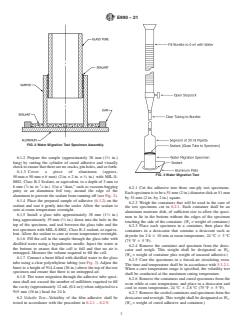
6.1.1 The core Splice Adhesive Mold is illustrated in Fig. 1 (Note 1). Apply a mold release agent to both the interior of the female
portion and the exterior of the male portion of the mold. Install a layer of adhesive (Note 2) on the entire length of the 19.05 mm
diameter part of the male portion of the mold so that the layer of adhesive overlaps along a vertical seam. Close the mold by
lowering the female portion over the male portion until it seats against the base of the male portion. A press may be used to help
close the mold. Remove the mold from the press and place in an oven. Cure in the oven at 121121 °C 6 5.6°C (2505.6 °C (250 °F
6 10°F)10 °F) for 1 h minimum. Remove cured adhesive from the mold.
NOTE 1—The mold may be made of aluminum, acrylic plastic, or other suitable material. The outer shell may be fabricated as a split mold.
NOTE 2—Depending on the expansion ratio and the unexpanded thickness of the material being tested, it may be necessary to install more than one layer
3 3
of adhesive. The size of the adhesive shall be calculated as follows: Length × width × thickness = 1.65 cm (0.65 in. ).
6.1.2 Prepare the sample (approximately 38 mm (1 ⁄2 in.) long) by cutting the cylinder of cured adhesive and visually check to
ensure that there are no cracks, pin holes, and so forth.
6.1.3 Cover a piece of aluminum (approx. 50 × 50 × 650 mm × 50 mm × 6 mm) (2 × 2 × (2 in. × 2 in. × ⁄4 in.) with MIL-S-8802,
1 1
Class B-2 Sealant, or equivalent, to a depth of 33 mm to 6 mm ( ⁄8 in. to ⁄4 in.). Use a “dam,” such as vacuum-bagging putty or
an aluminum foil tray, around the edge of the aluminum to prevent the sealant from running off (see Fig. 2).
6.1.4 Place the prepared sample of adhesive (6.1.2) on the sealant and seat it gently into the sealer. Allow the sealant to cure at
room temperature overnight.
FIG. 1 Core Splice Adhesive Mold
E990 − 21
FIG. 2 Water Migration Test Specimen Assembly
1 3
6.1.5 Install a glass tube approximately 38 mm (1 ⁄2 in.) long approximately 19 mm ( ⁄4 in.) down into the hole in the top of the
specimen, and seal between the glass tube and the test specimen with MIL-S-8802, Class B-2 sealant, or equivalent. Allow the
sealant to cure at room temperature overnight.
6.1.6 Fill the cell in the sample through the glass tube with distilled water using a hypodermic needle. Inject the water at the
bottom to ensure that the cell is full and that no air is entrapped. Measure the volume required to fill the cell.
6.1.7 Connect a buret filled with distilled water to the glass tube using a clear polyethylene tubing (see Fig. 3). Adjust the buret
to a height of 914.4 mm (36 in.) above the top of the test specimen and ensure that there is no entrapped air.
6.1.8 The water migration through the adhesive tube specimen shall not exceed the number of millilitres required to fill the cavity
(approximately 12 mL (0.4 oz)) when subjected to a 915 mm (36-in.)(36 in.) head for 24 h.
6.2 Volatile Test—Volatility of the film adhesive shall be tested in accordance with the procedure in 6.2.1 – 6.2.9.
6.2.1 Cut the adhesive into three one-ply test specimens. Each specimen is to be a 51-mm (2-in.)51 mm (2 in.) diameter disk or
5151 mm by 51-mm (251 mm (2 in. by 2-in.)2 in.) square.
6.2.2 Weigh the containers that will be used in the cure of the test specimens cut in 6.2.1. Each container shall be an aluminum
moisture dish, of sufficient size to allow the specimen to lie in the bottom without the edges of the specimen touching the side of
the container. (W = weight of container.)
6.2.3 Place each specimen in a container, then place the containers in a desiccator that contains a desiccant such as dryerite for
2 h 6 10 min at room temperature, 2424 °C 6 3°C (753 °C (75 °F 6 5°F).5 °F).
6.2.4 Remove the container and specimen from the desiccator and weigh. This weight shall be designated as W . (W = weight
2 2
of container plus weight of uncured adhesive.)
6.2.5 Cure the specimens in a forced-air circulating oven. The time and temperature shall be in accordance with 5.3.2.1. When
a cure temperature range is specified, the volatility test shall be conducted at the maximum curing temperature.
E990 − 21
FIG. 3 Water Migration Test
6.2.6 Remove the containers and cured specimens from the oven while at cure temperature, and place in a desiccator and cool to
room temperature, 2424 °C 6 2.8°C (752.8 °C (75 °F 6 5°F).5 °F).
6.2.7 Remove the cooled containers and specimens from the desiccator and reweigh. This weight shall be designated as W .
(W = weight of cured adhesive and container.)
6.2.8 The percent weight loss shall be calculated as follows:
W 2 W
2 3
V 5 3100 (1)
W 2 W
2 1
where:
V = weight loss (volatility), %,
W = weight of container, g (oz),
W = weight of container plus weight of uncured adhesive, g (oz), and
W = weight of cured adhesive and container, g (oz).
6.2.9 The percent of weight loss of three specimens shall be averaged and reported as volatility.
6.3 Expansion Test—Cut three specimens of the core splice adhesive (approx. 102 × 102102 mm × 102 mm) (4 × 4(4 in. × 4 in.)
with the liners intact. Record the average thickness (at least three readings per sp
...