

ASTM F1836M-15(2023)
(Specification)Standard Specification for Stuffing Tubes, Nylon, and Packing Assemblies (Metric)
General Information
- Abstract
ABSTRACT
This specification covers the general requirements for nylon stuffing tubes and packing assemblies. Nylon stuffing tubes are intended for making electric cable penetrations in marine shipboard enclosures for electrical equipment. The following types are suitable for thin-wall enclosures up to a certain thickness and thick-wall enclosures, bulkheads, and decks of also of a certain thickness. Nylon stuffing tubes shall be classified into four types: Type 1 with straight, unified form thread, Type 2 with 90°, unified form thread, Type 3 with NPT, American standard pipe thread and Type 4 with Y, unified form thread. Materials used for the manufacture of these stuffing tubes and packing assemblies shall include polyamide or nylon and synthetic rubber or neoprene. The sizes and dimensions of stuffing tubes and packing assemblies are completely described. In order determine properties such as vibration resistance, ruggedness, and seal effectiveness of stuffing tubes, the following tests shall be performed: vibration test, mechanical abuse test, and level of effectiveness test. In terms of physical appearance, stuffing tubes shall be free from warp, cracks, chipped edges or surfaces, blisters, uneven surfaces, scratches, dents, and heat marks. They shall be free from fins, burrs, and unsightly finish caused by chipping, filing, or grinding without subsequent buffing or polishing. All molded nylon parts shall be cleaned thoroughly of annealing mediums. Packing assemblies shall be free of voids, pin holes, flash, or other imperfections, that may impair their serviceability.
SCOPE
1.1 This specification covers the general requirements for nylon stuffing tubes and packing assemblies. Nylon stuffing tubes are intended for making electric cable penetrations in marine shipboard enclosures for electrical equipment. The following types are suitable for both thin-wall enclosures up to 5 mm (3/16 in.) thick and thick-wall enclosures, bulkheads, and decks of 5 mm to 19 mm (3/16 in. to 3/4 in.) thick.
1.2 This specification does not cover metal stuffing tubes.
1.3 The values stated in SI units are to be regarded as standard. No other units of measurement are included in this standard.
1.4 This standard does not purport to address all of the safety concerns, if any, associated with its use. It is the responsibility of the user of this standard to establish appropriate safety, health, and environmental practices and determine the applicability of regulatory limitations prior to use.
1.5 This international standard was developed in accordance with internationally recognized principles on standardization established in the Decision on Principles for the Development of International Standards, Guides and Recommendations issued by the World Trade Organization Technical Barriers to Trade (TBT) Committee.
- Status
- Published
- Publication Date
- 30-Nov-2023
- Technical Committee
- F25 - Ships and Marine Technology
- Drafting Committee
- F25.10 - Electrical
Overview
ASTM F1836M-15(2023) is the international standard specification developed by ASTM for nylon stuffing tubes and packing assemblies in metric units. These components are specifically intended for sealing and protecting electrical cable penetrations in marine shipboard enclosures and associated electrical equipment. The standard establishes requirements for design, material selection, performance testing, workmanship, and quality assurance to ensure reliable cable entry seals in challenging marine environments.
Key Topics
Classification and Types: The specification covers four types of nylon stuffing tubes based on thread design and configuration:
- Type 1: Straight, unified form threads
- Type 2: 90°, unified form threads
- Type 3: NPT (National Pipe Thread) American standard pipe threads
- Type 4: Y, unified form threads
Materials: Only non-metallic materials are covered - polyamide/nylon for the tube components and synthetic rubber or neoprene for the compressible packing assemblies.
Performance and Testing:
- Vibration resistance: Tested using IEC vibration standards to simulate marine conditions
- Mechanical abuse: Evaluates durability against impact and rugged use
- Seal effectiveness: Confirms resistance to leakage, supporting protection according to NEMA enclosure requirements (such as 4, 4X, 6, 6P)
Quality Requirements:
- Stuffing tubes must be free of defects such as warping, cracks, blisters, uneven surfaces, and other imperfections that could compromise seal or integrity
- Marking requirements include manufacturer identifications and specification numbers
Order and Identification:
- Orders specify type, part number, packing size, and compliance with O-ring shelf life
Applications
Nylon stuffing tubes and packing assemblies are critical for:
- Marine electrical installations: Providing reliable cable entry seals in shipboard electrical panels, junction boxes, light fixtures, and control panels
- Cable penetration protection: Ensuring electrical equipment maintains or exceeds the original environmental sealing of enclosures after cable entries are punched or drilled
- Thin and thick wall applications: Suitable for thin walls up to 5 mm and thick walls, decks, and bulkheads from 5 mm to 19 mm
- Harsh and high-impact environments: Performance-verified for shock, vibration, and mechanical stresses common in naval and commercial ships
Related Standards
Implementing ASTM F1836M-15(2023) often requires reference to related standards for material and performance requirements:
- ASTM D4066: Classification system for nylon injection and extrusion materials
- ASTM D2000: Classification system for rubber products, relevant to synthetic rubber and neoprene packing materials
- NEMA Standard 250: Enclosures for electrical equipment, specifies environmental protection requirements
- ASME B1.1: Unified inch screw threads, relevant to thread definitions for tube components
- IEC 68-2-6: Environmental vibration testing
- MIL-S-901: (If specified for DoD procurement) Shock tests for high-impact shipboard equipment
Practical Value
Adherence to ASTM F1836M-15(2023) ensures:
- Reliable and safe cable entry sealing to preserve water-tightness, environmental protection, and mechanical integrity in marine electrical systems
- Standardized quality and interchangeability of non-metallic stuffing tubes and assemblies across suppliers and installations
- Reduced risk of environmental damage or system failure due to cable entry point compromise
By following this standard, organizations can support compliance with marine industry regulations and best practices for shipboard electrical installation safety.
Keywords: stuffing tubes, nylon, packing assemblies, marine cable entry seal, electrical enclosure protection, ASTM F1836M, metric, cable penetrators, ship electrical standards
Relations
- Effective Date
- 01-Dec-2023
Get Certified
Connect with accredited certification bodies for this standard

DNV
DNV is an independent assurance and risk management provider.

Lloyd's Register
Lloyd's Register is a global professional services organisation specialising in engineering and technology.

FSC International
Forest Stewardship Council certification.
Sponsored listings
Frequently Asked Questions
ASTM F1836M-15(2023) is a technical specification published by ASTM International. Its full title is "Standard Specification for Stuffing Tubes, Nylon, and Packing Assemblies (Metric)". This standard covers: ABSTRACT This specification covers the general requirements for nylon stuffing tubes and packing assemblies. Nylon stuffing tubes are intended for making electric cable penetrations in marine shipboard enclosures for electrical equipment. The following types are suitable for thin-wall enclosures up to a certain thickness and thick-wall enclosures, bulkheads, and decks of also of a certain thickness. Nylon stuffing tubes shall be classified into four types: Type 1 with straight, unified form thread, Type 2 with 90°, unified form thread, Type 3 with NPT, American standard pipe thread and Type 4 with Y, unified form thread. Materials used for the manufacture of these stuffing tubes and packing assemblies shall include polyamide or nylon and synthetic rubber or neoprene. The sizes and dimensions of stuffing tubes and packing assemblies are completely described. In order determine properties such as vibration resistance, ruggedness, and seal effectiveness of stuffing tubes, the following tests shall be performed: vibration test, mechanical abuse test, and level of effectiveness test. In terms of physical appearance, stuffing tubes shall be free from warp, cracks, chipped edges or surfaces, blisters, uneven surfaces, scratches, dents, and heat marks. They shall be free from fins, burrs, and unsightly finish caused by chipping, filing, or grinding without subsequent buffing or polishing. All molded nylon parts shall be cleaned thoroughly of annealing mediums. Packing assemblies shall be free of voids, pin holes, flash, or other imperfections, that may impair their serviceability. SCOPE 1.1 This specification covers the general requirements for nylon stuffing tubes and packing assemblies. Nylon stuffing tubes are intended for making electric cable penetrations in marine shipboard enclosures for electrical equipment. The following types are suitable for both thin-wall enclosures up to 5 mm (3/16 in.) thick and thick-wall enclosures, bulkheads, and decks of 5 mm to 19 mm (3/16 in. to 3/4 in.) thick. 1.2 This specification does not cover metal stuffing tubes. 1.3 The values stated in SI units are to be regarded as standard. No other units of measurement are included in this standard. 1.4 This standard does not purport to address all of the safety concerns, if any, associated with its use. It is the responsibility of the user of this standard to establish appropriate safety, health, and environmental practices and determine the applicability of regulatory limitations prior to use. 1.5 This international standard was developed in accordance with internationally recognized principles on standardization established in the Decision on Principles for the Development of International Standards, Guides and Recommendations issued by the World Trade Organization Technical Barriers to Trade (TBT) Committee.
ABSTRACT This specification covers the general requirements for nylon stuffing tubes and packing assemblies. Nylon stuffing tubes are intended for making electric cable penetrations in marine shipboard enclosures for electrical equipment. The following types are suitable for thin-wall enclosures up to a certain thickness and thick-wall enclosures, bulkheads, and decks of also of a certain thickness. Nylon stuffing tubes shall be classified into four types: Type 1 with straight, unified form thread, Type 2 with 90°, unified form thread, Type 3 with NPT, American standard pipe thread and Type 4 with Y, unified form thread. Materials used for the manufacture of these stuffing tubes and packing assemblies shall include polyamide or nylon and synthetic rubber or neoprene. The sizes and dimensions of stuffing tubes and packing assemblies are completely described. In order determine properties such as vibration resistance, ruggedness, and seal effectiveness of stuffing tubes, the following tests shall be performed: vibration test, mechanical abuse test, and level of effectiveness test. In terms of physical appearance, stuffing tubes shall be free from warp, cracks, chipped edges or surfaces, blisters, uneven surfaces, scratches, dents, and heat marks. They shall be free from fins, burrs, and unsightly finish caused by chipping, filing, or grinding without subsequent buffing or polishing. All molded nylon parts shall be cleaned thoroughly of annealing mediums. Packing assemblies shall be free of voids, pin holes, flash, or other imperfections, that may impair their serviceability. SCOPE 1.1 This specification covers the general requirements for nylon stuffing tubes and packing assemblies. Nylon stuffing tubes are intended for making electric cable penetrations in marine shipboard enclosures for electrical equipment. The following types are suitable for both thin-wall enclosures up to 5 mm (3/16 in.) thick and thick-wall enclosures, bulkheads, and decks of 5 mm to 19 mm (3/16 in. to 3/4 in.) thick. 1.2 This specification does not cover metal stuffing tubes. 1.3 The values stated in SI units are to be regarded as standard. No other units of measurement are included in this standard. 1.4 This standard does not purport to address all of the safety concerns, if any, associated with its use. It is the responsibility of the user of this standard to establish appropriate safety, health, and environmental practices and determine the applicability of regulatory limitations prior to use. 1.5 This international standard was developed in accordance with internationally recognized principles on standardization established in the Decision on Principles for the Development of International Standards, Guides and Recommendations issued by the World Trade Organization Technical Barriers to Trade (TBT) Committee.
ASTM F1836M-15(2023) is classified under the following ICS (International Classification for Standards) categories: 47.020.60 - Electrical equipment of ships and of marine structures. The ICS classification helps identify the subject area and facilitates finding related standards.
ASTM F1836M-15(2023) has the following relationships with other standards: It is inter standard links to ASTM F1836M-15(2019). Understanding these relationships helps ensure you are using the most current and applicable version of the standard.
ASTM F1836M-15(2023) is available in PDF format for immediate download after purchase. The document can be added to your cart and obtained through the secure checkout process. Digital delivery ensures instant access to the complete standard document.
Standards Content (Sample)
This international standard was developed in accordance with internationally recognized principles on standardization established in the Decision on Principles for the
Development of International Standards, Guides and Recommendations issued by the World Trade Organization Technical Barriers to Trade (TBT) Committee.
Designation: F1836M − 15 (Reapproved 2023) An American National Standard
Standard Specification for
Stuffing Tubes, Nylon, and Packing Assemblies (Metric)
This standard is issued under the fixed designation F1836M; the number immediately following the designation indicates the year of
original adoption or, in the case of revision, the year of last revision. A number in parentheses indicates the year of last reapproval. A
superscript epsilon (´) indicates an editorial change since the last revision or reapproval.
This standard has been approved for use by agencies of the U.S. Department of Defense.
1. Scope D4066 Classification System for Nylon Injection and Extru-
sion Materials (PA)
1.1 This specification covers the general requirements for
2.2 NEMA Standard:
nylon stuffing tubes and packing assemblies. Nylon stuffing
Standard 250 Enclosures for Electrical Equipment (1000 V
tubes are intended for making electric cable penetrations in
Max)
marine shipboard enclosures for electrical equipment. The
2.3 ASME Standard:
following types are suitable for both thin-wall enclosures up to
ASME B1.1 Unified Inch Screw Threads (UN and UNR
5 mm ( ⁄16 in.) thick and thick-wall enclosures, bulkheads, and
Thread Form)
3 3
decks of 5 mm to 19 mm ( ⁄16 in. to ⁄4 in.) thick.
2.4 IEC Standard:
1.2 This specification does not cover metal stuffing tubes.
Standard 68-2-6 Environmental Testing–Part 2: Tests–Test
1.3 The values stated in SI units are to be regarded as FC: Vibration (Sinusoidal) Sixth Edition
standard. No other units of measurement are included in this
3. Terminology
standard.
3.1 Definitions of Terms Specific to This Standard:
1.4 This standard does not purport to address all of the
3.1.1 nylon stuffıng tube, n—a marine electrical fitting used
safety concerns, if any, associated with its use. It is the
for the sealing of cable penetration into shipboard enclosures
responsibility of the user of this standard to establish appro-
while maintaining or exceeding the degree of protection for
priate safety, health, and environmental practices and deter-
which the enclosure is rated.
mine the applicability of regulatory limitations prior to use.
1.5 This international standard was developed in accor- 3.1.2 packing assembly, n—the compressible insert for the
dance with internationally recognized principles on standard- nylon stuffing tube. It consists of one neoprene bushing and
ization established in the Decision on Principles for the three nylon washers.
Development of International Standards, Guides and Recom-
3.1.3 enclosure, n—an electrical panel, cabinet, junction
mendations issued by the World Trade Organization Technical
box, light fixture, electrical equipment, control box, or panel.
Barriers to Trade (TBT) Committee.
4. Classification
2. Referenced Documents
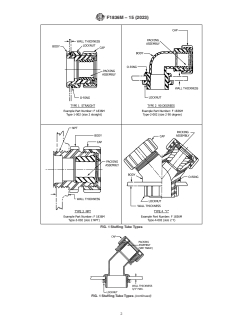
4.1 Nylon stuffing tubes shall be of the following types (see
2.1 ASTM Standards:
Fig. 1):
D2000 Classification System for Rubber Products in Auto-
4.1.1 Type 1—straight—Unified Form Thread.
motive Applications
4.1.2 Type 2—90°—Unified Form Thread.
4.1.3 Type 3—NPT—American Standard Pipe Thread.
4.1.4 Type 4—Y—Unified Form Thread.
This specification is under the jurisdiction of ASTM Committee F25 on Ships
and Marine Technology and is the direct responsibility of Subcommittee F25.10 on
Electrical. Available from National Electrical Manufacturers Association (NEMA), 1300
Current edition approved Dec. 1, 2023. Published December 2023. Originally N. 17th St., Suite 900, Arlington, VA 22209, http://www.nema.org.
approved in 1997. Last previous edition approved in 2019 as F1836M – 15 (2019). Available from American Society of Mechanical Engineers (ASME), ASME
DOI: 10.1520/F1836M-15R23. International Headquarters, Two Park Ave., New York, NY 10016-5990, http://
For referenced ASTM standards, visit the ASTM website, www.astm.org, or www.asme.org.
contact ASTM Customer Service at service@astm.org. For Annual Book of ASTM Available from International Electrotechnical Commission (IEC), 3, rue de
Standards volume information, refer to the standard’s Document Summary page on Varembé, 1st floor, P.O. Box 131, CH-1211, Geneva 20, Switzerland, https://
the ASTM website. www.iec.ch.
Copyright © ASTM International, 100 Barr Harbor Drive, PO Box C700, West Conshohocken, PA 19428-2959. United States
F1836M − 15 (2023)
FIG. 1 Stuffing Tube Types
FIG. 1 Stuffing Tube Types (continued)
F1836M − 15 (2023)
5. Ordering Information
5.1 Orders for stuffing tubes under this specification shall
include the following:
5.1.1 Type (see 4.1).
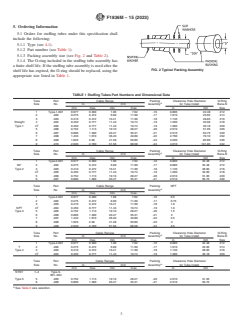
5.1.2 Part number (see Table 1).
5.1.3 Packing assembly size (see Fig. 2 and Table 2).
5.1.4 The O-ring included in the stuffing tube assembly has
a finite shelf life. If the stuffing tube assembly is used after the
FIG. 2 Typical Packing Assembly
shelf life has expired, the O-ring should be replaced, using the
appropriate size listed in Table 1.
TABLE 1 Stuffing Tubes Part Numbers and Dimensional Data
Tube Part Cable Range Packing Clearance Hole Diameter O-Ring
A
Size No. in. mm Assembly for Tube Install Buna-N
min. max. min. max. in. mm Size
1 Type-1-001 0.077 0.300 1.96 7.62 -16 0.885 22.48 212
2 -002 0.275 0.472 6.99 11.99 -17 1.010 25.65 214
3 -003 0.410 0.472 10.41 11.99 -18 1.135 28.83 216
Straight 4 -004 0.450 0.777 11.43 19.74 -19 1.260 32.00 218
Type 1 4T -005 0.450 0.777 11.43 19.74 -19 1.385 35.18 220
5 -006 0.752 1.113 19.10 28.27 -20 2.010 51.05 226
6 -007 0.806 1.390 20.47 35.31 -21 2.510 63.75 230
7 -008 1.433 1.610 36.40 40.89 -22 2.760 70.10 232
8 -009 1.625 2.00 41.28 50.80 -23 3.260 82.80 236
9 -010 2.030 2.700 51.56 68.58 -24 4.010 101.85 242
Tube Part Cable Range Packing Clearance Hole Diameter O-Ring
A
Size No. in. mm Assembly for Tube Install Buna-N
min. max. min. max. in. mm Size
1 Type-2-001 0.077 0.300 1.96 7.62 -16 0.885 22.48 212
90° 2 -002 0.275 0.472 6.99 11.99 -17 0.885 22.48 212
Type 2 3 -003 0.410 0.472 10.41 11.99 -18 1.135 28.83 216
4T -005 0.450 0.777 11.43 19.74 -19 1.260 32.00 218
5 -006 0.752 1.113 19.10 28.27 -20 2.010 51.05 220
6 -007 0.806 1.390 20.47 35.31 -21 2.510 63.75 230
Tube Part Cable Range Packing NPT
A
Size No. in. mm Assembly
min. max. min. max.
1 Type-3-001 0.077 0.300 1.96 7.62 -16 0.5
2 -002 0.275 0.472 6.99 11.99 -17 0.75
3 -003 0.410 0.472 10.41 11.99 -18 1.0
NPT 4T -004 0.450 0.777 11.43 19.74 -19 1.0
Type 3 5 -005 0.752 1.113 19.10 28.27 -20 1.5
6 -006 0.806 1.390 20.47 35.31 -21 2
7 -007 1.433 1.610 36.40 40.89 -22 2.5
8 -008 1.625 2.00 41.28 50.80 -23 3
9 -009 2.030 2.700 51.56 68.58 -24 3.5
Tube Part Cable Ranges Packing Clearance Hole Diameter O-Ring
A
Size No. in. mm Assembly for Tube Install Buna-N
min. max. min. max. in. mm Size
1 Type-4-001 0.077 0.300 1.96 7.62 -16 0.885 22.48 212
Y 2 -002 0.275 0.472 6.99 11.99 -17 1.010 25.65 214
Type 4 3 -003 0.410 0.472 10.41 11.99 -18 1.135 28.83 216
4T -004 0.450 0.777 11.43 19.74 -19 1.385 35.18 220
Tube Part Cable Ranges Packing Clearance Hole Diameter
A
Size No. in. mm Assembly for Tube Install
min. max. min. max. in. mm
NYST 1–4 Type-5-
001–004
Type 5 5 -005 0.752 1.113 19.10 28.27 -20 2.010 51.05
6 -006 0.806 1.390 20.47 35.31 -21 2.510 63.75
A
See Table 2 size selection.
F1836M − 15 (2023)
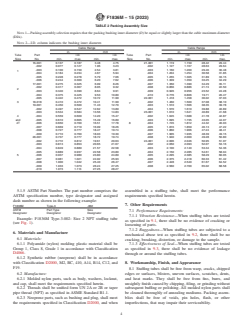
TABLE 2 Packing Assembly Size
NOTE 1—Packing assembly selection requires that the packing bushing inner diameter (D) be equal or slightly larger than the cable maximum diameter
(DIA).
NOTE 2—I.D. column indicates the bushing inner diameter.
Cable Range Cable Range
in. mm in. mm
Tube Part I.D. I.D. Tube Part I.D. I.D.
Size No. min. max. min. max. Size No. min. max. min. max.
16-001 0.137 0.187 3.48 4.75 21-001 1.119 1.159 28.42 29.44
-002 0.077 0.127 1.96 3.23 -002 1.127 1.167 28.63 29.64
-003 0.100 0.150 2.54 3.81 -003 1.160 1.200 29.46 30.48
-004 0.184 0.234 4.67 5.94 -004 1.204 1.254 30.58 31.85
-005 0.228 0.278 5.79 7.06 -005 1.255 1.305 31.89 33.15
-006 0.244 0.300 6.20 7.62 -006 1.309 1.350 33.25 34.29
17-001 0.275 0.325 6.99 8.26 -007 1.350 1.390 34.29 35.11
-002 0.317 0.367 8.05 9.32 -008 0.856 0.886 21.74 22.50
-003 0.340 0.390 8.64 9.91 -009 0.926 0.956 23.52 24.28
-004 0.375 0.425 9.53 10.80 -010 0.776 0.806 19.71 20.47
-005 0.422 0.472 10.72 11.99 22-001 1.418 1.458 36.02 37.03
3 18-018 0.410 0.472 10.41 11.99 -002 1.460 1.500 37.08 38.10
19-001 0.450 0.500 11.43 12.70 -003 1.510 1.566 38.35 39.78
-002 0.497 0.547 12.62 13.89 -004 1.570 1.610 39.88 40.89
-003 0.534 0.584 13.56 14.83 23-001 1.610 1.641 40.89 41.68
4 -004 0.559 0.609 14.20 15.47 -002 1.645 1.688 41.78 42.87
and -005 0.610 0.665 15.49 16.89 -003 1.695 1.735 43.05 44.07
4T -006 0.650 0.700 16.51 17.78 8 -004 1.745 1.812 44.32 46.03
-007 0.669 0.719 16.99 18.26 -005 1.816 1.859 46.13 47.22
-008 0.727 0.777 18.47 19.74 -006 1.860 1.906 47.24 48.41
-009 0.710 0.760 18.03 19.30 -007 1.905 1.935 48.39 49.15
20-001 0.737 0.777 18.72 19.74 -008 1.940 2.000 49.28 50.80
-002 0.772 0.812 19.61 20.63 24-001 2.006 2.046 50.95 51.97
-003 0.813 0.853 20.65 21.67 -002 2.050 2.093 52.07 53.16
-004 0.849 0.889 21.57 22.58 -003 2.100 2.140 53.34 54.36
-005 0.889 0.937 22.58 23.80 -004 2.150 2.285 54.61 58.04
5 -006 0.937 0.980 23.80 24.89 9 -005 2.295 2.385 58.29 60.05
-007 0.981 1.021 24.92 25.93 -006 2.375 2.418 60.33 61.42
-008 1.000 1.042 25.40 26.47 -007 2.428 2.540 61.67 64.52
-009 1.033 1.073 26.24 27.25 -008 2.560 2.700 65.02 68.58
-010 1.073 1.113 27.25 28.27
5.1.5 ASTM Part Number. The part number comprises the assembled in a stuffing tube, shall meet the performance
ASTM specification number, type designator and assigned requirements specified herein.
dash number as shown in the following example:
7. Other Requirements
F1836M Type-3 -002
ASTM Part Type Size
7.1 Performance Requirements:
Designator Designator Designator
7.1.1 Vibration Resistance—When stuffing tubes are tested
Example: F1836M Type-3-002: Size 2 NPT stuffing tube
as specified in 9.1, there shall be no evidence of cracking or
(see Fig. 1).
loosening of parts.
7.1.2 Ruggedness
...