

ASTM D6404-99(2020)
(Practice)Standard Practice for Sampling Vegetable Materials Containing Tannin
General Information
- Abstract
SIGNIFICANCE AND USE
5.1 This practice provides standard procedures for obtaining representative samples of various materials used as a source of tannins for the tanning industry.
5.2 Procedures are described for obtaining representative samples of economical and convenient quantities from a lot, or sections of a lot, of material for examination and analysis so that agreement may be reached with regard to the extent of variation of quality in different portions of a lot and the average quality of the entire lot of material.
5.3 No directions for sampling, however explicit, can take the place of judgment, skill, and previous experience on the part of persons actually engaged in the sampling or the supervision of the sampling. These directions are intended to supplement that experience and, particularly, to serve as a guide in the selection of the method which is to be used, in common, by each of two or more contracting parties.
5.4 Tanning materials contain moisture in varying amounts, depending both on the nature of the material and on the climatic conditions, so that sampling must be carried out as quickly as is consistent with thoroughness in order to avoid changes in moisture content.
SCOPE
1.1 This practice covers obtaining representative samples from shipment lots of botanical materials containing tannin.
1.2 The values stated in SI units are to be regarded as standard. The values given in parentheses after SI units are provided for information only and are not considered standard.
1.3 This standard does not purport to address all of the safety concerns, if any, associated with its use. It is the responsibility of the user of this standard to establish appropriate safety, health, and environmental practices and determine the applicability of regulatory limitations prior to use.
1.4 This international standard was developed in accordance with internationally recognized principles on standardization established in the Decision on Principles for the Development of International Standards, Guides and Recommendations issued by the World Trade Organization Technical Barriers to Trade (TBT) Committee.
- Status
- Published
- Publication Date
- 30-Nov-2020
- Technical Committee
- D31 - Leather
- Drafting Committee
- D31.01 - Vegetable Leather
Overview
ASTM D6404-99(2020), Standard Practice for Sampling Vegetable Materials Containing Tannin, provides a widely recognized methodology for sampling botanical materials intended as sources of tannin, primarily for the tanning industry. Developed by ASTM International, this standard aims to ensure that samples collected from shipments of vegetable tanning materials are representative and suitable for reliable analysis. The document also sets out practices to minimize variation in sample quality and handle the inherent complexities associated with natural products.
Key Topics
- Representative Sampling Procedures: Outlines how to obtain samples from lots or portions of lots, whether the material is solid, powdered, pasty, or liquid. Specific techniques such as quartering ensure that the collected subsample accurately represents the whole.
- Sample Reduction and Handling: Details the use of approved methods and apparatus, such as balances, sieves, and sampling tools, to reduce sample sizes while maintaining representative quality and avoiding changes in moisture content.
- Container and Preservation Requirements: Provides guidance on selecting suitable, airtight containers for various forms of vegetable tannins, advising against materials that could allow moisture loss or contamination.
- Number of Samples: Presents tabulated guidance for determining how many packages to sample from lots of different sizes, supporting statistical confidence in the results.
- Certification and Documentation: Emphasizes the need for sampler’s certification, ensuring accountability and traceability for each official sample.
Applications
ASTM D6404-99(2020) is essential for companies and laboratories involved in the procurement, quality control, and analysis of tanning materials derived from plant sources, such as bark, wood, leaves, nuts, fruits, and roots. Its consistent sampling methodology supports:
- Leather Production: Ensuring accurate determination of tannin content and uniformity, which is critical for processing animal hides into high-quality leather.
- Material Trading: Providing a standardized basis for agreements between buyers and sellers regarding the quality and composition of bulk lots of vegetable tannins.
- Regulatory Compliance: Helping organizations demonstrate due diligence and conformance to international guidelines on sampling and analysis of botanical materials, reinforcing trust in supply chains.
- Research and Development: Serving as a methodological foundation for testing and developing new vegetable tannin sources or extraction processes.
Related Standards
- ASTM D1517: Terminology Relating to Leather - Offers essential definitions referenced within ASTM D6404 for clear communication across the industry.
- ALCA Method J10: Sampling Vegetable Materials Containing Tannin - The direct precursor to ASTM D6404, providing additional background on sampling approaches.
- World Trade Organization Principles: This standard adheres to internationally recognized practices for the development of technical regulations, ensuring global applicability.
Practical Value
By adopting ASTM D6404-99(2020), companies benefit from:
- Consistent Quality Assessments: Uniform sampling reduces disputes over batch quality and supports objective, science-based analysis.
- Reduced Sampling Bias: Standardized methods minimize human error and the impact of subjective judgment, even as the importance of experience is recognized.
- Efficient Sampling Operations: Clear guidance, including on the number of samples to collect and container selection, streamlines routine quality control and purchasing activities.
- Credibility in International Trade: Conformance to ASTM and WTO principles assures trading partners of reliability and fair practice in the assessment of tannin materials.
Keywords
sampling vegetable tannins, ASTM D6404, tannin sampling standard, tanning industry quality control, representative sample, botanical materials testing, leather production standards
For more information and access to the most current version of ASTM D6404-99(2020), visit ASTM International.
Relations
- Effective Date
- 01-Dec-2015
- Effective Date
- 01-Oct-2010
- Effective Date
- 01-Oct-2006
- Effective Date
- 01-Sep-2004
- Effective Date
- 01-Sep-2004
- Effective Date
- 01-Apr-2004
- Effective Date
- 10-May-1999
Get Certified
Connect with accredited certification bodies for this standard

Control Union Certifications
Global certification for agriculture and sustainability.

Hohenstein Institut
Textile testing and certification.

Bureau Veritas Bangladesh
Bureau Veritas certification services in Bangladesh.
Sponsored listings
Frequently Asked Questions
ASTM D6404-99(2020) is a standard published by ASTM International. Its full title is "Standard Practice for Sampling Vegetable Materials Containing Tannin". This standard covers: SIGNIFICANCE AND USE 5.1 This practice provides standard procedures for obtaining representative samples of various materials used as a source of tannins for the tanning industry. 5.2 Procedures are described for obtaining representative samples of economical and convenient quantities from a lot, or sections of a lot, of material for examination and analysis so that agreement may be reached with regard to the extent of variation of quality in different portions of a lot and the average quality of the entire lot of material. 5.3 No directions for sampling, however explicit, can take the place of judgment, skill, and previous experience on the part of persons actually engaged in the sampling or the supervision of the sampling. These directions are intended to supplement that experience and, particularly, to serve as a guide in the selection of the method which is to be used, in common, by each of two or more contracting parties. 5.4 Tanning materials contain moisture in varying amounts, depending both on the nature of the material and on the climatic conditions, so that sampling must be carried out as quickly as is consistent with thoroughness in order to avoid changes in moisture content. SCOPE 1.1 This practice covers obtaining representative samples from shipment lots of botanical materials containing tannin. 1.2 The values stated in SI units are to be regarded as standard. The values given in parentheses after SI units are provided for information only and are not considered standard. 1.3 This standard does not purport to address all of the safety concerns, if any, associated with its use. It is the responsibility of the user of this standard to establish appropriate safety, health, and environmental practices and determine the applicability of regulatory limitations prior to use. 1.4 This international standard was developed in accordance with internationally recognized principles on standardization established in the Decision on Principles for the Development of International Standards, Guides and Recommendations issued by the World Trade Organization Technical Barriers to Trade (TBT) Committee.
SIGNIFICANCE AND USE 5.1 This practice provides standard procedures for obtaining representative samples of various materials used as a source of tannins for the tanning industry. 5.2 Procedures are described for obtaining representative samples of economical and convenient quantities from a lot, or sections of a lot, of material for examination and analysis so that agreement may be reached with regard to the extent of variation of quality in different portions of a lot and the average quality of the entire lot of material. 5.3 No directions for sampling, however explicit, can take the place of judgment, skill, and previous experience on the part of persons actually engaged in the sampling or the supervision of the sampling. These directions are intended to supplement that experience and, particularly, to serve as a guide in the selection of the method which is to be used, in common, by each of two or more contracting parties. 5.4 Tanning materials contain moisture in varying amounts, depending both on the nature of the material and on the climatic conditions, so that sampling must be carried out as quickly as is consistent with thoroughness in order to avoid changes in moisture content. SCOPE 1.1 This practice covers obtaining representative samples from shipment lots of botanical materials containing tannin. 1.2 The values stated in SI units are to be regarded as standard. The values given in parentheses after SI units are provided for information only and are not considered standard. 1.3 This standard does not purport to address all of the safety concerns, if any, associated with its use. It is the responsibility of the user of this standard to establish appropriate safety, health, and environmental practices and determine the applicability of regulatory limitations prior to use. 1.4 This international standard was developed in accordance with internationally recognized principles on standardization established in the Decision on Principles for the Development of International Standards, Guides and Recommendations issued by the World Trade Organization Technical Barriers to Trade (TBT) Committee.
ASTM D6404-99(2020) is classified under the following ICS (International Classification for Standards) categories: 59.140.10 - Processes and auxiliary materials. The ICS classification helps identify the subject area and facilitates finding related standards.
ASTM D6404-99(2020) has the following relationships with other standards: It is inter standard links to ASTM D1517-15, ASTM D1517-10, ASTM D1517-06, ASTM D1517-04, ASTM D1517-04e1, ASTM D1517-99(2004), ASTM D1517-99. Understanding these relationships helps ensure you are using the most current and applicable version of the standard.
ASTM D6404-99(2020) is available in PDF format for immediate download after purchase. The document can be added to your cart and obtained through the secure checkout process. Digital delivery ensures instant access to the complete standard document.
Standards Content (Sample)
This international standard was developed in accordance with internationally recognized principles on standardization established in the Decision on Principles for the
Development of International Standards, Guides and Recommendations issued by the World Trade Organization Technical Barriers to Trade (TBT) Committee.
Designation: D6404 − 99 (Reapproved 2020)
Standard Practice for
Sampling Vegetable Materials Containing Tannin
This standard is issued under the fixed designation D6404; the number immediately following the designation indicates the year of
original adoption or, in the case of revision, the year of last revision. A number in parentheses indicates the year of last reapproval. A
superscript epsilon (´) indicates an editorial change since the last revision or reapproval.
1. Scope 3.1.3 tannin—an astringent substance found in the various
parts of plants such as bark, wood, leaves, nuts, fruits, roots,
1.1 This practice covers obtaining representative samples
etc.
from shipment lots of botanical materials containing tannin.
3.1.4 vegetable tannins—mixtures of substances (natural
1.2 The values stated in SI units are to be regarded as
products) obtained from plant tissues by water extraction
standard. The values given in parentheses after SI units are
which have the chemical and physical properties necessary to
provided for information only and are not considered standard.
convert animal hides and skins into leather.
1.3 This standard does not purport to address all of the
4. Summary of Practice
safety concerns, if any, associated with its use. It is the
responsibility of the user of this standard to establish appro-
4.1 This practice describes methods for obtaining represen-
priate safety, health, and environmental practices and deter-
tative samples for analysis from shipments of vegetable tan-
mine the applicability of regulatory limitations prior to use.
ning materials and tannin extracts.
1.4 This international standard was developed in accor-
5. Significance and Use
dance with internationally recognized principles on standard-
ization established in the Decision on Principles for the
5.1 Thispracticeprovidesstandardproceduresforobtaining
Development of International Standards, Guides and Recom-
representative samples of various materials used as a source of
mendations issued by the World Trade Organization Technical
tannins for the tanning industry.
Barriers to Trade (TBT) Committee.
5.2 Procedures are described for obtaining representative
samples of economical and convenient quantities from a lot, or
2. Referenced Documents
sections of a lot, of material for examination and analysis so
2.1 ASTM Standards:
that agreement may be reached with regard to the extent of
D1517 Terminology Relating to Leather
variationofqualityindifferentportionsofalotandtheaverage
2.2 ALCA Method:
quality of the entire lot of material.
J10 Sampling Vegetable Materials Containing Tannin
5.3 No directions for sampling, however explicit, can take
3. Terminology
the place of judgment, skill, and previous experience on the
part of persons actually engaged in the sampling or the
3.1 Definitions:
supervision of the sampling. These directions are intended to
3.1.1 For definitions of general leather and tanning terms
supplement that experience and, particularly, to serve as a
used in this practice refer to Terminology D1517.
guide in the selection of the method which is to be used, in
3.1.2 quartering—the term applied to a method described in
common, by each of two or more contracting parties.
this practice of reducing the size of samples without impairing
their representative quality.
5.4 Tanning materials contain moisture in varying amounts,
depending both on the nature of the material and on the
climatic conditions, so that sampling must be carried out as
This practice is under the jurisdiction ofASTM Committee D31 on Leather and
is the direct responsibility of Subcommittee D31.01 on Vegetable Leather. This test
quickly as is consistent with thoroughness in order to avoid
method has been adapted from and is a replacement for Method J10 of the Official
changes in moisture content.
Methods of the American Leather Chemists Association.
Current edition approved Dec. 1, 2020. Published December 2020. Originally
6. Apparatus
approved in 1999. Last previous edition approved in 2014 as D6404 – 99 (2014).
DOI: 10.1520/D6404-99R20.
6.1 Balance, analytical balance which will weigh the quan-
For referenced ASTM standards, visit the ASTM website, www.astm.org, or
tity of material specified in this practice to an accuracy of 610
contact ASTM Customer Service at service@astm.org. For Annual Book of ASTM
g(6 0.35 oz).
Standards volume information, refer to the standard’s Document Summary page on
the ASTM website.
6.2 Canvas, 11-oz weight and of sufficient size (as deter-
Official Methods of the American Leather Chemists Association. Available
mined by the discretion of the sampler or analyst) for use in
from the American Leather Chemists Association, University of Cincinnati, P.O.
Box 210014, Cincinnati, OH 45221-0014. mixing and quartering samples.
Copyright © ASTM International, 100 Barr Harbor Drive, PO Box C700, West Conshohocken, PA 19428-2959. United States
D6404 − 99 (2020)
6.3 Sieve, with round openings 1.27 cm (0.50 in.) in
diameter.
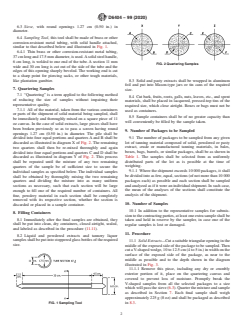
6.4 Sampling Tool, this tool shall be made of brass or other
corrosion-resistant metal tubing, with solid handle attached,
similar to that described below and illustrated in Fig. 1.
6.4.1 Thin brass or other corrosion-resistant metal tubing,
37cmlongand17.5mmdiameter,isused.Asolidsteelhandle,
6 cm long, is welded to one end of the tube. A section 11 mm
FIG. 2 Quartering Samples
wide and 30 cm long is cut out of the side of the tube and the
edges of this opening sharply beveled. The working end is cut
to a sharp point for piercing sacks, or other tough materials,
8.3 Solid and pasty extracts shall be wrapped in aluminum
like plantation gambier.
foil and put into Mason-type jars or tin cans of the required
7. Quartering Samples
size.
7.1 “Quartering” is a term applied to the following method
8.4 Cut bark, fruits, roots, galls, nuts, leaves, etc., and spent
of reducing the size of samples without impairing their
materials, shall be placed in lacquered, pressed-top tins of the
representative quality.
required size, which close airtight. Boxes or bags must not be
7.1.1 All of the material, taken from the various containers
used as containers.
or parts of the shipment of solid material being sampled, shall
8.5 Sample containers shall be of no greater capacity than
be immediately and thoroughly mixed on a square piece of 11
will conveniently be filled by the sample taken.
oz canvas. In the case of solid extracts, large pieces shall have
been broken previously so as to pass a screen having round
9. Number of Packages to be Sampled
openings 1.27 cm (0.50 in.) in diameter. The pile shall be
9.1 The number of packages to be sampled from any given
divided into four equal portions and quarters A and B shall be
lot of tanning material composed of solid, powdered or pasty
discarded as illustrated in diagram X of Fig. 2. The remaining
extract, crude or manufactured tanning materials, in bales,
two quarters shall then be re-mixed thoroughly and again
boxes, bags, barrels, or similar packages, shall be as shown in
divided into four equal portions and quarters C and D shall be
Table 1. The samples shall be selected from as uniformly
discarded as illustrated in diagram Y of Fig. 2. This process
distributed parts of the lot as is possible at the time of
shall be repeated until the mixture of any two remaining
weighing.
quarters of the sample be of sufficient size to secure the
9.1.1 Where the shipment exceeds 10 000 packages, it shall
individual samples as specified below. The individual samples
bedividedintoasfew,equal,sections(ofnotmorethan10 000
shall be obtained by thoroughly mixing the two remaining
packages each) as possible and each section shall be sampled
quarters and dividing the mixture into as many uniform
and analyzed as if it were an individual shipment. In such case,
sections as necessary, such that each section will be large
the mean of the analyses of the sections shall constitute the
enough to fill one of the required number of containers. All
analysis of the shipment.
fine, powdery material in each section shall be completely
removed with its respective section, whether the section is
10. Number of Samples
discarded or placed in a sample container.
10.1 In addition to the representative samples for submis-
8. Filling Containers
siontothecontractingparties,atleastoneextrasampleshallbe
8.1 Immediately after the final samples are obtained, they
taken and held in reserve by the sampler, in case one of the
shall be put into clean, dry containers, closed airtight, sealed,
regular samples is lost or damaged.
and labeled as described in the procedure (11.11).
11. Procedure
8.2 Liquid and powdered extracts and tannery liquor
samples shall be put into stoppered glass bottles of the required
11.1 Solid Extracts—Cutasuitabletriangularopeninginthe
size. middle of the exposed side of the package to be sampled. Then
cutaV-shapedwedge,10to12.5cm(4to5in.)inwidthonthe
surface of the exposed side of the package, as near to the
middle as possible and to the depth shown in the diagram
illustrated in Fig. 3.
11.1.1 Remove this piece, including any dry or crumbly
exterior portion of it, place on the quartering canvas and
covered to prevent loss of moisture. Promptly break the
V-shaped samples from all the selected packages to a size
which will pass the sieve (6.3). Quarter the mixture and sample
as described in Section 7. Each final sample shall weigh
approximately 225 g (8 oz) and shall be packaged as described
FIG. 1 Sampling Tool in 8.3.
D6404 − 99 (2020)
TABLE 1 Sampling Quantities
Number of Number of Number of Number of Number of Number of
Packages Packages to Packages Packages to Packages Packages to
in Lot Be Sampled in Lot Be Sampled in Lot Be Sampled
1 to 3 each 1201 to 1300 25 4551 to 4700 48
3 to 24 3 1301 to 1400 26 4701 to 4900 49
25 to 40 4 1401 to 1510 27 4901 to 5100 50
41 to 60 5 1511 to 1640 28 5101 to 5300 51
61 to 84 6 1641 to 1730 29 5301 to 5520 52
85 to 112 7 1731 to 1860 30 5521 to 5720 53
113 to 144 8 1861 to 1980 31 5721 to 5940 54
145 to 180 9 1861 to 1980
...