

ASTM D6182-23
(Test Method)Standard Test Method for Flexibility and Adhesion of Finish on Leather
General Information
- Abstract
SIGNIFICANCE AND USE
5.1 This test method is intended for use on any type of finished leather.
5.2 This test method will give an indication of the flexibility, adhesion, and strength of the finish on leather.
SCOPE
1.1 This test method is intended for use on finished leather to evaluate resistance to cracking, delamination, and discoloration of the finish when subjected to repeated flexing. This test method does not apply to wet blue.
1.2 The values stated in SI units are to be regarded as standard. No other units of measurement are included in this standard.
1.3 This standard does not purport to address all of the safety concerns, if any, associated with its use. It is the responsibility of the user of this standard to establish appropriate safety, health, and environmental practices and determine the applicability of regulatory limitations prior to use.
1.4 This international standard was developed in accordance with internationally recognized principles on standardization established in the Decision on Principles for the Development of International Standards, Guides and Recommendations issued by the World Trade Organization Technical Barriers to Trade (TBT) Committee.
- Status
- Published
- Publication Date
- 31-Aug-2023
- Technical Committee
- D31 - Leather
- Drafting Committee
- D31.07 - Physical Properties



Overview
ASTM D6182-23: Standard Test Method for Flexibility and Adhesion of Finish on Leather is an internationally recognized method developed by ASTM to assess the durability and performance of finished leather surfaces. This standard is crucial for industries that utilize finished leather, ensuring that products maintain appearance and integrity when subjected to repeated flexing. The test method evaluates the resistance of leather finishes to cracking, delamination, and discoloration, providing an indication of the flexibility, adhesion, and strength of the finish.
Key Topics
Scope and Applicability
- Applies to all types of finished leather except wet blue.
- Evaluates resistance to cracking, delamination, and discoloration after repeated flexing.
- Uses SI units as the standard measurement system.
Test Procedure
- Leather specimens are conditioned as per prescribed practices.
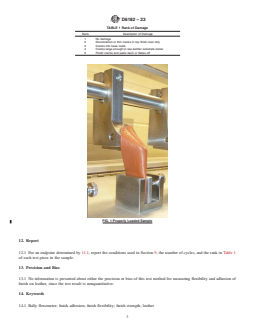
- The Bally Flexometer, in accordance with DIN 53351 and ISO 32100, is used to repeatedly flex the leather at 100 cycles per minute.
- Specimens are examined after a set number of cycles, and any damage is ranked based on a standardized table.
Result Interpretation
- Damage is ranked from 1 (no damage) to 5 (finish cracks and flakes off).
- Test results offer a nonquantitative evaluation of flexibility and adhesion, guiding quality assessment.
Safety and Compliance
- Users must determine appropriate safety, health, and environmental practices before use.
- Developed under international standardization principles recognized by the WTO TBT Committee.
Applications
ASTM D6182-23 is highly relevant across sectors that manufacture, process, or utilize finished leather, including:
- Footwear: Ensures the finish on shoes resists cracking and peeling during bending and flexing.
- Upholstery: Validates the appearance and durability of leather in furniture and automotive interiors.
- Apparel: Confirms that garments made from finished leather maintain their quality and aesthetic under regular use.
- Accessories: Certifies leather goods like bags, belts, and wallets will resist finish failure in daily wear.
- Quality Assurance: Helps manufacturers, suppliers, and buyers evaluate product quality, compare material performance, and meet regulatory expectations.
By following this standard, organizations can ensure that their leather products meet industry performance criteria, reduce returns due to finish failure, and satisfy end-user quality expectations.
Related Standards
For a comprehensive quality assurance program in leather testing, the following related standards are referenced in ASTM D6182-23:
- ASTM D1517 - Terminology Relating to Leather
- ASTM D1610 - Practice for Conditioning Leather and Leather Products for Testing
- ASTM D2813 - Practice for Sampling Leather for Physical and Chemical Tests
- DIN 53351 / ISO 32100 - Determination of flex resistance in rubber- or plastics-coated fabrics using the flexometer method
Summary
ASTM D6182-23 is an essential test method for assessing the flexibility and adhesion of leather finishes. It supports consistent product quality across global leather goods supply chains and helps manufacturers demonstrate compliance with international standards. Proper implementation ensures leather products retain their appearance, meet customer expectations, and offer long-term durability in demanding applications. For further details or the latest updates, always refer to the official ASTM documentation.
Relations
- Effective Date
- 01-Dec-2015
- Refers
ASTM D1610-01(2013) - Standard Practice for Conditioning Leather and Leather Products for Testing - Effective Date
- 01-May-2013
- Effective Date
- 01-Oct-2010
- Effective Date
- 01-Sep-2008
- Refers
ASTM D1610-01(2007) - Standard Practice for Conditioning Leather and Leather Products for Testing - Effective Date
- 01-Apr-2007
- Effective Date
- 01-Oct-2006
- Effective Date
- 01-Sep-2004
- Effective Date
- 01-Sep-2004
- Effective Date
- 01-Apr-2004
- Effective Date
- 01-Oct-2003
- Effective Date
- 10-May-2001
- Effective Date
- 10-May-2001
- Effective Date
- 10-May-1999
- Effective Date
- 10-Apr-1997
Get Certified
Connect with accredited certification bodies for this standard

Control Union Certifications
Global certification for agriculture and sustainability.

Hohenstein Institut
Textile testing and certification.

Bureau Veritas Bangladesh
Bureau Veritas certification services in Bangladesh.
Sponsored listings
Frequently Asked Questions
ASTM D6182-23 is a standard published by ASTM International. Its full title is "Standard Test Method for Flexibility and Adhesion of Finish on Leather". This standard covers: SIGNIFICANCE AND USE 5.1 This test method is intended for use on any type of finished leather. 5.2 This test method will give an indication of the flexibility, adhesion, and strength of the finish on leather. SCOPE 1.1 This test method is intended for use on finished leather to evaluate resistance to cracking, delamination, and discoloration of the finish when subjected to repeated flexing. This test method does not apply to wet blue. 1.2 The values stated in SI units are to be regarded as standard. No other units of measurement are included in this standard. 1.3 This standard does not purport to address all of the safety concerns, if any, associated with its use. It is the responsibility of the user of this standard to establish appropriate safety, health, and environmental practices and determine the applicability of regulatory limitations prior to use. 1.4 This international standard was developed in accordance with internationally recognized principles on standardization established in the Decision on Principles for the Development of International Standards, Guides and Recommendations issued by the World Trade Organization Technical Barriers to Trade (TBT) Committee.
SIGNIFICANCE AND USE 5.1 This test method is intended for use on any type of finished leather. 5.2 This test method will give an indication of the flexibility, adhesion, and strength of the finish on leather. SCOPE 1.1 This test method is intended for use on finished leather to evaluate resistance to cracking, delamination, and discoloration of the finish when subjected to repeated flexing. This test method does not apply to wet blue. 1.2 The values stated in SI units are to be regarded as standard. No other units of measurement are included in this standard. 1.3 This standard does not purport to address all of the safety concerns, if any, associated with its use. It is the responsibility of the user of this standard to establish appropriate safety, health, and environmental practices and determine the applicability of regulatory limitations prior to use. 1.4 This international standard was developed in accordance with internationally recognized principles on standardization established in the Decision on Principles for the Development of International Standards, Guides and Recommendations issued by the World Trade Organization Technical Barriers to Trade (TBT) Committee.
ASTM D6182-23 is classified under the following ICS (International Classification for Standards) categories: 59.140.10 - Processes and auxiliary materials. The ICS classification helps identify the subject area and facilitates finding related standards.
ASTM D6182-23 has the following relationships with other standards: It is inter standard links to ASTM D1517-15, ASTM D1610-01(2013), ASTM D1517-10, ASTM D2813-03(2008), ASTM D1610-01(2007), ASTM D1517-06, ASTM D1517-04e1, ASTM D1517-04, ASTM D1517-99(2004), ASTM D2813-03, ASTM D1610-01, ASTM D1610-00, ASTM D1517-99, ASTM D2813-97. Understanding these relationships helps ensure you are using the most current and applicable version of the standard.
ASTM D6182-23 is available in PDF format for immediate download after purchase. The document can be added to your cart and obtained through the secure checkout process. Digital delivery ensures instant access to the complete standard document.
Standards Content (Sample)
This international standard was developed in accordance with internationally recognized principles on standardization established in the Decision on Principles for the
Development of International Standards, Guides and Recommendations issued by the World Trade Organization Technical Barriers to Trade (TBT) Committee.
Designation: D6182 − 23
Standard Test Method for
Flexibility and Adhesion of Finish on Leather
This standard is issued under the fixed designation D6182; the number immediately following the designation indicates the year of
original adoption or, in the case of revision, the year of last revision. A number in parentheses indicates the year of last reapproval. A
superscript epsilon (´) indicates an editorial change since the last revision or reapproval.
1. Scope 3. Terminology
1.1 This test method is intended for use on finished leather 3.1 Definitions—Terms used in this test method are defined
to evaluate resistance to cracking, delamination, and discolor- in accordance with Terminology D1517.
ation of the finish when subjected to repeated flexing. This test
4. Summary of Test Method
method does not apply to wet blue.
4.1 Leather is conditioned according to one of two pre-
1.2 The values stated in SI units are to be regarded as
scribed procedures, flexed in a Bally Flexometer, and an
standard. No other units of measurement are included in this
endpoint is determined by rating the degree of damage after a
standard.
fixed number of flexes.
1.3 This standard does not purport to address all of the
safety concerns, if any, associated with its use. It is the
5. Significance and Use
responsibility of the user of this standard to establish appro-
5.1 This test method is intended for use on any type of
priate safety, health, and environmental practices and deter-
finished leather.
mine the applicability of regulatory limitations prior to use.
1.4 This international standard was developed in accor- 5.2 This test method will give an indication of the flexibility,
dance with internationally recognized principles on standard- adhesion, and strength of the finish on leather.
ization established in the Decision on Principles for the
6. Apparatus
Development of International Standards, Guides and Recom-
mendations issued by the World Trade Organization Technical
6.1 Bally Flexometer, conforming to ISO 32100, and oper-
Barriers to Trade (TBT) Committee.
ating at a rate of 100 cycles/min.
6.2 Die for cutting leather specimens to 45 mm by 70 mm.
2. Referenced Documents
2.1 ASTM Standards:
7. Reagents and Materials
D1517 Terminology Relating to Leather
7.1 Distilled or Deionized Water.
D1610 Practice for Conditioning Leather and Leather Prod-
ucts for Testing
8. Sampling, Test Specimens, and Test Units
D2813 Practice for Sampling Leather for Physical and
8.1 Sample leather according to Practice D2813.
Chemical Tests
8.2 Cut two test pieces 45 mm by 70 mm from each sample
2.2 ISO Standard:
using a die, one piece cut parallel and the other perpendicular
ISO 32100 Rubber- or plastics-coated fabrics—Physical and
to the backbone.
mechanical tests—Determination of flex resistance by the
flexometer method
9. Conditioning
9.1 Dry Leather Test—Prepare the test pieces according to
This test method is under the jurisdiction of ASTM Committee D31 on Leather
Practice D1610.
and is the direct responsibility of Subcommittee D31.07 on Physical Properties.
Current edition approved Sept. 1, 2023. Published September 2023. Originally
9.2 Wet Leather Test—Submerge the test pieces in distilled
approved in 1997. Last previous edition approved in 2015 as D6182 – 00 (2015).
or deionized water for 20 min 6 1 min. Blot excess water off
DOI: 10.1520/D6182-23.
using blotting paper or a paper towel.
For referenced ASTM standards, visit the ASTM website, www.astm.org, or
contact ASTM Customer Service at service@astm.org. For Annual Book of ASTM
Standards volume information, refer to the standard’s Document Summary page on
the ASTM website. Equipment conforming to ISO 32100
...
This document is not an ASTM standard and is intended only to provide the user of an ASTM standard an indication of what changes have been made to the previous version. Because
it may not be technically possible to adequately depict all changes accurately, ASTM recommends that users consult prior editions as appropriate. In all cases only the current version
of the standard as published by ASTM is to be considered the official document.
Designation: D6182 − 00 (Reapproved 2015) D6182 − 23
Standard Test Method for
Flexibility and Adhesion of Finish on Leather
This standard is issued under the fixed designation D6182; the number immediately following the designation indicates the year of
original adoption or, in the case of revision, the year of last revision. A number in parentheses indicates the year of last reapproval. A
superscript epsilon (´) indicates an editorial change since the last revision or reapproval.
1. Scope
1.1 This test method is intended for use on finished leather to evaluate resistance to cracking, delamination, and discoloration of
the finish when subjected to repeated flexing. This test method does not apply to wet blue.
1.2 The values stated in SI units are to be regarded as standard. No other units of measurement are included in this standard.
1.3 This standard does not purport to address all of the safety concerns, if any, associated with its use. It is the responsibility
of the user of this standard to establish appropriate safety and healthsafety, health, and environmental practices and determine
the applicability of regulatory limitations prior to use.
1.4 This international standard was developed in accordance with internationally recognized principles on standardization
established in the Decision on Principles for the Development of International Standards, Guides and Recommendations issued
by the World Trade Organization Technical Barriers to Trade (TBT) Committee.
2. Referenced Documents
2.1 ASTM Standards:
D1517 Terminology Relating to Leather
D1610 Practice for Conditioning Leather and Leather Products for Testing
D2813 Practice for Sampling Leather for Physical and Chemical Tests
2.2 DINISO Standard:
DIN 53351ISO 32100 DauerfaltverhaltenRubber- or plastics-coated fabrics—Physical and mechanical tests—Determination of
flex resistance by the flexometer method
3. Terminology
3.1 Definitions—Terms used in this test method are defined in accordance with Terminology D1517.
4. Summary of Test Method
4.1 Leather is conditioned according to one of two prescribed procedures, flexed in a Bally Flexometer, and an endpoint is
determined by rating the degree of damage after a fixed number of flexes.
This test method is under the jurisdiction of ASTM Committee D31 on Leather and is the direct responsibility of Subcommittee D31.07 on Physical Properties.
Current edition approved May 1, 2015Sept. 1, 2023. Published July 2015September 2023. Originally approved in 1997. Last previous edition approved in 20102015 as
D6182 – 00 (2010).(2015). DOI: 10.1520/D6182-00R15.10.1520/D6182-23.
For referenced ASTM standards, visit the ASTM website, www.astm.org, or contact ASTM Customer Service at service@astm.org. For Annual Book of ASTM Standards
volume information, refer to the standard’s Document Summary page on the ASTM website.
DIN 53351ISO 32100 Dauerfaltverhaltenis published by DIN Deutsches Institut für Notmungthe International Organization for Standardization and is available from
ANSI, 11 W. 42nd St., 13th Floor, New York, NY 10036, and from Global Engineering Documents, 15 Inverness Way East, Englewood, CO 80112.
Equipment conforming to DIN 53351ISO 32100 is available from Bally Trading Ltd. Prüfgeräteverkauf, CH-5012 Schönenwerd, Switzerland. Soraco SRL Via
Orfanotrofio, 26 13900 Biella, Italy. Other manufacturers are Giuliani S.N.C., Via Cervino, 10 Torino, Italy, and Pellizzato Bruno, 31033 Salvarosa di Castelfranco Venito
(Treviso), Borgo Mandolato 13, Italy.Italy and Schap Specialty Machine, Inc. Spring Lake, MI, USA.
Copyright © ASTM International, 100 Barr Harbor Drive, PO Box C700, West Conshohocken, PA 19428-2959. United States
D6182 − 23
5. Significance and Use
5.1 This test method is intended for use on any type of finished leather.
...