


ASTM D8055-23
(Guide)Standard Guide for Selecting an Appropriate Electronic Thermometer for Replacing Mercury Thermometers in D04 Road and Paving Standards
Standard Guide for Selecting an Appropriate Electronic Thermometer for Replacing Mercury Thermometers in D04 Road and Paving Standards
SIGNIFICANCE AND USE
4.1 General guidance is provided for electronic thermometers for general temperature measurements typically needed for D04 practices and test methods which need to monitor oven, water and oil bath, and material temperatures during drying, heating, aging, and mixing.
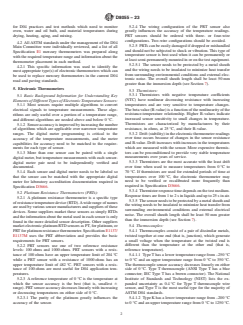
4.2 All ASTM standards under the management of the D04 Main Committee were individually reviewed, and a list of all Specification E1 mercury thermometers was prepared along with the required temperature range and information about the thermometer placement in each method.
4.2.1 This specific information was used to identify the most appropriate type(s) of electronic thermometers which can be used to replace mercury thermometers in the current D04 road and paving standards.
SCOPE
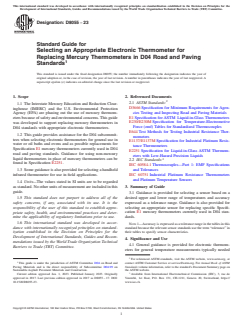
1.1 The Interstate Mercury Education and Reduction Clearinghouse (IMERC) and the U.S. Environmental Protection Agency (EPA) are phasing out the use of mercury thermometers because of safety and environmental concerns. This guide was developed to support replacing mercury thermometers in D04 standards with appropriate electronic thermometers.
1.2 This guide provides assistance for the D04 subcommittees when selecting electronic thermometers for general use in water or oil baths and ovens and as possible replacements for Specification E1 mercury thermometers currently used in D04 road and paving standards. Guidance for using non-mercury liquid thermometers in place of mercury thermometers can be found in Specification E2251.
1.3 Some guidance is also provided for selecting a handheld infrared thermometer for use in field applications.
1.4 Units—The values stated in SI units are to be regarded as standard. No other units of measurement are included in this guide.
1.5 This standard does not purport to address all of the safety concerns, if any, associated with its use. It is the responsibility of the user of this standard to establish appropriate safety, health, and environmental practices and determine the applicability of regulatory limitations prior to use.
1.6 This international standard was developed in accordance with internationally recognized principles on standardization established in the Decision on Principles for the Development of International Standards, Guides and Recommendations issued by the World Trade Organization Technical Barriers to Trade (TBT) Committee.
General Information
- Status
- Published
- Publication Date
- 31-Dec-2022
- Technical Committee
- D04 - Road and Paving Materials
- Drafting Committee
- D04.99 - Sustainable Asphalt Pavement Materials and Construction
Relations
- Effective Date
- 01-Nov-2023
- Effective Date
- 01-May-2023
- Effective Date
- 01-Nov-2019
- Effective Date
- 01-Oct-2016
- Effective Date
- 01-Dec-2013
- Effective Date
- 01-May-2013
- Effective Date
- 01-Dec-2011
- Effective Date
- 15-May-2011
- Effective Date
- 15-May-2011
- Effective Date
- 01-May-2011
- Effective Date
- 01-May-2011
- Effective Date
- 01-Nov-2010
- Effective Date
- 01-Dec-2009
- Effective Date
- 01-Nov-2009
- Effective Date
- 01-Nov-2008
Overview
ASTM D8055-23 provides comprehensive guidance for selecting appropriate electronic thermometers to replace mercury thermometers in ASTM D04 road and paving standards. With increasing restrictions on mercury devices due to environmental and safety regulations, such as those enacted by IMERC and the U.S. Environmental Protection Agency (EPA), this standard aims to streamline the transition to modern, safer, and equally accurate temperature measurement systems in road and paving laboratory and field applications.
Key Topics
Electronic Thermometer Types: The standard discusses the main categories of electronic thermometers suitable for D04 applications, including:
- Platinum Resistance Thermometers (PRTs/RTDs): Preferred for their accuracy in many temperature measurement scenarios required in laboratory settings.
- Thermistors: Noted for high sensitivity and suitable for lower temperature ranges with fast response times.
- Thermocouples: Valued for wide temperature range capabilities, particularly Type T and Type K varieties.
- Handheld Infrared Thermometers: Used primarily for field measurement of material surfaces, such as during asphalt paving.
Selection Criteria:
- Temperature Range and Tolerance: Guidance on matching the electronic thermometer’s capabilities to those of the original mercury thermometers, with specific attention to required accuracy and application temperature ranges.
- Sensor Calibration: Emphasis on calibrating each sensor-meter pair as a single unit to ensure accurate temperature measurement and traceable records for laboratory accreditation.
- Immersion Depth: Recommendations for determining the minimum immersion length to achieve reliable and stable readings, crucial for replacing liquid-in-glass thermometers.
Performance and Comparability:
- Ensuring that the chosen electronic thermometer provides statistically similar results to mercury thermometers, preserving data integrity and comparability.
Applications
The guide is designed for use in a variety of temperature measurement scenarios encountered in D04 road and paving standards, including:
- Oven, Water and Oil Bath Monitoring: Ensuring precise control during sample drying, heating, aging, and mixing.
- Material Temperature Measurement: Real-time temperature monitoring in the preparation and testing of asphalt, concrete, and other paving materials.
- Construction Site Use: Fast, non-contact surface temperature measurements with handheld infrared thermometers, essential for monitoring pavement laid temperatures and assuring quality.
- Laboratory Accreditation: Assisting laboratories in selecting and documenting appropriate devices for compliance with ASTM D3666 and related requirements.
Related Standards
ASTM D8055-23 references and is best used in conjunction with several key national and international standards to support best practices in thermometer replacement:
- ASTM E1: Specification for ASTM Liquid-in-Glass Thermometers.
- ASTM E2251: Specification for Low-Hazard Precision Liquid Thermometers.
- ASTM E1137/E1137M: Specification for Industrial Platinum Resistance Thermometers.
- ASTM E230/E230M: Specification for Thermocouple Temperature-EMF Tables.
- ASTM D3666: Specification for Minimum Requirements for Agencies Testing Road and Paving Materials.
- IEC 60584-1: Thermocouple EMF Specifications and Tolerances.
- IEC 60751: Industrial Platinum Resistance Thermometers and Sensors.
Practical Value
Adopting ASTM D8055-23 ensures compliance with environmental and safety regulations, enhances laboratory practices, and maintains data consistency. By guiding users through the evaluation and selection of electronic thermometers, the standard supports accurate temperature monitoring, minimizes disruption during the transition away from mercury devices, and fosters sustainable pavement engineering.
Keywords: mercury thermometer replacement, electronic thermometers, platinum resistance thermometers, thermistors, thermocouples, ASTM D04, road and paving standards, asphalt testing, thermometer calibration, laboratory accreditation.
Buy Documents
ASTM D8055-23 - Standard Guide for Selecting an Appropriate Electronic Thermometer for Replacing Mercury Thermometers in D04 Road and Paving Standards
REDLINE ASTM D8055-23 - Standard Guide for Selecting an Appropriate Electronic Thermometer for Replacing Mercury Thermometers in D04 Road and Paving Standards
Get Certified
Connect with accredited certification bodies for this standard

BSMI (Bureau of Standards, Metrology and Inspection)
Taiwan's standards and inspection authority.
Sponsored listings
Frequently Asked Questions
ASTM D8055-23 is a guide published by ASTM International. Its full title is "Standard Guide for Selecting an Appropriate Electronic Thermometer for Replacing Mercury Thermometers in D04 Road and Paving Standards". This standard covers: SIGNIFICANCE AND USE 4.1 General guidance is provided for electronic thermometers for general temperature measurements typically needed for D04 practices and test methods which need to monitor oven, water and oil bath, and material temperatures during drying, heating, aging, and mixing. 4.2 All ASTM standards under the management of the D04 Main Committee were individually reviewed, and a list of all Specification E1 mercury thermometers was prepared along with the required temperature range and information about the thermometer placement in each method. 4.2.1 This specific information was used to identify the most appropriate type(s) of electronic thermometers which can be used to replace mercury thermometers in the current D04 road and paving standards. SCOPE 1.1 The Interstate Mercury Education and Reduction Clearinghouse (IMERC) and the U.S. Environmental Protection Agency (EPA) are phasing out the use of mercury thermometers because of safety and environmental concerns. This guide was developed to support replacing mercury thermometers in D04 standards with appropriate electronic thermometers. 1.2 This guide provides assistance for the D04 subcommittees when selecting electronic thermometers for general use in water or oil baths and ovens and as possible replacements for Specification E1 mercury thermometers currently used in D04 road and paving standards. Guidance for using non-mercury liquid thermometers in place of mercury thermometers can be found in Specification E2251. 1.3 Some guidance is also provided for selecting a handheld infrared thermometer for use in field applications. 1.4 Units—The values stated in SI units are to be regarded as standard. No other units of measurement are included in this guide. 1.5 This standard does not purport to address all of the safety concerns, if any, associated with its use. It is the responsibility of the user of this standard to establish appropriate safety, health, and environmental practices and determine the applicability of regulatory limitations prior to use. 1.6 This international standard was developed in accordance with internationally recognized principles on standardization established in the Decision on Principles for the Development of International Standards, Guides and Recommendations issued by the World Trade Organization Technical Barriers to Trade (TBT) Committee.
SIGNIFICANCE AND USE 4.1 General guidance is provided for electronic thermometers for general temperature measurements typically needed for D04 practices and test methods which need to monitor oven, water and oil bath, and material temperatures during drying, heating, aging, and mixing. 4.2 All ASTM standards under the management of the D04 Main Committee were individually reviewed, and a list of all Specification E1 mercury thermometers was prepared along with the required temperature range and information about the thermometer placement in each method. 4.2.1 This specific information was used to identify the most appropriate type(s) of electronic thermometers which can be used to replace mercury thermometers in the current D04 road and paving standards. SCOPE 1.1 The Interstate Mercury Education and Reduction Clearinghouse (IMERC) and the U.S. Environmental Protection Agency (EPA) are phasing out the use of mercury thermometers because of safety and environmental concerns. This guide was developed to support replacing mercury thermometers in D04 standards with appropriate electronic thermometers. 1.2 This guide provides assistance for the D04 subcommittees when selecting electronic thermometers for general use in water or oil baths and ovens and as possible replacements for Specification E1 mercury thermometers currently used in D04 road and paving standards. Guidance for using non-mercury liquid thermometers in place of mercury thermometers can be found in Specification E2251. 1.3 Some guidance is also provided for selecting a handheld infrared thermometer for use in field applications. 1.4 Units—The values stated in SI units are to be regarded as standard. No other units of measurement are included in this guide. 1.5 This standard does not purport to address all of the safety concerns, if any, associated with its use. It is the responsibility of the user of this standard to establish appropriate safety, health, and environmental practices and determine the applicability of regulatory limitations prior to use. 1.6 This international standard was developed in accordance with internationally recognized principles on standardization established in the Decision on Principles for the Development of International Standards, Guides and Recommendations issued by the World Trade Organization Technical Barriers to Trade (TBT) Committee.
ASTM D8055-23 is classified under the following ICS (International Classification for Standards) categories: 17.200.20 - Temperature-measuring instruments. The ICS classification helps identify the subject area and facilitates finding related standards.
ASTM D8055-23 has the following relationships with other standards: It is inter standard links to ASTM E230/E230M-23a, ASTM E230/E230M-23, ASTM E644-11(2019), ASTM D3666-16, ASTM D3666-13, ASTM E1-13, ASTM D3666-11, ASTM E230/E230M-11, ASTM E230/E230M-11e1, ASTM E644-11, ASTM E2251-11, ASTM E2251-10, ASTM D3666-09a, ASTM E644-09, ASTM E1137/E1137M-08. Understanding these relationships helps ensure you are using the most current and applicable version of the standard.
ASTM D8055-23 is available in PDF format for immediate download after purchase. The document can be added to your cart and obtained through the secure checkout process. Digital delivery ensures instant access to the complete standard document.
Standards Content (Sample)
This international standard was developed in accordance with internationally recognized principles on standardization established in the Decision on Principles for the
Development of International Standards, Guides and Recommendations issued by the World Trade Organization Technical Barriers to Trade (TBT) Committee.
Designation: D8055 − 23
Standard Guide for
Selecting an Appropriate Electronic Thermometer for
Replacing Mercury Thermometers in D04 Road and Paving
Standards
This standard is issued under the fixed designation D8055; the number immediately following the designation indicates the year of
original adoption or, in the case of revision, the year of last revision. A number in parentheses indicates the year of last reapproval. A
superscript epsilon (´) indicates an editorial change since the last revision or reapproval.
1. Scope 2. Referenced Documents
2.1 ASTM Standards:
1.1 The Interstate Mercury Education and Reduction Clear-
D3666 Specification for Minimum Requirements for Agen-
inghouse (IMERC) and the U.S. Environmental Protection
cies Testing and Inspecting Road and Paving Materials
Agency (EPA) are phasing out the use of mercury thermom-
E1 Specification for ASTM Liquid-in-Glass Thermometers
eters because of safety and environmental concerns.This guide
E230/E230M Specification for Temperature-Electromotive
was developed to support replacing mercury thermometers in
Force (emf) Tables for Standardized Thermocouples
D04 standards with appropriate electronic thermometers.
E644 Test Methods for Testing Industrial Resistance Ther-
1.2 This guide provides assistance for the D04 subcommit-
mometers
tees when selecting electronic thermometers for general use in
E1137/E1137M Specification for Industrial Platinum Resis-
water or oil baths and ovens and as possible replacements for
tance Thermometers
Specification E1 mercury thermometers currently used in D04
E2251 Specification for Liquid-in-Glass ASTM Thermom-
road and paving standards. Guidance for using non-mercury
eters with Low-Hazard Precision Liquids
liquid thermometers in place of mercury thermometers can be
2.2 IEC Standards:
found in Specification E2251.
IEC 60584-1 Thermocouples—Part 1: EMF Specifications
and Tolerances
1.3 Some guidance is also provided for selecting a handheld
IEC 60751 Industrial Platinum Resistance Thermometers
infrared thermometer for use in field applications.
and Platinum Temperature Sensors
1.4 Units—The values stated in SI units are to be regarded
3. Summary of Guide
as standard. No other units of measurement are included in this
guide.
3.1 Guidance is provided for selecting a sensor based on a
desired upper and lower range of temperatures and accuracy
1.5 This standard does not purport to address all of the
expressed as a tolerance range. Guidance is also provided for
safety concerns, if any, associated with its use. It is the
selecting an appropriate sensor for replacing specific Specifi-
responsibility of the user of this standard to establish appro-
cation E1 mercury thermometers currently used in D04 stan-
priate safety, health, and environmental practices and deter-
dards.
mine the applicability of regulatory limitations prior to use.
1.6 This international standard was developed in accor-
NOTE 1—Accuracy is expressed as a tolerance range in the tables in this
dance with internationally recognized principles on standard-
standard because the relevant sensor standards use the term “tolerance” in
their tables to specify sensor characteristics.
ization established in the Decision on Principles for the
Development of International Standards, Guides and Recom-
4. Significance and Use
mendations issued by the World Trade Organization Technical
4.1 General guidance is provided for electronic thermom-
Barriers to Trade (TBT) Committee.
eters for general temperature measurements typically needed
For referenced ASTM standards, visit the ASTM website, www.astm.org, or
This guide is under the jurisdiction of ASTM Committee D04 on Road and contact ASTM Customer Service at service@astm.org. For Annual Book of ASTM
Paving Materials and is the direct responsibility of Subcommittee D04.99 on Standards volume information, refer to the standard’s Document Summary page on
Sustainable Asphalt Pavement Materials and Construction. the ASTM website.
Current edition approved Jan. 1, 2023. Published January 2023. Originally Available from International Electrotechnical Commission (IEC), 3, rue de
approved in 2017. Last previous edition approved in 2017 as D8055 – 17. DOI: Varembé, 1st floor, P.O. Box 131, CH-1211, Geneva 20, Switzerland, https://
10.1520/D8055-23. www.iec.ch.
Copyright © ASTM International, 100 Barr Harbor Drive, PO Box C700, West Conshohocken, PA 19428-2959. United States
D8055 − 23
for D04 practices and test methods which need to monitor 5.2.4 The wiring configuration of the PRT sensor also
oven, water and oil bath, and material temperatures during greatly influences the accuracy of the temperature readings.
drying, heating, aging, and mixing. PRT sensors should be ordered with three- or four-wire
configurations. Two-wire configurations should be avoided.
4.2 All ASTM standards under the management of the D04
5.2.5 PRTs can be easily damaged if dropped or mishandled
Main Committee were individually reviewed, and a list of all
and should not be subjected to shock or vibration. This type of
Specification E1 mercury thermometers was prepared along
temperature sensor is best used when it can be permanently or
with the required temperature range and information about the
at least semi-permanently mounted in or on the test equipment.
thermometer placement in each method.
5.2.5.1 The sensor needs to be protected by a metal sheath
4.2.1 This specific information was used to identify the
and the wiring needs to be insulated to minimize heat transfer
most appropriate type(s) of electronic thermometers which can
from surrounding environmental conditions and external elec-
be used to replace mercury thermometers in the current D04
tronic noise. The overall sheath length shall be least 50 mm
road and paving standards.
greater than the immersion depth (see Section 7).
5. Electronic Thermometers
5.3 Thermistors:
5.3.1 Thermistors with negative temperature coefficients
5.1 Basic Background Information for Understanding Key
(NTC) have nonlinear decreasing resistance with increasing
Elements of Different Types of Electronic Temperature Sensors:
temperatures and are very sensitive to temperature changes.
5.1.1 Most sensors require multiple algorithms to convert
The beta value (B-value) is a function of the nonlinearity of the
electrical signals to temperature measurements. These algo-
resistance-temperature relationship. Higher B-values indicate
rithms are only useful over a portion of a temperature range,
increased sensor sensitivity to small changes in temperature.
and different algorithms are needed above and below 0 °C.
Thermistors are characterized by manufacturers by their
5.1.2 Sensoraccuracyisimprovedbyincreasingthenumber
resistance, in ohms, at 25 °C, and their B-value.
of algorithms which are applicable over narrower temperature
5.3.2 Drift (stability) in the electronic thermometer readings
ranges. The digital meter programming is critical to the
over time occurs because of changes in the sensor resistance
accuracy of the temperature measurements, and the meter
and B-value. Drift increases with increases in the temperatures
capabilities for accuracy need to be matched to the require-
which are measured with the sensor. More expensive thermis-
ments for each type of sensor.
tors can be preconditioned to provide very stable temperature
5.1.3 More than one sensor can be paired with a single
measurements over years of service.
digital meter, but temperature measurements with each sensor-
5.3.3 Thermistors are the most accurate with the least drift
digital meter pair need to be independently verified and
over time when used to measure temperatures from 0 °C to
documented.
70 °C. If thermistors are used for extended periods of time at
5.1.4 Each sensor and digital meter needs to be labeled so
temperatures over 100 °C, the electronic thermometer may
that the sensor can be matched with the appropriate digital
need to be verified or recalibrated more frequently than
meter for laboratory accreditation documentation required in
required in Specification D3666.
Specification D3666.
5.3.4 Thermistorresponsetimedependsonthetestmedium.
5.2 Platinum Resistance Thermometers (PRTs):
Responsetimesarefrom1to2 sinliquidsandupto25 sinair.
5.2.1 A platinum resistance thermometer is a specific type
5.3.5 Thesensorneedstobeprotectedbyametalsheathand
ofresistancetemperaturedevice(RTD).Awiderangeofnames
the wiring needs to be insulated to minimize heat transfer from
areusedbyvarioussensormanufacturersandsuppliersofthese
surrounding environmental conditions and external electrical
devices. Some suppliers market these sensors as simply RTDs
noise. The overall sheath length shall be least 50 mm greater
and the information about the metal used in each sensor is only
than the immersion depth (see Section 7).
found in the more detailed sensor description. Other suppliers
marketelectronicplatinumRTDsensorsasPT,forplatinum,or 5.4 Thermocouples:
PRTforplatinumresistancethermometer.SpecificationE1137/ 5.4.1 Thermocouples consist of a pair of dissimilar metals,
E1137M uses the PRT abbreviation and provides the basic twisted together at one end (that is, junction), which generate
a small voltage when the temperature at the twisted end is
requirements for PRT sensors.
5.2.2 PRT sensors use one of two reference resistance different than the temperature at the other end (that is,
reference temperature).
levels: 100 ohms and 1000 ohms. PRT sensors with a resis-
tance of 100 ohms have an upper temperature limit of 204 °C 5.4.1.1 Type T has a lower temperature range from –250 °C
while a PRT sensor with a resistance of 1000 ohms has an to 0 °C and an upper temperature range from 0 °C to 350 °C.
upper temperature limit of 482 °C. PRT sensors with a resis- The thermocouple sensor accuracy decreases linearly on either
tance of 100 ohms are most useful for D04 application tem- side of 0 °C. Type T thermocouple (ANSI Type T has a blue
peratures. connector; IEC Type T has a brown connector). The National
Institute of Standards and Technology (NIST) lists the ex-
5.2.3 A reference temperature of 0 °C is the temperature at
which the sensor accuracy is the best (that is, smallest 6 panded uncertainty as 0.4 °C for Type T thermocouple wire
sensor, and Type T is the most useful type for the majority of
range). PRTsensor accuracy decreases linearly with increasing
or decreasing temperatures on either side of 0 °C. ASTM D04 standards.
5.2.3.1 The purity of the platinum greatly influences the 5.4.1.2 Type K has a lower temperature range from –200 °C
accuracy of the sensor. to 0 °C and an upper temperature range from 0 °C to 1250 °C.
D8055 − 23
The thermocouple sensor accuracy decreases linearly on either 5.5.4 Handheld infrared thermometers with laser sighting
side of 0 °C.Type K thermocouple (ANSIType K has a yellow for the spot diameter help ensure the target area of interest is
connector; IEC Type K has a green connector) wire. NIST lists included in the temperature measurement. When the spot
the expanded uncertainty as 1 °C, and Type K is useful for diameter is too large, the temperatures of the area surrounding
ASTM D04 applications which only require a low level of the target are included in the temperature measurement.
accuracy for temperature measurements.
5.4.2 The thermocouple sensor, which is the junction of the
6. Sensor Selection
two wires, can be protected by mounting in a metal sheath.
6.1 Sensor Selection for General Applications—A number
Whenametalsheathisused,thejunctioncanbeattachedtothe
of ASTM D04 standards require temperature measurements to
metal sheath, encased but separate from the sheath, or exposed
control oven and water bath temperatures but do not specifi-
at the tip of the sheath. Connecting the junction to the sheath
cally identify the thermometer to be used. Sensors for these
improves heat transfer and provides a faster response time than
applications can be selected from Table 2.
when the junction is isolated from the sheath. An exposed
6.2 Replacing Specification E1 Mercury Thermometers—
junctionprovidesthefastestresponsetime,butdoesnotprotect
The Specification E1 mercury thermometer designations used
the wires and can limit their usefulness in corrosive or
in ASTM D04 standards are listed in Table 3 along with
pressurized environments. The thermocouple junction needs to
potential sensor replacements with similar accuracy and appli-
be grounded to the sheath and the overall sheath length shall be
cationtemperaturelimitsandranges.Thistableisorganizedby
least 50 mm greater than the immersion depth (see Section 7).
levels of accuracy needed for each thermometer.
5.4.3 When the thermocouple wire is not encased in a metal
6.2.1 Anelectronicse
...
This document is not an ASTM standard and is intended only to provide the user of an ASTM standard an indication of what changes have been made to the previous version. Because
it may not be technically possible to adequately depict all changes accurately, ASTM recommends that users consult prior editions as appropriate. In all cases only the current version
of the standard as published by ASTM is to be considered the official document.
Designation: D8055 − 17 D8055 − 23
Standard Guide for
Selecting an Appropriate Electronic Thermometer for
Replacing Mercury Thermometers in D04 Road and Paving
Standards
This standard is issued under the fixed designation D8055; the number immediately following the designation indicates the year of
original adoption or, in the case of revision, the year of last revision. A number in parentheses indicates the year of last reapproval. A
superscript epsilon (´) indicates an editorial change since the last revision or reapproval.
1. Scope
1.1 The Interstate Mercury Education and Reduction Clearinghouse (IMERC) and the U.S. Environmental Protection Agency
(EPA) are phasing out the use of mercury thermometers because of safety and environmental concerns. This guide was developed
to support replacing mercury thermometers in D04 standards with appropriate electronic thermometers.
1.2 This guide provides assistance for the D04 subcommittees when selecting electronic thermometers for general use in water
or oil baths and ovens and as possible replacements for Specification E1 mercury thermometers currently used in D04 road and
paving standards. Guidance for using non-mercury liquid thermometers in place of mercury thermometers can be found in
Specification E2251.
1.3 Some guidance is also provided for selecting a hand-heldhandheld infrared thermometer for use in field applications.
1.4 Units—The values stated in SI units are to be regarded as standard. No other units of measurement are included in this guide.
1.5 This standard does not purport to address all of the safety concerns, if any, associated with its use. It is the responsibility
of the user of this standard to establish appropriate safety safety, health, and healthenvironmental practices and determine the
applicability of regulatory limitations prior to use.
1.6 This international standard was developed in accordance with internationally recognized principles on standardization
established in the Decision on Principles for the Development of International Standards, Guides and Recommendations issued
by the World Trade Organization Technical Barriers to Trade (TBT) Committee.
2. Referenced Documents
2.1 ASTM Standards:
D3666 Specification for Minimum Requirements for Agencies Testing and Inspecting Road and Paving Materials
E1 Specification for ASTM Liquid-in-Glass Thermometers
E230/E230M Specification for Temperature-Electromotive Force (emf) Tables for Standardized Thermocouples
E644 Test Methods for Testing Industrial Resistance Thermometers
E1137/E1137M Specification for Industrial Platinum Resistance Thermometers
This guide is under the jurisdiction of ASTM Committee D04 on Road and Paving Materials and is the direct responsibility of Subcommittee D04.99 on Sustainable
Asphalt Pavement Materials and Construction.
Current edition approved March 1, 2017Jan. 1, 2023. Published April 2017January 2023. Originally approved in 2017. Last previous edition approved in 2017 as
D8055 – 17. DOI: 10.1520/D8055-17.10.1520/D8055-23.
For referenced ASTM standards, visit the ASTM website, www.astm.org, or contact ASTM Customer Service at service@astm.org. For Annual Book of ASTM Standards
volume information, refer to the standard’s Document Summary page on the ASTM website.
Copyright © ASTM International, 100 Barr Harbor Drive, PO Box C700, West Conshohocken, PA 19428-2959. United States
D8055 − 23
E2251 Specification for Liquid-in-Glass ASTM Thermometers with Low-Hazard Precision Liquids
2.2 IEC Standards:
IEC 60584-1 Thermocouples—Part 1: EMF Specifications and Tolerances
IEC 60751 Industrial Platinum Resistance Thermometers and Platinum Temperature Sensors
3. Summary of PracticeGuide
3.1 Guidance is provided for selecting a sensor based on a desired upper and lower range of temperatures, and accuracy.
temperatures and accuracy expressed as a tolerance range. Guidance is also provided for selecting an appropriate sensor for
replacing specific Specification E1 mercury thermometers currently used in D04 standards.
NOTE 1—Accuracy is expressed as a tolerance range in the tables in this standard because the relevant sensor standards use the term “tolerance” in their
tables to specify sensor characteristics.
4. Significance and Use
4.1 General guidance is provided for electronic thermometers for general temperature measurements typically needed for D04
practices and test methods which need to monitor oven, water and oil bath, and material temperatures during drying, heating, aging,
and mixing.
4.2 All ASTM standards under the management of the D04 Main Committee were individually reviewed, and a list of all
Specification E1 mercury thermometers was prepared along with the required temperature range and information about the
thermometer placement in each method.
4.2.1 This specific information was used to identify the most appropriate type(s) of electronic thermometers which can be used
to replace mercury thermometers in the current D04 road and paving standards.
5. Electronic Thermometers
5.1 Basic Background Information for Understanding Key Elements of Different Types of Electronic Temperature Sensors:
5.1.1 Most sensors require multiple algorithms to convert electrical signals to temperature measurements. These algorithms are
only useful over a portion of a temperature range, and different algorithms are needed above and below 0 °C.
5.1.2 Sensor accuracy is improved by increasing the number of algorithms which are applicable over narrower temperature ranges.
The digital meter programming is critical to the accuracy of the temperature measurements, and the meter capabilities for accuracy
need to be matched to the requirements for each type of sensor.
5.1.3 More than one sensor can be paired with a single digital meter, but temperature measurements with each sensor-digital meter
pair need to be independently verified and documented.
5.1.4 Each sensor and digital meter needs to be labeled so that the sensor can be matched with the appropriate digital meter for
laboratory accreditation documentation required in Specification D3666.
5.2 Platinum Resistance Thermometers (PRTs):
5.2.1 A platinum resistance thermometer is a specific type of resistance temperature device (RTD). A wide range of names are used
by various sensor manufacturers and suppliers of these devices. Some suppliers market these sensors as simply RTDs and the
information about the metal used in each sensor is only found in the more detailed sensor description. Other suppliers market
electronic platinum RTD sensors as PT, for platinum, or PRT for platinum resistance thermometer. Specification E1137/E1137M
uses the PRT abbreviation and provides the basic requirements for PRT sensors.
5.2.2 PRT sensors use one of two reference resistance levels: 100 ohms and 1000 ohms. PRT sensors with a resistance of 100 ohms
have an upper temperature limit of 204 °C while a PRT sensor with a resistance of 1000 ohms has an upper temperature limit of
482 °C. PRT sensors with a resistance of 100 ohms are most useful for D04 application temperatures.
Available from International Electrotechnical Commission (IEC), 3, rue de Varembé, 1st floor, P.O. Box 131, CH-1211, Geneva 20, Switzerland, https://www.iec.ch.
D8055 − 23
5.2.3 A reference temperature of 0 °C is the temperature at which the sensor accuracy is the best (that is, smallest 6 range). PRT
sensor accuracy decreases linearly with increasing or decreasing temperatures on either side of 0 °C.
5.2.3.1 The purity of the platinum greatly influences the accuracy of the sensor.
5.2.4 The wiring configuration of the PRT sensor also greatly influences the accuracy of the temperature readings. PRT sensors
should be ordered with three- or four-wire configurations. Two-wire configurations should be avoided.
5.2.5 PRTs can be easily damaged if dropped or mishandled and should not be subjected to shock or vibration. This type of
temperature sensor is best used when it can be permanently or at least semi-permanently mounted in or on the test equipment.
5.2.5.1 The sensor needs to be protected by a metal sheath and the wiring needs to be insulated to minimize heat transfer from
surrounding environmental conditions and external electronic noise. The overall sheath length shall be least 50 mm greater than
the immersion depth (see Section 7).
5.3 Thermistors:
5.3.1 Thermistors with negative temperature coefficients (NTC) have nonlinear decreasing resistance with increasing temperatures
and are very sensitive to temperature changes. The beta value (B-value) is a function of the nonlinearity of the resistance-
temperature relationship. Higher B-values indicate increased sensor sensitivity to small changes in temperature. Thermistors are
characterized by manufacturers by their resistance, in ohms, at 25 °C, and their B-value.
5.3.2 Drift (stability) in the electronic thermometer readings over time occurs because of changes in the sensor resistance and
B-value. Drift increases with increases in the temperatures which are measured with the sensor. More expensive thermistors can
be preconditioned to provide very stable temperature measurements over years of service.
5.3.3 Thermistors are the most accurate with the least drift over time when used to measure temperatures from 0 °C to 70 °C. If
thermistors are used for extended periods of time at temperatures over 100 °C, the electronic thermometer may need to be verified
or recalibrated more frequently than required in Specification D3666.
5.3.4 Thermistor response time depends on the test medium. Response times are from 1 to 2 s in liquids and up to 25 s in air.
5.3.5 The sensor needs to be protected by a metal sheath and the wiring needs to be insulated to minimize heat transfer from
surrounding environmental conditions and external electrical noise. The overall sheath length shall be least 50 mm greater than the
immersion depth (see Section 7).
5.4 Thermocouples:
5.4.1 Thermocouples consist of a pair of dissimilar metals, twisted together at one end (that is, junction), which generate a small
voltage when the temperature at the twisted end is different than the temperature at the other end (that is, reference temperature).
5.4.1.1 Type T has a lower temperature range from –250 °C to 0 °C and an upper temperature range from 0 °C to 350 °C. The
thermocouple sensor accuracy decreases linearly, increasing or decreasing temperatures linearly on either side of 0 °C. Type T
thermocouple (ANSI Type T has a blue connector; IEC Type T has a brown connector). The National Institute of Standards and
Technology (NIST) lists the expanded uncertainty as 0.4 °C for Type T thermocouple wire sensor, and Type T is the most useful
type for the majority of ASTM D04 standards.
5.4.1.2 Type K has a lower temperature range from –200 °C to 0 °C and an upper temperature range from 0 °C to 1250 °C. The
thermocouple sensor accuracy decreases linearly, with increasing or decreasing temperatures linearly on either side of 0 °C. Type
K thermocouple (ANSI Type K has a yellow connector; IEC Type K has a green connector) wire. NIST lists the expanded
uncertainty as 1 °C, and Type K is useful for ASTM D04 applications which only require a low level of accuracy for temperature
measurements.
5.4.2 Thermocouple wire The thermocouple sensor, which is the junction of the two wires, can be protected by mounting in a
metal sheath. The sheath gives the thermocouple wire a similar physical diameter and length to that of conventional mercury
thermometers, which can minimize changes needed to mount electronic thermometer in existing equipment. When a metal sheath
is used, the junction can be attached to the metal sheath, encased but separate from the sheath, or exposed at the tip of the sheath.
D8055 − 23
Connecting the junction to the sheath improves heat transfer and provides a faster response time than when the junction is isolated
from the sheath. An exposed junction provides the fastest response time, but does not protect the wires and can limit their
usefulness in corrosive or pressurized environments. The thermocouple junction needs to be grounded to the sheath and the overall
sheath length shall be least 50 mm greater than the immersion depth. depth (see Section 7).
5.4.3 When the thermocouple wire is not encased in a metal sheath, the two wires should be joined using a welded bead
connection.
5.4.4 The thermocouple wire insulation needs to be selected based on the anticipated application temperature (Table 1).
5.5 Hand-HeldHandheld Infrared Thermometers:
5.5.1 Hand-heldHandheld infrared thermometers (that is, infrared “guns”) are typically used for monitoring temperature during the
construction of asphalt pavements. The accuracy of the readings is dependent a number of infrared gun characteristics, reflectivity
of the object’s surface, and the distance of the user from the object.
5.5.1.1 While this type of thermometer provides fast, non-contact temperature measurements, the measured temperature only
reflects the surface temperature of the object.
5.5.2 Hand-heldHandheld infrared thermometers combine the sensors and meter into a single device. The optical lens focal point
concentrates light in the infrared range on a group of small thermocouple junctions (that is, thermopile). When the thermometer
is pointed at a target, the average temperature within the field of view is the temperature shown on the thermometer display.
5.5.3 The field of view of a hand-heldhandheld infrared thermometer is circular (spot) and dependent on the lens characteristics.
The spot diameter is a function of the distance of the lens from the target and is characterized by manufacturers as the distance
t
...
Questions, Comments and Discussion
Ask us and Technical Secretary will try to provide an answer. You can facilitate discussion about the standard in here.
Loading comments...