

ASTM E3100-22
(Guide)Standard Guide for Acoustic Emission Examination of Concrete Structures
General Information
- Abstract
SIGNIFICANCE AND USE
5.1 Real-time detection and assessment of cracks and other flaws in concrete structures is of great importance. A number of methods have been developed and standardized in recent decades for non-destructive evaluation of concrete structures as well as methods for in-place evaluation of concrete properties. Review of some of these methods can be found in ACI 228.2R-13, ACI 228.1R-03, and ACI 437R-03. They include visual inspection, stress-wave methods such as impact echo, pulse velocity, impulse response, nuclear methods, active and passive infrared thermography, ground-penetrating radar and others. These methods in most of the cases are not used for overall inspection of the concrete structure due to limited accessibility, significant thickness of concrete components, or other reasons and are not applied for continuous long-term monitoring. Further, these methods cannot be utilized for estimation of flaw propagation rate or evaluation of flaw sensitivity to operational level loads or environmental changes, or both.
5.2 In addition to the previously mentioned non-destructive tests methods, vibration, displacement, tilt, shock, strain monitoring, and other methods have been applied to monitor, periodically or continuously, various factors that can affect the integrity of concrete structures during operation. However, these methods monitor risk factors that are not necessarily associated with actual damage accumulation in the monitored structures.
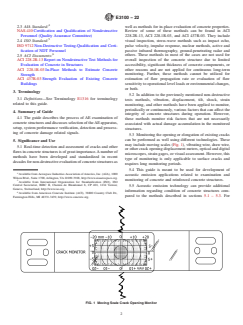
5.3 Monitoring the opening or elongation of existing cracks can be performed as well using different technologies. These may include moving scales (Fig. 1), vibrating wire, draw wire, or other crack opening displacement meters, optical and digital microscopes, strain gages, or visual assessment. However, this type of monitoring is only applicable to surface cracks and requires long monitoring periods.
FIG. 1 Moving Scale Crack Opening Monitor
5.4 This guide is meant to be used for development of acoustic emission a...
SCOPE
1.1 This guide describes the application of acoustic emission (AE) technology for examination of concrete and reinforced concrete structures during or after construction, or in service.
1.2 Structures under consideration include but are not limited to buildings, bridges, hydraulic structures, tunnels, decks, pre/post-tensioned (PT) structures, piers, nuclear containment units, storage tanks, and associated structural elements.
1.3 AE examinations may be conducted periodically (short-term) or monitored continuously (long-term), under normal service conditions or under specially designed loading procedures. Examples of typical examinations are the detection of growing cracks in structures or their elements under normal service conditions or during controlled load testing, long term monitoring of pre-stressed cables, and establishing safe operational loads.
1.4 AE examination results are achieved through detection, location, and characterization of active AE sources within concrete and reinforced concrete. Such sources include micro- and macro-crack development in concrete due to loading scenarios such as fatigue, overload, settlement, impact, seismicity, fire and explosion, and also environmental effects such as temperature gradients and internal or external chemical attack (such as sulfate attack and alkali-silica reaction) or radiation. Other AE source mechanisms include corrosion of rebar or other metal parts, corrosion and rupture of cables in pre-stressed concrete, as well as friction due to structural movement or instability, or both.
1.5 This guide discusses selection of the AE apparatus, setup, system performance verification, detection and processing of concrete damage related AE activity. The guide also provides approaches that may be used in analysis and interpretation of acoustic emission data, assessment of examination results and establishing accept/reject criteria.
1.6 Units—The values stated ...
- Status
- Published
- Publication Date
- 30-Nov-2022
- Technical Committee
- E07 - Nondestructive Testing
- Drafting Committee
- E07.04 - Acoustic Emission Method
Overview
ASTM E3100-22: Standard Guide for Acoustic Emission Examination of Concrete Structures provides comprehensive guidelines for applying acoustic emission (AE) technology in the inspection and monitoring of concrete and reinforced concrete structures. Developed by ASTM International, this guide supports real-time detection, assessment, and ongoing monitoring of cracks, flaws, and structural integrity without causing damage to the structure. AE methods can be applied during or after construction and throughout a structure's service life, supporting both short-term examinations and long-term health monitoring.
Key Topics
- Acoustic Emission Methods: The standard covers the selection, setup, performance verification, and use of AE systems to detect and characterize sources of acoustic signals caused by mechanical stresses or environmental effects in concrete.
- Scope of Application: AE examination is applicable to a variety of concrete structures, such as buildings, bridges, tunnels, hydraulic structures, pre/post-tensioned (PT) elements, nuclear containment units, storage tanks, and piers.
- Types of Examination: AE can be used for both periodic (short-term) inspections or continuous (long-term) monitoring under normal service or specially designed loading conditions.
- Detection Capabilities: The methodology allows for the detection and localization of both micro-cracking and macro-cracking, corrosion of reinforcement, cable rupture, impact, seismic effects, environmental degradation (e.g., alkali-silica reaction), and other failure mechanisms.
- Process Guidelines: Detailed procedures are outlined for defining examination objectives, understanding structural and material properties, equipment selection, sensor placement, performance verification, data acquisition, noise management, and data interpretation.
- Data Analysis and Reporting: The guide includes procedures for AE source location, clustering, flaw identification, severity assessment, and comprehensive reporting of results, including findings, reliability considerations, and recommended follow-up actions.
Applications
The use of acoustic emission testing in concrete structures is essential for:
- Structural Health Monitoring: Enables owners and engineers to track the development of cracks, corrosion, and other flaws in real time for early warning and maintenance planning.
- Integrity Assessment of Critical Infrastructure: Applicable to bridges, tunnels, nuclear containment, and other safety-critical structures where undetected flaws can have significant consequences.
- Controlled Load Testing: AE helps assess the response of structures to load testing, such as establishing safe operational loads or verifying the integrity after modifications or repair.
- Long-Term Monitoring: Provides ongoing evaluation for high-value or high-risk concrete assets, identifying slow-developing damage mechanisms that traditional surface inspections may miss.
- Correlation with Environmental or Operational Conditions: AE allows operators to understand how factors like load, temperature, or corrosion environment influence crack initiation and propagation.
Related Standards
Adherence to ASTM E3100-22 is enhanced by referencing the following important standards for nondestructive evaluation and personnel qualification:
- ASTM E543: Specification for Agencies Performing Nondestructive Testing
- ASTM E1316: Terminology for Nondestructive Examinations
- ASTM E2374: Guide for Acoustic Emission System Performance Verification
- ANSI/ASNT SNT-TC-1A and CP-189: Recommended practices and standards for NDT personnel qualification and certification
- ISO 9712: Qualification and certification of NDT personnel
- ACI 228.2R-13 / ACI 228.1R-03 / ACI 437R-03: American Concrete Institute reports on methods for evaluating concrete structures and estimating in-place concrete strength
Practical Value
By implementing ASTM E3100-22, stakeholders benefit from a robust, standardized approach to nondestructive evaluation (NDE) for concrete structures. The guide supports safer, more reliable infrastructure by detecting hidden or developing flaws, informing maintenance decisions, and extending the service life of concrete assets. Utilizing AE examination enhances conventional inspection methods, making it a vital tool in asset management, repair prioritization, and risk reduction for concrete structures worldwide.
Relations
- Effective Date
- 01-Feb-2024
- Effective Date
- 01-Dec-2019
- Effective Date
- 01-Mar-2019
- Effective Date
- 01-Jan-2018
- Effective Date
- 15-Jun-2017
- Effective Date
- 01-Feb-2017
- Effective Date
- 01-Aug-2016
- Effective Date
- 01-Feb-2016
- Effective Date
- 01-Dec-2015
- Effective Date
- 01-Dec-2015
- Effective Date
- 01-Sep-2015
- Effective Date
- 01-Jun-2014
- Effective Date
- 01-Jun-2014
- Effective Date
- 01-Dec-2013
- Effective Date
- 15-Jun-2013
Get Certified
Connect with accredited certification bodies for this standard

DIBt (Deutsches Institut für Bautechnik)
German Institute for Building Technology.
DIN CERTCO
DIN Group product certification.

Aboma Certification B.V.
Specialized in construction, metal, and transport sectors.
Sponsored listings
Frequently Asked Questions
ASTM E3100-22 is a guide published by ASTM International. Its full title is "Standard Guide for Acoustic Emission Examination of Concrete Structures". This standard covers: SIGNIFICANCE AND USE 5.1 Real-time detection and assessment of cracks and other flaws in concrete structures is of great importance. A number of methods have been developed and standardized in recent decades for non-destructive evaluation of concrete structures as well as methods for in-place evaluation of concrete properties. Review of some of these methods can be found in ACI 228.2R-13, ACI 228.1R-03, and ACI 437R-03. They include visual inspection, stress-wave methods such as impact echo, pulse velocity, impulse response, nuclear methods, active and passive infrared thermography, ground-penetrating radar and others. These methods in most of the cases are not used for overall inspection of the concrete structure due to limited accessibility, significant thickness of concrete components, or other reasons and are not applied for continuous long-term monitoring. Further, these methods cannot be utilized for estimation of flaw propagation rate or evaluation of flaw sensitivity to operational level loads or environmental changes, or both. 5.2 In addition to the previously mentioned non-destructive tests methods, vibration, displacement, tilt, shock, strain monitoring, and other methods have been applied to monitor, periodically or continuously, various factors that can affect the integrity of concrete structures during operation. However, these methods monitor risk factors that are not necessarily associated with actual damage accumulation in the monitored structures. 5.3 Monitoring the opening or elongation of existing cracks can be performed as well using different technologies. These may include moving scales (Fig. 1), vibrating wire, draw wire, or other crack opening displacement meters, optical and digital microscopes, strain gages, or visual assessment. However, this type of monitoring is only applicable to surface cracks and requires long monitoring periods. FIG. 1 Moving Scale Crack Opening Monitor 5.4 This guide is meant to be used for development of acoustic emission a... SCOPE 1.1 This guide describes the application of acoustic emission (AE) technology for examination of concrete and reinforced concrete structures during or after construction, or in service. 1.2 Structures under consideration include but are not limited to buildings, bridges, hydraulic structures, tunnels, decks, pre/post-tensioned (PT) structures, piers, nuclear containment units, storage tanks, and associated structural elements. 1.3 AE examinations may be conducted periodically (short-term) or monitored continuously (long-term), under normal service conditions or under specially designed loading procedures. Examples of typical examinations are the detection of growing cracks in structures or their elements under normal service conditions or during controlled load testing, long term monitoring of pre-stressed cables, and establishing safe operational loads. 1.4 AE examination results are achieved through detection, location, and characterization of active AE sources within concrete and reinforced concrete. Such sources include micro- and macro-crack development in concrete due to loading scenarios such as fatigue, overload, settlement, impact, seismicity, fire and explosion, and also environmental effects such as temperature gradients and internal or external chemical attack (such as sulfate attack and alkali-silica reaction) or radiation. Other AE source mechanisms include corrosion of rebar or other metal parts, corrosion and rupture of cables in pre-stressed concrete, as well as friction due to structural movement or instability, or both. 1.5 This guide discusses selection of the AE apparatus, setup, system performance verification, detection and processing of concrete damage related AE activity. The guide also provides approaches that may be used in analysis and interpretation of acoustic emission data, assessment of examination results and establishing accept/reject criteria. 1.6 Units—The values stated ...
SIGNIFICANCE AND USE 5.1 Real-time detection and assessment of cracks and other flaws in concrete structures is of great importance. A number of methods have been developed and standardized in recent decades for non-destructive evaluation of concrete structures as well as methods for in-place evaluation of concrete properties. Review of some of these methods can be found in ACI 228.2R-13, ACI 228.1R-03, and ACI 437R-03. They include visual inspection, stress-wave methods such as impact echo, pulse velocity, impulse response, nuclear methods, active and passive infrared thermography, ground-penetrating radar and others. These methods in most of the cases are not used for overall inspection of the concrete structure due to limited accessibility, significant thickness of concrete components, or other reasons and are not applied for continuous long-term monitoring. Further, these methods cannot be utilized for estimation of flaw propagation rate or evaluation of flaw sensitivity to operational level loads or environmental changes, or both. 5.2 In addition to the previously mentioned non-destructive tests methods, vibration, displacement, tilt, shock, strain monitoring, and other methods have been applied to monitor, periodically or continuously, various factors that can affect the integrity of concrete structures during operation. However, these methods monitor risk factors that are not necessarily associated with actual damage accumulation in the monitored structures. 5.3 Monitoring the opening or elongation of existing cracks can be performed as well using different technologies. These may include moving scales (Fig. 1), vibrating wire, draw wire, or other crack opening displacement meters, optical and digital microscopes, strain gages, or visual assessment. However, this type of monitoring is only applicable to surface cracks and requires long monitoring periods. FIG. 1 Moving Scale Crack Opening Monitor 5.4 This guide is meant to be used for development of acoustic emission a... SCOPE 1.1 This guide describes the application of acoustic emission (AE) technology for examination of concrete and reinforced concrete structures during or after construction, or in service. 1.2 Structures under consideration include but are not limited to buildings, bridges, hydraulic structures, tunnels, decks, pre/post-tensioned (PT) structures, piers, nuclear containment units, storage tanks, and associated structural elements. 1.3 AE examinations may be conducted periodically (short-term) or monitored continuously (long-term), under normal service conditions or under specially designed loading procedures. Examples of typical examinations are the detection of growing cracks in structures or their elements under normal service conditions or during controlled load testing, long term monitoring of pre-stressed cables, and establishing safe operational loads. 1.4 AE examination results are achieved through detection, location, and characterization of active AE sources within concrete and reinforced concrete. Such sources include micro- and macro-crack development in concrete due to loading scenarios such as fatigue, overload, settlement, impact, seismicity, fire and explosion, and also environmental effects such as temperature gradients and internal or external chemical attack (such as sulfate attack and alkali-silica reaction) or radiation. Other AE source mechanisms include corrosion of rebar or other metal parts, corrosion and rupture of cables in pre-stressed concrete, as well as friction due to structural movement or instability, or both. 1.5 This guide discusses selection of the AE apparatus, setup, system performance verification, detection and processing of concrete damage related AE activity. The guide also provides approaches that may be used in analysis and interpretation of acoustic emission data, assessment of examination results and establishing accept/reject criteria. 1.6 Units—The values stated ...
ASTM E3100-22 is classified under the following ICS (International Classification for Standards) categories: 91.120.20 - Acoustics in building. Sound insulation. The ICS classification helps identify the subject area and facilitates finding related standards.
ASTM E3100-22 has the following relationships with other standards: It is inter standard links to ASTM E1316-24, ASTM E1316-19b, ASTM E1316-19, ASTM E1316-18, ASTM E1316-17a, ASTM E1316-17, ASTM E1316-16a, ASTM E1316-16, ASTM E1316-15a, ASTM E2374-15, ASTM E1316-15, ASTM E1316-14, ASTM E1316-14e1, ASTM E1316-13d, ASTM E1316-13c. Understanding these relationships helps ensure you are using the most current and applicable version of the standard.
ASTM E3100-22 is available in PDF format for immediate download after purchase. The document can be added to your cart and obtained through the secure checkout process. Digital delivery ensures instant access to the complete standard document.
Standards Content (Sample)
This international standard was developed in accordance with internationally recognized principles on standardization established in the Decision on Principles for the
Development of International Standards, Guides and Recommendations issued by the World Trade Organization Technical Barriers to Trade (TBT) Committee.
Designation: E3100 − 22
Standard Guide for
Acoustic Emission Examination of Concrete Structures
This standard is issued under the fixed designation E3100; the number immediately following the designation indicates the year of
original adoption or, in the case of revision, the year of last revision. A number in parentheses indicates the year of last reapproval. A
superscript epsilon (´) indicates an editorial change since the last revision or reapproval.
1. Scope tation of acoustic emission data, assessment of examination
results and establishing accept/reject criteria.
1.1 This guide describes the application of acoustic emis-
sion (AE) technology for examination of concrete and rein-
1.6 Units—The values stated in SI units are to be regarded
forced concrete structures during or after construction, or in
as standard. No other units of measurement are included in this
service.
standard.
1.2 Structures under consideration include but are not lim-
1.7 This standard does not purport to address all of the
ited to buildings, bridges, hydraulic structures, tunnels, decks,
safety concerns, if any, associated with its use. It is the
pre/post-tensioned (PT) structures, piers, nuclear containment
responsibility of the user of this standard to establish appro-
units, storage tanks, and associated structural elements.
priate safety, health, and environmental practices and deter-
1.3 AE examinations may be conducted periodically (short-
mine the applicability of regulatory limitations prior to use.
term) or monitored continuously (long-term), under normal
1.8 This international standard was developed in accor-
service conditions or under specially designed loading proce-
dance with internationally recognized principles on standard-
dures. Examples of typical examinations are the detection of
ization established in the Decision on Principles for the
growing cracks in structures or their elements under normal
Development of International Standards, Guides and Recom-
service conditions or during controlled load testing, long term
mendations issued by the World Trade Organization Technical
monitoring of pre-stressed cables, and establishing safe opera-
Barriers to Trade (TBT) Committee.
tional loads.
1.4 AE examination results are achieved through detection,
2. Referenced Documents
location, and characterization of active AE sources within
2.1 ASTM Standards:
concrete and reinforced concrete. Such sources include micro-
E543 Specification for Agencies Performing Nondestructive
and macro-crack development in concrete due to loading
Testing
scenarios such as fatigue, overload, settlement, impact,
E1316 Terminology for Nondestructive Examinations
seismicity, fire and explosion, and also environmental effects
E1932 Guide for Acoustic Emission Examination of Small
such as temperature gradients and internal or external chemical
Parts
attack (such as sulfate attack and alkali-silica reaction) or
E2374 Guide for Acoustic Emission System Performance
radiation. Other AE source mechanisms include corrosion of
Verification
rebar or other metal parts, corrosion and rupture of cables in
pre-stressed concrete, as well as friction due to structural
2.2 ANSI/ASNT Standards:
movement or instability, or both.
SNT-TC-1A Recommended Practice for Nondestructive
Testing Personnel Qualification and Certification
1.5 This guide discusses selection of the AE apparatus,
setup, system performance verification, detection and process- ANSI/ASNT CP-189 Standard for Qualification and Cer-
tification of Nondestructive Testing Personnel
ing of concrete damage related AE activity. The guide also
provides approaches that may be used in analysis and interpre-
1 2
This guide is under the jurisdiction of ASTM Committee E07 on Nondestruc- For referenced ASTM standards, visit the ASTM website, www.astm.org, or
tive Testing and is the direct responsibility of Subcommittee E07.04 on Acoustic contact ASTM Customer Service at service@astm.org. For Annual Book of ASTM
Emission Method. Standards volume information, refer to the standard’s Document Summary page on
Current edition approved Dec. 1, 2022. Published December 2022. Originally the ASTM website.
approved in 2017. Last previous edition approved in 2017 as E3100 – 17. DOI: Available from American National Standards Institute (ANSI), 25 W. 43rd St.,
10.1520/E3100-22. 4th Floor, New York, NY 10036, http://www.ansi.org.
Copyright © ASTM International, 100 Barr Harbor Drive, PO Box C700, West Conshohocken, PA 19428-2959. United States
E3100 − 22
2.3 AIA Standard: well as methods for in-place evaluation of concrete properties.
NAS-410 Certification and Qualification of Nondestructive Review of some of these methods can be found in ACI
Personnel (Quality Assurance Committee) 228.2R-13, ACI 228.1R-03, and ACI 437R-03. They include
2.4 ISO Standard: visual inspection, stress-wave methods such as impact echo,
pulse velocity, impulse response, nuclear methods, active and
ISO 9712 Non-Destructive Testing-Qualification and Certi-
fication of NDT Personnel passive infrared thermography, ground-penetrating radar and
others. These methods in most of the cases are not used for
2.5 ACI Documents:
ACI 228.2R-13 Report on Nondestructive Test Methods for overall inspection of the concrete structure due to limited
accessibility, significant thickness of concrete components, or
Evaluation of Concrete in Structures
ACI 228.1R-03 In-Place Methods to Estimate Concrete other reasons and are not applied for continuous long-term
monitoring. Further, these methods cannot be utilized for
Strength
ACI 437R-03 Strength Evaluation of Existing Concrete estimation of flaw propagation rate or evaluation of flaw
sensitivity to operational level loads or environmental changes,
Buildings
or both.
3. Terminology
5.2 In addition to the previously mentioned non-destructive
3.1 Definitions—See Terminology E1316 for terminology
tests methods, vibration, displacement, tilt, shock, strain
related to this guide.
monitoring, and other methods have been applied to monitor,
periodically or continuously, various factors that can affect the
4. Summary of Guide
integrity of concrete structures during operation. However,
4.1 The guide describes the process of AE examination of
these methods monitor risk factors that are not necessarily
concretestructuresanddiscussesselectionoftheAEapparatus,
associated with actual damage accumulation in the monitored
setup, system performance verification, detection and process-
structures.
ing of concrete damage related signals.
5.3 Monitoring the opening or elongation of existing cracks
can be performed as well using different technologies. These
5. Significance and Use
may include moving scales (Fig. 1), vibrating wire, draw wire,
5.1 Real-time detection and assessment of cracks and other
or other crack opening displacement meters, optical and digital
flawsinconcretestructuresisofgreatimportance.Anumberof
microscopes, strain gages, or visual assessment. However, this
methods have been developed and standardized in recent
type of monitoring is only applicable to surface cracks and
decadesfornon-destructiveevaluationofconcretestructuresas
requires long monitoring periods.
5.4 This guide is meant to be used for development of
Available fromAerospace IndustriesAssociation ofAmerica, Inc. (AIA), 1000
acoustic emission applications related to examination and
Wilson Blvd., Suite 1700,Arlington, VA22209-3928, http://www.aiaaerospace.org.
monitoring of concrete and reinforced concrete structures.
Available from International Organization for Standardization (ISO), ISO
Central Secretariat, BIBC II, Chemin de Blandonnet 8, CP 401, 1214 Vernier,
5.5 Acoustic emission technology can provide additional
Geneva, Switzerland, http://www.iso.org.
information regarding condition of concrete structures com-
Available from American Concrete Institute (ACI), 38800 Country Club Dr.,
pared to the methods described in sections 5.1 – 5.3. For
Farmington Hills, MI 48331-3439, http://www.concrete.org.
FIG. 1 Moving Scale Crack Opening Monitor
E3100 − 22
example, the acoustic emission method can be used to detect 8.2 The way in which AE technology is applied can vary
and monitor internal cracks growing in the concrete, assess with different goals. Examples of primary goals are:
crack growth rate as a function of different load or environ-
8.2.1 Evaluation of known crack development under spe-
mental conditions, or to detect concrete micro-cracking due to cific load conditions.
significant rebar corrosion.
8.2.2 Characterization of mechanical and fracture mechan-
ics properties of concrete members used in a structure.
5.6 Accuracy, robustness, and efficiency of AE procedures
8.2.3 Establishment of safe loads/operational conditions.
can be enhanced through the implementation of fundamental
8.2.4 Prediction of ultimate loads.
principles described in the guide.
8.3 Primary examination goals can be achieved when at
6. Basis of Application
least one or several of the following objectives are addressed:
6.1 The following items are subject to contractual agree-
8.3.1 Detection of active concrete cracking and other flaw-
ment between the parties using or referencing this guide.
indications in the structure.
8.3.2 Location of flaw-indications.
6.2 Personnel Qualification:
6.2.1 If specified in the contractual agreement, personnel 8.3.3 Identification of flaw-indications, for example, identi-
performing examinations to this guide shall be qualified in
fication of tensile or shear concrete micro-cracking, corrosion
accordance with a nationally and internationally recognized damage, and others (2-4).
NDT personnel qualification practice or standard such as
8.3.4 Assessment of flaw-indications, for example damage
ANSI/ASNT CP-189, SNT-TC-1A, NAS-410, ISO 9712, or a
qualification of reinforced concrete beams subjected to re-
similar document and certified by the employer or certifying
peated loading (3).
agency, as applicable. The practice or standard used and its
8.3.5 Structural integrity diagnostics and establishment of
applicable revision shall be identified in the contractual agree-
serviceability.
ment between the using parties.
8.3.6 Prediction of ultimate loads.
6.3 Qualification of Nondestructive Testing Agencies:
9. Understanding the Structure, Material Properties, and
6.3.1 If specified in the contractual agreement, NDT
Flaw Characteristics
agencies shall be qualified and evaluated as described in
Specification E543. The applicable edition of Specification
9.1 Correct interpretation of AE results for source mecha-
E543 shall be specified in the contractual agreement.
nism identification, flaw-indication assessment and diagnostics
depends on satisfactory knowledge of the examined structure,
7. The Process of Acoustic Emission Examination of
examinationconditions(includingenvironmental),understand-
Concrete Structures
ing the material properties of the structure, manufacturing
7.1 The process of AE examination of concrete structures
methods and material behavior under stress.Therefore, prior to
includes the following principal steps. As decisions are made
an acoustic emission examination, it is recommended to obtain
under these steps (7.1.1 – 7.1.4), a test procedure or instruction
the following information:
shall be written, based on those steps, to guide the field
9.1.1 Structural Information:
activities.
9.1.1.1 Thefunctionofthestructureanditsdesignincluding
7.1.1 Defining the goal(s) of the examination.
detailed drawings, if available.
7.1.2 Developinganunderstandingofthestructure,material
9.1.1.2 Operational/stress/environmental conditions and
properties, and flaw characteristics.
other factors that may contribute to flaw origination and
7.1.3 Selection of the operational, load, and environmental
development.
conditions for conducting the examination.
9.1.1.3 Results of previous NDT examinations, including
7.1.4 Selectionofsuitableequipmentandsensorinstallation
the location and nature of known flaw indications (if any).
methods.
9.1.1.4 Statistics of failures of similar structures, typical
7.1.5 System performance verification.
flaws, possible location of flaws and expected rate of flaw
7.1.6 Field examination and post examination system per-
propagation.
formance verification.
9.1.1.5 Factors that can contribute to flaw origination and
7.1.7 Data analysis, interpretation, and assessment.
development (deformation, support instability, known or sus-
7.1.8 Reporting.
pected design errors, etc.).
8. Defining Goals of the Examination 9.1.1.6 Wave propagation characteristics in the structure
(propagation modes, velocities, attenuation characteristics, ef-
8.1 Prior to conducting anAE examination orAE structural
fects of anisotropy, etc.).
health monitoring of a concrete structure, it is necessary to
9.1.2 Material Information:
define the primary goals and the scope of the examination
9.1.2.1 Materials used (concrete and reinforcing steel), re-
together with a designer or operator of the structure, or both
lated properties, manufacturing methods, and processes.
(1). Success of the examination is defined as the degree to
9.1.2.2 Potential failure mechanisms.
which the goals of the examination is achieved.
9.1.3 Examination Conditions:
9.1.3.1 Possible sources of noise and other conditions that
The boldface numbers in parentheses refer to the list of references at the end of
this standard. may affect the examination.
E3100 − 22
9.2 Laboratory or full scale tests, or both, can provide quantitativeAE characteristics that can be usefully applied for
significant portions of the above required information. Tests examination of real structures. Examples of such invariant
can be conducted on specimens or structural elements, or both, characteristics are:
such as beams, columns, or full-sized structural systems with 9.3.1 Stress at onset of detectableAE in flawless specimens
or without flaws to develop the ability to detect, identify and (without known flaws such as cracks or segregations).
assess/classify specific flaws in the target structure. Normally 9.3.2 Stress at onset of events related to macro-crack
flawless concrete cubic or cylindrical specimens (taken from growth.
the target structure or specially prepared) are examined to 9.3.3 Stress at onset of damage development acceleration
better understand initiation and development of flaws up to accompanied by acceleration of AE rate.
failure and to study load bearing capabilities of materials;
9.4 Mechanical properties acquired during specimen tests
whereas flawed specimens are examined to study flaw-
should be documented, and should include the compressive
detectioncapabilitiesbyAEtestingortoevaluatesustainability
strength or load at failure, or both, at a minimum. When a
of materials with damage. In addition, standard examination of
statistically sufficient number of specimens are tested, it is
concrete cores taken from the examined structure, together
useful to:
with AE measurement, is recommended to identify the condi-
9.4.1 Investigate the statistical distribution of the mechani-
tion and quality of the concrete (for example concrete unifor-
cal properties and acoustic emission parameters or character-
mity or presence of internal flaws like segregations and
istics of the examined specimens.
honeycombing), identify possible concrete age related
9.4.2 When statistically significant groups of specimens are
degradation, and possible deviation from the designed proper-
identified, based on similar mechanical or AE characteristics,
ties.
perform fractography examinations to identify qualitative or
9.3 AE signals acquired during testing of small scale speci- quantitative differences between groups of specimens. Once
mens can be affected by reflections, different geometric/size such differences are identified, the obtained information may
effects on flaw development, and other factors. Therefore, in be used for detection of these indications in target applications.
every test it is necessary to find invariant qualitative or
9.5 Whenever possible, it is recommended to perform full
scale tests on structures with known service developed or
artificially induced flaws. Artificially developed flaws may
have lower detectability compared with service developed
flaws.
9.6 Obtaining the above information is required for devel-
opment of appropriate examination procedures, including se-
lection of equipment, and determining examination setup,
development of assessment criteria, evaluation of flaw
detectability, and reliability of examination. When partial
inspection of a bridge is performed, the collected information
may be used to prioritize zones for AE examination.
10. Selection of Equipment and Sensor Installation
10.1 General rules for selection of equipment described in
Guide E1932 shall apply with the following additional consid-
erations:
10.1.1 The primary consideration in selection of sensors is
frequency characteristics of AE waves produced by the devel-
opment of potential flaws in the examined structure.
10.1.2 Sensors sensitive in the frequency range between 20
to 250 kHz are typically applied for examination of reinforced
concrete structures. Sensors sensitive in other frequency bands
can be used in special cases.
10.1.3 Flat response sensors in the above mentioned fre-
quency range may be used whenever it is necessary to perform
frequency-based analysis of AE signals to separate different
processes by their frequency characteristics and for performing
techniques for advanced AE source location, etc.
10.2 Sensor positioning and installation should be per-
formed under the following considerations:
10.2.1 Sensors spacing is based on investigation of wave
propagationcharacteristicsinthestructuralcomponentsandby
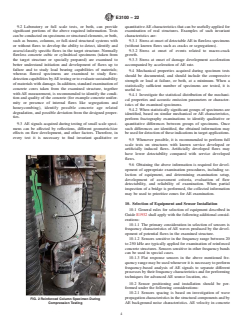
FIG. 2 Reinforced Column Specimen During
Compression Testing AE background noise characteristics. AE velocity in concrete
E3100 − 22
can vary with the concrete quality and the presence of rebar or and develop in the examined structure. For example, if it is
other inclusions. Significant reduction of AE velocity locally assumed that flaws originate and develop in a bridge primarily
can be the result of cracks, voids, and other significant flaws. due to heavy traffic, it is recommended to conduct AE
Therefore, it is recommended to perform velocity estimation examination with and without heavy traffic conditions. If
and attenuation tests in all main structural elements indepen- c
...
This document is not an ASTM standard and is intended only to provide the user of an ASTM standard an indication of what changes have been made to the previous version. Because
it may not be technically possible to adequately depict all changes accurately, ASTM recommends that users consult prior editions as appropriate. In all cases only the current version
of the standard as published by ASTM is to be considered the official document.
Designation: E3100 − 17 E3100 − 22
Standard Guide for
Acoustic Emission Examination of Concrete Structures
This standard is issued under the fixed designation E3100; the number immediately following the designation indicates the year of
original adoption or, in the case of revision, the year of last revision. A number in parentheses indicates the year of last reapproval. A
superscript epsilon (´) indicates an editorial change since the last revision or reapproval.
1. Scope
1.1 This guide describes the application of acoustic emission (AE) technology for examination of concrete and reinforced concrete
structures during or after construction, or in service.
1.2 Structures under consideration include but are not limited to buildings, bridges, hydraulic structures, tunnels, decks,
pre/post-tensioned (PT) structures, piers, nuclear containment units, storage tanks, and associated structural elements.
1.3 AE examinations may be conducted periodically (short-term) or monitored continuously (long-term), under normal service
conditions or under specially designed loading procedures. Examples of typical examinations are the detection of growing cracks
in structures or their elements under normal service conditions or during controlled load testing, long term monitoring of
pre-stressed cables, and establishing safe operational loads.
1.4 AE examination results are achieved through detection, location, and characterization of active AE sources within concrete and
reinforced concrete. Such sources include micro- and macro-crack development in concrete due to loading scenarios such as
fatigue, overload, settlement, impact, seismicity, fire and explosion, and also environmental effects such as temperature gradients
and internal or external chemical attack (such as sulfate attack and alkali-silica reaction) or radiation. Other AE source mechanisms
include corrosion of rebar or other metal parts, corrosion and rupture of cables in pre-stressed concrete, as well as friction due to
structural movement or instability, or both.
1.5 This guide discusses selection of the AE apparatus, setup, system performance verification, detection and processing of
concrete damage related AE activity. The guide also provides approaches that may be used in analysis and interpretation of acoustic
emission data, assessment of examination results and establishing accept/reject criteria.
1.6 Units—The values stated in SI units are to be regarded as standard. No other units of measurement are included in this
standard.
1.7 This standard does not purport to address all of the safety concerns, if any, associated with its use. It is the responsibility
of the user of this standard to establish appropriate safety safety, health, and healthenvironmental practices and determine the
applicability of regulatory limitations prior to use.
1.8 This international standard was developed in accordance with internationally recognized principles on standardization
established in the Decision on Principles for the Development of International Standards, Guides and Recommendations issued
by the World Trade Organization Technical Barriers to Trade (TBT) Committee.
This test method guide is under the jurisdiction of ASTM Committee E07 on Nondestructive Testing and is the direct responsibility of Subcommittee E07.04 on Acoustic
Emission Method.
Current edition approved June 1, 2017Dec. 1, 2022. Published June 2017December 2022. Originally approved in 2017. Last previous edition approved in 2017 as
E3100 – 17. DOI: 10.1520/E3100–17.10.1520/E3100-22.
Copyright © ASTM International, 100 Barr Harbor Drive, PO Box C700, West Conshohocken, PA 19428-2959. United States
E3100 − 22
2. Referenced Documents
2.1 ASTM Standards:
E543 Specification for Agencies Performing Nondestructive Testing
E1316 Terminology for Nondestructive Examinations
E1932 Guide for Acoustic Emission Examination of Small Parts
E2374 Guide for Acoustic Emission System Performance Verification
2.2 ANSI/ASNT Standards:
SNT-TC-1A Recommended Practice for Nondestructive Testing Personnel Qualification and Certification
ANSI/ASNT CP-189 Standard for Qualification and Certification of Nondestructive Testing Personnel
2.3 AIA StandardStandard:
NAS-410 Certification and Qualification of Nondestructive Personnel (Quality Assurance Committee)
2.4 ISO Standard:
ISO 9712 Non-Destructive Testing-Qualification and Certification of NDT Personnel
2.5 American Concrete Institute DocumentsACI Documents:
ACI 228.2R-13 Report on Nondestructive Test Methods for Evaluation of Concrete in Structures
ACI 228.1R-03 In-Place Methods to Estimate Concrete Strength
ACI 437R-03 Strength Evaluation of Existing Concrete Buildings
3. Terminology
3.1 Definitions—See Terminology E1316 for terminology related to this guide.
4. Summary of Guide
4.1 The guide describes the process of AE examination of concrete structures and discusses selection of the AE apparatus, setup,
system performance verification, detection and processing of concrete damage related signals.
5. Significance and Use
5.1 Real-time detection and assessment of cracks and other flaws in concrete structures is of great importance. A number of
methods have been developed and standardized in recent decades for non-destructive evaluation of concrete structures as well as
methods for in-place evaluation of concrete properties. Review of some of these methods can be found in ACI 228.2R-13, ACI
228.1R-03, and ACI 437R-03. They include visual inspection, stress-wave methods such as impact echo, pulse velocity, impulse
response, nuclear methods, active and passive infrared thermography, ground-penetrating radar and others. These methods in most
of the cases are not used for overall inspection of the concrete structure due to limited accessibility, significant thickness of concrete
components, or other reasons and are not applied for continuous long-term monitoring. Further, these methods cannot be utilized
for estimation of flaw propagation rate or evaluation of flaw sensitivity to operational level loads or environmental changes, or
both.
5.2 In addition to the previously mentioned non-destructive tests methods, vibration, displacement, tilt, shock, strain monitoring,
and other methods have been applied to monitor, periodically or continuously, various factors that can affect the integrity of
concrete structures during operation. However, these methods monitor risk factors that are not necessarily associated with actual
damage accumulation in the monitored structures.
5.3 Monitoring the horizontal (opening) or vertical displacement opening or elongation of existing cracks can be performed as well
using different technologies. These may include moving scales (Fig. 1), vibrating wire, draw wire, or other crack opening
displacement meters, optical and digital microscopes, strain gages, or visual assessment. However, this type of monitoring is only
applicable to surface cracks and requires long monitoring periods.
For referenced ASTM standards, visit the ASTM website, www.astm.org, or contact ASTM Customer Service at service@astm.org. For Annual Book of ASTM Standards
volume information, refer to the standard’s Document Summary page on the ASTM website.
Available from American National Standards Institute (ANSI), 25 W. 43rd St., 4th Floor, New York, NY 10036, http://www.ansi.org.
Available from Aerospace Industries Association of America, Inc. (AIA), 1000 Wilson Blvd., Suite 1700, Arlington, VA 22209-3928, http://www.aiaaerospace.org.
Available from International Organization for Standardization (ISO), ISO Central Secretariat, BIBC II, Chemin de Blandonnet 8, CP 401, 1214 Vernier, Geneva,
Switzerland, http://www.iso.org.
Available from American Concrete Institute (ACI), 38800 Country Club Dr., Farmington Hills, MI 48331-3439, http://www.concrete.org.
E3100 − 22
FIG. 1 Moving Scale Crack Opening Monitor
5.4 This guide is meant to be used for development of acoustic emission applications related to examination and monitoring of
concrete and reinforced concrete structures.
5.5 Acoustic emission technology can provide additional information regarding condition of concrete structures compared to the
methods described in sections 5.1 – 5.3. For example, the acoustic emission method can be used to detect and monitor internal
cracks growing in the concrete, assess crack growth rate as a function of different load or environmental conditions, or to detect
concrete micro-cracking due to significant rebar corrosion.
5.6 Accuracy, robustness, and efficiency of AE procedures can be enhanced through the implementation of fundamental principles
described in the guide.
6. Basis of Application
6.1 The following items are subject to contractual agreement between the parties using or referencing this guide.
6.2 Personnel Qualification:
6.2.1 If specified in the contractual agreement, personnel performing examinations to this standardguide shall be qualified in
accordance with a nationally and internationally recognized NDT personnel qualification practice or standard such as ANSI/ASNT
CP-189, SNT-TC-1A, NAS-410, ISO 9712, or a similar document and certified by the employer or certifying agency, as applicable.
The practice or standard used and its applicable revision shall be identified in the contractual agreement between the using parties.
6.3 Qualification of Nondestructive Testing Agencies:
6.3.1 If specified in the contractual agreement, NDT agencies shall be qualified and evaluated as described in PracticeSpecifi-
cation E543. The applicable edition of PracticeSpecification E543 shall be specified in the contractual agreement.
7. The Process of Acoustic Emission Examination of Concrete Structures
7.1 The process of AE examination of concrete structures includes the following principal steps. As decisions are made under these
steps (7.1.1 – 7.1.4), a test procedure or instruction shall be written, based on those steps, to guide the field activities.
7.1.1 Defining the goal(s) of the examination.
E3100 − 22
7.1.2 Developing an understanding of the structural system, structure, material properties, and flaw characteristics.
7.1.3 Selection of the operational, load, and environmental conditions for conducting the examination.
7.1.4 Selection of suitable equipment and sensor installation methods.
7.1.5 System performance verification.
7.1.6 Field examination and post examination system performance verification.
7.1.7 Data analysis, interpretation, and assessment.
7.1.8 Reporting.
8. Defining Goals of the Examination
8.1 Prior to conducting an AE examination or AE structural health monitoring of a concrete structure, it is necessary to define the
primary goals and the scope of the examination together with a designer or operator of the structure, or both (1). Success of the
examination is defined as the degree to which the goals of the examination is achieved.
8.2 The way in which AE technology is applied can vary with different goals. Examples of primary goals are:
8.2.1 Evaluation of known crack development under specific load conditions.
8.2.2 Characterization of mechanical and fracture mechanics properties of concrete members used in a structure.
8.2.3 Establishment of safe loads/operational conditions.
8.2.4 Prediction of ultimate loads.
8.3 Primary examination goals can be achieved when at least one or several of the following objectives are addressed:
8.3.1 Detection of active concrete cracking and other flaw-indications in the structure.
8.3.2 Location of flaw-indications.
8.3.3 Identification of flaw-indications, for example, identification of tensile or shear concrete micro-cracking, corrosion damage,
and others (2-4).
8.3.4 Assessment of flaw-indications, for example damage qualification of reinforced concrete beams subjected to repeated
loading (3).
8.3.5 Structural integrity diagnostics and establishment of serviceability.
8.3.6 Prediction of ultimate loads.
9. Understanding the Structure, Material Properties, and Flaw Characteristics
9.1 Correct interpretation of AE results for source mechanism identification, flaw-indication assessment and diagnostics depends
on satisfactory knowledge of the examined structure, examination conditions (including environmental), understanding the
material properties of the structure, manufacturing methods and material behavior under stress. Therefore, prior to an acoustic
emission examination, it is recommended to obtain the following information:
9.1.1 Structural Information:
The boldface numbers in parentheses refer to athe list of references at the end of this standard.
E3100 − 22
9.1.1.1 The function of the structure and its design including detailed drawings, if available.
9.1.1.2 Operational/stress/environmental conditions and other factors that may contribute to flaw origination and development.
9.1.1.3 Results of previous NDT examinations, including the location and nature of known flaw indications (if any).
9.1.1.4 Statistics of failures of similar structures, typical flaws, possible location of flaws and expected rate of flaw propagation.
9.1.1.5 Factors that can contribute to flaw origination and development (deformation, support instability, known or suspected
design errors, etc.).
9.1.1.6 Wave propagation characteristics in the structure (propagation modes, velocities, attenuation characteristics, effects of
anisotropy, etc.).
9.1.2 Material Information:
9.1.2.1 Materials used (concrete and reinforcing steel), related properties, manufacturing methods, and processes.
9.1.2.2 Potential failure mechanisms.
9.1.3 Examination Conditions:
9.1.3.1 Possible sources of noise and other conditions that may affect the examination.
9.2 Laboratory or full scale tests, or both, can provide significant portions of the above required information. Tests can be
conducted on specimens or structural elements, or both, such as beams, columns, or full-sized structural systems with or without
flaws to develop the ability to detect, identify and assess/classify specific flaws in the target structure. Normally flawless concrete
cubic or cylindrical specimens (taken from the target structure or specially prepared) are examined to better understand initiation
and development of flaws up to failure and to study load bearing capabilities of materials; whereas flawed specimens are examined
to study flaw-detection capabilities by AE testing or to evaluate sustainability of materials with damage. In addition, standard
examination of concrete cores taken from the examined structure, together with AE measurement, is recommended to identify the
condition and quality of the concrete (for example concrete uniformity or presence of internal flaws like segregations and
honeycombing), identify possible concrete age related degradation, and possible deviation from the designed properties.
9.3 AE signals acquired during testing of small scale specimens can be affected by reflections, different geometric/size effects on
flaw development, and other factors. Therefore, in every test it is necessary to find invariant qualitative or quantitative AE
characteristics that can be usefully applied for examination of real structures. Examples of such invariant characteristics are:
9.3.1 Stress at onset of detectable AE in flawless specimens (without known flaws such as cracks or segregations).
9.3.2 Stress at onset of events related to macro-crack growth.
9.3.3 Stress at onset of damage development acceleration accompanied by acceleration of AE rate.
9.4 Mechanical properties acquired during specimen tests should be documented, and should include the compressive strength or
load at failure, or both, at a minimum. When a statistically sufficient number of specimens are tested, it is useful to:
9.4.1 Investigate the statistical distribution of the mechanical properties and acoustic emission parameters or characteristics of the
examined specimens.
9.4.2 When statistically significant groups of specimens are identified, based on similar mechanical or AE characteristics, perform
fractography examinations to identify qualitative or quantitative differences between groups of specimens. Once such differences
are identified, the obtained information may be used for detection of these indications in target applications.
9.5 Whenever possible, it is recommended to perform full scale tests on structures with known service developed or artificially
induced flaws. Artificially developed flaws may have lower detectability compared with service developed flaws.
E3100 − 22
FIG. 2 Reinforced Column Specimen During
Compression Testing
9.6 Obtaining the above information is required for development of appropriate examination procedures, including selection of
equipment, and determining examination setup, development of assessment criteria, evaluation of flaw detectability, and reliability
of examination. When partial inspection of a bridge is performed, the collected information may be used to prioritize zones for
AE examination.
10. Selection of Equipment and Sensor Installation
10.1 General rules for selection of equipment described in Guide E1932 shall apply with the following additional considerations:
10.1.1 The primary consideration in selection of sensors is frequency characteristics of AE waves produced by the development
of potential flaws in the examined structure.
10.1.2 Sensors sensitive in the frequency range between 20 to 250 kHz are typically applied for examination of reinforced concrete
structures. Sensors sensitive in other frequency bands can be used in special cases.
10.1.3 Flat response sensors in the above mentioned frequency range may be used whenever it is necessary to perform
frequency-based analysis of AE signals to separate different processes by their frequency characteristics and for performing
techniques for advanced AE source location, etc.
10.2 Sensor positioning and installation should be performed under the following considerations:
10.2.1 Sensors spacing is based on investigation of wave propagation characteristics in the structural components and by AE
background noise characteristics. AE velocity in concrete can vary with the concrete quality and the presence of rebar or other
inclusions. Significant reduction of AE velocity locally can be the result of cracks, voids, and other significant flaws. Therefore,
E3100 − 22
it is recommended to perform velocity estimation and attenuation tests in all main structural elements independently. In zones with
elevated and/or variable background noise, the distance between sensors can be shortened to allow better detectability, which is
one of the primary obj
...