

ASTM D5267-97(2017)
(Test Method)Standard Test Method for Determination of Extrudability of Cartridge Adhesives
General Information
- Abstract
SIGNIFICANCE AND USE
4.1 Cartridge adhesives are typically used at job sites in a wide variety of temperature ranges. These products may be exposed to cold temperatures, where one of the limiting application factors is whether the product can be extruded from the cartridge.
4.2 The test method quantitatively measures the force necessary to extrude a cartridge adhesive at a given temperature. This provides the formulator with results that can assist in formulation development and the end user with information for use in selecting a product for general usage.
4.3 By measuring (the ease of) extrusion from the cartridge, the test method can also be used as a quality control tool to measure the shelf life stability of a product.
SCOPE
1.1 This test method measures the amount of force necessary to extrude an adhesive from a cartridge at a given temperature.
1.2 The values stated in inch-pound units are to be regarded as standard. The values given in parentheses are mathematical conversions to SI units that are provided for information only and are not considered standard.
1.3 This standard does not purport to address all of the safety concerns, if any, associated with its use. It is the responsibility of the user of this standard to establish appropriate safety, health, and environmental practices and determine the applicability of regulatory limitations prior to use.
1.4 This international standard was developed in accordance with internationally recognized principles on standardization established in the Decision on Principles for the Development of International Standards, Guides and Recommendations issued by the World Trade Organization Technical Barriers to Trade (TBT) Committee.
- Status
- Published
- Publication Date
- 31-Oct-2017
- Technical Committee
- D14 - Adhesives
- Drafting Committee
- D14.10 - Working Properties
Overview
ASTM D5267-97(2017) – Standard Test Method for Determination of Extrudability of Cartridge Adhesives is a widely recognized standard developed by ASTM International. This test method specifies procedures for quantitatively measuring the force required to extrude adhesives from cartridges at a given temperature. Cartridge adhesives are frequently used in construction, manufacturing, and repair applications, often across varied temperature conditions. Accurate determination of extrudability is essential for both product development and consistent field application.
Key Topics
- Extrudability Measurement: The standard outlines a method to assess the force (typically in psi) needed to begin and maintain the extrusion of adhesive from a cartridge. This is especially critical for performance in cold or variable climates, where adhesive flow can be limited.
- Temperature Conditioning: Extrudability is determined at specified temperatures, reflecting real-world scenarios where cartridges might be stored or used in cold or warm environments.
- Quality Control: By measuring ease of extrusion, the test method serves as a tool for quality assurance, helping manufacturers monitor product consistency and shelf-life stability.
- Reporting Requirements: Detailed reporting is required, including adhesive and cartridge identification, testing temperature, crosshead speed, and measured forces.
- Precision and Variability: The standard provides guidelines on test repeatability within labs while recognizing inherent variability between different laboratories.
Applications
ASTM D5267-97(2017) is highly relevant for:
- Adhesive Manufacturers: Used to inform formulation development by providing quantitative feedback on product performance at various temperatures. This assists in creating adhesives optimized for ease of use and customer satisfaction.
- Field Technicians and Contractors: Enables the selection of cartridge adhesives that can reliably extrude at the anticipated field temperatures, reducing installation delays and ensuring application quality.
- Quality Assurance/Control: Used as a routine check in manufacturing to confirm product consistency, monitor batch variations, and track shelf life over time.
- Product Selection: Purchasers and specifiers can request or compare extrudability data to select products suitable for specific environmental conditions.
Keywords: cartridge adhesives, extrudability, ASTM D5267, adhesive extrusion, force measurement, quality control, temperature conditioning, product testing
Related Standards
The extrudability test method is closely connected with other standards, including:
- ASTM D907 – Terminology of Adhesives: Provides comprehensive definitions used throughout adhesive testing standards, including terms referenced in ASTM D5267.
- ASTM Adhesive Standards: Various standards address other properties of adhesives, such as shear strength, set time, and environmental resistance.
- ISO and National Standards: While ASTM D5267 is widely referenced in North America and internationally, organizations should be aware of regional equivalents or additional requirements for testing adhesive materials.
Adopting ASTM D5267-97(2017) helps ensure reliable adhesive performance, supports product innovation, and meets industry, contractual, or regulatory requirements for quality assurance and consistency. Use of this test method strengthens confidence in adhesive application, particularly under challenging temperature conditions encountered in field operations.
Relations
- Replaces
ASTM D5267-97(2012) - Standard Test Method for Determination of Extrudability of Cartridge Adhesives - Effective Date
- 01-Nov-2017
- Effective Date
- 01-Jul-2012
- Effective Date
- 01-May-2012
- Effective Date
- 01-Dec-2011
- Effective Date
- 01-Jan-2011
- Effective Date
- 01-Oct-2008
- Effective Date
- 15-Aug-2008
- Effective Date
- 01-Mar-2008
- Effective Date
- 01-Dec-2006
- Effective Date
- 01-Apr-2005
- Effective Date
- 01-Apr-2005
- Effective Date
- 01-Dec-2004
- Effective Date
- 01-Apr-2004
- Effective Date
- 10-May-2003
- Effective Date
- 10-Oct-2000
Get Certified
Connect with accredited certification bodies for this standard

DIN CERTCO
DIN Group product certification.

Smithers Quality Assessments
US management systems and product certification.
Sponsored listings
Frequently Asked Questions
ASTM D5267-97(2017) is a standard published by ASTM International. Its full title is "Standard Test Method for Determination of Extrudability of Cartridge Adhesives". This standard covers: SIGNIFICANCE AND USE 4.1 Cartridge adhesives are typically used at job sites in a wide variety of temperature ranges. These products may be exposed to cold temperatures, where one of the limiting application factors is whether the product can be extruded from the cartridge. 4.2 The test method quantitatively measures the force necessary to extrude a cartridge adhesive at a given temperature. This provides the formulator with results that can assist in formulation development and the end user with information for use in selecting a product for general usage. 4.3 By measuring (the ease of) extrusion from the cartridge, the test method can also be used as a quality control tool to measure the shelf life stability of a product. SCOPE 1.1 This test method measures the amount of force necessary to extrude an adhesive from a cartridge at a given temperature. 1.2 The values stated in inch-pound units are to be regarded as standard. The values given in parentheses are mathematical conversions to SI units that are provided for information only and are not considered standard. 1.3 This standard does not purport to address all of the safety concerns, if any, associated with its use. It is the responsibility of the user of this standard to establish appropriate safety, health, and environmental practices and determine the applicability of regulatory limitations prior to use. 1.4 This international standard was developed in accordance with internationally recognized principles on standardization established in the Decision on Principles for the Development of International Standards, Guides and Recommendations issued by the World Trade Organization Technical Barriers to Trade (TBT) Committee.
SIGNIFICANCE AND USE 4.1 Cartridge adhesives are typically used at job sites in a wide variety of temperature ranges. These products may be exposed to cold temperatures, where one of the limiting application factors is whether the product can be extruded from the cartridge. 4.2 The test method quantitatively measures the force necessary to extrude a cartridge adhesive at a given temperature. This provides the formulator with results that can assist in formulation development and the end user with information for use in selecting a product for general usage. 4.3 By measuring (the ease of) extrusion from the cartridge, the test method can also be used as a quality control tool to measure the shelf life stability of a product. SCOPE 1.1 This test method measures the amount of force necessary to extrude an adhesive from a cartridge at a given temperature. 1.2 The values stated in inch-pound units are to be regarded as standard. The values given in parentheses are mathematical conversions to SI units that are provided for information only and are not considered standard. 1.3 This standard does not purport to address all of the safety concerns, if any, associated with its use. It is the responsibility of the user of this standard to establish appropriate safety, health, and environmental practices and determine the applicability of regulatory limitations prior to use. 1.4 This international standard was developed in accordance with internationally recognized principles on standardization established in the Decision on Principles for the Development of International Standards, Guides and Recommendations issued by the World Trade Organization Technical Barriers to Trade (TBT) Committee.
ASTM D5267-97(2017) is classified under the following ICS (International Classification for Standards) categories: 83.180 - Adhesives. The ICS classification helps identify the subject area and facilitates finding related standards.
ASTM D5267-97(2017) has the following relationships with other standards: It is inter standard links to ASTM D5267-97(2012), ASTM D907-12a, ASTM D907-12, ASTM D907-11a, ASTM D907-11, ASTM D907-08b, ASTM D907-08a, ASTM D907-08, ASTM D907-06, ASTM D907-05e1, ASTM D907-05, ASTM D907-04a, ASTM D907-04, ASTM D907-03, ASTM D907-00. Understanding these relationships helps ensure you are using the most current and applicable version of the standard.
ASTM D5267-97(2017) is available in PDF format for immediate download after purchase. The document can be added to your cart and obtained through the secure checkout process. Digital delivery ensures instant access to the complete standard document.
Standards Content (Sample)
This international standard was developed in accordance with internationally recognized principles on standardization established in the Decision on Principles for the
Development of International Standards, Guides and Recommendations issued by the World Trade Organization Technical Barriers to Trade (TBT) Committee.
Designation: D5267 − 97 (Reapproved 2017)
Standard Test Method for
Determination of Extrudability of Cartridge Adhesives
This standard is issued under the fixed designation D5267; the number immediately following the designation indicates the year of
original adoption or, in the case of revision, the year of last revision. A number in parentheses indicates the year of last reapproval. A
superscript epsilon (´) indicates an editorial change since the last revision or reapproval.
1. Scope 4.2 The test method quantitatively measures the force nec-
essary to extrude a cartridge adhesive at a given temperature.
1.1 This test method measures the amount of force neces-
This provides the formulator with results that can assist in
sary to extrude an adhesive from a cartridge at a given
formulation development and the end user with information for
temperature.
use in selecting a product for general usage.
1.2 The values stated in inch-pound units are to be regarded
4.3 By measuring (the ease of) extrusion from the cartridge,
as standard. The values given in parentheses are mathematical
the test method can also be used as a quality control tool to
conversions to SI units that are provided for information only
measure the shelf life stability of a product.
and are not considered standard.
1.3 This standard does not purport to address all of the
5. Apparatus
safety concerns, if any, associated with its use. It is the
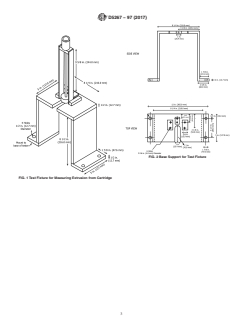
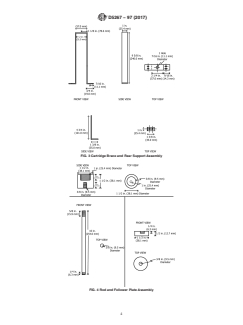
5.1 The test fixture is shown in Fig. 1. Details are shown in
responsibility of the user of this standard to establish appro-
Figs. 2-4. Make the framework from aluminum. Make the rod
priate safety, health, and environmental practices and deter-
and plunger combination from steel.
mine the applicability of regulatory limitations prior to use.
1.4 This international standard was developed in accor- 5.2 The test fixture is designed to be fitted onto a test
dance with internationally recognized principles on standard- machine capable of measuring compressive strength.
ization established in the Decision on Principles for the
6. Conditioning
Development of International Standards, Guides and Recom-
mendations issued by the World Trade Organization Technical
6.1 Before measuring extrudability, condition the cartridge
Barriers to Trade (TBT) Committee.
filled with adhesive until it reaches the desired constant
temperature.
2. Referenced Documents
2.1 ASTM Standards:
7. Procedure
D907 Terminology of Adhesives
7.1 Mount the test fixture to the test machine for stability.
3. Terminology
7.2 After conditioning the cartridge, cut off enough of the
tip, perpendicular to the cartridge, to ensure an inside diameter
3.1 Definitions—Many terms in this test method are defined
of ⁄4 in. (6.3 mm). If the cartridge has a foil or plastic liner,
in Terminology D907.
puncture it completely to allow passage of the material through
4. Significance and Use
the orifice. Record the temperature of the adhesive by inserting
a thermometer or suitable thermocouple into the cartridge.
4.1 Cartridge adhesives are typically used at job sites in a
wide variety of temperature ranges. These products may be
7.3 Set the crosshead speed to 5.0 in. (127.0 mm) per min or
exposed to cold temperatures, where one of the limiting
another acceptable rate.
application factors is whether the product can be extruded from
7.4 Activate the machine to begin extrusion of the adhesive
the cartridge.
from the cartridge, measure the maximum force necessary to
begin the extrusion process as well as the force necessary to
This test method is under the jurisdiction of ASTM Committee D14 on
maintain continued extrusion of the adhesive. The first value is
Adhesives and is the direct responsibility of Subcommittee D14.10 on Working
the force needed to release the plunger from the cartridge. The
Properties.
second value is the force needed to extrude the adhesive from
Current edition approved Nov. 1, 2017. Published November 2017. Originally
approved in 1992. Last previous edition approved in 2012 as D5267 – 97 (2012).
the cartridge continuously.
DOI: 10.1520/D5267-97R17.
For referenced ASTM standards, visit the ASTM website, www.astm.org, or
contact ASTM Customer
...