

ASTM C1825-19
(Guide)Standard Guide for Developing Specifications for Masonry Units
General Information
- Abstract
SIGNIFICANCE AND USE
5.1 This guide is intended to provide guidance for developing ASTM unit specifications for nontraditional masonry units. The user of this guide is encouraged to review the Form and Style for ASTM Standards as well as the referenced unit specifications and test methods. Note that not all items presented in this guide are necessarily applicable or appropriate in all cases.
5.2 ASTM specifications are not intended for proprietary products, but rather for a class of products that multiple manufacturers can produce, and are intended to ensure performance using those constituent materials or processes. Therefore, specific attributes that only relate to a specific brand should be avoided.
5.3 This guide does not identify the complete range of considerations that may be required for a masonry unit manufactured using a non-traditional material. Traditional masonry units possess intrinsic properties that are commonly associated with masonry including but not limited to strength, fire resistance, durability, thermal and acoustical attributes.
5.4 Non-traditional masonry unit products may meet all the physical property requirements of an existing ASTM standard unit specification, when tested using ASTM standard test methods. Nevertheless, performance of non-traditional masonry units is not assured since the intrinsic properties that are associated with traditional masonry units and assemblies may not be specifically evaluated through testing for specification compliance. Additionally, compliance with the physical properties in existing unit specifications does not mean that non-traditional units are in compliance with those specifications as traditional unit standards are only applicable to units produced with those materials and processes defined within that specification (refer to Appendix X1).
SCOPE
1.1 This guide provides general guidance for developing ASTM unit specification for masonry units manufactured with constituent materials, manufacturing methods, and combinations thereof, that are not included in a current ASTM standard. This guide shall not be construed as permitting the use of a product conflicting with requirements of the governing building code.
1.2 This standard does not purport to address all of the safety concerns, if any, associated with its use. It is the responsibility of the user of this standard to establish appropriate safety, health, and environmental practices and determine the applicability of regulatory limitations prior to use.
1.3 This international standard was developed in accordance with internationally recognized principles on standardization established in the Decision on Principles for the Development of International Standards, Guides and Recommendations issued by the World Trade Organization Technical Barriers to Trade (TBT) Committee.
- Status
- Published
- Publication Date
- 30-Nov-2019
- Technical Committee
- C15 - Masonry – Manufactured Masonry Units, Mortars and Grouts
- Drafting Committee
- C15.12 - Alternative Masonry Materials and Related Units
Overview
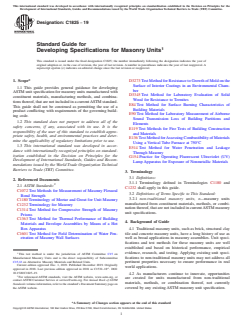
ASTM C1825-19: Standard Guide for Developing Specifications for Masonry Units is a guidance document from ASTM International. It is designed to assist in creating specifications for masonry units manufactured with new or non-traditional materials and manufacturing methods not addressed in existing ASTM standards. This guide is especially relevant as innovation in masonry leads to products that fall outside the scope of traditional specifications.
ASTM C1825-19 helps stakeholders-including manufacturers, specifiers, and regulatory bodies-develop comprehensive and appropriate performance criteria for these innovative masonry units. Its application supports consistency, performance reliability, and fair competition across manufacturers, while ensuring compliance with governing building codes and safety requirements.
Key Topics
- Scope of Application: Provides general principles for specifying masonry units made with novel materials, manufacturing processes, or combinations thereof not included in current ASTM standards.
- Non-Traditional Masonry Units: Addresses products manufactured with unconventional materials or methods, and guides users on how these should be specified and evaluated.
- Performance Considerations: Covers physical properties such as strength, fire resistance, durability, thermal characteristics, acoustic performance, water penetration resistance, chemical compatibility, mold and termite resistance, UV resistance, color fastness, and impact resistance.
- Specification Development:
- Identifying applicable ASTM test methods and terminology standards
- Preparing sections such as materials, manufacturing, defects, physical properties, durability, and appearance requirements
- Considering dimensional tolerances and finish/appearance standards
- Avoiding brand-specific or proprietary product attributes
- Testing and Compliance: Emphasizes use of recognized ASTM test methods for performance verification, including ASTM C1314 for compressive strength, ASTM E119 for fire resistance, and ASTM C1363 for thermal performance.
Applications
ASTM C1825-19 is highly applicable in scenarios where innovation is driving the development of masonry products not covered by existing standards. Users and developers of this guide include:
- Product Manufacturers seeking to introduce masonry units with alternative materials, such as composites or eco-friendly formulations, ensuring their products can be properly specified and evaluated by the industry.
- Specification Writers and Architects tasked with ensuring that non-traditional masonry products meet required levels of performance for safety, durability, and code compliance on construction projects.
- Testing Laboratories developing or modifying procedures to accurately assess the performance of novel masonry units, based on referenced ASTM test methods.
- Regulatory Bodies assessing compliance of innovative masonry products with building codes and industry best practices.
The guide fosters equal assessment criteria for all manufacturers, ensures the safety and performance of new materials, and avoids favoring proprietary attributes, thus supporting market fairness and product acceptance.
Related Standards
ASTM C1825-19 references and works in conjunction with several important ASTM standards, including:
- ASTM C1072: Test Methods for Measurement of Masonry Flexural Bond Strength
- ASTM C1180/C1232: Terminology for Mortar, Grout, and Masonry
- ASTM C1314: Test Method for Compressive Strength of Masonry Prisms
- ASTM C1363: Test Method for Thermal Performance of Building Materials
- ASTM C1601: Test Method for Field Determination of Water Penetration
- ASTM D3273: Test Method for Resistance to Growth of Mold
- ASTM D3345: Test Method for Termite Resistance
- ASTM E84/E119/E136/E514/E90: Test Methods for Fire, Combustibility, Water Penetration, and Acoustical Properties
- ASTM G154: UV Resistance Test Method
By referencing these and other relevant standards, users of ASTM C1825-19 ensure their specifications for non-traditional masonry units are comprehensive, reliable, and aligned with global best practices in masonry construction.
Relations
- Effective Date
- 01-Dec-2019
- Effective Date
- 01-Mar-2024
- Effective Date
- 01-Mar-2024
- Effective Date
- 01-Feb-2024
- Effective Date
- 15-Dec-2023
- Effective Date
- 01-Dec-2023
- Effective Date
- 01-Dec-2023
- Effective Date
- 01-Dec-2023
- Effective Date
- 01-Sep-2023
- Effective Date
- 01-Oct-2019
- Effective Date
- 01-Sep-2019
- Effective Date
- 01-Jul-2019
- Effective Date
- 15-Apr-2019
- Effective Date
- 01-Mar-2019
- Effective Date
- 01-Feb-2019
Get Certified
Connect with accredited certification bodies for this standard

DIBt (Deutsches Institut für Bautechnik)
German Institute for Building Technology.
DIN CERTCO
DIN Group product certification.

Aboma Certification B.V.
Specialized in construction, metal, and transport sectors.
Sponsored listings
Frequently Asked Questions
ASTM C1825-19 is a guide published by ASTM International. Its full title is "Standard Guide for Developing Specifications for Masonry Units". This standard covers: SIGNIFICANCE AND USE 5.1 This guide is intended to provide guidance for developing ASTM unit specifications for nontraditional masonry units. The user of this guide is encouraged to review the Form and Style for ASTM Standards as well as the referenced unit specifications and test methods. Note that not all items presented in this guide are necessarily applicable or appropriate in all cases. 5.2 ASTM specifications are not intended for proprietary products, but rather for a class of products that multiple manufacturers can produce, and are intended to ensure performance using those constituent materials or processes. Therefore, specific attributes that only relate to a specific brand should be avoided. 5.3 This guide does not identify the complete range of considerations that may be required for a masonry unit manufactured using a non-traditional material. Traditional masonry units possess intrinsic properties that are commonly associated with masonry including but not limited to strength, fire resistance, durability, thermal and acoustical attributes. 5.4 Non-traditional masonry unit products may meet all the physical property requirements of an existing ASTM standard unit specification, when tested using ASTM standard test methods. Nevertheless, performance of non-traditional masonry units is not assured since the intrinsic properties that are associated with traditional masonry units and assemblies may not be specifically evaluated through testing for specification compliance. Additionally, compliance with the physical properties in existing unit specifications does not mean that non-traditional units are in compliance with those specifications as traditional unit standards are only applicable to units produced with those materials and processes defined within that specification (refer to Appendix X1). SCOPE 1.1 This guide provides general guidance for developing ASTM unit specification for masonry units manufactured with constituent materials, manufacturing methods, and combinations thereof, that are not included in a current ASTM standard. This guide shall not be construed as permitting the use of a product conflicting with requirements of the governing building code. 1.2 This standard does not purport to address all of the safety concerns, if any, associated with its use. It is the responsibility of the user of this standard to establish appropriate safety, health, and environmental practices and determine the applicability of regulatory limitations prior to use. 1.3 This international standard was developed in accordance with internationally recognized principles on standardization established in the Decision on Principles for the Development of International Standards, Guides and Recommendations issued by the World Trade Organization Technical Barriers to Trade (TBT) Committee.
SIGNIFICANCE AND USE 5.1 This guide is intended to provide guidance for developing ASTM unit specifications for nontraditional masonry units. The user of this guide is encouraged to review the Form and Style for ASTM Standards as well as the referenced unit specifications and test methods. Note that not all items presented in this guide are necessarily applicable or appropriate in all cases. 5.2 ASTM specifications are not intended for proprietary products, but rather for a class of products that multiple manufacturers can produce, and are intended to ensure performance using those constituent materials or processes. Therefore, specific attributes that only relate to a specific brand should be avoided. 5.3 This guide does not identify the complete range of considerations that may be required for a masonry unit manufactured using a non-traditional material. Traditional masonry units possess intrinsic properties that are commonly associated with masonry including but not limited to strength, fire resistance, durability, thermal and acoustical attributes. 5.4 Non-traditional masonry unit products may meet all the physical property requirements of an existing ASTM standard unit specification, when tested using ASTM standard test methods. Nevertheless, performance of non-traditional masonry units is not assured since the intrinsic properties that are associated with traditional masonry units and assemblies may not be specifically evaluated through testing for specification compliance. Additionally, compliance with the physical properties in existing unit specifications does not mean that non-traditional units are in compliance with those specifications as traditional unit standards are only applicable to units produced with those materials and processes defined within that specification (refer to Appendix X1). SCOPE 1.1 This guide provides general guidance for developing ASTM unit specification for masonry units manufactured with constituent materials, manufacturing methods, and combinations thereof, that are not included in a current ASTM standard. This guide shall not be construed as permitting the use of a product conflicting with requirements of the governing building code. 1.2 This standard does not purport to address all of the safety concerns, if any, associated with its use. It is the responsibility of the user of this standard to establish appropriate safety, health, and environmental practices and determine the applicability of regulatory limitations prior to use. 1.3 This international standard was developed in accordance with internationally recognized principles on standardization established in the Decision on Principles for the Development of International Standards, Guides and Recommendations issued by the World Trade Organization Technical Barriers to Trade (TBT) Committee.
ASTM C1825-19 is classified under the following ICS (International Classification for Standards) categories: 91.080.30 - Masonry. The ICS classification helps identify the subject area and facilitates finding related standards.
ASTM C1825-19 has the following relationships with other standards: It is inter standard links to ASTM C1825-18e1, ASTM C1363-24, ASTM E136-24a, ASTM E136-24, ASTM C1232-23, ASTM C1314-23b, ASTM E84-23d, ASTM E90-23, ASTM E84-23c, ASTM E119-19, ASTM C1363-19, ASTM E84-19b, ASTM E84-19a, ASTM E84-19, ASTM E136-19. Understanding these relationships helps ensure you are using the most current and applicable version of the standard.
ASTM C1825-19 is available in PDF format for immediate download after purchase. The document can be added to your cart and obtained through the secure checkout process. Digital delivery ensures instant access to the complete standard document.
Standards Content (Sample)
This international standard was developed in accordance with internationally recognized principles on standardization established in the Decision on Principles for the
Development of International Standards, Guides and Recommendations issued by the World Trade Organization Technical Barriers to Trade (TBT) Committee.
Designation: C1825 −19
Standard Guide for
Developing Specifications for Masonry Units
This standard is issued under the fixed designation C1825; the number immediately following the designation indicates the year of
original adoption or, in the case of revision, the year of last revision. A number in parentheses indicates the year of last reapproval. A
superscript epsilon (´) indicates an editorial change since the last revision or reapproval.
1. Scope* D3273 TestMethodforResistancetoGrowthofMoldonthe
Surface of Interior Coatings in an Environmental Cham-
1.1 This guide provides general guidance for developing
ber
ASTM unit specification for masonry units manufactured with
D3345 Test Method for Laboratory Evaluation of Solid
constituent materials, manufacturing methods, and combina-
Wood for Resistance to Termites
tionsthereof,thatarenotincludedinacurrentASTMstandard.
E84 Test Method for Surface Burning Characteristics of
This guide shall not be construed as permitting the use of a
Building Materials
product conflicting with requirements of the governing build-
E90 Test Method for Laboratory Measurement of Airborne
ing code.
Sound Transmission Loss of Building Partitions and
1.2 This standard does not purport to address all of the
Elements
safety concerns, if any, associated with its use. It is the
E119 Test Methods for Fire Tests of Building Construction
responsibility of the user of this standard to establish appro-
and Materials
priate safety, health, and environmental practices and deter-
E136 TestMethodforAssessingCombustibilityofMaterials
mine the applicability of regulatory limitations prior to use.
Using a Vertical Tube Furnace at 750°C
1.3 This international standard was developed in accor-
E514 Test Method for Water Penetration and Leakage
dance with internationally recognized principles on standard-
Through Masonry
ization established in the Decision on Principles for the
G154 Practice for Operating Fluorescent Ultraviolet (UV)
Development of International Standards, Guides and Recom-
Lamp Apparatus for Exposure of Nonmetallic Materials
mendations issued by the World Trade Organization Technical
Barriers to Trade (TBT) Committee.
3. Terminology
3.1 Definitions:
2. Referenced Documents
3.1.1 Terminology defined in Terminologies C1180 and
2.1 ASTM Standards:
C1232 shall apply in this guide.
C1072 Test Methods for Measurement of Masonry Flexural
3.2 Definitions of Terms Specific to This Standard:
Bond Strength
3.2.1 non-traditional masonry units, n—masonry units
C1180 Terminology of Mortar and Grout for Unit Masonry
manufactured from constituent materials, methods, or combi-
C1232 Terminology for Masonry
nation thereof, that are not included in currentASTM masonry
C1314 Test Method for Compressive Strength of Masonry
unit specifications.
Prisms
C1363 Test Method for Thermal Performance of Building
4. Background of Guide
Materials and Envelope Assemblies by Means of a Hot
Box Apparatus 4.1 Traditional masonry units, such as brick, structural clay
C1601 Test Method for Field Determination of Water Pen- tile and concrete masonry units, have a long history of use as
etration of Masonry Wall Surfaces well as broad applications in masonry assemblies. Unit speci-
fications and test methods for these masonry units are well
established and based on historical performance, empirical
evidence, research, and testing. Applying existing unit speci-
This test method is under the jurisdiction of ASTM Committee C15 on
fications to non-traditional masonry units may not address all
Manufactured Masonry Units and is the direct responsibility of Subcommittee
C15.12 on Alternative Masonry Materials and Related Units.
pertinent properties necessary to ensure performance in real
Current edition approved Dec. 1, 2019. Published December 2019. Originally
world applications.
ɛ1
approved in 2018. Last previous edition approved in 2018 as C1532–18 . DOI:
10.1520/C1825–19.
4.2 As manufacturers continue to innovate, opportunities
For referenced ASTM standards, visit the ASTM website, www.astm.org, or
are created for units manufactured from non-traditional
contact ASTM Customer Service at service@astm.org. For Annual Book of ASTM
materials, methods, or combination thereof, not currently
Standards volume information, refer to the standard’s Document Summary page on
the ASTM website. covered by any existing ASTM masonry unit specification.
*A Summary of Changes section appears at the end of this standard
Copyright © ASTM International, 100 Barr Harbor Drive, PO Box C700, West Conshohocken, PA 19428-2959. United States
C1825 − 19
4.3 Non-traditional masonry units may require additional 6.1.4 Select appropriate standard test methods to determine
evaluation and assessment, in addition to those required of the required physical properties. All modifications to the
traditional units, to ensure that the product is suitable for its standard test methods should be identified.
intended use.
7. Typical Sections
5. Significance and Use
7.1 The following list of sections are typically provided in a
5.1 This guide is intended to provide guidance for develop- unit specification. Depending on the scope of the non-
ingASTM unit specifications for nontraditional masonry units. traditional unit specification some sections may not apply.
The user of this guide is encouraged to review the Form and
7.2 Materials and Manufacturing:
Style for ASTM Standards as well as the referenced unit
7.2.1 Constituent Material(s)—Most traditional masonry
specifications and test methods. Note that not all items pre-
unit specifications contain a list or range of acceptable con-
sented in this guide are necessarily applicable or appropriate in
stituent materials. Such a listing may be appropriate for a
all cases.
non-traditional masonry unit standard. A performance specifi-
5.2 ASTM specifications are not intended for proprietary cation may also be considered, wherein constituent materials
products, but rather for a class of products that multiple are not defined, and compliance is solely based on testing and
manufacturers can produce, and are intended to ensure perfor- performance. There may be a wide range of materials allowed
mance using those constituent materials or processes. by the specification if specific performance criteria for the unit
Therefore, specific attributes that only relate to a specific brand and assemblage are defined.
should be avoided. 7.2.2 Manufacturing Process—Define the manufacturing
process and the mechanism(s) that bonds the materials in the
5.3 This guide does not identify the complete range of
unit.
considerations that may be required for a masonry unit
7.2.3 Coating or Surface Treatments—Consideration should
manufactured using a non-traditional material. Traditional
be given to whether coatings or surface treatments at point of
masonry units possess intrinsic properties that are commonly
manufacture should or can be applied to the unit. The type and
associated with masonry including but not limited to strength,
durability of those coatings should be established. There
fire resistance, durability, thermal and acoustical attributes.
should be a requirement that the effects of any coatings on the
5.4 Non-traditional masonry unit products may meet all the
properties and performance of the unit and the assembly be
physical property requirements of an existing ASTM standard
identified and where possible, quantified.
unit specification, when tested using ASTM standard test
7.3 Defects and Deficiencies—Provide limitations for de-
methods. Nevertheless, performance of non-traditional ma-
fects and deficiencies that may interfere with the proper laying
sonry units is not assured since the intrinsic properties that are
of the unit or significantly impair the strength or performance
associated with traditional masonry units and assemblies may
of the construction.
not be specifically evaluated through testing for specification
7.4 Physical Properties—Physical properties are an impor-
compliance. Additionally, compliance with the physical prop-
erties in existing unit specifications does not mean that tant predictor of the unit performance as well as the perfor-
non-traditional units are in compliance with those specifica- mance of unit assemblies. The physical property requirements
tions as traditional unit standards are only applicable to units of the specification should ensure that the masonry unit and
produced with those materials and processes defined within unit assemblies perform as required in use, both in the
that specification (refer to Appendix X1). short-term and long-term, including consideration of the vari-
ous environments to which the unit and assembly likely will be
6. Procedure
exposed to in service. Consideration should be given whether
6.1 Preparation:
different unit classifications will be needed for different appli-
6.1.1 Review the referenced Specifications, Test Methods,
cations. These unit classifications will likely have different
Terminology standards and Form and Style for ASTM Stan-
physical properties and specifications.
dards for general background information and required sec-
7.4.1 Strength—Minimum unit strength requirements may
tions and components. Include all mandatory sections de-
berequiredtoensurethatwhenunitsareplacedinanassembly,
scribed by the Form and Style for ASTM Standards documents
it will possess sufficient strength to retain integrity for its
during the development of the unit specification.
intended application and use. Consideration needs to be given
to whether the units are intended to be used in non-structural
NOTE1—Duringthisreview,itmaybedeterminedthattheproductdoes
facing or structural applications, or both. Typical strength
not satisfy the definition of a manufactured masonry unit and is outside of
the scope of Committee C15. In that case, developing a unit specification requirements include minimum compressive, flexural, and
under another ASTM committee can be considered.
shear strengths. Effects of unit strengths on the structural
6.1.2 The unit specification must be written in a manner to performance of the assembly must be considered including
avoid contractual language. required, or limits on, mortar types or mortar properties should
6.1.3 Consider and develop mandatory and non-mandatory be stated so that the anticipated performance is achieved.
sections including but not limited to Scope, Referenced Strength may change with unit orientation and this should
Documents, Terminology and Ordering Information Sections addressed in the standard.
(see Section 7). Modify accordingly as the specification is 7.4.2 Absorption—Consideration needs to be given as to
developed. whether maximum or minimum absorption requirements are
C1825 − 19
necessary to ensure adequate unit performance, compatibility testing best ensures adequate performance in the field (con-
of other materials in the assembly, and satisfactory minimum tinuous versus discontinuous tests, level of saturation, brine or
assembly performance. water solutions should all be considered).
7.4.7.2 Mold Resistance—No traditional masonry unit
NOTE 2—Traditional masonry unit specifications have used absorption
specifications have mold resistance requirements. The low
requirements as indicators of various properties, such as unit quality,
durability, compatibility with mortar, or combinations thereof. Some or all potential for the unit assembly to promote the growth of mold
of these may be necessary with non-traditional masonry units.
during service is an important aspect of masonry construction.
Consideration should be given to whether the non-traditional
7.4.3 Density—Some traditional masonry unit specifications
masonry unit incorporates materials that may promote mold
have density requirements. Densities of some units manufac-
growth. One method that can be used to determining whether
tured from traditional materials are dependent on the density of
a constituent material may support or encourage the growth of
the material(s) within the unit. In addition, variations in the
mold or mildew is ASTM D3273, Standard Test Method for
density of these materials may affect the physical characteris-
Resistance to Growth of Mold on the Surface of Interior
tics of the units. Consideration should be given as to whether
Coatings in an Environmental Chamber.
density requirements should be provided.
7.4.7.3 Termite Resistance—Traditional masonry unit speci-
7.4.4 Soundness and Dimensional Stability—The ability of
fications have no termite resistance requirements. In regions
the unit to remain sound in use and to be dimensional stable
prone to subterranean termite infestation, the International
needs to be addressed in the unit standard through control of
Building Code and the International Residential Code
...
This document is not an ASTM standard and is intended only to provide the user of an ASTM standard an indication of what changes have been made to the previous version. Because
it may not be technically possible to adequately depict all changes accurately, ASTM recommends that users consult prior editions as appropriate. In all cases only the current version
of the standard as published by ASTM is to be considered the official document.
´1
Designation: C1825 − 18 C1825 − 19
Standard Guide for
Developing Specifications for Masonry Units
This standard is issued under the fixed designation C1825; the number immediately following the designation indicates the year of
original adoption or, in the case of revision, the year of last revision. A number in parentheses indicates the year of last reapproval. A
superscript epsilon (´) indicates an editorial change since the last revision or reapproval.
ε NOTE—Changes were editorially made throughout the standard in December 2018.
1. Scope Scope*
1.1 This guide provides general guidance for developing ASTM unit specification for masonry units manufactured with
constituent materials, manufacturing methods, and combinations thereof, that are not included in a current ASTM standard. This
guide shall not be construed as permitting the use of a product conflicting with requirements of the governing building code.
1.2 This standard does not purport to address all of the safety concerns, if any, associated with its use. It is the responsibility
of the user of this standard to establish appropriate safety, health, and environmental practices and determine the applicability of
regulatory limitations prior to use.
1.3 This international standard was developed in accordance with internationally recognized principles on standardization
established in the Decision on Principles for the Development of International Standards, Guides and Recommendations issued
by the World Trade Organization Technical Barriers to Trade (TBT) Committee.
2. Referenced Documents
2.1 ASTM Standards:
C1072 Test Methods for Measurement of Masonry Flexural Bond Strength
C1180 Terminology of Mortar and Grout for Unit Masonry
C1232 Terminology for Masonry
C1314 Test Method for Compressive Strength of Masonry Prisms
C1363 Test Method for Thermal Performance of Building Materials and Envelope Assemblies by Means of a Hot Box Apparatus
C1601 Test Method for Field Determination of Water Penetration of Masonry Wall Surfaces
D3273 Test Method for Resistance to Growth of Mold on the Surface of Interior Coatings in an Environmental Chamber
D3345 Test Method for Laboratory Evaluation of Solid Wood for Resistance to Termites
E84 Test Method for Surface Burning Characteristics of Building Materials
E90 Test Method for Laboratory Measurement of Airborne Sound Transmission Loss of Building Partitions and Elements
E119 Test Methods for Fire Tests of Building Construction and Materials
E136 Test Method for Assessing Combustibility of Materials Using a Vertical Tube Furnace at 750°C
E514 Test Method for Water Penetration and Leakage Through Masonry
G154 Practice for Operating Fluorescent Ultraviolet (UV) Lamp Apparatus for Exposure of Nonmetallic Materials
3. Terminology
3.1 Definitions:
3.1.1 Terminology defined in Terminologies C1180 and C1232 shall apply in this guide.
3.2 Definitions of Terms Specific to This Standard:
3.2.1 non-traditional masonry units, n—masonry units manufactured from constituent materials, methods, or combination
thereof, that are not included in current ASTM masonry unit specifications.
This test method is under the jurisdiction of ASTM Committee C15 on Manufactured Masonry Units and is the direct responsibility of Subcommittee C15.12 on
Alternative Masonry Materials and Related Units.
Current edition approved July 1, 2018Dec. 1, 2019. Published August 2018December 2019. Originally approved in 2018. Last previous edition approved in 2018 as
ɛ1
C1532–18 . DOI: 10.1520/C1825–18E01.10.1520/C1825–19.
For referenced ASTM standards, visit the ASTM website, www.astm.org, or contact ASTM Customer Service at service@astm.org. For Annual Book of ASTM Standards
volume information, refer to the standard’s Document Summary page on the ASTM website.
*A Summary of Changes section appears at the end of this standard
Copyright © ASTM International, 100 Barr Harbor Drive, PO Box C700, West Conshohocken, PA 19428-2959. United States
C1825 − 19
4. Background of Guide
4.1 Traditional masonry units, such as brick, structural clay tile and concrete masonry units, have a long history of use as well
as broad applications in masonry assemblies. Unit specifications and test methods for these masonry units are well established and
based on historical performance, empirical evidence, research, and testing. Applying existing unit specifications to non-traditional
masonry units may not address all pertinent properties necessary to ensure performance in real world applications.
4.2 As manufacturers continue to innovate, opportunities are created for units manufactured from non-traditional materials,
methods, or combination thereof, not currently covered by any existing ASTM masonry unit specification.
4.3 Non-traditional masonry units may require additional evaluation and assessment, in addition to those required of traditional
units, to ensure that the product is suitable for its intended use.
5. Significance and Use
5.1 This guide is intended to provide guidance for developing ASTM unit specifications for nontraditional masonry units. The
user of this guide is encouraged to review the Form and Style for ASTM Standards as well as the referenced unit specifications
and test methods. Note that not all items presented in this guide are necessarily applicable or appropriate in all cases.
5.2 ASTM specifications are not intended for proprietary products, but rather for a class of products that multiple manufacturers
can produce, and are intended to ensure performance using those constituent materials or processes. Therefore, specific attributes
that only relate to a specific brand should be avoided.
5.3 This guide does not identify the complete range of considerations that may be required for a masonry unit manufactured
using a non-traditional material. Traditional masonry units possess intrinsic properties that are commonly associated with masonry
including but not limited to strength, fire resistance, durability, thermal and acoustical attributes.
5.4 Non-traditional masonry unit products may meet all the physical property requirements of an existing ASTM standard unit
specification, when tested using ASTM standard test methods. Nevertheless, performance of non-traditional masonry units is not
assured since the intrinsic properties that are associated with traditional masonry units and assemblies may not be specifically
evaluated through testing for specification compliance. Additionally, compliance with the physical properties in existing unit
specifications does not mean that non-traditional units are in compliance with those specifications as traditional unit standards are
only applicable to units produced with those materials and processes defined within that specification (refer to Appendix X1).
6. Procedure
6.1 Preparation:
6.1.1 Review the referenced Specifications, Test Methods, Terminology standards and Form and Style for ASTM Standards for
general background information and required sections and components. Include all mandatory sections described by the Form and
Style for ASTM Standards documents during the development of the unit specification.
NOTE 1—During this review, it may be determined that the product does not satisfy the definition of a manufactured masonry unit and is outside of
the scope of Committee C15. In that case, developing a unit specification under another ASTM committee can be considered.
6.1.2 The unit specification must be written in a manner to avoid contractual language.
6.1.3 Consider and develop mandatory and non-mandatory sections including but not limited to Scope, Referenced Documents,
Terminology and Ordering Information Sections (see Section 7). Modify accordingly as the specification is developed.
6.1.4 Select appropriate standard test methods to determine the required physical properties. All modifications to the standard
test methods should be identified.
7. Typical Sections
7.1 The following list of sections are typically provided in a unit specification. Depending on the scope of the non-traditional
unit specification some sections may not apply.
7.2 Materials and Manufacturing:
7.2.1 Constituent Material(s)—Define the range of constituent material(s) that may be used in the manufacture of the masonry
unit. Include constituent materials and any additives. Most traditional masonry unit specifications contain a list or range of
acceptable constituent materials. Such a listing may be appropriate for a non-traditional masonry unit standard. A performance
specification may also be considered, wherein constituent materials are not defined, and compliance is solely based on testing and
performance. There may be a wide range of materials allowed by the specification if specific performance criteria for the unit and
assemblage are defined.
7.2.2 Manufacturing Process—Define the manufacturing process and the mechanism(s) that bonds the materials in the unit.
7.2.3 Coating or Surface Treatments—Consideration should be given to whether coatings or surface treatments at point of
manufacture should or can be applied to the unit. The type and durability of those coatings should be established. There should
be a requirement that the effects of any coatings on the properties and performance of the unit and the assembly be identified and
where possible, quantified.
C1825 − 19
7.3 Defects and Deficiencies—Provide limitations for defects and deficiencies that may interfere with the proper laying of the
unit or significantly impair the strength or performance of the construction.
7.4 Physical Properties—Physical properties are an important predictor of the unit performance as well as the performance of
unit assemblies. The physical property requirements of the specification should ensure that the masonry unit and unit assemblies
perform as required in use, both in the short-term and long-term, including consideration of the various environments to which the
unit and assembly likely will be exposed to in service. Consideration should be given whether different unit classifications will be
needed for different applications. These unit classifications will likely have different physical properties and specifications.
7.4.1 Strength—Minimum unit strength requirements may be required to ensure that when units are placed in an assembly, it
will possess sufficient strength to retain integrity for its intended application and use. Consideration needs to be given to whether
the units are intended to be used in non-structural facing or structural applications, or both. Typical strength requirements include
minimum compressive, flexural, and shear strengths. Effects of unit strengths on the structural performance of the assembly must
be considered including required, or limits on, mortar types or mortar properties should be stated so that the anticipated
performance is achieved. Strength may change with unit orientation and this should addressed in the standard.
7.4.2 Absorption—Consideration needs to be given as to whether maximum or minimum absorption requirements are necessary
to ensure adequate unit performance, compatibility of other materials in the assembly, and satisfactory minimum assembly
performance.
NOTE 2—Traditional masonry unit specifications have used absorption requirements as indicators of various properties, such as unit quality, durability,
compatibility with mortar, or combinations thereof. Some or all of these may be necessary with non-traditional masonry units.
7.4.3 Density—Some traditional masonry unit specifications have density requirements. Densities of some units manufactured
from traditional materials are dependent on the density of the material(s) within the unit. In addition, variations in the density of
these materials may affect the physical characteristics of the units. Consideration should be given as to whether density
requirements should be provided.
7.4.4 Soundness and Dimensional Stability—The ability of the unit to remain sound in use and to be dimensional stable needs
to be addressed in the unit standard through control of constituents and or unit characteristics.
7.4.5 Chemical Compatibility—Chemical compatibility of the units with other materials and components included in the
assembly, or commonly found in other construction assemblies to which the units or its assemblies join or junction is important
and needs to be addressed in the unit standard through control of constituents, unit characteristics, or notes for materials to avoid
in use.
7.4.6 Volume Change:
7.4.6.1 Moisture Expansion—Not all traditional masonry unit specifications provide moisture expansion requirements.
Consideration should be given as to whether cyclic moisture expansion requirements should be provided.
7.4.6.2 Linear Drying Shrinkage—Not all traditional masonry unit specifications provide linear drying shrinkage requirements.
Consideration should be given as to whether cyclic linear drying shrinkage requi
...