

ASTM C1715/C1715M-22
(Test Method)Standard Test Method for Evaluation of Water Leakage Performance of Masonry Wall Drainage Systems
General Information
- Abstract
SIGNIFICANCE AND USE
5.1 This test method is suitable for use on walls to determine the ability of masonry wall drainage systems to collect water penetrating the exterior wythe and to direct this water back to the exterior surface of the exterior wythe. Removal of a portion of the interior wall finishes is desirable to observe leakage into backup walls. Even with removal of interior finishes, in many cases it is not practical to observe surfaces behind spandrel beams, columns, or other obstructions. Potential areas where leakage may occur but that are not visible during the test shall be considered when interpreting the results of the test and shall be recorded in the report.
5.2 This test method is suitable for use on mock-up walls to determine the performance of masonry wall drainage systems.
5.3 This test method is suitable for evaluating the effectiveness of flashing repairs.
SCOPE
1.1 This test method describes a standard procedure for determining the ability of masonry wall drainage systems to collect water that penetrates the exterior masonry wythe during rainstorms and to direct this water back to the exterior surface of the wall.
1.2 This test method is applicable to wall systems that contain an exterior masonry wythe with a drainage zone on the interior face of the exterior wythe. It is not applicable to single-wythe drainage walls.
1.3 This test method is not applicable to masonry barrier walls or other masonry walls that are designed without drainage zones behind the exterior wythe.
1.4 This test method covers the application of the testing using either inch-pound or SI units. The values stated in either SI units or inch-pound units are to be regarded separately as standard. Within the text, the inch-pound units are shown in brackets. The values stated in each system may not be exact equivalents; therefore, each system shall be used independently of the other. Combining values from the two systems may result in nonconformance with the standard.
1.5 This standard does not purport to address all of the safety concerns, if any, associated with its use. It is the responsibility of the user of this standard to establish appropriate safety, health, and environmental practices and determine the applicability of regulatory limitations prior to use.
1.6 This international standard was developed in accordance with internationally recognized principles on standardization established in the Decision on Principles for the Development of International Standards, Guides and Recommendations issued by the World Trade Organization Technical Barriers to Trade (TBT) Committee.
- Status
- Published
- Publication Date
- 31-May-2022
- Technical Committee
- C15 - Masonry – Manufactured Masonry Units, Mortars and Grouts
- Drafting Committee
- C15.04 - Research for Masonry Units and Assemblies
Buy Documents
ASTM C1715/C1715M-22 - Standard Test Method for Evaluation of Water Leakage Performance of Masonry Wall Drainage Systems
REDLINE ASTM C1715/C1715M-22 - Standard Test Method for Evaluation of Water Leakage Performance of Masonry Wall Drainage Systems
Overview
ASTM C1715/C1715M-22 is the industry-recognized standard test method for evaluating the water leakage performance of masonry wall drainage systems. Developed by ASTM International, this test method provides a structured procedure to assess how well a masonry wall drainage system collects water that penetrates the exterior wythe (the outer masonry layer) and redirects it to the outside surface, preventing moisture intrusion to interior structures.
This standard is applicable to wall systems featuring an exterior masonry wythe and a drainage zone located on the interior face of the exterior wythe. It is not intended for single-wythe drainage walls or masonry barrier walls that lack a drainage zone. The procedure accommodates testing in both inch-pound and SI units, prescribed separately to maintain measurement integrity.
Key Topics
- Water Leakage Evaluation: The main focus is on determining the capacity of masonry wall drainage systems to manage water ingress during rainstorms by collecting and directing the penetrated water back to the exterior.
- Drainage System Components: Critical system parts defined in the standard include the drainage zone, flashing, weep systems, water-resistive barriers, and water collection systems.
- Testing Procedures:
- Controlled introduction of water through drilled entry points.
- Observations and measurements are made before, during, and after the test to detect leaks and discharge efficacy.
- Calibration and verification of test apparatus to ensure accurate measurement and distribution.
- Limitations and Safety: The method addresses the visibility limitations of certain wall areas due to structural obstructions and emphasizes safety, health, and environmental responsibilities for users.
- Use on Mock-Ups and Repairs: Suitable for both in-place masonry walls and wall mock-ups to assess new installations or the effectiveness of flashing and repairs.
- Reporting Requirements: Detailed guidance is provided on what to record, including test setups, wall characteristics, conditions, moisture observations, apparatus details, all observations of leakage, and deviations from the standard.
Applications
The practical applications of ASTM C1715/C1715M-22 extend across multiple contexts:
- Building Diagnostics: Helps assess the water management performance of existing masonry walls, identifying sources and pathways for potential leaks.
- Quality Assurance for New Construction: Ensures new masonry drainage wall systems meet water leakage requirements, facilitating compliance with industry best practices for moisture control.
- Flashing and Repair Verification: Measures the effectiveness of repairs or upgrades to flashing and other drainage components.
- Wall Mock-Ups: Used in laboratory or field-built samples to predict long-term performance prior to full-scale construction, reducing the risk of future water-related failures.
- Documentation and Compliance: Supports the generation of comprehensive records that can be referenced for regulatory or insurance purposes.
Professionals such as architects, building envelope consultants, contractors, and quality control personnel utilize this standard to confirm the integrity and resilience of masonry wall drainage designs.
Related Standards
For a holistic understanding of masonry water leakage and drainage performance, consider the following related standards:
- ASTM C1232 – Terminology for Masonry
- ASTM C1601 – Field Determination of Water Penetration of Masonry Wall Surfaces
- ASTM E514/E514M – Water Penetration and Leakage Through Masonry
- ASTM E631 – Terminology of Building Constructions
By referencing these related ASTM standards, professionals ensure consistent terminology and methodology across all aspects of masonry water penetration testing and evaluation.
Keywords: ASTM C1715, masonry wall drainage systems, water leakage test, drainage zone, flashing, weep system, water-resistive barrier, water collection, building moisture management, water penetration, masonry quality assurance.
Relations
- Effective Date
- 15-Dec-2023
- Effective Date
- 01-Jun-2017
- Effective Date
- 01-Sep-2015
- Effective Date
- 01-Jun-2015
- Effective Date
- 01-Mar-2015
- Effective Date
- 01-Nov-2014
- Effective Date
- 01-Feb-2014
- Effective Date
- 01-Feb-2014
- Effective Date
- 01-Jun-2012
- Effective Date
- 15-Dec-2011
- Effective Date
- 15-Dec-2011
- Effective Date
- 15-Dec-2010
- Effective Date
- 15-Jun-2010
- Effective Date
- 01-May-2010
- Effective Date
- 01-May-2010
Buy Documents
ASTM C1715/C1715M-22 - Standard Test Method for Evaluation of Water Leakage Performance of Masonry Wall Drainage Systems
REDLINE ASTM C1715/C1715M-22 - Standard Test Method for Evaluation of Water Leakage Performance of Masonry Wall Drainage Systems
Get Certified
Connect with accredited certification bodies for this standard

DIBt (Deutsches Institut für Bautechnik)
German Institute for Building Technology.
DIN CERTCO
DIN Group product certification.

Aboma Certification B.V.
Specialized in construction, metal, and transport sectors.
Sponsored listings
Frequently Asked Questions
ASTM C1715/C1715M-22 is a standard published by ASTM International. Its full title is "Standard Test Method for Evaluation of Water Leakage Performance of Masonry Wall Drainage Systems". This standard covers: SIGNIFICANCE AND USE 5.1 This test method is suitable for use on walls to determine the ability of masonry wall drainage systems to collect water penetrating the exterior wythe and to direct this water back to the exterior surface of the exterior wythe. Removal of a portion of the interior wall finishes is desirable to observe leakage into backup walls. Even with removal of interior finishes, in many cases it is not practical to observe surfaces behind spandrel beams, columns, or other obstructions. Potential areas where leakage may occur but that are not visible during the test shall be considered when interpreting the results of the test and shall be recorded in the report. 5.2 This test method is suitable for use on mock-up walls to determine the performance of masonry wall drainage systems. 5.3 This test method is suitable for evaluating the effectiveness of flashing repairs. SCOPE 1.1 This test method describes a standard procedure for determining the ability of masonry wall drainage systems to collect water that penetrates the exterior masonry wythe during rainstorms and to direct this water back to the exterior surface of the wall. 1.2 This test method is applicable to wall systems that contain an exterior masonry wythe with a drainage zone on the interior face of the exterior wythe. It is not applicable to single-wythe drainage walls. 1.3 This test method is not applicable to masonry barrier walls or other masonry walls that are designed without drainage zones behind the exterior wythe. 1.4 This test method covers the application of the testing using either inch-pound or SI units. The values stated in either SI units or inch-pound units are to be regarded separately as standard. Within the text, the inch-pound units are shown in brackets. The values stated in each system may not be exact equivalents; therefore, each system shall be used independently of the other. Combining values from the two systems may result in nonconformance with the standard. 1.5 This standard does not purport to address all of the safety concerns, if any, associated with its use. It is the responsibility of the user of this standard to establish appropriate safety, health, and environmental practices and determine the applicability of regulatory limitations prior to use. 1.6 This international standard was developed in accordance with internationally recognized principles on standardization established in the Decision on Principles for the Development of International Standards, Guides and Recommendations issued by the World Trade Organization Technical Barriers to Trade (TBT) Committee.
SIGNIFICANCE AND USE 5.1 This test method is suitable for use on walls to determine the ability of masonry wall drainage systems to collect water penetrating the exterior wythe and to direct this water back to the exterior surface of the exterior wythe. Removal of a portion of the interior wall finishes is desirable to observe leakage into backup walls. Even with removal of interior finishes, in many cases it is not practical to observe surfaces behind spandrel beams, columns, or other obstructions. Potential areas where leakage may occur but that are not visible during the test shall be considered when interpreting the results of the test and shall be recorded in the report. 5.2 This test method is suitable for use on mock-up walls to determine the performance of masonry wall drainage systems. 5.3 This test method is suitable for evaluating the effectiveness of flashing repairs. SCOPE 1.1 This test method describes a standard procedure for determining the ability of masonry wall drainage systems to collect water that penetrates the exterior masonry wythe during rainstorms and to direct this water back to the exterior surface of the wall. 1.2 This test method is applicable to wall systems that contain an exterior masonry wythe with a drainage zone on the interior face of the exterior wythe. It is not applicable to single-wythe drainage walls. 1.3 This test method is not applicable to masonry barrier walls or other masonry walls that are designed without drainage zones behind the exterior wythe. 1.4 This test method covers the application of the testing using either inch-pound or SI units. The values stated in either SI units or inch-pound units are to be regarded separately as standard. Within the text, the inch-pound units are shown in brackets. The values stated in each system may not be exact equivalents; therefore, each system shall be used independently of the other. Combining values from the two systems may result in nonconformance with the standard. 1.5 This standard does not purport to address all of the safety concerns, if any, associated with its use. It is the responsibility of the user of this standard to establish appropriate safety, health, and environmental practices and determine the applicability of regulatory limitations prior to use. 1.6 This international standard was developed in accordance with internationally recognized principles on standardization established in the Decision on Principles for the Development of International Standards, Guides and Recommendations issued by the World Trade Organization Technical Barriers to Trade (TBT) Committee.
ASTM C1715/C1715M-22 is classified under the following ICS (International Classification for Standards) categories: 91.080.30 - Masonry. The ICS classification helps identify the subject area and facilitates finding related standards.
ASTM C1715/C1715M-22 has the following relationships with other standards: It is inter standard links to ASTM C1232-23, ASTM C1232-17, ASTM C1232-15a, ASTM C1232-15, ASTM E631-15, ASTM E631-14, ASTM E514/E514M-14, ASTM C1601-14, ASTM C1232-12, ASTM C1601-11, ASTM E514/E514M-11, ASTM C1232-10c, ASTM C1232-10b, ASTM C1232-10a, ASTM C1601-10. Understanding these relationships helps ensure you are using the most current and applicable version of the standard.
ASTM C1715/C1715M-22 is available in PDF format for immediate download after purchase. The document can be added to your cart and obtained through the secure checkout process. Digital delivery ensures instant access to the complete standard document.
Standards Content (Sample)
This international standard was developed in accordance with internationally recognized principles on standardization established in the Decision on Principles for the
Development of International Standards, Guides and Recommendations issued by the World Trade Organization Technical Barriers to Trade (TBT) Committee.
Designation: C1715/C1715M − 22
Standard Test Method for
Evaluation of Water Leakage Performance of Masonry Wall
Drainage Systems
This standard is issued under the fixed designation C1715/C1715M; the number immediately following the designation indicates the
year of original adoption or, in the case of revision, the year of last revision. A number in parentheses indicates the year of last
reapproval. A superscript epsilon (´) indicates an editorial change since the last revision or reapproval.
1. Scope* 2. Referenced Documents
2.1 ASTM Standards:
1.1 This test method describes a standard procedure for
C1232 Terminology for Masonry
determining the ability of masonry wall drainage systems to
C1601 Test Method for Field Determination of Water Pen-
collect water that penetrates the exterior masonry wythe during
etration of Masonry Wall Surfaces
rainstorms and to direct this water back to the exterior surface
E514/E514M Test Method for Water Penetration and Leak-
of the wall.
age Through Masonry
1.2 This test method is applicable to wall systems that
E631 Terminology of Building Constructions
contain an exterior masonry wythe with a drainage zone on the
interior face of the exterior wythe. It is not applicable to
3. Terminology
single-wythe drainage walls.
3.1 Definitions—For definitions of terms relating to building
construction used in this test method, see Terminology E631.
1.3 This test method is not applicable to masonry barrier
For definitions of terms relating to masonry, brick and clay tile,
walls or other masonry walls that are designed without
and concrete masonry units used in this test method, see
drainage zones behind the exterior wythe.
Terminology C1232.
1.4 This test method covers the application of the testing
3.2 Definitions of Terms Specific to This Standard:
using either inch-pound or SI units. The values stated in either
3.2.1 back-up wall, n—the portion of the wall system
SI units or inch-pound units are to be regarded separately as
located on the interior side of the drainage zone.
standard. Within the text, the inch-pound units are shown in
3.2.2 drainage zone, n—the region located between the
brackets. The values stated in each system may not be exact
interior face of the exterior wythe of masonry and the exterior
equivalents;therefore,eachsystemshallbeusedindependently
face of the back-up wall or the water-resistive barrier placed on
of the other. Combining values from the two systems may
the exterior face of the back-up wall to facilitate the flow of
result in nonconformance with the standard.
water to a flashing or water collection system.
1.5 This standard does not purport to address all of the
3.2.2.1 Discussion—The drainage zone often includes other
safety concerns, if any, associated with its use. It is the
components such as rigid insulation in addition to devices that
responsibility of the user of this standard to establish appro-
facilitate the flow of water or prevent mortar from blocking the
priate safety, health, and environmental practices and deter-
weeps.
mine the applicability of regulatory limitations prior to use.
3.2.3 flashing, n—animperviousmaterialplacedatspecified
1.6 This international standard was developed in accor-
locations in a masonry wall drainage system to collect and
dance with internationally recognized principles on standard-
direct water penetrating through the exterior wythe of masonry
ization established in the Decision on Principles for the
to the exterior face of the exterior wythe of masonry by means
Development of International Standards, Guides and Recom-
of a weep system.
mendations issued by the World Trade Organization Technical
3.2.4 masonry barrier wall, n—single or multi-wythe ma-
Barriers to Trade (TBT) Committee.
sonry wall system that does not contain a drainage zone
directly behind the exterior masonry wythe.
This test method is under the jurisdiction of ASTM Committee C15 on
Manufactured Masonry Units and is the direct responsibility of Subcommittee
C15.04 on Research. For referenced ASTM standards, visit the ASTM website, www.astm.org, or
Current edition approved June 1, 2022. Published June 2022. Originally contact ASTM Customer Service at service@astm.org. For Annual Book of ASTM
approved in 2009. Last previous edition approved in 2021 as C1715 – 21. DOI: Standards volume information, refer to the standard’s Document Summary page on
10.1520/C1715_C1715M-22. the ASTM website.
*A Summary of Changes section appears at the end of this standard
Copyright © ASTM International, 100 Barr Harbor Drive, PO Box C700, West Conshohocken, PA 19428-2959. United States
C1715/C1715M − 22
3.2.5 masonry drainage wall, n—masonry wall system de- during, and after the test to detect water leakage and to observe
signed with a drainage zone immediately behind the exterior the discharge of water to the exterior.
masonry wythe that allows water penetrating the masonry to
5. Significance and Use
flow down the drainage zone where the water is collected and
divertedbyflashingtotheexteriorfaceoftheexteriorwytheor
5.1 This test method is suitable for use on walls to deter-
collected and drained by some other water collection system.
mine the ability of masonry wall drainage systems to collect
3.2.5.1 Discussion—This wall type includes: masonry cav-
water penetrating the exterior wythe and to direct this water
ity walls; anchored masonry veneer walls; insulated cavity
back to the exterior surface of the exterior wythe. Removal of
walls; and any other masonry wall systems with a drainage
a portion of the interior wall finishes is desirable to observe
zone.
leakage into backup walls. Even with removal of interior
finishes, in many cases it is not practical to observe surfaces
3.2.6 masonry wall drainage system, n—the drainage zone,
behind spandrel beams, columns, or other obstructions. Poten-
the water resistive barrier (where included), the flashing or
tial areas where leakage may occur but that are not visible
other water collection devices, and the weep system in a
during the test shall be considered when interpreting the results
masonrydrainagewalldesignedtocollectwaterthatpenetrates
of the test and shall be recorded in the report.
the exterior masonry wythe and direct it back to the exterior
face of the exterior masonry wythe.
5.2 This test method is suitable for use on mock-up walls to
determine the performance of masonry wall drainage systems.
3.2.7 masonry wall system, n—allcomponentsofanexterior
wall including the exterior masonry wythe, wall ties or 5.3 This test method is suitable for evaluating the effective-
anchors, the drainage system (if included), the back-up wall,
ness of flashing repairs.
insulation, and wall finishes.
6. Apparatus
3.2.7.1 Discussion—By definition in this standard, a ma-
sonry wall system shall consist of at least an exterior masonry
6.1 Major Components:
wythe exposed to weather.
6.1.1 Water Source—a source of potable water under pres-
sure such as the local pressurized water supply, a water supply
3.2.8 water leakage, n—penetration of water beyond the
connected to a pump, or water from an elevated storage tank.
innermostplaneboundingthemasonrywalldrainagesystemor
6.1.2 Flow Meter—a device capable of measuring the water
water penetration below or behind flashings.
flow with sufficient accuracy to meet the permitted variations
3.2.9 water collection system, n—a trough system or similar
listed in Section 7. The flow meter shall be either integral with
systematthebaseofadrainagezoneoraportionofthattrough
or following the flow regulator. Flow meters are connected to
system, used in place of flashing, intended to collect any water
each water entry point (Type l as shown in Fig. 1). If all water
that penetrates the exterior wythe of masonry and direct that
entry points are located within 13 mm [0.5 in.] from the
water to a drainage system.
average height of water entry points, the flow meter is
3.2.10 water resistive barrier, n—a coating or membrane on
permittedtobeattachedtoadistributionmanifoldconnectedto
the exterior surface of the back-up wall that is intended to
multiple entry points (Type 2 as shown in Fig. 2) provided the
prevent water, which has penetrated the exterior masonry
top of the distribution manifold is located at least 250 mm [10
wythe and has bridged the air space, from reaching the surface
in.] below the lowest entry point, the entry point hoses are the
of the back-up wall and to direct this water into the flashing or
same length (within 25 mm [1.0 in.]), and the entry points are
water collection system below.
evenly spaced (within 10 % of average spacing).
3.2.11 weep system, n—a series of openings, tubes, wicks,
NOTE 1—Using separate flow meters and flow regulators attached to
vents, or other devices at the top surface of the flashing that each entry point allows adjustment of the spacing, height, and flow rates
at the entry points based on the tributary area of the wall represented by
facilitate the flow of water that collects on the flashing back to
each entry point. When using a manifold attached to a single flow meter
the exterior surface of the wall.
and flow regulator, the spacing, height, and flow rates at each entry point
supplied by the manifold must be approximately equal. To ensure that the
4. Summary of Test Method flow rates from the entry point hoses are within the specified tolerance, the
heights of the entry points above the flow meter need to be approximately
4.1 This test method introduces water directly into the
equal, the lowest entry point must exceed the minimum height above the
masonry wall drainage system through holes drilled in the
distribution manifold, and the length of each hose need to be approxi-
mately equal. Conformance to the specified tolerance is verified during
exterior masonry wythe. Water is introduced along the interior
calibration.
face of the exterior masonry wythe by means of hoses at each
entry point. These hoses are connected to a common water 6.1.3 Flow Regulator—a valve, either integral with the flow
source. The flow rates are controlled by flow regulators meters or separate, to control the rate of water flow.
attached to each of the entry point hoses or to a manifold that 6.1.4 Entry Point Hoses—hoses attached directly to the flow
distributes water uniformly to multiple hoses. This standard meterortoadistributionmanifoldforthepurposeofsupplying
sets limits for several parameters to control the velocity and water into the masonry wall drainage system. The diameter of
volume of the water at points of entry as well as limits on the these hoses shall be large enough to ensure that the exterior
maximum spacing of entry points to provide uniform distribu- face of the water flow shall extend no farther than 6 mm [0.25
tion of water along the interior face of the exterior masonry in.]horizontallybeyondtheendofthehoseatadistanceof500
wythe. Interior and exterior observations are performed before, mm [20 in.] below the end of the hose (Fig. 3).
C1715/C1715M − 22
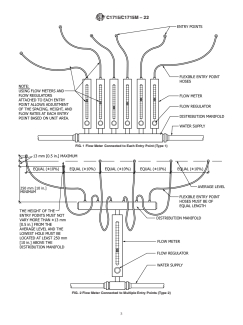
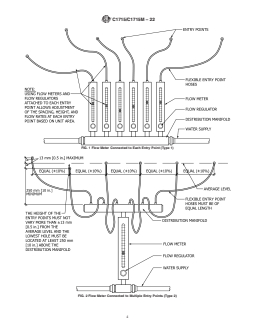
FIG. 1 Flow Meter Connected to Each Entry Point (Type 1)
FIG. 2 Flow Meter Connected to Multiple Entry Points (Type 2)
C1715/C1715M − 22
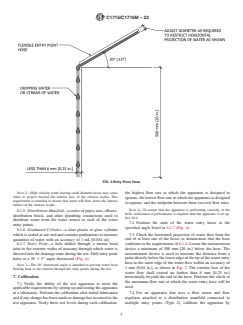
FIG. 3 Entry Point Hose
NOTE 2—High velocity water leaving small diameter hoses may cause
the highest flow rate at which the apparatus is designed to
water to project beyond the interior face of the exterior wythe. This
operate, the lowest flow rate at which the apparatus is designed
requirement is intended to ensure that water will flow down the interior
to operate, and the midpoint between these two test flow rates.
surface of the exterior wythe.
NOTE 4—To ensure that the apparatus is performing correctly in the
6.1.5 Distribution Manifold—a series of pipes, tees, elbows,
field, verification of performance is required after the apparatus is set up.
distribution block, and other plumbing connections used to
See 10.4.
distribute water from the water source to each of the water
7.2 Position the ends of the water entry hoses at the
entry points.
specified angle listed in 6.1.7 (Fig. 4).
6.1.6 Graduated Cylinder—a clear plastic or glass cylinder
7.3 Check the horizontal projection of water flow from the
which is sealed at one end and contains graduations to measure
end of at least one of the hoses to demonstrate that the hose
quantities of water with an accuracy of 1 mL [0.034 oz].
6.1.7 Entry Point—a hole drilled through a mortar head conformstotherequirementsof6.1.4.Locatethemeasurement
device a minimum of 500 mm [20 in.] below the hose. The
joint in the exterior wythe of masonry through which water is
directed into the drainage zone during the test. Drill entry point measurement device is used to measure the distance from a
point directly below the lower edge of the tip of the water entry
holes at a 30 6 5° angle downward (Fig. 4).
hose to the outer edge of the water flow within an accuracy of
NOTE 3—The 30° downward angle is intended to prevent water from
1 mm [0.04 in.], as shown in Fig. 3. The exterior face of the
flowing back to the exterior through the entry points during the test.
water flow shall extend no farther than 6 mm [0.25 in.]
7. Calibration horizontally beyond the end of the hose. Perform this check at
the maximum flow rate at which the water entry hose will be
7.1 Verify the ability of the test apparatus to meet the
used.
applicable requirements by setting up and testing the apparatus
in a laboratory. Perform the calibration after initial fabrication 7.4 For an apparatus that uses a flow meter and flow
andifanychangehasbeenmadeordamagehasoccurredtothe regulator attached to a distribution manifold connected to
test apparatus. Verify three test levels during each calibration: multiple entry points (Type 2), calibrate the apparatus by
C1715/C1715M − 22
FIG. 4 Entry Point with Hose Inserted
setting up the system in a laboratory so that the water entry 9. Preparation of Test Apparatus
points are located at the same level (within 2 mm [0.08 in.])
9.1 Install entry points on the exterior face of the exterior
except that one entry point is positioned 13 mm [0.5 in.] above
masonry wythe at a distance above the base of the masonry
the average level and one entry point is positioned 13 mm [0.5
walldrainagesystemorelementtobetestedthatisgreaterthan
in.]belowtheaveragelevel.Settheheightbetweentheaverage
or equal to the spacing of the entry points, but not less than 400
level of the entry points and the top of the flow meter at the
mm [16 in.] (Fig. 5 and Fig. 6).
specified minimum level specified in 6.1.2.
NOTE 6—The element to be tested may include the flashing or water
collection system within the height of the wall; the portion of the wall
N
...
This document is not an ASTM standard and is intended only to provide the user of an ASTM standard an indication of what changes have been made to the previous version. Because
it may not be technically possible to adequately depict all changes accurately, ASTM recommends that users consult prior editions as appropriate. In all cases only the current version
of the standard as published by ASTM is to be considered the official document.
Designation: C1715/C1715M − 21 C1715/C1715M − 22
Standard Test Method for
Evaluation of Water Leakage Performance of Masonry Wall
Drainage Systems
This standard is issued under the fixed designation C1715/C1715M; the number immediately following the designation indicates the
year of original adoption or, in the case of revision, the year of last revision. A number in parentheses indicates the year of last
reapproval. A superscript epsilon (´) indicates an editorial change since the last revision or reapproval.
1. Scope*
1.1 This test method describes a standard procedure for determining the ability of masonry wall drainage systems to collect water
that penetrates the exterior masonry wythe during rainstorms and to direct this water back to the exterior surface of the wall.
1.2 This test method is applicable to wall systems that contain an exterior masonry wythe with a drainage zone on the interior face
of the exterior wythe. It is not applicable to single-wythe drainage walls.
1.3 This test method is not applicable to masonry barrier walls or other masonry walls that are designed without drainage zones
behind the exterior wythe.
1.4 This test method covers the application of the testing using either inch-pound or SI units. The values stated in either SI units
or inch-pound units are to be regarded separately as standard. Within the text, the inch-pound units are shown in brackets. The
values stated in each system may not be exact equivalents; therefore, each system shall be used independently of the other.
Combining values from the two systems may result in nonconformance with the standard.
1.5 This standard does not purport to address all of the safety concerns, if any, associated with its use. It is the responsibility
of the user of this standard to establish appropriate safety, health, and environmental practices and determine the applicability of
regulatory limitations prior to use.
1.6 This international standard was developed in accordance with internationally recognized principles on standardization
established in the Decision on Principles for the Development of International Standards, Guides and Recommendations issued
by the World Trade Organization Technical Barriers to Trade (TBT) Committee.
2. Referenced Documents
2.1 ASTM Standards:
C1232 Terminology for Masonry
C1601 Test Method for Field Determination of Water Penetration of Masonry Wall Surfaces
E514/E514M Test Method for Water Penetration and Leakage Through Masonry
E631 Terminology of Building Constructions
This test method is under the jurisdiction of ASTM Committee C15 on Manufactured Masonry Units and is the direct responsibility of Subcommittee C15.04 on Research.
Current edition approved Dec. 1, 2021June 1, 2022. Published December 2021June 2022. Originally approved in 2009. Last previous edition approved in 20152021 as
C1715 – 15.C1715 – 21. DOI: 10.1520/C1715_C1715M-21.10.1520/C1715_C1715M-22.
For referenced ASTM standards, visit the ASTM website, www.astm.org, or contact ASTM Customer Service at service@astm.org. For Annual Book of ASTM Standards
volume information, refer to the standard’s Document Summary page on the ASTM website.
*A Summary of Changes section appears at the end of this standard
Copyright © ASTM International, 100 Barr Harbor Drive, PO Box C700, West Conshohocken, PA 19428-2959. United States
C1715/C1715M − 22
3. Terminology
3.1 Definitions—For definitions of terms relating to building construction used in this test method, see Terminology E631. For
definitions of terms relating to masonry, brick and clay tile, and concrete masonry units used in this test method, see Terminology
C1232.
3.2 Definitions of Terms Specific to This Standard:
3.2.1 back-up wall, n—the portion of the wall system located on the interior side of the drainage zone.
3.2.2 drainage zone, n—the region located between the interior face of the exterior wythe of masonry and the exterior face of the
back-up wall or the water-resistive barrier placed on the exterior face of the back-up wall to facilitate the flow of water to a flashing
or water collection system.
3.2.2.1 Discussion—
The drainage zone often includes other components such as rigid insulation in addition to devices that facilitate the flow of water
or prevent mortar from blocking the weeps.
3.2.3 flashing, n—an impervious material placed at specified locations in a masonry wall drainage system to collect and direct
water penetrating through the exterior wythe of masonry to the exterior face of the exterior wythe of masonry by means of a weep
system.
3.2.4 masonry barrier wall, n—single or multi-wythe masonry wall system that does not contain a drainage zone directly behind
the exterior masonry wythe.
3.2.5 masonry drainage wall, n—masonry wall system designed with a drainage zone immediately behind the exterior masonry
wythe that allows water penetrating the masonry to flow down the drainage zone where the water is collected and diverted by
flashing to the exterior face of the exterior wythe or collected and drained by some other water collection system.
3.2.5.1 Discussion—
This wall type includes: masonry cavity walls; anchored masonry veneer walls; insulated cavity walls; and any other masonry wall
systems with a drainage zone.
3.2.6 masonry wall drainage system, n—the drainage zone, the water resistive barrier (where included), the flashing or other water
collection devices, and the weep system in a masonry drainage wall designed to collect water that penetrates the exterior masonry
wythe and direct it back to the exterior face of the exterior masonry wythe.
3.2.7 masonry wall system, n—all components of an exterior wall including the exterior masonry wythe, wall ties or anchors, the
drainage system (if included), the back-up wall, insulation, and wall finishes.
3.2.7.1 Discussion—
By definition in this standard, a masonry wall system shall consist of at least an exterior masonry wythe exposed to weather.
3.2.8 water leakage, n—penetration of water beyond the innermost plane bounding the masonry wall drainage system or water
penetration below or behind flashings.
3.2.9 water collection system, n—a trough system or similar system at the base of a drainage zone or a portion of that trough
system, used in place of flashing, intended to collect any water that penetrates the exterior wythe of masonry and direct that water
to a drainage system.
3.2.10 water resistive barrier, n—a coating or membrane on the exterior surface of the back-up wall that is intended to prevent
water, which has penetrated the exterior masonry wythe and has bridged the air space, from reaching the surface of the back-up
wall and to direct this water into the flashing or water collection system below.
3.2.11 weep system, n—a series of openings, tubes, wicks, vents, or other devices at the top surface of the flashing that facilitate
the flow of water that collects on the flashing back to the exterior surface of the wall.
C1715/C1715M − 22
4. Summary of Test Method
4.1 This test method introduces water directly into the masonry wall drainage system through holes drilled in the exterior masonry
wythe. Water is introduced along the interior face of the exterior masonry wythe by means of hoses at each entry point. These hoses
are connected to a common water source. The flow rates are controlled by flow regulators attached to each of the entry point hoses
or to a manifold that distributes water uniformly to multiple hoses. This standard sets limits for several parameters to control the
velocity and volume of the water at points of entry as well as limits on the maximum spacing of entry points to provide uniform
distribution of water along the interior face of the exterior masonry wythe. Interior and exterior observations are performed before,
during, and after the test to detect water leakage and to observe the discharge of water to the exterior.
5. Significance and Use
5.1 This test method is suitable for use on walls to determine the ability of masonry wall drainage systems to collect water
penetrating the exterior wythe and to direct this water back to the exterior surface of the exterior wythe. Removal of a portion of
the interior wall finishes is desirable to observe leakage into backup walls. Even with removal of interior finishes, in many cases
it is not practical to observe surfaces behind spandrel beams, columns, or other obstructions. Potential areas where leakage may
occur but that are not visible during the test shall be considered when interpreting the results of the test and shall be recorded in
the report.
5.2 This test method is suitable for use on mock-up walls to determine the performance of masonry wall drainage systems.
5.3 This test method is suitable for evaluating the effectiveness of flashing repairs.
6. Apparatus
6.1 Major Components:
6.1.1 Water Source—a source of potable water under pressure such as the local pressurized water supply, a water supply connected
to a pump, or water from an elevated storage tank.
6.1.2 Flow Meter—a device capable of measuring the water flow with sufficient accuracy to meet the permitted variations listed
in Section 7. The flow meter shall be either integral with or following the flow regulator. Flow meters are connected to each water
entry point (Type l as shown in Fig. 1). If all water entry points are located within 13 mm [0.5 in.] from the average height of water
entry points, the flow meter is permitted to be attached to a distribution manifold connected to multiple entry points (Type 2 as
shown in Fig. 2) provided the top of the distribution manifold is located at least 250 mm [10 in.] below the lowest entry point,
the entry point hoses are the same length (within 25 mm [1.0 in.]), and the entry points are evenly spaced (within 10 % of average
spacing).
NOTE 1—Using separate flow meters and flow regulators attached to each entry point allows adjustment of the spacing, height, and flow rates at the entry
points based on the tributary area of the wall represented by each entry point. When using a manifold attached to a single flow meter and flow regulator,
the spacing, height, and flow rates at each entry point supplied by the manifold must be approximately equal. To ensure that the flow rates from the entry
point hoses are within the specified tolerance, the heights of the entry points above the flow meter need to be approximately equal, the lowest entry point
must exceed the minimum height above the distribution manifold, and the length of each hose need to be approximately equal. Conformance to the
specified tolerance is verified during calibration.
6.1.3 Flow Regulator—a valve, either integral with the flow meters or separate, to control the rate of water flow.
6.1.4 Entry Point Hoses—hoses attached directly to the flow meter or to a distribution manifold for the purpose of supplying water
into the masonry wall drainage system. The diameter of these hoses shall be large enough to ensure that the exterior face of the
water flow shall extend no farther than 6 mm [0.25 in.] horizontally beyond the end of the hose at a distance of 500 mm [20 in.]
below the end of the hose (Fig. 3).
NOTE 2—High velocity water leaving small diameter hoses may cause water to project beyond the interior face of the exterior wythe. This requirement
is intended to ensure that water will flow down the interior surface of the exterior wythe.
6.1.5 Distribution Manifold—a series of pipes, tees, elbows, machined distribution block, and other plumbing connections used
to distribute water from the water source to each of the water entry points.
C1715/C1715M − 22
FIG. 1 Flow Meter Connected to Each Entry Point (Type 1)
FIG. 2 Flow Meter Connected to Multiple Entry Points (Type 2)
C1715/C1715M − 22
FIG. 3 Entry Point Hose
6.1.6 Graduated Cylinder—a clear plastic or glass cylinder which is sealed at one end and contains graduations to measure
quantities of water with an accuracy of 1 mL [0.034 oz].
6.1.7 Entry Point—a hole drilled through a mortar head joint in the exterior wythe of masonry through which water is directed
into the drainage zone during the test. Drill entry point holes at a 30 6 5° angle downward (Fig. 4).
NOTE 3—The 30° downward angle is intended to prevent water from flowing back to the exterior through the entry points during the test.
7. Calibration
7.1 Verify the ability of the test apparatus to meet the applicable requirements by setting up and testing the apparatus in a
laboratory. Perform the calibration after initial fabrication and if any change has been made or damage has occurred to the test
apparatus. Verify three test levels during each calibration: the highest flow rate at which the apparatus is designed to operate, the
lowest flow rate at which the apparatus is designed to operate, and the midpoint between these two test flow rates.
NOTE 4—To ensure that the apparatus is performing correctly in the field, verification of performance is required after the apparatus is set up. See 10.4.
7.2 Position the ends of the water entry hoses at the specified angle listed in 6.1.7 (Fig. 4).
7.3 Check the horizontal projection of water flow from the end of at least one of the hoses to demonstrate that the hose conforms
to the requirements of 6.1.4. Locate the measurement device a minimum of 500 mm [20 in.] below the hose. The measurement
C1715/C1715M − 22
FIG. 4 Entry Point with Hose Inserted
device is used to measure the distance from a point directly below the lower edge of the tip of the water entry hose to the outer
edge of the water flow within an accuracy of 1 mm [0.04 in.], as shown in Fig. 3. The exterior face of the water flow shall extend
no farther than 6 mm [0.25 in.] horizontally beyond the end of the hose. Perform this check at the maximum flow rate at which
the water entry hose will be used.
7.4 For an apparatus that uses a flow meter and flow regulator attached to a distribution manifold connected to multiple entry
points (Type 2), calibrate the apparatus by setting up the system in a laboratory so that the water entry points are located at the
same level (within 2 mm [0.08 in.]) except that one entry point is positioned 13 mm [0.5 in.] above the average level and one entry
point is positioned 13 mm [0.5 in.] below the average level. Set the height between the average level of the entry points and the
top of the flow meter at the specified minimum level specified in 6.1.2.
NOTE 5—Laboratory studies have been performed with up to six entry points. Experience in the field has shown that distribution manifolds can supply
adequate water flow to up to six entry point hoses to meet the calibration requirements of this standard.
7.5 Verify the flow rate at each entry point in either the Type 1 or the Type 2 apparatus using a graduated cylinder by
...