

ASTM C1531-22
(Test Method)Standard Test Methods for In Situ Measurement of Masonry Mortar Joint Shear Strength Index
General Information
- Abstract
SIGNIFICANCE AND USE
5.1 This test method provides a means of evaluating the horizontal in-plane shear behavior of mortar joints in existing unreinforced masonry assemblies (see Note 2).
Note 2: The masonry mortar joint shear strength index obtained by this test method can be related to the masonry wall shear strength by relationships contained in referencing Codes and Standards. For example, formulas relating shear index to wall shear strength are found in Chapter A1 of the International Existing Building Code and Chapter 11 of the Seismic Evaluation and Retrofit of Existing Buildings, ASCE Standard ASCE/SEI 41. The user of this standard is cautioned that these shear strength relationships are typically empirical relationships based on tests of early 20th-century unreinforced brick masonry. These relationships typically assume that wall shear strength is limited by shear of the mortar joints rather than shear through the units
5.2 For hollow ungrouted or solid unit masonry construction the shear strength index is measured only for the mortar bed joints vertically adjacent to the unit being tested. When testing hollow ungrouted masonry construction, the shear strength index is based on the horizontal interface between the mortar and the test unit and the masonry above and below the test unit. In the case of multi-wythe construction, the measured mortar joint shear strength index is applicable only to the wythe in which the test unit is located; no headers shall exist immediately above or below the test unit. The contribution of any existing collar joint mortar to the measured shear strength index is neglected, and this may lead to an overestimate of the shear strength index (see Note 3).
Note 3: Some documents that reference this test method, including ASCE/SEI 41, include a reduction factor to account for the contribution of a filled collar joint to the measured shear strength index.
5.3 The test procedure listed for Method A may be conducted as an extension of Test Method C1...
SCOPE
1.1 These test methods cover procedures for the determination of the average in situ mortar joint shear strength index in existing unreinforced solid-unit and ungrouted hollow-unit masonry built with clay or concrete units. Three methods are provided:
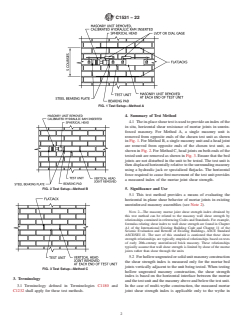
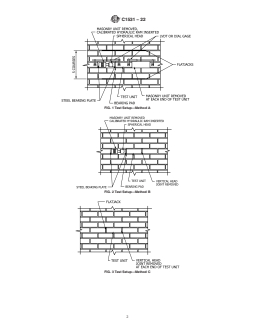
1.1.1 Method A (with Flatjacks Controlling Normal Compressive Stress)—For determining mortar joint shear strength index when the state of normal compressive stress at the test site is controlled during the test using the flatjack method described in Test Method C1197. Horizontal displacement of the test unit is monitored throughout the test. The test setup for Method A is shown in Fig. 1.
FIG. 1 Test Setup—Method A
Note 1: A paper2 by Francesco Graziotti et. al of Univ. of Pavia included in ASTM STP 1612 discusses alternative methods for interpreting Method A testing results.
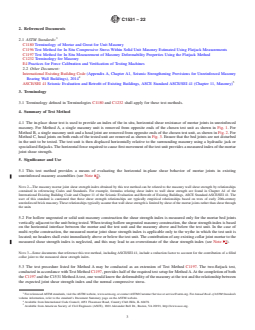
1.1.2 Method B (without Flatjacks Controlling Normal Compressive Stress)—For determining mortar joint shear strength index when using an estimate of the normal compressive stress at the location of the test site. Horizontal displacement of the test unit is not monitored during this procedure. The test set up for Method B is shown in Fig. 2.
FIG. 2 Test Setup—Method B
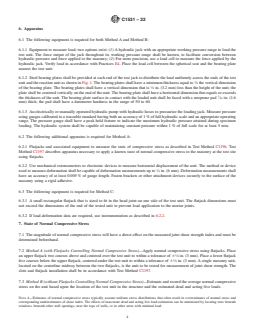
1.1.3 Method C (with Flatjack Applying Horizontal Load)—For determining mortar joint shear strength index using an estimate of the normal compressive stress at the location of the test site, as shown in Fig. 3. Horizontal displacement of the test unit is generally not measured during this procedure.
FIG. 3 Test Setup—Method C
1.2 The text of this standard refers to notes and footnotes that provide explanatory material. These notes and footnotes (excluding those in tables and figures) shall not be considered as requirements of the standard.
1.3 The values stated in inch-pound units are to be regarded as standard. The values given in parentheses are mathematical conversions to SI units that are provided for informat...
- Status
- Published
- Publication Date
- 30-Nov-2022
- Technical Committee
- C15 - Masonry – Manufactured Masonry Units, Mortars and Grouts
- Drafting Committee
- C15.04 - Research for Masonry Units and Assemblies
Buy Documents
ASTM C1531-22 - Standard Test Methods for In Situ Measurement of Masonry Mortar Joint Shear Strength Index
REDLINE ASTM C1531-22 - Standard Test Methods for In Situ Measurement of Masonry Mortar Joint Shear Strength Index
Overview
ASTM C1531-22: Standard Test Methods for In Situ Measurement of Masonry Mortar Joint Shear Strength Index provides industry-recognized procedures for determining the horizontal in-plane shear strength index of mortar joints in existing unreinforced masonry. This standard is essential for assessing the structural performance of masonry walls made from clay or concrete units, specifically in unreinforced solid-unit or ungrouted hollow-unit masonry. The methodology allows for the in situ evaluation of historic or existing structures, helping engineers, architects, and consultants make informed decisions about seismic retrofitting, restoration, and continued service life.
Key Topics
Test Methods: ASTM C1531-22 outlines three distinct test methods for determining the mortar joint shear strength index:
- Method A (with Flatjacks Controlling Normal Compressive Stress): Controls compressive stress using flatjacks as described in ASTM C1197. Horizontal displacement of the test unit is monitored throughout the test.
- Method B (without Flatjacks): Uses estimated normal compressive stress at the location; horizontal displacement is not monitored.
- Method C (with Flatjack Applying Horizontal Load): Employs a flatjack to apply horizontal load, using an estimate of the normal compressive stress. Displacement is generally not monitored.
Significance and Use:
- Evaluates the horizontal in-plane shear strength of mortar joints, a critical factor for seismic performance and lateral load resistance.
- The shear strength index obtained can be related to the wall shear strength through empirical relationships, often referenced in codes such as the International Existing Building Code (IEBC) and ASCE/SEI 41 for seismic evaluation and retrofit.
Types of Construction Covered:
- Applicable to solid-unit masonry and ungrouted hollow-unit masonry constructed with either clay or concrete units.
- In multi-wythe wall assemblies, measurements apply only to the specific wythe tested.
Equipment and Apparatus:
- Utilizes hydraulic jacks, flatjacks, load cells, and displacement measurement devices, with verification and calibration as per ASTM E4.
Applications
- Seismic Assessment and Retrofit: The shear strength information provided by ASTM C1531-22 helps structural engineers evaluate the lateral load resistance of unreinforced masonry walls, which is vital for seismic retrofitting projects.
- Historic Building Conservation: In situ measurements offer a minimally invasive means to assess the existing strength characteristics of historic masonry, supporting preservation and rehabilitation strategies.
- Condition Assessment and Safety Evaluations: The standard is widely used for evaluating the current shear performance of mortar joints as part of comprehensive structural condition assessments.
- Supporting Code Compliance: Results from ASTM C1531-22 tests underpin analyses required by building codes and seismic standards for existing structures.
Related Standards
- ASTM C1196: Test Method for In Situ Compressive Stress Within Solid Unit Masonry Estimated Using Flatjack Measurements.
- ASTM C1197: Test Method for In Situ Measurement of Masonry Deformability Properties Using the Flatjack Method.
- ASTM C1180 & ASTM C1232: Terminology standards related to mortar, grout, and masonry.
- ASCE/SEI 41: Seismic Evaluation and Retrofit of Existing Buildings.
- International Existing Building Code (IEBC): Provides formulas and empirical relationships for relating measured shear index to wall shear strength.
- ASTM E4: Practices for Force Calibration and Verification of Testing Machines.
Practical Value
Using ASTM C1531-22 ensures reliable, consistent, and code-recognized assessment of masonry mortar joint shear strength index. The standard improves understanding of in-place structural performance, supports targeted interventions for safety and seismic resilience, and aligns with requirements for documentation and reporting needed for code compliance and historic preservation.
Keywords: masonry, mortar joint, in situ testing, shear strength, unreinforced masonry, flatjack, seismic assessment, ASTM C1531-22, structural evaluation.
Relations
- Effective Date
- 15-Dec-2023
- Effective Date
- 01-Dec-2018
- Effective Date
- 01-Jun-2017
- Effective Date
- 01-Sep-2015
- Effective Date
- 01-Jun-2015
- Effective Date
- 01-Jul-2014
- Effective Date
- 01-Jul-2014
- Effective Date
- 01-Jun-2014
- Effective Date
- 01-Jun-2012
- Effective Date
- 15-Dec-2010
- Effective Date
- 01-Dec-2010
- Effective Date
- 15-Jun-2010
- Effective Date
- 01-Jun-2010
- Effective Date
- 01-May-2010
- Effective Date
- 01-Jan-2010
Buy Documents
ASTM C1531-22 - Standard Test Methods for In Situ Measurement of Masonry Mortar Joint Shear Strength Index
REDLINE ASTM C1531-22 - Standard Test Methods for In Situ Measurement of Masonry Mortar Joint Shear Strength Index
Get Certified
Connect with accredited certification bodies for this standard

DIBt (Deutsches Institut für Bautechnik)
German Institute for Building Technology.
DIN CERTCO
DIN Group product certification.

Aboma Certification B.V.
Specialized in construction, metal, and transport sectors.
Sponsored listings
Frequently Asked Questions
ASTM C1531-22 is a standard published by ASTM International. Its full title is "Standard Test Methods for In Situ Measurement of Masonry Mortar Joint Shear Strength Index". This standard covers: SIGNIFICANCE AND USE 5.1 This test method provides a means of evaluating the horizontal in-plane shear behavior of mortar joints in existing unreinforced masonry assemblies (see Note 2). Note 2: The masonry mortar joint shear strength index obtained by this test method can be related to the masonry wall shear strength by relationships contained in referencing Codes and Standards. For example, formulas relating shear index to wall shear strength are found in Chapter A1 of the International Existing Building Code and Chapter 11 of the Seismic Evaluation and Retrofit of Existing Buildings, ASCE Standard ASCE/SEI 41. The user of this standard is cautioned that these shear strength relationships are typically empirical relationships based on tests of early 20th-century unreinforced brick masonry. These relationships typically assume that wall shear strength is limited by shear of the mortar joints rather than shear through the units 5.2 For hollow ungrouted or solid unit masonry construction the shear strength index is measured only for the mortar bed joints vertically adjacent to the unit being tested. When testing hollow ungrouted masonry construction, the shear strength index is based on the horizontal interface between the mortar and the test unit and the masonry above and below the test unit. In the case of multi-wythe construction, the measured mortar joint shear strength index is applicable only to the wythe in which the test unit is located; no headers shall exist immediately above or below the test unit. The contribution of any existing collar joint mortar to the measured shear strength index is neglected, and this may lead to an overestimate of the shear strength index (see Note 3). Note 3: Some documents that reference this test method, including ASCE/SEI 41, include a reduction factor to account for the contribution of a filled collar joint to the measured shear strength index. 5.3 The test procedure listed for Method A may be conducted as an extension of Test Method C1... SCOPE 1.1 These test methods cover procedures for the determination of the average in situ mortar joint shear strength index in existing unreinforced solid-unit and ungrouted hollow-unit masonry built with clay or concrete units. Three methods are provided: 1.1.1 Method A (with Flatjacks Controlling Normal Compressive Stress)—For determining mortar joint shear strength index when the state of normal compressive stress at the test site is controlled during the test using the flatjack method described in Test Method C1197. Horizontal displacement of the test unit is monitored throughout the test. The test setup for Method A is shown in Fig. 1. FIG. 1 Test Setup—Method A Note 1: A paper2 by Francesco Graziotti et. al of Univ. of Pavia included in ASTM STP 1612 discusses alternative methods for interpreting Method A testing results. 1.1.2 Method B (without Flatjacks Controlling Normal Compressive Stress)—For determining mortar joint shear strength index when using an estimate of the normal compressive stress at the location of the test site. Horizontal displacement of the test unit is not monitored during this procedure. The test set up for Method B is shown in Fig. 2. FIG. 2 Test Setup—Method B 1.1.3 Method C (with Flatjack Applying Horizontal Load)—For determining mortar joint shear strength index using an estimate of the normal compressive stress at the location of the test site, as shown in Fig. 3. Horizontal displacement of the test unit is generally not measured during this procedure. FIG. 3 Test Setup—Method C 1.2 The text of this standard refers to notes and footnotes that provide explanatory material. These notes and footnotes (excluding those in tables and figures) shall not be considered as requirements of the standard. 1.3 The values stated in inch-pound units are to be regarded as standard. The values given in parentheses are mathematical conversions to SI units that are provided for informat...
SIGNIFICANCE AND USE 5.1 This test method provides a means of evaluating the horizontal in-plane shear behavior of mortar joints in existing unreinforced masonry assemblies (see Note 2). Note 2: The masonry mortar joint shear strength index obtained by this test method can be related to the masonry wall shear strength by relationships contained in referencing Codes and Standards. For example, formulas relating shear index to wall shear strength are found in Chapter A1 of the International Existing Building Code and Chapter 11 of the Seismic Evaluation and Retrofit of Existing Buildings, ASCE Standard ASCE/SEI 41. The user of this standard is cautioned that these shear strength relationships are typically empirical relationships based on tests of early 20th-century unreinforced brick masonry. These relationships typically assume that wall shear strength is limited by shear of the mortar joints rather than shear through the units 5.2 For hollow ungrouted or solid unit masonry construction the shear strength index is measured only for the mortar bed joints vertically adjacent to the unit being tested. When testing hollow ungrouted masonry construction, the shear strength index is based on the horizontal interface between the mortar and the test unit and the masonry above and below the test unit. In the case of multi-wythe construction, the measured mortar joint shear strength index is applicable only to the wythe in which the test unit is located; no headers shall exist immediately above or below the test unit. The contribution of any existing collar joint mortar to the measured shear strength index is neglected, and this may lead to an overestimate of the shear strength index (see Note 3). Note 3: Some documents that reference this test method, including ASCE/SEI 41, include a reduction factor to account for the contribution of a filled collar joint to the measured shear strength index. 5.3 The test procedure listed for Method A may be conducted as an extension of Test Method C1... SCOPE 1.1 These test methods cover procedures for the determination of the average in situ mortar joint shear strength index in existing unreinforced solid-unit and ungrouted hollow-unit masonry built with clay or concrete units. Three methods are provided: 1.1.1 Method A (with Flatjacks Controlling Normal Compressive Stress)—For determining mortar joint shear strength index when the state of normal compressive stress at the test site is controlled during the test using the flatjack method described in Test Method C1197. Horizontal displacement of the test unit is monitored throughout the test. The test setup for Method A is shown in Fig. 1. FIG. 1 Test Setup—Method A Note 1: A paper2 by Francesco Graziotti et. al of Univ. of Pavia included in ASTM STP 1612 discusses alternative methods for interpreting Method A testing results. 1.1.2 Method B (without Flatjacks Controlling Normal Compressive Stress)—For determining mortar joint shear strength index when using an estimate of the normal compressive stress at the location of the test site. Horizontal displacement of the test unit is not monitored during this procedure. The test set up for Method B is shown in Fig. 2. FIG. 2 Test Setup—Method B 1.1.3 Method C (with Flatjack Applying Horizontal Load)—For determining mortar joint shear strength index using an estimate of the normal compressive stress at the location of the test site, as shown in Fig. 3. Horizontal displacement of the test unit is generally not measured during this procedure. FIG. 3 Test Setup—Method C 1.2 The text of this standard refers to notes and footnotes that provide explanatory material. These notes and footnotes (excluding those in tables and figures) shall not be considered as requirements of the standard. 1.3 The values stated in inch-pound units are to be regarded as standard. The values given in parentheses are mathematical conversions to SI units that are provided for informat...
ASTM C1531-22 is classified under the following ICS (International Classification for Standards) categories: 91.080.30 - Masonry. The ICS classification helps identify the subject area and facilitates finding related standards.
ASTM C1531-22 has the following relationships with other standards: It is inter standard links to ASTM C1232-23, ASTM C1180-18, ASTM C1232-17, ASTM C1232-15a, ASTM C1232-15, ASTM C1197-14, ASTM C1196-14, ASTM E4-14, ASTM C1232-12, ASTM C1232-10c, ASTM C1180-10, ASTM C1232-10b, ASTM E4-10, ASTM C1232-10a, ASTM C1232-10. Understanding these relationships helps ensure you are using the most current and applicable version of the standard.
ASTM C1531-22 is available in PDF format for immediate download after purchase. The document can be added to your cart and obtained through the secure checkout process. Digital delivery ensures instant access to the complete standard document.
Standards Content (Sample)
This international standard was developed in accordance with internationally recognized principles on standardization established in the Decision on Principles for the
Development of International Standards, Guides and Recommendations issued by the World Trade Organization Technical Barriers to Trade (TBT) Committee.
Designation: C1531 − 22
Standard Test Methods for
In Situ Measurement of Masonry Mortar Joint Shear
Strength Index
This standard is issued under the fixed designation C1531; the number immediately following the designation indicates the year of
original adoption or, in the case of revision, the year of last revision. A number in parentheses indicates the year of last reapproval. A
superscript epsilon (´) indicates an editorial change since the last revision or reapproval.
1. Scope* 1.3 The values stated in inch-pound units are to be regarded
as standard. The values given in parentheses are mathematical
1.1 These test methods cover procedures for the determina-
conversions to SI units that are provided for information only
tion of the average in situ mortar joint shear strength index in
and are not considered standard.
existing unreinforced solid-unit and ungrouted hollow-unit
1.4 This standard does not purport to address all of the
masonry built with clay or concrete units. Three methods are
safety concerns, if any, associated with its use. It is the
provided:
responsibility of the user of this standard to establish appro-
1.1.1 Method A (with Flatjacks Controlling Normal Com-
priate safety, health, and environmental practices and deter-
pressive Stress)—For determining mortar joint shear strength
mine the applicability of regulatory limitations prior to use.
index when the state of normal compressive stress at the test
1.5 This international standard was developed in accor-
site is controlled during the test using the flatjack method
dance with internationally recognized principles on standard-
described in Test Method C1197. Horizontal displacement of
ization established in the Decision on Principles for the
the test unit is monitored throughout the test.The test setup for
Development of International Standards, Guides and Recom-
Method A is shown in Fig. 1.
mendations issued by the World Trade Organization Technical
NOTE 1—A paper by Francesco Graziotti et. al of Univ. of Pavia
Barriers to Trade (TBT) Committee.
included in ASTM STP 1612 discusses alternative methods for interpret-
ing Method A testing results.
2. Referenced Documents
1.1.2 Method B (without Flatjacks Controlling Normal
2.1 ASTM Standards:
Compressive Stress)—For determining mortar joint shear
C1180 Terminology of Mortar and Grout for Unit Masonry
strength index when using an estimate of the normal compres-
C1196 Test Method for In Situ Compressive Stress Within
sive stress at the location of the test site. Horizontal displace-
Solid Unit Masonry Estimated Using Flatjack Measure-
ment of the test unit is not monitored during this procedure.
ments
The test set up for Method B is shown in Fig. 2.
C1197 Test Method for In Situ Measurement of Masonry
1.1.3 MethodC(withFlatjackApplyingHorizontalLoad)—
Deformability Properties Using the Flatjack Method
For determining mortar joint shear strength index using an
C1232 Terminology for Masonry
estimate of the normal compressive stress at the location of the
E4 Practices for Force Calibration and Verification of Test-
testsite,asshowninFig.3.Horizontaldisplacementofthetest
ing Machines
unit is generally not measured during this procedure.
2.2 Other Document:
1.2 The text of this standard refers to notes and footnotes
International Existing Building Code (Appendix A, Chapter
that provide explanatory material. These notes and footnotes
A1, Seismic Strengthening Provisions for Unreinforced
(excluding those in tables and figures) shall not be considered
Masonry Bearing Wall Buildings), 2014
as requirements of the standard.
ASCE/SEI 41 Seismic Evaluation and Retrofit of Existing
Buildings, ASCE Standard ASCE/SEI 41 (Chapter 11,
Masonry)
These test methods are under the jurisdiction of ASTM Committee C15 on
Manufactured Masonry Units and are the direct responsibility of Subcommittee
C15.04 on Research. For referenced ASTM standards, visit the ASTM website, www.astm.org, or
Current edition approved Dec. 1, 2022. Published December 2022. Originally contact ASTM Customer Service at service@astm.org. For Annual Book of ASTM
approved in 2002. Last previous edition approved in 2016 as C1531 – 16. DOI: Standards volume information, refer to the standard’s Document Summary page on
10.1520/C1531-22. the ASTM website.
2 4
Graziotti, F., Guerrini, G., Rossi,A.,Andreotti, G., and Magenes, G., “Proposal Available from International Code Council, 4051 Flossmoor Road, Country
for an Improved Procedure and Interpretation of ASTM C1531 for the In Situ Club Hills, IL 60478.
DeterminationofBrick-MasonryShearStrength,”Masonry2018,ASTMSTP1612, Available from American Society of Civil Engineers (ASCE), 1801 Alexander
ASTM International, 2018, pp. 13–33, http://dx.doi.org/10.1520/STP161220170181 Bell Dr., Reston, VA 20191, http://www.asce.org.
*A Summary of Changes section appears at the end of this standard
Copyright © ASTM International, 100 Barr Harbor Drive, PO Box C700, West Conshohocken, PA 19428-2959. United States
C1531 − 22
FIG. 1 Test Setup—Method A
4. Summary of Test Method
4.1 The in-place shear test is used to provide an index of the
in situ, horizontal shear resistance of mortar joints in unrein-
forced masonry. For Method A, a single masonry unit is
removed from opposite ends of the chosen test unit as shown
in Fig. 1. For Method B, a single masonry unit and a head joint
are removed from opposite ends of the chosen test unit, as
shown in Fig. 2. For Method C, head joints on both ends of the
tested unit are removed as shown in Fig. 3. Ensure that the bed
joints are not disturbed in the unit to be tested. The test unit is
thendisplacedhorizontallyrelativetothesurroundingmasonry
using a hydraulic jack or specialized flatjacks. The horizontal
force required to cause first movement of the test unit provides
a measured index of the mortar joint shear strength.
5. Significance and Use
FIG. 2 Test Setup—Method B
5.1 This test method provides a means of evaluating the
horizontal in-plane shear behavior of mortar joints in existing
unreinforced masonry assemblies (see Note 2).
NOTE 2—The masonry mortar joint shear strength index obtained by
this test method can be related to the masonry wall shear strength by
relationships contained in referencing Codes and Standards. For example,
formulas relating shear index to wall shear strength are found in Chapter
A1 of the International Existing Building Code and Chapter 11 of the
Seismic Evaluation and Retrofit of Existing Buildings, ASCE Standard
ASCE/SEI 41. The user of this standard is cautioned that these shear
strength relationships are typically empirical relationships based on tests
of early 20th-century unreinforced brick masonry. These relationships
typically assume that wall shear strength is limited by shear of the mortar
joints rather than shear through the units
5.2 Forhollowungroutedorsolidunitmasonryconstruction
the shear strength index is measured only for the mortar bed
joints vertically adjacent to the unit being tested. When testing
FIG. 3 Test Setup—Method C
hollow ungrouted masonry construction, the shear strength
index is based on the horizontal interface between the mortar
3. Terminology
andthetestunitandthemasonryaboveandbelowthetestunit.
3.1 Terminology defined in Terminologies C1180 and In the case of multi-wythe construction, the measured mortar
C1232 shall apply for these test methods. joint shear strength index is applicable only to the wythe in
C1531 − 22
which the test unit is located; no headers shall exist immedi- 6.2.2 Usemechanicalextensometersorelectronicdevicesto
ately above or below the test unit. The contribution of any measure horizontal displacement of the unit. The method or
existing collar joint mortar to the measured shear strength device used to measure deformation shall be capable of
index is neglected, and this may lead to an overestimate of the deformation measurements up to ⁄4 in. (6 mm). Deformation
shear strength index (see Note 3). measurements shall have an accuracy of at least 0.005 % of
gauge length. Fasten brackets or other attachment devices
NOTE 3—Some documents that reference this test method, including
securely to the surface of the masonry using a rigid adhesive.
ASCE/SEI41,includeareductionfactortoaccountforthecontributionof
a filled collar joint to the measured shear strength index.
6.3 The following equipment is required for Method C:
6.3.1 A small rectangular flatjack that is sized to fit in the
5.3 The test procedure listed for Method A may be con-
head joint on one side of the test unit. The flatjack dimensions
ducted as an extension ofTest MethodC1197.The two-flatjack
must not exceed the dimensions of the end of the tested unit to
test, conducted in accordance with Test Method C1197, pro-
prevent load application to the mortar joints.
vides half of the required test setup for Method A. At the
6.3.2 If load-deformation data are required, use instrumen-
completion of both the C1197 and the C1531 Method A test,
tation as described in 6.2.2.
one would know the deformability of the masonry at the test
and the relationship between the expected joint shear strength
7. State of Normal Compressive Stress
index and the normal compressive stress.
7.1 The magnitude of normal compressive stress will have a
direct effect on the measured joint shear strength index and
6. Apparatus
must be determined beforehand.
6.1 The following equipment is required for both MethodA
7.2 MethodA(withFlatjacksControllingNormalCompres-
and Method B:
sive Stress)—Apply normal compressive stress using flatjacks.
6.1.1 Equipment to measure load; two options exist: (1)A
Place an upper flatjack two courses above and centered over
hydraulic jack with an appropriate working pressure range to
the test unit to within a tolerance of 6 ⁄8 in. (3 mm). Place a
load the test unit. The force output of the jack throughout its
lower flatjack five courses below the upper flatjack, centered
workingpressurerangeshallbeknown,tofacilitateconversion
under the test unit to within a tolerance of 6 ⁄8 in. (3 mm). A
between hydraulic pressure and force applied to the masonry;
single masonry unit, located on the centerline midway between
(2) For more precision, use a load cell to measure the force
the two flatjacks, is the unit to be tested for measurement of
applied by the hydraulic jack. Verify load in accordance with
joint shear strength. The slots and flatjack installation shall be
Practices E4. Place the load cell between the spherical seat and
in accordance with Test Method C1197.
the bearing plate nearest the test unit.
7.3 Method B (without Flatjacks Controlling Normal Com-
6.1.2 Steel bearing plates shall be provided at each end of
pressive Stress)—Estimate and record the average normal
the test jack to distribute the load uniformly across the ends of
compressive stress on the unit based upon the location of the
the test unit and the reaction unit as shown in Fig. 1. The
1 test unit in the structure and the estimated dead and acting live
bearing plates shall have a minimum thickness equal to ⁄8 the
loads.
verticaldimensionofthebearingplate.Thebearingplatesshall
have a vertical dimension that is ⁄8 in. (3.2 mm) less than the
NOTE 4—Estimates of normal compressive stress typically assume
height of the unit; the plate shall be centered vertically on the
uniform stress distributions that often result in overestimates of normal
stress and corresponding underestimates of shear index. The effects of
end of the unit. The bearing plate shall have a horizontal
inaccurate dead and acting live load estimation can be minimized by
dimension that equals or exceeds the thickness of the unit. The
locatingtestsbeneathwindows,beneathotherwallopenings,nearthetops
bearing plate surface in contact with the loaded unit shall be
of walls, or in other areas with minimal load.
faced with a neoprene pad ⁄16 in. (1.6 mm) thick; the pad shall
7.4 Method C (with Flatjack Applying Horizontal Load)—
have a durometer hardness in the range of 50 to 60.
Estimate the average normal compressive stress using the
6.1.3 An electrically or manually operated hydraulic pump
method described in 7.3.
with hydraulic hoses to pressurize the loading jack. Measure
pressure using gauges calibrated to a traceable standard having
8. Preparation of Test Site
both an accuracy of 1 % of full hydraulic scale and an
8.1 The location at which the joint shear strength index is
appropriate operating range. The pressure gauge shall have a
measured is dictated by engineering objectives.Avoid areas in
peak hold feature to indicate the maximum hydraulic pressure
which the mortar joints appear to be nonparallel.The unit to be
attained during specimen loading. The hydraulic system shall
tested must be in the stretcher orientation. Locate the test site
be capable of maintaining constant pressure within 1 % of full
far enough from wall openings or ends so that the loading jack
scale for at least 5 min.
bears against enough masonry to resist forces generated during
6.2 The following additional apparatus is required for
loading of the test unit. The basic arrangement is illustrated in
Method A:
Fig. 1 for MethodA, in Fig. 2 for Method B, and in Fig. 3 for
6.2.1 Flatjacks and associated equipment to measure the Method C.At the desired location the following steps must be
state of compressive stress as described inTest Method C1196. taken to prepare the site for testing:
Test Method C1197 describes apparatus necessary to apply a 8.1.1 For Method A or Method B, provide a space for the
knownstateofnormalcompressivestresstothemasonryatthe loading jack by removing a unit on one end of the test unit. Do
test site using flatjacks. not remove a unit for Method C.
C1531 − 22
8.1.2 For Method A, if the joint shear strength index in flatjacks and displacement measurement devices.Any voids or
opposite directions is to be determined, remove the unit at both slots created during site preparation are permitted to be filled
ends of the test unit to isolate the joints being investigated. usingtheoriginalorsimilarunitsandamortarorothersuitable
Otherwise, follow the procedure of 8.1.3. The mortar in the material of a color and strength similar to the original mortar.
joints above and below the test specimen shall not extend
9.2 Method B (without Flatjacks Controlling Normal Com-
beyond the vertical ends of the unit being tested.
pressive Stress):
8.1.3 For Method B, remove a masonry unit on one side of
9.2.1 Place the loading jack, spherical seat ( if used), and
the test unit and the head joint on the opposite end of the test
bearing plates into the space next to the test unit. Shim the jack
unit. The mortar in the
...
This document is not an ASTM standard and is intended only to provide the user of an ASTM standard an indication of what changes have been made to the previous version. Because
it may not be technically possible to adequately depict all changes accurately, ASTM recommends that users consult prior editions as appropriate. In all cases only the current version
of the standard as published by ASTM is to be considered the official document.
Designation: C1531 − 16 C1531 − 22
Standard Test Methods for
In Situ Measurement of Masonry Mortar Joint Shear
Strength Index
This standard is issued under the fixed designation C1531; the number immediately following the designation indicates the year of
original adoption or, in the case of revision, the year of last revision. A number in parentheses indicates the year of last reapproval. A
superscript epsilon (´) indicates an editorial change since the last revision or reapproval.
1. Scope*
1.1 These test methods cover procedures for the determination of the average in situ mortar joint shear strength index in existing
unreinforced solid-unit and ungrouted hollow-unit masonry built with clay or concrete units. Three methods are provided:
1.1.1 Method A (with Flatjacks Controlling Normal Compressive Stress)—For determining mortar joint shear strength index when
the state of normal compressive stress at the test site is controlled during the test using the flatjack method described in Test Method
C1197. Horizontal displacement of the test unit is monitored throughout the test. The test setup for Method A is shown in Fig. 1.
NOTE 1—A paper by Francesco Graziotti et. al of Univ. of Pavia included in ASTM STP 1612 discusses alternative methods for interpreting Method A
testing results.
1.1.2 Method B (without Flatjacks Controlling Normal Compressive Stress)—For determining mortar joint shear strength index
when using an estimate of the normal compressive stress at the location of the test site. Horizontal displacement of the test unit
is not monitored during this procedure. The test set up for Method B is shown in Fig. 2.
1.1.3 Method C (with Flatjack Applying Horizontal Load)—For determining mortar joint shear strength index using an estimate
of the normal compressive stress at the location of the test site, as shown in Fig. 3. Horizontal displacement of the test unit is
generally not measured during this procedure.
1.2 The text of this standard refers to notes and footnotes that provide explanatory material. These notes and footnotes (excluding
those in tables and figures) shall not be considered as requirements of the standard.
1.3 The values stated in inch-pound units are to be regarded as standard. The values given in parentheses are mathematical
conversions to SI units that are provided for information only and are not considered standard.
1.4 This standard does not purport to address all of the safety concerns, if any, associated with its use. It is the responsibility
of the user of this standard to establish appropriate safety safety, health, and healthenvironmental practices and determine the
applicability of regulatory limitations prior to use.
1.5 This international standard was developed in accordance with internationally recognized principles on standardization
established in the Decision on Principles for the Development of International Standards, Guides and Recommendations issued
by the World Trade Organization Technical Barriers to Trade (TBT) Committee.
These test methods are under the jurisdiction of ASTM Committee C15 on Manufactured Masonry Units and are the direct responsibility of Subcommittee C15.04 on
Research.
Current edition approved June 1, 2016Dec. 1, 2022. Published July 2016December 2022. Originally approved in 2002. Last previous edition approved in 20152016 as
C1531 – 15.C1531 – 16. DOI: 10.1520/C1531-16.10.1520/C1531-22.
Graziotti, F., Guerrini, G., Rossi, A., Andreotti, G., and Magenes, G., “Proposal for an Improved Procedure and Interpretation of ASTM C1531 for the In Situ
Determination of Brick-Masonry Shear Strength,” Masonry 2018, ASTM STP 1612, ASTM International, 2018, pp. 13–33, http://dx.doi.org/10.1520/STP161220170181
*A Summary of Changes section appears at the end of this standard
Copyright © ASTM International, 100 Barr Harbor Drive, PO Box C700, West Conshohocken, PA 19428-2959. United States
C1531 − 22
FIG. 1 Test Setup—Method A
FIG. 2 Test Setup—Method B
FIG. 3 Test Setup—Method C
C1531 − 22
2. Referenced Documents
2.1 ASTM Standards:
C1180 Terminology of Mortar and Grout for Unit Masonry
C1196 Test Method for In Situ Compressive Stress Within Solid Unit Masonry Estimated Using Flatjack Measurements
C1197 Test Method for In Situ Measurement of Masonry Deformability Properties Using the Flatjack Method
C1232 Terminology for Masonry
E4 Practices for Force Calibration and Verification of Testing Machines
2.2 Other Document:
International Existing Building Code (Appendix A, Chapter A1, Seismic Strengthening Provisions for Unreinforced Masonry
Bearing Wall Buildings), 2014
ASCE/SEI 41 Seismic Evaluation and Retrofit of Existing Buildings, ASCE Standard ASCE/SEI 41 (Chapter 11, Masonry)
3. Terminology
3.1 Terminology defined in Terminologies C1180 and C1232 shall apply for these test methods.
4. Summary of Test Method
4.1 The in-place shear test is used to provide an index of the in situ, horizontal shear resistance of mortar joints in unreinforced
masonry. For Method A, a single masonry unit is removed from opposite ends of the chosen test unit as shown in Fig. 1. For
Method B, a single masonry unit and a head joint are removed from opposite ends of the chosen test unit, as shown in Fig. 2. For
Method C, head joints on both ends of the tested unit are removed as shown in Fig. 3. Ensure that the bed joints are not disturbed
in the unit to be tested. The test unit is then displaced horizontally relative to the surrounding masonry using a hydraulic jack or
specialized flatjacks. The horizontal force required to cause first movement of the test unit provides a measured index of the mortar
joint shear strength.
5. Significance and Use
5.1 This test method provides a means of evaluating the horizontal in-plane shear behavior of mortar joints in existing
unreinforced masonry assemblies (see Note 12).
NOTE 2—The masonry mortar joint shear strength index obtained by this test method can be related to the masonry wall shear strength by relationships
contained in referencing Codes and Standards. For example, formulas relating shear index to wall shear strength are found in Chapter A1 of the
International Existing Building Code and Chapter 11 of the Seismic Evaluation and Retrofit of Existing Buildings, ASCE Standard ASCE/SEI 41. The
user of this standard is cautioned that these shear strength relationships are typically empirical relationships based on tests of early 20th-century
unreinforced brick masonry. These relationships typically assume that wall shear strength is limited by shear of the mortar joints rather than shear through
the units
5.2 For hollow ungrouted or solid unit masonry construction the shear strength index is measured only for the mortar bed joints
vertically adjacent to the unit being tested. When testing hollow ungrouted masonry construction, the shear strength index is based
on the horizontal interface between the mortar and the test unit and the masonry above and below the test unit. In the case of
multi-wythe construction, the measured mortar joint shear strength index is applicable only to the wythe in which the test unit is
located; no headers shall exist immediately above or below the test unit. The contribution of any existing collar joint mortar to the
measured shear strength index is neglected, and this may lead to an overestimate of the shear strength index (see Note 23).
NOTE 3—Some documents that reference this test method, including ASCE/SEI 41, include a reduction factor to account for the contribution of a filled
collar joint to the measured shear strength index.
5.3 The test procedure listed for Method A may be conducted as an extension of Test Method C1197. The two-flatjack test,
conducted in accordance with Test Method C1197, provides half of the required test setup for Method A. At the completion of both
the C1197 and the C1531 Method A test, one would know the deformability of the masonry at the test and the relationship between
the expected joint shear strength index and the normal compressive stress.
For referenced ASTM standards, visit the ASTM website, www.astm.org, or contact ASTM Customer Service at service@astm.org. For Annual Book of ASTM Standards
volume information, refer to the standard’s Document Summary page on the ASTM website.
Available from International Code Council, 4051 Flossmoor Road, Country Club Hills, IL 60478.
Available from American Society of Civil Engineers (ASCE), 1801 Alexander Bell Dr., Reston, VA 20191, http://www.asce.org.
C1531 − 22
6. Apparatus
6.1 The following equipment is required for both Method A and Method B:
6.1.1 Equipment to measure load; two options exist: (1) A hydraulic jack with an appropriate working pressure range to load the
test unit. The force output of the jack throughout its working pressure range shall be known, to facilitate conversion between
hydraulic pressure and force applied to the masonry; (2) For more precision, use a load cell to measure the force applied by the
hydraulic jack. Verify load in accordance with Practices E4. Place the load cell between the spherical seat and the bearing plate
nearest the test unit.
6.1.2 Steel bearing plates shall be provided at each end of the test jack to distribute the load uniformly across the ends of the test
unit and the reaction unit as shown in Fig. 1. The bearing plates shall have a minimum thickness equal to ⁄8 the vertical dimension
of the bearing plate. The bearing plates shall have a vertical dimension that is ⁄8 in. (3.2 mm) less than the height of the unit; the
plate shall be centered vertically on the end of the unit. The bearing plate shall have a horizontal dimension that equals or exceeds
the thickness of the unit. The bearing plate surface in contact with the loaded unit shall be faced with a neoprene pad ⁄16 in. (1.6
mm) thick; the pad shall have a durometer hardness in the range of 50 to 60.
6.1.3 An electrically or manually operated hydraulic pump with hydraulic hoses to pressurize the loading jack. Measure pressure
using gauges calibrated to a traceable standard having both an accuracy of 1 % of full hydraulic scale and an appropriate operating
range. The pressure gauge shall have a peak hold feature to indicate the maximum hydraulic pressure attained during specimen
loading. The hydraulic system shall be capable of maintaining constant pressure within 1 % of full scale for at least 5 min.
6.2 The following additional apparatus is required for Method A:
6.2.1 Flatjacks and associated equipment to measure the state of compressive stress as described in Test Method C1196. Test
Method C1197 describes apparatus necessary to apply a known state of normal compressive stress to the masonry at the test site
using flatjacks.
6.2.2 Use mechanical extensometers or electronic devices to measure horizontal displacement of the unit. The method or device
used to measure deformation shall be capable of deformation measurements up to ⁄4 in. (6 mm). Deformation measurements shall
have an accuracy of at least 0.005 % of gauge length. Fasten brackets or other attachment devices securely to the surface of the
masonry using a rigid adhesive.
6.3 The following equipment is required for Method C:
6.3.1 A small rectangular flatjack that is sized to fit in the head joint on one side of the test unit. The flatjack dimensions must
not exceed the dimensions of the end of the tested unit to prevent load application to the mortar joints.
6.3.2 If load-deformation data are required, use instrumentation as described in 6.2.2.
7. State of Normal Compressive Stress
7.1 The magnitude of normal compressive stress will have a direct effect on the measured joint shear strength index and must be
determined beforehand.
7.2 Method A (with Flatjacks Controlling Normal Compressive Stress)—Apply normal compressive stress using flatjacks. Place
an upper flatjack two courses above and centered over the test unit to within a tolerance of 6 ⁄8 in. (3 mm). Place a lower flatjack
five courses below the upper flatjack, centered under the test unit to within a tolerance of 6 ⁄8 in. (3 mm). A single masonry unit,
located on the centerline midway between the two flatjacks, is the unit to be tested for measurement of joint shear strength. The
slots and flatjack installation shall be in accordance with Test Method C1197.
7.3 Method B (without Flatjacks Controlling Normal Compressive Stress)—Estimate and record the average normal compressive
stress on the unit based upon the location of the test unit in the structure and the estimated dead and acting live loads.
NOTE 4—Estimates of normal compressive stress typically assume uniform stress distributions that often result in overestimates of normal stress and
corresponding underestimates of shear index. The effects of inaccurate dead and acting live load estimation can be minimized by locating tests beneath
windows, beneath other wall openings, near the tops of walls, or in other areas with minimal load.
C1531 − 22
7.4 Method C (with Flatjack Applying Horizontal Load)—Estimate the average normal compressive stress using the method
described in 7.3.
8. Preparation of Test Site
8.1 The location at which the joint shear strength index is measured is dictated by engineering objectives. Avoid areas in which
the mortar joints appear to be nonparallel. The unit to be tested must be in the stretcher orientation. Locate the test site far enough
from wall openings or ends so that the loading jack bears against enough masonry to resist forces generated during loading of the
test unit. The basic arrangement is illustrated in Fig. 1 for Method A, in Fig. 2 for Method B, and in Fig. 3 for Method C. At the
desired location the following steps must be taken to prepare the site for testing:
8.1.1 For Method A or Method B, provide a space for the loading jack by removing a unit on one end of the test unit. Do not
remove a unit for Method C.
8.1.2 For Method A, if the joint shear strength index in opposite directions is to be determined, remove the unit at both ends of
the test unit to isolate the joints being investigated. Otherwise, follow the procedure of 8.1.3. The mortar in the joints above and
below the test specimen shall not extend beyond the vertical ends of the unit being tested.
8.1.3 For Method B, remove a masonry unit on one side of the test unit and the head joint on the opposite end of the test unit.
The mortar in the joints above and below the test specimen shall not extend beyond the vertical ends of the unit being tested.
8.1.4 For Method C, remove the head joints on both ends of the test unit. The mortar in the joints above and below the test unit
shall not extend beyond the vertical ends of the unit being tested.
8.2 For solid unit and solid grouted masonry construction, measure the width and length at the top and bottom of the test unit to
an accuracy of ⁄32 in. (0.8 mm). For hollow ungrouted masonry construction, measure the length at mid-height of each face to an
1 1
accuracy of ⁄32 in. (0.8 mm) and measure the minimum thickness of each face shell at a point ⁄2 in. (12.7 mm) above the
mortar-bed plane to an accuracy of ⁄32 in. (0.8 mm).
9. Procedure
9.1 Method A
...